
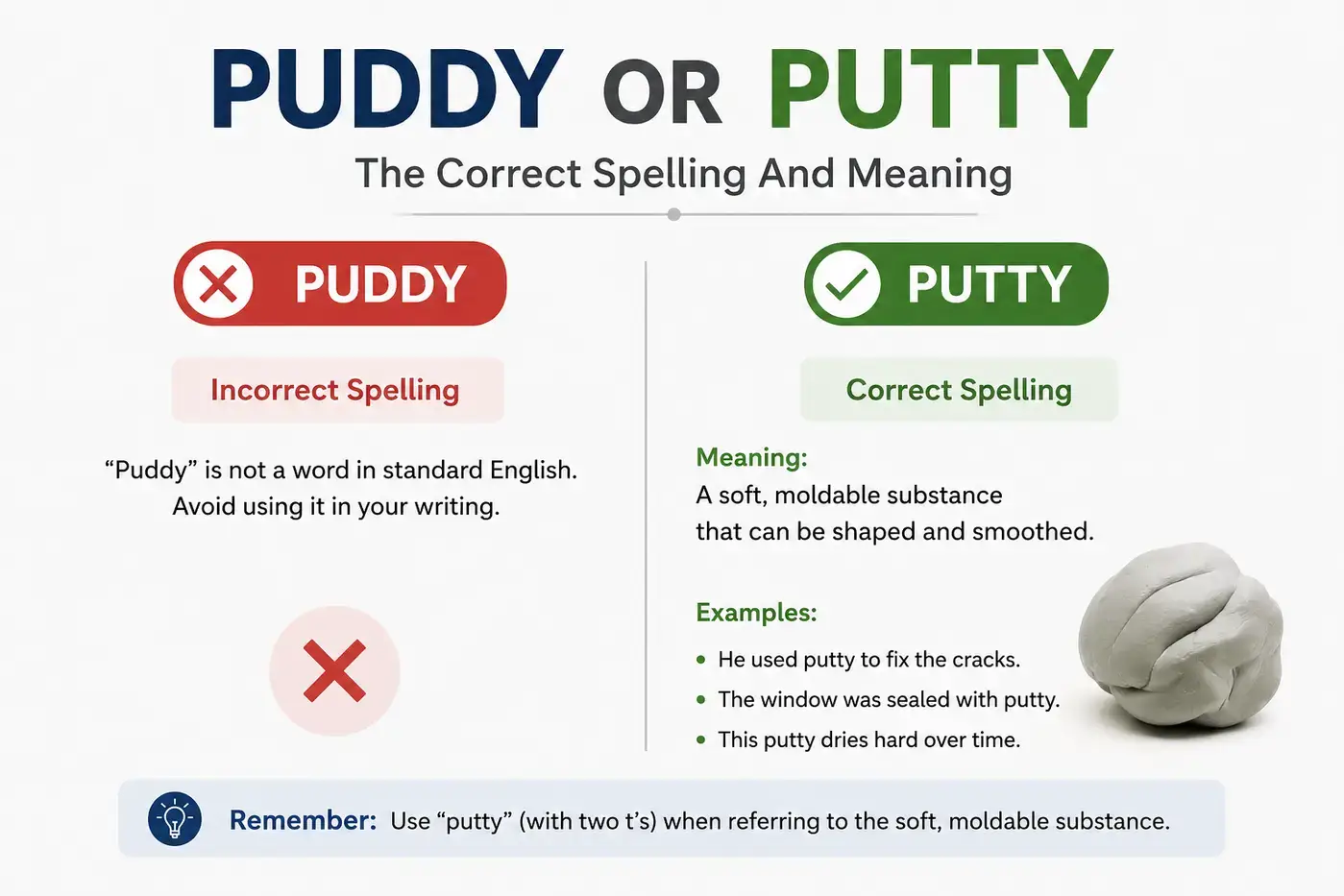
If you are unsure about puddy or putty, the correct spelling for the soft material used to fill holes, seal gaps, and secure window glass is putty. The spelling with two t letters is the standard form in American English and British English. The spelling with a d is not an accepted alternative for this material.
The confusion makes sense because the two forms look similar, and the middle consonant in spoken English can sound softer than expected. However, pronunciation alone does not always reveal the correct spelling. There is also a small detail worth knowing. Puddy does appear in some English references as a rare adjective and in certain informal or name based uses. That does not make it interchangeable with the standard word for the repair compound.
Understanding this distinction helps you write clearly in everyday messages, school assignments, product descriptions, and professional instructions. You will also learn what the word means, how to pronounce it, how it works in a sentence, and which related terms fit different repair jobs.
Quick Answer
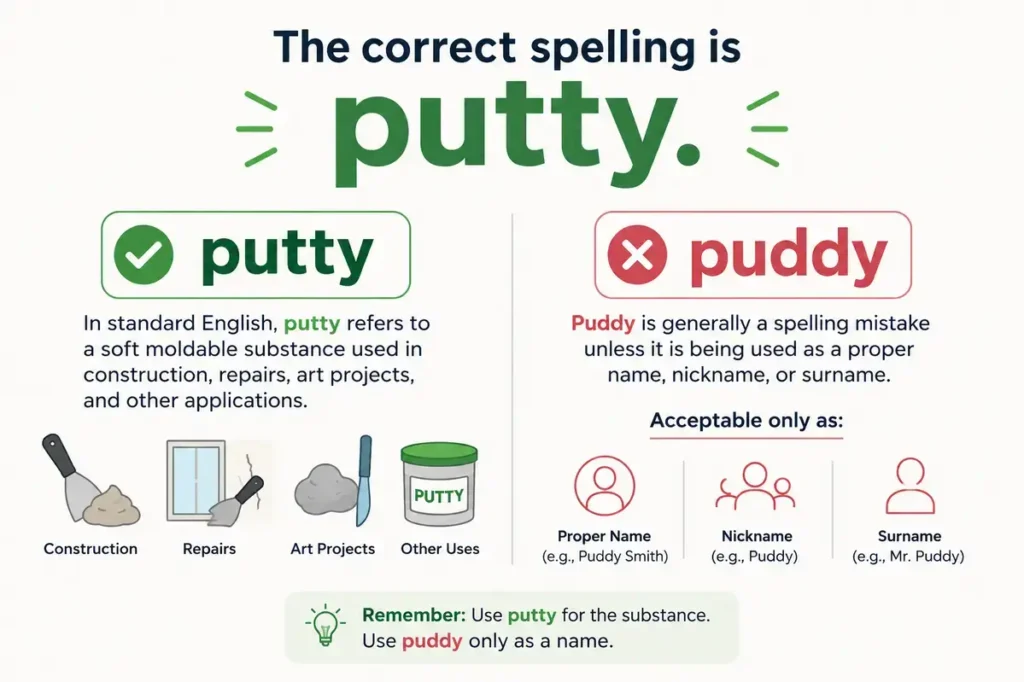
Putty is the correct spelling for the soft material used to fill small holes, seal gaps, and secure glass in suitable window frames. Puddy is not a standard alternative spelling for that material, although it has rare or specialized uses in other contexts. When discussing home repairs or construction, use putty.
Meaning and Definition
What Does Putty Mean.
Putty is a soft and workable substance used to fill gaps, repair small surface defects, or seal certain joints. Traditional glazing putty helps secure glass panes in appropriate window frames. Other products sold as putty are designed for wood repair, surface preparation, plumbing, or similar tasks.
The exact composition depends on the product. Traditional glazing putty often contains a mixture of finely ground chalk and linseed oil. Modern repair compounds may use different ingredients to meet specific needs. Some stay flexible for a time before hardening, while others are designed for sanding, shaping, or creating a firm repair.
The word can also describe a color. Putty is a muted shade that often falls between gray, beige, and brown. In figurative speech, the phrase putty in someone’s hands describes a person who is easily persuaded or controlled.
For example, a carpenter might use putty to fill a small hole in wood. A decorator might choose a putty colored paint for a calm, neutral room. Someone who is easily persuaded by a friend might be described as putty in that friend’s hands.
What Does Puddy Mean.
Puddy is not the standard name for the repair material described above. If someone writes about applying puddy to a wall or using puddy to repair a window, the intended word is almost certainly putty.
However, it would be inaccurate to claim that the spelling can never appear as an English word. Some dictionaries record it as a rare adjective related to being short and podgy or pudgy. It can also appear as a personal name, nickname, fictional name, or playful spelling in informal language.
These uses depend on context. A writer describing a character with a rare adjective may have a different purpose from a builder writing a list of supplies. In the first case, the unusual form might be intentional. In the second, it would normally be a spelling error.
The practical rule is simple. Use putty for the material, and do not substitute puddy unless a particular name or specialized meaning calls for that exact spelling.
Comparison Table.
| Feature | Putty | Puddy |
|---|---|---|
| Standard spelling for the repair material | Yes | No |
| Main meaning | A workable material used for filling and sealing | A rare adjective in some dictionary entries |
| Common part of speech | Noun and verb | Rarely an adjective |
| American English | Standard | Not an alternative spelling for the material |
| British English | Standard | Has a rare adjective use in some references |
| Pronunciation | Usually /ˈpʌti/ in American English | Can vary by intended use |
| Typical context | Repairs glazing and surface filling | Specialized description names or informal usage |
| Example | The carpenter applied putty to the wood. | The writer used a rare descriptive term. |
The table highlights the main difference. The words are not interchangeable simply because their spellings differ by one letter. Meaning and sentence context determine the right choice.
Key Differences Explained
Spelling.
The standard spelling contains two t letters: putty. The alternate form with a d does not name the same repair material in standard English.
A useful way to remember the spelling is to connect it with familiar expressions such as putty knife and wood putty. Both use the same form. If you see a product label or a repair guide, that is the spelling to expect.
Meaning.
Putty has several related meanings. It can refer to a repair compound, a similar workable substance, a particular neutral color, or a person who is easy to influence in a figurative expression.
Puddy has much more limited uses. It may appear as a rare descriptive word or as a name. It does not replace putty in ordinary descriptions of building materials.
Grammar.
Putty works as both a noun and a verb. As a noun, it names the substance. As a verb, it describes applying that substance to a surface or joint.
For example, you can say that a window needs putty. You can also say that a worker puttied the frame. The second sentence uses the past tense of the verb.
The rare adjective puddy has a different grammatical function. It is not the ordinary noun used to describe a repair product.
Pronunciation.
In American English, putty is generally pronounced with two syllables and stress on the first syllable. The middle consonant may sound like a quick flap in everyday American speech. As a result, it can sound less like a strong t and more like a soft d to some listeners.
That sound does not change the spelling. Standard English keeps the double t in writing.
Formality and context.
Putty is appropriate in casual conversation, schoolwork, technical instructions, construction documents, and professional communication. It is the normal choice for the material.
Puddy requires more care. If it appears in a name or a deliberate piece of creative writing, preserve the intended spelling. If it appears in an ordinary repair instruction, correct it to putty.
Regional usage.
American and British English both use putty for the repair material. The main difference is pronunciation rather than spelling. Australian and Canadian English also use the standard form.
There is no general regional rule that makes puddy the accepted spelling in one of these varieties. A writer should not treat it as an American or British alternative.
Which Form Is Correct.
Use putty when you mean a substance for filling holes, sealing suitable gaps, or securing window glass. This is the established spelling found in major English dictionaries, including Oxford, Cambridge, Collins, and the American Heritage Dictionary.
The spelling follows established word usage rather than a special grammar rule. English contains many words whose pronunciation can make their spelling hard to predict. Putty is one of them, particularly for people who hear the word more often than they read it.
Puddy has limited independent uses, but it is not a recognized spelling variant for the repair compound. Writing it in a construction estimate, school assignment, or product description can confuse readers and make the text look unedited.
Consider these examples.
- Correct. We need more putty to repair the window frame.
- Incorrect for the material. We need more puddy to repair the window frame.
- Correct. The carpenter used wood putty to fill the small hole.
- Incorrect for the material. The carpenter used wood puddy to fill the small hole.
The sentence meaning makes the decision clear. When the subject is a repair compound, choose the form used by standard dictionaries and product terminology.
Sentence Examples.
Here are ten natural sentences showing how to use the word correctly in different situations.
- Everyday conversation. I need to buy some putty before I start fixing the window.
- Home repair. Dad used putty to fill the small holes in the wooden frame.
- School assignment. The student explained how glazing putty helps hold certain window panes in place.
- Workplace communication. Please check the repair list and order another container of putty.
- Text message. Can you pick up some putty on your way home.
- Product description. This wood putty is designed to fill small cracks and surface defects.
- Formal writing. The technician applied the appropriate glazing compound according to the manufacturer’s instructions.
- Interior design. The walls were painted a soft putty shade that complemented the wooden furniture.
- Storytelling. After a little encouragement, the stubborn customer was putty in the salesman’s hands.
- Maintenance report. The team replaced damaged glazing putty during the window repair.
These examples show that the word can appear in several settings. It does not always refer to the same product, so the surrounding words help identify its meaning.
Common Spelling Mistakes.
Writing Puddy for the Repair Material.
Incorrect. The worker spread puddy over the damaged surface.
Correct. The worker spread putty over the damaged surface.
The error usually comes from hearing the word and guessing its spelling. In ordinary repair contexts, the correct form contains two t letters.
Using Putty and Putty Knife Inconsistently.
Incorrect. The worker used a putty knife to spread puddy.
Correct. The worker used a putty knife to spread putty.
Related terms should follow the same established spelling. A putty knife is a tool commonly used to apply or smooth certain compounds. Changing the material’s spelling does not create a different product category.
Confusing Putty With Filler.
Putty and filler can overlap in meaning, but they are not always identical. Filler is a broad term for a substance used to fill gaps or defects. Putty refers to particular materials and compounds.
For example, wood filler may be the best label for a product made specifically for repairing wood. The correct product depends on the surface, the repair, and the manufacturer’s directions.
Confusing Putty With Caulk.
Caulk is generally used to seal joints and gaps. Putty can also fill or seal certain spaces, but the products may differ in composition, flexibility, and intended use.
For example, a gap around a bathtub often requires a suitable bathroom sealant rather than ordinary glazing putty. Choose the product for the job instead of assuming the words mean exactly the same thing.
Treating Puddy as a Regional Spelling.
Incorrect assumption. British writers use puddy for window repair, while American writers use putty.
Correct understanding. Putty is the standard spelling for the material in both varieties of English.
A rare dictionary entry or a personal name does not establish a regional spelling rule. Check the intended meaning before deciding how to edit an unfamiliar form.
Pronunciation Guide.
The standard pronunciation of putty is straightforward once you divide it into syllables.
Putty
American English pronunciation
/ˈpʌt̬.i/
Two syllables. The first syllable receives the main stress.
How to Say It.
- Start with the vowel sound in words such as cup or luck.
- Move quickly through the middle consonant.
- Finish with the short vowel sound heard at the end of happy.
In many American accents, the t between the vowels becomes a quick flap. This can make it sound similar to a d in words such as water and city. That is a normal feature of American pronunciation rather than a reason to change the spelling.
The word is still written with tt. You do not need to pronounce an extra t sound just because the word contains two t letters.
Common Pronunciation Errors.
One mistake is to stress the second syllable. Standard American pronunciation puts the stress on the first syllable. Another mistake is to assume that a soft sounding consonant must be written as d. English spelling does not always map directly to the sounds people hear.
For the rare word puddy, pronunciation may depend on the intended meaning or name. Do not assume that its pronunciation alone tells you that it means the repair material.
Etymology and Word Origin.
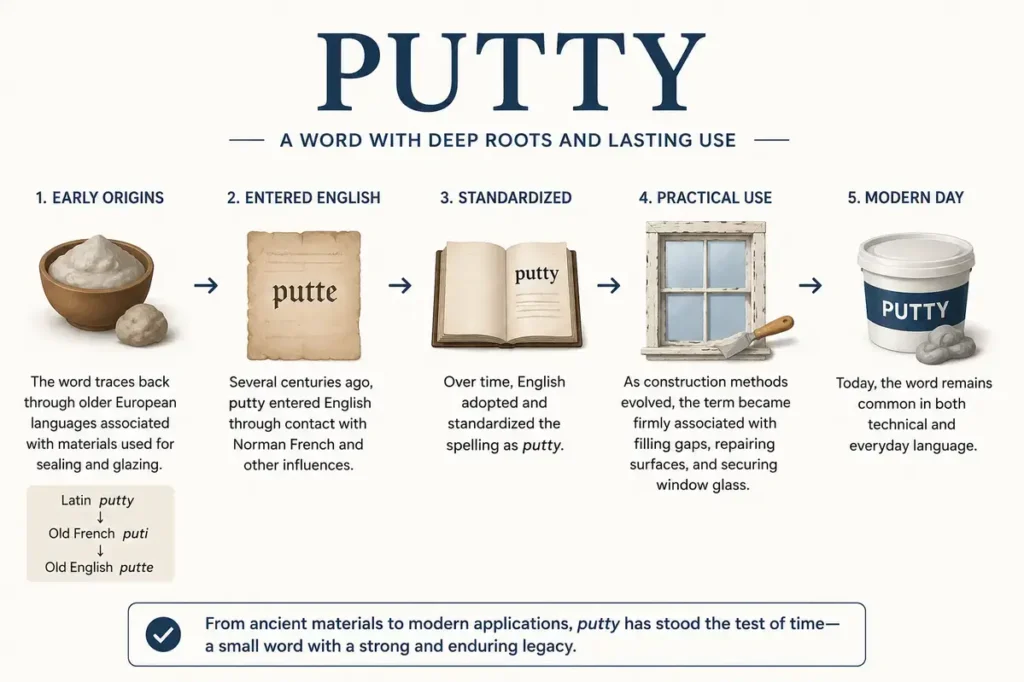
The word putty entered English through French. Its history is linked to the French word potée, which referred to a potful or material associated with a pot. The historical term was used for substances such as polishing powder and fine paste.
Over time, the English word became associated with workable compounds used in repair and finishing tasks. One familiar use is glazing putty, which has traditionally helped secure window glass in frames. The word also developed broader meanings for similar substances and a figurative meaning for a person who is easily influenced.
This history helps explain the word’s range today. It can name a physical material, describe a color, appear in a common idiom, or function as a verb. Its spelling has remained established as putty in modern English.
The history of puddy is separate from the ordinary repair term. Its limited descriptive or informal uses do not make it a historical alternative spelling of putty.
Regional Usage.
American English.
In the United States, putty is the standard word for the repair material. You will see it in home improvement instructions, window repair guides, woodworking discussions, paint preparation advice, and product descriptions.
The word also appears in the expression putty in someone’s hands. For example, a parent might joke that a grandparent is putty in a child’s hands because the child can easily persuade them.
Puddy is not the standard American spelling for the material. If it appears in a repair list or a work order, it should normally be corrected.
British English.
British English uses putty for glazing compounds, filling materials, similar substances, and related expressions. The spelling is the same as in American English, although pronunciation can differ slightly.
Some British dictionary references also record puddy as a rare adjective with a descriptive meaning related to being short and podgy. This is a separate use, not a regional spelling of the repair compound.
Australian English.
Australian English also uses putty as the standard spelling for the material. In a home maintenance guide or a woodworking discussion, the ordinary spelling remains unchanged.
There is no established Australian rule that replaces the double t with d. Writers should use the spelling that matches the intended meaning.
Canadian English.
Canadian English follows the same general pattern. Putty is the standard form for the substance used in repair and finishing work.
The most useful lesson across these varieties is that regional pronunciation can vary without changing the standard spelling. If you are writing for an international audience, putty is the reliable choice for the material.
Grammar Rules and Part of Speech.
Putty as a Noun.
Putty is commonly an uncountable noun when it refers to the material in general. This means writers usually do not add a plural ending when discussing the substance as a whole.
For example, you can write, The window needs putty. You can also write, We bought some putty for the repair.
When referring to separate types or portions, a plural form such as putties may appear in appropriate technical contexts. In everyday writing, however, it is usually clearer to name the product or amount.
Putty as a Verb.
Putty can also function as a verb meaning to apply putty to a surface or joint. It is a regular verb with standard forms.
- Present tense. The worker putties the frame.
- Past tense. The worker puttied the frame.
- Present participle. The worker is puttying the frame.
Notice the spelling changes in the past tense and the form ending in ing. The final y changes to i before the endings in puttied and puttying is formed by dropping the final y and adding ing? In standard spelling, the correct forms are puttied and puttying. The first changes y to i before ed. The second keeps the y before ing.
Putty as an Adjective or Color Description.
The word can appear before another noun to describe the material or color. For example, putty knife names a tool used to apply or smooth putty. Putty colored fabric describes fabric in a muted neutral shade.
In formal writing, choose a clear phrase that readers can understand quickly. A product called putty may serve a different purpose from another product with a similar color or texture.
Puddy in Grammar.
The rare adjective puddy has limited use and is not the normal choice for describing a repair material. If you encounter it in older writing, a dictionary entry, or a character description, examine the sentence before editing it.
Do not automatically replace a proper name with another spelling. Names, nicknames, and deliberately playful spellings may be intentional. In ordinary construction writing, though, the expected word is putty.
Real Life Usage Examples.
Daily Conversation.
- We should buy putty before repairing the old window.
- Do you know where I left the putty knife.
In conversation, people often understand the intended word from the situation. In writing, the standard spelling makes that meaning clear to readers who do not share the same context.
Email and Workplace Communication.
- Please order the glazing putty listed in the maintenance plan.
- The repair team found that the old putty needed replacement.
Workplace messages benefit from accurate product names. A small spelling error may not stop someone from understanding a message, but correct wording helps avoid confusion when people are ordering supplies or following technical instructions.
Academic Writing.
- The report describes the traditional use of putty in window glazing.
- The experiment compared the drying behavior of two repair compounds.
In academic work, use the specific name of the material being studied. If the project concerns a particular formulation, give its product name or technical description rather than relying on a broad everyday term.
News and Journalism.
- The renovation team repaired the historic windows using a suitable glazing compound.
- The building report noted that sections of the old putty had cracked and needed attention.
News writing should favor precision over guesswork. A reporter covering a restoration project should identify the material accurately and avoid suggesting that all repair compounds serve the same purpose.
Literature and Storytelling.
- The artist pressed the soft putty into a small crack and smoothed the surface.
- After years of friendship, he was still putty in her hands whenever she asked for a favor.
The first example uses the literal meaning. The second uses a familiar expression to describe someone who is easily persuaded. Both are standard uses, but the intended meaning comes from the context.
Related and Confused Terms.
Several words appear in the same situations as putty. Knowing the difference helps you select the right term for the material or task.
Filler.
Filler is a broad term for a substance used to fill holes, cracks, or uneven areas. Wood filler and wall filler are common examples. Putty can act as a filler, but not every filler is putty.
Caulk.
Caulk is used to seal gaps and joints. It is common around windows, trim, and other building surfaces. The correct product depends on the location and the amount of movement the joint must handle.
Sealant.
Sealant is a general term for a material that blocks the passage of air, water, dust, or other substances through a joint or opening. Putty can provide a seal in certain applications, but a sealant designed for a specific environment may be more suitable.
Glazing Compound.
Glazing compound is a material used to install or seal glass in certain frames. Traditional glazing putty is one type of glazing compound. Modern windows may use other systems, so the manufacturer’s instructions should guide the choice.
Wood Filler.
Wood filler is designed to repair holes, dents, and other defects in wood. Some products can be sanded and painted after drying. Putty and wood filler may overlap in use, but they are not automatically interchangeable.
Putty Knife.
A putty knife is a tool with a flat blade used to apply, spread, or remove certain materials. Despite its name, the tool may also be used for other repair tasks. The word putty in its name follows the standard spelling.
Paste.
Paste usually refers to a thick, soft mixture that can be spread or shaped. Some pastes resemble putty in texture, but the terms describe different categories of materials and should not be substituted without checking the intended use.
Pudgy.
Pudgy is a familiar adjective meaning somewhat short and rounded or slightly plump. It is more common in modern everyday English than the rare adjective puddy recorded in some references. The two forms should not be confused with the name of the repair material.
Expert Editor Insight.
An experienced editor looks at meaning before correcting a spelling. If a sentence describes a window repair, a wood filler, or a glazing compound, putty is the clear choice. If the unusual form appears as a name or a deliberate descriptive word, the editor checks the context before changing it. Spelling tools may flag puddy in ordinary repair instructions, but an automatic suggestion should never replace careful reading. The best editing habit is to check the whole sentence and confirm that the chosen word expresses the intended meaning.
Conclusion.
When comparing puddy or putty, remember that putty is the correct spelling for the material used in repairs, glazing, and surface filling. The other form has limited uses as a rare adjective or a name, but it does not replace the standard word for this substance. Both American and British English use the same spelling for the material.
The easiest way to avoid mistakes is to connect the word with familiar terms such as putty knife, glazing putty, and wood putty. Before submitting an assignment or sending a work message, check the spelling against the intended meaning. A quick check can make your writing clearer and more professional.
FAQs.
Is Puddy a Real English Word?
Puddy does appear in some English references as a rare adjective, and it can also occur as a name or an informal spelling. However, it is not the standard spelling for the soft material used in repairs. If you are writing about glazing, woodwork, or filling small holes, use putty instead.
What Does Putty Mean?
Putty is a soft and workable material used to fill small holes, repair certain surface defects, or seal and secure parts of suitable window frames. The word can also describe a muted grayish beige color. In the expression putty in someone’s hands, it refers figuratively to someone who is easy to influence or persuade.
Which Is Correct for Window Repairs?
Putty is correct when referring to the material used in window repairs. Traditional glazing putty can help hold glass in a frame and seal the edge around it. Puddy is not an accepted alternative spelling for this purpose. Always check the product instructions because modern windows may use different glazing systems.
How Do You Pronounce Putty?
In American English, putty has two syllables and stress on the first syllable. Its pronunciation is commonly represented as /ˈpʌt̬.i/. The middle consonant may sound like a quick d to some listeners because of a common feature of American speech. The standard spelling still uses two t letters.
Can Putty Be Used as a Verb?
Yes. Putty can describe the act of applying the material to a surface or joint. For example, a worker may putty a window frame before finishing the repair. The past tense is puttied, and the form ending in ing is puttying. The verb is less common in everyday conversation than the noun.
What Is Another Word for Putty?
The best alternative depends on the job. Filler may describe a product used to repair holes or surface defects, while sealant usually refers to a substance designed to seal joints and gaps. Glazing compound is relevant to certain glass installations. These words overlap in some contexts, but they do not always refer to the same materials.
Is Putty the Same in American and British English?
Yes. Putty is the standard spelling for the repair material in both American and British English. Pronunciation can vary slightly between accents, but the written form remains the same. Some references list puddy as a rare British adjective, yet that separate use does not make it a British spelling variant for the material.
Is Putty Appropriate in Formal Writing?
Yes. Putty is suitable for formal writing, technical instructions, maintenance reports, academic descriptions, and product documentation. Use a more specific term when the exact compound matters. For instance, glazing putty and wood filler may serve different purposes. Accurate terminology helps readers understand the task and reduces confusion during repairs.
