
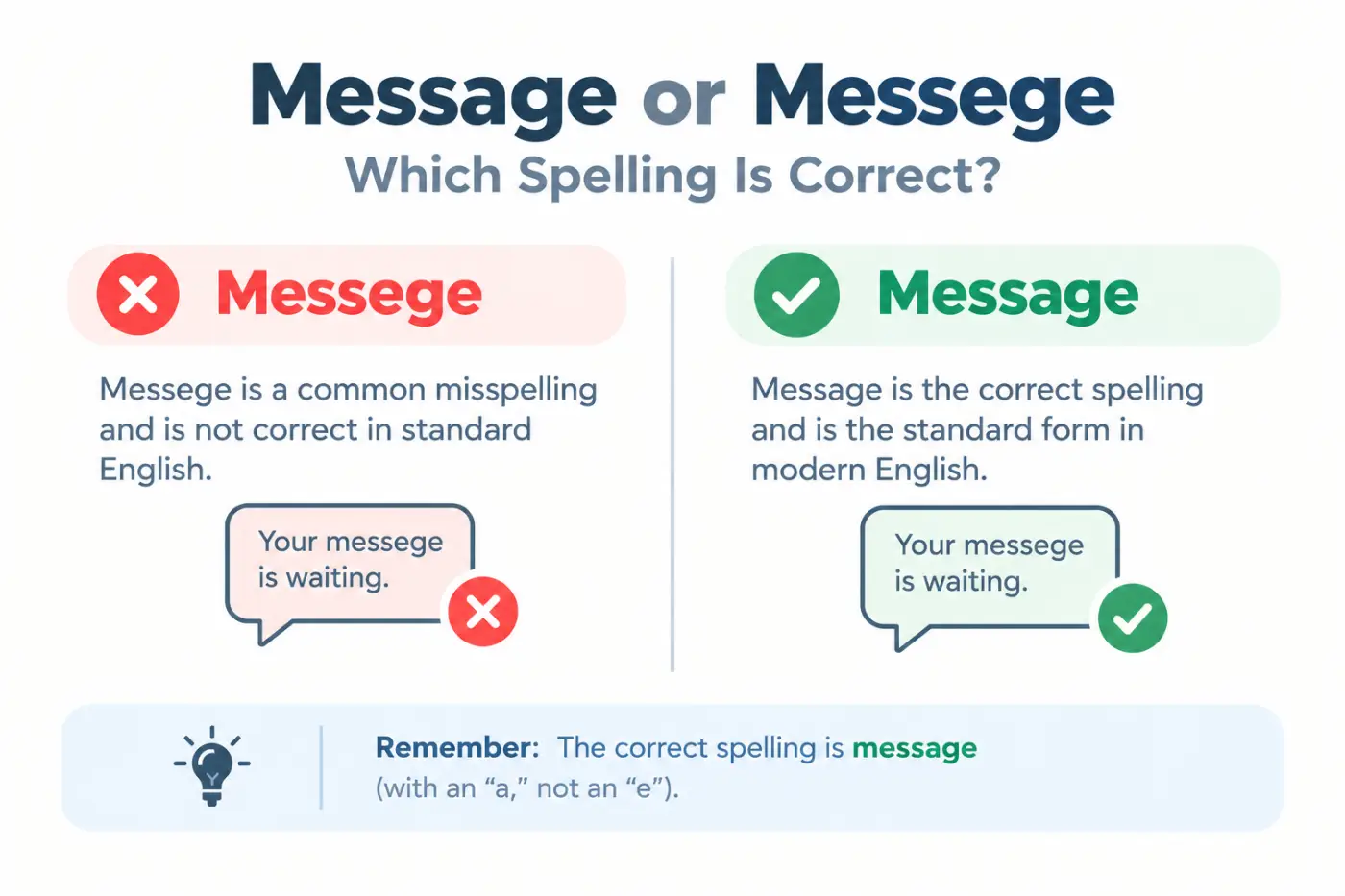
Have you ever typed a quick note and paused to wonder if you spelled the word correctly? The difference between message or messege is easy to miss when you’re writing quickly. However, only one spelling is accepted in standard modern English.
Message is the correct spelling. Messege is a common spelling mistake, not a standard alternative. You should use the correct form in text messages, emails, school assignments, business documents, and other forms of communication.
The confusion makes sense because English spelling doesn’t always follow the sounds we hear. The word contains an unstressed middle syllable, so its vowel can be difficult to identify by sound alone. Typing quickly can also lead to missing or misplaced letters.
Learning the correct spelling takes only a moment. Once you understand its meaning, pronunciation, grammar, and spelling pattern, you’ll find it easier to write confidently. The examples and practical tips below will help you avoid the mistake in everyday communication and formal writing.
Quick Answer
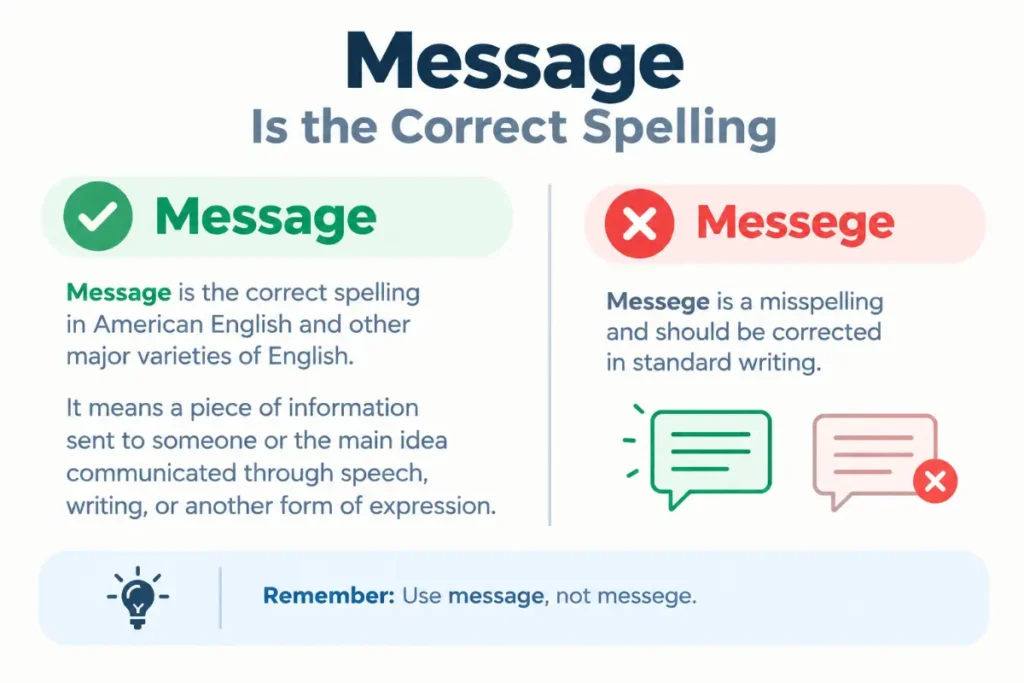
Message is the correct spelling in American English and other major varieties of English. It means a piece of information sent to someone or the main idea communicated through speech, writing, or another form of expression. Messege is a misspelling and should be corrected in standard writing.
Featured Snippet Definition
A message is a piece of written, spoken, or electronic information sent from one person to another. The word can also describe the central idea of a speech, book, movie, or public statement. The correct spelling is message. The spelling messege is incorrect in standard modern English.
The Difference Between The Two Spellings
The main difference is the spelling itself. One form follows standard English spelling rules, while the other contains an incorrect vowel.
| Feature | Message | Messege |
|---|---|---|
| Spelling status | Correct standard spelling | Common misspelling |
| Meaning | Information sent or an idea communicated | No standard independent meaning |
| Part of speech | Noun and verb | Not a standard English word |
| Pronunciation | /ˈmes.ɪdʒ/ | No standard pronunciation |
| Formal writing | Appropriate | Incorrect |
| Informal writing | Appropriate | Typo that should be corrected |
| Common contexts | Texts, emails, letters, speeches, and media | Accidental typing errors |
| Example | I received your message. | I received your messege. |
The first form is the one to use in your writing. The second usually appears when someone relies on memory, types too quickly, or guesses how the word should look.
What Message Means
A message communicates information, an idea, a request, or a feeling to another person. It can arrive as a text on your phone, an email in your inbox, a note on your desk, or a spoken statement from a friend.
The word also has a broader meaning. A movie can have a message about friendship, a speech can deliver a message about public safety, and a novel can express a message about human nature.
Message As A Noun
As a noun, the word refers to a piece of information or an idea that someone communicates.
For example, you might leave a message for a coworker who stepped away from their desk. You might also receive a message from a friend who wants to change your meeting time.
The noun can describe several kinds of communication.
- A text message sent through a phone.
- An email containing information or a request.
- A spoken message passed through another person.
- A written note left for someone to find.
- The central idea expressed in a book, speech, or film.
- A signal transmitted within a technical or biological system.
The surrounding words usually make the intended meaning clear.
Message As A Verb
The same word can function as a verb. To message someone means to send that person a message, usually through a phone or computer.
For example, you might say, I messaged my friend yesterday. You could also write, Please message me when you arrive.
The verb follows regular patterns in modern usage.
- Present tense: message.
- Third person singular: messages.
- Past tense: messaged.
- Present participle: messaging.
These forms are useful in everyday conversation, workplace communication, and online discussions.
Does Messege Have A Meaning
No. In standard modern English, messege has no recognized independent meaning as a common word. It is generally a misspelling of message.
If you see the incorrect form in an email or online post, the intended meaning is usually clear from the context. Still, readers may notice the mistake, especially in formal documents, professional communication, or schoolwork.
A spelling mistake doesn’t always prevent understanding. However, using the accepted form helps your writing look polished and makes your meaning easier to trust.
Why Message Is The Correct Spelling
English spelling often preserves patterns that aren’t obvious from pronunciation. In this case, the accepted spelling uses the letters m, e, s, s, a, g, e in that order.
The incorrect form changes the letter a to e in the second syllable. That small change creates a spelling error even though readers can usually understand the intended word.
A useful way to remember the spelling is to focus on the middle letters. After the first three letters, the word contains ss, followed by age. Keeping that sequence in mind makes the correct form easier to recall.
A Simple Spelling Rule
You don’t need a complicated grammar rule to spell this word correctly. Instead, remember its established spelling and practice it in a few familiar phrases.
- Send a message.
- Read the message.
- Leave a message.
- Check your messages.
- Send me a message later.
Repeated exposure to correct examples helps you recognize the word more quickly. Over time, the correct letter pattern becomes familiar, and the misspelling becomes easier to spot.
Why The Mistake Happens
Several ordinary habits can cause this error.
- Guessing from sound. The middle vowel isn’t strongly stressed, so a writer may choose the wrong letter.
- Typing too quickly. Fast typing can lead to letter substitutions that go unnoticed.
- Remembering the sound instead of the spelling. Knowing how a word sounds doesn’t always tell you how to write it.
- Relying on visual memory. If you’ve seen the incorrect form many times, it may briefly look familiar.
- Skipping proofreading. Small errors can remain in a sentence when you focus on its meaning rather than its spelling.
These are common features of everyday writing. The best solution is to learn the correct form and check it when accuracy matters.
Ten Correct Sentence Examples
The following examples show how the word works in different situations. Notice that the spelling stays the same even as the meaning and context change.
- I received your message this morning and will reply after lunch.
- Please send me a message when you reach the airport.
- She left a message on my phone because I missed her call.
- The teacher wrote a message on the board before class began.
- I sent my manager a message to explain the delay.
- His email contained a clear message about the new schedule.
- The movie’s message encouraged viewers to treat others with kindness.
- Please check your messages before the meeting starts.
- The company shared a public message about its updated safety rules.
- I messaged my brother yesterday, but he hasn’t replied yet.
These examples cover the word’s role as both a noun and a verb. In the first nine examples, it appears as a noun or a plural noun. In the final example, it appears as a verb in the past tense.
Common Spelling Mistakes To Avoid
The incorrect form is the main spelling problem associated with this word. Still, a few related errors can appear when writers use different forms or confuse spelling with grammar.
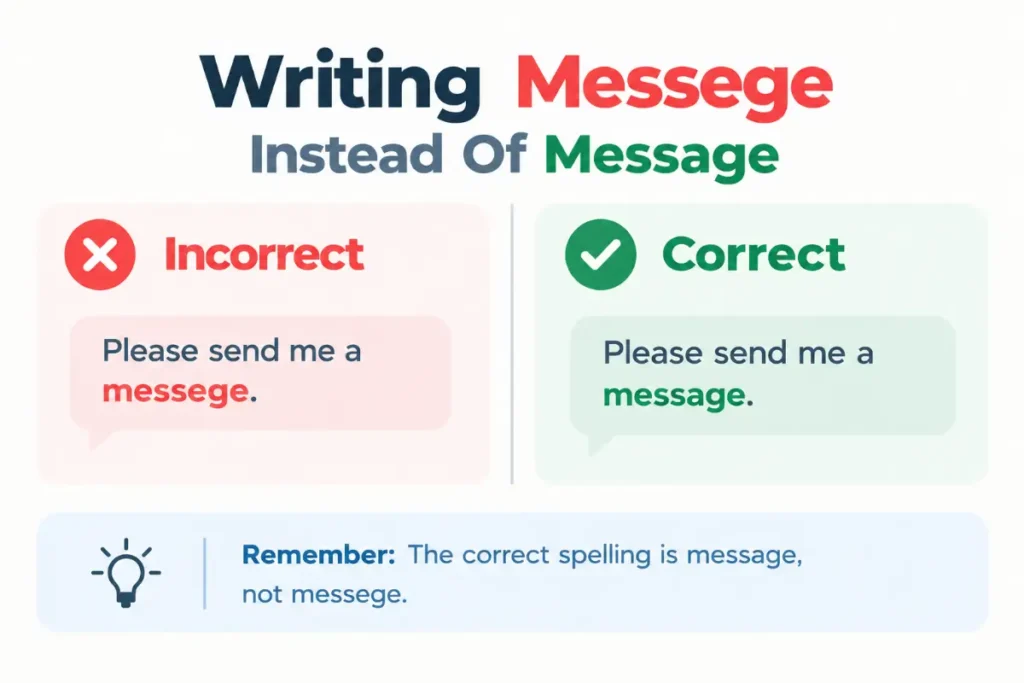
1. Writing Messege Instead Of Message
Incorrect: Please send me a messege.
Correct: Please send me a message.
The mistake comes from replacing the letter a with e in the second syllable. Remember the final sequence ssage to help you avoid this error.
2. Adding An Unnecessary Letter
Incorrect: I received your messsage.
Correct: I received your message.
The incorrect version contains an extra s. Since the word already has two consecutive s letters, an extra one is unnecessary.
3. Confusing Message With Messaging
Incorrect: I sent a messaging to my friend.
Correct: I sent a message to my friend.
Message is the noun needed in this sentence. Messaging usually refers to the act of sending messages or to a communication activity.
4. Using The Wrong Verb Form
Incorrect: She message me yesterday.
Correct: She messaged me yesterday.
The verb needs its past tense form because the action happened yesterday. In standard English, the past tense is formed by adding d to the verb.
5. Forgetting The Plural Ending
Incorrect: I have three message from my teacher.
Correct: I have three messages from my teacher.
A regular countable noun takes an s ending in the plural form. The correct plural is messages, not message when referring to several separate communications.
Pronunciation Guide
The correct spelling becomes easier to remember when you connect it with the way the word sounds. In standard American English, it has two syllables and stress falls on the first syllable.
American English pronunciation
/ˈmes.ɪdʒ/
Easy pronunciation guide
MES ij
Syllables: mes + ij. Stress the first syllable.
How To Say It Clearly
Start with the sound in mess. Then move into a short, relaxed vowel sound before ending with the sound found at the end of bridge.
The first syllable carries the main stress. The second syllable is shorter and less prominent, which helps explain why some writers find its spelling less obvious.
Common Pronunciation Errors
- Overstressing the second syllable. The word normally places stress on the first syllable.
- Changing the final sound. The ending sounds like the final sound in bridge, not a hard g as in go.
- Pronouncing each letter separately. Natural speech blends the sounds into two connected syllables.
The misspelling doesn’t have an established standard pronunciation of its own. Most readers who encounter it will interpret it as an attempt to write the correctly spelled word.
The Origin Of The Word
The history of the word helps explain why its spelling is established rather than based on a simple sound to letter rule.
English adopted the noun from Old French message, which referred to communication, news, or information carried by a messenger. The French form developed from Medieval Latin missaticum, associated with sending or dispatching something.
The related Latin verb mittere means to send or let go. This historical connection also appears in English words such as mission and transmit.
The word entered English during the Middle Ages. Over time, its meaning expanded beyond information delivered by a messenger. Today, it can describe electronic communication, spoken information, and the central idea of a work of art or public statement.
The verb form also developed in English. Modern speakers can now say that they message someone, messaged someone yesterday, or are messaging someone at the moment.
The spelling messege does not represent a standard historical variant that readers should use today. For ordinary modern writing, the established form remains the correct choice.
Regional Usage In English
The standard spelling remains the same across major English speaking regions. American, British, Canadian, and Australian writers use the same form for ordinary communication.
American English
In the United States, message is the standard spelling in everyday and professional writing. You will see it in text messages, email conversations, business reports, school assignments, and news stories.
The verb is also common in American English. For example, someone might say, I messaged you this morning, or Please message me when you’re free.
British English
British English uses the same spelling and meaning. There is no standard British spelling change that replaces the letter a with e.
British writers use the word in formal documents and casual conversation. The verb also appears in modern digital communication.
Australian English
Australian English follows the same standard spelling. People use the noun for written communication and the verb for sending someone a message through a digital device.
The spelling error is not an accepted Australian alternative.
Canadian English
Canadian English also uses the standard form. There is no meaningful regional spelling difference for this word.
If you’re writing for readers in any of these countries, use the same spelling. You don’t need to change it to match a regional style guide.
Grammar Rules And Parts Of Speech
Understanding how a word functions in a sentence can help you use it correctly. This word works as both a noun and a verb, so its grammatical role depends on the sentence.
Using The Word As A Noun
A noun names a person, place, thing, idea, or concept. Here, it names a piece of communication or the idea that someone wants to express.
You can use it with articles, possessive words, and adjectives.
- I received a message from my cousin.
- Please read the message carefully.
- She sent her message before the meeting.
- The teacher shared an important message with the class.
The noun is countable in its common communication sense. One communication is a message, and several communications are messages.
Using The Word As A Verb
As a verb, it describes the action of sending information to someone.
- I message my coworkers during office hours.
- She messages her family every evening.
- We messaged the customer yesterday.
- He is messaging his friend right now.
The verb usually takes a person as its object. For example, you can message a friend, message a colleague, or message a customer.
Sentence Position
The noun often appears after a verb such as send, receive, read, leave, or write.
For example, I received a message. In that sentence, message is the object of the verb received.
The verb itself can appear before the person receiving the communication. For example, I messaged Sarah. Here, messaged describes the action, while Sarah identifies the person contacted.
Capitalization And Punctuation
The word doesn’t need a capital letter in the middle of a sentence. Capitalize it at the beginning of a sentence or when it appears in a title that follows your chosen capitalization style.
Punctuation depends on the sentence rather than the word itself.
- She sent me a message.
- Did you read the message?
- Please send a message when you arrive.
- The message was clear, but the timing was poor.
You don’t need a special punctuation rule just because the sentence refers to a digital communication.
Real Life Examples In Different Contexts
The meaning stays consistent across settings, but the tone and purpose can change. These examples show how people use the word in everyday life.
Daily Conversation
People often use the word when talking about missed calls, plans, or quick updates.
- I saw your message while I was driving, so I waited until I parked to reply.
- Can you leave a message for Dad and tell him we’ll be home late?
These sentences sound natural because they connect the word with familiar communication needs.
Email And Workplace Communication
In professional settings, the word can refer to a request, an update, or information shared with a team.
- I received your message about the revised deadline and will update the schedule.
- Please send the client a message confirming the appointment time.
Clear spelling matters in workplace communication because small errors can distract readers from the main point.
Academic Writing
Students and researchers can use the word to discuss ideas, themes, and communication.
- The author’s main message focuses on the value of honesty.
- The speech communicates a message about equal access to education.
In academic writing, the word often refers to an underlying idea rather than a short electronic note.
News And Journalism
Journalists may use the word to describe a public statement or the central point of a speech.
- The mayor delivered a message of support to families affected by the storm.
- The report examined the central message of the campaign.
The exact meaning depends on the subject being reported.
Literature And Storytelling
Writers often use the word to describe a theme or idea conveyed through a story.
- The novel’s message encourages readers to question their assumptions.
- She found a mysterious message tucked inside an old book.
These examples show the word’s range. It can describe a simple note or a larger idea that stays with a reader long after a story ends.
Related Words And Expressions
Several words share part of the meaning of a communication. However, they aren’t all interchangeable. Choosing the right one depends on the type of information, the person receiving it, and the context.
- Note. A short written reminder or piece of information. For example, I left a note on the kitchen table.
- Text. An electronic message sent through a text messaging service. For example, I’ll send you a text after work.
- Email. A message sent through an electronic mail system. For example, Please send the details by email.
- Communication. A broad term for sharing information, ideas, or feelings. It can refer to a single exchange or a larger process.
- Notification. An alert that informs someone about an event, update, or activity. A notification may contain a message or simply direct attention to something.
- Announcement. Information shared with a group or the public. For example, the school made an announcement about the schedule.
- Statement. A clear expression of information, a position, or an opinion. It often appears in formal or public settings.
- Correspondence. Written communication exchanged between people or organizations. It often refers to letters and emails in professional or formal contexts.
These terms overlap, but each has its own use. A text is a type of electronic communication, while an announcement usually reaches a wider audience. A statement often expresses a position, and correspondence can refer to an ongoing exchange of written communication.
How To Remember The Correct Spelling
The easiest way to avoid this mistake is to learn the word as a complete spelling pattern rather than trying to guess each letter from its sound.
Use The Final Letter Pattern
Focus on the ending ssage. Once you remember that sequence, you can rebuild the full word without guessing the middle vowel.
Try writing these related phrases a few times.
- A message from a friend.
- Send a message today.
- Read the message again.
- Several messages arrived.
- I messaged my teacher.
The goal isn’t to memorize a long list. It’s to make the correct spelling familiar enough that you recognize it automatically.
Read Before You Send
A quick review can catch many typing errors. Before sending an important email or submitting an assignment, scan the text for words that look unusual.
Pay attention to common words as well as difficult ones. Familiar words can slip past your attention because your brain focuses on the meaning of a sentence rather than each individual letter.
Use Spelling Tools Wisely
Spell checkers and grammar tools can identify many misspellings. However, they may not catch every error, especially when an incorrect form resembles a valid word or a name.
If a tool flags the word, check its spelling instead of accepting every suggestion automatically. Your goal is to write accurately, not simply to remove every warning on the screen.
Expert Editor Insight
An experienced editor checks spelling in context rather than relying only on the way a word sounds. The incorrect form is easy to understand, but that doesn’t make it an accepted spelling. Editors look for the established letter pattern, the word’s grammatical role, and the needs of the audience. Automated tools can help, but a final human review remains useful because spelling software doesn’t always understand the intended meaning. For an everyday word like this one, remembering the correct form and proofreading carefully are usually enough to prevent the error.
Conclusion
The choice between message or messege is simple once you know the correct spelling. Message is the standard form in American English and other major English varieties. It can refer to a written note, a text, an email, a spoken communication, or the main idea behind a speech or story. The alternative spelling is a common mistake and shouldn’t appear in polished writing.
To remember the correct form, focus on the letters ssage at the end of the word. Read your sentences before sending them, and use spelling tools when you need extra help. A small proofreading habit can make your writing clearer and more professional.
FAQs
Is Messege A Real Word?
No. Messege is not a standard English word with an established independent meaning. In ordinary writing, it is a misspelling of message. Readers can often understand what the writer intended, but you should correct it in schoolwork, emails, professional documents, and other writing where standard spelling matters.
What Does Message Mean?
A message is information communicated from one person to another. It may be a text, email, note, spoken statement, or other form of communication. The word can also describe the central idea of a book, movie, speech, or public statement. Its meaning depends on the context in which someone uses it.
Which Spelling Is Correct In American English?
The correct spelling is message. American English uses this form in casual conversation, digital communication, academic writing, and business documents. The alternative spelling messege is an error rather than a regional variation. The same standard spelling applies in British, Canadian, and Australian English.
How Do You Pronounce Message?
The word has two syllables and is pronounced /ˈmes.ɪdʒ/ in standard American English. The first syllable carries the main stress. Its opening sound resembles the word mess, while the ending has the same final sound as bridge. The spelling mistake has no separate standard pronunciation.
Can Message Start A Sentence?
Yes. You can begin a sentence with the word when it functions as a noun. For example, Message received is a short and natural response in some contexts. You can also write, The message arrived this morning. Capitalize the first letter because the word begins the sentence.
What Is A Synonym For Message?
Useful alternatives include note, text, communication, statement, and announcement. The best choice depends on the meaning. A note is often brief, a text is sent electronically, and an announcement usually shares information with a group. These words overlap in meaning, but they don’t always fit the same sentence.
Why Do People Misspell Message?
People often misspell the word because the vowel in the second syllable is unstressed. This can make the spelling less obvious when someone relies on pronunciation alone. Fast typing, weak visual memory, and limited proofreading can also contribute. Learning the correct letter sequence is a simple way to reduce these errors.
Is Message Appropriate In Formal Writing?
Yes. The word is appropriate in formal writing when it expresses the intended meaning clearly. You can refer to a message from a colleague, a public message from an organization, or the central message of a report. In formal documents, use the standard spelling and choose more specific terms when the context calls for them.
