
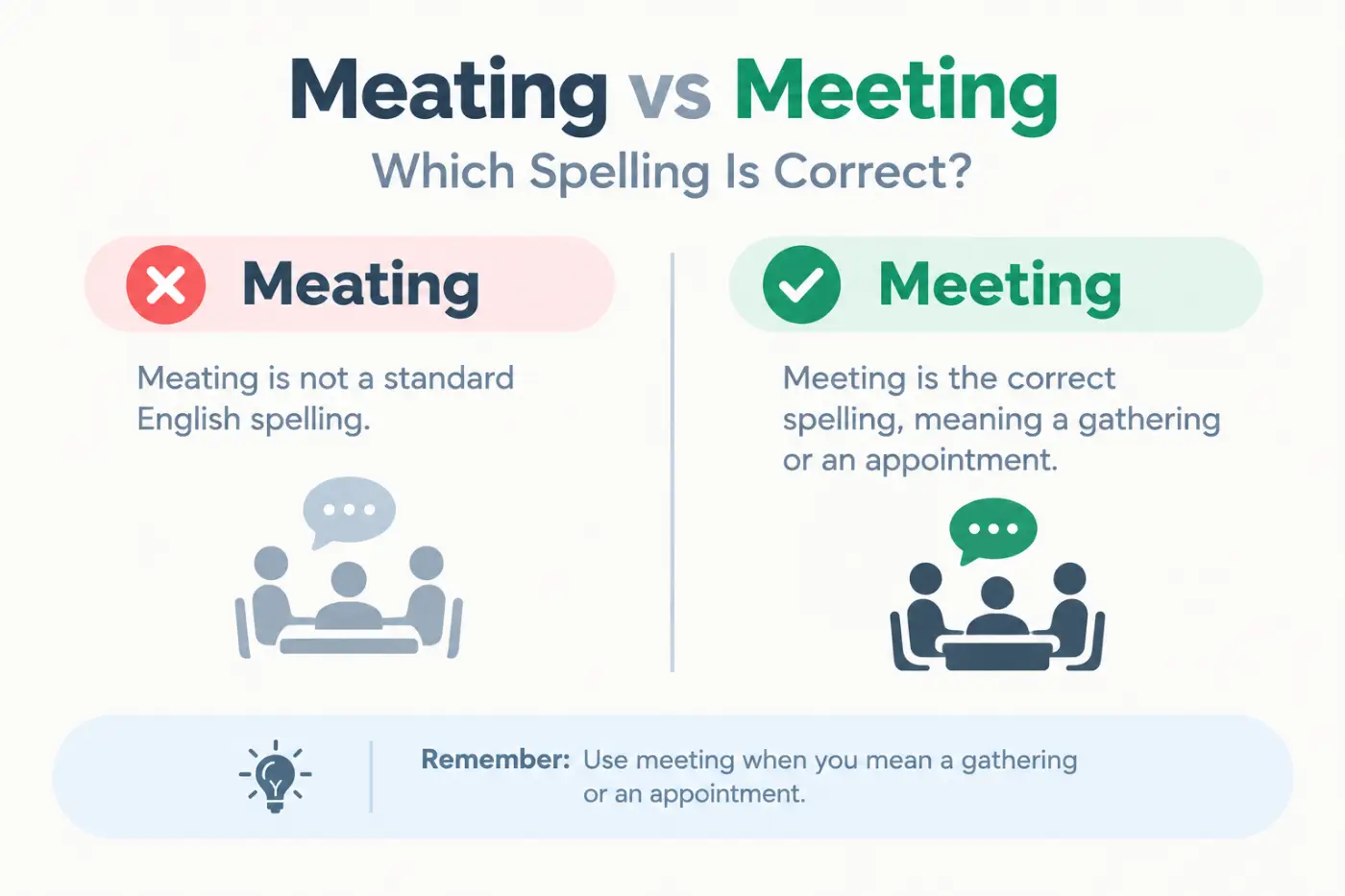
If you’ve ever typed meating vs meeting into a search engine because you weren’t sure which spelling was correct, you’re not alone. The correct spelling for a gathering, appointment, or planned discussion is meeting. The word meating is generally a misspelling when used with this meaning in standard English.
The confusion makes sense. English has many words that follow similar spelling patterns. Words such as eating, seating, and heating may lead you to choose the wrong vowel when typing quickly. However, a familiar spelling pattern doesn’t always produce the correct word for the meaning you intend.
Understanding this small difference can help you write clearer emails, schedule appointments, complete school assignments, and communicate more confidently at work. It also helps you distinguish a genuine English word from a spelling mistake.
The rule is simple. Use meeting when you mean a gathering or discussion. Remember that meating isn’t the standard spelling for that meaning. The examples and explanations below will help you remember the correct form and avoid this common mistake.
Quick Answer
Meeting is the correct spelling for a planned gathering, discussion, appointment, or encounter. Meating is generally an incorrect spelling when someone intends to write meeting. The correct word can function as a noun or as the ing form of the verb meet. For ordinary American English writing, choose meeting every time you mean a gathering or the act of meeting someone.
The Difference Between the Two Spellings.
The main difference is the spelling and the meaning attached to it. Meeting is the standard English word for a gathering or the act of coming together. Meating does not serve as a standard alternative for this meaning.
English spelling often reflects a word’s history rather than a simple sound pattern. That’s why a word can sound familiar but still look wrong when you write it. In this case, the correct spelling follows the verb meet, with the ending ing added to form meeting.
Comparison Table.
| Feature | Meeting | Meating |
|---|---|---|
| Standard spelling | Correct | Incorrect for the intended meaning |
| Meaning | A gathering or the act of meeting | No standard meaning as a substitute for a gathering |
| Part of speech | Noun or verb form | Usually a spelling error in this context |
| Word formation | Meet plus ing | An incorrect spelling of meeting |
| Pronunciation | Usually pronounced mee ting | Often intended to represent the same sound |
| American English | Standard | Nonstandard for this meaning |
| British English | Standard | Nonstandard for this meaning |
| Formal writing | Appropriate | Should be corrected |
| Common contexts | Work, school, appointments, social events | Accidental typing or spelling mistakes |
| Example | Our meeting starts at noon. | Our meating starts at noon. |
The table shows why choosing the correct letters matters. A reader may understand an incorrectly spelled word from context, but the mistake can still make a message look careless. In professional or academic writing, correct spelling helps your ideas come across clearly.
Meaning and Definition.
What Does Meeting Mean.
Meeting has two closely related uses in English. As a noun, it refers to an occasion when two or more people come together, often to talk, make decisions, share information, or work toward a common goal. As a verb form, it describes the action of meeting someone or something.
For example, consider these sentences.
- Our team has a meeting every Monday morning.
- I am meeting my friend after work.
- The meeting helped us settle the disagreement.
In the first and third examples, the word functions as a noun. In the second, it forms part of the present progressive verb phrase am meeting. Both uses are correct.
The word also appears in phrases such as business meeting, parent meeting, team meeting, and first meeting. The meaning changes slightly with the situation, but the spelling stays the same.
Is Meating a Real Word.
In ordinary modern English, meating is not the accepted spelling for a gathering or the act of meeting someone. When a person writes it in an email, school assignment, calendar invitation, or workplace message, they usually mean meeting.
A string of letters can appear in a name, a deliberately invented expression, or a specialized context without becoming a standard spelling for everyday English. However, that possibility doesn’t make meating a valid replacement for meeting in ordinary writing.
If you see the incorrect form in a sentence, use the surrounding context to identify the intended meaning. In a sentence about an appointment, discussion, conference, or scheduled conversation, the intended word is almost certainly meeting.
For example, the sentence I have a meating at three should read I have a meeting at three. The correction is straightforward because the sentence clearly refers to a scheduled event.
Why the Correct Form Uses Meet.
The spelling becomes easier to understand when you look at the base verb. The verb is meet, which means to come together with someone, encounter someone, or gather with others. Adding ing creates meeting.
The final letter of meet is already a consonant. You don’t need to change the vowel or insert the letter a. You simply keep the original spelling and add the ending.
This pattern appears in other common verbs.
- Greet becomes greeting.
- Feel becomes feeling.
- Sleep becomes sleeping.
- Keep becomes keeping.
- Meet becomes meeting.
These examples show a useful spelling pattern. When you add ing to these verbs, you normally retain the original spelling of the base word. Remembering the base verb can help you avoid adding an extra vowel by mistake.
Which Spelling Is Correct.
Meeting is the correct choice for standard English. Dictionaries recognize meeting as a noun and as a form of the verb meet. The spelling meating is not the standard form for either use.
The reason is grammatical as well as conventional. English forms the relevant word by attaching ing to the verb meet. The result is meeting, not meating. Changing the vowel creates a spelling that doesn’t follow the established form of this word.
For readers in the United States, the rule is simple. Use meeting in emails, reports, essays, invitations, text messages, and calendar entries. The same spelling applies in British, Canadian, and Australian English.
A spelling checker may flag the incorrect form, but automated tools don’t catch every mistake. Some systems may miss a typo if the surrounding sentence makes the intended word seem obvious. A quick manual review remains useful, especially when you write something important.
Key Differences Explained.
Spelling.
The correct form contains the letters m, e, e, t, i, n, and g. The incorrect form replaces the second e with an a. That single letter changes the accepted spelling.
A practical way to remember the difference is to start with the word meet. The spelling of the base verb remains visible when you add ing, so the double e stays in place.
Meaning.
Meeting can describe an organized gathering, a planned appointment, an encounter, or the action of coming together. The context tells you which meaning applies.
Meating has no established everyday meaning that makes it interchangeable with meeting. In a sentence about a work appointment or social gathering, it should be treated as a spelling error.
Grammar.
The correct form can function as a noun or a verb form.
- Noun. The meeting lasted an hour.
- Verb form. We are meeting the client tomorrow.
- Gerund. Meeting new people can be exciting.
A gerund is a verb form ending in ing that functions as a noun. In the third example, meeting new people acts as the subject of the sentence.
Pronunciation.
In most American English accents, meeting sounds like MEE ting. It has two syllables, with the main stress on the first syllable. The double e represents the long vowel sound heard in words such as see and green.
The incorrect spelling may be intended to represent the same spoken word. That’s one reason the mistake can survive a quick read. English spelling isn’t always predictable from sound alone, so writers need to remember the accepted written form.
Formality and Context.
Meeting works in casual and formal settings. You can use it when talking with a friend, arranging an appointment, writing a business report, or describing a public gathering.
The incorrect form is unsuitable in standard professional and academic writing. Even if readers understand it, it can distract them from your message. Correct spelling makes your communication easier to trust and understand.
Regional Usage.
There is no meaningful regional spelling difference for this word in standard American, British, Canadian, or Australian English. Writers in all four varieties use meeting for a gathering or the act of meeting.
This is different from words such as color and colour, which follow different regional spelling conventions. You don’t need to change the spelling of meeting for an international audience.
Ten Correct Sentence Examples.
The following examples show how to use the word naturally in different situations.
- Everyday conversation. I have a meeting with my neighbor this afternoon.
- Text message. Our meeting starts at ten, so please arrive a few minutes early.
- Workplace communication. The manager scheduled a meeting to review the new project.
- School. The teacher held a meeting with parents to discuss student progress.
- Academic writing. The committee held a meeting to evaluate the proposed research plan.
- Formal writing. The board will announce its decision after the meeting concludes.
- Social plans. Our first meeting was at a small coffee shop downtown.
- Online communication. Please use the calendar invitation to join the online meeting.
- News reporting. City officials attended a meeting to discuss plans for public transportation.
- Storytelling. Their unexpected meeting changed the course of the afternoon.
Notice how the spelling remains consistent across all ten examples. The word works in many settings because its meaning connects to the act of coming together or the event itself.
Common Spelling Mistakes.
Meating Instead of Meeting.
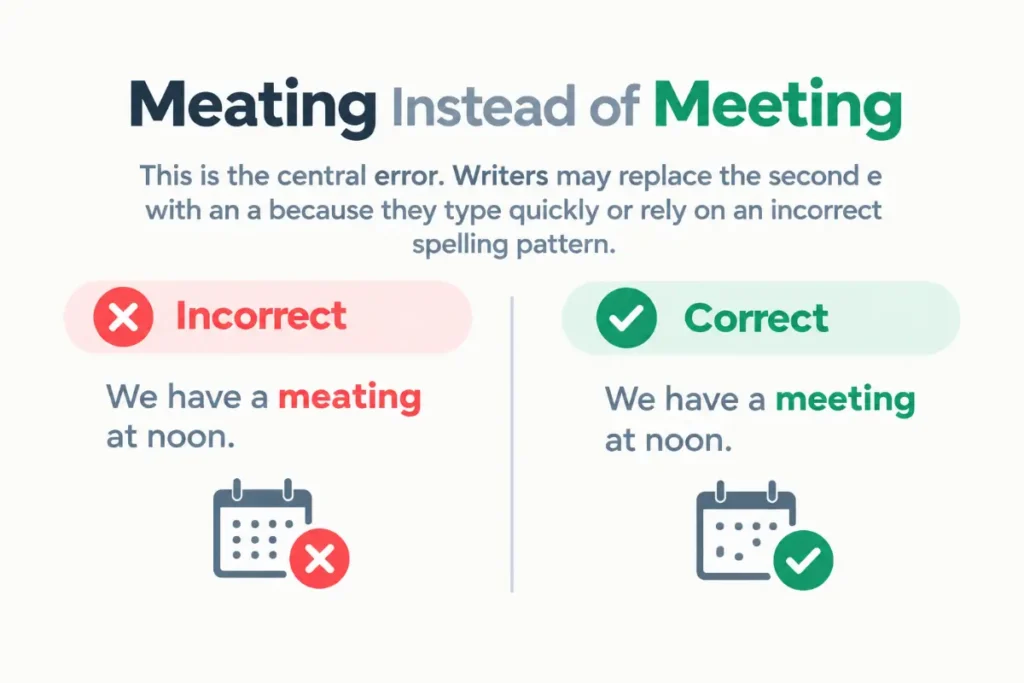
This is the central error. Writers may replace the second e with an a because they type quickly or rely on an incorrect spelling pattern.
Incorrect. We have a meating at noon.
Correct. We have a meeting at noon.
The best fix is to connect the word to its base form, meet. Once you remember the base verb, the correct spelling becomes easier to recall.
Meetting Instead of Meeting.
Some writers double the final consonant before adding ing. That creates an extra t.
Incorrect. I am meetting the new teacher today.
Correct. I am meeting the new teacher today.
The verb meet doesn’t require a doubled final consonant before this ending. Keep the original spelling and add ing.
Metting Instead of Meeting.
Another mistake removes one of the two e letters. This may happen when someone types quickly or isn’t sure how the vowel pattern works.
Incorrect. The metting went well.
Correct. The meeting went well.
Remember that the base verb contains two consecutive e letters. Both remain in the standard form.
Meetin Instead of Meeting.
Some writers leave off the final g, especially in quick messages or informal notes. Although shortened spellings can appear in casual communication, meetin is not the standard written form for school or professional work.
Incorrect. Our meetin is scheduled for Friday.
Correct. Our meeting is scheduled for Friday.
Use the full spelling in any writing that needs to follow standard English conventions.
Meeting’s Instead of Meetings.
This mistake involves punctuation rather than the main spelling. Writers sometimes add an apostrophe when they intend to make the noun plural.
Incorrect. The meeting’s are listed on the calendar.
Correct. The meetings are listed on the calendar.
Use meetings for more than one gathering. Use meeting’s only when the apostrophe marks possession or forms a contraction in a context that supports it.
Pronunciation Guide.
The standard pronunciation of meeting is /ˈmiː.tɪŋ/ in the International Phonetic Alphabet. For most American English speakers, it sounds like MEE ting, with the first syllable receiving the main stress.
Syllable Breakdown.
- First syllable. Mee contains the long vowel sound /iː/, as in see and green.
- Second syllable. Ting begins with /t/ and contains a short vowel /ɪ/, as in sit.
- Stress pattern. Put the strongest emphasis on the first syllable.
Say the word naturally rather than giving both syllables equal force. The first syllable should stand out, while the second remains shorter and lighter.
Common Pronunciation Mistakes.
Some speakers may reduce the final syllable in fast conversation. That’s a normal feature of connected speech and doesn’t change the standard spelling. The main point is to preserve the long vowel sound at the beginning and the clear second syllable.
The spelling mistake can also cause confusion for learners who assume that every vowel letter maps neatly to one sound. English doesn’t work that way. The safest approach is to learn the spoken form and the written form together.
Etymology and Word Origin.
The word meeting comes from the verb meet, which has a long history in English. The verb developed from Old English mētan, a word associated with coming upon or encountering someone or something. Related forms appear in older Germanic languages.
Over time, the verb gained the familiar modern spelling and a broad range of uses. People can meet a friend, meet a requirement, meet a deadline, or meet for a discussion. The noun meeting developed from the same base and came to describe an occasion when people gather.
The ending ing is productive in English. It can form present participles, as in we are meeting, and gerunds, as in meeting new people is enjoyable. It also appears in nouns that name activities or events, including training, reading, and gathering.
The spelling follows the established base word. Since the verb is meet, the standard form keeps both e letters when the ending is added. There is no need to replace a vowel or add another one.
Regional Usage.
American English.
In the United States, meeting is the standard spelling for a gathering, discussion, appointment, or encounter. It appears in workplace calendars, school notices, business reports, community announcements, and everyday conversation.
American writers should use this form in both formal and informal contexts. The spelling meating is not an accepted regional alternative for the same meaning.
British English.
British English uses the same spelling and follows the same basic grammar. A British writer might attend a staff meeting, arrange a meeting with a teacher, or describe a chance meeting with an old friend.
There is no standard British spelling rule that changes meeting to meating. The same correction applies in both varieties of English.
Australian English.
Australian English also uses meeting as the standard form. The word appears in professional, academic, social, and public settings without a special regional spelling change.
Canadian English.
Canadian English follows the same pattern. Writers use meeting for a scheduled gathering or the act of coming together. The spelling doesn’t change based on Canadian conventions.
The practical lesson is clear. You can use meeting confidently with English readers across these regions.
Grammar Rules and Part of Speech.
Understanding how the word works in a sentence can help you spell it correctly and use it with confidence.
Meeting as a Noun.
A noun names a person, place, thing, or idea. In this case, meeting names an event or occasion when people gather.
Examples include the following.
- The meeting begins at nine.
- We canceled the meeting because of the storm.
- Her first meeting with the director went well.
The noun often appears with an article or another determiner, such as a meeting, the meeting, our meeting, or this meeting. It can also appear with an adjective, as in an important meeting.
Meeting as a Verb Form.
The word also appears in progressive verb phrases. These phrases use a form of be followed by the verb ending in ing.
Examples include the following.
- I am meeting the new team today.
- She is meeting her professor after class.
- They were meeting when the power went out.
In each sentence, meeting describes an action in progress or an arranged future event. The helping verb changes to match the subject and tense, but the spelling of meeting stays the same.
Meeting as a Gerund.
A gerund is an ing form that functions as a noun. It can appear as the subject or object of a sentence.
For example, Meeting new people takes practice. The phrase meeting new people acts as the subject. In I enjoy meeting new colleagues, the same form follows the verb enjoy.
This grammatical role can seem confusing because the same written form can function in different ways. Look at the whole sentence to determine its role.
Singular and Plural Forms.
The singular noun is meeting. The regular plural is meetings.
- We have one meeting today.
- We have three meetings today.
Don’t use an apostrophe to form the plural. Write meetings, not meeting’s, when you mean more than one gathering.
An apostrophe can show possession, as in the meeting’s agenda. It can also appear in a contraction, though that use is less common with this particular noun.
Common Grammar Patterns.
The word appears in several useful patterns.
- Have a meeting. We have a meeting every Thursday.
- Attend a meeting. She attended the meeting yesterday.
- Hold a meeting. The principal held a meeting with teachers.
- Schedule a meeting. I’ll schedule a meeting for next week.
- Meet with someone. We will meet with the client tomorrow.
- Meeting about something. They held a meeting about the budget.
These patterns help you choose the right expression for the situation. They also give you a natural way to build sentences without repeating the same structure.
Real Life Usage Examples.
The following examples show how the word appears in different types of communication. Each category has a slightly different purpose, but the spelling remains consistent.
Daily Conversation.
People often use the word to talk about plans, appointments, and encounters.
- I can’t stay long because I have a meeting this afternoon.
- Our meeting at the park was completely unexpected.
The first example describes a scheduled event. The second describes an encounter that took place in a particular setting.
Email and Workplace Communication.
In professional messages, the word helps identify scheduled discussions and planned decisions.
- Please review the report before our meeting tomorrow morning.
- I’ve moved the meeting to Thursday so everyone can attend.
These sentences are direct and clear. They give readers the information they need without adding unnecessary detail.
Academic Writing.
Schools and universities use the word to describe discussions among students, teachers, researchers, and committees.
- The research team held a meeting to review the preliminary findings.
- The department scheduled a meeting to discuss changes to the course requirements.
In academic contexts, the word can refer to a formal gathering with a specific purpose. The surrounding sentence usually explains that purpose.
News and Journalism.
News writing often uses the word to report on decisions, public discussions, and official events.
- City leaders held a meeting to discuss the proposed road improvements.
- The committee announced its decision after a closed meeting.
Journalists may use related expressions such as public meeting, emergency meeting, and committee meeting. Each expression identifies the type or purpose of the gathering.
Literature and Storytelling.
In stories, the word can describe planned encounters or unexpected moments that affect the plot.
- Their first meeting seemed ordinary, but neither forgot it.
- The secret meeting took place just before sunrise.
These examples show that the word works in both factual and creative writing. It can describe a routine appointment or an event with major consequences for the characters.
Related and Confused Terms
Several English words share part of the meaning or spelling pattern of meeting. Learning the differences can help you write with greater precision.
1. Meet. This is the base verb. It means to come together with someone, encounter someone, or satisfy a condition. Example: We will meet after lunch.
2. Appointment. An appointment is an arrangement to see someone or do something at a set time. It often refers to a medical visit, professional consultation, or personal service. Example: I have a doctor’s appointment at two.
3. Conference. A conference is usually a larger or more formal gathering focused on a subject, profession, or shared interest. Example: She spoke at a science conference.
4. Gathering. This is a broad term for people coming together. It can describe a casual social event or an organized occasion. Example: We hosted a family gathering on Sunday.
5. Discussion. A discussion is an exchange of ideas or opinions. It can happen during a meeting, but the words don’t mean exactly the same thing. Example: Our discussion helped us solve the problem.
6. Session. A session is a period set aside for a particular activity. It may involve a meeting, a class, a training event, or a work period. Example: The training session lasted two hours.
7. Seating. This word refers to providing seats or arranging people in seats. It shares a similar spelling pattern with the incorrect form, but it has a different meaning. Example: Seating begins fifteen minutes before the show.
8. Greeting. This word refers to an expression or action used to welcome or acknowledge someone. It shares the same ing ending pattern, which can help reinforce the spelling of words built from a base verb. Example: Her warm greeting made everyone feel welcome.
These distinctions are useful because a related word doesn’t always have the same meaning. Choosing a precise term helps readers understand the purpose, size, and nature of an event.
Expert Editor Insight
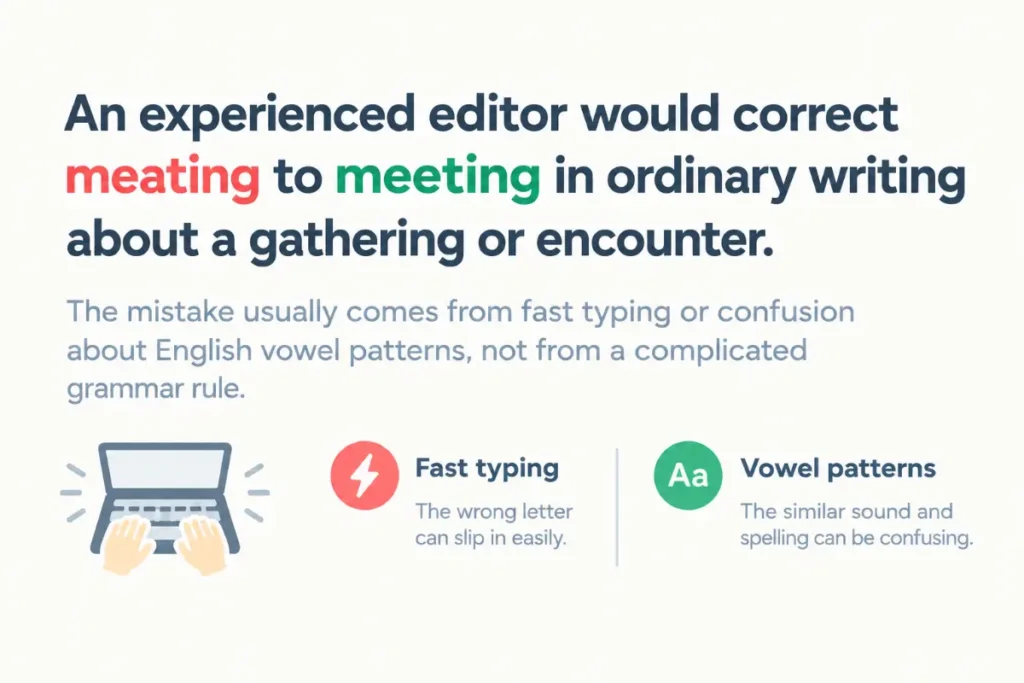
An experienced editor would correct meating to meeting in ordinary writing about a gathering or encounter. The mistake usually comes from fast typing or confusion about English vowel patterns, not from a complicated grammar rule. Spell checkers can catch many instances, but they may miss errors that look plausible within a sentence. A useful editing habit is to check the base verb first. Since the verb is meet, the correct form is meeting. Reading the sentence aloud can help you catch awkward wording, but checking the spelling of key words remains essential.
Conclusion
The difference in meating vs meeting comes down to one important spelling rule. Meeting is the correct standard English word for a gathering, discussion, appointment, or encounter. Meating is generally a misspelling when used with that meaning.
The easiest way to remember the correct form is to start with the verb meet and add ing. Keep both e letters in place. This simple trick works in emails, school assignments, calendar invitations, and professional documents. Before sending an important message, take a moment to check the spelling of key words. A small correction can make your writing clearer and help you communicate with confidence.
FAQs
Is Meating a Real Word?
Meating is not the standard spelling used for a gathering or the act of meeting someone. In ordinary writing, it is generally a misspelling of meeting. A name or deliberately invented expression might use the same letters, but that doesn’t make it an accepted substitute in standard English. If you mean a scheduled discussion or encounter, write meeting.
What Does Meeting Mean?
Meeting can mean an organized gathering of people who come together to discuss something, make decisions, or share information. It can also describe an encounter or the act of meeting someone. For example, The meeting starts at noon uses the word as a noun, while I am meeting my friend uses it as part of a verb phrase.
Which Spelling Should I Use in American English?
Use meeting in American English. It is the standard spelling in casual messages, business emails, school assignments, reports, and formal documents. The alternative spelling meating is not accepted for the same meaning. You don’t need to adjust the spelling for British, Canadian, or Australian readers because those varieties also use meeting.
How Do You Pronounce Meeting?
In standard American English, meeting is pronounced /ˈmiː.tɪŋ/. It has two syllables, with the stress on the first. An easy way to remember the sound is to compare the opening vowel with the vowel in see. The second syllable has the short vowel sound heard in sit. The pronunciation doesn’t change the standard spelling.
Can Meeting Start a Sentence?
Yes. You can begin a sentence with meeting when the grammar supports it. For example, Meeting new people can be exciting uses the word as a gerund phrase that acts as the subject. You can also begin with a noun phrase, as in The meeting starts at nine. Both forms are grammatically correct.
What Is a Synonym for Meeting?
The best synonym depends on the context. Gathering works for a general event, conference suits a larger or more formal event, and appointment often refers to an arranged visit. Discussion emphasizes the exchange of ideas rather than the gathering itself. These words overlap in meaning, but they aren’t interchangeable in every sentence.
Why Do People Confuse These Spellings?
People often make this mistake because they type quickly, misremember the vowel pattern, or assume the word follows a different spelling rule. Words such as eating, heating, and seating may also influence how someone spells the word. Remembering the base verb meet helps prevent the error because the correct form keeps both e letters.
Is Meeting Appropriate in Formal Writing?
Yes. Meeting is suitable for formal and informal writing. You can use it in official reports, academic papers, business correspondence, meeting minutes, and public announcements. The word itself isn’t too casual or too formal. The surrounding language should match the audience and purpose. Avoid the incorrect spelling in professional documents because it can distract readers and weaken the impression of care.
