
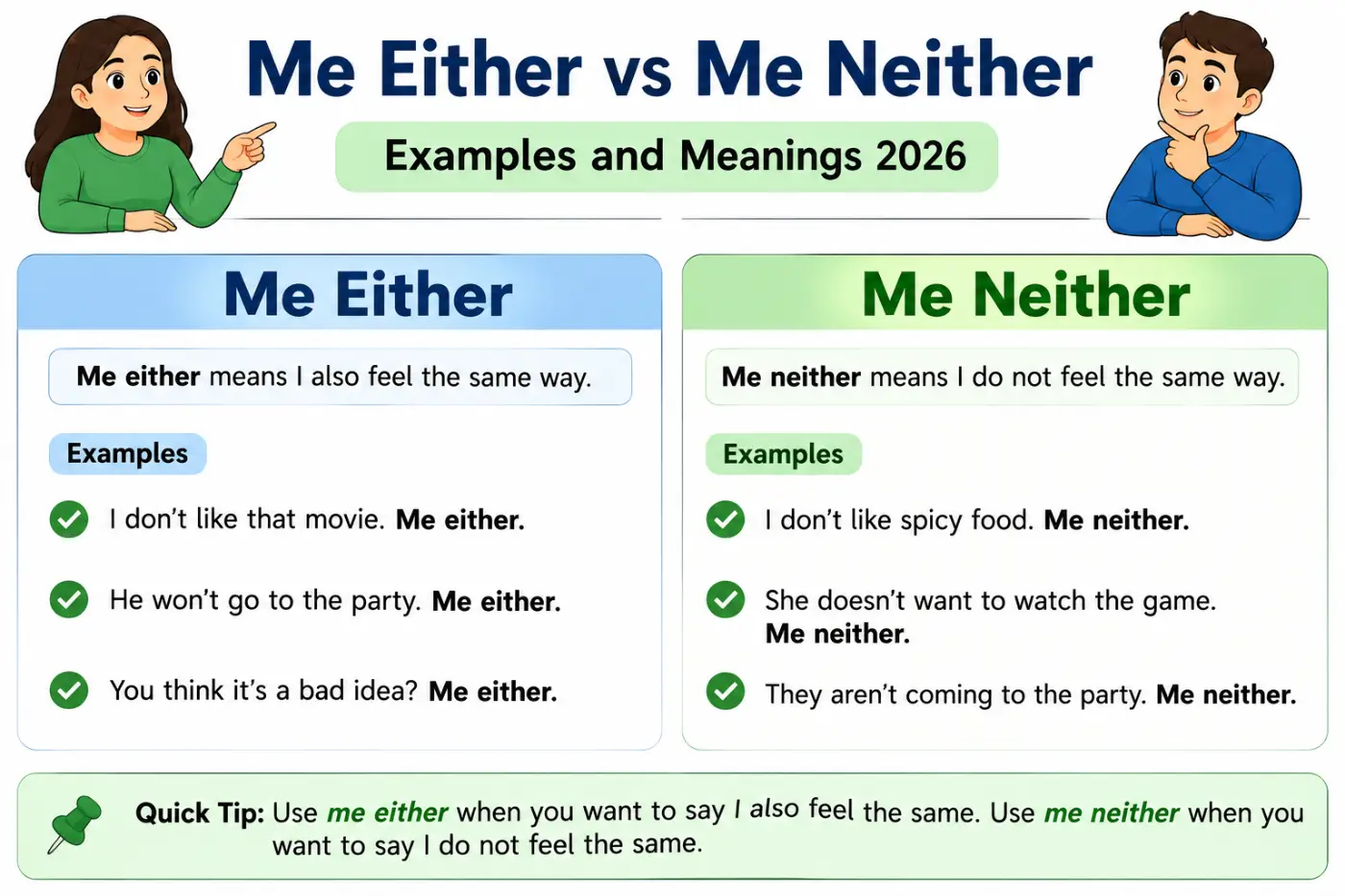
Me Either vs Me Neither can be confusing because both expressions appear in everyday English conversations. You might hear someone say, I don’t like cold weather, and then hear another person reply, Me neither. Someone else might respond, Me either. Both expressions can sound familiar, so it’s natural to wonder which one you should use. The difference comes down to how English speakers express agreement with a negative statement and how they use either and neither.
In everyday American English, me neither is a widely accepted informal response to a negative statement. Me either also occurs in casual speech, although some speakers prefer the first expression. Neither phrase is a complete formal sentence in traditional grammar, but both can work as conversational responses. If you’re writing an essay, a business email, or another formal document, a full construction such as Neither do I or I don’t either is usually a better choice.
Understanding the difference between me either and me neither helps you speak naturally without getting stuck on a small grammar question. You’ll learn what each expression means, how either and neither work, which forms fit different situations, and how to avoid common mistakes. You’ll also see examples from daily conversation, work, school, and written communication, so you can choose a natural response with confidence.
Quick Definition
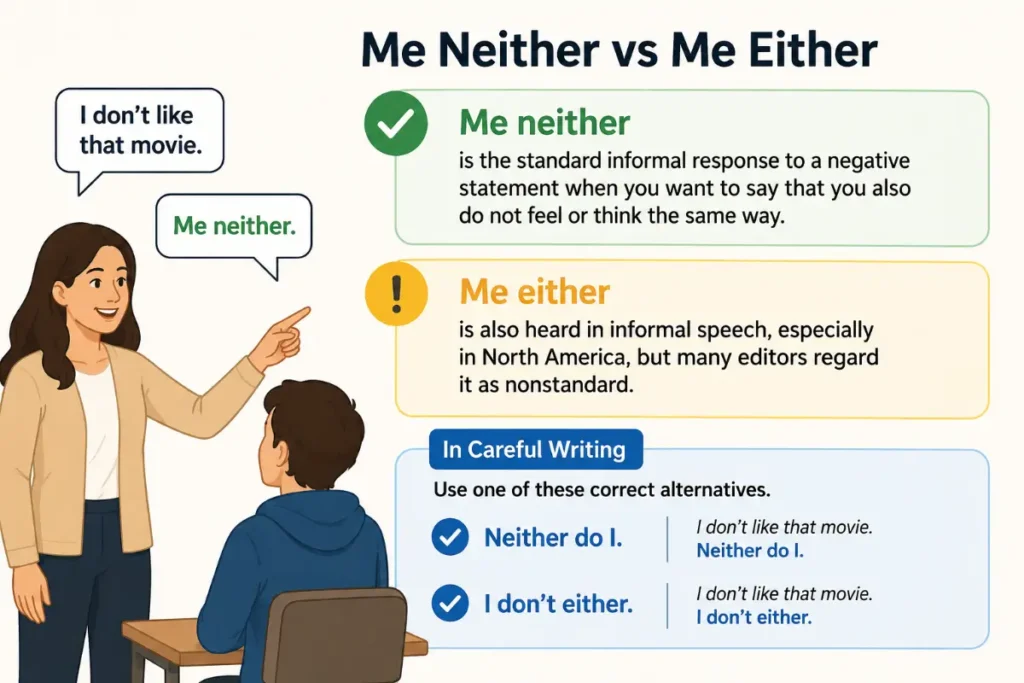
Me neither is the standard informal response to a negative statement when you want to say that you also do not feel or think the same way. Me either is also heard in informal speech, especially in North America, but many editors regard it as nonstandard. In careful writing, use Neither do I or I don’t either.
Quick Answer
Both me either and me neither appear in informal English as ways to agree with a negative statement. In American English, me neither is a common conversational response, while me either is also used, especially in casual speech. For formal writing, use a complete response such as Neither do I or I don’t either.
The Main Difference Between the Two Expressions
Both expressions communicate agreement with a negative statement. The main difference is the form speakers choose to express that agreement.
Me neither is a common informal response. It means that the same negative statement applies to the speaker.
Me either is also used informally by some English speakers. It carries the same general meaning in this conversational pattern, though many speakers find me neither more natural.
Consider this exchange.
Person A: I don’t eat seafood.
Person B: Me neither.
The second person means that they also don’t eat seafood.
Now consider this version.
Person A: I don’t eat seafood.
Person B: I don’t either.
This version expresses the same idea in a complete sentence. It is natural in both conversation and many forms of writing.
The important point is that agreement with a negative statement requires a negative meaning. You aren’t saying that you do the activity too. You’re saying that you share the other person’s lack of interest, experience, or action.
Comparison Table
| Expression | Meaning | Grammar | Formality | Typical use |
|---|---|---|---|---|
| Me neither | I also do not | Informal elliptical response | Casual | Everyday conversation |
| Me either | I also do not | Informal elliptical response | Casual | Some conversational varieties |
| Neither do I | I also do not | Complete negative agreement structure | Neutral to formal | Conversation and writing |
| I don’t either | I also do not | Complete negative sentence | Neutral | Conversation and writing |
| I don’t either agree | Usually awkward in this context | Unnatural word order | Avoid | Use I don’t agree either when that is the intended meaning |
The best choice depends on the setting. In a relaxed conversation, me neither is a dependable option. In professional or academic writing, a complete sentence makes the meaning clearer.
What Me Neither Means
Me neither is an informal expression used to agree with a negative statement. It tells the other person that the same situation or feeling applies to you.
For example:
Person A: I haven’t seen that movie.
Person B: Me neither.
The second speaker also hasn’t seen the movie.
The expression often follows statements containing negative words or structures such as don’t, doesn’t, didn’t, haven’t, hasn’t, can’t, won’t, and isn’t.
Examples include:
- I don’t drink coffee. Me neither.
- She hasn’t finished the assignment. Me neither.
- I can’t swim. Me neither.
- I wasn’t ready for the test. Me neither.
- I haven’t visited California. Me neither.
The phrase works because the listener understands the missing information from the previous statement. The speaker doesn’t need to repeat the entire sentence.
Although me neither is common in conversation, it is not usually the best choice for formal essays or reports. In those settings, use a complete construction such as Neither have I or I haven’t either.
What Me Either Means
Me either is another informal response used by some English speakers to agree with a negative statement. It generally means the same thing as me neither in this conversational setting.
For example:
Person A: I don’t enjoy horror movies.
Person B: Me either.
The second person means that they also don’t enjoy horror movies.
This expression is heard in casual speech, but preferences vary. Some speakers use it naturally, while others consider me neither the more standard or familiar response.
That difference in preference doesn’t mean every use of me either is a spelling error. The word either is standard English. The question is how it functions in a particular sentence.
Compare these examples.
- I don’t like mushrooms. Me either.
- I don’t like mushrooms. I don’t either.
- I don’t like mushrooms. Me neither.
The second and third responses are widely understood as expressions of negative agreement. The first also occurs in informal conversation, but some readers and listeners may prefer a different form.
For a safe choice in American English, use me neither in casual conversation and I don’t either in a complete sentence.
Which Expression Should You Use?
If you’re unsure which phrase to choose, start with the type of situation.
In Everyday Conversation
Use me neither when you want a short, natural response to a negative statement.
Example:
Person A: I don’t want to go out tonight.
Person B: Me neither.
This response is brief and clear. The listener understands that both people want to stay home.
You can also say I don’t either.
Person A: I don’t want to go out tonight.
Person B: I don’t either.
Both responses communicate the same idea.
In Text Messages
Informal expressions are common in texts because people often prefer short replies.
For example:
Friend: I haven’t started my homework.
You: Me neither.
This is natural in a casual exchange. You don’t need to repeat the full sentence unless you want to add emphasis.
In Formal Writing
Avoid using me neither or me either as standalone replies in formal academic writing. Choose a complete sentence that makes the relationship between the two statements clear.
For example:
Informal: I haven’t completed the survey. Me neither.
Formal: I haven’t completed the survey, and neither has my colleague.
The formal version communicates the same idea while fitting the expectations of professional writing.
How Either Works in Negative Sentences
Either has several uses in English. One common use is to express negative agreement when it appears at the end of a negative sentence.
For example:
I don’t like spicy food either.
This means that the speaker also doesn’t like spicy food, usually in response to someone who has said the same thing.
Here are more examples.
- I can’t attend the meeting either.
- She doesn’t know the answer either.
- We haven’t received the package either.
- He wasn’t invited either.
- They won’t be joining us either.
In these sentences, either follows a negative clause. The word doesn’t create the negative meaning by itself. The negative verb or auxiliary supplies that meaning.
This distinction matters because either can also appear in positive sentences with a different meaning.
For example:
You can choose either option.
Here either means one of two choices. It has nothing to do with agreeing with a negative statement.
How Neither Works in Negative Agreement
Neither is commonly used to express a negative meaning involving two people or situations. In agreement responses, it signals that the same negative statement applies to another person.
For example:
Person A: I don’t understand this question.
Person B: Neither do I.
The second person means that they also don’t understand the question.
Neither do I is a complete grammatical construction. It uses neither followed by an auxiliary verb and then the subject.
Other examples include:
- Neither can I.
- Neither have I.
- Neither was she.
- Neither did they.
The auxiliary verb changes to match the original statement.
If someone says I haven’t finished, you can respond Neither have I.
If someone says I didn’t hear the announcement, you can respond Neither did I.
The structure may seem tricky at first, but the pattern becomes easier with practice.
Grammar Rules and Sentence Structure
The main grammar issue is the difference between an informal response and a complete sentence.
Informal Responses
Expressions such as me neither work as conversational fragments. They depend on the previous statement to supply the missing meaning.
For example:
Person A: I don’t watch sports.
Person B: Me neither.
The second speaker doesn’t need to say I don’t watch sports either because the context makes the meaning clear.
This type of shortened response is common in spoken English. Conversation often relies on shared information rather than complete sentences.
Complete Sentences With Either
When you want a full sentence, use a negative clause followed by either.
For example:
I don’t watch sports either.
I haven’t watched that show either.
These sentences are grammatically complete and work in a wide range of situations.
Complete Sentences With Neither
You can also begin a sentence with neither and use subject auxiliary inversion.
For example:
Neither do I.
Neither did they.
This pattern is especially useful when you want a short but grammatically complete response.
Match the Auxiliary Verb
When using neither in a complete response, choose the auxiliary verb that fits the original sentence.
| Original statement | Natural response |
|---|---|
| I don’t understand. | Neither do I. |
| I haven’t eaten. | Neither have I. |
| I can’t swim. | Neither can I. |
| I wasn’t invited. | Neither was I. |
| I didn’t go. | Neither did I. |
| I won’t attend. | Neither will I. |
Notice that the response does not simply repeat the negative word. It uses the correct auxiliary structure to express agreement.
Ten Natural Example Sentences
These examples show how negative agreement works in common situations.
- Daily conversation: I don’t like waking up early. Me neither. The second speaker agrees that getting up early is unpleasant.
- Food preferences: I don’t eat meat. Me neither. Both speakers avoid meat.
- Movies: I haven’t seen the new comedy. Me neither. Neither person has watched it.
- Text messages: I can’t find my keys. I can’t find mine either. The second speaker shares the same problem.
- Work: I haven’t received the updated schedule. Neither have I. Both employees are still waiting for it.
- School: I didn’t understand the last question. Neither did I. Both students had difficulty understanding the question.
- Social plans: I don’t feel like going to the party. I don’t either. Both people prefer not to attend.
- Travel: I haven’t been to Seattle. Neither have I. Neither person has visited the city.
- Formal communication: We haven’t approved the proposal, and neither has the review committee. The sentence explains that both parties have yet to approve it.
- Personal experience: I’ve never tried skiing. Neither have I. Both speakers lack that experience.
These examples demonstrate an important rule. The response should agree with the negative meaning, not repeat the original sentence mechanically.
Common Mistakes to Avoid
Mistake One: Using Positive Agreement With a Negative Statement
Incorrect for the intended meaning:
Person A: I don’t like onions.
Person B: Me too.
In many contexts, me too suggests that the second speaker shares a positive statement. With a negative statement, it can sound confusing or be understood incorrectly.
Better options:
Me neither.
I don’t either.
Neither do I.
Mistake Two: Choosing the Wrong Auxiliary
Incorrect:
Person A: I haven’t finished the report.
Person B: Neither did I.
The original statement uses have to form the present perfect. The response should match that structure.
Correct:
Neither have I.
Or:
I haven’t either.
Mistake Three: Using Neither With an Unnecessary Negative
Incorrect:
Neither don’t I.
Correct:
Neither do I.
Neither already carries negative meaning in this structure. Adding don’t creates an incorrect construction.
Mistake Four: Treating Either as Always Negative
Incorrect reasoning:
Either can only appear in negative sentences.
Correct understanding:
Either has several uses. It can mean one of two options, as in You can choose either seat. It can also express negative agreement at the end of a sentence, as in I don’t like that movie either.
Mistake Five: Using Informal Fragments in Formal Reports
Less suitable:
The team hasn’t finished the analysis. Me neither.
Better:
The team hasn’t finished the analysis, and neither have we.
The revised version uses a complete sentence and is more appropriate for professional writing.
Pronunciation Guide
The expressions are usually easy to pronounce once you know the sounds of the individual words.
Me Neither
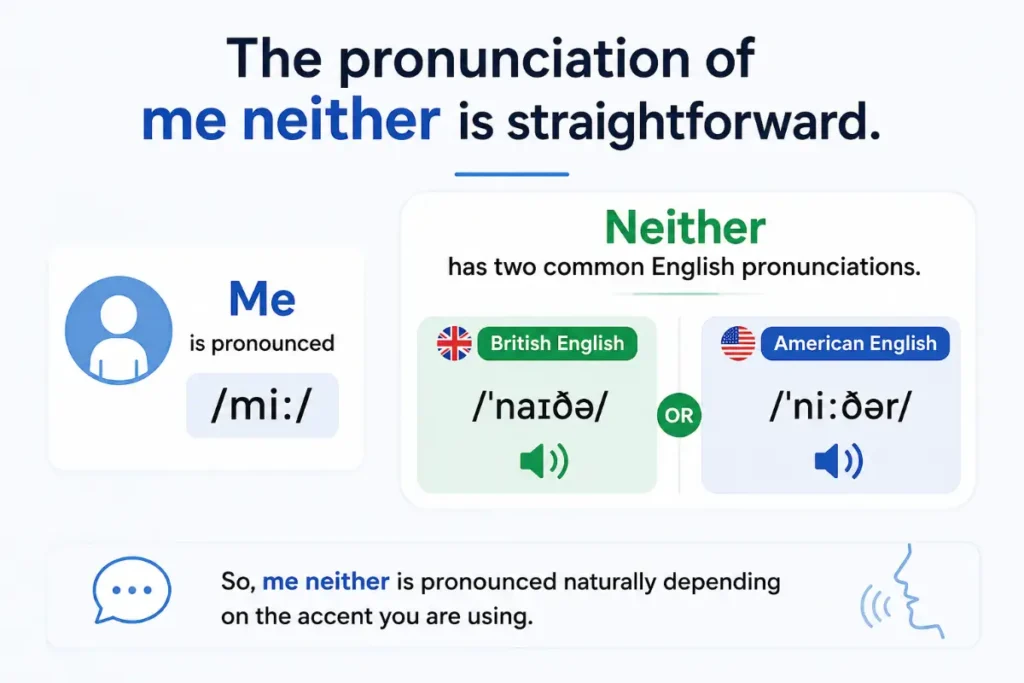
In American English, neither commonly has one of two accepted pronunciations:
- /ˈniː.ðɚ/, with an initial long ee sound.
- /ˈnaɪ.ðɚ/, with an initial eye sound.
The word has two syllables. The first syllable carries the main stress.
The th sound is voiced, as in the word this. It is not the same as the unvoiced th in think.
Me Either
Either also has two common American pronunciations:
- /ˈiː.ðɚ/, beginning with a long ee sound.
- /ˈaɪ.ðɚ/, beginning with an eye sound.
Both pronunciations are accepted in standard English. The preferred pronunciation can vary by speaker and region.
Pronunciation Tips
- Keep the first vowel clear.
- Use the voiced th sound in both words.
- Avoid replacing the th with a simple d sound in careful speech.
- Listen to the speaker’s rhythm rather than stressing every word equally.
Pronunciation does not determine which expression is grammatically best in a particular context. The sentence structure and intended meaning matter more.
Etymology and Word Origin
The words either and neither have long histories in English. Both developed from older English forms and have been used for centuries to express choices, alternatives, and negative relationships.
Either is commonly associated with a choice between two possibilities or with a negative clause in which it appears at the end. Neither expresses a negative choice or excludes both possibilities.
The phrase me neither uses me as an informal response and neither to signal negative agreement. The phrase me either follows a different conversational pattern that is also heard in informal speech.
The key point is that these expressions are best understood through modern usage and sentence structure. Their meanings in conversation cannot be decided by looking at the word origins alone.
Regional Usage
American English
In the United States, me neither is a common informal response to a negative statement. Me either is also used in casual conversation, though some speakers prefer me neither.
For neutral and professional writing, complete constructions such as I don’t either and Neither do I are safer choices.
British English
British English also uses neither and either to express negative agreement. The same general grammar rules apply.
Speakers may differ in their preference for short responses, and pronunciation may vary. Neither is not restricted to American English.
Australian English
Australian English uses the same basic constructions. Informal speech may favor short responses, while formal writing generally benefits from complete clauses.
Canadian English
Canadian English follows the same general distinction. Both either and neither are standard words, and the choice between informal responses can depend on personal and regional speech habits.
There is no major national grammar rule that makes either or neither unavailable in these varieties. The safest approach is to choose a form that fits the sentence and setting.
Related Expressions You Should Know
These expressions can help you agree with negative statements more naturally.
Neither Do I
Use this to agree with a statement in the simple present when the original uses do or does.
Example:
I don’t enjoy running. Neither do I.
Neither Did I
Use this when agreeing with a negative statement in the simple past.
Example:
I didn’t hear the announcement. Neither did I.
Neither Have I
Use this to agree with a statement in the present perfect.
Example:
I haven’t finished the book. Neither have I.
I Don’t Either
This is a complete and natural response to a negative statement.
Example:
I don’t want dessert.
I Haven’t Either
Use this when the original statement uses the present perfect.
Example:
I haven’t received the email. I haven’t either.
Not Me
This is a short informal response that can show you are not included in a group or do not share an action or preference. Its meaning depends on the context.
Example:
Who hasn’t submitted the form? Not me.
Same Here
This informal phrase means that the same situation applies to the speaker. It can follow either positive or negative statements, so the context must make the meaning clear.
Example:
I don’t have time to cook tonight. Same here.
Me Too
This usually expresses agreement with a positive statement or shared experience.
Example:
I love Italian food. Me too.
When responding to a negative statement, a form such as Me neither or I don’t either is usually clearer.
Real Life Usage Examples by Situation
Daily Conversation
Person A: I don’t like crowded places.
Person B: Me neither.
The second person shares the same dislike.
Person A: I haven’t tried that restaurant.
Person B: Neither have I.
The second person has not visited or tried it either.
Workplace Communication
A coworker says, I haven’t received the client notes yet.
You can reply, I haven’t either.
This response is clear and professional enough for most ordinary workplace conversations.
For a more formal email, you might write, I haven’t received the client notes either. Please let me know when they become available.
Academic Writing
Informal replies usually have little place in formal academic prose. Instead of writing a fragment such as Me neither, connect the ideas in a complete sentence.
For example:
The first group did not complete the exercise, and the second group did not complete it either.
This construction is clear and avoids an overly conversational tone.
News and Journalism
News writing usually favors complete statements that make the facts clear.
For example:
The agency had not confirmed the report, and neither had the local authorities.
This sentence clearly states that both parties had not confirmed the information.
Literature and Storytelling
Dialogue in fiction often uses short responses because people rarely speak in complete formal sentences all the time.
For example:
I don’t think we should go in there.
Me neither, Maya said, stepping away from the door.
The short reply fits a casual exchange and reinforces the shared concern.
Me Either Vs Me Neither For English Learners
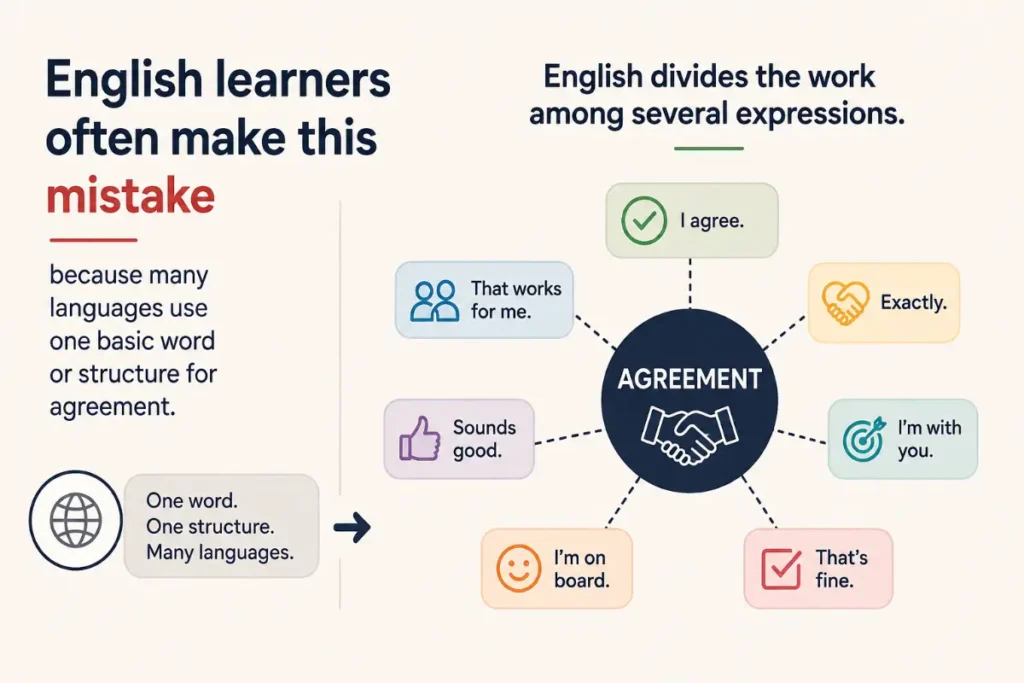
English learners often make this mistake because many languages use one basic word or structure for agreement.
English divides the work among several expressions.
Positive agreement:
“I do too.”
“Me too.”
Expert Editor Insight
An experienced editor looks at meaning and context before deciding which expression to keep. In dialogue, me neither is a natural informal response, and me either may reflect a character’s usual speech. In formal prose, editors often prefer a complete sentence such as I don’t either or Neither do I. Grammar checkers may flag fragments without recognizing that conversational dialogue regularly uses them. The goal is not to make every sentence formal. It is to make each sentence clear and suitable for its intended audience.
Key Takeaways
- Me neither is a common informal response to a negative statement.
- Me either also appears in informal speech, but some speakers prefer the first form.
- I don’t either is a natural complete sentence.
- Neither do I is another correct way to express negative agreement.
- Match the auxiliary verb to the original statement when using neither.
- Avoid using Me too when it could confuse the intended negative meaning.
- Informal fragments work well in dialogue, but formal writing usually calls for complete sentences.
- Either and neither both have more than one use, so sentence context matters.
Conclusion
The choice between me either and me neither depends on conversational habits and the level of formality. Both expressions are used to agree with a negative statement, but me neither is a familiar and dependable option in informal American English. For professional or academic writing, choose a complete form such as I don’t either or Neither do I.
These structures make your meaning clear and follow standard English grammar. Remember one simple rule: match your response to the negative meaning of the original statement. If you’re unsure, use a complete sentence and select the auxiliary verb that fits the original wording.
FAQs
Is me either grammatically correct?
Me either is used in informal English to agree with a negative statement, though some speakers prefer me neither. It is best treated as a conversational response rather than a complete formal sentence. In formal writing, use I don’t either or Neither do I to express the same idea clearly.
Is me neither better than me either?
In American English, me neither is a widely familiar choice for informal negative agreement. Me either also occurs in casual speech, but it may sound less natural to some readers. If you want a dependable response, choose me neither in conversation or a complete construction in formal writing.
Can I say me neither in a professional conversation?
Yes. It can sound natural in a relaxed conversation with coworkers, especially when responding to a simple statement such as I haven’t seen the report. In a formal email, report, or presentation, a full sentence such as I haven’t either or Neither have I is usually more suitable.
What is the difference between neither do I and I don’t either?
Both expressions mean that the speaker shares a negative statement. Neither do I uses inversion, placing neither before the auxiliary verb and subject. I don’t either follows the more familiar subject, verb, and adverb order. Both are standard English and can work in conversation or writing.
Can me neither start a sentence?
Yes. It can stand alone as a conversational response at the start of a new turn. For example, someone might say I don’t enjoy flying, and you could answer Me neither. In formal prose, however, the phrase is a fragment, so a complete sentence is often a better choice.
Is neither always used in negative sentences?
Neither usually carries a negative meaning, but its role varies by construction. It can introduce negative agreement, as in Neither do I, or connect two negative alternatives, as in Neither John nor Maria attended. The key is to use the correct sentence structure and avoid adding another negative unnecessarily.
How do you pronounce either and neither?
Both words have two common pronunciations in American English. Either may begin with a long ee sound or an eye sound. Neither can also begin with either of those sounds. Both words use a voiced th sound. Regional habits and personal preferences influence which pronunciation a speaker chooses.
What should I use instead of me neither in formal writing?
Use a complete sentence that matches the original verb structure. For example, respond to I don’t agree with Neither do I or I don’t either. Respond to I haven’t finished with Neither have I or I haven’t either. These forms make the relationship between the statements clear and suit formal writing better.
