
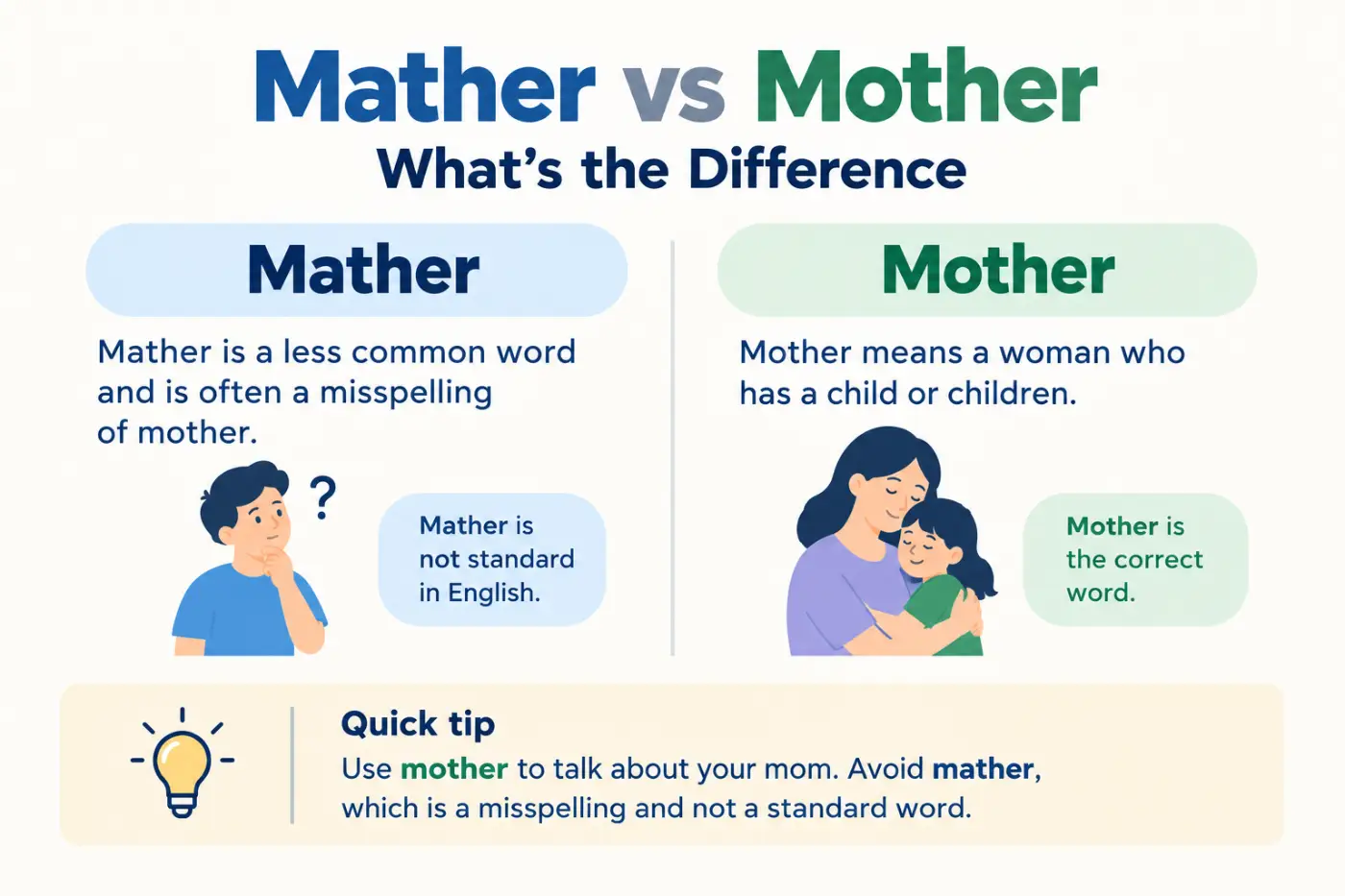
The difference between mather vs mother whats the difference comes down to spelling and meaning. The two words differ by just one vowel, so it’s easy to type one when you mean the other. However, mother is the correct standard spelling for a female parent, while Mather is generally used as a surname or part of a proper name.
A mother is a female parent. The word also appears in familiar expressions such as mother tongue, mother nature, and mother figure. In contrast, Mather isn’t the standard spelling for a parent and cannot replace mother in ordinary sentences.
Understanding this difference helps you avoid spelling mistakes in school assignments, emails, family messages, social media posts, and professional writing. You’ll also learn how to pronounce mother correctly, recognize the surname Mather, and choose the right spelling for your sentence.
Quick Answer
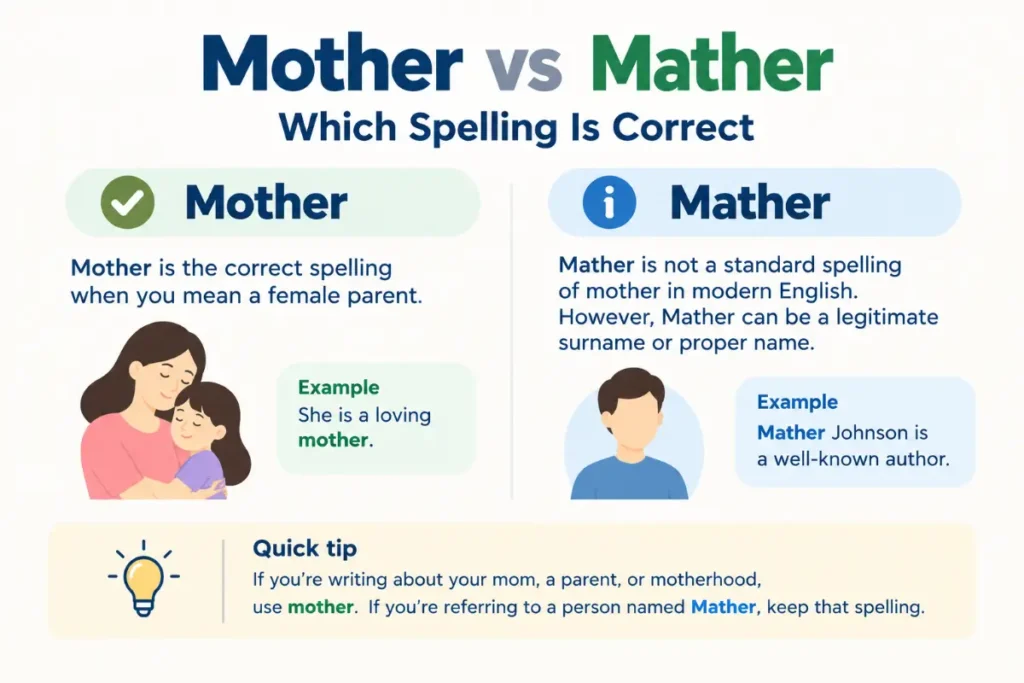
Mother is the correct spelling when you mean a female parent. Mather is not a standard spelling of mother in modern English. However, Mather can be a legitimate surname or proper name. If you’re writing about your mom, a parent, or motherhood, use mother. If you’re referring to a person named Mather, keep that spelling.
Meaning and Definition
What Does Mother Mean
Mother is a noun that usually means a female parent. It can refer to a woman who has a child through birth or adoption, and it can also describe someone who takes on a caring or protective parental role.
For example, consider this sentence.
My mother taught me how to cook.
Here, mother refers to the speaker’s parent. The word identifies a family relationship and works as the main noun in the sentence.
The term has several other uses. It can refer to a person who cares for someone like a parent, as in a mother figure. It can also appear in expressions that describe something as a source or origin, such as mother tongue, which means a person’s first language.
The exact meaning depends on the context, but the standard spelling remains mother.
What Does Mather Mean
Mather is not the standard English word for a female parent. If you write My mather is kind when you mean your parent, the sentence contains a spelling error. The correct sentence is My mother is kind.
However, Mather can be a proper noun. It is used as a surname and appears in the names of real people, institutions, and places. A proper name must retain its established spelling, even when it looks similar to another word.
For example, if a person’s last name is Mather, you could write, Ms. Mather will lead the meeting. That sentence is correct because Mather identifies a person by name.
The key is to understand the intended meaning before correcting the spelling. Don’t change a genuine surname to mother simply because the two forms look alike.
Comparison Table
| Feature | Mother | Mather |
|---|---|---|
| Standard spelling for a female parent | Correct | Incorrect |
| Main meaning | A female parent | Usually a surname or proper name |
| Part of speech | Noun and sometimes modifier | Proper noun when used as a name |
| Pronunciation | Usually /ˈmʌðər/ in American English | Depends on the person or name |
| Capitalization | Lowercase in ordinary use | Capitalized as a proper name |
| Everyday usage | Very common | Uncommon as an ordinary word |
| Family context | My mother called me | Mr. Mather called me |
| Formal writing | Standard | Correct only when the name or intended reference calls for it |
This comparison shows why the two spellings aren’t interchangeable. Mother has a well established meaning as a family term. Mather may be correct in a name, but it doesn’t replace mother in ordinary sentences about parents.
Key Differences Explained
The easiest way to tell these forms apart is to look at their meaning, spelling, pronunciation, and place in a sentence.
Spelling
The standard spelling for a female parent is mother. It contains the letter o after the initial m. The incorrect form mather replaces that letter with a.
Compare these sentences.
- Correct: My mother works at a local school.
- Incorrect: My mather works at a local school.
The second sentence has a spelling mistake if the writer means a parent. A spelling checker may flag it, but the reader can usually understand the intended meaning from the context.
Meaning
Mother refers to a female parent and has several related uses. Mather does not have that ordinary meaning in standard modern English.
For example, mother is correct in She became a mother last year. In Mr. Mather became a teacher last year, the second form is a surname.
The surrounding words often reveal the intended meaning. A sentence about family life usually calls for mother. A sentence about a named person may correctly use Mather.
Grammar
Mother is a common noun in ordinary family contexts. It can function as a subject, direct object, or object of a preposition.
- My mother is a nurse.
- I called my mother.
- I bought a gift for my mother.
In each sentence, the word identifies a family relationship.
Mather functions as a proper noun when it is a person’s surname. Proper nouns identify specific people, places, organizations, or other named entities.
- Mather spoke at the event.
- We sent the letter to Dr. Mather.
- The report was prepared by Mather.
The grammar depends on the role of the name in the sentence, not on its similarity to mother.
Capitalization
The word mother is usually lowercase when it refers to a parent in a general way or follows a possessive word.
For example, My mother is visiting us this weekend uses lowercase because the word follows my and describes a family relationship.
Capitalization can change when Mother is used as a direct form of address or as a title in a particular context.
For example, Thank you, Mother treats the word as a form of direct address. Some families also use Mother as a personal title in their writing.
Mather is capitalized when it is a surname because names begin with capital letters.
Pronunciation
In standard American English, mother is usually pronounced with the first syllable stressed. The middle consonant is the voiced sound represented by the letters th, as in this and they.
Mather may be pronounced differently depending on the person, family, or name involved. You shouldn’t assume every person with that surname uses a particular pronunciation without checking.
Formality
Mother is appropriate in formal and informal English. It appears in academic writing, legal documents, personal letters, news reports, and everyday conversation.
Mather is appropriate when it is the correct name or another specific proper noun. It is not an acceptable formal alternative to mother.
The distinction is about meaning rather than formality. Using mather to mean a parent is still a spelling error in a formal report, just as it would be in a text message.
Which Form Is Correct
Use mother when you mean a female parent. Use Mather when you are referring to someone or something that actually has that proper name.
English spelling conventions distinguish common nouns from proper nouns. A common noun identifies a general person, place, thing, or idea. A proper noun identifies a particular person, place, organization, or other named entity.
The word mother is a common noun in ordinary family usage. It has a recognized spelling and meaning. Replacing its o with an a doesn’t create a standard alternative spelling.
For example, write I asked my mother for advice, not I asked my mather for advice, when you mean your parent.
However, suppose a colleague’s surname is Mather. You should write I asked Ms. Mather for advice. In this case, changing the name to Mother would introduce an error.
The rule is simple. Choose the spelling based on what you mean, not just on how the word looks.
Ten Correct Sentence Examples
These examples show how to use mother naturally in different situations.
- Everyday conversation: My mother makes the best homemade soup. The word identifies the speaker’s parent.
- Text message: I’ll call my mother after work. The sentence uses mother as the object of the verb call.
- School assignment: My mother encouraged me to read from an early age. The word refers to a parent in a personal narrative.
- Workplace communication: My mother has an appointment tomorrow, so I’ll leave early. The sentence uses the word in a straightforward explanation of a family commitment.
- Formal writing: The child’s mother attended the school meeting. The term identifies the child’s female parent.
- Social situation: Her mother welcomed everyone into the house. The word identifies the person who welcomed the guests.
- Family conversation: My mother and I enjoy walking together. The noun appears as one of two subjects connected by and.
- Personal writing: My mother taught me the value of patience. The word refers to a parent who influenced the writer.
- Language discussion: Spanish is her mother tongue. The expression refers to the language she learned first.
- Storytelling: The mother held her child’s hand as they crossed the street. The noun identifies a parent in a narrative.
Each sentence uses the standard spelling. The examples also show that mother can appear at the beginning, middle, or end of a sentence without changing its spelling.
Five Common Mistakes
Spelling mistakes often happen when a writer types quickly, relies on memory, or confuses words with similar letter patterns. These are five useful errors to recognize.
Mistake One
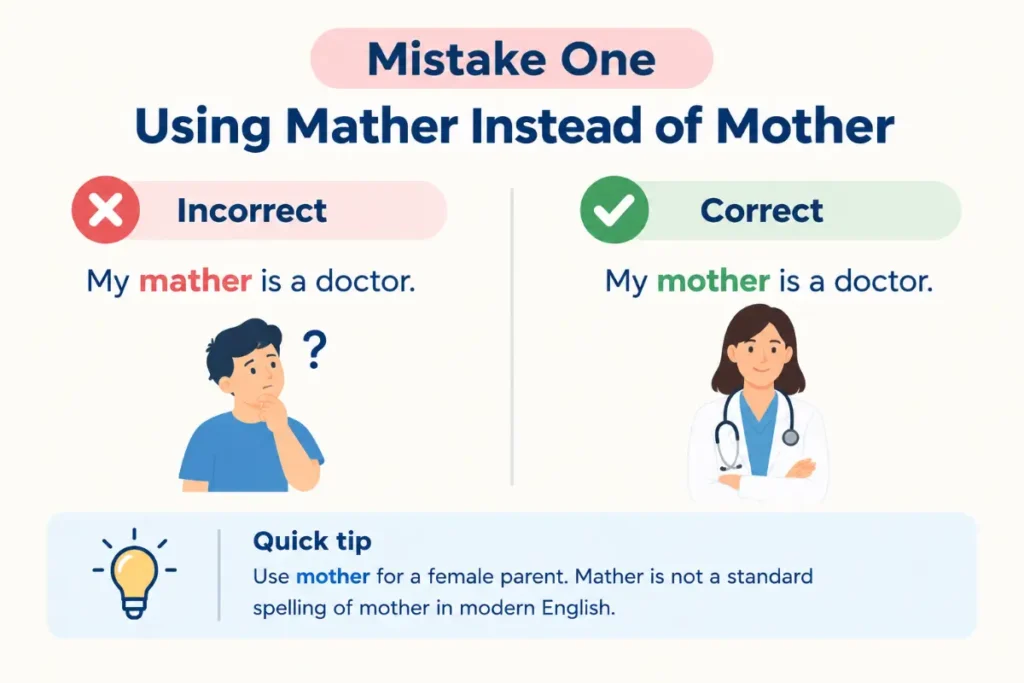
Incorrect: My mather is a doctor.
Correct: My mother is a doctor.
The incorrect form replaces the o with an a. Use mother when referring to a parent.
Mistake Two
Incorrect: I bought a present for my mather.
Correct: I bought a present for my mother.
The possessive word my does not change the spelling of the noun that follows it. The correct expression is my mother.
Mistake Three
Incorrect: Happy Birthday to my dear mather.
Correct: Happy birthday to my dear mother.
The mistake can appear in greetings and social media captions. Familiar messages may be typed quickly, but the standard spelling still uses o.
Mistake Four
Incorrect: My mather helped me with my homework.
Correct: My mother helped me with my homework.
The verb helped doesn’t affect the spelling of mother. The error is a spelling issue, not a tense or sentence structure problem.
Mistake Five
Incorrect: I want to thank my mather for everything.
Correct: I want to thank my mother for everything.
This mistake may be especially noticeable in a card, speech, or personal letter. Read the final message once before sending it to catch small errors that spellcheck might miss.
These corrections all follow the same rule. If the intended meaning is a female parent, write mother.
Pronunciation Guide
How to Pronounce Mother
In standard American English, mother is pronounced /ˈmʌðər/.
The word has two syllables. The first syllable carries the main stress, and the final syllable has a relaxed sound.
You can remember the sound by comparing it with familiar words such as brother and another. These words share some sounds, although their stress patterns and vowel sounds differ.
The consonant represented by th is voiced. To make it, place your tongue lightly between your teeth and let your voice vibrate as air passes through.
How to Pronounce Mather
The pronunciation of Mather depends on the person or name being discussed. Surnames can have established family pronunciations that aren’t obvious from their spelling.
If you see this name in a book, at work, or in a public record, use the pronunciation provided by the person or a reliable source associated with that name.
Don’t assume that Mather is simply another way to spell or pronounce mother. The words have different spelling conventions and uses.
Common Pronunciation Mistakes
- Confusing the vowels. The standard American pronunciation of mother uses the vowel sound /ʌ/, as in cup. It doesn’t use the vowel sound in cat.
- Using the wrong th sound. The th in mother is voiced, like the sound in this. It differs from the unvoiced sound in think.
- Putting stress on the wrong syllable. In ordinary American speech, the first syllable of mother receives the main stress.
Pronunciation practice can help you recognize the correct word, but spelling still depends on remembering the standard written form.
Etymology and Word Origin
The word mother has a long history in English. It comes from Old English mōdor and is related to similar words in other Germanic languages. For example, German has Mutter, Dutch has moeder, and Swedish has moder.
These similarities reflect the words’ shared historical roots. Related forms also appear in other Indo European languages, including Latin mater. The precise historical development involves changes in sound and spelling across languages and over many centuries.
The spelling mother became established in English and remains standard today. The fact that related languages use different vowels doesn’t make mather a valid alternative in modern English.
Mather has a separate history as a surname. A family name can preserve an older spelling, regional form, or inherited naming tradition. Its use as a name doesn’t establish it as a standard spelling of the common noun mother.
Etymology can explain why words resemble each other, but modern usage determines which spelling belongs in a particular sentence.
Regional Usage
American English
In the United States, mother is the standard spelling for a female parent. It is used in everyday conversation, education, journalism, and formal writing.
Mather isn’t a standard American English spelling for that meaning. It may still appear as a surname or proper name.
American English sometimes uses mom or mommy in place of mother. These words are also standard, but they differ in tone and context. Mom is common in casual conversation, while mother often sounds more formal or neutral.
British English
British English also uses mother as the standard spelling. There is no general British spelling rule that changes mother to mather.
British speakers may use mum instead of the American mom. However, this regional vocabulary difference doesn’t affect the spelling of mother.
Australian English
Australian English uses mother as well. Speakers may also use mum in family conversations. The spelling mather is not a standard regional alternative for the word.
Canadian English
Canadian English follows the same basic rule. Mother is the standard spelling, while Mather may appear as a surname or proper name.
Across these English varieties, the distinction remains stable. Regional differences in family terms don’t make mather an accepted substitute for mother.
Grammar Rules and Part of Speech
Mother as a Common Noun
In a sentence, mother usually functions as a noun. It can be singular or plural, and its role depends on the sentence structure.
- My mother is at home. The noun acts as the subject.
- I visited my mother. The noun acts as the direct object.
- We spoke about my mother. The noun follows a preposition.
- Both mothers attended the meeting. The plural form refers to two or more mothers.
The regular plural is mothers. You can also use possessive forms such as mother’s and mothers’.
For example, My mother’s car is blue means the car belongs to or is associated with one mother. The mothers’ meeting starts at noon refers to a meeting associated with multiple mothers.
Mother as a Modifier
The word can also come before another noun to describe a relationship or function.
Examples include mother tongue, mother company, and mother ship. In these expressions, the word contributes a meaning connected to origin, central status, or a parental role.
Its exact meaning depends on the phrase. For instance, mother tongue means a person’s first language, not a language spoken by their parent in every possible context.
Mather as a Proper Noun
When Mather is a surname, it follows the usual conventions for names.
For example, Mather submitted the report uses the name as the subject. I spoke with Mather uses it as the object.
A name doesn’t need to follow the spelling of a similar common noun. Proper names should be written according to their established spelling, even if that spelling looks unusual.
Punctuation and Capitalization
Use lowercase mother in ordinary references to a parent unless a capitalization rule or naming convention calls for a capital letter.
Examples include my mother, her mother, and the child’s mother.
Use Mother when it functions as a direct form of address in a sentence, as in Thank you, Mother. Capitalize Mather when it is a surname.
These are capitalization choices, not different spellings of the same word.
Real Life Usage Examples
Daily Conversation
Example One: My mother is picking me up at six.
This is a natural way to explain a family plan. The noun identifies the person who will provide the ride.
Example Two: I need to ask my mother for advice.
Here, mother is the person from whom the speaker wants advice.
Workplace Communication
Example One: My mother has a medical appointment, so I may arrive a little late.
The sentence explains a personal scheduling issue in a professional setting.
Example Two: Please send the completed form to Ms. Mather.
In this case, Mather is a surname. Changing it to Mother could direct the form to the wrong person or create confusion.
Academic Writing
Example One: The researcher interviewed each child’s mother.
The word identifies the parent who took part in the research.
Example Two: The phrase mother tongue refers to a person’s first language.
This example shows how mother can form part of a recognized expression with a meaning beyond family relationships.
News and Journalism
Example One: The mother thanked emergency workers for their help.
The noun identifies a parent mentioned in a news report.
Example Two: Professor Mather presented the findings at the conference.
The surname identifies a particular person. The capital letter is necessary because it is a proper noun.
Literature and Storytelling
Example One: Her mother told stories about their family’s past.
The word helps establish a family relationship and a connection between generations.
Example Two: Mr. Mather paused before answering the difficult question.
Here, the surname identifies a character. The spelling should remain consistent throughout the story.
These examples show why context matters. One form identifies a parent, while the other can identify a specific person by name.
Related and Confused Terms
Learning related words can help you understand the role of mother and avoid nearby spelling errors.
Mom
Mom is a common American English term for a mother. It is generally more casual than mother.
Example: My mom is coming over tonight.
Mommy
Mommy is an affectionate term for a mother. Young children often use it, and adults may use it in family settings.
Example: The child called for her mommy.
Mum
Mum is widely used in British English and Australian English. It serves the same basic purpose as American mom.
Example: I bought my mum some flowers.
Motherhood
Motherhood refers to the state or experience of being a mother.
Example: She wrote an article about motherhood.
The term can cover the personal, social, and practical aspects of raising children.
Maternal
Maternal is an adjective related to a mother or motherhood.
Example: The child received maternal care.
The word often appears in medical, family, and academic contexts.
Parent
Parent is a broader term that can refer to a mother or father. It can also refer to an adoptive parent or someone who fulfills a parental role.
Example: Every parent should receive clear information about school policies.
Mother Figure
A mother figure is someone who offers care, support, or guidance similar to what a mother might provide.
Example: Her aunt became a mother figure in her life.
The expression doesn’t require the person to be a biological parent.
Mother Tongue
A mother tongue is a person’s first language or a language learned from early childhood.
Example: English is his mother tongue.
The phrase has a recognized meaning and should not be confused with the spelling error mather.
These terms connect to the meaning of mother, but each has its own use. Learning them as complete words or expressions is more helpful than treating them as interchangeable.
Expert Editor Insight
An experienced editor checks meaning before changing a word that looks incorrect. In most sentences about parents, mather should be corrected to mother. However, if the word appears in a person’s name, the editor should verify the spelling rather than automatically replacing it. Spellcheckers can catch many typing errors, but they may not recognize every surname or proper noun. The safest approach is to read the full sentence, identify the intended meaning, and confirm unfamiliar names before making changes. This simple habit prevents spelling errors without accidentally changing someone’s name.
Key Takeaways
- Mother is the standard spelling for a female parent.
- Mather is not a standard alternative spelling of mother.
- Mather can be correct as a surname or proper name.
- The words have different meanings and should not be used interchangeably.
- In standard American English, mother is pronounced /ˈmʌðər/.
- The same spelling distinction applies in American, British, Canadian, and Australian English.
- Always check the meaning of a sentence before correcting an unfamiliar name.
Conclusion
The difference between mather and mother comes down to spelling and meaning. Mother is the correct word for a female parent and appears in many common expressions related to family, care, and language. Mather is not a standard spelling for that meaning, although it can be a legitimate surname or proper name.
To avoid mistakes, remember that the ordinary family word contains the letter o. If you’re writing about your parent, use mother. If you’re writing about someone named Mather, keep the person’s name unchanged. Before publishing or sending a message, check the word in context. That quick habit helps you catch spelling errors while protecting the correct spelling of names.
FAQs
Is Mather a real word?
Mather is used as a surname and proper name, but it isn’t the standard English spelling of the word for a female parent. If you mean a parent, write mother. If you’re referring to someone whose name is Mather, preserve the correct spelling of that name.
What does mother mean in English?
Mother usually means a female parent. It can also refer to someone who provides parental care or appear in expressions such as mother tongue and mother nature. The intended meaning depends on the context, but mother is the standard spelling in each of these common uses.
Which spelling is correct for a female parent?
Mother is the correct spelling for a female parent in standard English. Mather is a spelling mistake when used with that meaning. The two forms aren’t interchangeable, even though they look similar and differ by only one vowel.
How do you pronounce mother?
In standard American English, mother is pronounced /ˈmʌðər/. It has two syllables, with the main stress on the first. The th represents a voiced sound, similar to the sound in this. Practicing the word aloud can help you recognize it more easily in conversation.
Can Mather be used in a sentence?
Yes. Mather can appear in a sentence when it is a person’s surname or part of a proper name. For example, Dr. Mather will speak at the conference is correct if that is the person’s name. It shouldn’t replace mother when you mean a parent.
What is another word for mother?
Common alternatives include mom, mum, and mommy. In American English, mom is especially common in casual conversation. Mum is widely used in British and Australian English, while mommy often sounds affectionate or childlike. Parent is a broader term that can refer to a mother or father.
Why do people misspell mother as mather?
People may type the wrong vowel because the words look similar or because they’re writing quickly. A typing mistake can also happen when someone remembers the sound but not the exact spelling. Reading the sentence aloud and checking the written word can help catch the error before sending or publishing the text.
Is mother appropriate in formal writing?
Yes. Mother is a standard word in both formal and informal English. It appears in academic papers, news reports, legal documents, and everyday communication. In formal writing, choose mother when the sentence refers to a female parent. Use Mather only when the intended name or proper noun requires it.
