
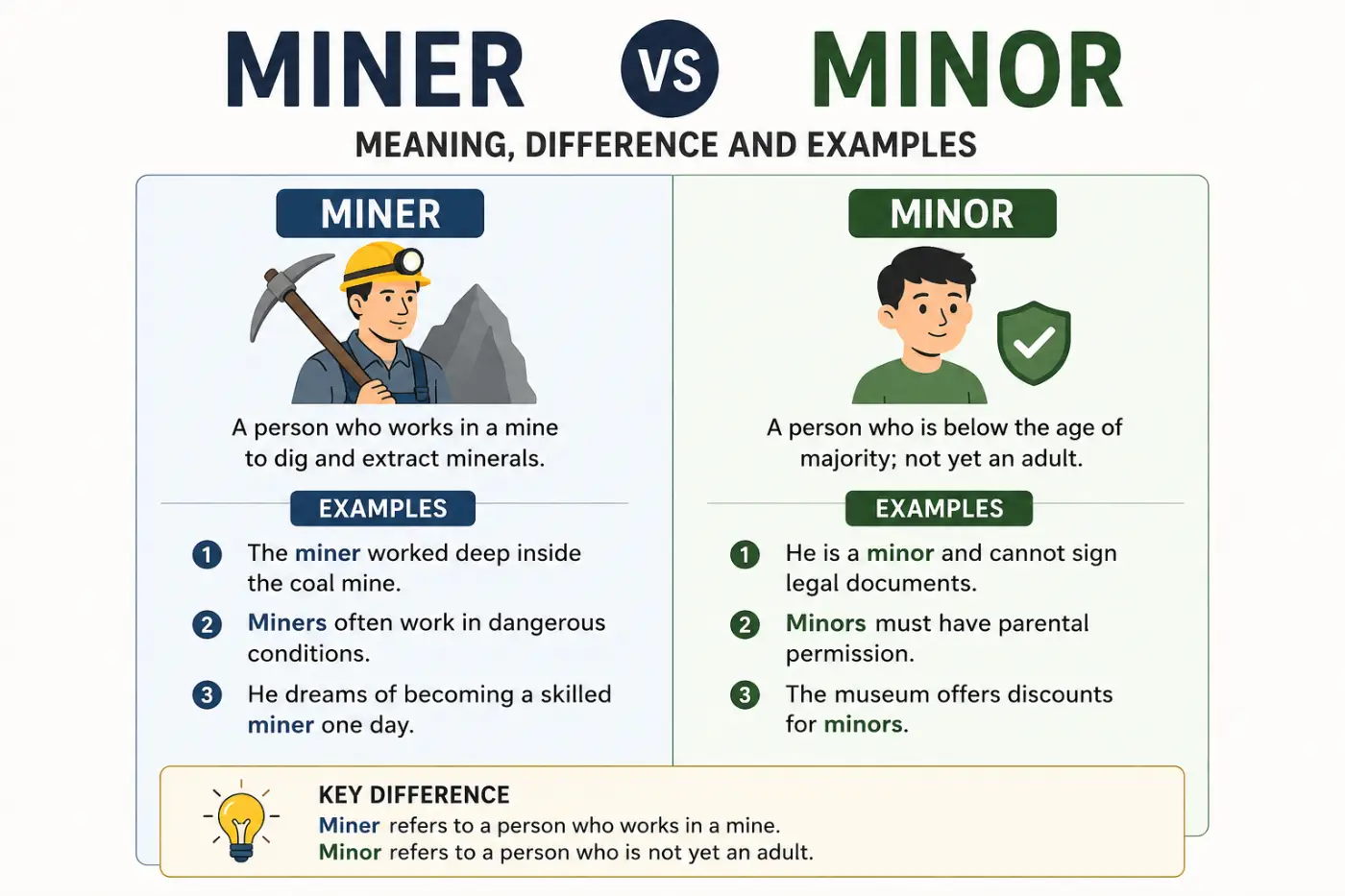
Miner vs minor is a common word confusion because the two words differ by just one letter. They also sound almost identical in American English, which makes it easy to choose the wrong spelling when writing quickly. However, their meanings are quite different. A miner works in a mine, while a minor can be a young person or something of lesser importance.
You might see both words in news stories, school assignments, workplace reports, legal documents, and everyday conversations. For example, a news report might describe a miner who was injured underground. A legal document might refer to a minor who needs a parent or guardian to sign a form. In another context, a writer might describe a small mistake as a minor error.
The good news is that you do not need to memorize complicated grammar rules to tell these words apart. Once you understand their meanings, recognize their common uses, and learn a simple memory trick, choosing the correct spelling becomes much easier. The examples below will help you use each word naturally and avoid common mistakes in American English.
Quick Answer
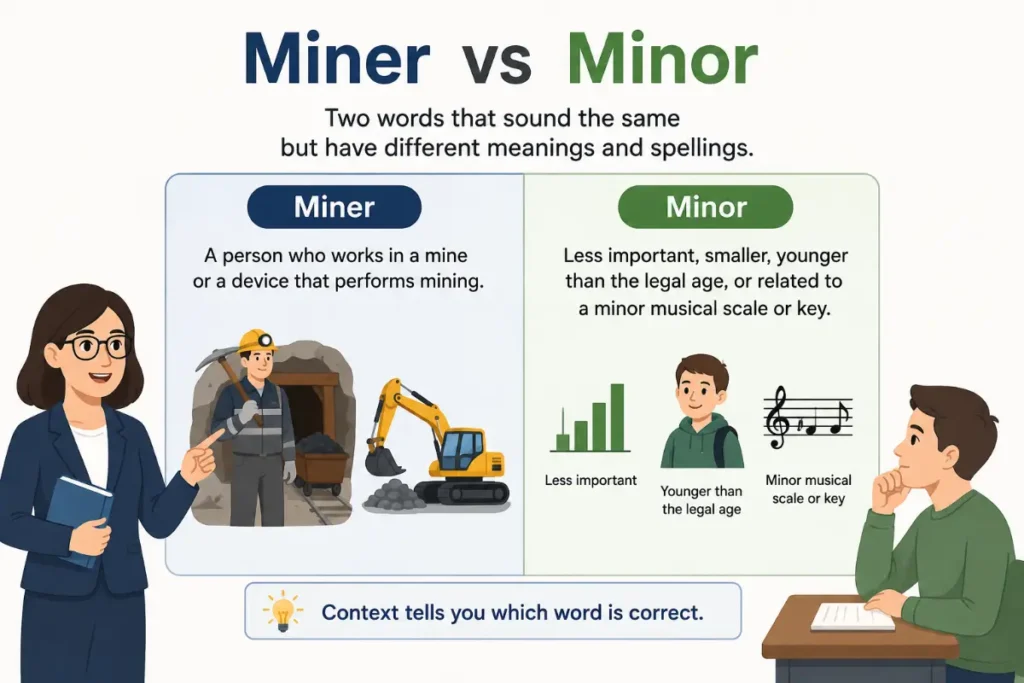
A miner is a person who works in a mine and extracts minerals, coal, or other natural resources. A minor is someone who has not reached the legal age of adulthood, or something that is small, less serious, or less important. Both words are correct, but they have different meanings. Choose the spelling that matches your intended meaning.
Comparison Table
| Feature | Miner | Minor |
|---|---|---|
| Main meaning | A person who works in a mine | A person below the legal age of adulthood or something of lesser importance |
| Part of speech | Noun | Noun and adjective |
| Pronunciation | Usually /ˈmaɪ.nɚ/ in American English | Usually /ˈmaɪ.nɚ/ in American English |
| Main context | Mining and natural resources | Law, age, music, education, and general descriptions |
| Common phrases | Coal miner, gold miner, mine worker | Minor child, minor injury, minor problem |
| Formality | Standard in everyday and professional English | Standard in everyday and professional English |
| Origin | Related to the word mine | From a Latin word meaning smaller or less |
| Example | The miner returned to the surface. | The minor needed parental consent. |
Meaning of Miner
A miner is a person who works in a mine or takes part in extracting natural resources from the earth. Miners may extract coal, gold, copper, iron ore, salt, diamonds, and other valuable materials. Their work can take place underground or at surface mining sites.
Mining supports many industries. Coal can be used to produce electricity and heat. Metals such as copper and iron are used in buildings, machinery, electrical systems, and transportation. Miners help obtain these resources so they can be processed and used.
The word usually refers to a worker involved in mining. It does not simply mean anyone who visits a mine or studies minerals. A geologist, for example, may study rocks and minerals without working as a miner.
Miner as a Noun
Miner is a countable noun. You can use it in the singular or plural form.
- The miner entered the tunnel early in the morning.
- Three miners helped repair the damaged equipment.
- Her grandfather worked as a coal miner for many years.
- The company hired another miner for the new project.
The plural form is miners. To make the plural, add the letter s.
Types of Miners
The word often appears with another word that identifies the resource being extracted or the type of work performed.
- Coal miner. A worker who extracts coal.
- Gold miner. A person who searches for or extracts gold.
- Diamond miner. A worker involved in extracting diamonds.
- Underground miner. A worker who mines below the surface.
- Surface miner. A worker involved in mining from the earth’s surface.
- Cryptocurrency miner. A person or organization that uses computing power to participate in certain blockchain networks. In systems such as Bitcoin, mining helps validate transactions and secure the network.
The last example has a specialized meaning. A cryptocurrency miner does not usually dig into the ground. The word refers to a computing process that shares some similarities with the idea of extracting something valuable.
How Miner Works in a Sentence
Miner usually functions as the subject or object of a sentence.
As a subject:
The miner checked his safety equipment before entering the mine.
As an object:
The rescue team located the trapped miner.
After a preposition:
The report described the conditions faced by miners.
In each example, the word refers to a person who performs mining work.
Meaning of Minor
Minor has several meanings. It can refer to a person who has not reached the legal age of adulthood. It can also describe something small, less serious, or less important than something else.
The exact meaning depends on the sentence.
Minor as a Person
In legal and everyday contexts, a minor is someone who has not reached the age at which the law recognizes them as an adult. In the United States, that age is generally 18, although specific rules and exceptions vary by state and by legal matter.
For example:
The minor needed a parent to sign the permission form.
Here, minor refers to a young person who has not reached the relevant legal age.
Other examples include:
- The school requires parental consent for minors attending the trip.
- A minor may need a guardian to complete certain legal documents.
- The court considered the child’s status as a minor.
- The event has special rules for minors.
The legal meaning matters because age requirements differ across activities and jurisdictions. A person may be treated as an adult for one purpose but face a different age requirement for another.
Minor as an Adjective
Minor is also an adjective. It describes something that is small, less serious, or less important compared with something else.
For example:
The driver reported a minor accident.
The adjective minor tells the reader that the accident was relatively limited in severity. It does not automatically mean that nobody was injured or that no damage occurred.
Other common examples include:
- She made a minor spelling mistake.
- The doctor treated a minor injury.
- We noticed a minor change in the schedule.
- The team fixed a minor technical problem.
- The editor suggested a few minor changes.
In these examples, minor describes the size, seriousness, or importance of the issue.
Minor in Education
In American colleges and universities, a minor is a secondary area of academic study. It usually requires fewer courses than a student’s major.
For example:
Maria is majoring in biology and minoring in chemistry.
Biology is her main field of study. Chemistry is her secondary area.
The exact requirements for a minor depend on the institution and its academic rules.
Minor in Music
In music, minor describes a type of scale, key, chord, or musical quality. Minor keys are often associated with a darker or more reflective sound, although the emotional effect depends on the music itself.
For example:
The song begins in A minor.
The word does not refer to a young person in this sentence. It describes the musical key.
Minor in Grammar and General Writing
Minor can also describe a point, detail, or issue that is not central to the main subject.
For example:
The writer made a minor adjustment to the final paragraph.
Here, minor signals that the change is limited rather than substantial.
The word is useful because it helps readers understand the relative importance of a detail without requiring a long explanation.
Key Differences Explained
The main difference comes down to meaning and grammatical function.
1. Spelling
Miner contains the letter e before the final r. Minor contains the letter o.
Miner has the spelling associated with mine. Minor has the spelling associated with the idea of something smaller or less important.
2. Meaning
Miner refers to a person who works in mining or, in specialized contexts, participates in a digital mining process.
Minor refers to a person below the applicable legal age of adulthood or describes something less serious or important.
3. Part of Speech
Miner is a noun.
Minor can function as a noun or an adjective.
For example:
The miner repaired the machine.
The word miner names a person.
The miner reported a minor injury.
In this sentence, miner is a noun and minor is an adjective describing the injury.
4. Context
Miner usually appears in discussions about mining, natural resources, mine safety, and cryptocurrency.
Minor appears in discussions about age, legal status, school, music, injuries, mistakes, and relative importance.
5. Pronunciation
In most standard American English speech, the two words are pronounced the same way. Their spelling and meaning differ, but their sound usually does not help you distinguish them.
6. Grammar
Miner usually needs a context related to a worker or mining activity.
Minor can appear before a noun as an adjective, as in minor problem, or stand alone as a noun, as in the minor signed the form.
7. Regional Usage
Both spellings are standard in American, British, Canadian, and Australian English. There is no major regional spelling difference between the two words.
Which Spelling Is Correct
Both miner and minor are correct English words. Neither is a misspelling of the other.
Use miner when referring to someone who works in a mine or performs mining activities.
Use minor when referring to a person below the relevant legal age or when describing something as relatively small or unimportant.
Consider these sentences:
Incorrect word choice: The company hired a minor to extract coal, when the writer actually means an adult mining worker.
The last sentence is not automatically grammatically wrong. A minor could legally or factually work in some mining related capacity under particular circumstances. The problem arises only if the writer intends to identify a mining worker but uses minor as the name of the occupation.
The correct choice depends on what you mean, not on which spelling is more common in a particular sentence.
Ten Natural Sentence Examples
The following examples show how both words work in different situations.
Examples With Miner
- The miner checked his helmet and flashlight before entering the tunnel.Miner identifies the worker entering the mine.
- My uncle worked as a coal miner before he retired.The word describes his occupation.
- Rescue workers searched for the missing miner throughout the night.Miner refers to the person who was missing underground.
- The gold miner discovered a small deposit near the river.Here, miner refers to someone extracting or searching for gold.
- The report examined the safety conditions faced by miners.The plural form refers to workers in the mining industry.
Examples With Minor
- The doctor said the cut was minor and would heal with proper care.Minor describes the injury as relatively limited in severity.
- The school requires a parent or guardian to sign the form for each minor attending the event.Minor refers to a young person below the applicable legal age.
- I found a minor error in the final paragraph of my essay.The adjective describes an error that is small or not central to the work.
- Daniel is majoring in business and pursuing a minor in psychology.In college, a minor is a secondary area of study.
- The composer changed the melody to move into a minor key.The word describes a musical key rather than a person or a small problem.
Common Mistakes and Misspellings
Because these words sound alike, writers sometimes choose one without checking the sentence’s meaning. These are the most common errors to watch for.
Mistake One: Using Minor for a Mining Worker
Incorrect for the intended meaning:
The minor entered the coal mine for his shift.
Correct:
The miner entered the coal mine for his shift.
The correction applies when the writer means a worker whose job involves mining. The original sentence could be grammatically valid if minor refers to an underage person who entered the mine, but it would communicate a different meaning.
Mistake Two: Using Miner for a Young Person
Incorrect for the intended meaning:
The miner needed his parent’s signature on the school form.
Correct:
The minor needed his parent’s signature on the school form.
The intended meaning concerns legal age, not a mining occupation.
Mistake Three: Confusing a Minor Problem With a Mining Problem
Incorrect for the intended meaning:
We found a miner error in the spreadsheet.
Correct:
We found a minor error in the spreadsheet.
Minor describes the size or importance of the error. Miner would suggest a person or a specialized mining related term.
Mistake Four: Assuming the Words Sound Different
Some writers expect the spelling difference to produce a different sound. In most American English accents, the words are homophones, so listening alone may not help.
To avoid the mistake, check the meaning of the sentence. Ask if the word refers to a worker, a young person, or something less serious.
Mistake Five: Treating Minor as Only a Noun
Incorrect:
The injury was a minor.
Correct:
The injury was minor.
When describing the injury, minor is an adjective and does not need an article. The phrase a minor is possible when the noun means a person below the relevant legal age, but it has a different meaning.
Quick Distinction By Context
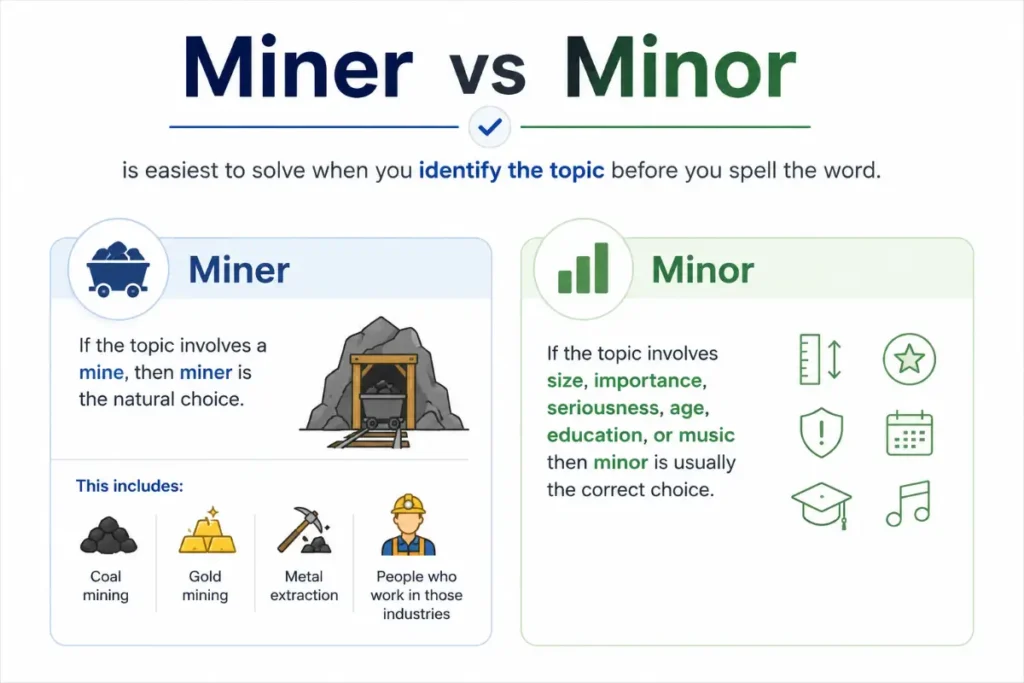
Miner vs Minor is easiest to solve when you identify the topic before you spell the word.
If the topic involves a mine then miner is the natural choice. This includes coal mining gold mining metal extraction and people who work in those industries.
If the topic involves size importance seriousness age education or music then minor is usually the correct choice.
Pronunciation Guide
Miner and minor are usually pronounced identically in standard American English.
Their common pronunciation is /ˈmaɪ.nɚ/.
A simple pronunciation guide is MY ner.
Both words have two syllables:
- First syllable: my.
- Second syllable: ner.
The stress falls on the first syllable. The final sound is the unstressed American English r colored vowel.
Because the two words sound the same for most American speakers, pronunciation is not a reliable way to decide which spelling belongs in a sentence.
For example, if someone says, “The miner was injured,” the spelling depends on the context. If the person was working underground, miner is appropriate. If the speaker means a young person, minor may be the intended word.
In writing, meaning is the best guide.
Etymology and Word Origin
The words have different histories, which helps explain why their meanings differ.
Origin of Miner
Miner comes from mine, the word for a place where people extract minerals or other resources. Mine entered English through French, with earlier roots in terms connected to digging and excavation. The occupational word miner developed from this base to describe a person who works in a mine.
That relationship makes the spelling easier to remember. A miner works in a mine.
Origin of Minor
Minor comes from Latin minor, meaning smaller or less. The word entered English through French and Latin influenced usage. Its central idea of being lesser or smaller remains visible in modern expressions such as minor problem, minor injury, and minor change.
The legal meaning developed around the distinction between a person who has reached adulthood and one who has not.
The musical meaning also reflects a separate established use of the word. In music theory, minor identifies a particular type of scale, key, or chord.
Although the two words sound alike, their histories and meanings are distinct.
Regional Usage
There is no major spelling difference between American and British English for these words. Both forms are standard in the United States, the United Kingdom, Canada, and Australia.
American English
In the United States, miner commonly refers to a worker in the mining industry. Minor is widely used in legal, educational, musical, and everyday contexts.
Examples include:
The miner returned to work after the safety inspection.
The student chose economics as a minor.
The doctor described the injury as minor.
British English
British English uses the same spellings and meanings.
Examples include:
The miner worked in the northern coalfield.
The court considered the rights of the minor.
The editor made a minor change to the report.
Canadian English
Canadian English also uses miner and minor with the same general meanings. Local laws determine the legal status and age requirements that apply to minors.
Australian English
Australian English follows the same distinction. Miner is used in the mining industry, while minor can refer to a young person or describe something less significant.
In all four varieties, context determines the correct word.
Grammar Rules and Part of Speech
Understanding grammar can help you identify the right spelling before you finish a sentence.
Miner as a Countable Noun
Miner is a countable noun, so it can take singular and plural forms.
Singular: The miner found a new passage.
Plural: The miners found a new passage.
You can also use articles and possessive forms.
A miner entered the tunnel.
The miner’s equipment was inspected.
The miners’ equipment was inspected.
The apostrophe in miner’s shows possession by one miner. The apostrophe in miners’ shows possession by more than one miner.
Minor as a Noun
When minor refers to a person below the applicable legal age, it is a countable noun.
A minor signed the form with a guardian present.
The minors attended the educational program.
A minor’s legal rights depend on the relevant jurisdiction and issue.
Minor as an Adjective
When minor describes something small or less important, it is an adjective.
A minor injury required treatment.
The editor made minor changes.
The team reported a minor delay.
Adjectives generally do not change form to agree with singular or plural nouns in English.
For example:
A minor problem.
Several minor problems.
Minor remains the same in both expressions.
Minor in College
In American academic writing, minor can be used as a noun or as a verb in the expression to minor in a subject.
Noun: Her minor is history.
Verb: She plans to minor in history.
The major is usually the student’s primary field of study, while the minor is a secondary field.
Punctuation and Capitalization
Neither word normally requires capitalization in the middle of a sentence. Both begin with a capital letter at the start of a sentence or in a title when title capitalization calls for it.
For example:
The miner reported the problem.
The minor signed the form.
Do not capitalize either word simply because it refers to a job, legal category, or academic subject.
Real Life Usage Examples
These examples show how the words appear in everyday communication and formal writing.
Daily Conversation
“My grandfather was a miner for thirty years.”
The speaker is describing a family member’s occupation.
“That was only a minor problem, so we fixed it quickly.”
The speaker is describing an issue that was not very serious.
Workplace Communication
“The mine manager asked every miner to complete the safety check.”
Miner identifies the workers responsible for the mining activity.
“The software update introduced a minor issue with the login screen.”
Minor describes a limited technical problem.
Academic Writing
“The historian examined the working conditions of miners during the industrial era.”
The word refers to people who worked in mines.
“Students can choose a minor that supports their main field of study.”
Minor refers to a secondary academic subject.
News and Journalism
“Rescue crews continued searching for the missing miner after the collapse.”
Miner identifies the person involved in the mining incident.
“The agency reported a minor delay in the release of the results.”
Minor describes a delay that was limited in scale or impact.
Literature and Storytelling
“The old miner told stories about the dangerous tunnels he had explored.”
Miner identifies a character by occupation.
“She dismissed the broken vase as a minor loss compared with the memories it held.”
Minor describes the loss as relatively small in importance.
Eight Related and Confused Terms
Learning related words can help you use the correct term more naturally.
1. Mine
A mine is a place where people extract minerals or other resources. A miner is someone who works in a mine.
Example: The miner returned to the mine before sunrise.
2. Mining
Mining is the activity or industry of extracting resources from the earth. It is related to miner but names the work rather than the worker.
Example: Mining provides materials used in construction and manufacturing.
3. Miner
Miner refers to a person who performs mining work. It is the occupational noun in this group.
Example: The miner inspected the equipment.
4. Minor
Minor can refer to an underage person or describe something less serious or important.
Example: The doctor treated a minor injury.
5. Adult
An adult is a person who has reached the age recognized as adulthood under the relevant law or social context. It contrasts with minor in many legal situations.
Example: The adult signed the contract independently.
6. Juvenile
Juvenile can refer to a young person, especially in legal or formal contexts. Its precise meaning depends on the area of law or subject being discussed.
Example: The report described the juvenile justice system.
7. Insignificant
Insignificant means too small or unimportant to have much effect or importance. It can sometimes replace minor, but the two words do not fit every sentence equally well.
Example: The change was insignificant and did not affect the final result.
8. Major
Major can mean important, large, or more significant. In education, it refers to a student’s primary field of study. It often contrasts with minor.
Example: Engineering is her major, and mathematics is her minor.
These terms are useful because they help establish the intended meaning. Mine, mining, and miner belong to the same occupational family. Minor, adult, juvenile, insignificant, and major belong to different meaning groups that can overlap depending on context.
Writing Tips For Professionals
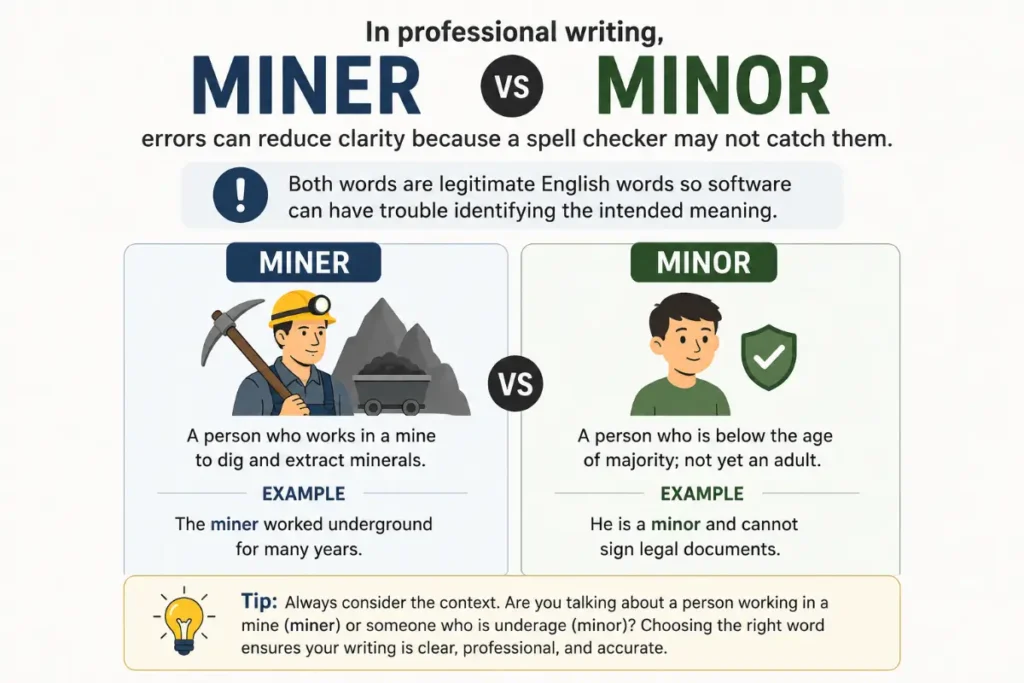
In professional writing Miner vs Minor errors can reduce clarity because a spell checker may not catch them. Both words are legitimate English words so software can have trouble identifying the intended meaning.
Proofread homophones by checking the meaning of the full sentence. This is especially useful in reports emails academic papers legal documents medical writing and technical content.
Expert Editor Insight
An experienced editor does not choose between these words by looking only at their spelling or sound. The editor checks the sentence’s meaning and grammatical role first. If the sentence concerns someone extracting coal or gold, miner is the right choice. If it concerns age, a small problem, or a secondary subject of study, minor is usually correct. Spelling tools may accept both words because both are legitimate English terms, so a grammar checker may not catch a wrong word choice. Reading the full sentence for meaning is often the best final check.
Key Takeaways
- Miner refers to a person who works in a mine or performs mining related work.
- Minor can refer to a person below the relevant legal age of adulthood.
- Minor is also an adjective meaning small, less serious, or less important.
- Both words are correctly spelled and standard in English.
- In most American accents, the words are pronounced the same way.
- Miner is a noun, while minor can function as a noun or an adjective.
- The spellings and meanings remain broadly consistent in American, British, Canadian, and Australian English.
- Context is the best way to choose the right word.
Conclusion
Miner and minor are both correct English words, but they serve different purposes. A miner works in a mine or takes part in mining activities. A minor is someone below the applicable legal age of adulthood or something that is small, less serious, or less important. The two words usually sound alike in American English, so pronunciation alone will not help you choose the spelling.
Remember this simple rule: a miner works in a mine, while a minor may be a young person or a small matter. Before submitting an assignment, email, or report, check the meaning of the full sentence. That quick review can prevent a small spelling choice from creating a much larger misunderstanding.
FAQs
Is miner or minor the correct spelling?
Both are correct spellings. Miner refers to a person who works in a mine or performs mining related work. Minor refers to a person below the applicable legal age of adulthood or describes something smaller or less serious. The correct choice depends on the meaning you want to express.
Is minor a real English word?
Yes. Minor is a standard English word used as both a noun and an adjective. It can refer to a young person who has not reached the relevant legal age, a secondary academic subject, or something of lesser importance. It also has an established meaning in music theory.
What does miner mean?
A miner is a person who extracts resources such as coal, gold, or other minerals from the earth. The term can describe workers in underground or surface mining. In technology, cryptocurrency miner refers to a person or system participating in certain blockchain mining processes.
Are miner and minor pronounced the same?
In most standard American English accents, the two words are pronounced the same way, as /ˈmaɪ.nɚ/. Both have two syllables with stress on the first syllable. Because their pronunciation is usually identical, you need to rely on meaning and context to choose the correct spelling.
Can minor be used as an adjective?
Yes. Minor is commonly used as an adjective to describe something small, less serious, or less important. Examples include minor injury, minor change, minor error, and minor delay. It can also describe a secondary field of study in college, depending on how the sentence is structured.
What is the difference between a minor and a juvenile?
A minor is a person who has not reached the applicable legal age of adulthood. Juvenile is another term for a young person, especially in legal or formal settings. The terms can overlap, but juvenile has specific uses in areas such as juvenile justice. Their exact legal meanings depend on the jurisdiction.
Is miner used only for coal workers?
No. Miner can refer to workers who extract many types of resources, including coal, gold, copper, salt, and diamonds. It can also refer to people who participate in cryptocurrency mining. The specific resource or activity usually becomes clear from the surrounding words.
Why do people confuse miner and minor?
People confuse the words because they have almost identical spellings and usually sound the same in American English. Spellcheckers may accept both, even if one does not fit the sentence. The easiest solution is to identify the intended meaning before choosing the spelling.
