
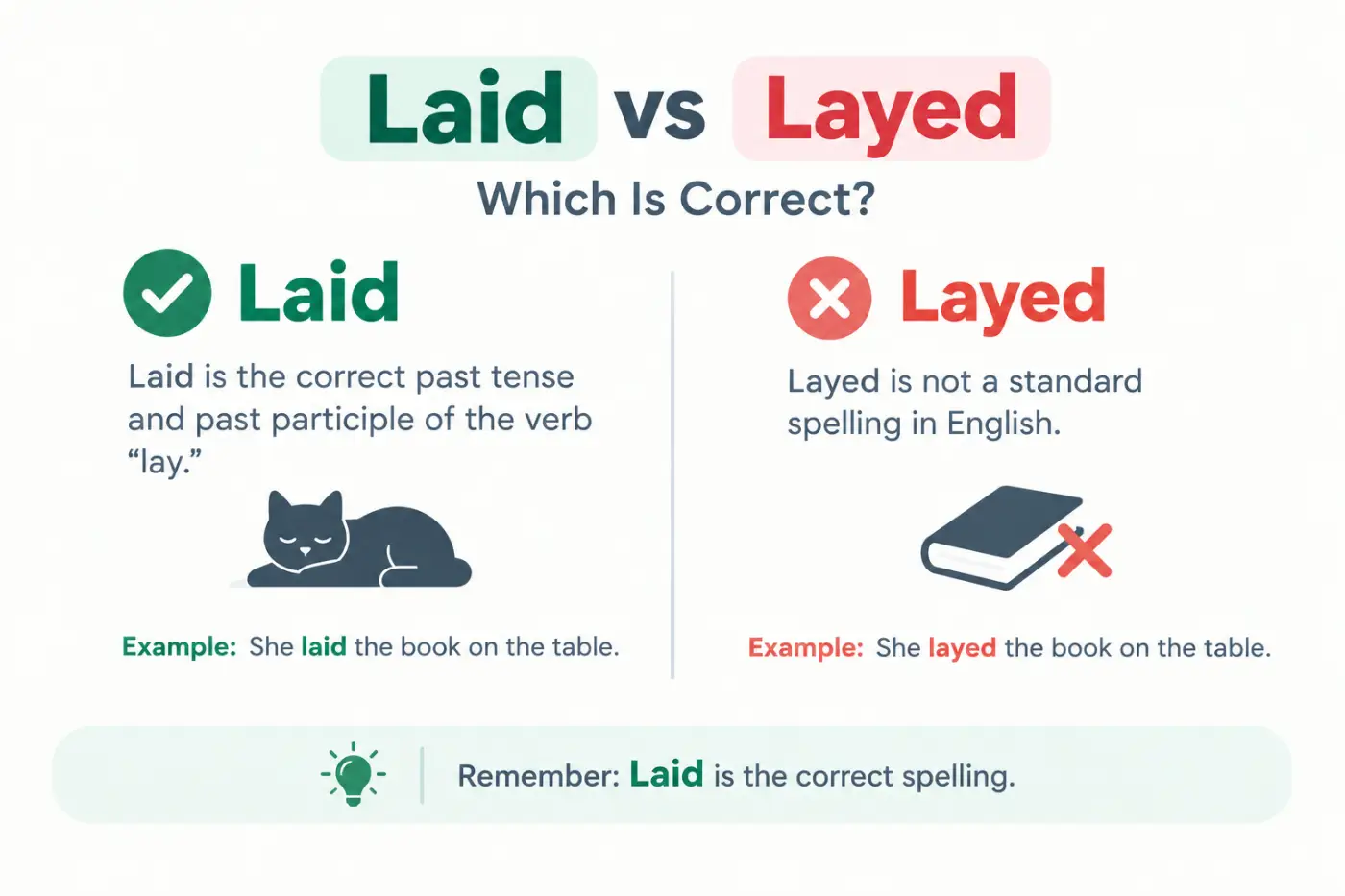
If you are unsure about laid or layed, you are dealing with one of English’s most common verb form problems. The correct spelling is laid when you mean the past form of lay, as in, “She laid the book on the table.” The form layed is not the standard past tense of this verb.
The confusion makes sense because many English verbs form the past tense by adding ed. A learner may naturally think that lay becomes layed, just as play becomes played. English does not follow that pattern here. The verb lay changes to laid in both its simple past and past participle forms.
There is another reason this topic causes trouble. The verb lie, meaning to rest or remain in a horizontal position, has lay as its past tense and lain as its past participle. That creates a small family of forms that look and sound alike. Once you separate their meanings and grammatical jobs, the pattern becomes much easier to remember.
Quick Answer
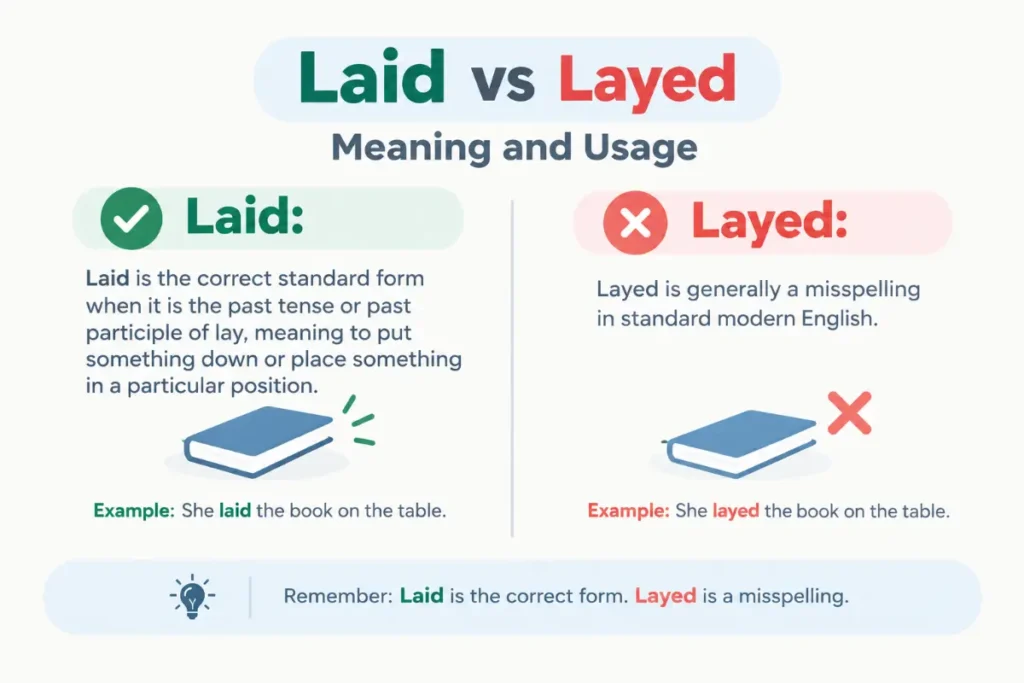
Laid is the correct standard form when it is the past tense or past participle of lay, meaning to put something down or place something in a particular position. Layed is generally a misspelling in standard modern English. The confusion often comes from regular verbs that form their past tense by adding ed, while lay uses the irregular form laid.
The Correct Form
The standard past tense and past participle of lay are both laid. Dictionaries list laid as the form used after the present form lay. Cambridge and Oxford both identify this pattern.
The basic pattern is:
- Present: lay.
- Simple past: laid.
- Past participle: laid.
- Present participle: laying.
For example:
- I lay the papers on the desk every morning.
- I laid the papers on the desk yesterday.
- I have laid the papers on the desk already.
- I am laying the papers on the desk now.
The spelling stays consistent in the past tense and past participle. You do not add ed to create layed.
Meaning And Definition
The verb lay usually means to put something or someone in a particular position. It often suggests placing something down carefully or intentionally. Cambridge describes it as putting something in a flat or horizontal position, while Oxford gives the broader idea of putting somebody or something in a particular position.
For example:
- She laid the blanket on the floor.
- He laid his phone beside the computer.
- They laid the child gently on the bed.
- We laid the documents on the table.
In each sentence, someone places something somewhere. That is the central meaning of the verb.
The verb also has several related meanings.
You can lay a foundation, lay a cable, lay a table, lay an egg, lay blame, lay charges, or lay the groundwork for something. The meaning changes with the context, but the past form remains laid. Cambridge lists these uses along with the standard past and past participle form.
For example:
- The workers laid the cables under the road.
- The team laid the foundation for the new building.
- The manager laid the blame on poor planning.
- The hen laid three eggs.
- The negotiations laid the groundwork for an agreement.
Comparison Table
| Form | Meaning | Part of Speech | Grammar | Standard Usage | Example |
|---|---|---|---|---|---|
| Lay | Put something in a position | Verb | Present tense | Standard | I lay the book on the desk. |
| Laid | Put something in a position in the past | Verb | Simple past | Standard | I laid the book on the desk. |
| Laid | Used with have, has, or had | Verb | Past participle | Standard | She has laid the book there. |
| Laying | Putting something in a position | Verb | Present participle | Standard | She is laying the book down. |
| Layed | Intended as the past form of lay | Verb form | Nonstandard in standard English | Usually incorrect | She layed the book down. |
| Lie | Rest or remain in a position | Verb | Present tense | Standard | I lie on the sofa. |
| Lay | Rested or remained in a position | Verb | Past tense of lie | Standard | I lay on the sofa yesterday. |
| Lain | Rested or remained in a position | Verb | Past participle of lie | Standard | I have lain on the sofa all afternoon. |
Why Laid Is Correct
The main reason is simple. Lay is an irregular verb in this sense. Its past form is not created by adding ed.
The standard forms are:
lay → laid → laid
This pattern is similar to other irregular verbs that change form instead of taking the ordinary ed ending.
For example:
- go becomes went.
- take becomes took.
- see becomes saw.
- write becomes wrote.
- lay becomes laid.
You cannot assume that every English verb follows the same past tense pattern. The spelling layed may look logical, but standard English uses laid for the past tense and past participle of this verb. Cambridge specifically notes the spelling as laid not layed.
Lay And Laid Grammar
The easiest way to understand the grammar is to focus on what happens to the object.
The verb lay normally takes an object. In simple terms, someone lays something.
You can lay a book.
You can lay flowers on a grave.
That object requirement is one of the most useful clues for separating lay from lie. Cambridge and Oxford both explain that lay takes an object, while lie does not.
Compare these sentences:
- She laid the baby on the bed.
- The baby lay on the bed.
In the first sentence, she puts the baby on the bed. The baby is the object of laid.
In the second sentence, the baby is simply in a resting position. There is no object receiving the action.
This difference is more important than memorizing isolated verb forms because it helps you choose the right verb while writing.
The Difference Between Lay And Lie
Many people search for the correct form because they are actually mixing up two different verbs.
The verb lay means to put something down. The verb lie means to rest or remain in a particular position.
Their forms are different.
Lay
The pattern is:
- Present: lay.
- Past: laid.
- Past participle: laid.
- Present participle: laying.
Example:
I lay the keys on the table every evening.
Yesterday, I laid the keys on the table.
I have laid the keys on the table.
Lie
The pattern is:
- Present: lie.
- Past: lay.
- Past participle: lain.
- Present participle: lying.
Example:
I lie on the sofa after work.
Yesterday, I lay on the sofa after work.
I have lain on the sofa for an hour.
Oxford gives the same pattern for lie, with lay as its past tense and lain as its past participle.
This creates a memorable but tricky sequence:
lay, laid, laid
means put something somewhere.
lie, lay, lain
means rest or remain somewhere.
Once you learn these two patterns separately, the confusion drops sharply.
Why People Write Layed
The spelling layed usually comes from a regular verb pattern being applied to an irregular verb.
For many verbs, adding ed creates the past tense.
Play becomes played.
Clean becomes cleaned.
Open becomes opened.
Work becomes worked.
A learner may therefore reason that lay should become layed. The problem is that English verbs do not all follow one simple formula.
The form laid must be learned as the established past form of lay.
There is also a second source of confusion. People sometimes remember that lay is a past tense form, but forget that it belongs to lie in that use.
For example:
Yesterday, I lay on the couch.
Some writers then try to turn that form into a regular verb and produce layed. That creates another error.
The correct sequence is:
lie → lay → lain
not:
lie → layed
The difference is small on the page but important in standard grammar.
Which Form Is Correct
If you mean the past tense of lay, use laid.
Correct:
She laid the keys on the counter.
Incorrect:
She layed the keys on the counter.
If you mean that someone rested or remained in a horizontal position, you may need lay because lay is the past tense of lie.
Correct:
She lay on the couch all afternoon.
Incorrect:
She laid on the couch all afternoon.
The second sentence is a common grammar mistake in standard English because laid needs an object when it is the past form of lay. Cambridge explains that the verb meaning put something down takes an object.
So the key question is not simply, “Is this past tense?” Ask what the verb means.
If someone puts something somewhere, use laid for the past.
If someone rests somewhere, use lay for the past.
Sentence Examples
Here are natural examples showing the standard use of laid.
- She laid the keys on the kitchen counter before leaving the house.
The person actively placed the keys on the counter.
- He laid his jacket over the back of the chair.
He moved the jacket into a particular position.
- The nurse laid the patient gently on the bed.
The nurse placed the patient on the bed.
- We laid the documents on the manager’s desk.
The documents were deliberately placed on the desk.
- The workers laid new cable beneath the street.
The workers installed the cable in a planned position.
- The farmer laid fresh straw inside the animal shelter.
The straw was placed inside the shelter.
- She had laid the foundation for the project months earlier.
Here the verb is being used figuratively. The project had been prepared or established earlier.
- The company laid the groundwork for a major expansion.
The expression means that the company created the conditions needed for the future plan.
- The bird laid two eggs in the nest.
Here lay means to produce eggs. The past form is still laid.
- The attorney argued that the evidence had laid the basis for further investigation.
The verb refers to establishing or creating a foundation for something.
These examples show why laid is useful beyond the simple meaning of putting an object down. It appears in everyday speech, professional writing, technical contexts, and established expressions.
Examples With Lay
The present form lay can describe a current or repeated action.
- I lay the book on my desk every night.
- We lay fresh towels in the guest room before visitors arrive.
- The workers lay the pipes beneath the road.
- The hens lay eggs regularly.
The word can also appear in instructions.
Lay the papers on the table.
Lay the blanket on the floor.
These are commands, so the base form lay is correct.
Examples With Laying
The ing form is laying, not laying with any spelling change beyond the normal form.
For example:
- She is laying the plates on the table.
- They are laying new flooring this week.
- The workers are laying cables underground.
- The bird is laying eggs.
Notice that laying does not become layeing or another modified form. The spelling follows the standard present participle of the verb.
Cambridge and Oxford both list laying as the present participle of lay.
Examples With Lain
Lain belongs to lie, not lay.
This form is the past participle of lie when the meaning is to rest or remain in a position.
For example:
- She has lain awake all night.
- The dog had lain beside the fireplace for hours.
- He had lain on the beach until sunset.
- The book had lain untouched on the shelf for months.
Oxford identifies lain as the past participle of lie.
This distinction matters because some writers use laid when they need lain.
Incorrect:
He had laid on the bed all morning.
Correct:
He had lain on the bed all morning.
The person did not put something down. The person rested on the bed.
Common Mistakes
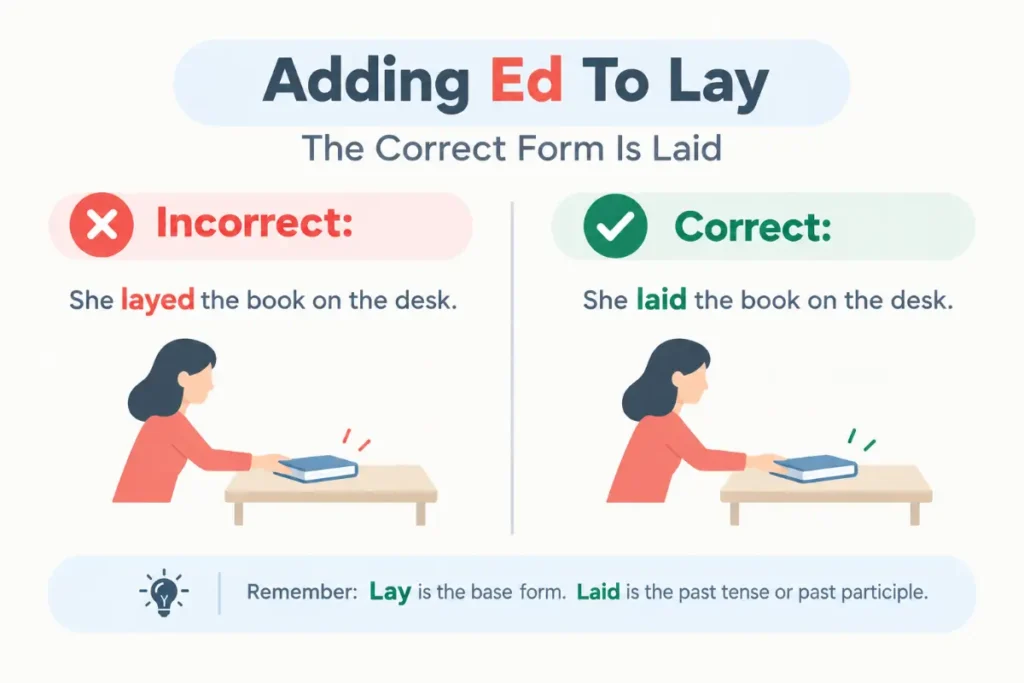
Adding Ed To Lay
Incorrect:
She layed the book on the desk.
Correct:
She laid the book on the desk.
The mistake comes from treating an irregular verb as a regular verb.
Using Laid Without An Object
Incorrect:
I laid on the sofa.
Correct:
I lay on the sofa.
If you mean that you rested on the sofa, the verb is lie, whose past form is lay.
Using Lay Instead Of Laid
Incorrect:
Yesterday, I lay the clothes on the bed.
Correct:
Yesterday, I laid the clothes on the bed.
The action is placing the clothes somewhere, so the past form of lay is needed.
Using Laid Instead Of Lain
Incorrect:
She had laid there for hours.
Correct:
She had lain there for hours.
The sentence describes remaining in a position, so lain is the past participle of lie.
Assuming Similar Sound Means Similar Grammar
English has many words that sound closely related but behave differently. The solution is to focus on meaning and grammatical function rather than sound alone.
If the action involves putting something somewhere, use lay and its forms.
If the action describes resting or remaining somewhere, use lie and its forms.
Pronunciation Guide
The word lay is pronounced /leɪ/. It has one syllable and uses the same vowel sound found in words such as day and say. Cambridge lists the American pronunciation as /leɪ/.
The word laid is pronounced /leɪd/. It also has one syllable.
A simple pronunciation guide is:
- Lay sounds like “lay.”
- Laid sounds like “layd.”
The pronunciation of layed, if someone writes it as a nonstandard form, does not solve the grammar problem. The standard written form is laid.
The word lie is pronounced /laɪ/, with the vowel sound found in words such as my and high. Oxford gives /laɪ/ for the verb lie.
The word lain is pronounced /leɪn/. Oxford gives /leɪn/ for the past participle of lie.
These pronunciation differences can help you keep the forms apart.
Etymology And Word Origin
The verb lay has a long history in English and is related to older Germanic verbs meaning to put or place. The modern forms developed through changes in English over many centuries.
The important point for modern writers is not the full historical path but the survival of the irregular form laid. English inherited many irregular verbs from older stages of the language, and their forms do not always follow the simple modern pattern of adding ed.
The related verb lie also has an old Germanic history, but it developed its own pattern of forms. Modern English therefore has two closely related looking verbs with different grammatical systems.
That historical development helps explain why the forms seem less predictable than regular verbs.
Regional Usage
American English
In American English, laid is the standard past tense and past participle of lay. The same form is used for meanings such as putting something down, preparing something, producing eggs, and establishing a foundation. Cambridge’s American Dictionary gives laid as both the past tense and past participle.
American English also uses lay as the past tense of lie.
For example:
I lay down for a few minutes.
That sentence is standard because the person rested.
British English
British English follows the same basic distinction.
The past and past participle of lay are laid.
The past tense of lie is lay, and its past participle is lain.
Cambridge’s British English grammar explanation gives the same distinction between these verbs.
Canadian And Australian English
Standard Canadian and Australian English also follow the same basic verb forms. There is no major regional spelling rule that turns laid into layed.
The confusion is therefore not mainly an American versus British spelling issue. It is a grammar and verb form issue that can affect English users across regions.
Grammar Rules And Part Of Speech
The word lay can have several grammatical roles, but this article focuses on the verb meaning to put something somewhere.
As a verb, it is transitive. That means it normally takes a direct object.
For example:
She laid the book on the table.
The direct object is the book.
You can ask, “What did she lay?” The answer is the book.
This test is useful because it separates lay from lie.
Compare:
She laid the book on the table.
She lay on the table.
In the first sentence, the book receives the action.
In the second sentence, the person simply occupies a position.
Oxford specifically notes that lay takes an object while lie does not.
There is one complication. Lay can have other meanings and uses, so the presence of an object alone is not enough to explain every possible use. Still, for the common confusion involving resting and placing, this grammar test is extremely useful.
Real Life Usage
Daily Conversation
People often use these verbs when talking about ordinary actions.
- I laid my phone on the table and forgot about it.
- She lay down for a few minutes after lunch.
The first sentence describes placing an object. The second describes resting.
Workplace Communication
Professional writing often uses laid in phrases connected with planning and preparation.
- The team laid the groundwork for the new project.
- The company laid out a clear plan for the next quarter.
The first example uses laid in a figurative sense. The second uses the related phrase laid out to describe presenting or arranging information.
Academic Writing
Academic and formal writing can also use the verb in abstract contexts.
- The study laid the foundation for later research.
- Earlier findings laid the basis for the new theory.
In these examples, the verb does not describe physically placing an object. It describes establishing a foundation or basis.
News Writing
News reports frequently use laid in established expressions.
- Investigators said the evidence laid the groundwork for further action.
- Officials said the new policy laid the foundation for future reforms.
The form remains laid even when the meaning is figurative.
Storytelling
Narrative writing often uses the verb in physical descriptions.
- She laid the letter beside the lamp.
- He had laid the photograph carefully inside the box.
These examples show how naturally the past form appears in storytelling.
Related And Confused Terms
Lie
Lie means to rest or remain in a position. Its past tense is lay, and its past participle is lain.
Example:
The dog lay beside the door.
Lay
Lay means to put something somewhere. Its past tense and past participle are laid.
Example:
She laid the keys beside the door.
Lain
Lain is the past participle of lie.
Example:
The dog had lain beside the door all night.
Laying
Laying is the present participle of lay.
Example:
She is laying the books on the shelf.
Lying
Lying is the present participle of lie when the meaning is resting or remaining in a position.
Example:
The dog is lying beside the door.
Laid Off
Laid off is a common expression meaning that a worker’s employment ended because the employer no longer had work or needed that position. It is not connected to the spelling mistake layed.
Example:
The company laid off several workers.
Laid Back
Laid back describes someone who is relaxed and easygoing.
Example:
His laid back attitude makes him easy to work with.
Laid Out
Laid out can mean arranged or presented clearly.
Example:
The report laid out the main findings.
These related forms are useful because they reinforce the correct spelling pattern. Once you recognize laid in common expressions, the incorrect layed starts to look noticeably wrong.
How To Remember The Difference
A simple memory trick is to connect lay with an object.
You lay something.
You have laid something.
For example:
- I lay the book down.
- I laid the book down yesterday.
- I have laid the book down already.
Now compare that pattern with lie.
You lie down.
You have lain down already.
This creates a useful three word memory chain:
Lay means put. Laid means put in the past. Lie means rest.
Another helpful trick is to remember that laid contains the extra d.
If you are describing a completed action of putting something somewhere, think of the d as a reminder that the action happened in the past.
This is not a grammatical rule. It is simply a memory aid.
A Simple Editing Test
When editing your writing, do not look only at the spelling. Check the meaning first.
Ask yourself these three questions.
- Am I putting something somewhere?
If yes, the verb is lay in the present or laid in the past.
- Am I resting or remaining somewhere?
If yes, the verb is lie in the present, lay in the past, or lain after a helping verb such as have or had.
This quick test catches most errors.
For example:
Yesterday, I lay the folder on my desk.
Ask what happened. The folder was placed on the desk. That means the correct form is:
Yesterday, I laid the folder on my desk.
Now consider:
Yesterday, I lay on my desk.
That sentence means the speaker rested on the desk. The verb is lie, and lay is its past tense.
The meaning changes the verb.
When Layed Appears In Writing
You may occasionally see layed in online posts, informal writing, learner writing, or text that has not been carefully edited. Seeing it does not make it the standard past form.
In standard modern English, writers should use laid for the past tense and past participle of lay. Cambridge explicitly identifies laid not layed as the correct spelling.
There can be unusual uses of words in specialized names, creative writing, or other contexts, but those do not change the standard grammar rule. If you are writing an email, essay, report, article, application, or professional document, laid is the safe standard choice for the past form of lay.
Expert Editor Insight
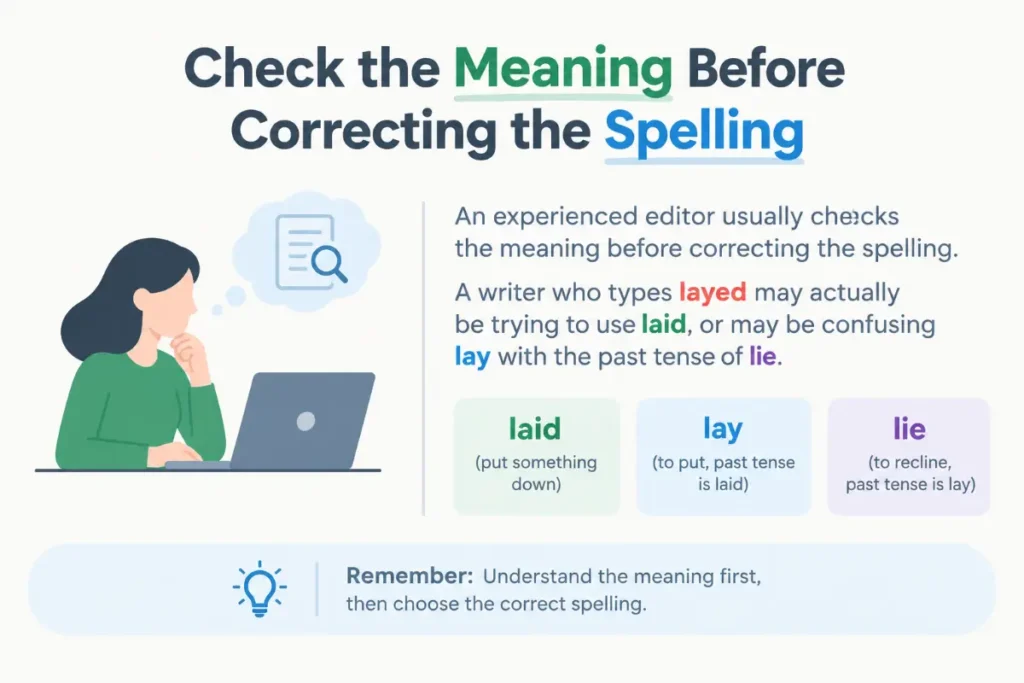
An experienced editor usually checks the meaning before correcting the spelling. A writer who types layed may actually be trying to use laid, or may be confusing lay with the past tense of lie. That is why a simple spelling correction is sometimes not enough. Good editing checks the whole verb pattern and the object of the verb. Grammar tools can catch the spelling layed, but they may not always understand the intended meaning, so the writer still needs to read the sentence in context.
The Fastest Way To Get It Right
If you need the answer while writing, remember this:
Lay means put something down.
Laid is the past form of lay.
Lie means rest or remain.
Lay is the past form of lie.
Lain is the past participle of lie.
Here is the complete pattern.
| Meaning | Present | Past | Past Participle | Present Participle |
|---|---|---|---|---|
| Put something somewhere | lay | laid | laid | laying |
| Rest or remain | lie | lay | lain | lying |
This table is worth memorizing because it solves the larger problem rather than just one spelling question.
Conclusion
The correct form is laid when you need the past tense or past participle of lay, meaning to put or place something somewhere. Layed is generally a misspelling in standard English. The bigger challenge is separating lay from lie, because lay is also the past tense of lie.
Remember the two patterns: lay, laid, laid means put something somewhere, while lie, lay, lain means rest or remain. When editing your sentence, first ask what action you mean and then choose the verb form. That simple check is more reliable than trying to remember the spelling in isolation.
FAQs
Is layed a real word?
In standard modern English, layed is not the accepted past tense or past participle of lay. The standard form is laid. If you mean that someone put something somewhere, write laid. For example, “She laid the book on the table.”
What is the past tense of lay?
The past tense of lay, meaning to put or place something, is laid. The past participle is also laid. The pattern is lay, laid, laid. For example, “He laid the papers on the desk yesterday” and “He has laid the papers on the desk.”
Is laid the past tense of lie?
No. Lay is the past tense of lie. The past participle of lie is lain. For example, “I lie on the sofa every evening,” “I lay on the sofa yesterday,” and “I have lain on the sofa for an hour.”
Why do people write layed?
People often write layed because many English verbs form their past tense by adding ed. They may also confuse the verb lay with lie, whose past tense is lay. Standard English uses laid as the past form of lay.
How do you pronounce laid?
Laid is pronounced /leɪd/. It has one syllable. The vowel sound is the same basic sound found in lay, with a final d sound added. The word lay is pronounced /leɪ/ in standard American English.
Should I say I laid down or I lay down?
It depends on the meaning and the structure. If you mean that you rested, the standard past form of lie is lay, so “I lay down” is correct. If you put something down, use laid, as in “I laid the book down.”
Is laid used in formal writing?
Yes. Laid is the standard form in formal and informal English. It appears in ordinary sentences as well as professional, academic, technical, and literary writing. Expressions such as laid the groundwork, laid the foundation, and laid the evidence before the court are all standard uses.
What is the easiest way to remember lay and laid?
Connect lay with putting something somewhere. The pattern is lay, laid, laid. Connect lie with resting somewhere. The pattern is lie, lay, lain. If you remember those two patterns and check the meaning of the sentence, most mistakes become easy to spot.
