
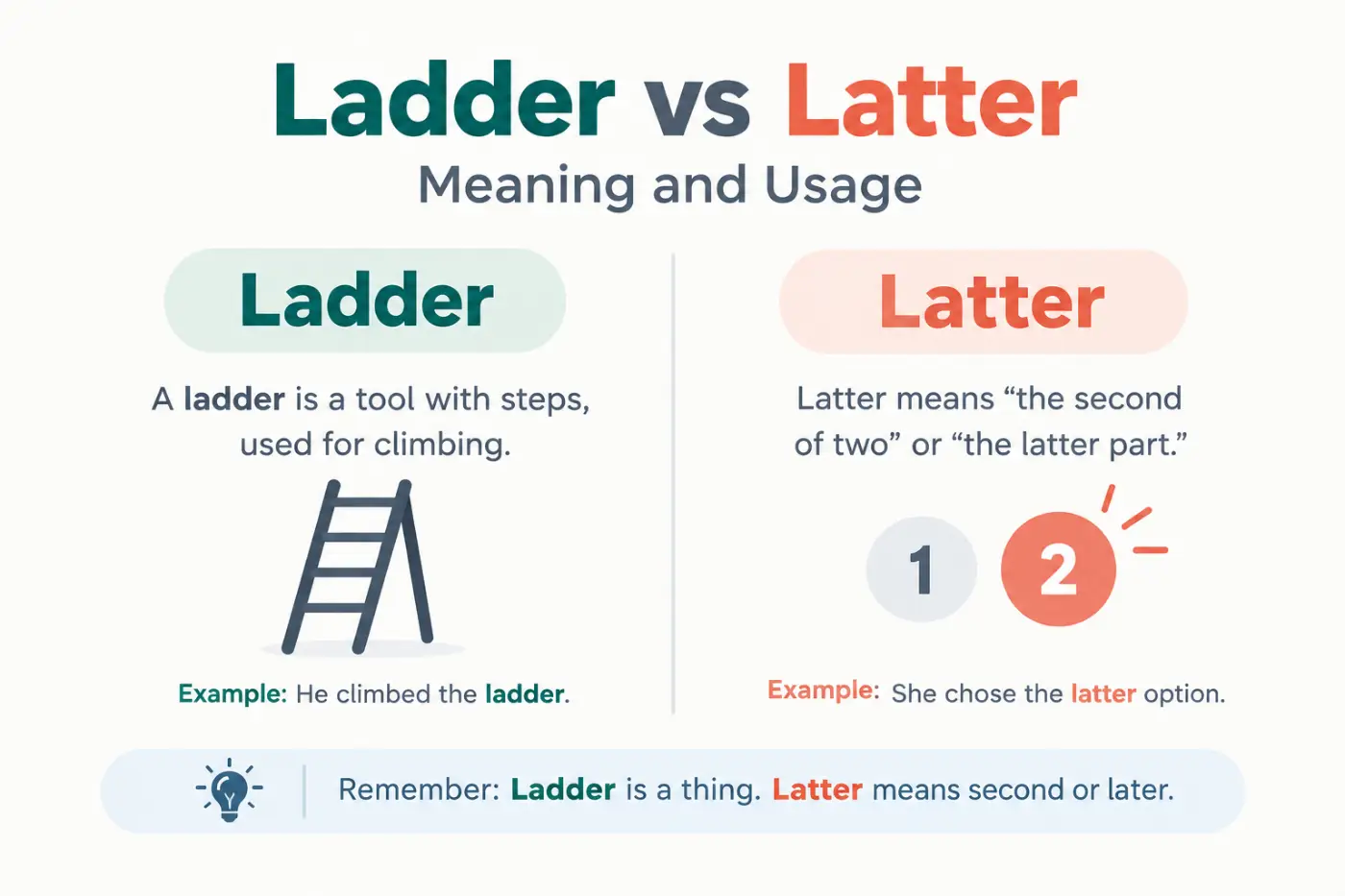
Ladder vs latter causes confusion because the words look and sound very similar, but they have completely different meanings. A ladder is something you can climb, while latter is a word used to point back to the second of two choices or to describe something near the end of a period.
The difference becomes clear when you look at the sentence around the word. If someone is painting a wall and needs something to reach a high window, they need a ladder. If someone compares tea and coffee and says they prefer the latter, they mean coffee because it was mentioned second.
The good news is that you don’t need a complicated grammar rule to choose correctly. You only need to connect each spelling with its main meaning. This guide explains the definitions, parts of speech, pronunciation, common phrases, grammar patterns, real life examples, common mistakes and an easy memory trick that will help you use both words with confidence.
Quick Answer
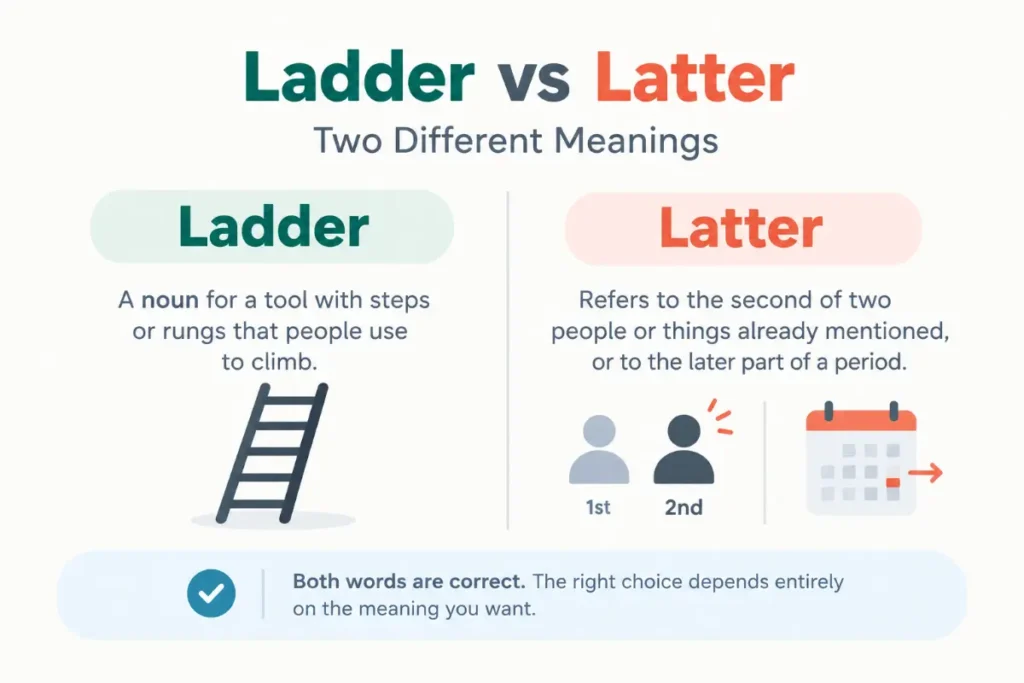
Ladder is a noun for a tool with steps or rungs that people use to climb. Latter refers to the second of two people or things already mentioned, or to the later part of a period. Both words are correct. The right choice depends entirely on the meaning you want.
What Ladder Means
Ladder is mainly a noun. Its most common meaning is a piece of equipment used for climbing up or down. A typical ladder has two long vertical sides with horizontal steps called rungs.
For example:
- The painter climbed the ladder to reach the ceiling.
- Please move the ladder away from the window.
- I left the ladder in the garage.
- The old ladder needs to be replaced.
In each sentence, ladder refers to physical equipment.
The word can also have a figurative meaning. It can describe a series of stages that lead toward a higher position, level, or goal.
For example:
- She climbed the corporate ladder quickly.
- He hopes to move up the career ladder.
- The company gave young employees a chance to climb the management ladder.
In these expressions, nobody is literally climbing a set of steps. The word creates an image of moving from one level to another.
This figurative use is common in business and everyday English. Cambridge Dictionary also recognizes ladder as a way to describe a series of increasingly important jobs or stages in a process.
What Latter Means
Latter has two closely related uses.
First, it can refer to the second of two people, things, or groups that have already been mentioned.
For example:
- We can travel by train or bus. I prefer the latter.
The sentence mentions train first and bus second. Therefore, latter refers to bus.
Second, latter can describe something near or toward the end of a period.
For example:
- The latter part of the year was unusually busy.
- Sales improved during the latter stages of the project.
- The latter half of the book was more exciting.
Here latter does not mean the second item in a pair. It means the later or final part of a particular period or sequence.
This second use is especially common in formal writing. It often appears in phrases such as latter half, latter part, latter stages, and latter years.
Ladder vs Latter At A Glance
| Word | Part of Speech | Main Meaning | Common Context | Example |
|---|---|---|---|---|
| Ladder | Noun | Equipment used for climbing | Home, work, construction | He climbed the ladder. |
| Ladder | Noun | A series of levels or stages | Career, business, society | She moved up the corporate ladder. |
| Latter | Adjective | Near the end of a period | Time and stages | The latter part was difficult. |
| Latter | Noun | The second of two things mentioned | Comparisons and choices | I prefer the latter. |
The simplest distinction is this.
Ladder is something you can climb.
Latter points to something that came second or something near the end.
The Main Difference Explained
The biggest difference is meaning.
Ladder refers to a physical object or a figurative series of levels.
Latter refers to position in a sequence.
That distinction gives you a reliable test.
If you can imagine rungs, climbing, reaching, or moving upward, ladder is probably the word you need.
If you are comparing two things and need to refer to the second one, latter is the right choice.
If you are talking about the final or later part of a period, latter can also work.
Consider these examples.
- The worker stood on a ladder.
- The worker chose the latter option.
The first sentence refers to equipment.
The second sentence refers to the second option.
The spellings differ by only one letter, but the meanings are miles apart.
Which Form Is Correct
Both ladder and latter are correct English words.
Neither is a misspelling of the other.
The mistake happens when a writer uses one word in place of the other.
For example:
Incorrect for the intended meaning:
I prefer the ladder.
If the writer means the second of two choices, the correct word is latter.
Correct:
I prefer the latter.
Now consider the opposite situation.
Incorrect for the intended meaning:
He climbed the latter to reach the roof.
If the writer means climbing equipment, the correct word is ladder.
Correct:
He climbed the ladder to reach the roof.
The spelling must match the meaning.
When To Use Ladder
Use ladder when you mean climbing equipment or a series of levels.
The physical meaning is the most common.
- She placed the ladder against the wall.
- The firefighter climbed the ladder.
- I need a taller ladder.
- The ladder has three broken rungs.
The figurative meaning is also common.
- He worked hard to climb the corporate ladder.
- She is moving up the career ladder.
- Education can help people move up the social ladder.
The word can describe progress from one level to another.
You can also find ladder in phrases connected with housing and careers.
The housing ladder describes stages of home ownership.
The corporate ladder describes levels of advancement within an organization.
The career ladder describes progression through increasingly advanced roles.
These expressions use the physical image of climbing to describe progress.
When To Use Latter
Use latter when you are referring to the second of two things or people already mentioned.
For example:
I could take the morning flight or the evening flight. I chose the latter.
The morning flight came first. The evening flight came second. Therefore, latter means the evening flight.
Here is another example:
Mark and Daniel applied for the position. The latter had more experience.
Mark was mentioned first. Daniel was mentioned second. Latter refers to Daniel.
This use normally depends on something that came before it. You should not use latter randomly when there is no clear earlier pair.
Latter can also refer to a later part of a period.
For example:
The latter part of the meeting was more productive.
The latter half of the season was difficult.
The team improved during the latter stages of the competition.
In these examples, latter means later or closer to the end.
How The Word Latter Works With Former
Former and latter are often taught together because they form a useful pair.
Former refers to the first of two people or things mentioned.
Latter refers to the second.
Consider this sentence:
Sarah and Emily applied for the scholarship. The former had stronger grades, while the latter had more volunteer experience.
Former refers to Sarah because Sarah came first.
Latter refers to Emily because Emily came second.
This pattern is especially common in formal writing.
Another example:
The company considered expanding into Canada or Mexico. The former option required less investment, while the latter offered a larger market.
Former means Canada.
Latter means Mexico.
The rule is simple.
Former means first.
Latter means second.
A Note About More Than Two Things
Traditionally, latter is used to identify the second of two things.
For example:
You can choose tea or coffee. I prefer the latter.
That is clear and standard.
Using latter to refer to the last item in a list of three or more can create confusion. Some dictionaries note that this use exists, but it is generally better to avoid it when clarity matters.
Suppose you write:
We considered tea, coffee, and juice. I chose the latter.
A reader may wonder what you mean. Does latter mean juice because it is last, or are you using the word in its traditional two item sense?
A clearer sentence would be:
We considered tea, coffee, and juice. I chose juice.
Good writing removes unnecessary guesswork.
Grammar And Part Of Speech
Ladder is primarily a countable noun.
You can say:
- A ladder.
- Two ladders.
- The ladder.
- Several ladders.
It can function as the subject or object of a sentence.
The ladder is leaning against the house.
I moved the ladder into the garage.
Latter has a different grammatical role.
It can function as an adjective before a noun.
The latter option was cheaper.
The latter part of the speech was inspiring.
It can also function as a noun when used in the phrase the latter.
I considered both options and chose the latter.
Because latter points back to something already mentioned, it normally depends on context.
That makes it different from ordinary nouns. You usually cannot introduce latter as though it were the name of a completely new object.
Pronunciation Guide
The pronunciation difference is subtle but useful.
In standard American English, ladder is commonly pronounced with the vowel sound represented by the short a in words such as cat. Cambridge gives the US pronunciation as /ˈlædɚ/.
Latter is commonly pronounced /ˈlæt̬ɚ/ in American English. The first vowel is very similar to the vowel in ladder, so the words can sound extremely close.
The middle consonant can also sound similar in American speech because the letter t in latter may be pronounced with a quick flap sound. This is one reason the words can be difficult to distinguish when spoken quickly.
The strongest clue is usually context rather than sound.
If someone says they climbed something, ladder is likely.
If someone says they chose one of two options, latter is likely.
Easy Pronunciation Guide
You can think of ladder as having a clear d sound in careful speech.
You can think of latter as having a quick t sound that may sound similar to a soft d in American English.
The two words are close enough that spelling becomes especially important in writing.
Ten Natural Example Sentences
Here are examples showing how each word works in real situations.
- The contractor carried the ladder around the back of the house.
This sentence uses ladder for physical climbing equipment.
- Please hold the ladder while I climb to the roof.
Again, ladder refers to equipment.
- She left the ladder beside the garage after painting the door.
The word identifies a physical object.
- He hopes to climb the corporate ladder over the next few years.
Here ladder has a figurative meaning connected with career advancement.
- The company created a clear career ladder for new employees.
The word refers to stages of professional progress.
- You can take the bus or the train, but I recommend the latter.
Latter refers to the second choice, which is the train.
- The teacher compared online classes with traditional classes and discussed the advantages of the latter.
Latter refers to traditional classes because they were mentioned second.
- The latter part of the presentation contained the most useful information.
Here latter means the later part of the presentation.
- The first half of the project went smoothly, but the latter half required several changes.
Latter refers to the second half.
- Between the two proposals, the latter seemed more practical.
Latter refers to the second proposal.
These examples show why context matters so much. The words can sound similar, but the sentence usually makes the intended meaning obvious.
Common Mistakes
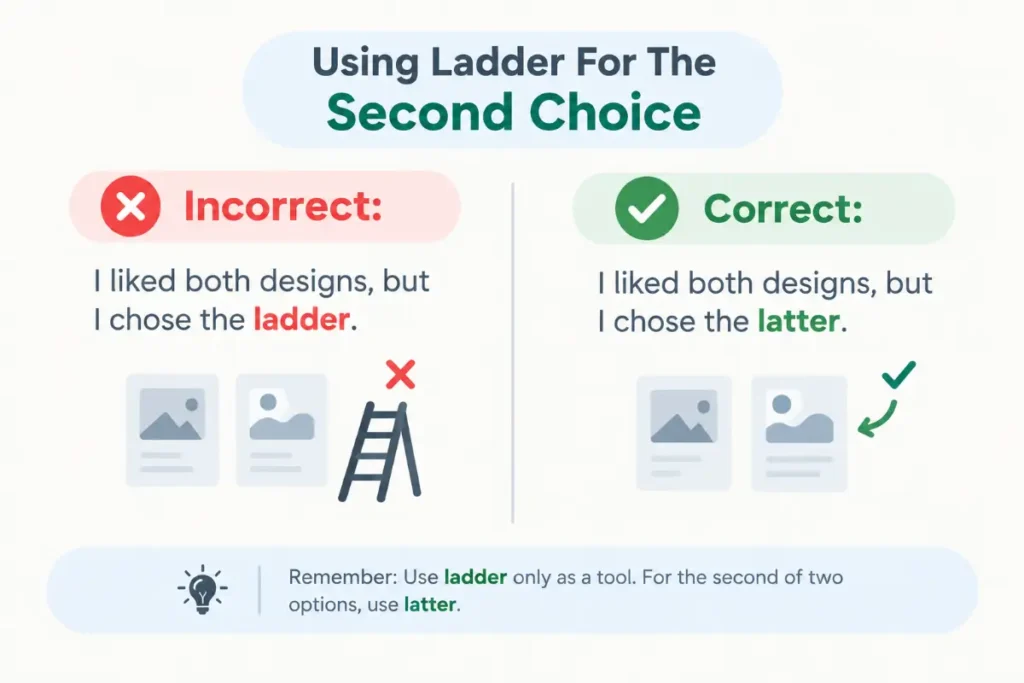
Using Ladder For The Second Choice
Incorrect:
I liked both designs, but I chose the ladder.
Correct:
I liked both designs, but I chose the latter.
The writer needs a word that points to the second design, not a word for climbing equipment.
Using Latter For Climbing Equipment
Incorrect:
He climbed the latter to reach the roof.
Correct:
He climbed the ladder to reach the roof.
The intended object is equipment with rungs, so ladder is required.
Confusing Latter With Later
This is another common spelling problem.
Later usually relates to time.
I will call you later.
Latter usually refers to the second of two things or a later part of something.
I chose the latter.
The latter part of the year was busy.
The difference is small in spelling but significant in meaning.
Using Latter Without A Clear Reference
A sentence such as this can be unclear:
The latter was expensive.
The reader needs to know what latter refers to. If you have not clearly mentioned two possible subjects, the word has no useful reference.
A clearer version would be:
The laptop and tablet were both expensive. The latter cost more.
Now the reader knows that latter refers to the tablet.
Using Latter For Any Final Item
Avoid using latter as a casual replacement for last when several items are involved.
For example:
I bought apples, oranges, bananas, and grapes. I chose the latter.
This is unclear because four items appear in the list.
Say:
I bought apples, oranges, bananas, and grapes. I chose grapes.
Clarity beats a fancy word every time.
Why People Confuse These Words
The confusion comes mainly from their similar spelling and pronunciation.
Both words contain the letters l, a, t, and e in nearly the same order.
Both have two syllables in ordinary American pronunciation.
Both can appear in short sentences where the context does most of the work.
There is also a natural spelling trap. People often remember the sound but not the exact meaning. When two words sound almost identical, writers may choose the spelling that looks familiar instead of the spelling that fits the sentence.
The solution is not to memorize complicated linguistic terminology. It is to build a strong meaning based connection.
Ladder belongs with climbing.
Latter belongs with second.
That connection is more useful than trying to remember the spelling in isolation.
Memory Tricks That Actually Work
The easiest memory trick is to connect ladder with rungs.
A ladder has rungs.
The word latter has two t letters.
You can use the extra t as a visual reminder that latter is the word you use for the second of two things.
Another useful trick is to remember this pair:
Former equals first.
Latter equals later in the pair.
The words former and latter often work together.
For example:
Between apples and oranges, I prefer the former.
Between apples and oranges, I prefer the latter.
Former points to the first item.
Latter points to the second.
For ladder, picture an actual ladder leaning against a wall.
That mental picture makes the spelling easier to retrieve.
Etymology And Word Origin
The two words have different historical backgrounds even though their modern spellings look similar.
Ladder comes from Old English forms related to a structure used for climbing. Etymological sources trace it through Middle English forms to Old English and an older Germanic root connected with climbing or leaning.
Latter has a different history. It developed from older English forms connected with the idea of the second or later of two. It is historically related to the comparative idea of something being later in a sequence.
These different histories help explain why the modern words have different meanings.
The visual similarity is not a reason to treat them as variations of the same word.
American English Usage
Both ladder and latter are standard in American English.
Ladder is common in everyday speech and writing. Americans use it for physical equipment and in figurative expressions such as corporate ladder and career ladder.
Latter is more common in formal or carefully structured writing than in casual conversation. In everyday speech, Americans often repeat the noun rather than use latter.
For example, a person might naturally say:
I prefer the second one.
A more formal sentence might say:
I prefer the latter.
Neither style is wrong. The choice depends on context and tone.
In professional, academic, legal, and formal writing, latter can be useful because it lets writers refer back to a previously mentioned choice without repeating the full noun phrase.
British English Usage
The basic distinction is the same in British English.
Ladder refers to climbing equipment or a figurative series of levels.
Latter refers to the second of two things or to a later part of a period.
The pronunciation may differ slightly between British and American accents, but the meanings remain stable.
There is no major American versus British spelling difference here. Writers in both varieties need to choose the word based on meaning.
Australian And Canadian English
Australian and Canadian English also maintain the same basic distinction.
Ladder refers to climbing equipment and figurative levels.
Latter refers to the second of two things or a later part of a period.
The spelling does not change because of regional variety.
Accent can affect how closely the two words sound, but context still provides the clearest clue.
Real Life Usage In Daily Conversation
In ordinary conversation, ladder usually appears when people are talking about home repairs, painting, cleaning, construction, gardening, or reaching high places.
For example:
- Can you bring me the ladder?
- The ladder is in the shed.
- Be careful on that ladder.
These sentences sound completely natural in everyday American English.
Latter appears less often in casual speech.
Instead of saying:
I prefer the latter.
Someone may simply say:
I prefer the second one.
Still, latter is perfectly natural in formal conversation and careful speech.
Workplace Usage
Ladder is common in workplace language when discussing physical work or career development.
For example:
- The technician used a ladder to inspect the equipment.
- She has climbed the corporate ladder quickly.
- The company created a career ladder for employees.
Latter is useful when comparing two options, approaches, or policies.
For example:
- We can use the old system or the new system. I recommend the latter.
- The company considered hiring internally or externally. The latter option offered a wider pool of candidates.
In business writing, the word can make comparisons concise. Still, don’t use it when repeating the noun would make the sentence clearer.
Academic Writing
Latter appears more often in academic writing because academic sentences frequently compare two theories, methods, groups, or ideas.
For example:
Researchers compared the traditional method with the experimental method. The latter produced more consistent results.
Here latter clearly points to the experimental method.
Another example:
The study examined qualitative and quantitative approaches. The latter relied on numerical data.
The word allows the writer to avoid repeating quantitative approaches.
Ladder can also appear in academic writing when discussing a progression of stages.
For example:
The model places these abilities on a developmental ladder.
The word is figurative here.
Formal Writing
Latter is appropriate in formal writing when the reference is clear.
For example:
The proposal offers two solutions. The latter requires fewer resources.
This is concise and precise.
However, formal writing does not require latter every time two things are mentioned. If repeating the noun makes the sentence easier to understand, repetition may be the better choice.
For example:
The company considered two suppliers. The second supplier had a better delivery record.
This may be clearer for a general audience than using latter.
Good editing is not about choosing the most formal word. It is about choosing the clearest word.
Related And Confused Terms
Several words are closely connected with this pair and can help you understand the larger pattern.
Former
Former refers to the first of two people or things mentioned.
Sarah and Maria applied. The former was selected.
Former refers to Sarah.
Later
Later refers to a time after another time.
I will finish the report later.
It does not normally mean the second item in a pair.
Last
Last can refer to the final item in a sequence.
She was the last person to arrive.
Last can apply to a list of more than two items. Latter traditionally works best when two items are being compared.
Earlier
Earlier refers to a time before another point in time.
We discussed the issue earlier.
It deals with time rather than the second item in a pair.
Second
Second can refer directly to the item that comes after the first.
Of the two options, I prefer the second.
Second is often clearer than latter in everyday writing.
Final
Final refers to the last stage or item in a sequence.
The final chapter was surprising.
It does not have the same specific pair based meaning as latter.
Rung
A rung is one of the horizontal steps on a ladder.
He stood on the top rung.
Remembering rung can help you remember ladder.
Staircase
A staircase is a permanent structure made of steps that allows people to move between levels.
A ladder is usually steeper and more portable.
This distinction is useful when describing physical objects.
How To Choose The Right Word
When you pause over the spelling, ask one question.
What am I trying to describe?
If the answer is climbing equipment, use ladder.
If the answer is the second of two things, use latter.
If the answer is the later part of a period, use latter.
If the answer is a time after another time, consider later instead.
If the answer is the final item in a longer list, last may be clearer.
This quick decision process prevents most errors.
You can also replace the word mentally.
If you can replace it with climbing equipment, choose ladder.
If you can replace it with the second one, choose latter.
If you can replace it with later, check the sentence carefully because latter and later are different words.
Expert Editor Insight
An experienced editor usually looks at context before looking at spelling. The two words are easy to confuse because their written forms are close and their American pronunciations can sound similar, but their grammatical jobs are different. Editors also watch for unclear uses of latter, especially after lists containing more than two items. When clarity matters, repeating the noun or using second is often better than forcing latter into the sentence.
A Simple Editing Test
Read the sentence without the target word.
Then ask what idea needs to fill the space.
If the sentence says someone climbed, moved, carried, placed, or stood on something, you probably need ladder.
If the sentence compares two options and refers back to the second one, you probably need latter.
If the sentence describes the later portion of a period, latter may fit.
If the sentence describes a future time, later is probably the correct choice.
This test works because it focuses on meaning rather than visual spelling.
Why Context Matters More Than Pronunciation
Many spelling errors happen because writers rely too heavily on sound.
English contains many words that sound alike or nearly alike but have different meanings. The spelling gives readers information that pronunciation cannot always provide.
Ladder and latter are a good example.
When spoken quickly in an American accent, the middle consonants can sound very similar. A listener may need context to tell which word the speaker means.
Writing removes that ambiguity only when the correct spelling is used.
That is why learning the meaning of each word is more useful than simply memorizing how the words look.
Common Phrases With Ladder
Several expressions can help reinforce the meaning.
- Climb a ladder.
- Climb the corporate ladder.
- Climb the career ladder.
- Move up the ladder.
- Fall off a ladder.
- Put up a ladder.
- Step onto a ladder.
- Reach the top of the ladder.
These phrases all connect with the idea of climbing or moving upward.
Common Phrases With Latter
Latter also appears in several established patterns.
- The latter part.
- The latter half.
- The latter stages.
- The latter years.
- The latter option.
- The latter choice.
- The latter example.
- The latter two.
The phrase the latter two deserves special attention.
For example:
The report contains four sections. The latter two focus on financial planning.
Here latter two refers to the final two sections. The meaning is clear because the phrase identifies a pair at the end of a larger sequence.
Still, if the list is complicated, naming the sections may provide greater clarity.
A Practical Comparison
Consider these sentences together.
I put the ladder against the wall.
The sentence describes an object.
I chose the latter option.
The sentence identifies the second option.
The latter part of the meeting was useful.
The sentence refers to a later portion of a period.
I will call you later.
The sentence refers to future time.
These four sentences are a useful mini lesson because they separate four similar looking words and meanings.
Ladder means climbing equipment.
Latter means the second of two or a later part.
Later means a time after now or another stated time.
Last means the final item or point in a sequence.
How To Avoid The Mistake Permanently
Don’t memorize the spellings alone.
Instead, memorize each word with a strong example.
For ladder, remember:
I climbed the ladder.
For latter, remember:
I chose the latter.
For later, remember:
I will call later.
For last, remember:
She came last.
These short examples create four separate mental categories.
You can also use a visual trick.
Picture a ladder with rungs.
Then picture two choices written on a page. The second choice is the latter.
This gives each spelling its own mental image.
Key Takeaways
- Ladder and latter are both correct English words.
- Ladder is mainly a noun for climbing equipment.
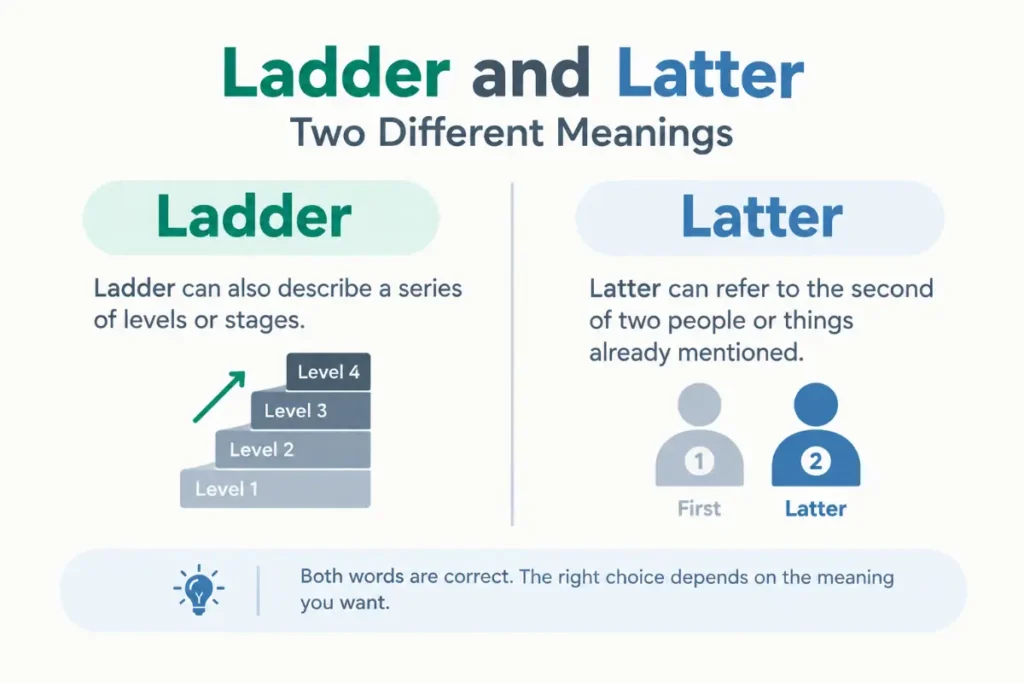
- Ladder can also describe a series of levels or stages.
- Latter can refer to the second of two people or things already mentioned.
- Latter can also describe the later part of a period.
- Former and latter often work together when comparing two things.
- Later refers to time and should not be confused with latter.
- Last can be clearer when you mean the final item in a list of several things.
- Ladder and latter can sound very similar in American English.
- Context is often the easiest way to distinguish them.
- Use ladder for climbing.
- Use latter for the second of two or a later part.
Conclusion
Ladder vs latter is easier to remember once you connect each word with its core meaning. Ladder refers to climbing equipment or a figurative series of levels. Latter refers to the second of two things already mentioned or to a later part of a period.
The most useful memory trick is simple. A ladder has rungs and you climb it. The latter is the second choice in a pair. If you’re comparing two options, former means the first and latter means the second. If you’re talking about time, check the spelling carefully because later has a different meaning. When editing your writing, focus on meaning first and spelling second. That quick habit will prevent this common confusion.
Frequently Asked Questions
Which is correct ladder or latter?
Both words are correct, but they have different meanings. Ladder is a noun for climbing equipment or a figurative series of levels. Latter refers to the second of two people or things already mentioned, or to a later part of a period. Choose the word that matches the meaning you intend.
Is latter the same as later?
No. Latter usually refers to the second of two things or to a later part of a particular period. Later usually refers to time after another point. For example, I chose the latter refers to a second choice, while I will call later refers to a future time.
Is latter the opposite of former?
Yes, in the common comparison between two things. Former refers to the first item mentioned, while latter refers to the second. For example, if you mention tea and coffee in that order, former refers to tea and latter refers to coffee.
Can latter refer to more than two things?
It is best used for the second of two things. Some dictionaries recognize uses involving the final part of a larger group, but using latter for a list of several unrelated items can create confusion. If clarity matters, name the item directly or use last when that is the intended meaning.
How do you pronounce ladder and latter?
In American English, ladder is commonly pronounced /ˈlædɚ/ and latter is commonly pronounced /ˈlæt̬ɚ/. They can sound very similar in natural speech. Context often provides the clearest clue, especially in fast conversation.
Is latter formal English?
Yes. Latter is standard English and is especially common in formal, academic, professional, and carefully edited writing. In casual conversation, people often say the second one instead. Latter is useful when two previously mentioned ideas need to be referenced without repeating the full noun phrase.
Can ladder have a figurative meaning?
Yes. Ladder can describe a series of stages or levels that lead upward. Expressions such as corporate ladder and career ladder use this figurative meaning. The image comes from climbing physical rungs to reach a higher position.
What is an easy way to remember ladder and latter?
Think of a ladder as something with rungs that you climb. Think of latter as the second of two things. You can also remember former and latter as a pair. Former means first and latter means second.
