
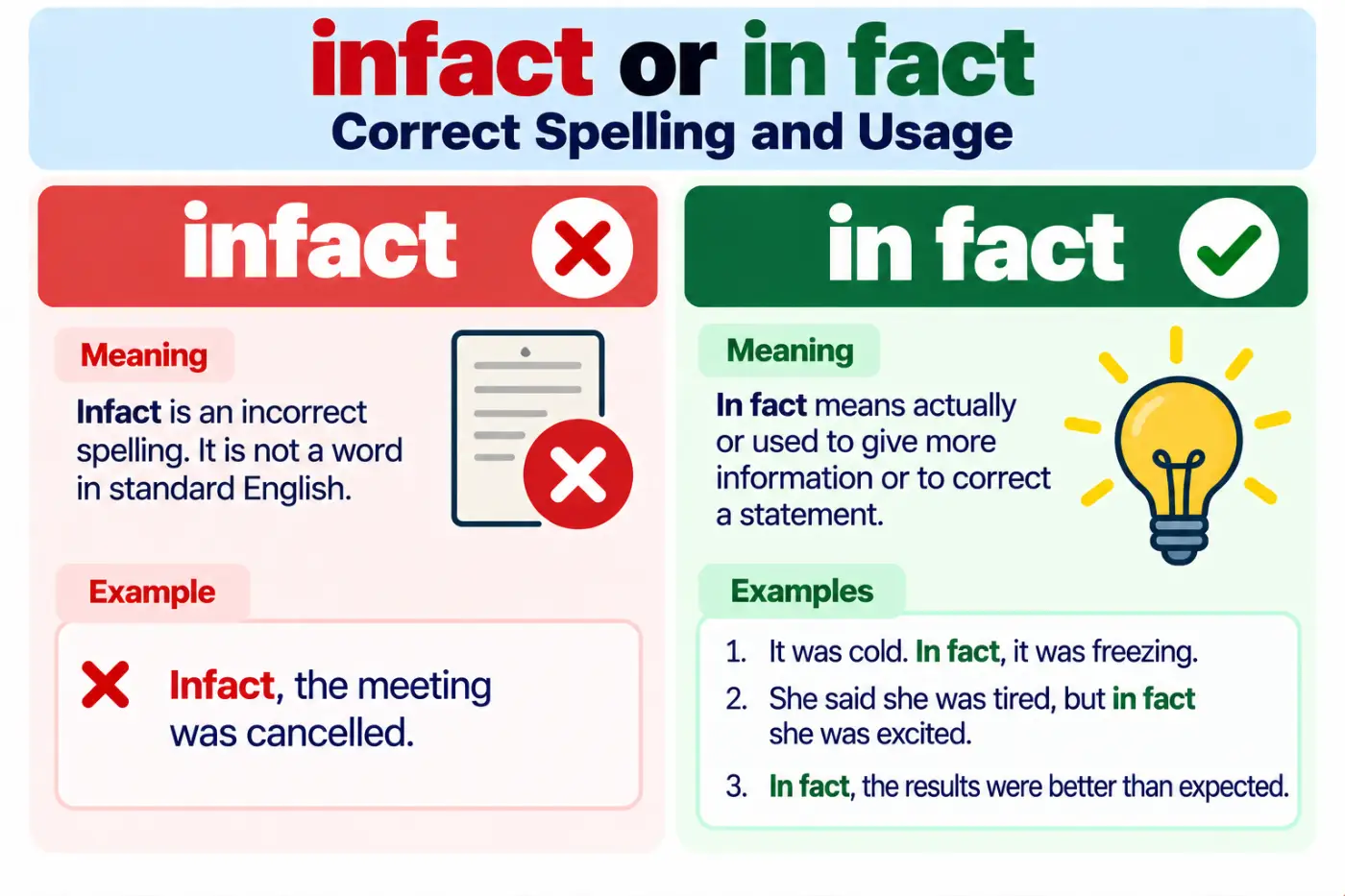
The confusion between infact or in fact is easy to understand. The expression is often pronounced quickly in everyday speech, so the two words can sound like one unit. That can lead writers to combine them when typing or writing, even though standard English keeps them separate.
The correct form is in fact, with a space between in and fact. It is a common English phrase used to emphasize a statement, correct an assumption, add a stronger fact, or show that the truth is slightly different from what someone might expect. For example, you can say, “I thought she was busy. In fact, she was waiting for us.”
This guide explains the spelling, meaning, grammar, pronunciation, punctuation, and natural use of the expression. You’ll also see common mistakes, examples from everyday and formal writing, related expressions, and simple ways to remember the correct form.
Quick Answer
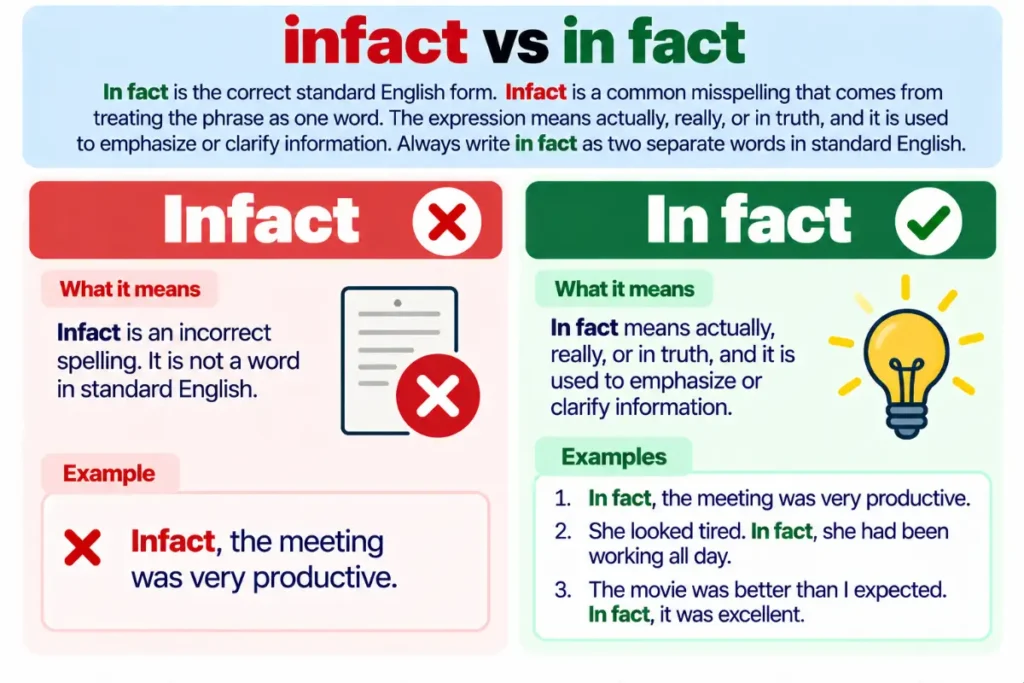
In fact is the correct standard English form. Infact is a common misspelling that comes from treating the phrase as one word. The expression means actually, really, or in truth, and it is used to emphasize or clarify information. Always write in fact as two separate words in standard English.
Meaning of In Fact
The phrase in fact means actually, really, or in truth. It is commonly used when a speaker or writer wants to emphasize that a statement is true or provide information that confirms, corrects, or strengthens an earlier idea.
For example:
The restaurant looks small. In fact, it can seat more than 100 people.
The first sentence gives an impression. The second sentence provides a fact that changes or corrects that impression.
The phrase can also strengthen a statement without correcting anything:
She is very talented. In fact, she is one of the best singers in the group.
Here, the second sentence adds stronger information to the first one.
Is Infact a Word?
No. Infact is not the standard spelling of the English expression. It is generally treated as a misspelling of in fact.
The error usually happens because the expression is frequently spoken as a connected sound. English has many compounds that are written as one word, so it can be tempting to assume that this phrase works the same way. It does not.
Compare these forms:
- Correct: In fact, I already knew the answer.
- Incorrect: Infact, I already knew the answer.
The first version follows standard English spelling and grammar.
The incorrect form may appear in informal online writing, messages, comments, or user generated text. Its appearance in those settings does not make it a standard English word.
Comparison Table
| Form | Meaning | Part of Speech | Standard Usage | Formality | Example |
|---|---|---|---|---|---|
| in fact | Actually, really, or in truth | Adverbial phrase | Standard English | Neutral to formal | In fact, the meeting starts at nine. |
| infact | No established standard meaning as one word | Not a standard English word | Nonstandard spelling | Not appropriate in edited writing | Infact, the meeting starts at nine. |
The important distinction is simple. In fact is a two word adverbial phrase. Infact is normally just a spelling error.
Why the Confusion Happens
Several features of English make this mistake common.
First, speech does not always preserve clear spaces between words. Native speakers often connect short function words to the words around them. As a result, a phrase that is written as two words can sound almost like a single word.
Second, English contains many expressions that have changed from separate words into compound words over time. Examples include words such as breakfast, altogether, and maybe. A learner may reasonably assume that another frequently used expression has undergone the same change.
Third, typing habits can encourage errors. When someone writes quickly, they may type a familiar phrase as one unit without noticing the missing space.
The solution is straightforward: learn the expression as a fixed two word phrase and keep the space every time you write it.
Key Differences Explained
Spelling
The standard spelling contains two separate words:
in fact
There is a space between them. Writing the phrase as one word is not the standard form.
Meaning
The phrase usually means:
- Actually.
- Really.
- In truth.
- As a matter of fact.
The exact meaning depends on the surrounding sentence, but the basic idea is that the speaker is emphasizing or presenting something as true.
Grammar
In fact functions as an adverbial phrase. It can modify a whole statement rather than acting like a normal single noun or verb.
For example:
In fact, I agree with you.
It can also appear later in a sentence:
I was, in fact, the person who called.
It can also appear at the end when the context allows it:
She knew the answer, in fact.
The most common position is at the beginning of a sentence, especially when the phrase introduces a correction or additional information.
Pronunciation
The expression is commonly pronounced with connected speech. This can make the two words sound closely linked, but pronunciation does not determine written spacing.
Formality
The phrase is acceptable in everyday conversation, workplace communication, academic writing, journalism, and formal prose. It is neither slang nor restricted to casual speech.
Which Form Is Correct?
The correct form is in fact.
The reason is grammatical as well as orthographic. The expression consists of the preposition in and the noun fact, and together they form an established adverbial phrase. Standard English writes the expression as two words.
The phrase has a long history of use in English, and modern dictionaries and edited writing treat the standard expression as two words. There is no general spelling rule that turns it into the single word infact.
A useful editing rule is simple: if you mean actually, really, or in truth, write in fact.
How to Use In Fact in a Sentence
The expression can perform several useful jobs.
To Correct an Earlier Impression
You can use it when the second statement differs from what someone might expect.
I thought the store was closed. In fact, it was still open.
The phrase signals that the second statement gives the real situation.
To Add Stronger Information
It can introduce information that makes a previous statement stronger.
He is a good student. In fact, he received the highest grade in the class.
The second statement provides stronger evidence for the first.
To Emphasize a Truth
It can emphasize something the speaker considers important.
In fact, I remember exactly what happened.
Here, the expression adds emphasis rather than correcting a previous claim.
To Confirm Information
It can introduce information that confirms an idea.
The road is longer than it looks. In fact, it takes about an hour to drive.
The second sentence supports the first with a specific detail.
Sentence Examples
Here are natural examples showing how the expression works in different settings.
- Everyday conversation: I thought Tom was from Boston. In fact, he grew up in Chicago.
- Everyday conversation: You don’t need to bring anything. In fact, we already have everything we need.
- Text message: I thought the appointment was tomorrow. In fact, it’s on Friday.
- Workplace communication: The report is almost finished. In fact, I only have two sections left to review.
- School writing: The experiment produced an unexpected result. In fact, the second trial produced an even stronger effect.
- Academic writing: The evidence does not weaken this argument. In fact, it supports the central claim.
- Formal writing: The proposal appears expensive at first. In fact, it could reduce long term costs.
- Social situation: I assumed Sarah had already left. In fact, she was sitting in the next room.
- Online communication: I wasn’t upset with your comment. In fact, I thought it was funny.
- Professional communication: The project is progressing well. In fact, we are ahead of the original schedule.
These examples show that the phrase is flexible. It can work in casual speech and in more formal writing without sounding out of place.
Common Mistakes and Misspellings
1. Writing Infact
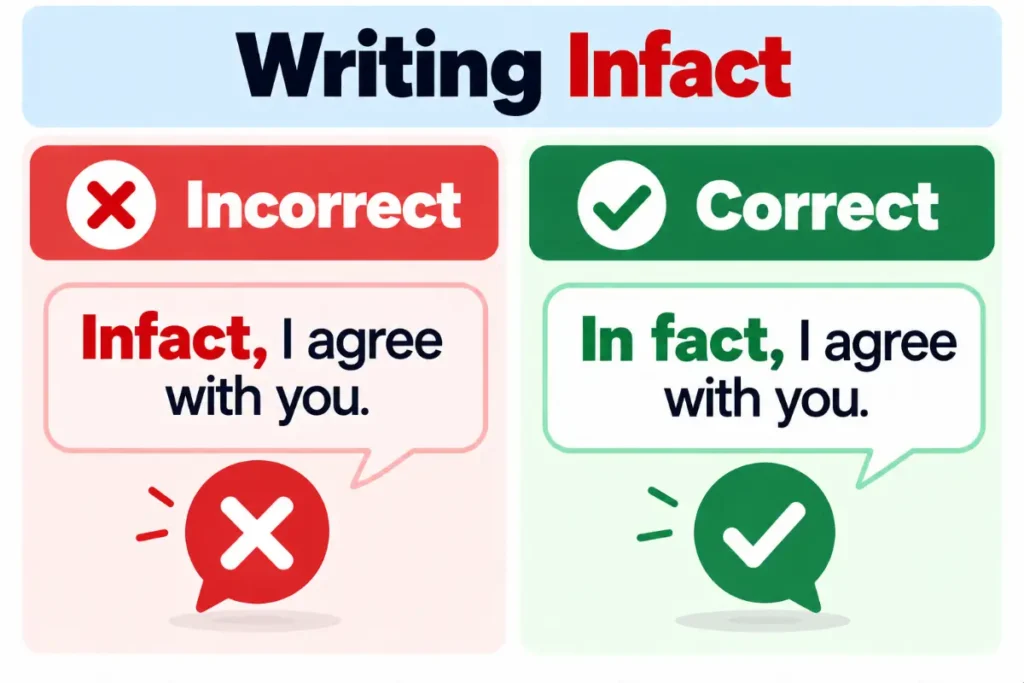
Incorrect: Infact, I agree with you.
Correct: In fact, I agree with you.
The most common error is removing the space between the two words.
2. Treating the Phrase Like a Single Noun
Some writers may assume that fact is part of a compound word. It is not.
Incorrect: This infact changed my opinion.
Correct: This fact changed my opinion.
Notice that fact by itself is a noun, while in fact is an adverbial phrase.
3. Adding an Unnecessary Hyphen
Do not write the expression with a hyphen.
Incorrect: In-fact, the answer was obvious.
Correct: In fact, the answer was obvious.
The standard expression does not need a hyphen.
4. Confusing In Fact With In Fact That
The phrase can introduce a statement, but it does not normally require that after it.
Natural: In fact, she already knew.
Less natural: In fact that she already knew.
If you need a noun clause, the grammar changes:
The fact that she already knew surprised me.
Here, the fact that is a different grammatical structure.
5. Overusing the Expression
The phrase is useful, but repeated use can make writing sound mechanical.
For example, a paragraph with several sentences beginning with the same expression may feel repetitive. Strong writing usually varies its transitions.
Instead of repeating the phrase, you can sometimes use actually, indeed, really, or as a matter of fact when the meaning fits.
Pronunciation Guide
The phrase is commonly pronounced:
in fact
A simple pronunciation guide is:
in FAKT
The main stress falls on fact.
The IPA pronunciation is commonly represented as:
/ɪn fækt/
The first word is short and unstressed in normal speech. The second word receives the stronger stress.
Because the phrase is often spoken quickly, the boundary between the two words may not sound very clear. This is one reason learners sometimes write the expression as one word.
Remember that spoken connection does not change written form. English speakers often connect words in natural speech while keeping them separate in writing.
Punctuation With In Fact
Punctuation depends on the phrase’s position in the sentence.
At the Beginning
When it introduces a sentence, a comma commonly follows it.
In fact, I had already finished the work.
The comma helps separate the introductory expression from the main clause.
In the Middle
When it appears as an interrupting phrase, commas can set it off.
She was, in fact, the first person to arrive.
The commas show that the phrase is inserted into the main sentence.
At the End
The phrase can sometimes appear at the end.
He knew about the problem, in fact.
This position is possible, but it is less common than beginning or middle placement.
Punctuation should follow the phrase’s role in the sentence rather than being added automatically.
Grammar Rules and Part of Speech
Understanding the grammar makes the spelling easier to remember.
In Is a Preposition
In is a common English preposition. It appears in many expressions and structures.
Fact Is a Noun
Fact is a noun referring to something known or accepted as true.
Together They Form an Adverbial Phrase
When the two words appear together as in fact, they function as an adverbial phrase. The phrase can comment on or emphasize a whole statement.
For example:
In fact, the results were better than expected.
The phrase does not describe one particular noun. Instead, it frames the statement that follows.
It Can Introduce a Correction
This is one of its most useful functions.
I thought Mark was absent. In fact, he was in the library.
The phrase tells the reader that the second statement gives the actual situation.
It Can Strengthen an Argument
In formal writing, the expression can help connect a general claim with stronger supporting information.
The method is effective. In fact, several tests produced similar results.
Used carefully, it can make the relationship between ideas clear.
Real Life Usage Examples
Daily Conversation
In casual conversation, the phrase often corrects an assumption or adds surprising information.
I thought the movie was two hours long. In fact, it was nearly three hours.
I didn’t forget your birthday. In fact, I bought your gift last week.
The expression sounds natural in both examples.
Email and Workplace Communication
The phrase can make workplace messages clear and direct.
The client has approved the revised proposal. In fact, they asked us to begin the next stage.
We expected the repairs to take several days. In fact, the team completed them this morning.
It works well in professional communication because it is clear without being overly formal.
Academic Writing
Academic writers may use the phrase to introduce evidence, clarification, or a stronger observation.
The results were not merely consistent. In fact, they were remarkably similar across all three trials.
Still, academic writing should not rely on the same transition repeatedly. Use it only when it adds a clear logical purpose.
News and Journalism
The expression can help contrast an assumption with a verified detail.
Officials initially expected delays. In fact, the service resumed earlier than predicted.
The phrase draws attention to the factual update.
Literature and Storytelling
Writers can use it to reveal information or change a character’s understanding.
She believed she was alone. In fact, someone had been watching from the doorway.
This use can create emphasis or surprise.
Related and Confused Terms
Several words and phrases can have a similar function.
Actually
Actually can mean in reality or in truth.
I thought he was younger. Actually, he is forty.
It often introduces a correction or clarification.
Really
Really can emphasize truth or intensity.
I really enjoyed the concert.
Its meaning is broader, so it is not always a direct replacement.
Indeed
Indeed can emphasize a statement or confirm an idea.
The task was difficult indeed.
It often has a more formal tone than everyday actually.
As a Matter of Fact
This phrase can serve a similar purpose.
As a matter of fact, I have already spoken with her.
It can sound more deliberate or emphatic than the shorter expression.
In Truth
In truth means according to the real situation.
In truth, he was disappointed by the decision.
It can have a more literary or formal tone.
In Reality
In reality introduces a contrast between appearance and the actual situation.
The job looked easy. In reality, it required several weeks of training.
Factually
Factually means in a way that concerns facts or accuracy.
The statement is factually correct.
It does not always work as a direct replacement for the phrase.
The Fact Is
The fact is introduces an important truth or explanation.
The fact is, we don’t have enough time.
This is grammatically different from the adverbial phrase, even though the meanings can overlap.
American English
In American English, in fact is a standard and common expression. It appears in conversation, business communication, education, journalism, and formal prose.
There is no American spelling change that turns the expression into one word. American writers should keep the space between in and fact.
For example:
In fact, the United States has several different regional varieties of English.
The phrase works naturally in both casual and formal American writing.
British English
British English also uses in fact as the standard form. There is no meaningful regional spelling difference between American and British English for this expression.
A British writer would write:
In fact, I had never seen the place before.
The single word infact is still considered a nonstandard spelling in ordinary English writing.
Canadian and Australian English
Canadian English and Australian English also use in fact as the standard form.
The spelling does not change simply because the writer is using one of these English varieties. The expression remains two words.
That consistency is useful for learners because there is no regional spelling choice to remember.
Etymology and Word Origin
The phrase is built from two older English words, in and fact.
In comes from Old English and related Germanic forms associated with position or inclusion. Fact entered English through French from Latin factum, meaning something done or made. Over time, fact developed its modern sense of something known or accepted as true.
The phrase in fact developed as an expression meaning in reality or in truth. Its modern use continues that basic idea.
The important point for spelling is that the historical development did not create a single standard word spelled infact. Modern English retains the two word expression.
When Should You Use In Fact?
Use the phrase when you want to make a statement stronger, correct an earlier impression, or point out the actual situation.
It is especially useful when two ideas have a clear relationship.
For example:
The house looks small from the street. In fact, it has six bedrooms.
The second sentence corrects the reader’s first impression.
You can also use it to strengthen a claim:
She is an excellent student. In fact, she won the school award this year.
In both cases, the phrase has a clear purpose. It connects the new information to the statement that came before it.
When Should You Avoid It?
You do not need the phrase every time you state a fact. Adding it to every sentence can make writing repetitive.
Compare:
The weather was cold. In fact, the wind was strong. In fact, the roads were icy. In fact, everyone stayed home.
The repetition feels heavy.
A stronger version might be:
The weather was cold, and the strong wind made the roads icy. As a result, most people stayed home.
Good writing uses transitions because they clarify relationships between ideas, not simply because they sound formal.
Memory Trick for the Correct Spelling
Think of the phrase as two simple parts:
in + fact = in fact
The word fact already has a clear meaning, and in remains a separate preposition.
A useful mental sentence is:
In fact, there are two words.
The sentence itself reminds you of the spelling.
Another easy test is to replace the phrase with actually. If actually fits the sentence, in fact may also fit.
For example:
Actually, I knew the answer.
becomes:
In fact, I knew the answer.
This does not mean the two expressions are identical in every context, but it can help you remember the basic function.
Expert Editor Insight
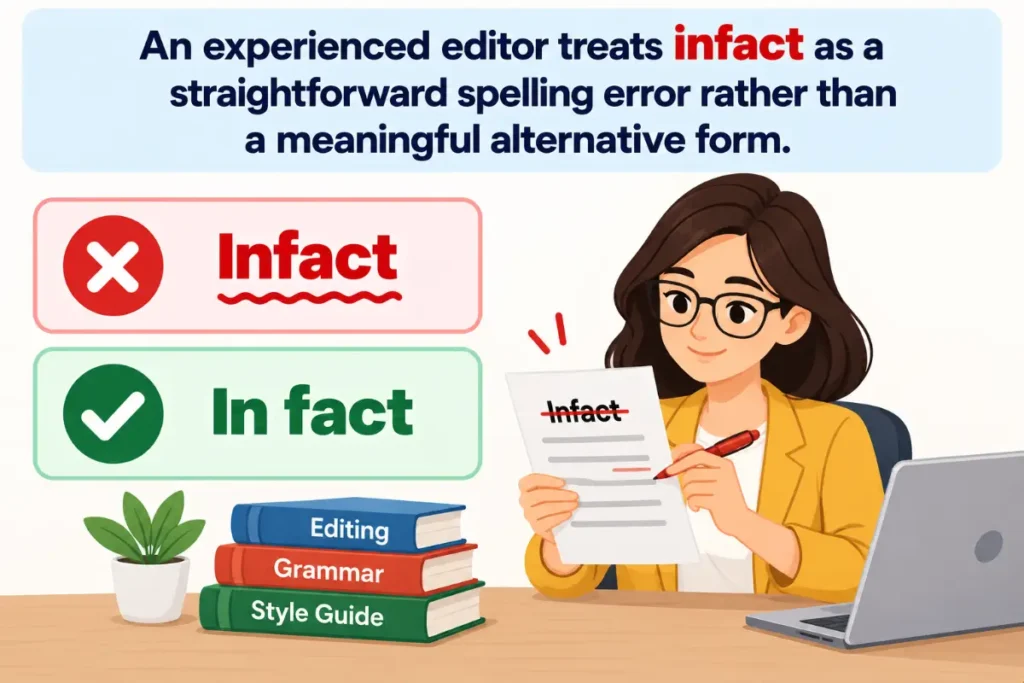
An experienced editor treats infact as a straightforward spelling error rather than a meaningful alternative form. The confusion usually comes from connected speech and fast typing, not from a real difference in meaning. Editing and spelling tools may flag the single word because standard English recognizes the expression as two words. The best fix is simple: restore the space and check the surrounding sentence to make sure the phrase actually adds emphasis or clarification.
Key Takeaways
- In fact is the standard English form.
- Infact is a common misspelling, not the normal standard form.
- The expression means actually, really, or in truth.
- It functions as an adverbial phrase.
- It can introduce a correction, clarification, emphasis, or stronger supporting information.
- It can appear at the beginning, middle, or end of a sentence.
- When it begins a sentence, a comma commonly follows it.
- The pronunciation can make the phrase sound connected, but the written form remains two words.
- The spelling is the same in American, British, Canadian, and Australian English.
- In formal and professional writing, always use the standard two word form.
Conclusion
The answer to infact or in fact is clear: in fact is the correct standard form. The phrase is written as two words and means actually, really, or in truth. It is common in everyday speech as well as professional, academic, and formal writing.
The single word infact is generally a misspelling caused by fast speech, connected pronunciation, or typing habits. It does not represent a separate standard English word with a different meaning. When you use the expression, keep the space between in and fact.
A simple memory trick is to think of the phrase as in + fact. If you mean actually or in truth, write in fact. That small space keeps your spelling accurate and your writing polished.
FAQs
Is Infact a real English word?
No. Infact is not the standard spelling of the expression. It is normally a misspelling of in fact. You may see the one word form in informal online writing, messages, or user generated text, but that does not make it standard English. In edited writing, schoolwork, professional documents, and formal communication, use the two word form.
What does In Fact mean?
In fact means actually, really, or in truth. Writers often use it to correct an earlier impression, emphasize a statement, or add information that makes a previous point stronger. For example, “I thought he was new. In fact, he has worked here for ten years” uses the phrase to correct an assumption.
Which is correct: Infact or In Fact?
In fact is correct. The expression is written as two separate words. Infact is a common spelling error caused partly by the way the phrase can sound when spoken quickly. If you are writing an essay, email, report, school assignment, or professional document, always use the standard two word form.
How do you pronounce In Fact?
It is commonly pronounced /ɪn fækt/, with the main stress on fact. In normal speech, the two words may connect closely, so they can sound almost like one unit. That connected pronunciation does not change the written spelling. Keep a space between in and fact whenever you write the expression.
Can In Fact start a sentence?
Yes. Starting a sentence with in fact is common and grammatically acceptable. A comma usually follows the phrase when it introduces the sentence. For example, “In fact, I had already completed the assignment.” It can also appear in the middle or at the end when the sentence structure supports that placement.
Is In Fact appropriate in formal writing?
Yes. In fact is suitable for formal and informal writing. You can use it in academic work, professional emails, reports, journalism, and everyday conversation. The phrase is not slang. Still, strong writing uses it only when it adds emphasis, clarification, or contrast rather than repeating it throughout a paragraph.
Why do people misspell In Fact as Infact?
People often combine the words because they are closely connected in natural speech. Fast typing can create the same mistake. English also has many compound words, so writers may assume that a frequently used expression should be written as one word. Remembering the phrase as two separate words prevents the error.
What is a synonym for In Fact?
Common alternatives include actually, really, indeed, in reality, in truth, and as a matter of fact. They are not interchangeable in every sentence because each has its own tone and grammatical behavior. Actually is often the closest everyday alternative, while indeed and as a matter of fact can sound more formal or emphatic.
