
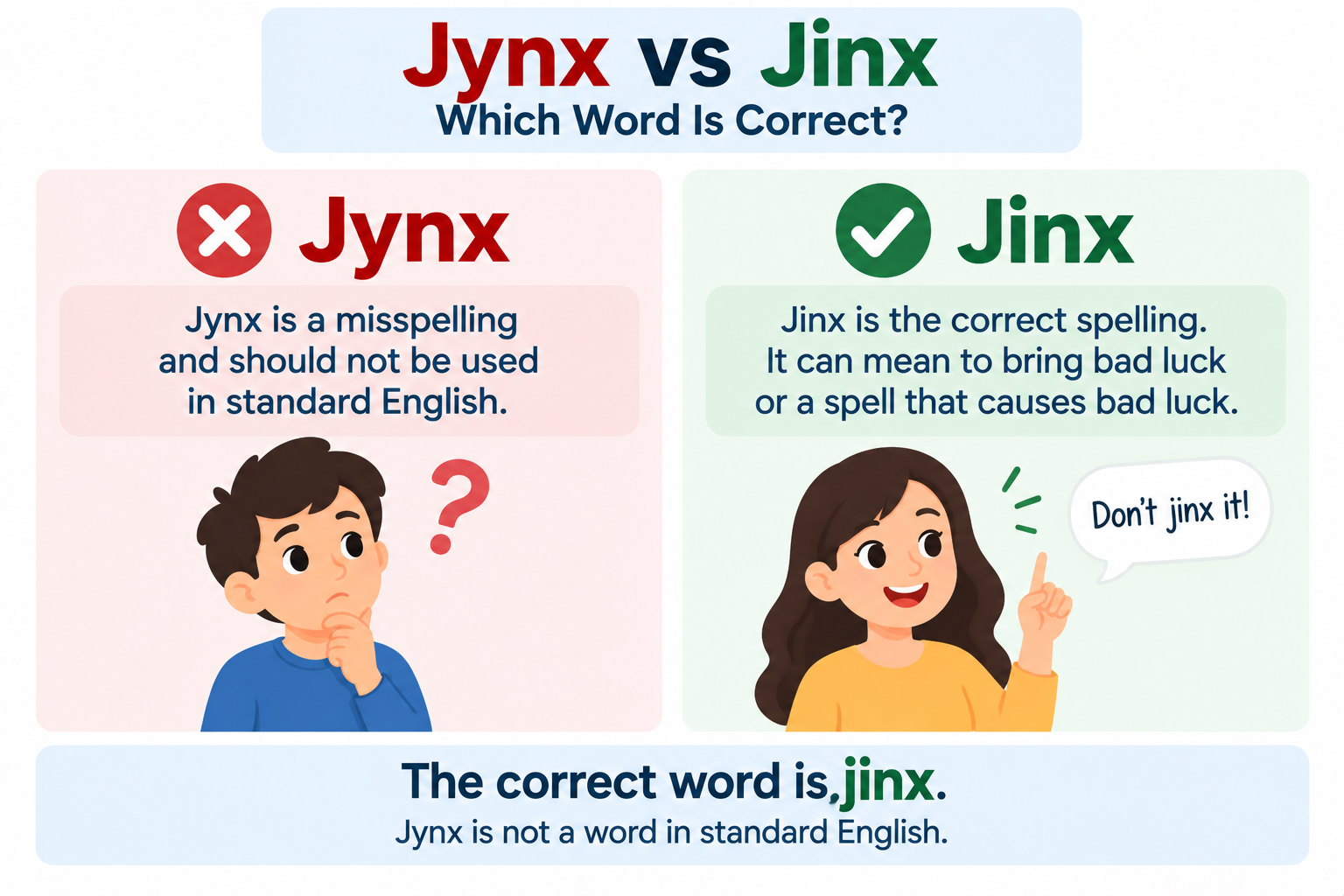
jynx vs jinx looks like a simple spelling question, but the answer depends on what you mean. If you’re talking about bad luck, a person or thing believed to cause bad luck, or the act of bringing bad luck to something, jinx is the standard English word. Jynx has a specific use as the name of a Pokémon and is therefore not simply an alternative spelling of the everyday word.
The confusion is understandable because the two forms sound alike and differ by only one letter. English has many words where a small spelling change creates a completely different word or name. In this case, the difference is especially easy to miss because the pronunciation stays very close.
If you’re writing an email, school assignment, article, message, or general English sentence about bad luck, choose jinx. If you’re referring to the Pokémon, keep the capital J in Jynx. This guide explains the meanings, grammar, pronunciation, word history, regional usage, common mistakes, examples, and a simple way to remember the distinction.
Quick Definition
Jinx is the standard English noun and verb connected with bad luck or the act of bringing bad luck to someone or something. Jynx is a proper name, most notably the name of a Pokémon. They are not interchangeable spellings. Use lowercase jinx for the ordinary English word and capitalized Jynx for the proper name.
Quick Answer
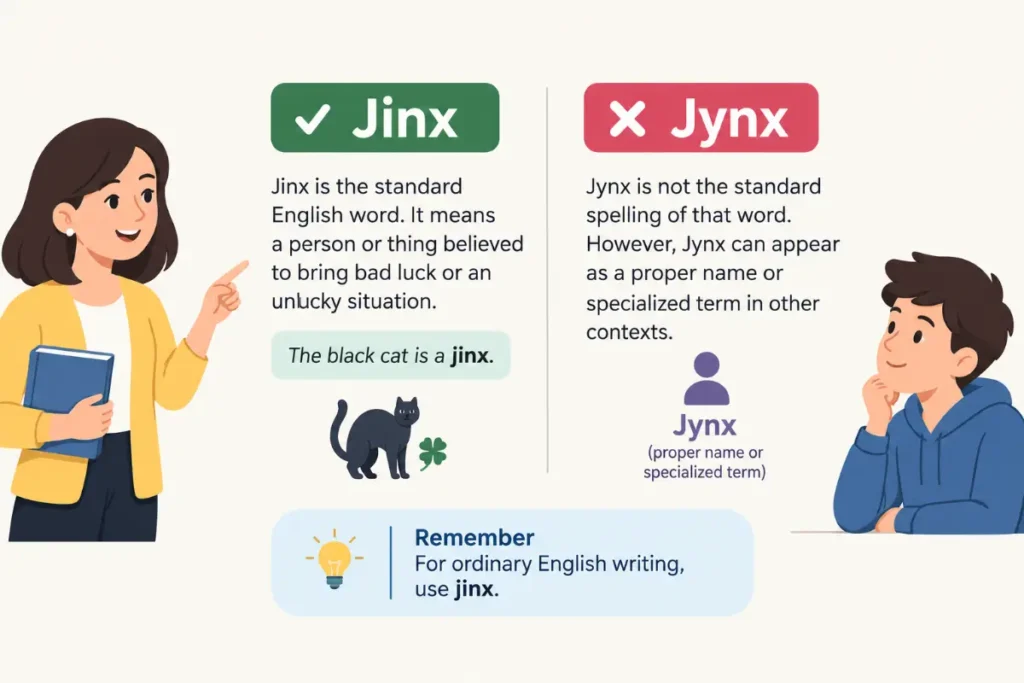
Use jinx when you mean bad luck or something believed to cause bad luck. You can also use it as a verb meaning to bring bad luck to something.
Use Jynx when you mean the Pokémon named Jynx. The capital letter matters because a Pokémon name is a proper noun. Official Pokémon materials consistently use Jynx as the character’s name.
So these sentences have different meanings.
I don’t want to jinx the game.
Jynx is a Pokémon.
The first sentence uses the ordinary English word. The second uses a proper name.
Comparison Table
| Form | Meaning | Part of Speech | Origin | Usage Frequency | Formality | Common Contexts | Example |
|---|---|---|---|---|---|---|---|
| jinx | Something believed to bring bad luck or the act of bringing bad luck | Noun and verb | American English word with a debated earlier connection to jynx | Common | Neutral | Conversation, sports, entertainment, everyday writing | I hope I don’t jinx our chances. |
| Jynx | The name of a specific Pokémon | Proper noun | Fictional character name | Specialized | Neutral | Pokémon games, cards, Pokédex entries, fan discussions | Jynx is listed as Pokémon number 124. |
The most important distinction is context. One is a regular English vocabulary word. The other is a proper name.
Meaning And Definition
Meaning Of Jynx
Jynx is a proper name rather than the standard spelling of the English word for bad luck.
The best known modern use is the Pokémon character Jynx. Official Pokémon sources list Jynx as Pokémon number 124 and use the capitalized spelling consistently.
Because Jynx is a proper noun, you should capitalize the first letter when referring to the character.
For example:
Jynx is a Psychic type Pokémon.
I found a Jynx card in my collection.
The trainer used Jynx during the battle.
The spelling does not become lowercase simply because it appears in the middle of a sentence. Proper names keep their capitalization unless a particular style or context requires something different.
Jynx can also appear in other specialized names or labels. Those uses depend on the name itself. They do not turn Jynx into a standard replacement for the ordinary word jinx.
Meaning Of Jinx
Jinx is a standard English word with noun and verb uses.
As a noun, it can mean a person, thing, or influence believed to bring bad luck.
For example:
That old car seems to be a jinx.
As a verb, it means to bring bad luck to something or cause an unwanted result through an unlucky influence or belief.
For example:
I don’t want to jinx our chances.
Dictionary sources also record a familiar conversational use of jinx as an interjection. People sometimes say jinx when two people say the same thing at almost the same moment.
The word therefore has more than one everyday use. Its core idea remains connected with bad luck.
Key Differences Explained
- Spelling. The ordinary English word is spelled jinx. The proper name Jynx uses a y instead of an i.
- Capitalization. Jinx is normally lowercase when used as an English vocabulary word. Jynx is capitalized because it is a proper name.
- Meaning. Jinx can describe bad luck or the act of causing bad luck. Jynx refers to a named Pokémon.
- Grammar. Jinx can function as a noun or verb. Jynx functions as a proper noun when referring to the Pokémon.
- Pronunciation. The two forms are generally pronounced alike or extremely similarly in ordinary English speech.
- Context. Jinx appears in conversations about luck, sports, predictions, superstition, and everyday situations. Jynx appears in Pokémon related contexts.
- Standard usage. Jinx is the standard spelling for the ordinary English word. Jynx is a specialized proper name.
- Writing style. If you mean bad luck, lowercase jinx is appropriate. If you mean the Pokémon, use capitalized Jynx.
This is a useful example of how spelling and meaning can interact. Two forms can sound almost identical while serving completely different purposes in writing.
Which Form Is Correct?
Both forms can be correct, but they are correct in different contexts.
If you mean bad luck, use jinx. Dictionary sources define it as a noun connected with bad luck and as a verb meaning to bring bad luck to someone or something.
If you mean the Pokémon, use Jynx. Official Pokémon material uses that exact capitalization and spelling.
This distinction is more accurate than calling one spelling wrong in every situation. Jynx is not simply a typo when it refers to the Pokémon. At the same time, writing Jynx in a normal sentence about bad luck would be inappropriate.
Compare these examples.
I hope I don’t jinx the team.
Jynx is a Pokémon.
Changing the spelling changes the reference.
Why The Two Forms Get Confused
The main reason for the confusion is visual similarity.
Jinx and Jynx contain the same basic consonant pattern and end with the same x. The only major spelling difference is the vowel in the middle. When people hear the word rather than see it, that difference disappears.
Pronunciation creates another layer of confusion. The ordinary word is pronounced with a sound represented by the letter i in the spelling. The proper name uses y but does not create a pronunciation that clearly separates it from the English word for most speakers.
There is also an interesting historical connection. Dictionary sources trace the English word jinx to an Americanism recorded in the early twentieth century and discuss a possible connection with Latin jynx, the name of a bird associated historically with divination and magic.
That historical connection helps explain why the spellings can look related, but modern usage still treats the two forms differently.
Sentence Examples
Here are natural examples using the standard English word.
- I don’t want to jinx our chances before the game begins.
- Everyone thought the old stadium was a jinx.
- She joked that her lucky shirt had stopped being a jinx after the team lost.
- Don’t say we’re definitely going to win because you might jinx us.
- He believes talking about success too early can jinx a project.
- I almost said we had the job, but I didn’t want to jinx it.
- The team had a reputation for being a jinx during important matches.
- She laughed and said jinx after they both chose the same answer.
- I’m keeping quiet about the trip because I don’t want to jinx anything.
- Fans joked that the coach had jinxed the team by predicting an easy victory.
Now compare sentences using the proper name.
Jynx appears in Pokémon games and official Pokémon products.
The player added Jynx to the team.
I recognized Jynx from the Pokédex.
The collection includes a Jynx trading card.
Jynx is listed as number 124 in the Pokédex.
These examples show why context matters more than appearance.
Common Mistakes And Misspellings
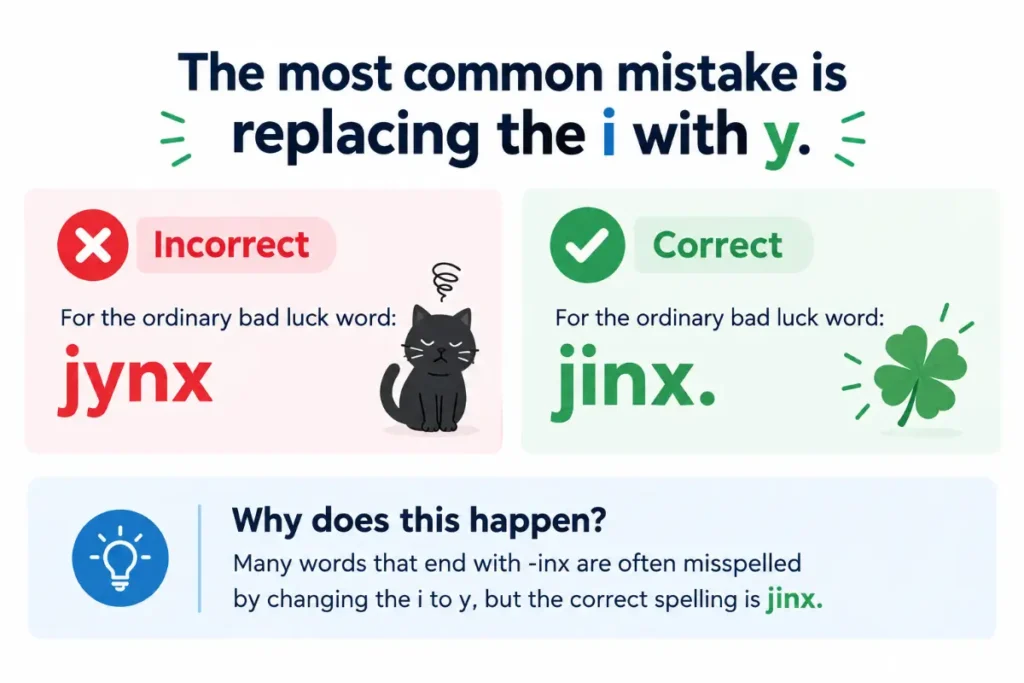
Using Jynx For Bad Luck
Incorrect in ordinary English:
I don’t want to Jynx our chances.
Correct:
I don’t want to jinx our chances.
The capital letter and y spelling make the word look like a proper name. If you mean bad luck, use lowercase jinx.
Using Jinx For The Pokémon
If you are naming the Pokémon, the official spelling is Jynx.
Incorrect:
I found a Jinx card.
Correct:
I found a Jynx card.
The proper name uses a capital J and y.
Treating Jynx As A General English Variant
Jynx should not be presented as a normal alternative spelling for jinx. The two forms have distinct modern uses.
This is a semantic confusion rather than a simple typo. The reader needs context to understand which meaning you intend.
Confusing Jinx With Jink
Jink is a separate English word. It can refer to a quick evasive movement and has its own history and usage. Dictionary sources specifically distinguish jink from jinx.
So changing the final letter does not create another spelling of the same word.
Writing A Proper Name In Lowercase
If you are talking about the Pokémon, write Jynx with a capital J.
Proper nouns normally receive capitalization because they identify a specific person, place, character, organization, product, or other named entity.
Pronunciation Guide
The standard English word jinx is pronounced /dʒɪŋks/. Dictionary sources give this pronunciation for American and British English.
A simple pronunciation guide is:
JINGKS
The word has one syllable.
The beginning sounds like the j in jump. The middle contains the short i sound found in sit. The ending has the ng sound followed by the k and s sounds.
Jynx is normally pronounced in essentially the same way when referring to the Pokémon. The spelling changes, but the pronunciation does not create a reliable spoken distinction for most speakers.
That creates an interesting problem for learners. If someone says the word aloud, you may not know which spelling they mean. You need the context to identify the intended word.
For example, if someone says:
I don’t want to jinx it.
The context clearly points to the ordinary English word.
If someone says:
Jynx is my favorite Pokémon.
The context identifies the proper name.
When spelling from sound, remember the meaning before choosing the letters.
Etymology And Word Origin
The history of jinx is more interesting than its modern spelling might suggest.
Dictionary sources identify jinx as an Americanism first recorded around 1910 to 1915. They also describe a possible connection with Latin jynx, the name of the wryneck bird, which had associations with divination and magic. The deeper Latin form is connected with Greek terminology involving the bird.
The exact historical path is not presented as completely certain. That matters because word histories sometimes involve several stages of borrowing, spelling change, and popular reinterpretation.
The modern English word developed its familiar association with bad luck. From there, it gained both noun and verb uses.
As a noun, a jinx can be something or someone believed to cause bad luck.
As a verb, to jinx something means to bring or seem to bring bad luck to it.
The Pokémon name Jynx uses a spelling that is visually related to this older word history, but its status today is different because it functions as a proper name.
Regional Usage
American English
Jinx is a standard American English word. It is common in everyday speech and writing, especially in conversations about sports, predictions, luck, and unfortunate events. Dictionary sources specifically identify the word as an Americanism in its historical development.
Jynx is used as a proper name when referring to the Pokémon.
There is no ordinary American English rule that treats Jynx as an alternative spelling of jinx.
British English
British English also uses jinx as a noun and verb. The meaning remains connected with bad luck and the act of bringing bad luck to someone or something. Dictionary sources list the word in British usage as well.
The Pokémon name remains Jynx.
Australian English
Australian English follows the same basic distinction. Jinx is used as the ordinary English word, while Jynx can refer to the Pokémon or another specific proper name.
There is no major Australian spelling rule that turns the everyday word into Jynx.
Canadian English
Canadian English also uses jinx as the standard ordinary spelling. The specialized name Jynx remains capitalized when it identifies the Pokémon.
The difference is therefore based on meaning and naming rather than a regional spelling preference.
Grammar Rules And Part Of Speech
Jinx has two major grammatical roles.
Jinx As A Noun
As a noun, jinx refers to a person, thing, or influence associated with bad luck.
For example:
The team believes the stadium is a jinx.
In this sentence, jinx functions as a noun because it names the supposed source of bad luck.
You can also use it with an article.
He thinks I’m a jinx.
She called the old building a jinx.
The plural form is jinxes.
Several jinxes seemed to follow the team throughout the season.
Jinx As A Verb
Jinx can also function as a verb.
For example:
I hope I don’t jinx it.
Here jinx is an action. The speaker believes that talking about the situation or behaving in a certain way might cause bad luck.
The verb can take an object.
Don’t jinx the plan.
She jinxed the game by predicting an easy win.
The common forms include jinxes, jinxed, and jinxing. Dictionary sources list these standard forms.
Jinx As An Interjection
There is also a familiar conversational use.
Two people may say the same thing at the same moment. One person can say:
Jinx.
This playful use is especially common among children and in casual conversation. It is different from the bad luck meaning, although both uses belong to the same modern word.
Jynx As A Proper Noun
Jynx does not normally function as a general English noun or verb. When used as the Pokémon name, it is a proper noun.
That means you should capitalize it.
Jynx appeared in my game.
The player chose Jynx.
Using a lowercase form in this context can look like a spelling error because the official name is capitalized.
Real Life Usage Examples
Daily Conversation
I don’t want to jinx our plans before everything is confirmed.
Please don’t jinx it. We’re almost there.
These examples show how naturally the word appears in casual American conversation.
Workplace Communication
I don’t want to jinx the project by celebrating before the final approval.
The manager joked that announcing the launch too early might jinx the schedule.
The word can work in workplace communication when the tone is relaxed. In highly formal writing, a more direct expression such as create a risk or cause a problem may fit better.
Academic Writing
The researchers would not normally use jinx in a serious academic claim unless they were discussing superstition, language, culture, or popular belief.
For example:
The study examines how athletes use the idea of a jinx to describe perceived bad luck.
The article discusses the cultural role of luck and the belief that speaking about success can jinx an outcome.
Here the word belongs because the subject itself concerns the concept.
News Writing
Sports journalism uses jinx especially often because athletes and fans frequently discuss luck and predictions.
A headline or article may describe fans as worried about jinxing a winning streak.
News writing can also use the verb in a direct quotation or informal sports context.
Literature And Storytelling
Fiction can use jinx to create a sense of superstition or tension.
She feared that saying the plan aloud would jinx their chances.
Everyone in the village believed the abandoned house was a jinx.
The word works well in storytelling because it can suggest fear, uncertainty, superstition, or playful belief without needing a long explanation.
Related And Confused Terms
Curse
A curse usually suggests a stronger or more deliberate supernatural force. A jinx can be lighter, more casual, or even humorous.
Bad Luck
Bad luck is the plainest expression for an unfortunate outcome. Jinx has an added sense of a person, thing, or action being linked to that bad fortune.
Omen
An omen is something believed to predict a future event. A jinx is generally associated with causing or bringing bad luck.
Superstition
Superstition is a belief or practice that connects events in ways not supported by ordinary evidence. A jinx can be part of a superstition.
Hex
Hex can mean a magical spell intended to cause harm or bad fortune. It generally sounds stronger and more supernatural than jinx.
Curse
Curse and jinx overlap in some contexts, but curse can suggest a deliberate act of placing supernatural harm on someone.
Jink
Jink is a different word involving a quick evasive movement. It should not be treated as another spelling of jinx.
Lucky Charm
A lucky charm is associated with bringing good luck rather than bad luck. It works as a useful conceptual contrast with a jinx.
These related terms show why meaning matters. The closest word is not always the best replacement because each expression carries its own tone and idea.
Is Jynx Ever A Misspelling?
If someone writes Jynx when they simply mean bad luck, it is best treated as a spelling error in ordinary English.
For example:
I hope I don’t Jynx the team.
In a normal sentence about luck, the standard form is:
I hope I don’t jinx the team.
However, calling Jynx a misspelling without considering context would be too broad. If the writer means the Pokémon, Jynx is exactly the intended spelling.
This is an important editing principle. You should never judge a spelling only by how it looks. Meaning and context matter.
A spellchecker may identify one form as unusual in a particular sentence, but automated tools cannot always determine the intended proper name. A human reader can usually resolve the issue from context.
Why The Spelling Matters
A single letter can change the identity of a word.
Compare:
I hope I don’t jinx the game.
Jynx is a Pokémon.
The first sentence describes an action involving perceived bad luck. The second identifies a fictional character.
This is similar to many English words and proper names that share sounds but differ in spelling and meaning. Context supplies the missing information.
For students, this distinction is especially useful in written work. If you are describing superstition, sports, luck, or an unlucky event, lowercase jinx is the natural choice.
If you are discussing Pokémon, use Jynx.
For editors, the capitalization is a useful clue. A capital J signals that the writer may be referring to a proper name rather than the ordinary English word.
Expert Editor Insight
A professional editor would not automatically mark Jynx as wrong because the intended meaning matters first. In a sentence about luck, jinx is the expected English form. In a sentence about Pokémon, Jynx is the correct proper name. Spelling tools may flag an unfamiliar proper name or suggest a familiar vocabulary word, but they do not always understand the context behind the choice. The best editing habit is to read the whole sentence before changing the spelling.
Key Takeaways
- Jinx is the standard English word for an unlucky influence or supposed source of bad luck.
- Jynx isn’t the standard spelling for that ordinary meaning.
- Jinx can function as both a noun and a verb.
- The noun can describe a person object or situation associated with bad luck.
- The verb can mean to bring or supposedly bring bad luck.
- Don’t jinx it is a common conversational expression.
- Jinx is pronounced /dʒɪŋks/ and has one syllable.
- Jynx can appear as a proper name or creative spelling without becoming the standard English vocabulary form.
- The word is common across American British Canadian and Australian English.
- For ordinary writing choose jinx.
Conclusion
jynx vs jinx is mainly a question of context rather than a simple case of right spelling and wrong spelling. Jinx is the standard English word for a person, thing, or influence associated with bad luck and can also function as a verb. Jynx is a proper name used for the Pokémon.
The two forms are easy to confuse because they look nearly identical and are generally pronounced the same. Still, the y and capital letter in Jynx signal a specific name. The lowercase i in jinx belongs to the ordinary English vocabulary word.
The easiest editing trick is to check the meaning before checking the letters. If you are talking about bad luck, use jinx. If you are naming the Pokémon, use Jynx. That quick context check will keep the two forms separate.
FAQs
Is Jynx a correct spelling of jinx?
Jynx is a correct spelling for a proper name such as the Pokémon Jynx, but it is not the standard spelling of the ordinary English word connected with bad luck. For that meaning, use lowercase jinx. The two forms look similar and sound alike, but their modern uses are different.
What does jinx mean?
Jinx can be a noun meaning a person, thing, or influence believed to bring bad luck. It can also be a verb meaning to bring bad luck to someone or something. In casual conversation, people may also say jinx when two people say the same thing at the same time.
What is Jynx in Pokémon?
Jynx is a Pokémon and is officially written with a capital J and a y. The official Pokédex lists Jynx as Pokémon number 124. Pokémon trading card databases also consistently use the spelling Jynx for the character.
How do you pronounce jinx?
Jinx is pronounced /dʒɪŋks/. An easy approximation is JINGKS. It has one syllable, with the vowel sound similar to the short i in sit. The Pokémon name Jynx is normally pronounced in essentially the same way, so you usually need context to know which spelling the speaker intends.
Can jinx be used as a verb?
Yes. Jinx can function as a verb meaning to bring bad luck to something or someone. For example, you can say I don’t want to jinx our chances. The verb can appear in forms such as jinxes, jinxed, and jinxing. This verb use is common in casual speech, especially around sports, predictions, and uncertain outcomes.
Is jinx appropriate in formal writing?
Jinx is a standard English word, but its suitability depends on the subject and tone. It works naturally in formal writing that discusses superstition, culture, language, sports, or popular belief. In a highly technical report, a more precise term may be better if you are describing an actual cause rather than a belief about bad luck.
Why do people confuse Jynx and jinx?
The two forms are easy to confuse because they look almost identical and are generally pronounced alike. The main spelling difference is the vowel in the middle. The confusion also increases when people know the Pokémon name but need the ordinary English word in another context. Meaning and capitalization usually provide the clearest clues.
Which spelling should I use for bad luck?
Use lowercase jinx when you mean bad luck, something believed to cause bad luck, or the act of bringing bad luck to someone or something. Use capitalized Jynx when referring to the Pokémon. A simple editing test is to ask what the word names in your sentence. If it describes bad luck, jinx is the standard choice.
