
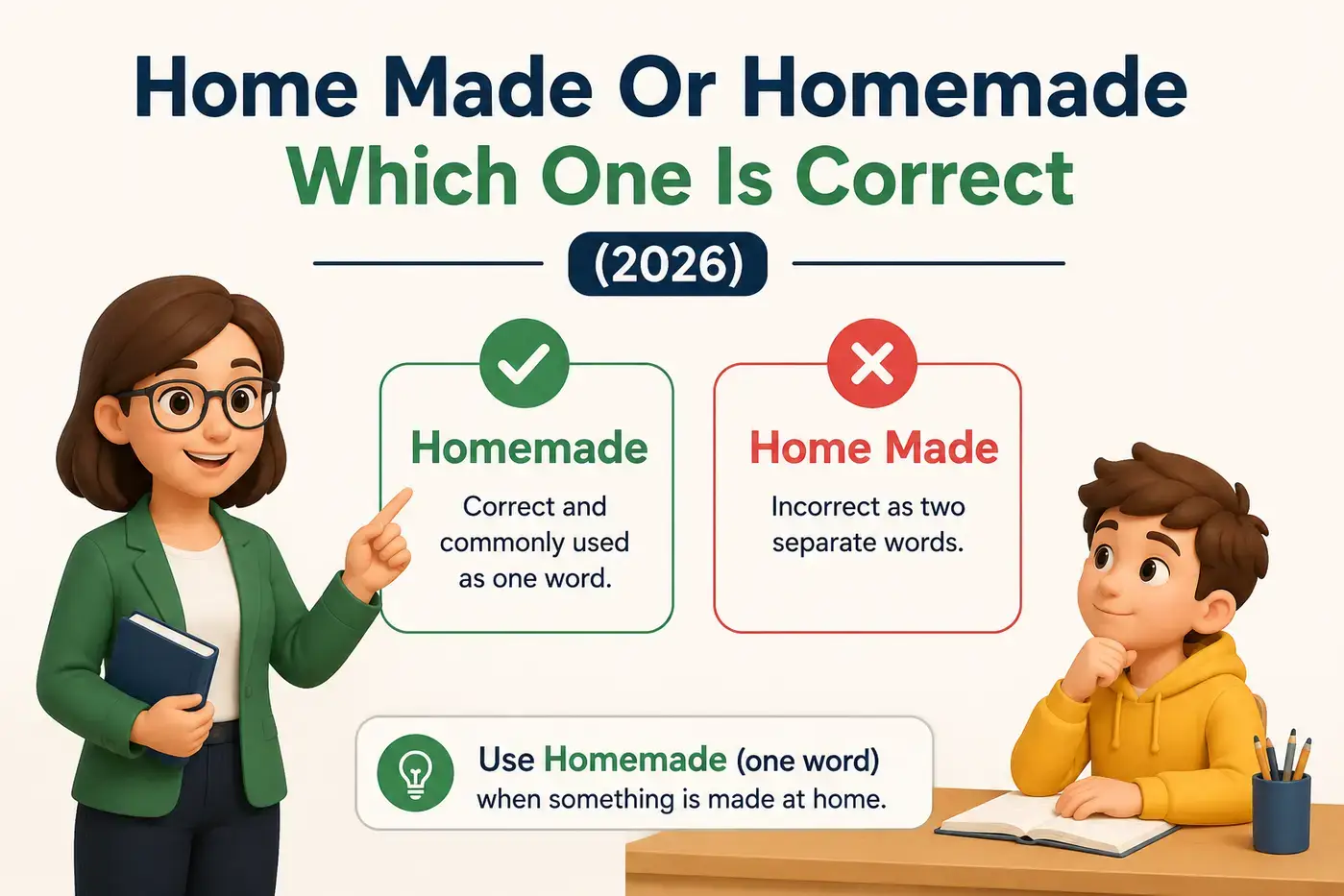
home made or homemade can look like a small spelling question, but the answer depends on how the phrase works in a sentence. Homemade is the standard form when you mean something made at home rather than commercially produced. The one word form is especially common when the expression works as an adjective before a noun or describes something prepared at home.
The confusion comes from the fact that English often combines two words into a single compound word over time. Home and made can function separately in other situations, so seeing both forms can make the choice feel less obvious. Context matters, but the standard adjective for food crafts products and similar things is homemade.
You’ll often see this word in phrases such as homemade bread, homemade cookies, homemade soup, and homemade gifts. This guide explains the meaning, spelling, grammar, pronunciation, word history, regional usage, common mistakes, and natural examples. It also shows when home and made should remain separate words so you can make the right choice without guessing.

Quick Definition
Homemade is the standard one word spelling when you describe something made at home rather than bought ready made. It commonly works as an adjective before a noun or after a linking verb. The separate phrase home made can occur in specific grammatical contexts but is not normally the preferred spelling for the adjective.
Quick Answer
Homemade is the standard spelling when the word describes something produced at home.
For example, you can write:
She baked homemade bread for breakfast.
The word homemade describes bread and tells us that the bread was made at home.
The separate words home and made can still appear in a sentence when they perform different grammatical jobs. For example:
The cake was made at home.
Here made is the verb and at home is a separate phrase. You would not normally replace that construction with home made.
Comparison Table
| Form | Meaning | Part of Speech | Origin | Usage Frequency | Formality | Common Contexts | Example |
|---|---|---|---|---|---|---|---|
| Homemade | Made at home rather than commercially | Adjective | Compound formed from home and made | Very common | Neutral | Food, crafts, gifts, products, personal projects | She brought homemade cookies. |
| Home made | Usually a nonpreferred form when intended as the adjective | Two separate words | Home and made functioning separately | Less common for the adjective | Context dependent | Sentences where home and made have separate grammatical roles | The bread was made at home. |
The key point is that these forms are not always interchangeable. Homemade is a compound adjective. The phrase made at home contains a verb and a prepositional phrase. Those structures may express a similar idea while working differently in a sentence.
Meaning And Definition
Meaning Of The Separate Form
The two words home and made can appear next to each other in English when they have separate grammatical functions. However, that does not automatically make home made a standard alternative spelling of the adjective homemade.
Consider this sentence:
The bread was made at home.
Made is the past participle of make. It forms part of the passive verb phrase was made. At home tells us where the action happened.
Now compare it with:
She served homemade bread.
Here homemade describes the bread. It functions as an adjective.
The difference is grammatical rather than simply visual. The first sentence describes an action and its location. The second uses a compound adjective to describe the bread itself.
That distinction helps explain why replacing one form with the other can create an awkward sentence.
Meaning Of Homemade
Homemade means made at home rather than produced by a commercial manufacturer or purchased as a ready made product.
The word commonly describes food.
My grandmother makes homemade jam.
It can also describe objects.
He gave me a homemade card.
You can use it for clothing crafts decorations sauces desserts meals and many other things.
The word often carries a positive personal association. It can suggest care personal effort familiarity or a traditional method of preparation. Still, the basic dictionary meaning is straightforward. Something homemade is made at home.
The word does not always mean that a person made the item entirely from raw materials. For example, someone might use packaged ingredients to make homemade cookies. The important point is that the finished product was prepared at home rather than purchased as a finished commercial product.
Key Differences Explained
- Spelling. Homemade is normally written as one word when it functions as the adjective meaning made at home.
- Grammar. Homemade functions as an adjective. Made is usually a verb form when it appears in a construction such as was made at home.
- Meaning. Homemade describes an item produced at home. Made at home describes the action and location more explicitly.
- Sentence structure. Homemade can appear directly before a noun. Made at home normally follows a verb.
- Usage. Homemade is common in food descriptions product descriptions personal writing advertising and everyday conversation.
- Formality. Homemade is neutral and works in casual as well as formal writing.
- Pronunciation. Homemade is generally pronounced as a single compound word with the main stress on home.
- Regional usage. American British Canadian and Australian English all use homemade as the standard compound adjective.
The biggest mistake is treating every appearance of home and made as a spelling question. Sometimes the words should be separate because they have separate grammatical functions.
Which Form Is Correct?
Homemade is the standard spelling for the adjective meaning made at home.
The reason is simple. English has developed many compound words by combining two words that originally appeared separately. Homemade is one of these established compounds.
You can use it before a noun.
She sells homemade candles.
You can also use it after a linking verb.
The candles are homemade.
In both examples the word describes the candles.
However, you should not change every instance of made at home into homemade. Consider:
The cookies were made at home.
This sentence is already correct and natural. Made is part of the verb phrase were made. At home is a prepositional phrase explaining where the cookies were prepared.
You could rewrite it as:
The cookies were homemade.
Both sentences work, but they have slightly different structures.
The first emphasizes the action and location. The second gives the cookies a descriptive quality.
This is the kind of distinction professional editing focuses on. Correct writing depends on grammar and meaning rather than simply choosing the shortest form.
When To Use Homemade
Use homemade when the word directly describes an item that someone made at home.
Here are common patterns.
Before A Noun
This is one of the most common uses.
She brought homemade cookies.
We ate homemade pizza.
He sells homemade candles.
They served homemade soup.
The adjective comes before the noun it modifies.
After A Linking Verb
Homemade can also appear after verbs such as is are was and were.
The bread is homemade.
These decorations are homemade.
The sauce was homemade.
The gifts were homemade.
In these sentences homemade remains an adjective. It describes the subject.
In Product Descriptions
Homemade often appears in descriptions of food crafts and personal creations.
Our homemade strawberry jam contains fresh fruit.
She sells homemade greeting cards at the local market.
The word can help distinguish personally prepared products from factory produced products.
When To Keep The Words Separate
The separate construction made at home is often the natural choice when you are describing an action.
Compare these examples.
The cake was made at home.
The cake was homemade.
Both sentences are correct.
The first focuses on where the cake was made. The second describes the cake as a homemade product.
Another example makes the difference clearer.
My mother made the cookies at home.
My mother made homemade cookies.
In the first sentence made is the main verb. Home appears inside the phrase at home.
In the second sentence homemade modifies cookies.
The choice depends on what you want the sentence to do.

Sentence Examples
Here are ten natural examples using the standard compound adjective.
- We had homemade pancakes for breakfast.
- My aunt brought a homemade pie to the family dinner.
- She prefers homemade soup to canned soup.
- The children made homemade cards for their teachers.
- He sells homemade candles at the weekend market.
- I love the smell of homemade bread in the kitchen.
- They served homemade ice cream after dinner.
- She gave me a homemade gift for my birthday.
- The restaurant is known for its homemade pasta.
- We made homemade decorations for the holiday party.
Now compare these examples with the separate construction.
- The cookies were made at home.
- My sister made the cake at home.
- The decorations were made at home by the students.
- We made the sauce at home instead of buying it.
- The bread was made at home that morning.
These examples show why the two forms should not be treated as simple spelling variants. Homemade is a compound adjective. Made at home is a grammatical phrase containing a verb and a location phrase.
Common Mistakes And Misspellings
Writing Home Made As The Adjective
A common error is writing home made when the intended meaning is made at home.
Incorrect for standard adjective usage:
She sells home made bread.
Preferred:
She sells homemade bread.
The problem is not the meaning. Most readers will understand the sentence. The issue is standard compound spelling.
Confusing Homemade With Handmade
These words are related but not identical.
Homemade means made at home.
Handmade means made by hand rather than primarily by machine.
A handmade item can be produced in a workshop or factory. It does not have to be made at home.
Confusing Homemade With Homegrown
Homegrown usually means grown at home or locally. It is commonly used for fruits vegetables herbs and similar products.
Homemade describes something made or prepared at home.
You might have homegrown tomatoes and use them to make homemade salsa.
Using Homemade For Everything Made Personally
The word specifically connects the item with home production.
A product made in a professional workshop by an individual artisan may be handmade but not homemade.
That distinction matters in product descriptions.
Using A Hyphen Unnecessarily
You may sometimes see home made written with a hyphen in informal or older material. Modern standard usage generally favors the single word homemade for the adjective.
Pronunciation Guide
Homemade is commonly pronounced /ˌhoʊmˈmeɪd/ in American English.
You can break it into two sound parts:
home made
The word has two syllables. The main stress usually falls on made.
An easy pronunciation guide is:
hohm MAYD
The pronunciation reflects the two original words quite clearly. That can make the spelling feel intuitive once you have learned the compound form.
A common mistake is to overpronounce the word as though it contains a separate pause between home and made. In natural speech it usually flows as one compound adjective.
Another point worth remembering is that homemade and home made may sound almost identical in ordinary speech. The difference is mainly visible in writing. That is one reason the spelling question appears so often.
Etymology And Word Origin
Homemade is a compound formed from home and made. The two words have much older histories in English, but their combination developed as a natural way to describe things produced in the home.
Home comes from Old English forms related to a dwelling or place where someone lives. Made comes from the verb make, whose history also reaches back through older forms of English and Germanic languages.
As English developed, compound words became an important part of its vocabulary. Writers and speakers began combining familiar words to create concise descriptions.
The same pattern appears in many everyday compounds.
Homemade follows this broader English tendency to turn a phrase into a compact descriptive word when the combination becomes established and useful.
Its modern meaning remains close to the literal meanings of its parts. Home provides the setting. Made identifies the act of production.
Regional Usage
American English
Homemade is standard American English. It appears often in everyday conversation food descriptions recipes product descriptions family stories and marketing language.
Americans commonly use the word for food prepared in a private kitchen. It can also describe crafts decorations cards gifts and other personal creations.
The phrase made at home is also common when the sentence focuses on the act of making something.
British English
British English uses homemade as the standard compound adjective too. There is no major spelling difference between American and British English in this word.
British speakers may use homemade for food crafts and other things produced at home. The phrase made at home remains useful when the writer wants to emphasize the location of the action.
Australian English
Australian English also uses homemade as the standard form. The word works naturally in food writing everyday speech product descriptions and personal communication.
There is no major Australian spelling variant that changes the basic rule.
Canadian English
Canadian English follows the same standard spelling. Homemade is written as one word when it functions as the adjective.
Canadian writers may use both homemade and made at home depending on sentence structure and intended emphasis.
Grammar Rules And Part Of Speech
Homemade is primarily an adjective.
An adjective describes a noun or provides information about the subject of a sentence.
Consider:
She baked homemade bread.
Homemade describes bread.
Now consider:
The bread is homemade.
Homemade describes the bread after the linking verb is.
This makes the word flexible in sentence position.
Before A Noun
The most familiar pattern is:
homemade + noun
Examples include:
homemade bread
homemade soup
After A Linking Verb
You can also use the word after be verbs.
The soup is homemade.
The cookies were homemade.
The decorations are homemade.
In these cases the word still acts as an adjective.
Homemade As A Descriptive Modifier
Homemade can describe the nature or source of an item.
She brought a homemade cake.
The adjective gives the reader useful information before they reach the rest of the sentence.
Punctuation
Homemade normally does not require special punctuation.
You do not need a comma simply because the word describes something.
For example:
We enjoyed her homemade cookies.
The adjective sits naturally before the noun.
If the word appears within a larger sentence structure, punctuation follows the normal rules of that sentence rather than any special rule for homemade.
Homemade And Made At Home
These expressions are closely related but not identical in structure.
Compare:
The soup was made at home.
The soup was homemade.
The first sentence tells us about the preparation. The second gives the soup a descriptive label.
You can think of the distinction this way.
Made at home answers the question Where was it made?
Homemade answers the question What kind of product is it?
This is not an absolute rule for every sentence, but it is a useful practical guide.
For example:
I made this bread at home.
The speaker is emphasizing the place where the action happened.
I made this homemade bread for the party.
Now homemade describes the bread.
Both expressions can appear in the same sentence too.
I made this homemade bread at home.
This sentence is grammatically possible, although the repetition of the same idea may be unnecessary depending on the context.
A cleaner version might be:
I made this homemade bread for the party.
Good editing often means removing information that the reader already understands.
Real Life Usage Examples
Daily Conversation
I made some homemade soup for lunch.
Do you want to try my homemade cookies?
These examples sound natural because homemade is common in ordinary speech.
Email And Workplace Communication
We’re bringing homemade desserts to the office celebration.
The team prepared homemade decorations for the community event.
In workplace communication the word can sound warm and personal while remaining perfectly neutral.
Academic Writing
The study examined the nutritional differences between homemade meals and commercially prepared meals.
Researchers recorded how often participants consumed homemade food during the study period.
Academic writing can use the word naturally when the subject requires a distinction between food prepared at home and commercially produced food.
News Writing
The community group served homemade meals to local families.
The market featured homemade crafts from artists in the area.
News writing may use homemade when describing community events local products or food.
Literature And Storytelling
The kitchen smelled of homemade bread and fresh coffee.
She remembered the homemade quilts her grandmother kept in the old bedroom.
In storytelling the word can carry a sense of familiarity and personal history without needing extra explanation.
Related And Confused Terms
Handmade
Handmade means made by hand. It focuses on the method of production rather than the location.
A handmade chair can be made in a workshop.
Homegrown
Homegrown means grown at home or produced locally. It commonly describes food plants and agricultural products.
Homemade
Homemade describes something made at home. It often applies to food crafts gifts and personal creations.
Commercial
Commercial describes something produced or sold as part of business activity. It often contrasts with homemade in food and product contexts.
Store Bought
Store bought means purchased from a store rather than made at home. It is a common everyday alternative when comparing products.
Factory Made
Factory made describes something manufactured in a factory. It emphasizes industrial production.
Ready Made
Ready made describes something prepared in advance and available for immediate use or purchase.
Do It Yourself
Do it yourself refers to making repairing or building something personally instead of paying someone else to do it. A do it yourself project can be completed at home but does not have to be.
These terms overlap in some situations, but each highlights a different part of the production process.
Homemade In Food Writing
Food is probably the context where this word feels most familiar.
You’ll see it used with meals ingredients sauces desserts and baked goods.
Examples include homemade bread, homemade soup, homemade cookies, homemade jam, homemade pasta, and homemade pizza.
The word can suggest that food was prepared in a personal kitchen rather than purchased as a finished commercial product.
Still, homemade does not automatically mean healthier. It does not guarantee that a dish contains fewer calories, less sugar, or fewer additives. The word describes where or how the food was prepared, not its nutritional value.
That distinction is useful in careful writing.
For example:
This is homemade cake.
The sentence tells us about preparation.
It does not tell us anything specific about ingredients or nutrition.
Homemade In Product Descriptions
Small businesses and individual sellers often use homemade to describe candles, soaps, decorations, cards, baked goods, crafts, and gifts.
The word can communicate personal production and a nonindustrial setting.
However, writers should use it accurately. If a product is manufactured commercially, calling it homemade can give customers the wrong impression.
For professional product descriptions, precise language matters. Handmade, locally made, artisan made, and homemade can describe different production methods or settings.
Choosing the correct term makes the description more trustworthy.
Homemade In Formal Writing
Homemade is perfectly acceptable in formal writing when the meaning fits the subject.
You can use it in:
- Academic papers.
- Business reports.
- Professional emails.
- News articles.
- Research writing.
- Product descriptions.
- Public information materials.
The word itself is not informal or slang. Its tone depends more on the subject and sentence around it.
For example:
The researchers compared homemade meals with commercially prepared meals.
That sentence can appear naturally in serious academic writing.

Expert Editor Insight
An experienced editor would usually choose homemade when the word acts as an adjective meaning made at home. The most common confusion comes from the fact that home and made can also appear separately in the perfectly correct phrase made at home. Grammar tools may flag a spelling variation, but they cannot always understand the writer’s intended sentence structure. A useful editing test is to ask what the word is doing. If it directly describes a noun, homemade is usually the right form. If made functions as the verb and at home tells you the location, keep the words separate.
Conclusion
home made or homemade has a clear answer for standard adjective usage. Homemade is the preferred one word form when you describe something made at home. You can use it before a noun as in homemade bread or after a linking verb as in the bread is homemade.
The separate phrase made at home is also correct, but it serves a different grammatical purpose. It describes an action and tells the reader where that action happened. This distinction explains why both forms can appear in correct English without being interchangeable.
A simple editing trick is to look at the role of the word. If you need an adjective that describes an item, choose homemade. If made is functioning as the verb and at home explains the location, keep the phrase separate. That quick check will help you choose naturally and accurately.
FAQs
Is homemade one word or two?
Homemade is normally written as one word when it functions as an adjective meaning made at home. For example, homemade bread and homemade cookies use the standard compound spelling. The phrase made at home is also correct, but it has a different grammatical structure. In that phrase, made functions as a verb while at home identifies the location.
Is home made incorrect?
Home made is generally not the preferred spelling when you intend the established adjective meaning made at home. Standard English uses homemade for that purpose. However, home and made can appear separately in sentences where they perform different grammatical functions. For example, the bread was made at home is completely correct and should remain separate.
What does homemade mean?
Homemade means made at home rather than produced commercially or purchased as a finished product. It commonly describes food such as bread, cookies, soup, and jam, but it can also describe crafts, decorations, gifts, and other personal creations. The word focuses on the place or setting of production rather than automatically describing quality, health, or ingredients.
Can homemade be used before a noun?
Yes. This is one of its most common grammatical uses. Homemade works as an adjective before nouns such as bread, soup, cookies, candles, gifts, and decorations. For example, you can write, She brought homemade cookies. The word describes the cookies and tells the reader that they were made at home.
Can homemade come after a verb?
Yes. Homemade can appear after a linking verb such as is, are, was, or were. For example, The soup is homemade. In this sentence homemade describes the soup. The word remains an adjective even though it appears after the noun and linking verb rather than directly before the noun.
Is homemade formal or informal?
Homemade is neutral English and works in both informal and formal writing. You can use it in everyday conversation, professional communication, academic writing, journalism, and product descriptions. Its suitability depends on the subject rather than the level of formality. For example, researchers can discuss homemade meals in an academic paper without creating a stylistic problem.
What is the difference between homemade and handmade?
Homemade focuses on where something was made, usually in a home. Handmade focuses on how something was made, specifically by hand. A handmade item can come from a professional workshop or commercial setting. A homemade item can involve tools or equipment. The two words sometimes overlap, but they describe different aspects of production.
Is homemade the same as made at home?
They can communicate a similar basic idea, but they have different grammatical structures. Homemade is a compound adjective that describes an item. Made at home is a verb phrase followed by a location phrase. The bread is homemade and the bread was made at home are both correct, but they emphasize the idea differently.
