
hight or height can be confusing because the two forms look almost identical and sound the same in some historical and modern dictionary entries. If you mean the distance from the bottom of something to the top, the standard modern spelling is height. The spelling hight is not the normal modern form for this meaning.
The confusion makes sense because English spelling often preserves older forms long after pronunciation changes. Height has a particularly unusual spelling because it developed from the same historical word family as high, yet its modern pronunciation is not simply high with an ending added. Modern dictionaries list height as the standard noun for physical size from bottom to top, distance above a surface, and related meanings such as the highest point or greatest degree.
The form hight does exist in English, but it has a different and largely historical story. Dictionaries record it as an archaic word meaning called or named, and some dictionaries also record it as an obsolete or nonstandard variant of height. This article explains the difference, spelling pattern, pronunciation, grammar, word history, regional usage, common mistakes, and practical examples so you can choose the right form with confidence.
Quick Definition
Height is the standard modern English noun for the distance from the bottom of something to the top or for the distance above a particular surface or level. Hight is not the standard modern spelling for this meaning. It survives mainly in archaic uses meaning called or named and in historical usage as an old variant of height.
Quick Answer
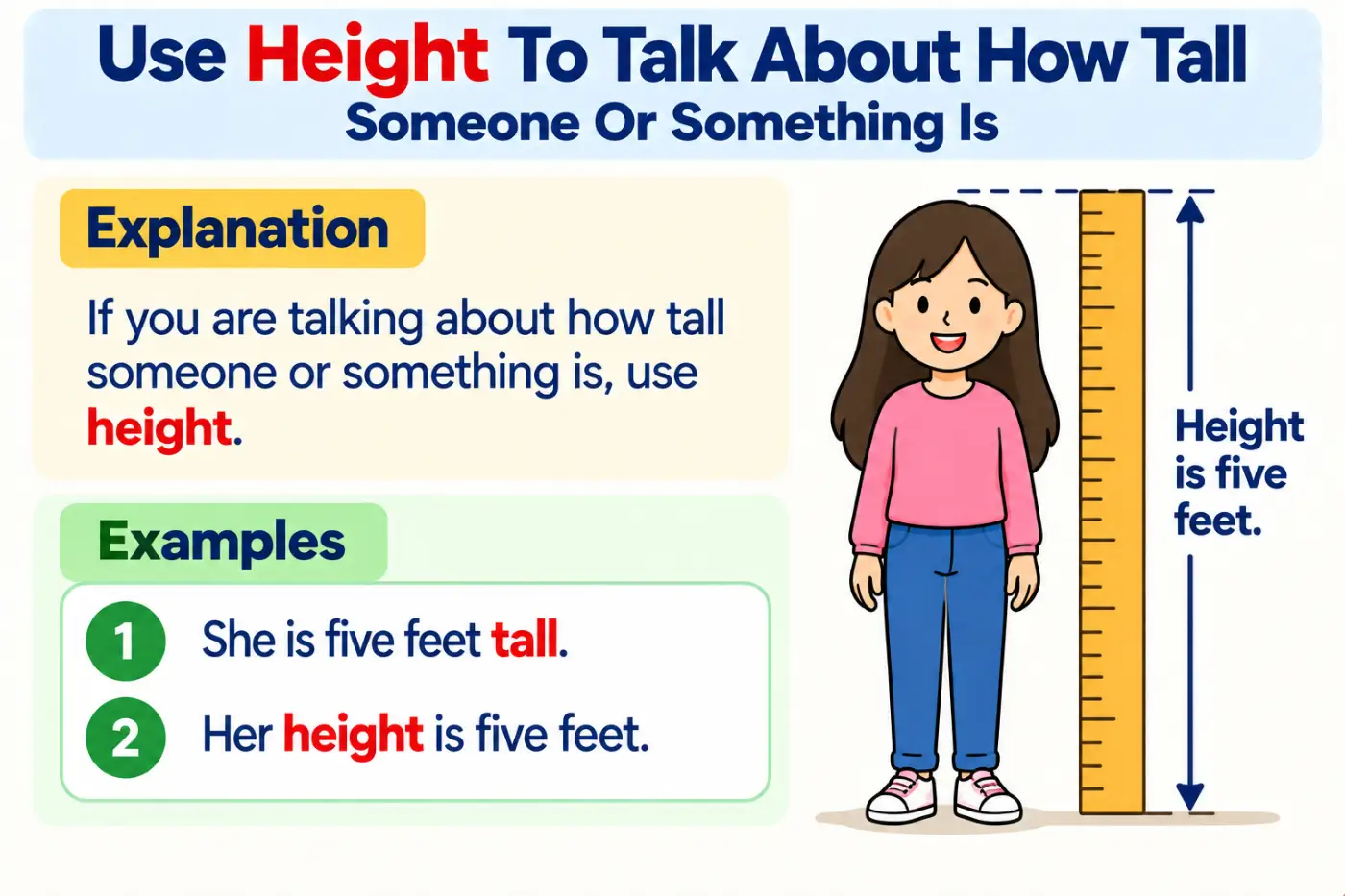
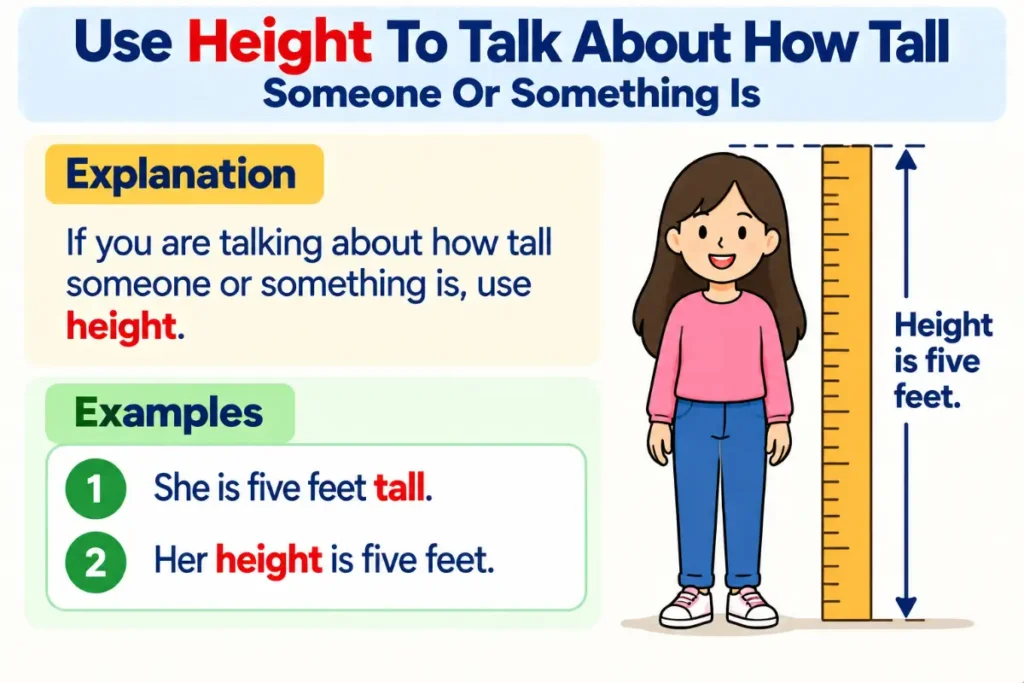
If you are talking about how tall someone or something is, use height.
For example:
She is five feet tall.
Her height is five feet.
The building has a height of 100 feet.
The modern spelling hight is not the normal choice for these meanings. It does appear in historical English and dictionaries still record some specialized archaic uses.
So if you are writing a school paper, email, article, report, application, or everyday message, choose height when you mean vertical measurement.
Comparison Table
| Form | Meaning | Part of Speech | Origin | Modern Usage | Formality | Common Contexts | Example |
|---|---|---|---|---|---|---|---|
| Height | The distance from bottom to top or the distance above a surface | Noun | Old English and Middle English word family related to high | Standard and very common | Neutral and formal | Measurements, people, buildings, mountains, objects, and abstract degrees | The height of the building is 80 feet. |
| Hight | Archaic meaning called or named. It can also appear as an obsolete form of height. | Adjective, verb, or historical noun depending on use | Old English and Middle English forms with several historical roots | Rare and mainly historical | Archaic or literary | Older literature, historical texts, and poetic language | A maiden hight Elaine. |
The table shows why calling hight simply a misspelling can be slightly misleading. If you use hight when you mean the modern noun height, it is a spelling error in that context. However, hight is also a genuine historical word with meanings recorded in dictionaries.
Meaning And Definition
Meaning Of Hight
Hight is a real English word, but its modern everyday use is extremely limited.
Historical dictionaries record hight as an archaic adjective meaning called or named. It can also appear as a verb meaning to call or name. Collins gives examples of literary constructions such as a person being hight a particular name.
For example:
A maiden hight Elaine.
In modern English, you would normally write:
A maiden named Elaine.
The older form belongs to a different stage of English. It should not be confused with the ordinary modern noun used for physical measurement.
Some dictionary sources also record hight as a historical or obsolete form of height. Dictionary.com specifically identifies hight as a nonstandard form in the context of modern American usage while also recording its historical meanings.
This distinction matters when editing old literature. If you are reading a historical poem and see hight, changing it automatically to height could destroy the original meaning.
Meaning Of Height
Height is the standard modern noun for vertical measurement.
Cambridge defines height as the distance from the top to the bottom of something or the quality of being tall. It can also describe a particular distance above a surface.
Consider these examples:
The height of the wall is six feet.
She is average height.
The plane was flying at a height of 30,000 feet.
The height of the tree surprised us.
The word can also describe an extreme point or the highest level of something.
At the height of his career, he was widely known.
The phrase height of the season refers to the point when the season is at its busiest or most intense.
Height therefore has both physical and abstract meanings. It can describe size, elevation, a high point, or the greatest degree of something.
The Key Difference Explained
The central distinction is straightforward.
- Height is the standard modern spelling. Use it when you mean the measurement from bottom to top or a related idea of elevation.
- Hight has historical meanings. In older English, it could mean called or named. Dictionaries also record it as an obsolete form related to height.
- Height is a noun. It names a measurement, quality, position, or highest point.
- Hight can have different historical grammatical roles. Depending on the historical context, it may function as an adjective or verb.
- They sound alike when pronounced as the modern measurement word. Height is pronounced /haɪt/.
- Modern writers should use height for measurements. Hight should not replace height in ordinary English.
The easiest practical rule is simple. If you can replace the word with tallness, vertical measurement, or elevation, write height.
Which Form Is Correct?
For modern standard English, height is the correct form when you mean how tall something is or how far something extends upward.
Dictionary sources consistently recognize height for this meaning. Cambridge lists it as a noun referring to the distance from the top to the bottom of something and to a particular distance above a surface. Collins gives the same basic modern meanings and traces the word to Old English forms related to high.
Hight is different. It has a legitimate place in historical English, but it is not the normal modern spelling for physical height. Collins and the American Heritage Dictionary both preserve the archaic sense of hight as called or named.
So write:
What is your height?
Not:
What is your hight?
Write:
The height of the tower is 200 feet.
Not:
The hight of the tower is 200 feet.
The second version might appear as a spelling mistake in modern writing.
Why People Misspell Height
Height is one of those English words that looks more complicated than it sounds.
You pronounce it as one syllable:
height.
The sound is /haɪt/.
The spelling contains several letters that do not map neatly onto the modern sound. This creates a memory problem for learners and fast typists.
The word is also related historically to high. That relationship can make the spelling feel logical and strange at the same time.
A person may know:
high
higher
highest
Then they see:
height
The change from the spelling of high to height is not something you can always predict from pronunciation alone. English spelling preserves historical patterns, and height is a good example.
The form hight can therefore appear as a natural spelling substitution. Someone may remember the sound and write the letters in the order that feels easiest.
Sentence Examples
Here are ten natural examples using the standard modern form.
- What is your height?
- The height of the door is seven feet.
- She measured the height of the table before buying it.
- The mountain has an impressive height above the surrounding valley.
- His height makes it easy for him to reach the top shelf.
- We need to check the height of the ceiling before installing the fan.
- The airplane reached a cruising height of several thousand feet.
- The height of the building makes the street feel much narrower.
- The athlete’s height gives him an advantage in some events.
- At the height of summer, temperatures can become extremely high.
These examples show that the noun can refer to people, buildings, furniture, aircraft, mountains, and abstract situations.
Here are examples showing hight only in its historical sense.
- In the old poem, the hero was hight Arthur.
- The maiden hight Eleanor in the medieval tale.
- The character was hight Robin in the original text.
- The knight hight Sir Thomas in the old story.
- A young prince hight Edward appears in the poem.
These examples are intentionally literary. They do not represent normal modern English. In contemporary writing, named, called, or known as would usually replace hight.
Common Mistakes And Misspellings
Writing Hight For A Measurement
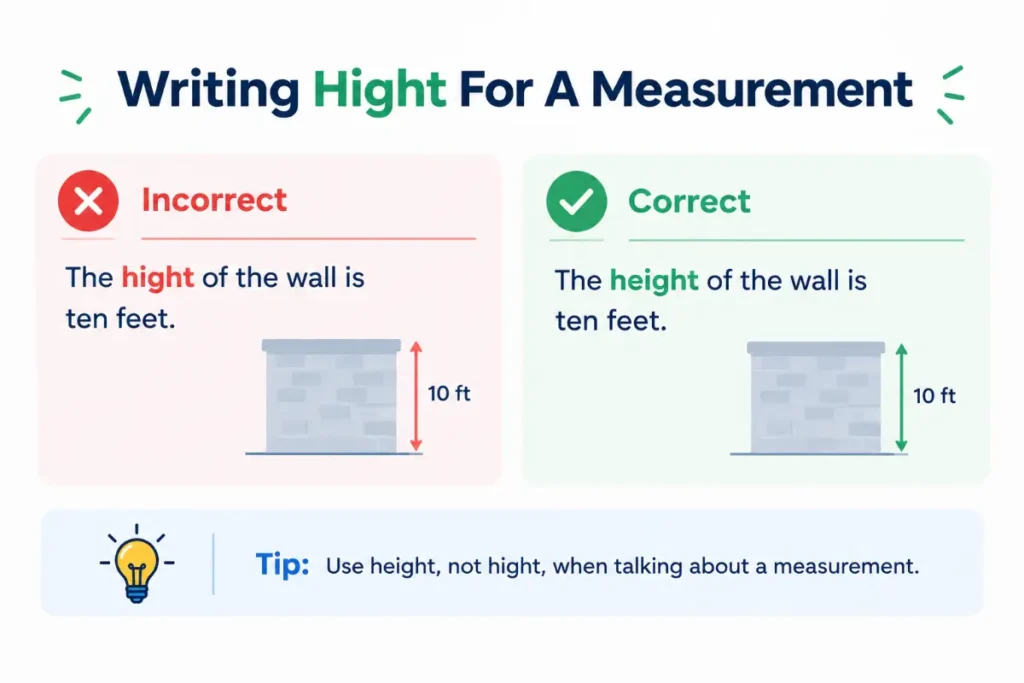
Incorrect in modern standard English:
The hight of the wall is ten feet.
Correct:
The height of the wall is ten feet.
The mistake usually comes from writing the word according to its sound rather than remembering its established spelling.
Writing Heigth
Another common spelling mistake is moving the g and h into the wrong position.
Incorrect:
The heigth of the building is impressive.
Correct:
The height of the building is impressive.
The correct sequence is h e i g h t.
Writing Heighth
Heighth appears as a nonstandard spelling in some English usage. Dictionary.com specifically notes heighth alongside hight as a nonstandard form.
Modern standard writing should use height.
Confusing Height With High
Height is a noun.
High is usually an adjective or adverb and can also function as a noun.
For example:
The building is high.
The height of the building is 100 feet.
You should not write:
The building has a high of 100 feet.
Use height after phrases such as the height of, at a height of, and measure the height.
Confusing Height With Heighth In Speech
Some speakers pronounce an additional sound in the word and then spell what they hear. This can lead to heighth.
Standard modern English uses height.
The standard pronunciation is /haɪt/.
Pronunciation Guide
Height is pronounced /haɪt/ in both standard US and UK pronunciation. Cambridge gives /haɪt/ for both varieties.
It is a one syllable word.
A simple pronunciation guide is:
hite
It rhymes with:
light
night
right
sight
tight
The pronunciation is not the same as saying high plus a separate sound. The final t is part of the word.
This creates an interesting spelling challenge. The written form has more visual complexity than the spoken form.
The word high is pronounced /haɪ/. Height adds the final t sound, producing /haɪt/. Cambridge gives high as /haɪ/ and height as /haɪt/.
One pronunciation mistake involves adding an extra syllable. Height does not have two syllables.
It is simply:
height
Not:
high it
Another issue is the nonstandard pronunciation sometimes associated with heighth. In careful standard English, use the one syllable pronunciation /haɪt/.
Etymology And Word Origin
The history of height explains much of its unusual spelling.
Etymology sources trace the word to Middle English forms such as height, heighthe, and hegthe. These developed from Old English forms including hiehþu and are connected with the Old English word heah meaning high. The suffix was used to form an abstract noun related to qualities such as width and depth.
The word originally referred to the highest part or point and eventually developed the modern sense of distance from bottom to top. Etymological sources date this measurement sense to the late thirteenth century.
The modern pronunciation with the final t developed later. Etymonline notes that the modern pronunciation was not established until the nineteenth century and that older writers used forms such as highth.
This history helps explain why the spelling may look unusual today. English spelling reflects earlier forms of the language as well as modern pronunciation.
The historical word hight has a separate and complicated history. Collins traces its archaic sense of called or named to Old English heht and the verb hatan meaning to call.
So modern height and historical hight have overlapping spelling history but should not be treated as identical words in every historical context.
Regional Usage
American English
Height is the standard form in American English for physical measurement, elevation, stature, and related abstract meanings. American dictionaries also recognize height as the normal noun.
Hight may appear in dictionaries as an archaic word or historical form, but it is not the normal choice for everyday American writing.
If you are writing a school assignment, resume, article, report, email, or social media post, use height when discussing vertical measurement.
British English
British English also uses height as the standard modern noun.
Hight survives mainly in historical, poetic, or archaic contexts. Collins lists its British use as an archaic verb meaning to name or call.
There is no modern British spelling rule that makes hight an ordinary alternative to height.
Australian English
Australian English follows the same modern spelling for the measurement word. Height is the normal form in everyday and formal communication.
Hight may appear in historical texts or literary contexts, but it is not the standard modern spelling for physical measurement.
Canadian English
Canadian English also uses height as the normal noun.
A Canadian writer would normally write:
The height of the fence is six feet.
The historical word hight has no ordinary role in modern Canadian writing when the intended meaning is physical measurement.
Grammar Rules And Part Of Speech
Height is a noun.
It names a measurement or quality rather than describing something directly.
Compare:
The building is high.
The height of the building is 100 feet.
In the first sentence, high is an adjective.
In the second sentence, height is a noun.
This distinction is one of the most useful grammar points to remember.
Height With Of
A common structure is:
the height of + noun
Examples include:
The height of the building.
The height of the tree.
This construction identifies the thing being measured.
Height With A Measurement
You can also use:
a height of + measurement
For example:
The tower has a height of 300 feet.
The aircraft was flying at a height of 20,000 feet.
The fence reaches a height of six feet.
Height In Questions
Common questions include:
How tall are you?
What is your height?
How high is the wall?
How high is the mountain?
These questions are related but not identical in grammar.
How tall usually asks about a person’s or object’s vertical size.
How high often asks about the vertical position or elevation of something.
What is your height directly asks for the measurement.
Cambridge notes that English uses nouns such as height alongside adjectives such as high and tall when discussing dimensions.
Height And Tall
Use tall mainly for people and things with a noticeable vertical shape.
He is tall.
That is a tall building.
Use height when you are naming the measurement.
His height is six feet.
The height of the building is 200 feet.
Height And High
High can describe something that extends upward or exists at an elevated position.
The shelf is high.
The wall is high.
Height names the measurement itself.
The shelf has a height of six feet.
The height of the wall is ten feet.
This noun and adjective distinction is simple but very useful.
Real Life Usage Examples
Daily Conversation
How tall is your brother?
His height is about six feet.
I need to know the height of this shelf before I buy the cabinet.
These examples sound natural in everyday American English.
Workplace Communication
Please confirm the height of the equipment before installation.
The design team needs the exact height of the doorway.
In workplace communication, precise measurement matters. Height is especially common in construction, engineering, manufacturing, interior design, transportation, and safety instructions.
Academic Writing
The researchers recorded the height of each plant at regular intervals.
The study examined the relationship between altitude and plant height.
Academic writing often uses height as a measurable variable. In these contexts, the noun has a precise technical meaning.
News Writing
The storm produced waves that reached an unusual height.
The new tower will have a height of more than 500 feet.
News writing uses the word for buildings, waves, mountains, aircraft, and other measurable subjects.
Literature And Storytelling
He stood at the height of the hill and looked across the valley.
The character had reached the height of his power.
Literary writing can also use height metaphorically. The second example does not describe physical measurement. It means the greatest level of influence or achievement.
Physical Meaning And Abstract Meaning
Height is not limited to physical measurement.
Its abstract meaning can describe the highest or most intense point of something.
For example:
At the height of her career, she received several major awards.
The phrase height of the crisis refers to the most intense period of the crisis.
The height of excitement describes a point when excitement reaches its greatest level.
You can also see the expression:
the height of absurdity
Here the word does not describe physical distance. It means an extreme or highest degree of absurdity.
This abstract use is important because it shows how English often extends physical concepts into figurative language.
Something physically high becomes a metaphor for something intense, powerful, or extreme.
Height In Measurements
Height is one of the basic measurement terms used alongside length, width, and depth.
For a box, you might measure:
length
width
height
For a person, you usually measure height from the floor to the top of the head.
For an aircraft, height can describe its distance above a surface or level. In aviation, altitude is often more precise when referring to distance above a defined reference level such as sea level.
Cambridge distinguishes height as a noun from high as an adjective and explains how English uses height for dimensions.
This makes height a useful technical term as well as an everyday word.
Height And Related Measurement Words
Height
It describes vertical extent from bottom to top or distance above a surface.
Length
Length usually describes the greatest or principal horizontal dimension of an object.
Width
Width describes how broad something is from one side to another.
Depth
Depth usually describes distance from a surface inward or from front to back.
Altitude
Altitude usually describes vertical distance above a reference level, especially sea level or the ground in technical contexts.
Elevation
Elevation describes the height of a place or object above a reference level. It is especially common for landforms and geographic locations.
Stature
Stature commonly refers to the height or build of a person and can also describe a person’s standing or importance.
Tallness
Tallness refers to the quality of being tall. It is less common in ordinary conversation than height.
These words overlap, but they are not interchangeable in every sentence.
Why Height Is Not Spelled Like High
This is one of the most common questions learners have.
High is an adjective:
The wall is high.
Height is a noun:
The height of the wall is ten feet.
The spelling difference comes from the history of the words. Height developed through older forms that included Middle English heighthe and Old English hiehþu. Its history is related to high but does not simply involve adding a modern ending to the present day spelling of high.
English has many word families that do not follow a perfectly predictable spelling pattern. This is one of them.
The safest approach is not to try to reconstruct the spelling every time. Learn the pair together:
high → height
Then practice them in real sentences.
The building is high.
The building has great height.
That connection makes the spelling easier to remember.
A Useful Memory Trick
If you often write hight by mistake, use a simple visual memory trick.
Think:
height = high + t
This is not a historical explanation of how the word was formed. It is simply a practical spelling aid.
You can also remember the phrase:
High has height.
For example:
The tree is high.
The tree has great height.
Another useful trick is to remember that the correct word contains eigh.
Height.
Weight.
Eight.
These words share a familiar letter pattern.
You should not expect every word with eigh to sound the same. English spelling is full of exceptions. Still, connecting height with a familiar spelling pattern can make the word easier to remember.
Expert Editor Insight
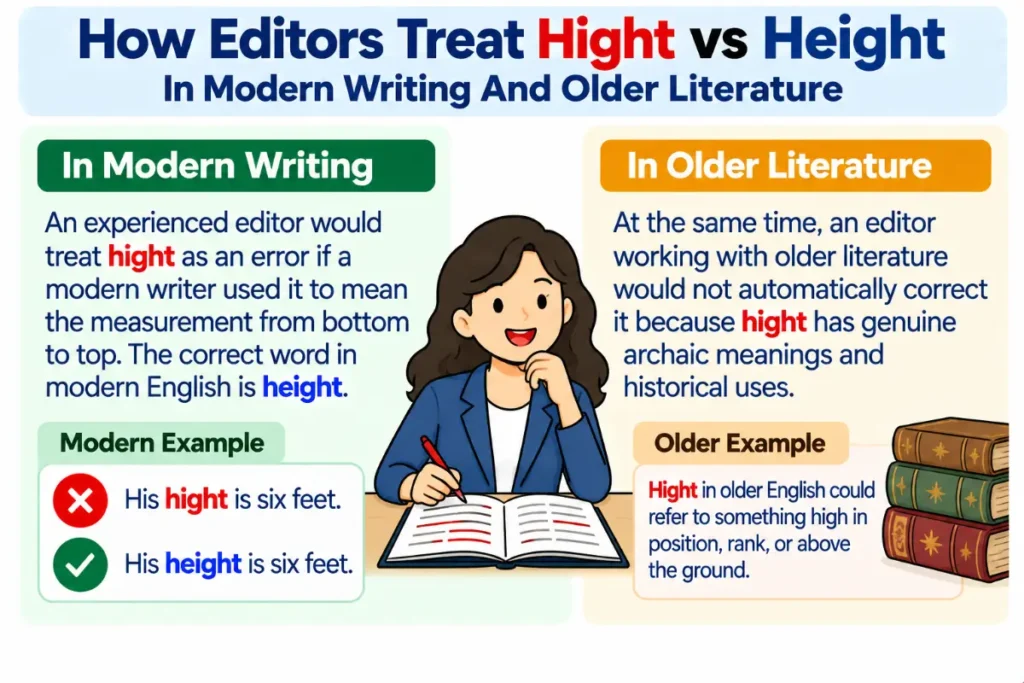
An experienced editor would treat hight as an error if a modern writer used it to mean the measurement from bottom to top. At the same time, an editor working with older literature would not automatically correct it because hight has genuine archaic meanings and historical uses. Modern spellcheck tools may flag hight in ordinary sentences, but a spelling checker cannot always understand historical context. The best editing habit is to ask what the word means in the sentence. If it means vertical measurement, use height.
Conclusion
hight or height has a clear answer for modern everyday English. Use height when you mean how tall someone or something is, the distance from bottom to top, or a related idea of elevation or an extreme point. Hight exists as a historical English form, mainly with archaic meanings such as called or named, and it has also appeared as an obsolete variant of height.
The spelling can feel tricky because height sounds much simpler than it looks. Its connection with high does not make the modern spelling completely predictable, but the pair is easy to learn together. High describes something, while height names the measurement or quality.
For a practical editing trick, remember the phrase High has height. If you are talking about a person’s measurement, a building’s size, a mountain’s elevation, or the vertical distance of an object, write height. That one habit will prevent the most common spelling mistake.
FAQs
Is hight a correct spelling of height?
Hight is not the standard modern spelling for the noun that means vertical measurement. The standard form is height. However, hight is a genuine historical English word with archaic meanings such as called or named. Dictionaries also record historical use of hight as an obsolete form related to height. So the answer depends on context.
What is the correct spelling for how tall something is?
The correct spelling is height. You can use it to describe the distance from the bottom of something to the top or the quality of being tall. For example, you can write, The height of the building is 100 feet. You should not use hight for this meaning in standard modern English.
Why is height spelled with eigh?
The spelling reflects the word’s historical development rather than modern pronunciation alone. Height comes through Middle English forms from Old English and is related to the word high. Historical forms included heighthe and other spellings before the modern form became established. This long history explains why the spelling does not look as simple as its pronunciation.
How do you pronounce height?
Height is pronounced /haɪt/ in standard US and UK English. It is one syllable and rhymes with words such as light, night, right, and tight. The word sounds roughly like hite. The final t is pronounced, so the word is not pronounced exactly like high. Cambridge lists /haɪt/ for both US and UK pronunciation.
What is the difference between high and height?
High is usually an adjective or adverb, while height is a noun. You can say, The wall is high. You can also say, The height of the wall is ten feet. High describes the position or vertical size, while height names the measurement or quality itself. Keeping this noun and adjective distinction in mind helps prevent many grammar mistakes.
Is heighth a correct spelling?
Heighth is a nonstandard spelling of height. Some dictionaries record it as a variant found in English usage, but standard modern writing uses height. If you are writing an essay, report, application, article, or professional message, choose height. The extra h is unnecessary and can make the word look like an attempt to spell the pronunciation.
Does hight have a meaning in old English?
Hight has historical meanings connected with calling or naming. Older English texts may use it to mean called or named. Collins records this archaic use and traces it to Old English forms related to a verb meaning to call. It can therefore appear in poetry or older literature without being a simple spelling error.
How can I remember the spelling?
A simple memory aid is to connect height with high. Think of the phrase, High has height. You can also focus on the middle spelling eigh. Another helpful method is to practice the word in a complete sentence rather than memorizing the letters alone. For example, The height of the building is 50 feet.
