
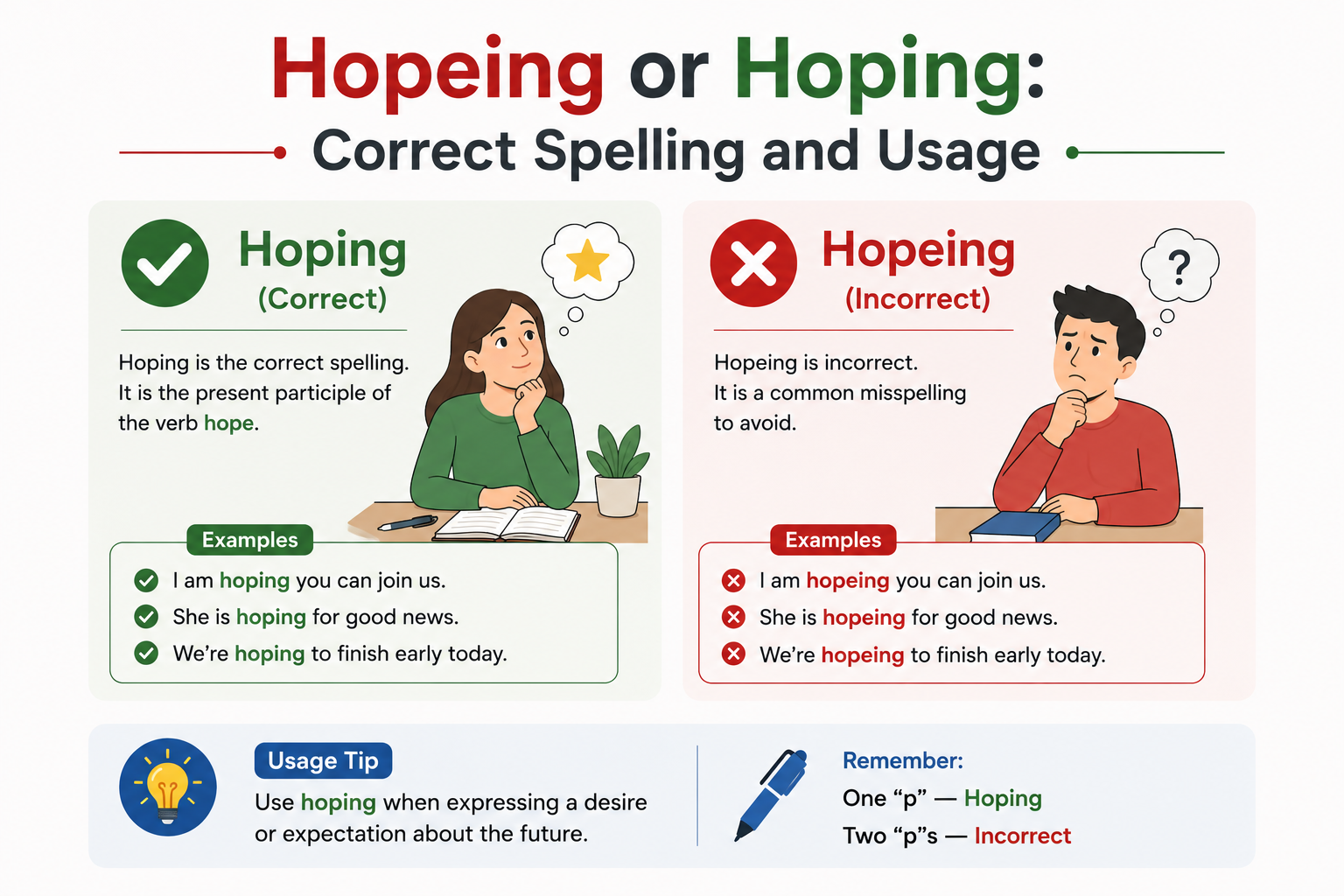
hoping or hopeing is a common spelling question because the word hope seems to invite a simple addition of ing. If you follow that idea mechanically, you might write hopeing. However, the correct spelling is hoping because the final silent e is dropped before the ending ing is added.
The confusion comes from a basic English spelling rule that applies to many verbs ending in silent e. The rule keeps the pronunciation and spelling pattern natural when the word changes form. That is why hope becomes hoping rather than hopeing. The same pattern appears in verbs such as make, write, take, and come.
Once you understand this rule, the spelling becomes much easier to remember. You’ll learn what the word means, how it works grammatically, how to pronounce it, why the final e disappears, and how the same spelling pattern works with other verbs. You’ll also see natural examples from everyday conversation, school writing, professional communication, and formal English. The goal is simple: give you a rule you can actually use instead of asking yourself which spelling looks right each time.
Quick Definition
Hoping is the correct spelling of the present participle and gerund form of hope. Hopeing is a common spelling error. When a verb ends in a silent e, English usually drops that e before adding ing. Therefore, hope becomes hoping, not hopeing.
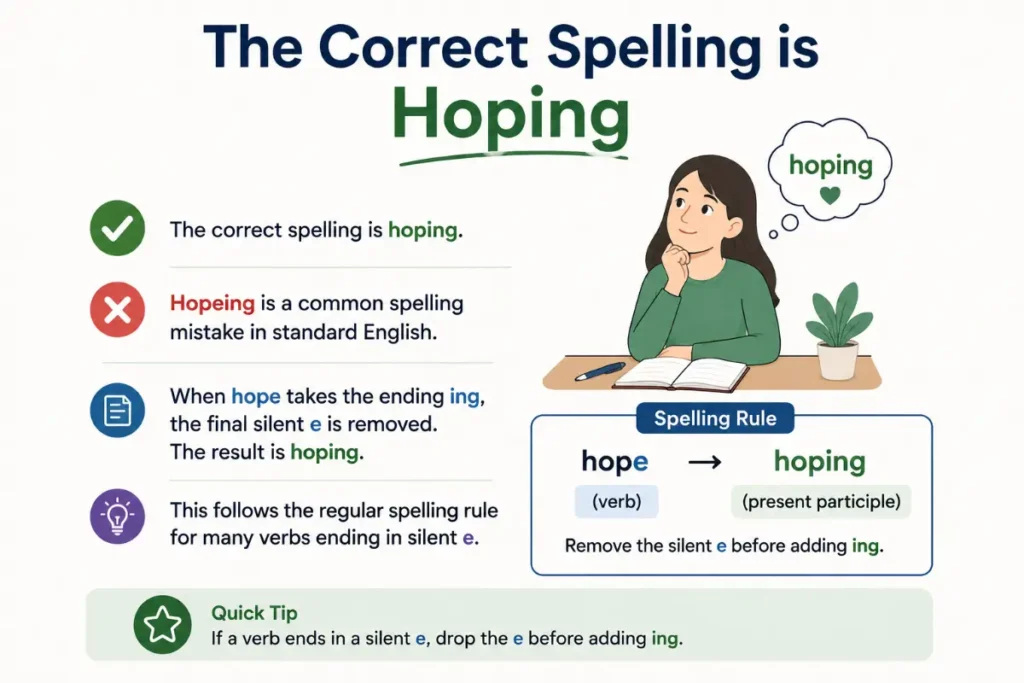
Quick Answer
Hoping is correct. Hopeing is incorrect.
The reason is the silent e rule. The base verb is hope. When you add ing, the final silent e is removed:
hope + ing = hoping
The same pattern appears in:
make → making
write → writing
take → taking
move → moving
The spelling rule is simple once you see the pattern. You remove the silent e and then add ing.
Comparison Table For Hoping And Hopeing
| Form | Meaning | Part Of Speech | Origin | Usage | Formality | Common Contexts | Example |
|---|---|---|---|---|---|---|---|
| Hoping | Expecting or wishing for something to happen | Present participle or gerund | From hope plus ing | Standard English | Neutral | Conversation, school, work, personal writing | I’m hoping to hear from you soon. |
| Hopeing | No standard English meaning | Incorrect verb form | Incorrect spelling of hope plus ing | Nonstandard | Not appropriate in standard writing | Spelling mistakes and typing errors | Hopeing is incorrect. |
The difference is not about meaning. The problem is spelling and word formation. Hoping is the standard form used in modern English.
Meaning And Definition
Meaning Of Hope
To understand the spelling, start with the base verb.
Hope means to want something to happen and believe that it may happen. It can describe a personal wish, expectation, or desire.
For example:
I hope you feel better soon.
She hopes to get the job.
They hope the weather improves.
The word can also function as a noun.
I have hope that things will improve.
The verb form is the one that changes to hoping when you add ing.
Meaning Of Hoping
Hoping is the present participle and gerund form of hope.
It commonly describes an action or state that is happening now or around the present time.
For example:
I’m hoping to finish the project today.
The speaker currently has that expectation.
Hoping can also function as a gerund when it acts like a noun.
Hoping for a quick answer can be stressful.
Here the word refers to the activity or experience of expecting something.
The meaning remains connected to hope. The change is grammatical rather than a change in the basic idea.
Meaning Of Hopeing
Hopeing is not the standard spelling of the word. It usually appears because someone adds ing to hope without applying the silent e rule.
A writer may think:
hope + ing = hopeing.
That looks logical at first because English often forms present participles by adding ing directly to the base verb. However, verbs ending in silent e usually follow a different spelling pattern.
The correct process is:
hope → remove silent e → hop → add ing → hoping.
Hopeing therefore represents a spelling mistake rather than a separate word with its own meaning.
The Main Spelling Rule
The key rule is simple.
When a verb ends in a silent e, the e is usually dropped before adding ing.
This gives us familiar forms such as:
- Hope becomes hoping.
- Make becomes making.
- Write becomes writing.
- Take becomes taking.
- Give becomes giving.
- Come becomes coming.
- Move becomes moving.
- Use becomes using.
- Drive becomes driving.
- Save becomes saving.
The final e in the base verb is silent. English keeps that e in the base form but normally removes it before the ing ending.
That is why writing hopeing as though you simply attached ing to the complete base word does not follow the standard spelling pattern.
Why The Final E Disappears
The silent e often helps establish the pronunciation of the base word.
Compare:
hop
hope
These words have different vowel sounds. The e at the end of hope helps signal the long vowel sound.
When ing is added, the spelling already provides the necessary vowel pattern. Keeping the final e would create an unnecessary letter sequence.
So English uses:
hope + ing → hoping.
The same idea appears in:
write + ing → writing.
The word write has a silent e. Once ing is added, the e disappears.
This is not just a random spelling habit. English spelling often changes slightly when suffixes are added. These changes help preserve established pronunciation and spelling patterns.
Which Spelling Is Correct?
Hoping is the correct spelling.
The incorrect form comes from treating every verb as though the ing ending can simply be attached without changing the base spelling. That approach works for many verbs but not for verbs that end in a silent e.
For example:
walk → walking
talk → talking
read → reading
But:
hope → hoping
make → making
write → writing.
This distinction is worth learning because it applies to many common English verbs.
A dictionary will list hoping as the standard inflected form of hope. Hopeing does not function as a standard alternative spelling.
Grammar And Part Of Speech
Hoping is most commonly used as a present participle or gerund.
Hoping As A Present Participle
A present participle often appears with a form of be to create a continuous verb construction.
For example:
I am hoping for good news.
She is hoping to find a new apartment.
They are hoping the plan works.
In these sentences, hoping forms part of the verb phrase.
The structure can show an action or mental state that is ongoing around the time of speaking.
Hoping As A Gerund
A gerund has the form of an ing word but functions as a noun.
For example:
Hoping for success is natural.
Here hoping is the subject of the sentence.
Another example is:
She spends a lot of time hoping for better results.
The word still comes from hope, but its grammatical role has changed.
Hoping In A Shortened Clause
Hoping can also appear at the beginning of a sentence to express the reason or expectation behind an action.
For example:
Hoping to save money, we cooked at home.
The implied subject of hoping is we because the next clause tells us who cooked at home.
This construction is common in writing, but you should make sure the person doing the hoping is also the person performing the main action.
Sentence Examples
Here are natural examples using the correct form.
- I’m hoping to finish my homework before dinner.
- She is hoping for good news from the university.
- We’re hoping the weather stays clear tomorrow.
- He left early, hoping to avoid traffic.
- I’m hoping you can help me with this problem.
- They are hoping to move into their new house next month.
- She called the office, hoping to speak with the manager.
- I’m hoping everything works out in the end.
- The team is hoping to improve its performance this season.
- Hoping for a better result, he practiced every evening.
These sentences show that the word can appear in conversation, professional communication, school writing, and more formal contexts.
Common Spelling Mistakes
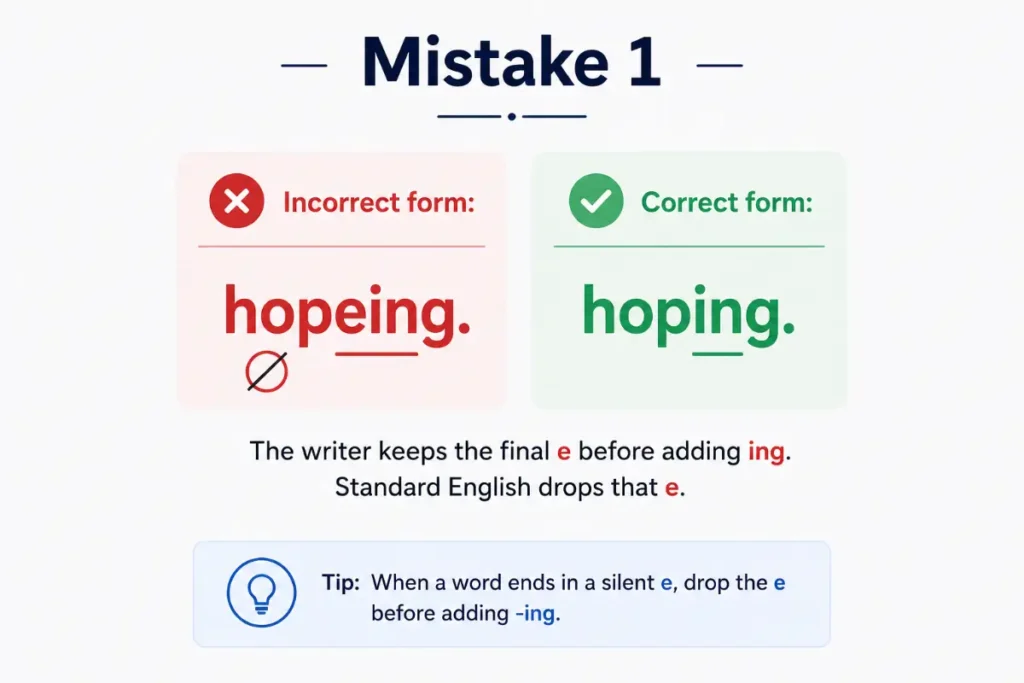
Hopeing
Incorrect: I am hopeing for good news.
Correct: I am hoping for good news.
The writer has kept the silent e before adding ing.
Hopeing To
Incorrect: She is hopeing to win.
Correct: She is hoping to win.
The same rule applies before the infinitive phrase.
Hopeing For
Incorrect: We are hopeing for rain.
Correct: We are hoping for rain.
The spelling mistake does not change the meaning, but it makes the sentence nonstandard.
Hopeing That
Incorrect: He is hopeing that you arrive soon.
Correct: He is hoping that you arrive soon.
The error comes from adding ing mechanically.
Hopeing It Works
Incorrect: They are hopeing it works.
Correct: They are hoping it works.
The same silent e rule applies regardless of what comes after the verb.
Why People Write Hopeing
There are several natural reasons this mistake happens.
First, English learners often learn a basic rule that says add ing to make a present participle. That rule is useful but incomplete. It does not explain what happens to verbs ending in silent e.
Second, the spelling of hope can make the process look obvious. A learner sees hope and ing and naturally joins them.
Third, pronunciation does not clearly reveal the spelling. The final e in hope is silent, so you cannot hear the letter disappearing when you say hoping.
Fourth, fast typing can make the problem worse. People often type words according to the visible base form rather than applying a spelling rule.
From an NLP perspective, this is a predictable word formation error. A language system can recognize the relationship between hope and hoping even when a person types hopeing, but standard writing still requires the established spelling.
Pronunciation Guide
Hoping is commonly pronounced /ˈhoʊpɪŋ/ in American English.
You can think of the pronunciation as:
HOH ping.
The stress falls on the first syllable.
The word has two syllables:
hope + ing
The final e is not pronounced. In fact, the spelling change is easier to understand once you notice that the e was silent in the first place.
Hope is pronounced approximately like hohp.
Hoping is pronounced approximately like HOH ping.
The final sound in hoping is the same ing sound you hear in words such as walking, talking, and reading.
One common mistake is to try to pronounce an extra sound because of the written e in hope. The e is silent and does not create another syllable.
Etymology And Word Origin
The word hope has a long history in English and is related to older Germanic forms. Old English had the noun and verb hopian, meaning to hope or expect. The modern English word developed from this earlier Germanic form.
The spelling has changed over time as English developed. Modern hope contains the silent e that helps distinguish its vowel pronunciation from related short vowel patterns.
The form hoping is created through ordinary English word formation. The base verb hope takes the ending ing, while the final silent e is removed.
This type of spelling change is common in English. It is part of a broader pattern involving suffixes and changes to base words.
Understanding the history is useful, but you do not need to memorize the historical details to spell the word correctly. The practical rule is enough:
Silent e plus ing usually means drop the e first.
Regional Usage
American English
Hoping is the standard spelling in American English.
It appears in casual conversation, school writing, professional communication, journalism, fiction, and formal prose.
For example:
I’m hoping to hear from you soon.
The spelling does not change in American English.
British English
British English also uses hoping as the standard form.
There is no major British spelling variation that changes hope into hopeing.
The same silent e rule applies.
Australian English
Australian English follows the same standard spelling pattern. Hoping is the normal form used in everyday and formal writing.
Hopeing remains a spelling error rather than a regional alternative.
Canadian English
Canadian English also uses hoping.
The spelling follows the same general English word formation rule used in American and British English.
This is a case where the major English varieties agree.
Real Life Usage Examples
Daily Conversation
I’m hoping we can meet this weekend.
She’s hoping her parents say yes.
These sentences sound natural in everyday American English. The word often appears with am, is, or are because it commonly forms part of a continuous verb phrase.
Email And Workplace Communication
I’m hoping to receive the updated report by Friday.
We’re hoping to resolve the issue before the next meeting.
In workplace writing, hoping can soften a request and make it sound less forceful.
Compare:
Send the report by Friday.
I’m hoping to receive the report by Friday.
The second version expresses an expectation or request in a softer way.
Academic Writing
The researchers are hoping to identify patterns in the data.
The study examines how people behave when hoping for a positive outcome.
In academic writing, hoping can be appropriate when describing expectations, intentions, or human behavior. However, writers should use it carefully when discussing research because academic claims usually need precise wording.
News Writing
Residents are hoping for better weather this weekend.
Officials are hoping the new measures will reduce delays.
News writing often uses the word when reporting expectations or reactions.
Literature And Storytelling
She walked toward the old house, hoping someone would answer.
He waited by the window, hoping to see his brother return.
In storytelling, hoping can add emotion and show what a character wants without explaining the feeling in a long sentence.
Related Words And Expressions
Hope
Hope is the base verb and noun from which hoping is formed.
I hope you arrive safely.
Hoped
Hoped is the past tense and past participle of hope.
She hoped for a better result.
Notice that the final e is retained before d.
Hopes
Hopes can be the third person singular present form of the verb or the plural noun form.
She hopes everything goes well.
He has high hopes for the project.
Hopeful
Hopeful is an adjective meaning full of hope or expecting a positive outcome.
She feels hopeful about the future.
Hopeless
Hopeless means without hope or with little possibility of success.
The situation seemed hopeless.
Wishing
Wishing expresses a desire for something. Hope and wish can overlap, but hope often suggests that the desired outcome is possible.
Hoping Versus Wishing
Hoping and wishing are related but not identical.
If you say:
I’m hoping to get the job.
You suggest that getting the job is a realistic possibility.
If you say:
I wish I could get the job.
The sentence can suggest that the situation is uncertain, unlikely, or not currently possible.
The difference becomes even clearer with past situations.
I hope she arrives soon.
I wish she were here.
The first expresses a present expectation or desire about a possible future event. The second often expresses a desire for a situation that is not true now.
This distinction helps you choose the right word when writing naturally.
Hoping Versus Expecting
Hoping usually describes what you want. Expecting usually describes what you believe is likely.
For example:
I’m hoping to pass the exam.
This tells the reader that passing is your desired outcome.
I’m expecting to pass the exam.
This suggests that you believe passing is likely.
You can hold both feelings at the same time.
I’m expecting to pass, but I’m still hoping for a high score.
The difference is subtle but useful. Hope points toward desire and expectation can point more strongly toward belief or prediction.
Common Grammar Patterns
Hoping often appears in several useful structures.
Hoping To Plus Verb
This is one of the most common patterns.
I’m hoping to visit New York next year.
She is hoping to find a new job.
They are hoping to finish early.
The structure is:
hoping to + base verb
Hoping For Plus Noun
Use for before a noun or noun phrase.
We’re hoping for good weather.
She’s hoping for a promotion.
They’re hoping for a positive response.
The structure is:
hoping for + noun
Hoping That Plus Clause
You can use that before a complete clause.
I’m hoping that you can come.
She’s hoping that the plan works.
They’re hoping that the situation improves.
In casual speech, that is often omitted.
I’m hoping you can come.
Both versions are grammatical.
The Difference Between Hope And Hoping
Hope and hoping are forms of the same verb, but they work differently in sentences.
Hope can describe a general desire or expectation.
I hope you feel better.
Hoping often emphasizes an ongoing state or forms part of a continuous construction.
I’m hoping you feel better soon.
The difference is small in some contexts, and the two forms can communicate almost the same basic idea.
The choice depends on grammar and emphasis.
Compare:
I hope to hear from you soon.
I’m hoping to hear from you soon.
The first is simple and direct. The second places more emphasis on the current expectation.
Neither is automatically better.
Formal And Informal Usage
Hoping is perfectly normal in both everyday and formal English.
The tone depends more on the sentence than on the word itself.
For example:
I’m hoping you can send the document today.
This sounds natural and polite in a workplace email.
In a more formal report, you might write:
The researchers expect to obtain further data next month.
The second sentence may be more precise because it describes an expectation rather than a personal desire.
Still, there is nothing grammatically informal about hoping itself. The word appears naturally across many forms of English.
Expert Editor Insight
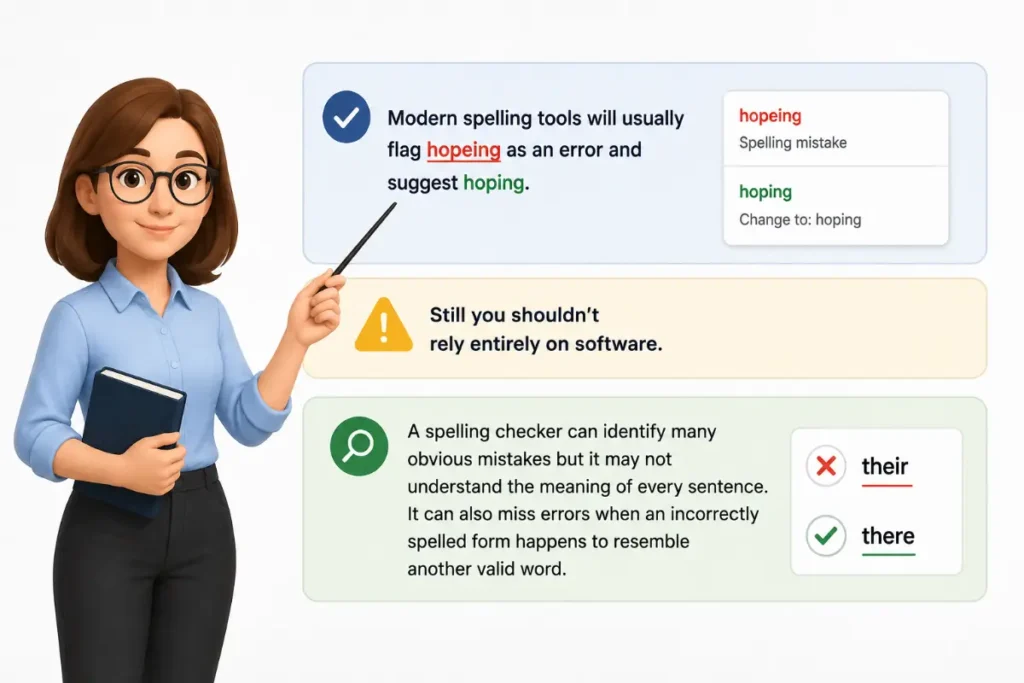
An experienced editor would treat hoping as a straightforward spelling form governed by the silent e rule. The common error happens because writers often remember the general idea of adding ing but forget that some verbs change their final spelling first. A useful proofreading trick is to look at the base verb before checking the ending. If the base form ends in silent e, ask yourself if that e should disappear before ing. That quick check catches hoping and many similar errors.
Conclusion
hoping or hopeing has a clear answer. Hoping is the correct standard spelling, while hopeing is a common spelling mistake. The reason is the silent e rule. When the verb hope takes the ending ing, its final silent e is dropped, giving us hoping.
The same pattern appears in many everyday verbs. Make becomes making, write becomes writing, and take becomes taking. Learning this pattern is much more useful than memorizing one word because it gives you a spelling rule you can apply again and again.
The easiest editing trick is to check the base verb first. If it ends in a silent e, remove that e before adding ing. Once you remember that simple step, hoping will no longer be a spelling puzzle.
FAQs
Is hopeing a real word?
Hopeing is not the standard spelling of the present participle or gerund form of hope. It is normally a spelling error caused by adding ing directly to the complete base word. The standard form is hoping. The final silent e in hope is removed before ing is added, producing hope plus ing as hoping.
Why is hoping spelled without the e?
Hoping is spelled without the final e because English normally drops a silent e before adding the suffix ing. The base verb is hope. Remove the silent e and then add ing, giving hoping. The same rule applies to many verbs such as make, write, take, give, and move.
Is hoping a verb?
Yes. Hoping is a verb form derived from hope. It is specifically the present participle form and can appear in continuous constructions such as I am hoping. It can also function as a gerund, as in Hoping for success can be stressful. Its grammatical role depends on how it is used in the sentence.
How do you pronounce hoping?
Hoping is commonly pronounced /ˈhoʊpɪŋ/ in American English. A simple pronunciation guide is HOH ping. It has two syllables, with the main stress on the first. The final e from hope is silent and disappears from the spelling before ing is added, so it does not create an extra sound or syllable.
Can you say hoping to?
Yes. Hoping to is a common grammatical structure. It is followed by the base form of a verb. For example, I’m hoping to finish my work today. She is hoping to find a new apartment. They are hoping to visit their family soon. The pattern is hoping to plus a base verb.
What is the difference between hoping and wishing?
Hoping usually suggests that you want something to happen and believe it is possible. Wishing can describe a desire that may be unlikely, impossible, or contrary to reality. For example, I’m hoping to win suggests a realistic possibility, while I wish I could fly describes something that is not realistically possible.
Is hoping formal or informal?
Hoping is standard English and can appear in both informal and formal contexts. It is common in conversation, emails, academic writing, reports, journalism, and fiction. The surrounding sentence determines the tone. In highly formal writing, a writer may choose words such as expecting or anticipating when those terms describe the intended meaning more precisely.
What are other words like hoping?
Related words include wishing, expecting, anticipating, looking forward to, and desiring. These words overlap with hope but are not identical. Hoping usually combines desire with a sense that the outcome is possible. Expecting focuses more on what you believe will happen, while wishing can describe a desire that may be less realistic.
