
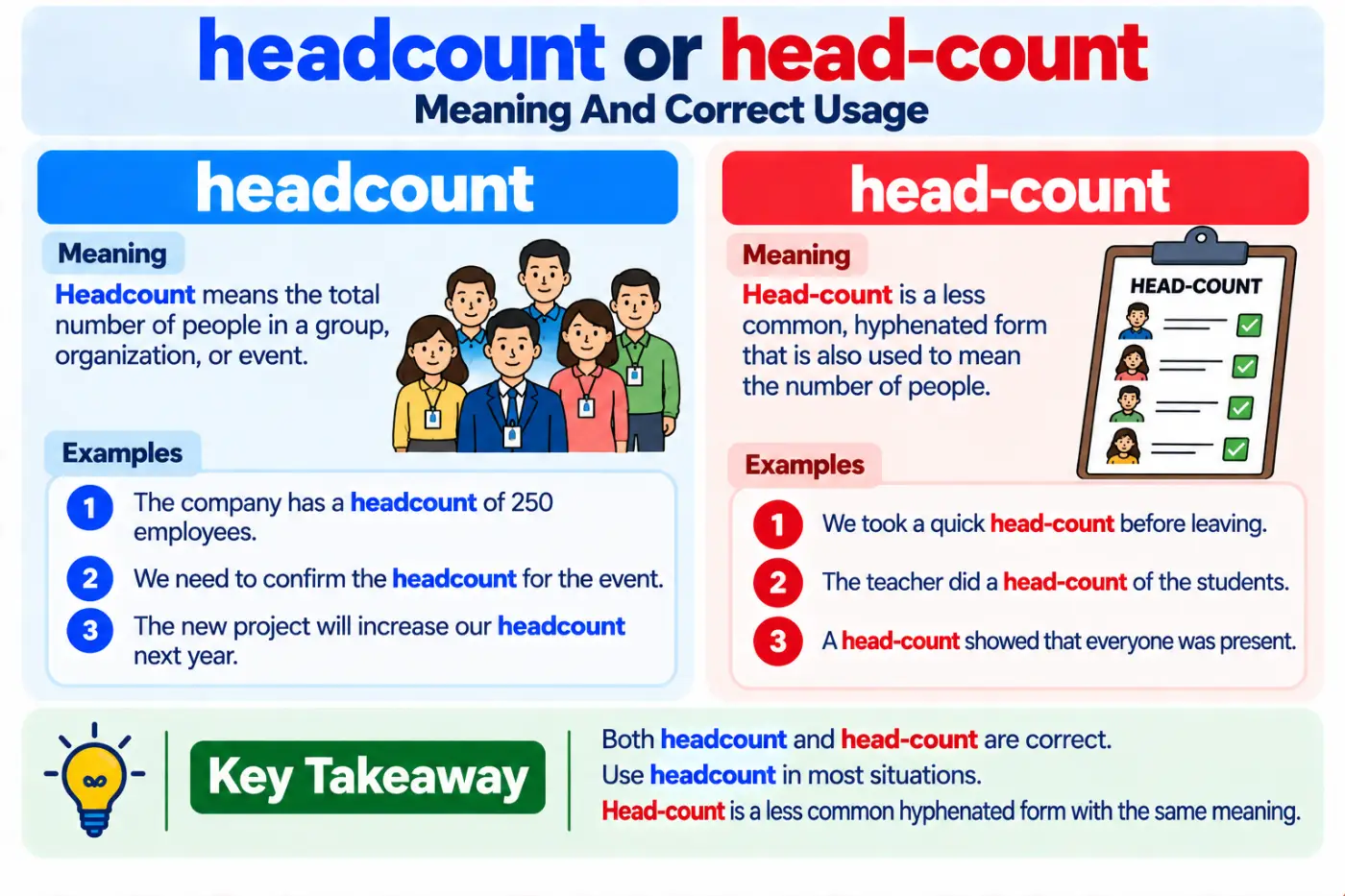
headcount or head count often causes confusion because English uses both a closed form and a two word form. The good news is that both forms are legitimate, but they can appear in slightly different contexts. The closed form is especially common in business and workplace language, while the two word form is often used when the words function more literally as a phrase.
The basic idea is simple. Both expressions relate to the number of people in a group or the act of counting people. However, modern business English strongly favors the closed form when referring to the total number of employees or the process of determining staffing levels. You might hear a manager say that the company needs to increase its headcount before a new project begins.
This distinction becomes clearer once you look at grammar and meaning. In this guide, you’ll learn how each form works, when to use it, how it differs in professional writing, how it is pronounced, and which version sounds most natural in American English. You’ll also see practical examples that show how native speakers use these expressions in real situations.
Quick Definition
Headcount is a noun that commonly means the total number of people in a group, especially employees in an organization. Head count is the two word form used when head functions as a noun and count describes the act or process of counting people. In modern workplace English, headcount is usually the preferred form for staffing numbers.
Quick Answer
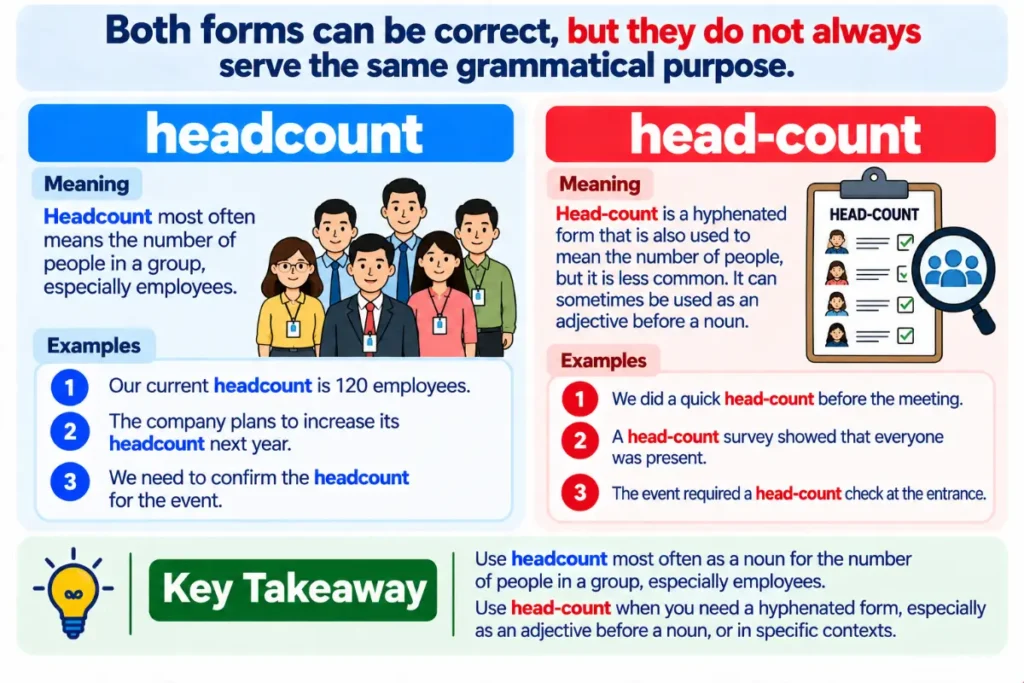
Both forms can be correct, but they do not always serve the same grammatical purpose.
Use headcount most often as a noun for the number of people in a group, especially employees.
Use head count when the phrase describes the literal act of counting people or when head functions independently as a noun modified by count.
For example:
The company increased its headcount by ten employees.
The teacher did a quick head count before the bus left.
The first sentence discusses the number of employees. The second describes the act of counting people.
Comparison Table Headcount Or Head Count
| Form | Meaning | Part of Speech | Origin | Usage Frequency | Formality | Common Contexts | Example |
|---|---|---|---|---|---|---|---|
| Headcount | The number of people in a group, especially employees | Noun | Formed from head and count | Very common in business English | Neutral and professional | Staffing, HR, budgets, organizations | The company plans to increase its headcount. |
| Head count | The act of counting people or a literal count of individuals | Noun phrase | Combination of head and count | Common | Neutral | Schools, events, travel, groups | The teacher took a head count before leaving. |
The distinction is useful, but real world usage can overlap. Some dictionaries and style references recognize headcount as a noun meaning the number of people in a group, while head count can still appear when writers emphasize the literal counting process.
Meaning And Definition
Meaning Of Headcount
Headcount is a noun that usually refers to the total number of people in a group. In modern American business English, it is especially common when discussing employees.
For example:
The company has a headcount of 250.
This means the company has 250 employees or people included in the relevant workforce total.
The word appears frequently in discussions about hiring, staffing, budgets, departments, organizational growth, and workforce planning.
A manager might say:
We need approval for five additional positions because our current headcount is too low for the new project.
Here the word does not describe someone physically counting employees. Instead, it refers to the size of the workforce.
That distinction is the heart of modern professional usage.
Headcount can also refer to the number of people in a group outside the workplace.
For example:
The event organizers are expecting a headcount of 500.
In this sentence, the word means the expected number of attendees.
The term can also refer to the process of determining that number depending on context. Still, its strongest modern business meaning is the total number of people included in a workforce or group.
Meaning Of Head Count
Head count is a noun phrase made from head and count.
The word head can refer informally to a person or individual. Count refers to the act of determining how many people or things are present.
For example:
The teacher took a head count before the students entered the museum.
Here the focus is on the counting process.
The teacher wants to make sure every student is present. The phrase describes an action rather than a permanent staffing figure.
You may also see head count in contexts involving groups, crowds, passengers, students, guests, or participants.
For example:
We need a head count before ordering lunch.
This means the organizer needs to know how many people will eat.
In everyday speech, people may use the two word form naturally because the literal idea of counting people remains strong.
The Main Difference
The distinction becomes easier if you focus on the idea behind the expression.
- Headcount usually refers to a number. It often describes the total number of employees or people in an organization or group.
- Head count often emphasizes counting. It describes the act of determining how many people are present.
- Business writing strongly favors headcount. HR departments, managers, finance teams, and executives commonly use the closed form when discussing staffing levels.
- Head count remains natural for literal counting. A teacher taking attendance or an event organizer checking guests might naturally use the two word phrase.
- The difference is grammatical as well as stylistic. Headcount behaves as a single noun. Head count functions as a noun phrase.
Consider these two sentences:
Our headcount has reached 500.
Please take a head count before we leave.
The first discusses a total. The second describes an action.
That small difference can guide your choice.
Which Form Is Correct?
Both forms have legitimate uses. The correct choice depends on what you mean.
If you are talking about the number of employees in a company, headcount is normally the better choice.
For example:
The department has a headcount of 42.
The company froze hiring because its headcount was already above budget.
The HR team tracks headcount each month.
If you are describing the act of counting people, head count can be appropriate.
For example:
The guide took a head count before the group entered the building.
The teacher did a head count after lunch.
We need a quick head count before the game starts.
Modern English often turns common combinations into closed compounds over time. This helps explain why headcount is so established in professional vocabulary. The closed form acts as a single lexical item rather than simply describing a physical counting action.
The key point is that you should not treat one spelling as universally right and the other as universally wrong.
Headcount In Business English
Business English is where the closed form appears most often.
Companies regularly need to describe the size of their workforce. Instead of repeatedly writing the number of employees, business writers often use headcount.
For example:
The company expects its headcount to reach 1,000 next year.
The finance team is reviewing headcount costs.
The department requested additional headcount for the new project.
The company reduced its headcount after the restructuring.
In these examples, the word is closely connected to staffing and workforce planning.
The term can also describe planned positions.
For example:
We have approval for ten additional headcount.
This usage is common in workplace communication, although some style guides and editors may prefer a clearer expression such as ten additional employees or ten additional positions.
That is because headcount can refer to people rather than job openings. The exact meaning depends on company usage.
For formal external communication, a more precise phrase may sometimes be better.
Instead of:
We added 50 headcount.
You could write:
We added 50 employees.
Or:
We increased our workforce by 50 employees.
Those versions tell the reader exactly what changed.
Headcount In Human Resources
Human resources teams use the word frequently because employee numbers affect hiring, compensation, benefits, reporting, and workforce planning.
A human resources report might contain statements such as:
The company ended the year with a headcount of 780.
The engineering team increased its headcount by 15 percent.
Current headcount is below the approved staffing plan.
These sentences use the term as a measurable workforce figure.
Headcount can also be divided into categories.
For example, a company may track full time employees, part time employees, contractors, and temporary workers separately.
In that setting, the meaning of headcount depends on the company’s reporting rules. A document should define its categories clearly if the number could be misunderstood.
For example:
Our employee headcount excludes independent contractors.
That sentence removes ambiguity.
Good professional writing does not assume every reader knows the internal meaning of a business term.
Head Count In Everyday Situations
The two word phrase is especially natural when someone is literally counting people.
Imagine a teacher taking students on a field trip.
Before the bus leaves, the teacher says:
Let’s do a head count.
That means the teacher wants to count the students and make sure everyone is present.
The same idea works at a family gathering.
We should take a head count before ordering dinner.
Here the speaker wants to know how many people need food.
It also works during travel.
The tour leader took a head count before the group entered the train.
In these situations, the phrase has a clear physical and practical meaning. Someone is checking the number of people present.
Grammar And Part Of Speech
Headcount is primarily a noun.
It can appear as the subject of a sentence.
Our headcount increased this quarter.
It can also appear after a linking verb.
The current headcount is 350.
It can follow a preposition.
We need to stay within our approved headcount.
It can also be modified by adjectives.
The total headcount was higher than expected.
The current employee headcount is 600.
Head count is also a noun phrase.
For example:
The manager took a head count.
The phrase can function as the object of a verb.
The teacher took a head count before the students left.
In both cases, the grammatical role is related to counting people.
The important difference is that the closed form has developed into a single noun with a strong workforce meaning.
Sentence Examples
Here are natural examples showing how the closed form works.
- The company increased its headcount by 20 employees this year.
- Our current headcount is 450 people.
- The finance team is reviewing next year’s expected headcount.
- The new office will allow us to expand our headcount.
- The manager wants to keep the department’s headcount within budget.
- The startup doubled its headcount after securing new funding.
- HR reported a lower headcount than expected at the end of the quarter.
- The organization tracks headcount across every department.
- The hiring plan includes an additional headcount for the sales team.
- Our headcount grew steadily during the first half of the year.
Now consider examples using the two word form.
- The teacher took a head count before the students boarded the bus.
- We need a quick head count before ordering pizza.
- The tour guide did a head count at the entrance.
- The coach took a head count before practice began.
- The event staff completed a head count before opening the doors.
These examples show why context matters. The closed form is strongly associated with workforce numbers, while the two word phrase naturally describes a counting action.
Common Mistakes
Treating Headcount As Always Wrong
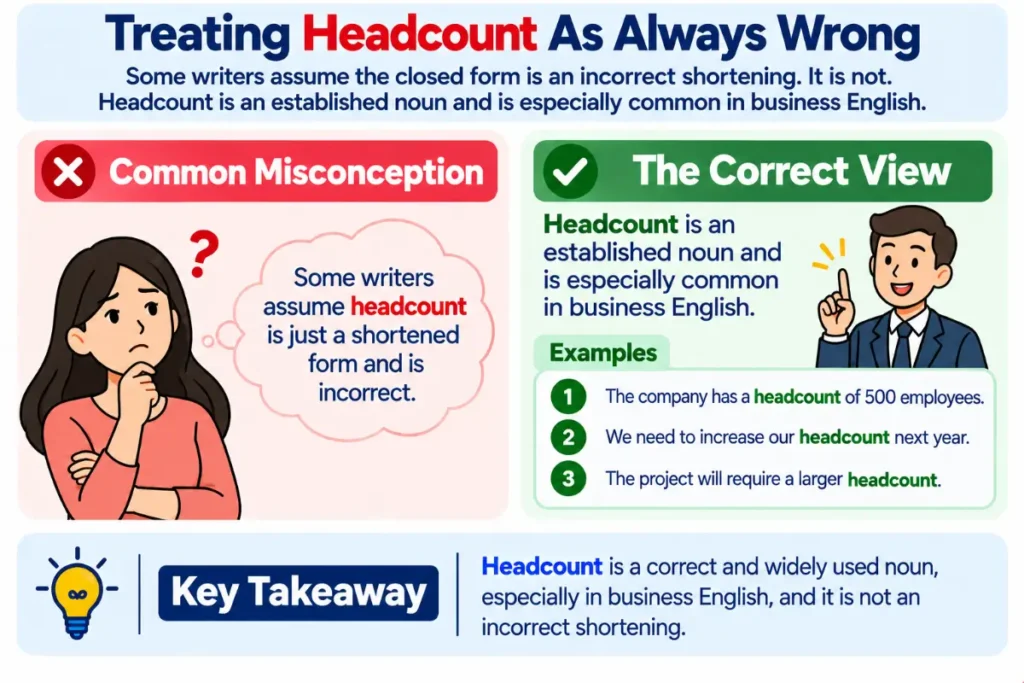
Some writers assume the closed form is an incorrect shortening. It is not. Headcount is an established noun and is especially common in business English.
The mistake is assuming that only the two word phrase can be correct.
Treating Head Count As Always Wrong
The opposite mistake is also common.
Head count can be appropriate when the phrase describes the literal act of counting people.
For example:
The teacher took a head count.
There is no need to force the closed form into this sentence.
Using Headcount For Job Positions
Business speakers sometimes use headcount to mean approved positions.
For example:
We have room for five more headcount.
The meaning may be clear inside a company, but it can sound imprecise to an outside reader.
A clearer version is:
We have approval for five more positions.
That wording separates people from vacancies.
Confusing Headcount With Workforce
The words can overlap but are not always identical.
Workforce refers to the people who make up an organization’s working population. Headcount usually refers to the number of people counted under a particular staffing definition.
A company can therefore have a workforce made up of employees and contractors while reporting employee headcount separately.
Adding Unnecessary Hyphenation
Writers sometimes create forms such as head-count.
That spelling is not normally necessary in the standard noun use. The established closed noun is headcount, while the literal phrase is head count.
Pronunciation Guide
Headcount and head count are pronounced the same way because they contain the same words.
A common American pronunciation is approximately:
HED kownt
The IPA form can be represented as /ˈhɛdˌkaʊnt/.
The first part rhymes with bed.
The second part rhymes with count.
The main stress normally falls on head, with secondary emphasis on count.
Because the pronunciation is the same, you cannot hear the difference between the closed form and the two word form in ordinary speech. The distinction becomes visible only in writing.
That is one reason the spelling question appears so often. Speakers hear the same expression and must choose the written form according to context.
Etymology And Word Origin
The expression combines two ordinary English words.
Head has a very old Germanic history and has developed many meanings over time. One of those meanings refers informally to a person or individual, as in a certain number of people.
Count comes through Old French and ultimately from Latin roots connected with calculation and numbering.
The combination of head and count developed naturally from the idea of counting individual people. Over time, the closed compound headcount became established as a noun, especially in organizational and business contexts.
This kind of development is common in English. Frequently used word combinations can gradually become recognized as single lexical units.
The modern workplace meaning is therefore easy to understand from the original concepts. A headcount is literally a count of heads, but in business language it usually refers to the resulting number of people rather than the physical act of counting them.
Regional Usage
American English
American English commonly uses headcount as a single noun in business and workplace contexts.
For example:
The company plans to increase headcount next year.
Head count also appears when the literal counting of people is the focus.
The teacher took a head count before leaving.
Both forms are understood, but their contexts differ.
British English
British English also uses headcount in organizational and staffing contexts. The two word form head count can appear when referring to the act of counting people.
The basic distinction is similar to American usage.
There is no major regional rule that makes one form universally correct.
Australian English
Australian English uses both forms according to context. Headcount can refer to staffing numbers, while head count can describe the process of counting people.
The same general grammar applies.
Canadian English
Canadian English also recognizes both forms. In professional contexts, headcount is common for workforce numbers. Head count can be used when the literal counting process is meant.
The difference is mainly based on meaning and context rather than regional spelling.
Formal And Informal Usage
Headcount is perfectly normal in professional writing, especially within organizations.
It appears naturally in HR documents, financial planning, staffing reports, management discussions, and internal company communication.
For example:
The projected headcount for next year is 1,200.
That sentence is concise and professional.
However, professional writing sometimes benefits from a more specific phrase.
Consider:
The company expects headcount to increase.
This is fine if the audience understands the business context.
For a general audience, you might write:
The company expects to hire more employees.
The second version is more direct.
Headcount is not a problem simply because it is business language. The real question is audience awareness. If your readers know the term, it can make the sentence shorter and more precise.
Real Life Usage Examples
Daily Conversation
We need a head count before ordering dinner.
The coach took a head count before the game.
These examples focus on counting people who are physically present.
Workplace Communication
Our headcount is higher than it was last quarter.
The department has approval to increase its headcount.
These examples use the closed noun in its common business sense.
Academic Writing
The researchers recorded the total headcount at each event.
The study compared attendance numbers across several groups.
In academic writing, headcount can be useful when the exact number of people is relevant. A more neutral phrase such as participant count may be preferable in some research contexts.
News Writing
The company announced plans to reduce its headcount over the next year.
Event organizers completed a head count before allowing guests into the venue.
News writing often uses the closed form for employment and the two word form for literal counting.
Literature And Storytelling
The guide stopped halfway through the trail to take a head count.
The village had a small headcount compared with the nearby city.
Creative writing can use either form depending on the intended meaning and rhythm of the sentence.
Related And Confused Terms
Workforce
Workforce refers to the people who work for an organization or within a broader employment system. It describes the group itself rather than simply the numerical count.
Staffing
Staffing refers to the process or level of providing an organization with employees.
Employee Count
Employee count is a clear alternative when you specifically mean the number of employees.
Staff Size
Staff size refers to how many employees make up a particular team or organization. It can sound more natural for general audiences.
Personnel
Personnel refers collectively to employees or staff members. It is often more formal than headcount.
Attendance
Attendance refers to the number of people present at an event, meeting, class, or activity. It should not automatically replace headcount because the terms have different contexts.
Enrollment
Enrollment refers to the number of people registered for a school, course, program, or similar activity.
Staffing Level
Staffing level describes the amount of employee coverage or personnel available for a particular operation. It often appears in planning and management contexts.
These terms overlap around the general idea of people and numbers, but each has its own useful meaning.
When A More Specific Word Is Better
Headcount is convenient, but convenience should not replace precision.
Suppose you write:
The headcount at the conference was 2,000.
A reader will probably understand that 2,000 people attended.
But if the context is a formal report, you might prefer:
Conference attendance reached 2,000 people.
That sentence is more specific because attendance directly describes people who were present.
Likewise, if you mean employees:
The company has 2,000 employees.
That is often clearer than:
The company has a headcount of 2,000.
The second version is not wrong. It simply uses business terminology.
Good writing gives readers the amount of information they need without making them decode jargon.
Headcount In Financial Planning
Headcount matters in financial planning because employees represent a major operating cost for many organizations.
A budget may include expected staffing numbers for each department.
For example:
The sales department plans to add ten employees next year.
A business might describe the same plan internally as:
The sales department plans to add ten headcount next year.
The second version is common in workplace speech, but the first is clearer for a broad audience.
Headcount planning can affect salary budgets, benefits, office space, equipment, training, and management structures.
This is why the word appears frequently in finance and operations discussions.
Still, professional writers should distinguish between employees and positions.
If a company has approval to hire ten people but has not hired them yet, saying it has ten additional employees would be inaccurate.
A clearer statement would be:
The company has approval for ten additional positions.
That distinction protects accuracy.
Headcount And Employee Count
The two expressions are closely related but not always identical.
Employee count usually tells you exactly what is being measured. It means the number of employees.
Headcount can be broader depending on how an organization defines its reporting group.
For example, a company might track:
Employee headcount.
Contractor headcount.
Department headcount.
Global headcount.
Regional headcount.
The exact definition should be clear in formal reports.
This matters because numerical terms can become misleading if the population being counted is not defined.
For example, 500 employees and 500 workers might not represent the same group if contractors or temporary workers are included in one number but not the other.
The word is therefore simple on the surface but can have important business implications in detailed reporting.
Head Count And Attendance
The two word form is often useful when counting people who are physically present.
For example:
The teacher took a head count.
That does not necessarily mean attendance in the formal administrative sense. It simply means the teacher counted the people present.
Attendance can include a record or measurement of presence over time.
A school may record attendance for every student.
A tour guide may take a head count before leaving a location.
The first is an administrative record. The second is a quick safety or organization check.
The expressions overlap, but they are not interchangeable in every situation.
Expert Editor Insight
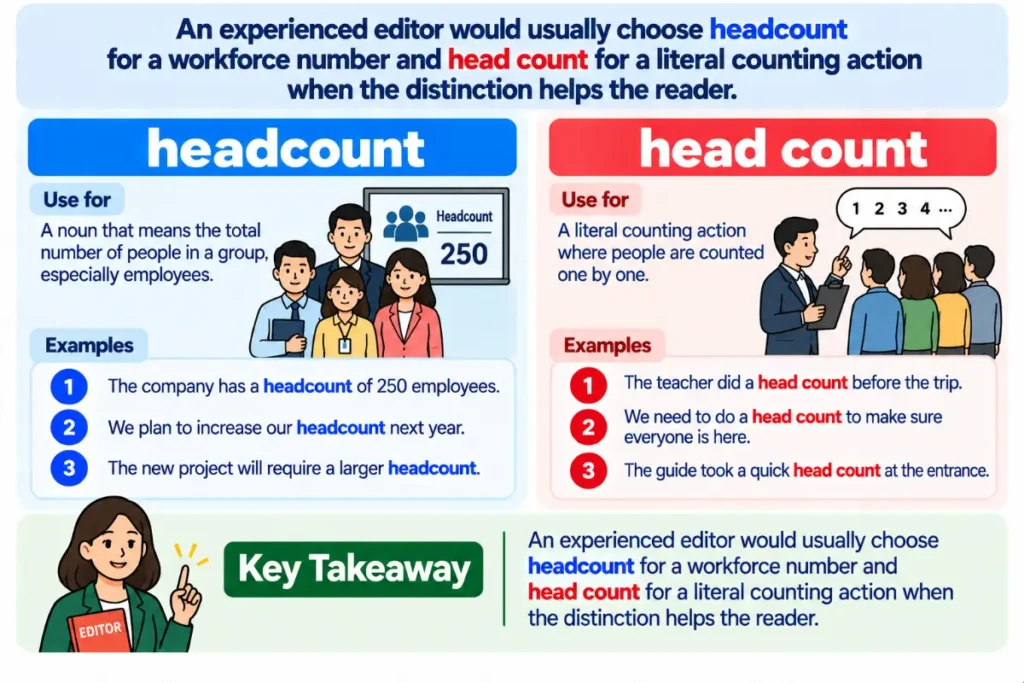
An experienced editor would usually choose headcount for a workforce number and head count for a literal counting action when the distinction helps the reader. The most common problem is not spelling but vague business usage. Phrases such as additional headcount can sometimes mean employees, positions, or approved hiring capacity. In a formal document, naming the exact thing being measured is often better. Spellcheck tools may accept both forms, so context and editorial judgment matter more than automatic correction.
Conclusion
headcount or head count depends mainly on what you are trying to express. Headcount is the standard choice for a workforce number, especially in business, HR, finance, and staffing discussions. Head count remains useful when you mean the literal act of counting people, such as checking a group before departure. Both forms are legitimate, so treating one as an error would be misleading.
The easiest editing rule is to look at the meaning first. If you are discussing how many employees or people belong to a group, the closed form will usually fit. If someone is physically counting people, the two word phrase can make more sense. When precision matters, you can always replace either form with a clearer phrase such as number of employees or number of people.
FAQs
Is headcount one word or two words?
Both headcount and head count can be correct. The closed form is especially common when the word means the number of employees or people in a group. The two word phrase often appears when describing the act of counting people. Context determines the better form, so neither spelling should be treated as universally incorrect.
Is headcount correct in business writing?
Yes. Headcount is a well established business term used to describe the number of employees or people included in a particular workforce total. It commonly appears in HR, finance, staffing, management, and organizational planning. For a general audience, employee count or number of employees may sometimes be clearer, but headcount is standard professional vocabulary.
What does headcount mean in HR?
In human resources, headcount usually means the number of employees in a particular group or organization. HR teams may track total company headcount, department headcount, regional headcount, or other defined workforce groups. The exact population should be clear in formal reporting because companies may count employees, contractors, or temporary workers under different categories.
Is head count still correct?
Yes. Head count remains a valid two word noun phrase, especially when the meaning focuses on physically counting people. For example, a teacher may take a head count before students board a bus. The closed form has become especially common for workforce numbers, but the two word phrase remains useful when describing the counting process.
Should I write headcount in a resume?
You can use headcount on a resume if the context involves workforce size, team management, hiring, or organizational responsibility. For example, you might say that you managed a team with a headcount of 50. However, team size or managed a team of 50 employees may sound clearer to a broad audience.
Is headcount formal or informal?
Headcount is neutral and professional, especially in business and HR contexts. It is not slang. However, it is also a piece of workplace terminology, so a general audience may find number of employees clearer. The two word phrase head count can sound more literal because it focuses on counting people rather than workforce planning.
What is another word for headcount?
Depending on the context, alternatives include employee count, workforce size, staff size, number of employees, personnel count, staffing level, or attendance. These terms are not perfect substitutes in every sentence. Employee count is usually the clearest replacement when you specifically mean employees. Attendance is more appropriate for people present at an event or activity.
Why do people write head count instead of headcount?
People often use head count because the phrase comes from the literal idea of counting individual people. English frequently develops both open phrases and closed compounds as usage changes. Headcount has become strongly established as a noun in business English, especially for workforce numbers. Head count remains natural when the writer emphasizes the actual act of counting people.
