
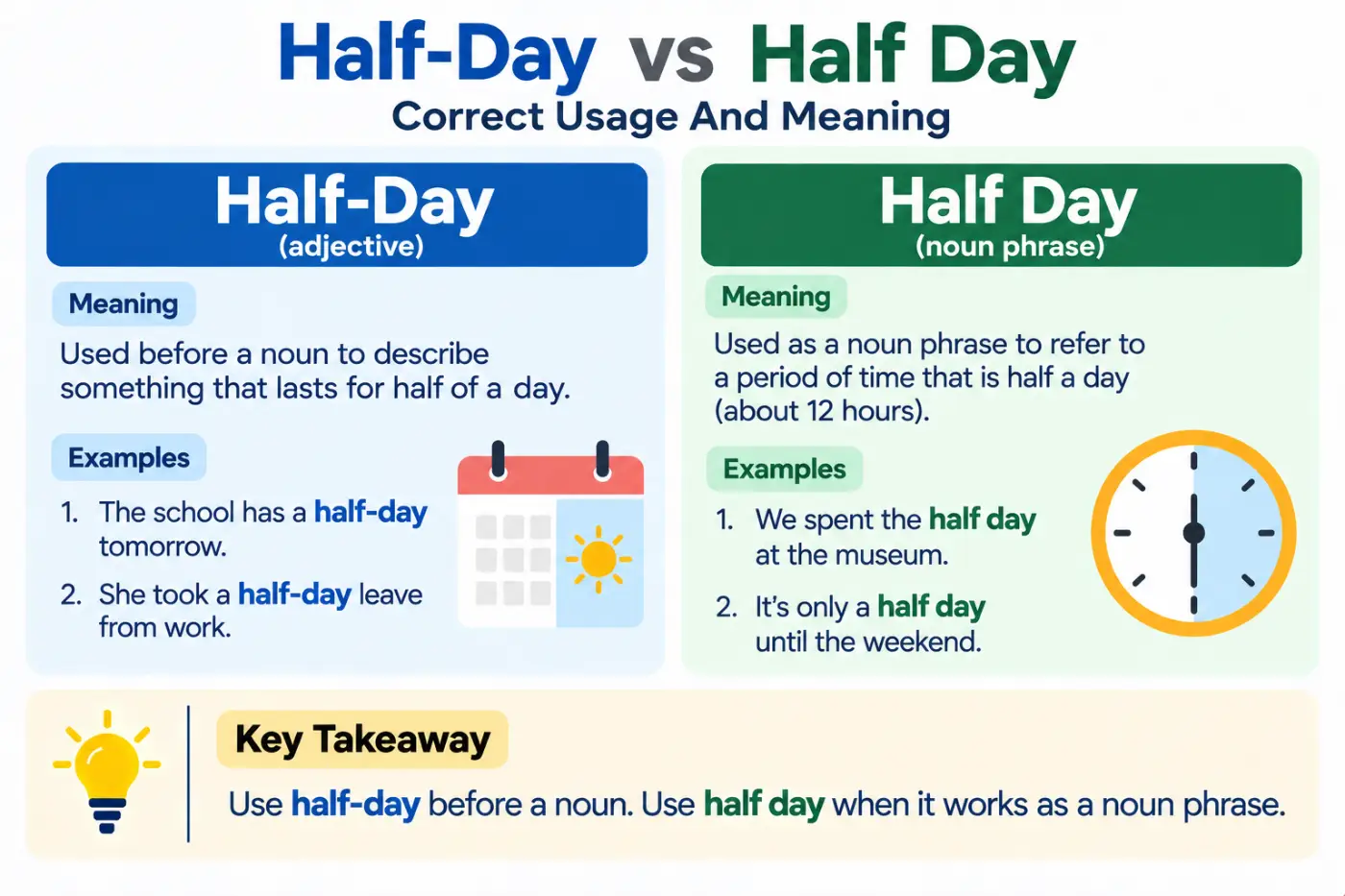
The choice between half day vs half day can be confusing because English uses both open and hyphenated compounds in different grammatical positions. The practical rule is straightforward. Use the hyphenated form when the expression works together as an adjective before a noun, while the open form is usually used when it functions as a noun phrase.
For example, you can write a half day workshop because the compound describes the workshop. You can also write The workshop lasts half a day because the expression now functions as a noun phrase rather than a compound adjective. This small change in sentence structure explains most of the confusion.
The expression refers to a period that lasts for approximately half of a day. You’ll see it in schedules, school notices, workplace communication, event descriptions, travel plans, and everyday conversation. This guide explains the difference between the two forms, shows how hyphenation works, covers American and British usage, and gives practical examples that make the rule easy to remember. You’ll also learn when half day appears without an article and why half a day is often the clearest choice in ordinary sentences.
Quick Definition
The hyphenated form is generally used when the expression acts as a compound adjective before a noun, as in a half day meeting. When the phrase functions as a noun expression, writers usually use half a day, as in The meeting lasted half a day. The exact choice depends on grammatical function and sentence structure.
Quick Answer
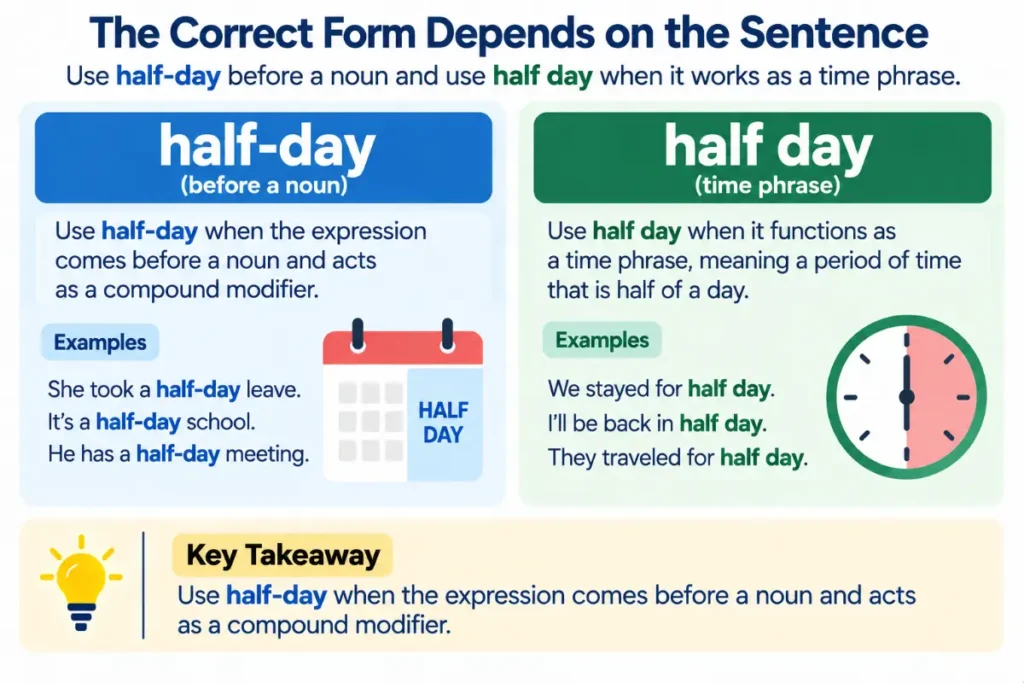
Use half day as a noun phrase when the meaning is a period equal to half of a day, although half a day is usually the most natural form in a complete sentence.
Use half day with a hyphen when the expression acts as a compound modifier before a noun. For example, a half day course and a half day event use the compound as an adjective.
The key is not the meaning. The meaning stays almost the same. The difference comes from how the words function in the sentence.
Comparison Table For Half Day Usage
| Form | Meaning | Part of Speech | Origin | Usage Frequency | Formality | Common Contexts | Example |
|---|---|---|---|---|---|---|---|
| half day | A period lasting half of a day | Noun phrase | English compound built from half and day | Common in practical and informal contexts | Neutral | Schedules, work, school, events | The office closes for half day. |
| half a day | A period lasting half of one day | Noun phrase | English phrase using an article | Very common | Neutral | Conversation, writing, schedules | The trip takes half a day. |
| half day | A modifier describing something lasting half a day | Compound adjective | English compound formation | Common before nouns | Neutral | Courses, events, workshops, shifts | It is a half day course. |
The table highlights an important detail. The open expression and the hyphenated compound are not simply competing spellings. They perform different grammatical jobs.
Meaning And Definition
Meaning Of The Expression
The expression describes a period equal to approximately half of a normal day.
A day contains twenty four hours, so half a day is twelve hours when you mean a literal division of the full day. However, everyday English often uses the expression more loosely for a shorter daytime period.
For example, a school may describe a morning session as half a day even though students are not attending for twelve hours. A company may call a four hour training session a half day workshop. The meaning often depends on the schedule and context.
This is why context matters.
If your employer says you have a half day on Friday, the meaning may be that you work only during the morning or only during the afternoon. It does not normally mean you must work exactly twelve hours.
Meaning Of Half A Day
Half a day is the most natural noun phrase when you are talking about duration.
For example:
The repair took half a day.
I spent half a day cleaning the house.
We walked for half a day.
Here the phrase answers a question about how long something lasted.
The article a belongs to the phrase because day is a singular count noun.
You would not normally say:
I worked for half day.
Instead, standard natural English is:
I worked for half a day.
This distinction is especially useful for learners because it explains why the open form can look incomplete in some sentences.
When To Use The Hyphen
A hyphen can join words that work together as one modifier before a noun.
Consider this sentence:
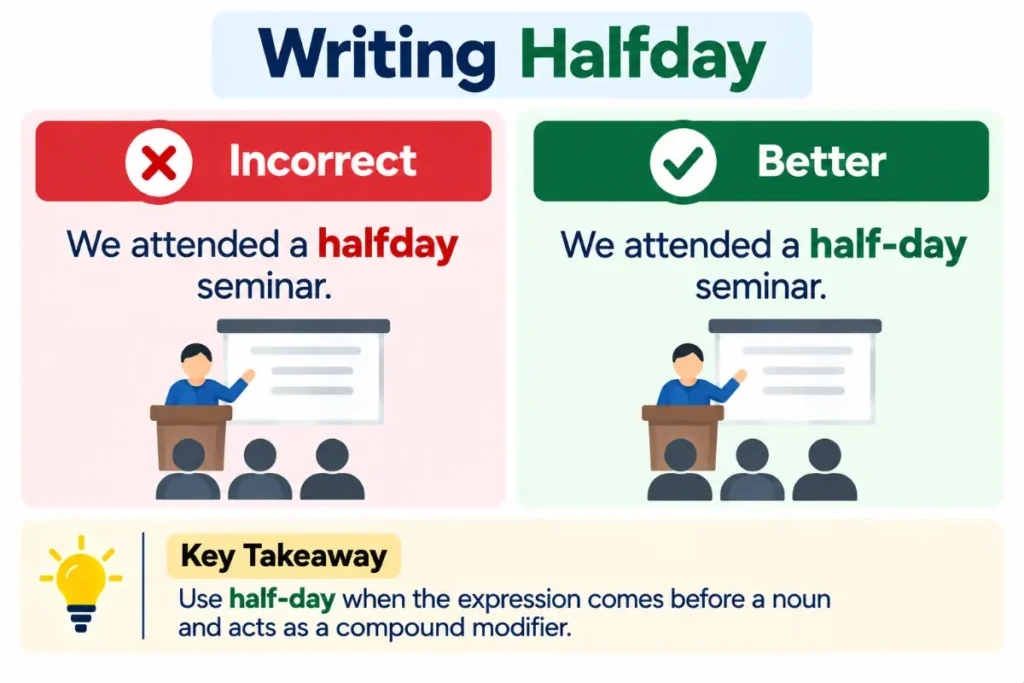
We attended a half day workshop.
The phrase half day describes workshop. Because the two words work together as one compound modifier, many style guides and dictionaries use the hyphenated form before the noun.
The clearer written form is:
We attended a half day workshop.
In a polished sentence, the compound adjective should be written with a hyphen:
We attended a half day workshop.
This tells the reader that half day functions as one unit describing the workshop.
The same principle appears in many English compounds.
a five hour trip
a three week course
a ten minute break
a half day seminar
The number or quantity expression works together with the noun that follows it. The hyphen helps the reader process the group as one modifier.
When To Use The Open Form
When the expression functions as a noun phrase rather than an adjective, the hyphen is usually unnecessary.
For example:
The course lasted half a day.
The meeting took half a day.
We spent half a day at the museum.
The phrase is describing duration rather than modifying another noun.
There is no noun immediately after the expression that needs a compound modifier.
This is why the structure changes.
Before a noun:
a half day workshop
As a duration:
The workshop lasted half a day.
The difference may look small, but it reflects an important English grammar pattern.
The Most Natural Choice In Everyday English
For many ordinary sentences, half a day is the safest and most natural choice.
If you are talking about how long something takes, use the full phrase.
The job will take half a day.
She spent half a day studying.
We stayed there for half a day.
This structure sounds natural in both speech and writing.
The compound form becomes useful when the expression directly describes another noun.
We attended a half day seminar.
She signed up for a half day class.
They organized a half day training session.
This distinction gives you a simple practical rule.
Duration usually takes half a day.
A noun modifier can take a hyphenated compound.
Key Differences Explained
- Grammatical role. The open phrase usually works as a noun phrase showing duration. The hyphenated form works as a compound adjective before a noun.
- Sentence position. A hyphenated compound commonly appears directly before the noun it describes. The duration phrase can appear after a verb or preposition.
- Article use. The noun phrase normally uses a before singular day. For example, half a day.
- Meaning. The basic idea remains the same. Both expressions relate to a period covering approximately half of a day.
- Punctuation. The hyphen belongs to the compound modifier when the words work together before a noun. It is not normally needed when the phrase expresses duration.
- Formality. Both patterns are standard. The choice depends on grammar rather than a difference between formal and informal English.
- Regional usage. American and British English follow broadly similar principles. Individual style guides can differ in their preferred treatment of compounds.
- Clarity. If the sentence could become confusing, rewriting it can be better than relying on a hyphen alone.
Why Hyphens Matter
Hyphens are small marks, but they can prevent a sentence from becoming ambiguous.
Consider:
She attended a half day training program.
A reader can understand the meaning, but the compound relationship is clearer when the modifier is treated as a single unit.
The hyphen signals that half and day belong together as one description of the training program.
This is the same reason English uses forms such as:
a well known author
a five year old child
a two hour meeting
a full time employee
The exact style treatment can vary depending on the words involved and the style guide being followed. Still, the general principle is useful.
When several words work together before a noun as one descriptive unit, a hyphen can make that relationship easier to see.
Sentence Examples
Here are natural examples showing the expression in different contexts.
- The students attended a half day workshop on writing skills.
- We booked a half day tour of the city.
- The company arranged a half day training session for new employees.
- She took a half day class before starting her new job.
- The school planned a half day event for parents and teachers.
- The repair should take half a day.
- I spent half a day organizing my office.
- The trip took half a day because of heavy traffic.
- We only need half a day to finish the project.
- He worked for half a day before leaving for his appointment.
The first five examples use the compound as a modifier. The final five use the expression as a duration.
That difference is more useful than memorizing a single spelling.
Common Mistakes
Leaving Out The Article
I worked for half day.
The more natural standard form is:
I worked for half a day.
Because day is a singular count noun, the article a normally belongs in the phrase.
Using A Hyphen For Duration
Another common mistake is writing:
The project took half a day.
There is no reason to hyphenate half a day in this sentence because the phrase is functioning as a duration.
The hyphen belongs in a compound modifier when appropriate.
Hyphenating Every Use
Some writers assume the compound must always contain a hyphen.
That creates unnecessary punctuation.
For example:
We stayed for half a day.
There is no compound adjective here.
Confusing Half Day With Half A Day
These forms can express related ideas but they do different grammatical work.
A half day course describes a course.
The course lasts half a day describes duration.
Learning to recognize the sentence structure solves the problem.
Treating Day As A Fixed Measurement
A half day does not always mean exactly twelve hours in practical communication.
A workplace half day may mean a morning shift. A school half day may mean several hours of classes. A tour operator may use the term for a shorter excursion.
Always interpret the phrase in context.
Grammar Rules And Part Of Speech
The words half and day can form different structures depending on their role.
Compound Adjective Before A Noun
When the phrase modifies a noun, the words can function together as a compound adjective.
Examples include:
a half day course
a half day workshop
a half day appointment
a half day event
In these examples, the compound tells us what kind of course, workshop, appointment, or event we mean.
Noun Phrase Showing Duration
When you describe how long something lasts, the natural structure is:
half a day
Examples:
The meeting lasted half a day.
We waited for half a day.
She worked for half a day.
The phrase functions as a measurement of time.
After A Preposition
The noun phrase can appear after prepositions such as for and in.
We finished it in half a day.
He worked for half a day.
She completed the task within half a day.
Again, the focus is duration.
Before A Noun
The compound modifier can appear before a noun.
It was a half day event.
They offered a half day course.
She booked a half day tour.
The compound describes the noun that follows.
Grammar And Hyphenation
English compound modifiers can be tricky because hyphenation is influenced by grammar, style, and clarity.
The safest approach is to ask one question.
Are the words working together immediately before a noun to create one description?
If yes, a hyphen may be appropriate.
For example:
a half day workshop
If the words simply describe duration, the hyphen is not normally needed.
The workshop lasted half a day.
This pattern also appears with measurements.
a two hour meeting
The meeting lasted two hours.
a three week course
The course lasted three weeks.
a six month contract
The contract lasted six months.
The grammar changes because the first construction modifies a noun while the second expresses duration.
Half Day As A Noun Modifier
The compound can describe many different kinds of activities.
A half day appointment may last only part of a normal working day.
A half day workshop usually means a workshop scheduled for part of the day.
A half day tour means a tour that occupies part of the day.
A half day shift describes a work shift that lasts approximately half of the normal daily schedule.
These expressions are especially common in schedules and service descriptions because they quickly communicate the expected length of an activity.
Still, exact duration can vary.
A half day tour might last four hours. Another provider might schedule one for six hours. The phrase gives a general idea rather than a universal clock measurement.
Half A Day As A Duration
The phrase is particularly natural with verbs that describe time.
Common patterns include:
take half a day
last half a day
spend half a day
work for half a day
wait half a day
finish within half a day
complete in half a day
For example:
The installation will take half a day.
She spent half a day preparing the presentation.
We finished the work in half a day.
These structures sound natural because the phrase clearly answers how long the activity takes.
Real Life Usage Examples
Daily Conversation
I only need half a day to finish cleaning the garage.
We spent half a day at the beach before heading home.
These sentences use the expression as a duration. In casual speech, people generally choose the full phrase rather than forcing a compound construction.
Email And Workplace Communication
The team will attend a half day training session on Friday.
The installation should take half a day to complete.
The first sentence uses a compound modifier before training session. The second uses the phrase to describe duration.
Academic Writing
The researchers conducted a half day workshop for participants.
The training required half a day of classroom instruction.
Academic writing can use either structure as long as the grammar is clear.
News And Journalism
The organization held a half day conference on public safety.
The event lasted half a day and attracted local community leaders.
Journalistic writing often uses the compound form in event descriptions and the duration form when reporting how long something lasted.
Literature And Storytelling
They spent half a day walking through the forest before finding the cabin.
By noon, the half day expedition had already become the most memorable part of the trip.
Creative writing gives the writer more freedom, but the same grammatical distinction still applies.
American English Usage
American English uses both the compound modifier and the duration phrase.
For general American writing, a phrase such as half a day is the natural choice when discussing duration.
For example:
The work took half a day.
When the phrase modifies a noun, American style commonly uses a hyphenated compound.
For example:
a half day workshop
This follows the broader American convention of hyphenating many compound modifiers that appear directly before a noun.
However, style guides can differ in their treatment of individual compounds. If you are preparing professional or published material, follow the style guide required by your organization.
For ordinary writing, the grammar based distinction is a reliable starting point.
British English Usage
British English follows the same broad grammatical pattern.
Writers can use a compound modifier before a noun and an open duration phrase in other positions.
For example:
a half day course
The course lasted half a day.
British and American English do not have a major difference in the underlying meaning here.
Some publications and style guides may make different editorial choices about hyphenation. That does not change the basic grammar.
Australian English Usage
Australian English also uses the expression in both compound and duration constructions.
For example:
a half day workshop
The workshop lasted half a day.
As with American and British English, the exact punctuation can depend on the publication style being followed.
There is no separate Australian meaning that changes the basic distinction.
Canadian English Usage
Canadian English follows the same general pattern.
Writers commonly use a hyphenated compound before a noun and the open phrase when discussing duration.
For example:
a half day seminar
The seminar lasted half a day.
The difference is therefore grammatical rather than a major regional spelling issue.
Etymology And Word Origin
The word half has Old English roots and has been part of English for many centuries. It developed from an older Germanic word related to the idea of one of two equal parts.
Day is also an old English word. It comes from Old English dæg and has Germanic roots.
The combination half day is therefore a straightforward English compound built from two very old everyday words.
The modern spelling issue is not really about the history of either word. It is about how English handles compounds in modern writing.
English frequently combines words to create modifiers. Sometimes those compounds become established as single words. Sometimes they remain open. Sometimes writers use a hyphen to show that several words function together.
That flexibility is one reason compound punctuation can feel inconsistent.
Pronunciation Guide
The words are pronounced naturally as part of a phrase.
Half day can be represented broadly as /hæf deɪ/ in American English.
The word half has a vowel sound similar to the one in laugh in many American accents. The final f sound is followed by day.
Half a day adds the unstressed article a.
You can think of it as:
half uh day
In natural speech, the a is usually weak rather than strongly stressed.
The main stress normally falls on half and day depending on the sentence.
The hyphen does not create a special pronunciation. It only shows that the words function together grammatically.
This is an important point. You do not pronounce the hyphen.
Related And Confused Terms
Half Day
This can function as a compound modifier when placed before a noun.
Example:
a half day class
Half A Day
This is a common noun phrase used to describe duration.
Example:
The class lasted half a day.
Full Day
Full day describes something lasting the entire scheduled day or an entire day.
Example:
We booked a full day tour.
Part Of A Day
This is a broader expression that can describe any portion of a day.
Example:
The appointment takes part of a day.
Half Time
Half time has a different meaning depending on context. It can refer to a midpoint in a game or a work arrangement involving reduced hours.
Half Hour
Half hour and half an hour follow a similar pattern.
A half hour meeting can function as a compound modifier.
The meeting lasted half an hour describes duration.
Two Hour
Two hour can form a compound modifier before a noun.
Example:
a two hour class
The duration phrase normally becomes two hours when used after a verb.
The class lasted two hours.
One Day
One day can describe a period or can refer to an unspecified future time.
For example:
The course is a one day event.
One day I hope to visit Alaska.
The context determines the meaning.
Common Questions About Hyphenation
Hyphenation often feels confusing because English does not use one universal rule for every compound. The main goal is to show the relationship between words.
If several words work together before a noun, the hyphen can tell the reader that they belong together.
For example:
a half day workshop
Without the hyphen, the sentence may still be understood. With the compound marked clearly, the grammatical relationship becomes easier to see.
After the noun, the same words can usually remain open.
The workshop was half a day long.
Here the phrase is not functioning as a compound modifier.
This is why simply memorizing a spelling is less useful than understanding the grammar.
When The Hyphen Can Be Avoided
Sometimes the cleanest solution is to rewrite the sentence.
Instead of:
a half day workshop
You could write:
a workshop lasting half a day
The second version is longer but completely clear.
Another option is:
a morning workshop
If the workshop actually occurs in the morning, that may be more precise.
This is an important editorial lesson. Hyphenation is not a competition. If a sentence becomes clearer after a small rewrite, take the clearer route.
Expert Editor Insight
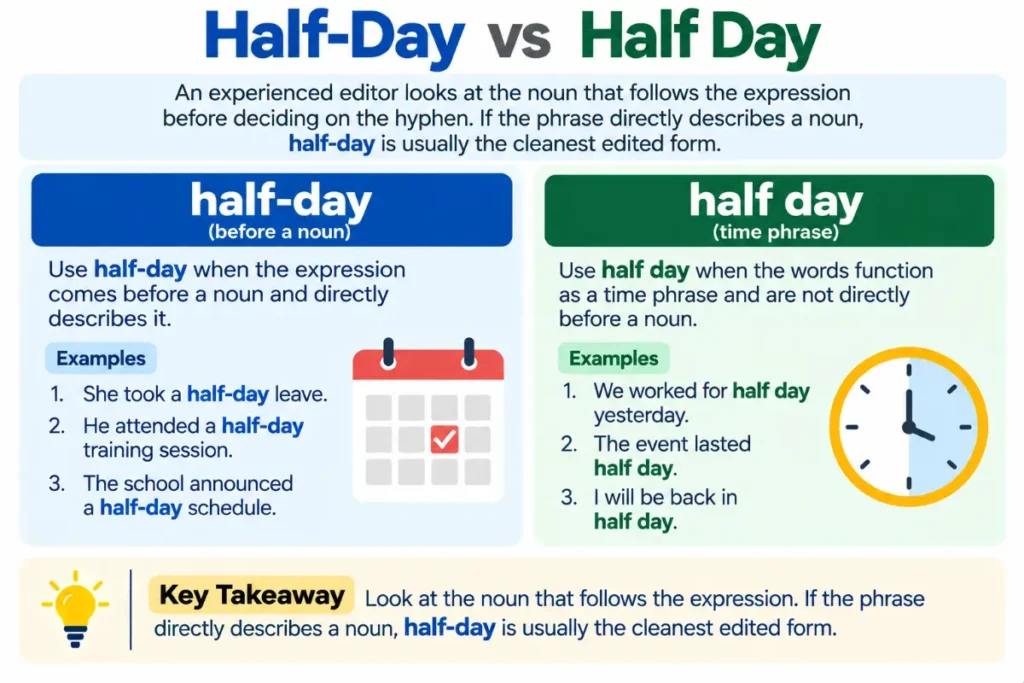
An experienced editor looks at the job the phrase is doing before deciding on punctuation. If it modifies a noun as a compound description, a hyphen can make the relationship clear. If it expresses duration, the natural structure is usually half a day. Editors also watch for missing articles because half day can look incomplete when it is being used as a noun phrase. The strongest practical test is to read the whole sentence rather than judging the two words in isolation.
Conclusion
half day vs half day is mainly a grammar and hyphenation question rather than a difference in meaning. When the expression describes a noun as a compound modifier, the hyphenated form is useful, as in a half day workshop. When you describe duration, half a day is normally the natural choice, as in The workshop lasted half a day.
The easiest way to remember the distinction is to look at the sentence structure. A compound before a noun can take a hyphen, while a duration phrase normally stays open and includes the article a. If you are unsure, rewrite the sentence so the time period is stated clearly. Good punctuation should make your meaning easier to understand, not harder.
For most everyday writing, this simple pattern will keep you on solid ground. Use the compound form before a noun when it works as one description. Use half a day when you are talking about how long something takes or lasts. Once you see the difference as a grammar issue rather than a spelling choice, the rule becomes much easier to apply.
FAQs
Is half day or half a day correct?
Both structures can be correct, but they serve different grammatical purposes. Use a hyphenated compound before a noun when the phrase acts as a modifier, such as a half day workshop. Use half a day when you are describing duration, such as The workshop lasted half a day. The surrounding sentence determines the correct structure.
Should half day have a hyphen?
Use a hyphen when the compound functions as a modifier before a noun, as in a half day course. You generally do not need a hyphen when the phrase expresses duration. For example, write The course lasted half a day. The hyphen helps show that the words work together as one description before the noun.
Is half day grammatically correct?
It can be correct when it forms part of a compound modifier or appears in a context where the noun is understood. For example, a half day workshop is a standard type of compound construction. However, if you are describing duration in a complete sentence, half a day is usually the natural choice. Context determines the best form.
Is half a day always twelve hours?
No. In literal time measurement, half of a twenty four hour day is twelve hours. In everyday English, however, half a day often means part of the normal daytime schedule rather than exactly twelve hours. A school half day or workplace half day may last only a few hours. The intended duration depends on the context.
Is half day one word?
No. The expression is not normally written as one word. When it works as a compound modifier before a noun, it is commonly written with a hyphen. When it expresses duration, it is usually written as half a day. The words should not normally be combined into a single word in standard English.
Can I say I worked half day?
In standard natural English, I worked half a day is usually the better form. The article a is normally needed because day is a singular count noun. In some workplace settings, people may use half day in shortened schedule language, but that does not make it the best structure for a complete sentence.
Is half day formal or informal?
The expression itself is neutral and can appear in professional, academic, and everyday writing. The choice of structure depends on grammar rather than formality. A half day training session can appear in workplace communication, while the training lasted half a day can appear in both casual and formal writing. Clear sentence structure matters more than the level of formality.
What is the easiest way to remember the rule?
Think about the word that follows the expression. If the phrase directly describes a noun, treat it as a compound modifier and use the appropriate hyphenation. If you are saying how long something lasted or took, use half a day. Compare a half day course with The course lasted half a day. This simple contrast covers most everyday cases.
