
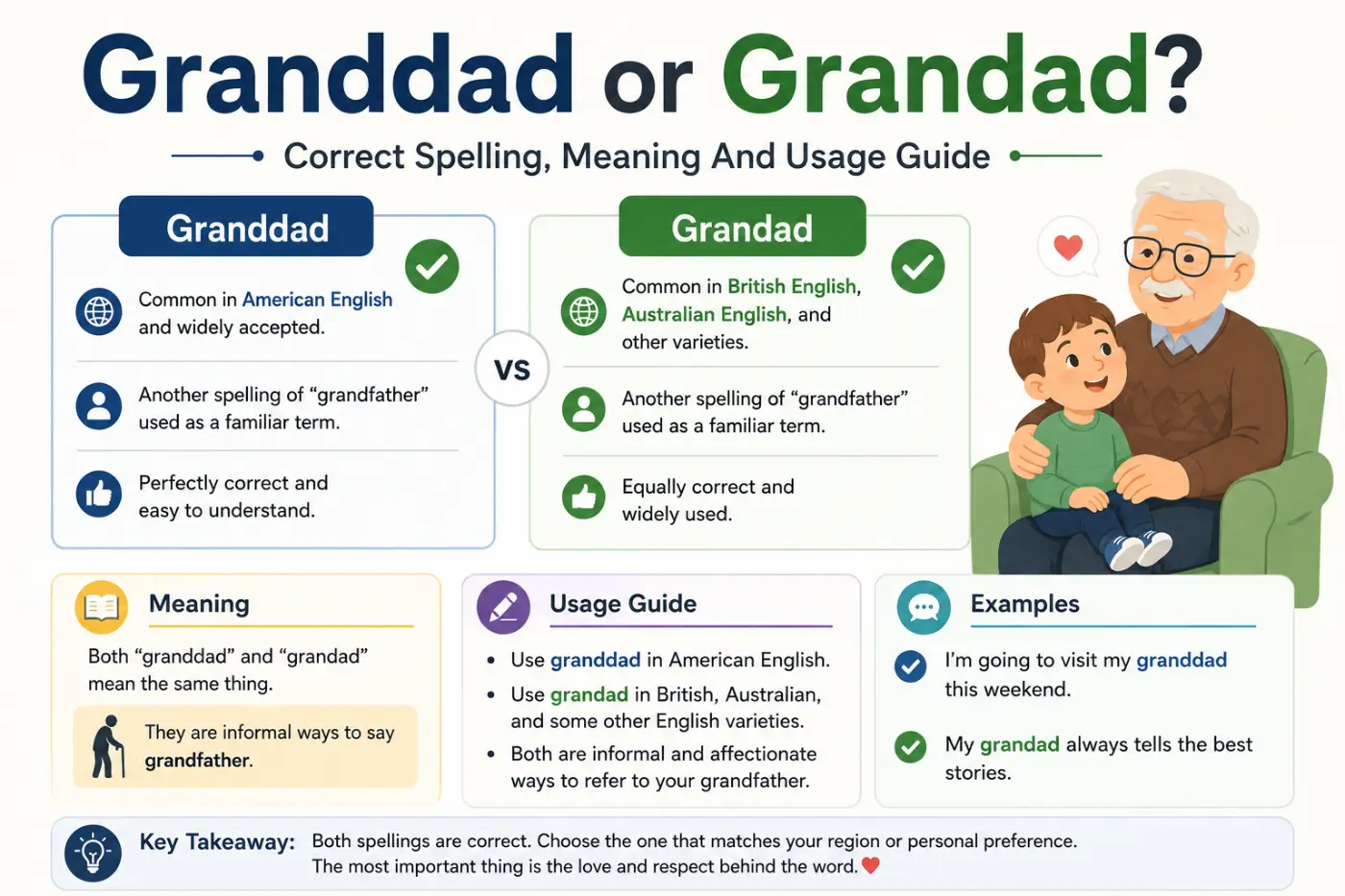
granddad or grandad can make even familiar English feel a little tricky because both spellings are correct. Both words refer to a person’s grandfather, but they are preferred in different varieties of English. In American English, granddad is the more familiar spelling, while grandad is especially common in British English.
The difference isn’t about one word being right and the other being wrong. Both forms are informal family terms that come from combining grand with dad. The main distinction is regional spelling preference. You may see one form much more often depending on the country, publication, family, or speaker.
For most US readers, granddad will feel natural in everyday writing and conversation. In British English, grandad is widely used and sounds completely normal. Both forms can express affection and familiarity, unlike the more neutral word grandfather. This guide explains the meaning, spelling, pronunciation, grammar, history, regional usage, common mistakes, and natural examples so you can choose the form that fits your audience and context.
Quick Definition
Granddad and grandad are both informal words meaning grandfather. Granddad is especially common in American English, while grandad is especially common in British English. Both are standard family terms and can be used as nouns. The difference is mainly regional and stylistic rather than a difference in meaning.
Quick Answer
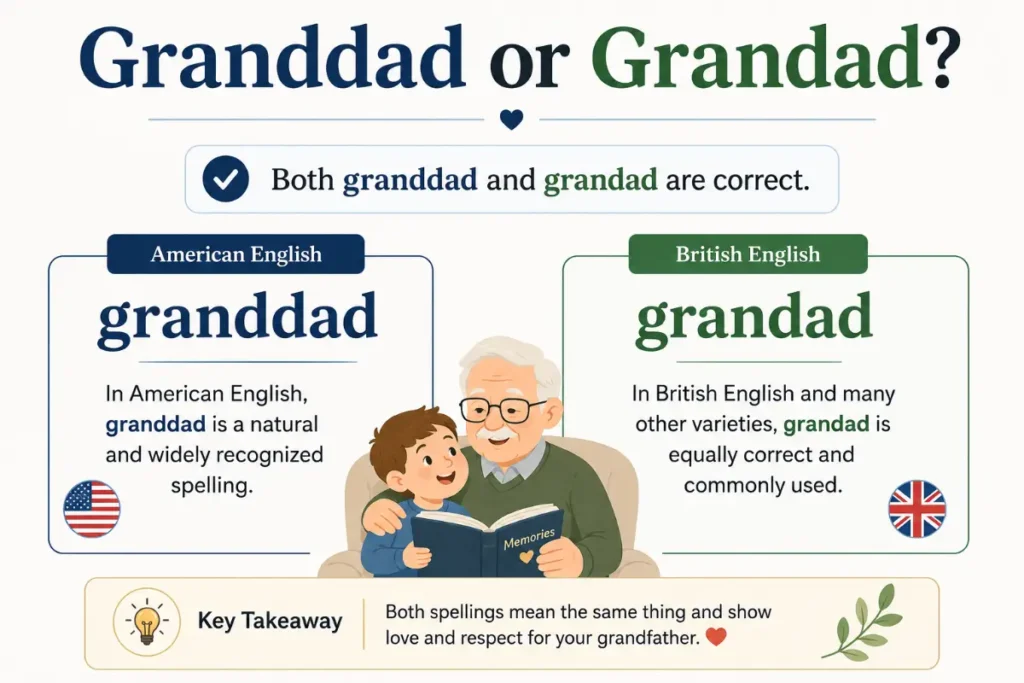
Both spellings are correct. Granddad is generally the more familiar form in American English, while grandad is especially common in British English.
The meaning is the same. Both refer to someone’s grandfather and are usually used in warm, informal family contexts. For formal writing, grandfather is usually the better choice.
Comparison Table For Granddad And Grandad
| Form | Meaning | Part of Speech | Origin | Usage Frequency | Formality | Common Contexts | Example |
|---|---|---|---|---|---|---|---|
| Granddad | Grandfather | Noun | Grand plus dad | Common | Informal | Family speech, personal writing, conversation | My granddad lives nearby. |
| Grandad | Grandfather | Noun | Grand plus dad | Common | Informal | Family speech, British conversation, personal writing | My grandad lives nearby. |
| Grandfather | A person’s father or parent of a parent | Noun | Grand plus father | Very common | Neutral and formal | Formal writing, family history, general writing | My grandfather was a teacher. |
The key point is simple. Granddad and grandad have the same basic meaning. The spelling mainly reflects regional and personal preference.
Meaning And Definition
Meaning Of Granddad
Granddad is an informal noun meaning grandfather.
It normally refers to the father of someone’s mother or father.
For example:
My granddad taught me how to fish.
The word creates a warm and familiar tone. It is common in family conversations, children’s speech, personal stories, cards, messages, and informal writing.
Granddad is formed from grand and dad. The first part identifies the family generation while the second part uses a familiar word for father.
The term can refer to a biological grandfather, but families may also use it for a step grandfather, adoptive grandfather, or another older male family figure depending on the family’s naming traditions.
For example:
My stepgranddad always comes to our birthday dinners.
The exact family relationship can vary, but the word itself remains informal and affectionate.
Meaning Of Grandad
Grandad has the same basic meaning as granddad. It refers to a grandfather in an informal and familiar way.
For example:
My grandad lives in Manchester.
The spelling with ad is particularly familiar in British English. It can also appear in other varieties of English and in families that simply prefer that spelling.
Like granddad, grandad is a noun.
You can use it as the subject of a sentence:
My grandad loves gardening.
You can use it as an object:
I visited my grandad last weekend.
You can also use it after a possessive:
Her grandad told wonderful stories.
The spelling doesn’t change the family relationship. It mainly reflects language variety and personal preference.
The Main Difference
The biggest difference is regional preference rather than meaning.
- Granddad is common in American English. Many American speakers use this form as an informal alternative to grandfather.
- Grandad is especially common in British English. It is a familiar everyday term in the United Kingdom.
- Both forms are correct. Neither spelling should automatically be treated as a mistake.
- Both are nouns. They identify a family member and can appear in the same grammatical positions.
- Both are informal. They generally sound warmer and more personal than grandfather.
- Grandfather is the neutral formal option. Use it when writing for a broad audience or in a formal document.
- Family preference matters. Some families choose a particular spelling regardless of regional patterns.
This is a useful example of English variation. The language doesn’t always have one spelling that works for every English speaking community.
Which Spelling Should You Use
If you’re writing for a US audience, granddad is a natural choice.
For example:
My granddad is coming to visit us this weekend.
If you’re writing for a British audience, grandad may sound more familiar.
For example:
My grandad is coming to visit us this weekend.
If you don’t know the reader’s regional preference and you’re writing something formal, grandfather is the safest neutral term.
For example:
My grandfather was born in 1940.
However, there is no need to replace a family member’s preferred name simply because another spelling is more common in your region. If someone calls himself Grandad or a family consistently uses Grandad, that spelling is part of the family’s own naming tradition.
The same principle applies to family titles such as Grandpa, Gramps, Granddad, Grandad, and other affectionate names. Family language often develops its own patterns.
Why Both Spellings Exist
The two forms developed from the same basic idea.
Grandfather combines grand with father. Informal English then developed familiar alternatives by pairing grand with everyday family words such as dad.
That produced forms such as granddad and grandad.
The difference between dad and ad reflects a natural spelling variation rather than two different meanings. English has many words that vary by region while remaining equally understandable.
Family vocabulary is especially likely to develop regional and personal differences because people often learn these terms through speech at home.
A child may hear one form repeatedly from parents and grandparents. That form can become strongly connected with family memories. Later, the person may continue using it throughout life.
This helps explain why people sometimes feel that one spelling looks more natural even after learning that both forms are standard.
Grammar And Part Of Speech
Granddad and grandad are nouns.
They can act as the subject of a sentence.
My granddad loves baseball.
They can act as the object of a verb.
I called my grandad yesterday.
They can follow a possessive determiner.
Her granddad lives in Texas.
They can also appear in direct address.
Granddad, can you help me?
When you use the word as a name or title before a person’s name, capitalization depends on how it functions in the sentence.
For example:
I asked Granddad about the old house.
Here Granddad is being used as a personal family name.
But:
My granddad lives in Ohio.
Here the word functions as a common noun after my, so lowercase is normal.
This follows a broader English rule for family terms. Words such as mom, dad, grandma, grandpa, granddad, and grandad can be lowercase when they describe a relationship and capitalized when they function as a name or direct form of address.
Compare these examples:
I visited my granddad.
Granddad picked me up from school.
The first uses a possessive determiner. The second uses the word as a name.
Capitalization Rules
Capitalization can cause more confusion than spelling.
Use lowercase when the term follows a possessive or another determiner.
My granddad lives nearby.
Her grandad loves gardening.
Their grandfather visits every Sunday.
Use a capital letter when the term functions as a personal name.
Granddad is waiting outside.
I asked Grandad for advice.
The exact style can vary in family writing, especially when the term has become a personal title. However, the distinction above is a useful standard guide.
Formal writing usually favors grandfather because it is neutral and precise.
Sentence Examples
Here are natural examples using the two regional forms.
- My granddad taught me how to ride a bicycle.
- I called my granddad after dinner.
- My granddad loves watching baseball with us.
- Her granddad built the wooden table in their kitchen.
- We visited my granddad during the holidays.
- My grandad used to tell us stories about his childhood.
- She spends every Sunday afternoon with her grandad.
- His grandad lives in a small village near London.
- I bought a birthday card for my grandad.
- My grandad always makes everyone laugh.
These sentences show that the two forms can occupy exactly the same grammatical position. The main difference is the spelling preference associated with region and family usage.
Common Mistakes And Confusion
Treating Grandad As A Misspelling
A common mistake is assuming that grandad must be wrong because granddad looks more familiar.
That isn’t accurate. Grandad is a standard informal form and is particularly common in British English.
Treating Granddad As A British Spelling Error
The reverse mistake also happens. A writer familiar with British English may see granddad and assume the extra d is unnecessary.
In American English, granddad is a normal spelling.
Using Grandfather In A Casual Family Message
Grandfather is correct, but it can sound more formal than granddad or grandad.
For example:
I can’t wait to see my grandfather.
This is perfectly grammatical, but:
I can’t wait to see my granddad.
sounds warmer and more conversational.
Incorrect Capitalization
Writers sometimes capitalize the word every time.
My Granddad lives in Florida.
That isn’t always appropriate. If the word follows my, her, his, or their and simply describes a family relationship, lowercase is usually appropriate.
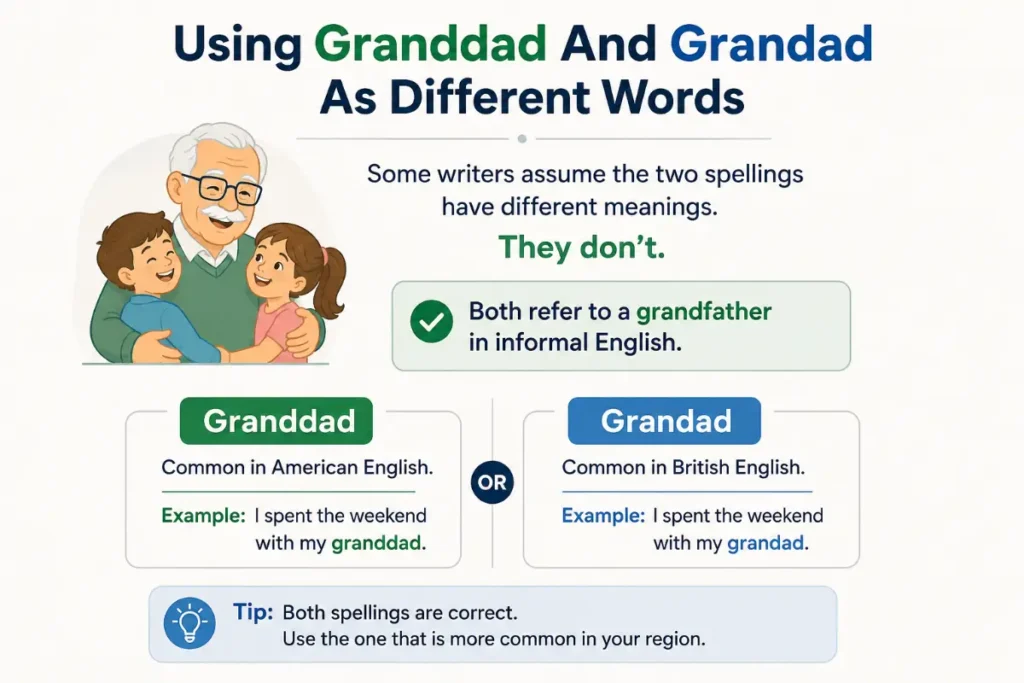
Assuming Regional Words Have Different Meanings
Granddad and grandad do not describe different family relationships.
Both mean grandfather.
The spelling doesn’t tell you that one is a biological grandfather and the other is a step grandfather. Family usage determines those distinctions.
Pronunciation Guide
Granddad and grandad are generally pronounced almost the same way.
A common American pronunciation of granddad is approximately:
/ˈɡrændˌdæd/
You can think of it as:
GRAND dad.
Grandad is commonly pronounced in a very similar way:
/ˈɡrændæd/
You can think of it as:
GRAND ad.
In natural speech, the difference between the two can become very small. This makes sense because the words have the same meaning and closely related forms.
The pronunciation can also vary by regional accent. American and British speakers may produce the vowel sounds somewhat differently, but the basic word remains easy to recognize.
The main learning challenge is therefore spelling rather than pronunciation.
Etymology And Word Origin
The word granddad is built from grand and dad.
Grand has a long history in English and entered the language through French from Latin roots associated with largeness or greatness. In family vocabulary, grand became associated with a generation above the immediate parent.
Dad is an informal English word for father. It has been used in English for centuries and remains one of the most common informal family terms.
The combination granddad therefore follows a clear pattern.
Grand plus dad gives a familiar term for the father of a parent.
Grandad follows the same family word formation but uses a shorter spelling.
Grandfather follows the same generational idea with the more formal word father.
The modern forms are therefore closely related rather than unrelated words that happen to mean the same thing.
Regional Usage
American English
Granddad is a familiar informal term in American English. It appears in family conversations, personal writing, children’s books, messages, cards, and storytelling.
Grandpa is also extremely common in the United States. Some American families prefer grandpa while others use granddad, grandfather, or a unique family name.
Grandad is understandable to American readers but may feel more associated with British English.
British English
Grandad is a very familiar informal term in British English.
You can hear and see it in everyday family language, children’s writing, novels, television dialogue, cards, and personal communication.
Granddad also exists in British English. The spelling isn’t incorrect, but grandad is a common regional preference.
Australian English
Australian English uses several informal terms for grandfather, including grandad and granddad. Family preference and individual speech patterns influence the choice.
The two forms can therefore appear in Australian writing without creating a major difference in meaning.
Canadian English
Canadian English can use both spellings. Granddad is familiar in North American English, while grandad is also understood and used.
Because Canadian English has influences from both American and British traditions, individual usage can vary.
There is no major grammatical difference between the forms.
Formal And Informal Usage
Granddad and grandad are informal.
That doesn’t mean they’re poor English. Informal vocabulary has an important place in natural communication. The right word depends on the situation.
A birthday card might say:
Happy birthday, Granddad. I hope you have a wonderful day.
That sounds warm and natural.
A family history document might say:
My grandfather was born in Pennsylvania in 1932.
The second version is more neutral.
In an academic paper, grandfather is generally more appropriate unless the informal family term itself is relevant to the discussion.
For example:
Participants described their grandfather as a major influence.
This sounds more neutral than:
Participants described their granddad as a major influence.
The second version isn’t wrong. It simply carries a more personal and conversational tone.
Granddad And Grandad In Family Names
Family names are different from ordinary dictionary usage.
A child may call one grandfather Granddad and another Grandpa. Another family may use Grandad and Pop.
These names can also become part of family identity.
For example:
Granddad Jack is coming for dinner.
Here Granddad functions almost like a title before a name.
Another family might write:
Grandad Jack is coming for dinner.
Both can work depending on the family’s chosen spelling.
If you’re writing a personal message or family story, consistency matters more than choosing a supposedly universal version.
Real Life Usage Examples
Daily Conversation
My granddad is picking me up after school.
I haven’t seen my grandad since Christmas.
Both sentences sound natural. The preferred spelling depends mainly on the speaker’s regional and family usage.
Text Messages
I’m going to Granddad’s house tonight.
Grandad says hello.
These short messages show how naturally the term fits casual communication.
Workplace Communication
A workplace document might mention a family member in a personal context.
I need Friday afternoon off to take my grandfather to an appointment.
Here grandfather is usually better because the writing is professional and neutral.
Academic Writing
Researchers writing about family relationships may prefer grandfather.
The participants described their grandfather as an important source of support.
The formal term avoids unnecessary informality.
News Writing
News reports usually prefer grandfather unless a direct quote or personal account uses a family term.
The man’s grandfather was present at the ceremony.
This keeps the tone neutral.
Literature And Storytelling
Fiction has more freedom.
Granddad sat by the window and watched the rain.
Grandad pulled an old photograph from the drawer.
The choice can help establish a character’s regional background, family voice, or age.
Related And Confused Terms
Grandfather
Grandfather is the standard neutral term. It works in both formal and informal contexts.
Grandpa
Grandpa is a common informal American family term. It can sound warm and familiar.
Gramps
Gramps is highly informal and often affectionate. It is especially common as a family nickname.
Grandpappy
Grandpappy is an informal and sometimes old fashioned term. It can also create a particular regional or humorous tone.
Grandmother
Grandmother is the female counterpart of grandfather. Informal alternatives include grandma and granny.
Grandparent
Grandparent is a gender neutral term covering both grandfathers and grandmothers.
Grandchild
Grandchild refers to the child of someone’s son or daughter. The relationship works in the opposite direction from grandparent.
Grandpa
Grandpa is not simply another spelling of granddad. It is a separate informal family term with the same basic relationship.
These terms can carry different emotional and regional associations even when they refer to the same family role.
How To Choose The Best Form
Choosing between the two spellings is usually easy once you identify your audience.
- Writing for Americans. Granddad is a natural choice, although grandpa may be even more familiar in some families.
- Writing for British readers. Grandad is a natural and widely recognized choice.
- Writing for Australians or Canadians. Either form can work. Consider the surrounding language and your intended audience.
- Writing a formal document. Use grandfather when you want a neutral tone.
- Writing a personal message. Use the spelling preferred by the family member or family.
- Writing dialogue. Choose the form that fits the speaker’s regional and personal voice.
This approach is better than trying to identify one universal winner because English has legitimate regional variation.
Why Spellings Vary In Family Vocabulary
Family words often develop differently from formal vocabulary because people learn them through conversation.
A child usually doesn’t learn the word granddad from a grammar book. The child hears a parent or grandparent use a particular form and adopts it.
That family pattern can remain strong for decades.
Regional language then adds another layer. A British child may hear grandad repeatedly. An American child may hear granddad or grandpa.
Neither child is learning a mistake.
They’re learning the vocabulary of their community.
This is one reason language experts distinguish between standard variation and genuine spelling errors. A different regional form can be fully correct even when it isn’t the form you personally use.
Expert Editor Insight
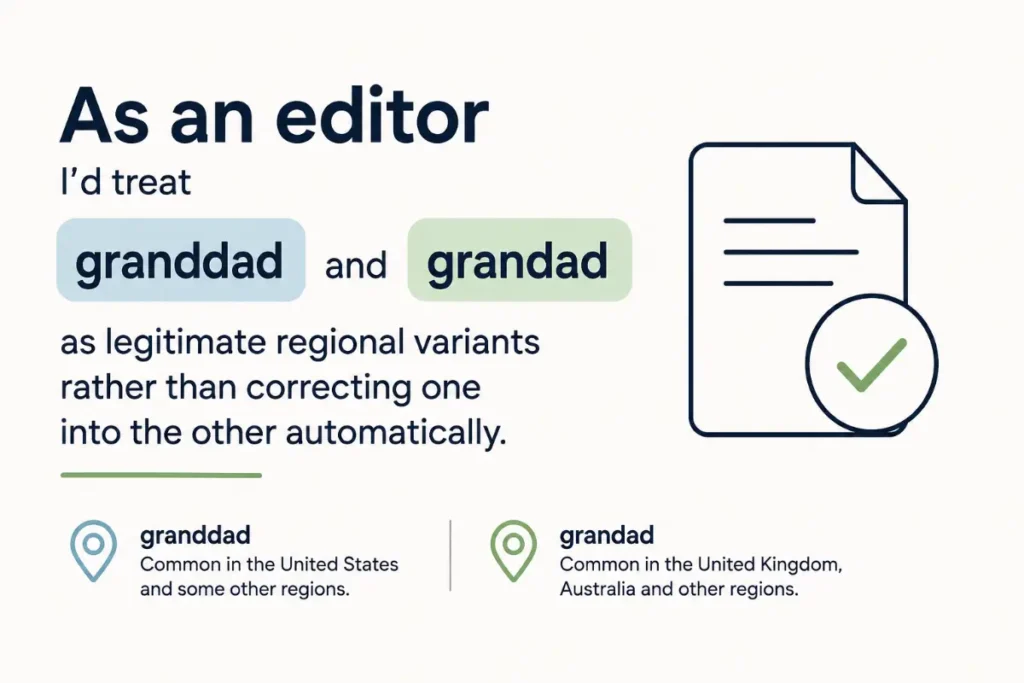
An experienced editor would not mark grandad as an error simply because granddad is preferred in American English. Both are established informal terms, and the right choice depends on audience and family preference. For general US content, granddad is a natural option, while British oriented writing often favors grandad. In formal documents, grandfather usually provides a more neutral tone. The best editing tip is simple: don’t correct legitimate regional variation unless your publication has a specific style preference.
Conclusion
granddad or grandad isn’t a case where one spelling is right and the other is wrong. Both are established informal words for grandfather. Granddad is a familiar choice in American English, while grandad is especially common in British English. The two forms have the same basic meaning and grammatical function.
Your audience should guide the choice. Use granddad naturally for general US writing, grandad for a British style or family preference, and grandfather when you want a neutral formal term. If you’re writing about a specific family member, their preferred spelling matters most.
The easiest editing rule is to treat both forms as valid regional variants. Don’t change one simply because the other looks more familiar. Choose the form that fits the audience, tone, and family context, then use it consistently throughout your writing.
FAQs
Is grandad a correct spelling?
Yes. Grandad is a correct standard informal English term for grandfather. It is especially common in British English. It is not simply a typo or an incorrect version of granddad. American readers will generally understand it as well, although granddad may feel more familiar to them.
Is granddad the American spelling?
Granddad is a common American English spelling for the informal word meaning grandfather. American English also uses grandpa and other family terms. Grandad is understood in the United States but can sound more strongly associated with British English. Family preference can override regional tendencies, so both spellings can appear in American families.
Do granddad and grandad mean the same thing?
Yes. Both words mean grandfather. The main difference is spelling preference and regional usage. Granddad is especially familiar in American English, while grandad is especially common in British English. Both can describe the same family relationship and both function as informal nouns.
Which spelling should I use in American English?
For a general American audience, granddad is a natural choice. However, grandad is also understandable and legitimate. If you’re writing about a particular person, use the spelling that person or family uses. For formal writing, grandfather is usually more neutral and appropriate.
Is grandad more British than American?
Grandad is strongly associated with British English and is a common informal family term in the United Kingdom. It is also used outside Britain and is easily understood by American readers. Granddad is more familiar in American English. The distinction is mainly regional preference rather than a difference in meaning.
Is granddad formal or informal?
Granddad is informal. It is suitable for family conversations, personal messages, children’s writing, stories, cards, and casual communication. For formal documents, academic writing, professional reports, or neutral descriptions, grandfather is generally a better choice. Informal does not mean incorrect. It simply describes the tone and setting where the word fits best.
Can I capitalize granddad or grandad?
Yes, but capitalization depends on how the word functions. Use lowercase when it follows a possessive such as my granddad. Capitalize it when it functions as a personal name or direct form of address, such as Granddad, can you help me? Family style may create additional preferences.
What is the difference between granddad and grandpa?
Both are informal terms for grandfather. Granddad is formed from grand and dad, while grandpa uses grand and pa. In American English, grandpa is very common, while granddad is also familiar. Grandad is another regional spelling of the granddad type. The choice often depends on family tradition, region, and personal preference.
