
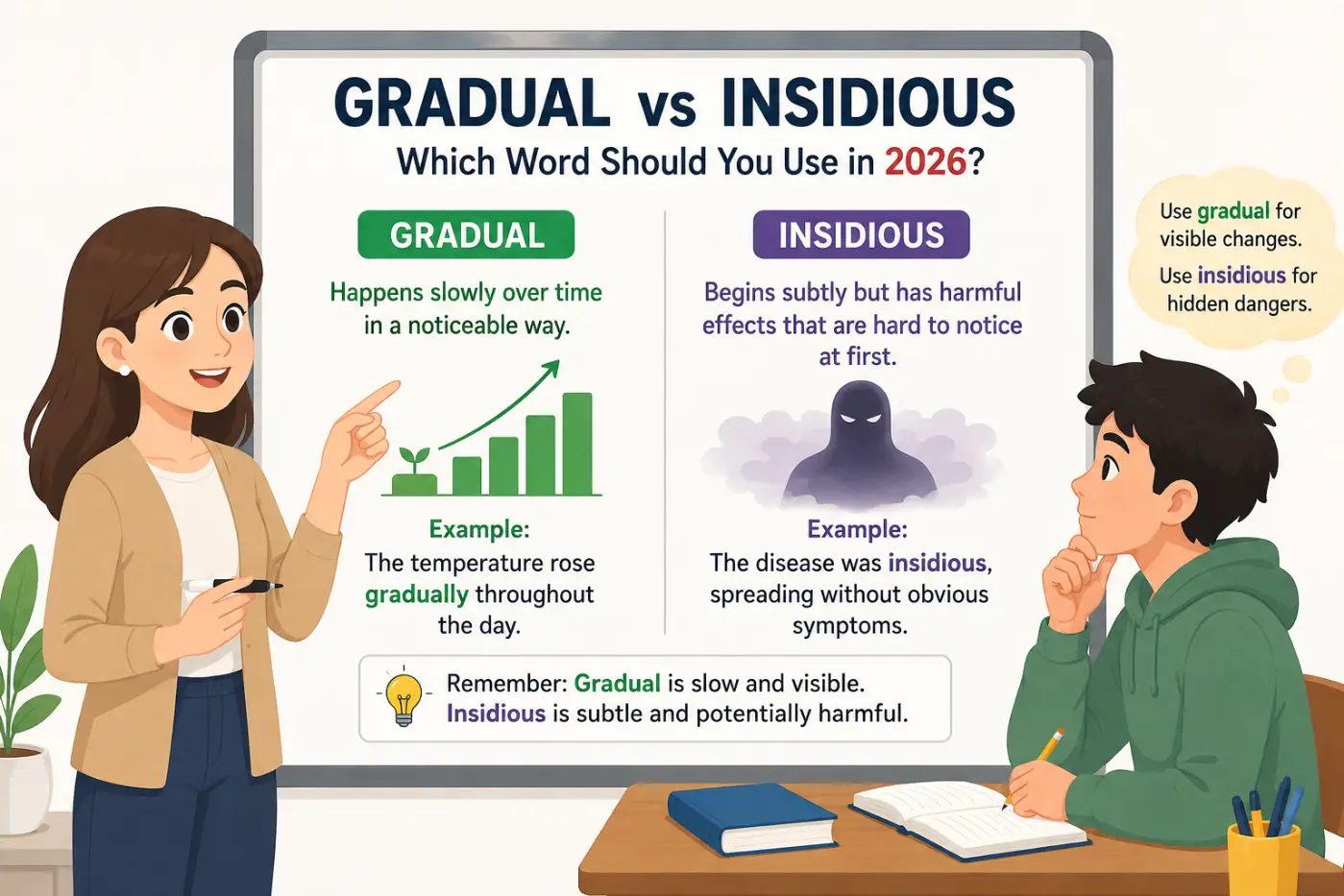
gradual vs insidious can be confusing because both words can describe something that develops slowly over time. However, they don’t carry the same meaning. Gradual simply describes a slow and steady change, while insidious usually describes something harmful or dangerous that develops quietly and subtly.
For example, a gradual improvement in your writing is positive and easy to understand. An insidious problem is different. It may develop little by little while remaining difficult to notice until its effects become serious. That hidden or harmful quality is the key idea behind insidious.
The distinction matters because choosing one word instead of the other can change the tone of a sentence. Gradual is neutral and works in positive, negative, and ordinary situations. Insidious is much stronger and usually suggests something unwanted, damaging, deceptive, or threatening. This guide explains the meanings, grammar, pronunciation, word origins, regional usage, common mistakes, and real life examples so you can choose the right word naturally.
Quick Definition
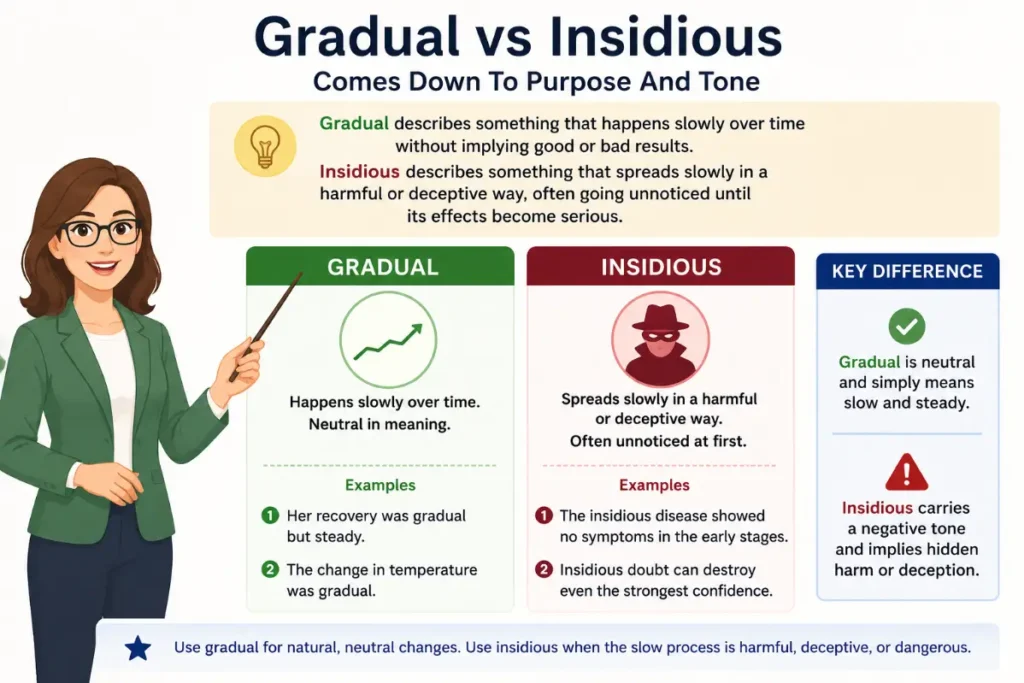
Gradual means happening slowly over a period of time through a series of small changes. Insidious describes something that develops gradually and subtly, especially when it causes harm or has a harmful effect that is difficult to notice at first. The two words overlap in the idea of slow development, but insidious carries a much stronger negative meaning.
Quick Answer
Gradual and insidious are both correct words, but they aren’t interchangeable in every sentence.
Use gradual when you simply want to describe a slow change or process. Use insidious when the slow development also involves a hidden, harmful, or potentially dangerous quality.
For example:
The patient made gradual progress.
The disease had an insidious onset.
The first sentence describes a slow improvement. The second suggests that the disease developed in a subtle way that could be difficult to recognize.
Comparison Table
| Word | Core Meaning | Part of Speech | Typical Tone | Common Contexts | Positive Use | Negative Use | Example |
|---|---|---|---|---|---|---|---|
| Gradual | Happening slowly through small changes | Adjective | Neutral | Change, growth, improvement, decline, learning | Very common | Very common | The company experienced gradual growth. |
| Insidious | Developing subtly and gradually with harmful or dangerous effects | Adjective | Strongly negative or cautionary | Disease, corruption, threats, influence, damage, social problems | Rare | Very common | The disease had an insidious onset. |
The table highlights the main difference. Gradual tells you how something happens. Insidious tells you how something happens and suggests that the process is harmful or difficult to detect.
Meaning And Definition
Meaning Of Gradual
Gradual is an adjective that describes something happening slowly rather than suddenly.
A gradual change usually happens through several small stages. You can observe the process over time even if the individual changes are small.
Consider these examples:
The weather became gradually warmer.
She made gradual progress in mathematics.
The company experienced a gradual decline in sales.
The word doesn’t tell you that the change is good or bad. That depends on the noun and the surrounding context.
A gradual improvement is positive.
A gradual increase may be positive or negative depending on what is increasing.
This neutrality makes gradual extremely flexible. You can use it in everyday conversation, academic writing, journalism, business communication, science, education, and many other settings.
The central idea is slow progression.
Meaning Of Insidious
Insidious is also an adjective, but it carries much more weight.
It describes something that develops gradually and subtly while causing harm or creating danger. The harmful nature may not be obvious at first.
For example:
The disease had an insidious onset.
This suggests that the disease developed quietly and its presence may not have been immediately obvious.
You can also use insidious outside medicine.
An insidious rumor can spread quietly and cause damage.
An insidious influence may slowly change people’s behavior without drawing attention to itself.
The word therefore contains more than the idea of slow development. It suggests that the process is subtle, harmful, and often difficult to detect.
That is why replacing insidious with gradual can weaken a sentence.
Consider:
The problem developed gradually.
This tells us the problem developed slowly.
The problem developed insidiously.
This suggests that the problem developed slowly and in a harmful or stealthy way.
The second sentence gives the reader more information about the nature of the problem.
The Core Difference
The easiest way to remember the distinction is to separate speed from danger.
- Gradual describes pace. Something happens little by little instead of suddenly.
- Insidious describes subtle harm. Something develops quietly and gradually while causing or threatening harm.
- Gradual can be positive. You can have gradual improvement, gradual recovery, or gradual growth.
- Insidious is usually negative. You normally use it for something harmful, dangerous, corrupting, or deceptive.
- Gradual doesn’t imply concealment. A gradual change can be obvious and easy to observe.
- Insidious often suggests difficulty of detection. The harmful process may remain unnoticed for some time.
- Insidious can include gradual development. Something insidious is often gradual, but something gradual isn’t necessarily insidious.
That final point is the most useful.
Think of the relationship this way:
Gradual = slow.
Insidious = slow + subtle + harmful.
This isn’t a mathematical formula, but it is a useful memory tool.
Why The Words Are Sometimes Confused
The confusion comes from a shared idea of slow development.
Imagine a crack in a building.
The crack developed gradually.
This sentence tells us that the crack appeared and became worse over time.
Now imagine that the crack grew so slowly that nobody noticed it until the structure became unsafe.
The crack developed insidiously.
Now the sentence carries an additional idea. The problem wasn’t simply slow. Its development was subtle and potentially dangerous.
The two words can therefore describe the same event from different angles.
A writer may focus on how fast something changed and choose gradual.
Another writer may focus on how quietly and harmfully the change developed and choose insidious.
This distinction is especially important in professional writing because precise word choice can affect the reader’s understanding.
Which Word Should You Use
Choose gradual when the main idea is slow and steady development.
For example:
The student showed gradual improvement.
Choose insidious when the main idea includes hidden or subtle harm.
For example:
The organization faced an insidious form of corruption.
If you’re unsure, ask yourself one simple question.
Am I only describing slow change, or am I warning the reader about a subtle harmful process?
If you’re only describing slow change, gradual is probably appropriate.
If the situation involves hidden harm, danger, corruption, disease, manipulation, or another negative force that develops quietly, insidious may be more precise.
Sentence Examples
Here are natural examples using gradual in different contexts.
- The patient made gradual progress during recovery.
- We saw a gradual increase in demand over the summer.
- Her confidence grew through gradual exposure to public speaking.
- The company plans to make a gradual transition to remote work.
- The temperature showed a gradual decline throughout the evening.
- He noticed a gradual improvement in his reading skills.
- The town experienced gradual population growth.
- The color changes from light blue to dark blue through a gradual transition.
- Learning a new language requires gradual practice and regular exposure.
- The team made gradual changes to the design instead of replacing everything at once.
Now consider examples using insidious.
- The disease can have an insidious onset.
- The insidious spread of misinformation made the problem harder to control.
- The manager became concerned about the insidious influence of the new policy.
- The community faced an insidious form of environmental damage.
- Small acts of dishonesty can have an insidious effect on workplace trust.
- The novel explores the insidious effects of fear.
- The doctor warned that the condition could develop in an insidious way.
- The habit had an insidious impact on his finances.
- The report examined the insidious spread of corruption.
- The threat was insidious because few people recognized it at first.
Notice how the second group usually involves a problem, threat, harm, or negative influence. That’s a strong clue that insidious is the better choice.
Common Mistakes
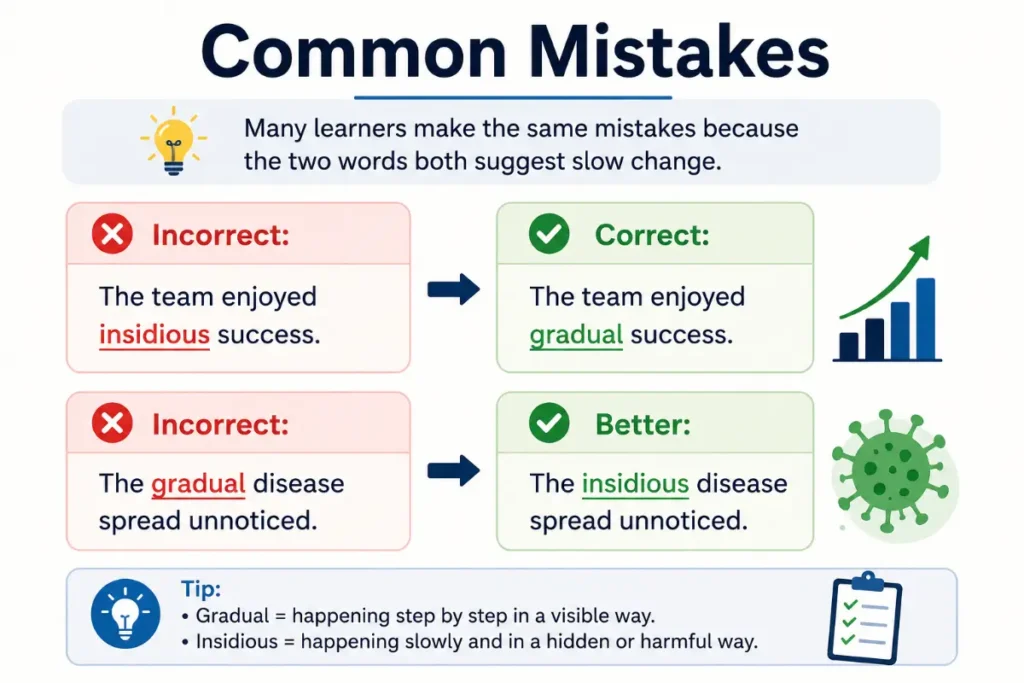
Using Insidious For Any Slow Change
This is the most common meaning error.
A writer may think insidious simply means gradual because both words can describe slow development.
That isn’t enough.
An insidious process normally involves a harmful or threatening quality.
Incorrect in ordinary neutral use:
The flowers showed an insidious growth during spring.
Better:
The flowers showed gradual growth during spring.
If the growth itself is harmful or damaging, insidious may become appropriate.
Using Gradual When Hidden Harm Matters
The opposite mistake can weaken the meaning.
Consider:
The disease developed gradually.
This is grammatically correct. However, if the writer wants to emphasize that the disease developed subtly and remained difficult to detect, insidious provides a stronger and more precise description.
Treating Insidious As A Synonym For Sneaky In Every Context
Insidious can suggest something stealthy, but it doesn’t simply mean sneaky.
A person can be sneaky because they deliberately hide an action.
An insidious problem can develop without a person deliberately planning it.
The word is especially useful for harmful processes, conditions, effects, and influences.
Assuming Insidious Always Means Intentional
Insidious does not require deliberate intent.
A disease can be insidious.
A social problem can be insidious.
An environmental threat can be insidious.
None of these necessarily involve a person deliberately trying to cause harm.
Confusing Insidious With Invidious
Insidious and invidious look and sound somewhat similar, but their meanings differ.
Insidious describes something subtly harmful or dangerous.
Invidious can describe something unfair, offensive, or likely to cause resentment.
For example:
The disease had an insidious onset.
The decision created an invidious distinction between the two groups.
Pronunciation Guide
Gradual
The common American English pronunciation is approximately:
/ˈɡrædʒuəl/
A simple pronunciation guide is:
GRAJ oo uhl
The primary stress falls on the first syllable.
The word is commonly divided into three syllables:
grad u al
In natural speech, the middle and final sounds can become less distinct. That is normal in conversational English.
Insidious
The common pronunciation is:
/ɪnˈsɪdiəs/
A simple pronunciation guide is:
in SID ee us
The main stress falls on the second syllable.
You can think of it as:
in SID ee us
A common mistake is putting too much stress on the first syllable. The strongest emphasis normally falls on sid.
Because insidious is less common in everyday conversation than gradual, some speakers may recognize the word visually before they feel comfortable saying it aloud. Reading the word slowly and then using it in a natural sentence can help.
Etymology And Word Origin
The history of gradual connects to the idea of moving step by step.
Gradual entered English through French and Latin. Its Latin roots are associated with steps and movement from one stage to another. That historical connection fits the modern meaning well because a gradual process advances through stages rather than making one sudden jump.
Insidious has a more striking history.
It comes from Latin insidiae, meaning an ambush or trap. The Latin family is connected with lying in wait.
That origin helps explain the modern meaning. Something insidious seems to wait quietly while developing or causing harm. The modern English word retains this sense of something dangerous that operates subtly rather than openly.
Understanding the history isn’t necessary to use either word correctly, but the origin of insidious provides a useful memory aid.
Think of an ambush.
The danger isn’t necessarily obvious at first.
That hidden quality is central to the modern meaning of insidious.
Regional Usage
American English
Both words are standard in American English.
Gradual is very common and appears in everyday conversation as well as formal writing. Americans use it to describe changes in temperature, health, learning, business, relationships, prices, and many other situations.
Insidious is less common in casual conversation because it has a stronger and more serious tone. It appears frequently in medical, political, social, literary, and analytical contexts where a writer wants to describe subtle harm or danger.
British English
British English uses both words with essentially the same meanings.
Gradual remains a neutral and widely useful adjective.
Insidious also carries the idea of something subtly harmful or dangerous. There is no major British English distinction that changes the core meaning of either word.
Australian English
Australian English follows the same basic distinction.
Gradual describes slow development without automatically suggesting a positive or negative result.
Insidious generally carries a negative sense involving hidden harm, danger, or a harmful influence that develops quietly.
Canadian English
Canadian English also uses both words in their standard meanings.
Gradual is suitable for ordinary and formal communication. Insidious tends to appear in more serious contexts where the writer wants to emphasize subtle danger or harm.
The difference is therefore semantic rather than regional.
Grammar Rules And Part Of Speech
Both gradual and insidious are adjectives.
They normally modify nouns.
For example:
The change was gradual.
The disease had an insidious onset.
They can also appear before nouns.
We noticed a gradual decline.
The condition had an insidious beginning.
Both adjectives can follow linking verbs such as become, seem, appear, remain, and be.
The decline became gradual.
The effect seemed insidious.
However, not every grammatical combination will sound equally natural. Native speakers choose nouns that fit the meaning of the adjective.
Gradual commonly appears with nouns such as:
change
increase
decline
growth
improvement
transition
progress
recovery
development
Insidious commonly appears with nouns such as:
disease
threat
influence
effect
problem
spread
corruption
damage
onset
The noun choice itself can help signal the intended meaning.
Comparative And Superlative Forms
Gradual can sometimes appear in comparative constructions.
The second change was more gradual than the first.
The transition became more gradual.
Insidious can also technically be compared in some contexts, but comparative forms are much less common and can sound awkward.
Writers usually choose a different construction when they need to compare degrees of hidden harm.
For example:
The second threat was more difficult to detect.
That often sounds more natural than trying to force a comparative form.
Gradual Change Can Be Positive Or Negative
One of the clearest ways to understand gradual is to look at the emotional neutrality of the word.
A gradual recovery is positive.
A gradual increase in income may be positive.
But a gradual decline in health is negative.
A gradual loss of trust is negative.
A gradual increase in pollution is negative.
The adjective itself doesn’t tell the reader how to feel about the change.
The noun provides much of the meaning.
This makes gradual useful in objective writing. It describes the pace without adding an unnecessary judgment.
Insidious Change Usually Carries A Warning
Insidious is different because the word itself contributes a negative idea.
Consider:
The influence was gradual.
This simply tells us that the influence developed slowly.
Now consider:
The influence was insidious.
The reader expects the influence to be harmful, unwanted, deceptive, or difficult to recognize.
That stronger meaning makes insidious useful in warnings and serious analysis.
For example:
The insidious spread of the disease concerned health officials.
The insidious nature of the problem became clear only after several years.
In each case, the word tells the reader more than speed alone.
Real Life Usage Examples
Daily Conversation
I noticed a gradual change in the weather.
Her confidence grew gradually after she started practicing.
The first example is completely natural in everyday conversation. The second is also common, although gradual itself may be replaced by the adverb gradually.
Insidious is less common in casual speech.
You might say:
The problem had an insidious effect on the family.
That sounds serious and deliberate. A casual speaker may instead say:
The problem slowly caused more trouble.
Both express a similar basic idea, but the vocabulary creates a very different tone.
Workplace Communication
The company made a gradual shift toward flexible working arrangements.
The manager warned about the insidious effects of poor communication on team trust.
The first sentence focuses on a controlled transition. The second highlights a problem that can grow quietly and cause damage.
Academic Writing
The researchers observed a gradual increase in participation.
The study examined the insidious effects of long term exposure to the pollutant.
Academic writing often benefits from this distinction because it allows writers to separate a neutral description of rate from a description of harmful development.
News Writing
The region experienced a gradual decline in rainfall.
Officials warned about the insidious spread of the invasive species.
News writers can use gradual for measurable change and insidious for threats that develop quietly.
Literature And Storytelling
The character underwent a gradual change in attitude.
The novel explores the insidious influence of fear on the community.
In storytelling, the choice can shape the reader’s emotional response. Gradual keeps the description neutral. Insidious adds tension and suggests that something harmful is working beneath the surface.
Related And Confused Terms
Slowly
Slowly focuses on speed. It is often the simplest everyday alternative to gradual.
The car moved slowly.
The temperature changed gradually.
The words overlap but are not grammatically identical because slowly is an adverb while gradual is an adjective.
Steady
Steady suggests consistent progress or movement without sudden changes.
The company experienced steady growth.
Steady does not automatically mean slow.
Progressive
Progressive describes something developing or advancing through stages. Depending on context, it can sound more technical than gradual.
Incremental
Incremental describes change that happens through small additions or steps.
The company made incremental improvements to the software.
It is especially common in business and technical writing.
Subtle
Subtle describes something difficult to notice, detect, or understand.
A subtle change may be small and hard to see, but it isn’t necessarily harmful.
Stealthy
Stealthy suggests avoiding attention or detection.
It is often associated with deliberate concealment, so it isn’t a complete synonym for insidious.
Harmful
Harmful simply means causing damage or injury. It doesn’t necessarily suggest gradual or hidden development.
Deceptive
Deceptive describes something that gives a false impression or intentionally misleads. Insidious can involve deception, but deliberate deception isn’t required.
These distinctions help explain why synonyms should not be treated as interchangeable labels. Each word highlights a different part of the situation.
When Gradual And Insidious Can Describe The Same Thing
Sometimes both words can reasonably appear in the same description.
Consider a disease.
The disease developed gradually.
This tells us that symptoms or effects appeared over time.
Now:
The disease developed insidiously.
This adds the idea that the disease developed subtly and may not have been recognized quickly.
You can even combine the concepts:
The disease had a gradual and insidious onset.
Here gradual describes the slow development while insidious emphasizes the subtle and harmful nature of the condition.
The combination can be useful when both ideas matter.
However, don’t combine words simply to make a sentence sound more sophisticated. If gradual already communicates what the reader needs, adding insidious may create unnecessary drama.
How To Choose The Right Word
Use this practical test when editing.
- Ask whether you are describing speed or harm.
If the main idea is slow development, choose gradual.
If the main idea is subtle harm, consider insidious.
- Look at the noun.
Gradual improvement makes sense.
Insidious improvement usually doesn’t because improvement is normally positive.
Gradual disease progression makes sense.
Insidious disease progression can also make sense when the disease is difficult to recognize.
- Consider the emotional tone.
Gradual is neutral.
Insidious is cautionary and negative.
- Consider the audience.
In everyday conversation, gradual or slowly may be more natural.
In analytical or formal writing, insidious can provide useful precision when the situation genuinely involves hidden harm.
- Read the sentence without the adjective.
Ask what information the adjective adds.
If it only tells the reader that something happened slowly, gradual may be enough.
If it tells the reader that the process was quietly harmful or dangerous, insidious may be the stronger choice.
Expert Editor Insight
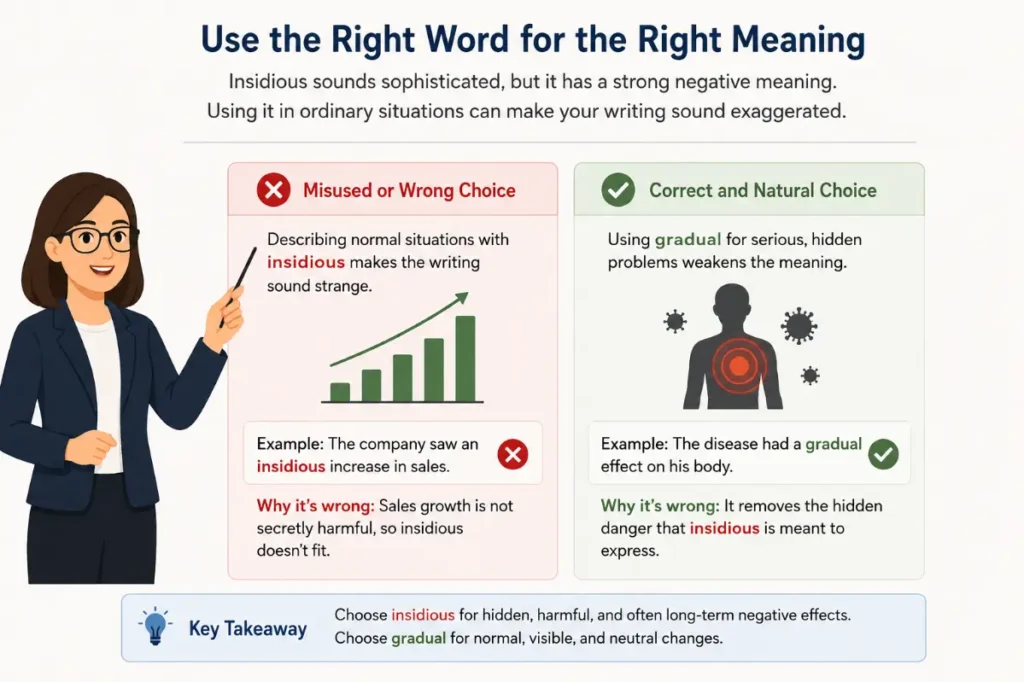
A good editor doesn’t treat these words as simple synonyms. The first question is what the sentence needs to communicate. Gradual is a neutral description of pace and works comfortably with both positive and negative changes. Insidious is much more loaded and usually signals subtle harm or danger. If a writer uses it only because it sounds sophisticated, an editor may replace it with gradual, subtle, or slowly. The best word is the one that adds the exact meaning the reader needs rather than the one that sounds strongest.
Conclusion
gradual vs insidious becomes much easier when you separate slow development from hidden harm. Gradual describes a change that happens slowly over time and can be positive, negative, or neutral. Insidious also suggests gradual development, but it adds the idea of something harmful, dangerous, or difficult to detect.
The best choice depends on the meaning you want to emphasize. Use gradual for slow progress, growth, decline, recovery, or transition. Use insidious when a harmful influence or problem develops quietly beneath the surface. A useful editing test is to ask whether the sentence needs only the idea of slow change or also a warning about subtle harm. That small distinction will help you choose the stronger word without overcomplicating your writing.
FAQs
Is gradual the same as insidious?
No. The words overlap because both can describe something that develops slowly, but they emphasize different ideas. Gradual focuses on the pace of change and is neutral. Insidious usually suggests that something develops subtly while causing harm or creating danger. A gradual improvement is natural, while an insidious improvement would usually sound contradictory because insidious has a strongly negative sense.
What does gradual mean?
Gradual means happening slowly through a series of small changes rather than occurring suddenly. It can describe positive, negative, or neutral developments. You can have gradual improvement, gradual decline, gradual growth, or a gradual transition. The word mainly tells the reader about the pace of change and does not automatically suggest that the change is good or bad.
What does insidious mean?
Insidious describes something that develops gradually and subtly while causing or threatening harm. It often suggests that the harmful quality is difficult to notice at first. The word is common in discussions of disease, corruption, threats, harmful influences, and social problems. It usually carries a negative or cautionary tone and is stronger than a simple description of slow development.
Can gradual and insidious be used in the same sentence?
Yes. They can work together when you want to describe both slow development and hidden harm. For example, you could say that a condition had a gradual and insidious onset. In that sentence, gradual describes the slow progression while insidious highlights the subtle and potentially harmful nature of the condition.
Is insidious always a negative word?
In normal modern English, insidious has a strongly negative sense. It usually describes something harmful, dangerous, or unwanted that develops subtly. It is not normally used for positive developments. Gradual, by contrast, is neutral and can describe improvement, growth, recovery, decline, or almost any other kind of slow change.
What is a synonym for gradual?
Depending on context, possible alternatives include slow, steady, progressive, incremental, measured, and step by step. These words are not exact replacements in every sentence. For example, steady emphasizes consistency, while incremental emphasizes small stages of change. Gradual is often the most neutral choice when you simply want to describe something happening over time rather than suddenly.
What is a synonym for insidious?
Possible related words include subtle, stealthy, harmful, dangerous, deceptive, and creeping. None is a perfect substitute in every context. Subtle focuses on difficulty of detection, while harmful focuses on damage. Insidious combines the idea of subtle development with a strong suggestion of harm or danger, which gives it a distinctive meaning.
Is insidious appropriate in formal writing?
Yes. Insidious is a standard English adjective and can be useful in formal writing when the subject genuinely involves subtle harm or danger. It commonly appears in medical, academic, analytical, journalistic, and literary contexts. However, don’t use it simply to make writing sound more sophisticated. If the situation is merely slow, gradual is clearer and more accurate.
