
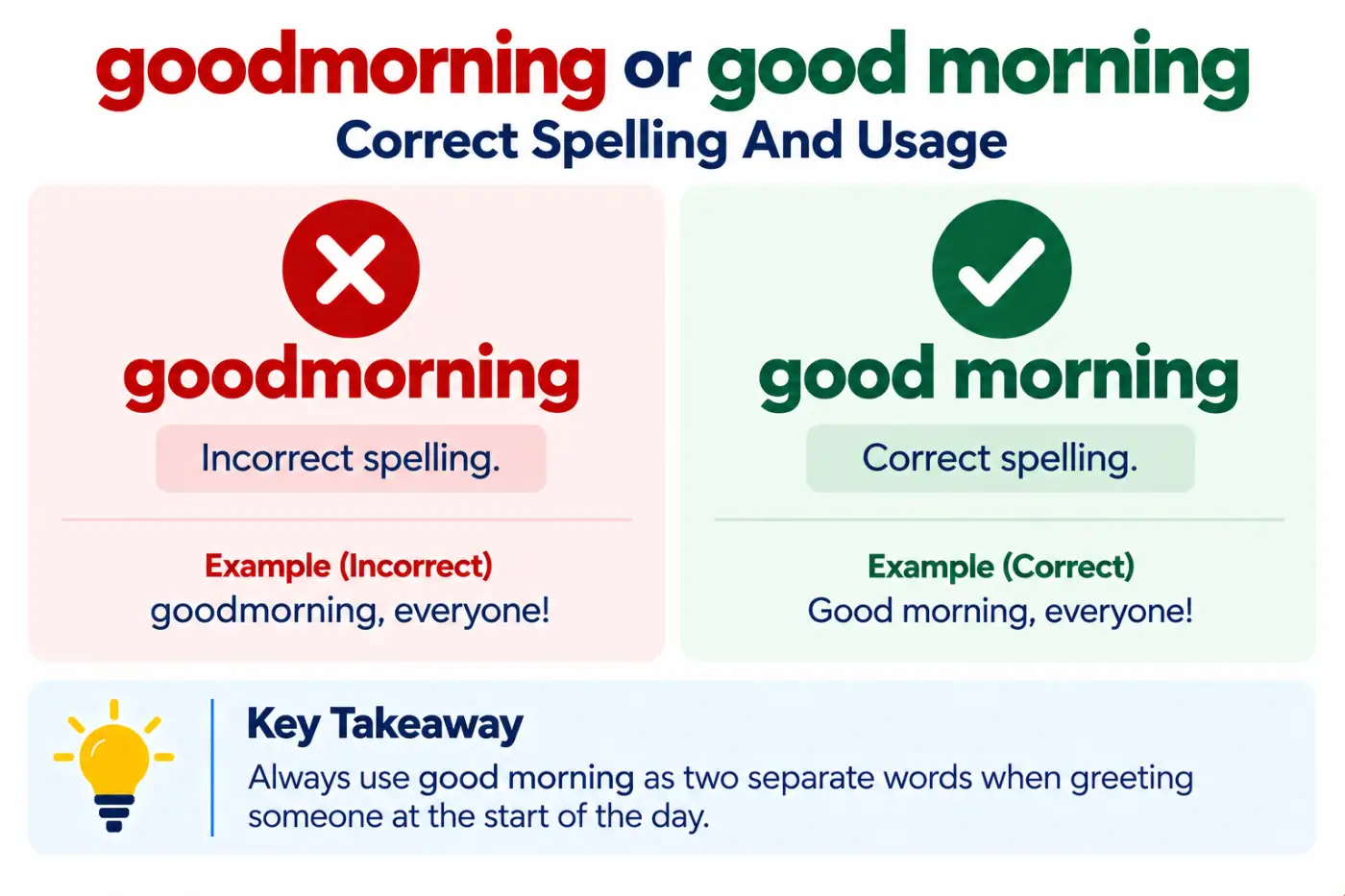
goodmorning or good morning can look like a small spelling question, but it causes plenty of confusion in texts, emails, captions, school assignments, and everyday messages. The correct standard form is good morning, written as two separate words. The closed form is not the standard spelling when you are using the expression as a greeting.
The confusion makes sense because English often combines words into new words over time. We have compounds such as goodbye and goodnight, so it is easy to assume that morning should work the same way. It does not. Good morning remains an open phrase in standard English, with good functioning as an adjective and morning functioning as a noun.
You’ll see why the two word form is standard, how the greeting works grammatically, where punctuation belongs, and how native speakers use it in real situations. We’ll also cover pronunciation, capitalization, formal emails, text messages, regional usage, common mistakes, and related greetings. By the end, you’ll have a simple rule you can remember whenever you write the expression.
Quick Definition
Good morning is the standard English greeting used when speaking to someone during the morning. It is written as two words, not one. Goodmorning is not the standard spelling of the greeting. The phrase can stand alone as a greeting or appear at the beginning of a longer sentence.
Quick Answer
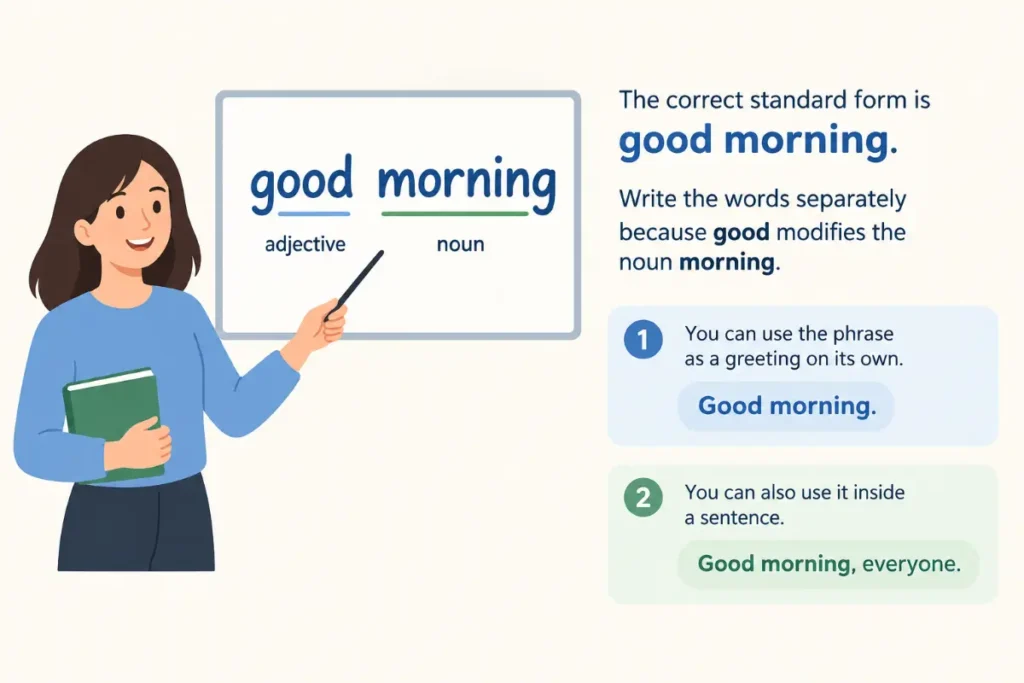
The correct form is good morning with a space between the two words.
Good functions as an adjective describing the morning, while morning is a noun referring to the early part of the day. Together they form a common greeting.
For example:
Good morning, Sarah.
Good morning is standard in American English and other major varieties of English. The closed spelling goodmorning is generally treated as a spelling error when used as the ordinary greeting.
Comparison Table For Good Morning
| Form | Meaning | Part of Speech | Origin | Usage Frequency | Formality | Common Contexts | Example |
|---|---|---|---|---|---|---|---|
| Good morning | A greeting used during the morning | Greeting phrase | English phrase built from good and morning | Very common | Neutral | Conversation, emails, school, work, messages | Good morning, everyone. |
| Goodmorning | No standard meaning as a closed greeting | Nonstandard spelling | Incorrect closed form | Uncommon | Not standard | Typing errors, informal digital mistakes | Goodmorning is not the standard form. |
The table highlights an important point. The issue is not a difference in meaning between two accepted words. The standard greeting is an open phrase consisting of two words.
Meaning And Definition
Meaning Of Goodmorning
Goodmorning is not the standard spelling of the everyday English greeting.
You may see it in social media posts, usernames, quick messages, search queries, or informal typing. Its appearance in digital communication does not make it the accepted standard form.
For example:
Goodmorning everyone.
The standard version is:
Good morning, everyone.
The mistake usually happens because people naturally hear the phrase as one smooth unit. When spoken quickly, the space between words disappears from the sound. A person who types by sound can therefore combine the two words.
Another reason is the existence of other common greetings and expressions that have become single words. Goodbye is one obvious example. Goodnight also has a standard closed form in many uses. That pattern can make goodmorning look reasonable even though standard English normally keeps good morning open.
Meaning Of Good Morning
Good morning is a greeting used during the morning.
It can be friendly and casual:
Good morning, Mike.
It can also be polite and professional:
Good morning, Dr. Carter.
It can address a group:
Good morning, everyone.
The expression usually communicates a polite acknowledgment at the beginning of an interaction. Depending on tone, it can sound warm, cheerful, respectful, formal, or simply routine.
The phrase can also appear in a longer sentence:
Good morning, everyone. I’m glad you could join us.
In that example, the greeting comes first and the main statement follows.
Why The Phrase Has Two Words
English spelling does not always follow pronunciation. A phrase can sound like one connected unit while remaining grammatically and orthographically separate.
Good morning is an example of an open compound or fixed phrase. The words retain their individual identities even though they commonly appear together.
Good describes morning.
Morning names the part of the day.
When you combine them as a greeting, the phrase takes on a conventional social function.
This is similar to other familiar phrases that remain separate in writing. For example:
good afternoon
good evening
Not all of these expressions follow exactly the same spelling history. That is why you should not assume that every phrase beginning with good should be written as one word.
English spelling is full of patterns, but it also contains many established conventions that simply need to be learned.
Key Differences Explained
- Spelling. Good morning is written as two words. Goodmorning is not the standard form.
- Meaning. Good morning is a greeting used during the morning. The closed form does not have a separate standard meaning.
- Grammar. Good functions as an adjective and morning functions as a noun within the phrase.
- Pronunciation. The phrase is normally spoken as two words even though they may flow together naturally in connected speech.
- Formality. Good morning works in casual, neutral, and professional situations.
- Context. You can use it in conversation, emails, classrooms, meetings, phone calls, and messages.
- Punctuation. A comma commonly follows the greeting when you directly address someone.
- Regional usage. The two word spelling is standard across major English varieties.
The main thing to remember is that pronunciation does not determine the written spacing.
Which Form Is Correct?
Good morning is the correct standard form when you are using the phrase as a greeting.
The reason is grammatical as well as conventional. Good is an adjective and morning is a noun. Together they form a phrase that has become a conventional greeting.
The closed spelling does not follow the standard written form used by major English dictionaries and ordinary edited English.
This distinction matters in school work and professional writing. A spelling checker may flag goodmorning because it does not recognize the closed form as the standard greeting.
A simple editing rule works well:
If you are greeting someone in the morning, write Good morning.
Do not remove the space.
Sentence Examples
Here are natural examples showing how the standard phrase works.
- Good morning, everyone.
- Good morning, Mom. How did you sleep?
- Good morning, Mr. Wilson.
- She walked into the office and said good morning to her coworkers.
- I sent my teacher a good morning message before class.
- Good morning. I’m calling about my appointment.
- He smiled and wished everyone a good morning.
- Good morning, team. We have a busy schedule today.
- The receptionist greeted each visitor with a friendly good morning.
- Good morning, Sarah. I hope you’re feeling better today.
These examples show that the expression can work as a complete greeting or as part of a larger sentence.
Common Mistakes And Misspellings
Writing Goodmorning As One Word
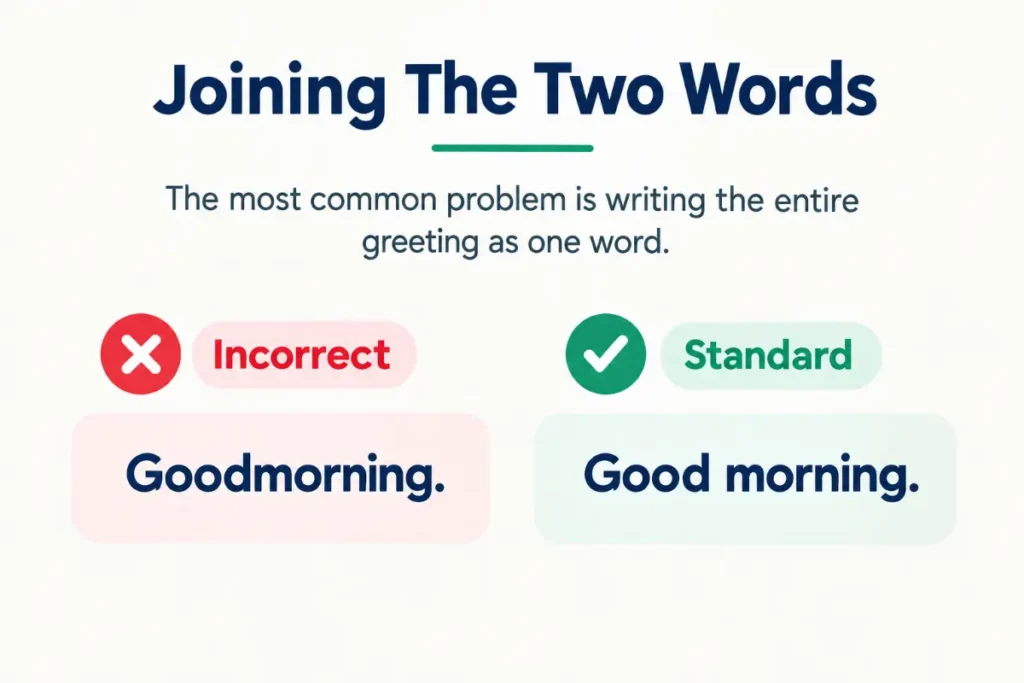
Incorrect:
Goodmorning, everyone.
Correct:
Good morning, everyone.
The mistake happens because the phrase sounds connected when spoken naturally.
Removing The Space In A Message
Incorrect:
Goodmorning how are you?
Correct:
Good morning. How are you?
Digital communication encourages fast typing, so spaces are sometimes skipped. Even in a casual message, the standard spelling remains two words.
Using The Wrong Capitalization
A greeting at the beginning of a sentence is normally capitalized:
Good morning, everyone.
Inside a sentence, lowercase can be appropriate:
She wished me a good morning.
The capitalization depends on position and grammatical use.
Forgetting The Comma In Direct Address
When you directly address someone, a comma is normally used:
Good morning, James.
The comma separates the greeting from the person’s name.
Compare:
Good morning, James.
Good morning is the greeting. James is the person being addressed.
Treating Every Morning Expression The Same Way
English has several morning related expressions with different structures.
Good morning is two words.
Morning coffee is two words.
Morningtime is not the usual standard expression.
Goodmorning is not the standard greeting.
Learning each common expression as a phrase helps prevent automatic spelling mistakes.
Pronunciation Guide
Good morning is commonly pronounced in American English as /ɡʊd ˈmɔːrnɪŋ/.
A simple pronunciation guide is:
good MOR ning
The main stress usually falls on the first syllable of morning.
The phrase has three main sound units:
good
MOR
ning
In natural speech, the words may flow together. You may hear something close to:
good morning
without a strong pause between good and morning.
That connected sound does not mean the written phrase should lose its space.
This is a useful lesson for English learners. Spoken English often reduces pauses between words. Written English still follows established spelling and word boundaries.
The word morning itself contains two syllables:
MOR ning
The first syllable receives the main stress.
Etymology And Word Origin
The phrase good morning is made from two ordinary English words with long histories.
Good comes from Old English and has been used for centuries to describe something favorable, desirable, proper, or pleasant. Morning is related to the idea of the early part of the day and has roots in Old English forms connected with the beginning of the day.
The greeting developed naturally from the broader use of good with times of day.
English speakers also use similar expressions such as good afternoon and good evening. These phrases work as conventional greetings rather than simply literal descriptions.
The phrase does not need to be treated as a single word just because it has a fixed social function. Many languages contain fixed expressions that remain grammatically separate.
This is one reason the spelling should be learned as a phrase rather than guessed from its pronunciation.
Regional Usage
American English
Good morning is the standard greeting in American English.
It is common in homes, schools, workplaces, customer service settings, meetings, phone calls, emails, and everyday conversations.
Americans often use it until late morning, although the exact boundary depends on the situation and personal habit.
For example:
Good morning, class.
Good morning, Mr. Davis.
The closed spelling is not standard American English.
British English
British English also uses good morning as the standard written form.
The greeting is common in everyday conversation, workplaces, schools, formal events, and written communication.
There is no major British spelling variation that turns the phrase into goodmorning.
Australian English
Australian English uses good morning in the same basic way.
The expression works in casual and formal situations, and the standard written form remains two words.
There is no established Australian spelling rule that makes goodmorning a standard alternative.
Canadian English
Canadian English also follows the standard two word form.
You can use good morning in personal messages, professional emails, school settings, and everyday conversation.
The difference between regional varieties is mainly related to accent and conversational style, not the spelling of the greeting.
Grammar Rules And Part Of Speech
Good morning is best understood as a greeting phrase rather than a single grammatical word.
The word good is an adjective.
The word morning is a noun.
In a literal phrase such as:
It was a good morning.
good describes morning.
In the greeting:
Good morning.
the expression has developed a conventional social function. It does not simply mean that the morning itself possesses a quality that is good. It is a polite greeting directed toward another person.
This difference becomes clearer when you compare:
It was a good morning.
Good morning, Sarah.
The first sentence describes the morning.
The second sentence greets Sarah.
Comma Rules
A comma is commonly used after good morning when you directly address someone.
Good morning, John.
Good morning, Professor Smith.
If the greeting stands alone, no comma is needed after morning.
Good morning.
If the phrase appears inside a sentence, punctuation depends on its grammatical role.
She wished me a good morning.
Here good morning is part of the sentence rather than a direct greeting to the listener.
Capitalization Rules
Capitalize Good when the greeting begins a sentence.
Good morning, everyone.
If the expression appears in the middle of a sentence as a noun phrase, lowercase is normally appropriate.
She wished everyone a good morning.
The same principle applies to many ordinary English phrases. Capitalization depends on where the expression appears.
Good Morning In Emails
Good morning is a common email greeting, especially when you know the recipient will read the message in the morning.
For a professional email, you might write:
Good morning, Ms. Taylor.
Thank you for your message.
Or:
Good morning, team.
I’m writing to confirm our meeting time.
The greeting is polite without sounding overly formal.
In a very formal letter, you may choose a more specific salutation based on the relationship and purpose of the message.
Still, good morning is perfectly normal in many workplace emails.
One practical point is timing. If the recipient may read your message later in the day, a neutral greeting such as Hello can sometimes work better.
Good Morning In Text Messages
Text messages are much more flexible.
You might write:
Good morning 😊
Good morning! Hope you have a great day.
Good morning. Are you awake yet?
The expression remains two words even when the message is extremely casual.
People sometimes type goodmorning in quick texts because they are writing fast. That does not make the closed version the standard spelling.
If you want your message to look polished, keep the space.
Good Morning In School Writing
Students often use good morning in classroom greetings, speeches, essays, and presentations.
For example:
Good morning, respected teacher and classmates.
Good morning, everyone. Today I’m going to talk about climate change.
In a speech, the greeting usually comes at the beginning and may be followed by an introduction.
In formal school writing, however, you should not use a greeting unless the assignment calls for one. An essay normally begins with its introduction rather than Good morning.
The phrase belongs naturally in speeches, letters, messages, dialogues, and other forms of direct communication.
Good Morning In Professional Settings
Good morning is widely accepted in professional communication.
A receptionist may say:
Good morning. How can I help you?
A manager may begin a meeting with:
Good morning, everyone.
An employee may write:
Good morning, Mr. Lee. I’ve attached the updated report.
The phrase creates a polite opening without requiring overly formal language.
Tone still matters. A warm voice can make the greeting friendly. A flat or rushed delivery can make the same words sound routine. The written form cannot show every part of that tone, so the rest of the message matters too.
Real Life Usage Examples
Daily Conversation
Good morning, Dad. Did you sleep well?
Good morning! I’m making coffee if you want some.
These examples show the natural conversational use of the phrase.
Workplace Communication
Good morning, everyone. The meeting will begin in five minutes.
Good morning, Lisa. Could you send me the updated schedule?
The expression fits naturally into professional settings without sounding stiff.
Academic Writing
Good morning, everyone. Today I’ll present the results of our project.
Good morning, Professor Adams. I’d like to ask about the assignment.
The greeting works especially well in spoken academic settings and direct communication.
News And Journalism
A television host may begin a morning program by saying:
Good morning. Here are today’s top stories.
A radio presenter may similarly open with:
Good morning, listeners. Thanks for joining us.
In these situations, the phrase clearly signals the beginning of a morning broadcast.
Literature And Storytelling
A character might say:
Good morning, Mrs. Brown.
Another character could reply:
Good morning. Did you enjoy the trip?
In storytelling, greetings help make dialogue feel natural and establish the time of day.
Related And Confused Terms
Good Afternoon
Good afternoon is the usual greeting used after morning and before evening. Like good morning, it is written as two words.
Good Evening
Good evening is a greeting generally used later in the day. It is also written as two words.
Good Night
Good night is commonly used when saying goodbye at night or wishing someone a good night. It has a different social function from a daytime greeting.
Hello
Hello is a general greeting that does not depend on the time of day. It works in both formal and informal situations.
Hi
Hi is a short and friendly greeting. It is common in casual conversation, texts, and informal emails.
Morning
Morning can stand alone as an informal greeting.
For example:
Morning, everyone.
This is casual and common in speech.
Have A Good Morning
This expression is a wish rather than a simple greeting.
For example:
Have a good morning.
It tells someone that you hope their morning goes well.
Good Day
Good day is a greeting or farewell expression, but it can sound more formal, old fashioned, or stylized than good morning in everyday American English.
Is Good Morning Formal Or Informal
Good morning sits comfortably between casual and formal language.
You can say it to a friend:
Good morning!
You can say it to a teacher:
Good morning, Professor.
You can say it to a manager:
Good morning, Mr. Wilson.
You can also use it during a formal presentation:
Good morning, people of all genders.
That flexibility makes the expression especially useful.
Still, tone and context matter. A very formal setting may call for a specific title or salutation, while a close friend may receive a shorter greeting such as Morning.
The phrase itself is neutral enough to work across many settings.
Why People Write Goodmorning
The most common reason is that the phrase sounds like one unit when spoken.
Connected speech reduces the noticeable boundary between words. Someone learning English may therefore hear something close to one continuous sound.
Another reason is analogy.
English contains many compound words that began as separate expressions or have similar structures. Learners may assume that a frequent phrase should eventually become one word.
Typing habits also play a role. People often omit spaces in usernames, hashtags, search queries, or quick messages. Digital environments make unusual word combinations look familiar.
There is also a visual issue. Good morning appears so frequently that writers may type it from memory without consciously checking the word boundary.
These factors explain the mistake, but they do not change the standard spelling.
Common NLP And Search Confusion
From a language processing perspective, good morning is a useful example of a multiword expression. The meaning of the whole phrase depends partly on its conventional use as a greeting.
Search systems can often understand variations such as goodmorning because surrounding words provide context. A search engine may infer the intended phrase even when a user removes the space.
That does not mean the closed form becomes standard English.
This distinction is useful when thinking about language technology. Search recognition and correct writing are different questions. A system may understand a misspelling without treating it as the preferred form.
For polished writing, follow the standard word boundary.
Expert Editor Insight
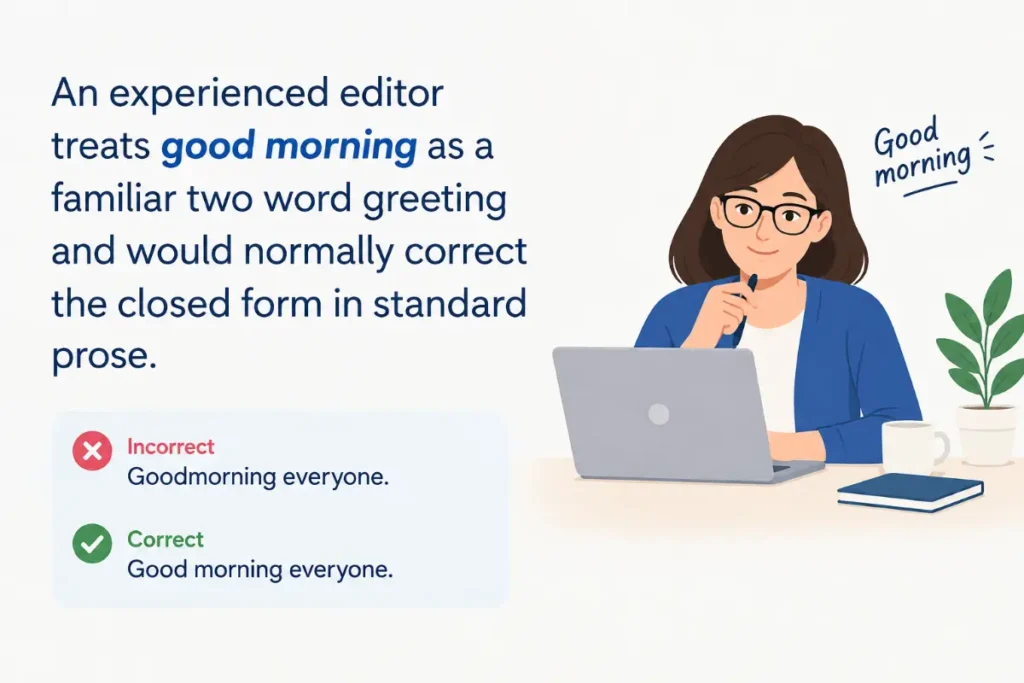
An experienced editor would keep the phrase as two words in ordinary English writing. The confusion usually comes from pronunciation, fast typing, or the mistaken assumption that frequent phrases should become compound words. Editors also check the punctuation and capitalization around the greeting, especially in emails and direct address. Spellcheck tools may flag the closed form, but the strongest editing habit is simple: learn the expression as a fixed two word greeting and preserve the space every time.
Conclusion
goodmorning or good morning has a straightforward answer. The standard English greeting is good morning, written as two separate words. The closed form is not the accepted spelling for ordinary school, workplace, academic, or personal writing. The phrase works as a greeting and can appear in casual conversations, professional emails, classroom settings, speeches, and many other situations.
The space matters because good and morning remain separate words even though they work together as a familiar expression. You should also remember the punctuation rule for direct address, as in Good morning, Sarah. Capitalization depends on where the phrase appears in the sentence.
The easiest editing trick is to remember the phrase as a complete greeting rather than spelling it from sound. Write good morning with a space every time. That small habit will keep your writing natural, polished, and standard.
FAQs
Is goodmorning a correct word?
Goodmorning is not the standard written form of the English greeting. The correct form is good morning with a space. You may see the closed version in usernames, casual digital writing, search queries, or typing mistakes, but those uses do not establish it as standard spelling. For school, work, published writing, and polished messages, use the two word form.
Why is good morning written as two words?
Good morning remains an open phrase because good functions as an adjective and morning functions as a noun. Together they form a conventional greeting. English does not automatically combine every frequently used phrase into one word. Although the expression sounds connected in natural speech, standard writing keeps the two words separate.
Can good morning be one word?
No, not as the standard English greeting. Goodmorning is not the normal dictionary spelling of the phrase. The standard form is good morning. The two words may sound closely connected during natural speech, but pronunciation does not remove the written space. Keep the words separate in professional, academic, and polished everyday writing.
Should you capitalize good morning?
Capitalize Good when the greeting begins a sentence. For example, write Good morning, everyone. If the phrase appears in the middle of a sentence as a regular noun phrase, lowercase is normally appropriate. For example, She wished me a good morning. Capitalization depends on the grammatical position of the phrase.
Should there be a comma after good morning?
Use a comma when you directly address someone. For example, write Good morning, Sarah. You can also write Good morning, everyone. If you simply say Good morning as a complete greeting, you do not need a comma after morning. The comma separates the greeting from the person or group being addressed.
Is good morning appropriate in professional emails?
Yes. Good morning is a polite and natural opening for many professional emails. You can write Good morning, Ms. Davis or Good morning, team. If your recipient may read the message much later in the day, Hello can be a more time neutral option. The choice depends on the timing, relationship, and tone of the message.
Is good morning formal or informal?
Good morning is flexible. It works in casual conversation, professional communication, classrooms, meetings, speeches, and formal events. Its tone depends partly on how you say or write it. A simple Good morning can sound warm and friendly, while Good morning, people of all genders can sound more formal and ceremonial.
What is another way to say good morning?
Common alternatives include morning, hello, hi, and have a good morning. Morning is especially casual and is often used in conversation. Hello and hi work throughout the day, so they do not specifically identify the morning. Have a good morning is a wish rather than a simple greeting and expresses hope that the person’s morning goes well.
