
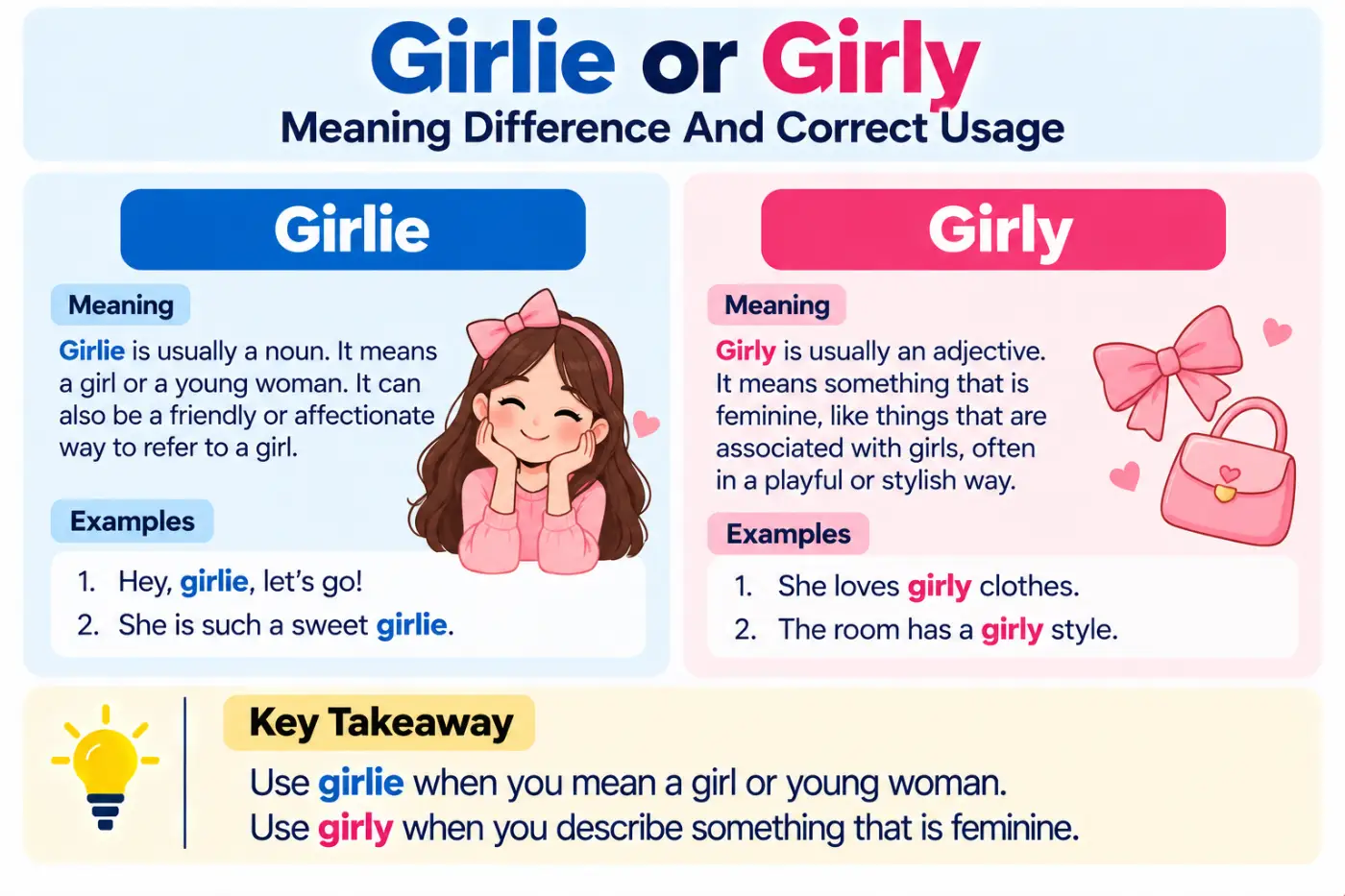
girlie or girly is a common English usage question because both forms are real words and both can describe something associated with girls or women. The short answer is that girly is the more common form in American English, while girlie is also standard and is especially common in some British English contexts. Neither spelling is simply a mistake.
The difference is mostly about style, usage, and context rather than basic meaning. Both words can describe something considered typical of girls or women, such as clothing, colors, interests, behavior, or activities. The spelling with ie can also appear as an informal noun for a girl or woman, while the spelling with y is mainly used as an adjective. Cambridge Dictionary lists girly as an adjective and notes girlie as an alternative form. It also lists girlie as an informal noun.
For most American writing, girly is the natural choice when you need an adjective. This article explains the difference in meaning, grammar, pronunciation, tone, regional usage, examples, common mistakes, and related terms. It also explains why the two spellings exist and how to choose the right form without overthinking it.
Quick Definition
Girly and girlie are both legitimate English forms. As adjectives, they can describe something considered typical of girls or women, such as girly clothes or a girly style. Girlie can also function as an informal noun meaning a girl or woman. In American English, girly is generally the more familiar adjective form.
Quick Answer
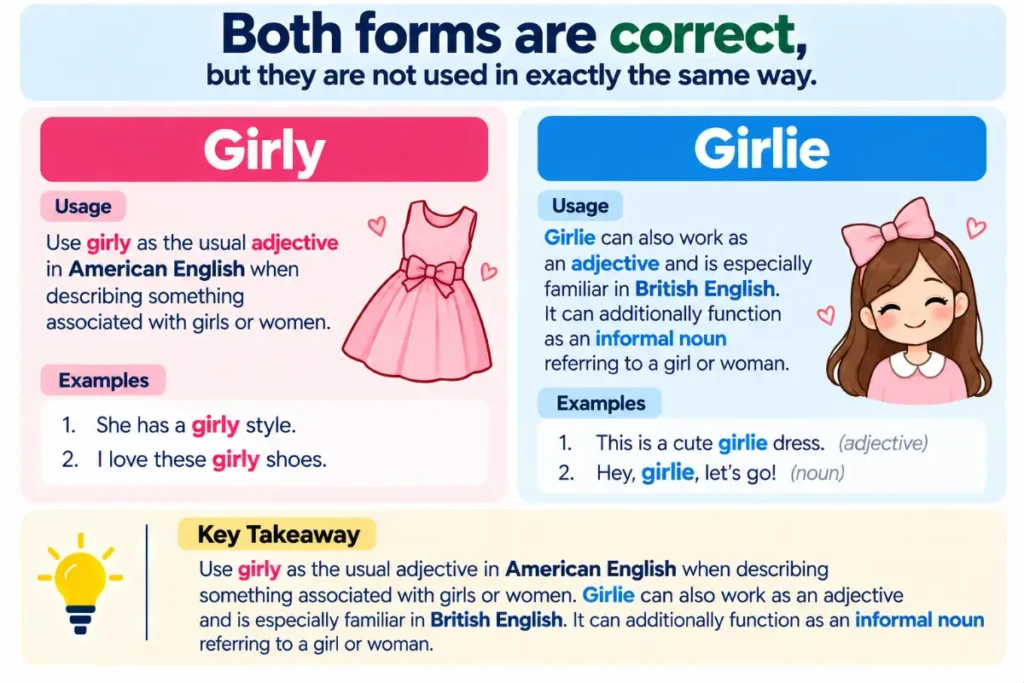
Both forms are correct, but they are not used in exactly the same way. Use girly as the usual adjective in American English when describing something associated with girls or women. Girlie can also work as an adjective and is especially familiar in British English. It can additionally function as an informal noun referring to a girl or woman.
For example, you can say:
She bought a girly pink dress.
You can also see:
She bought a girlie pink dress.
The first version will generally feel more natural to an American reader. The second is still understandable and standard, but it can carry a different regional or stylistic feel.
Comparison Table For Girly And Girlie
| Form | Meaning | Part of Speech | Origin | Usage Frequency | Formality | Common Contexts | Example |
|---|---|---|---|---|---|---|---|
| Girly | Typical of girls or women | Adjective | Formed from girl with the suffix y | Very common | Informal | Clothes, style, interests, behavior | She loves girly colors. |
| Girlie | Typical of girls or women | Adjective | Variant form of girly | Common | Informal | Style, activities, conversation | They planned a girlie weekend. |
| Girlie | An informal term for a girl or woman | Noun | Informal development from girl | Less common | Very informal | Casual conversation | The girlies went out for lunch. |
The important point is that the two forms overlap strongly as adjectives. The spelling difference does not create two completely separate concepts.
Meaning And Definition
Meaning Of Girly
Girly is an informal adjective used to describe something associated with girls or women. It can refer to appearance, clothing, colors, activities, interests, behavior, or general style.
For example:
She decorated her room in a very girly style.
The word can suggest qualities that a culture traditionally associates with girls. Pink clothing, dresses, makeup, flowers, cute designs, and certain hobbies can all be described as girly depending on the context.
However, the word does not have one fixed definition of femininity. What people call girly can vary across families, communities, generations, and cultures.
Cambridge Dictionary describes the adjective as informal and says it can refer to things considered typical of women or girls. It also notes that the word can sometimes carry a disapproving tone when used to describe a person or behavior.
That last point matters. The word itself is not automatically positive or negative. Context and tone determine how it comes across.
For example:
She loves girly clothes.
This may simply describe her fashion preferences.
But:
He thinks acting girly is embarrassing.
Here the speaker is attaching a judgment to the idea. The word itself is still descriptive, but the surrounding sentence creates the negative tone.
Meaning Of Girlie
Girlie can have the same basic adjective meaning as girly. It can describe something associated with girls or women.
For example:
We had a girlie afternoon at the spa.
The word can sound playful, casual, affectionate, or distinctly informal. In British English, girlie is especially familiar in phrases such as girlie weekend or girlie chat. Cambridge Dictionary gives examples of these uses and lists girlie as an alternative form of girly.
Girlie also has another important use. It can function as an informal noun referring to a girl or woman.
For example:
The girlies are meeting for coffee.
This noun use is much more casual than simply saying girls or women. It can sound friendly among people who use it comfortably, but it may not suit every audience.
Because of that, context matters more with girlie than with girly.
The Main Difference
The easiest way to understand the distinction is to separate spelling preference from meaning.
- Girly is usually the safer adjective for American English. If you are writing for a general US audience and need an adjective, girly is usually the natural choice.
- Girlie is also a legitimate adjective. It can mean the same basic thing and is particularly common in British English contexts.
- Girlie can also be a noun. It can informally refer to a girl or woman. Girly does not normally have that noun function.
- Both are informal. Neither is usually the best choice for highly formal or technical writing.
- Tone can change. Girly can sound playful or descriptive, while girlie can sometimes sound more deliberately cute, casual, or conversational.
- Neither form is simply wrong. The right choice depends on the sentence, audience, region, and intended tone.
This is a good example of why English spelling questions cannot always be solved by labeling one form correct and the other incorrect.
Which Form Should You Use
For most American English writing, use girly when you need an adjective.
For example:
She has a girly style.
That sounds natural and familiar to most American readers.
You can also use girlie in an informal context, especially if you want a playful or conversational tone.
For example:
We had a fun girlie weekend.
This version is particularly familiar in British usage.
If you are writing a school assignment, business document, academic paper, or professional article, there is another point to consider. Both words are informal, so a more precise descriptive phrase may be better.
Instead of:
The room has a girly design.
You might write:
The room has a feminine design.
Or:
The room uses colors and patterns traditionally associated with girls.
The best word depends on what you actually mean. Strong writing is not about choosing the fanciest word. It is about saying exactly what you intend.
Girly As An Adjective
Girly most commonly works as an adjective.
It can come before a noun:
She bought a girly dress.
It can also appear after a linking verb:
The design looks girly.
Here the adjective describes the subject.
The word often modifies nouns connected with style, appearance, interests, or behavior.
Common combinations include:
girly clothes
girly style
girly room
girly colors
girly voice
girly hobbies
girly fashion
girly accessories
These combinations are generally informal. Their meaning depends on social and cultural context.
A useful writing habit is to ask yourself what specific quality you mean. If you mean pink, floral, delicate, cute, youthful, feminine, or traditionally associated with girls, one of those more precise words may communicate your idea better.
Girlie As An Adjective
Girlie can also work as an adjective.
For example:
They planned a girlie weekend.
She wanted a girlie room with soft colors.
We had a girlie conversation about fashion and relationships.
The grammatical role is the same as girly in these examples. The main difference is spelling and style.
Girlie can feel more playful or conversational. In British English it may feel particularly natural in certain expressions. Cambridge Dictionary specifically records examples such as girlie chat and girlie weekend.
American readers will generally understand the word without difficulty, but girly is often the more familiar spelling for the adjective.
Girlie As A Noun
One of the most useful differences is that girlie can also function as an informal noun.
For example:
The girlies are going out tonight.
Here girlies refers informally to a group of girls or women.
Cambridge Dictionary lists this noun use and describes it as informal.
This use can sound friendly among close friends, but it should be handled carefully. A word that sounds warm inside one social group may sound childish or patronizing in another.
For professional communication, simply use girls or women when those words accurately describe the people involved.
For example:
The women are meeting after work.
That is clear and neutral.
The girlies are meeting after work.
That sounds much more casual and personal.
Neither sentence is automatically better. They serve different purposes.
Sentence Examples
Here are natural examples showing how the adjective form works.
- She loves wearing girly dresses in bright colors.
- My sister has a very girly bedroom with floral curtains.
- The movie has a playful and girly style.
- She wanted a girly birthday party with flowers and pastel decorations.
- I used to think pink was too girly, but now I wear it all the time.
- Her friends planned a girlie weekend at the beach.
- They enjoyed a relaxed girlie afternoon at the spa.
- The boutique sells clothes with a cute and girly look.
- She chose a simple design instead of something extremely girly.
- The brand uses a soft and girly visual style in its packaging.
Notice that the words do not necessarily describe a person. They can describe objects, activities, styles, or experiences.
Common Mistakes And Confusion
Treating One Form As Completely Wrong
The biggest mistake is assuming that one spelling must be incorrect.
Both forms are legitimate. The better question is which form fits your context.
For American English adjective use, girly is usually the safer default. Girlie remains a valid variant and has an additional informal noun use.
Using Girlie In Formal Writing
Girlie is informal. Using it in a formal report can make the writing sound casual or subjective.
Instead of:
The product has a girlie appearance.
Consider:
The product has a traditionally feminine appearance.
The second version gives the reader more precise information and avoids an informal tone.
Confusing Girly With Girlish
Girly and girlish overlap but are not always identical.
Girlish usually means characteristic of a girl or young girl. Cambridge Dictionary defines girlish as describing behavior or characteristics typical of a girl.
For example:
She gave a girlish laugh.
Girly can be broader and more informal:
She likes girly clothes.
The first sentence focuses on a characteristic. The second focuses on style or preference.
Assuming Girly Always Means Pink
Pink is often associated with girly style, but the word has a broader meaning.
A girly outfit might involve dresses, floral patterns, bows, soft colors, or other features that a speaker associates with femininity.
The word does not define one fixed color palette.
Using The Word Without Considering Tone
Words connected with gender can carry different feelings for different readers.
Saying someone has a girly style may sound playful in one conversation and dismissive in another.
Before using the word to describe a person, think about the context and the attitude behind the sentence.
Pronunciation Guide
Both girly and girlie are generally pronounced the same way.
Cambridge gives the US pronunciation as /ˈɡɝː.li/ and the UK pronunciation as /ˈɡɜː.li/.
A simple American pronunciation guide is:
GUR lee.
The stress falls on the first syllable.
You can think of the word as two sound parts:
GUR + lee.
The spelling changes from y to ie, but the pronunciation does not normally change.
This is one reason people may wonder about the difference. When two words sound the same but use different spellings, the distinction has to be learned from written usage rather than pronunciation.
The same basic pronunciation applies to the adjective and noun uses of girlie.
Etymology And Word Formation
Both forms come from the word girl with a suffix that creates a related descriptive or informal form.
Girly uses the ending y.
Girlie uses the ending ie.
This kind of spelling variation is not unusual in English. Informal vocabulary often develops multiple forms as speakers and writers shape words over time.
The base word girl is much older than either modern informal form. English girl has a long history and has developed several meanings and uses over the centuries. Modern English then created related forms to describe qualities, styles, and associations connected with girls.
The two spellings therefore belong to the same word family. They are not unrelated words that happen to sound alike.
This shared origin explains why their core adjective meanings are so close.
Regional Usage
American English
In American English, girly is generally the more familiar adjective spelling. You will commonly see it in phrases related to fashion, style, colors, hobbies, rooms, and personality.
For example:
She has a girly style.
That sentence sounds natural in everyday American English.
Girlie is understood in the United States but can feel more playful, informal, or influenced by British usage. The noun use is also informal.
British English
British English uses both forms. Girlie has a particularly established presence in informal expressions such as girlie weekend and girlie chat. Cambridge Dictionary specifically records these examples.
British usage therefore gives girlie a stronger everyday presence than some American readers may expect.
Australian English
Australian English can use both spellings, with context and personal style affecting the choice. There is no major rule that makes one spelling universally correct across Australian English.
The adjective meaning remains essentially the same.
Canadian English
Canadian English also recognizes both forms. Girly is generally easy for a North American audience to understand, while girlie can carry a more playful or informal tone.
The difference is mainly stylistic rather than a major grammatical distinction.
Grammar Rules And Part Of Speech
The most common grammatical role is adjective.
For example:
She bought a girly dress.
Here girly describes the noun dress.
The word can also appear after a linking verb.
The room looks girly.
In this sentence, the adjective describes the room.
Girlie works in the same way when used as an adjective.
The party felt girlie.
The noun use of girlie is different.
The girlies went shopping.
Here the word refers to people and acts as a noun.
One useful grammar point is that the noun form is informal. It should not automatically replace girls or women in every context.
The word also does not normally need capitalization unless it appears at the beginning of a sentence or forms part of a proper name.
Because the word is informal, punctuation is not the main concern. Context, tone, and word choice matter much more.
Formal And Informal Writing
Both forms are generally informal.
That does not mean you can never use them in serious writing. A writer might need the word when describing a person’s language, quoting a casual expression, discussing fashion, or analyzing popular culture.
But in formal writing, precision often helps.
Consider:
The advertisement uses a girly design.
This is understandable but somewhat broad.
A more precise version might be:
The advertisement uses pastel colors, floral patterns, and traditionally feminine imagery.
The second sentence tells the reader exactly what the writer means.
This is an important editing principle. If an informal adjective feels vague, replace it with the specific qualities you actually want to describe.
Real Life Usage Examples
Daily Conversation
I bought a cute girly notebook for my sister.
We had a fun girlie afternoon together.
The first sounds natural in American conversation. The second has a more playful informal feel.
Workplace Communication
The marketing team avoided an overly girly color scheme.
The designers created a softer style for the new collection.
The first example may work in a casual workplace conversation. The second is more precise for a professional document.
Academic Writing
The study examines how products marketed with traditionally feminine imagery appeal to younger consumers.
The researchers analyzed language associated with girlish behavior.
Academic writing usually benefits from precise terms rather than broad informal labels.
News Writing
A retailer launched a collection aimed at customers who prefer traditionally feminine styles.
The article described the event as a playful girlie gathering.
Journalistic writing often chooses the more precise phrase unless the informal word itself is relevant to the story.
Literature And Storytelling
She wore a bright dress and carried a small floral purse. Her style was distinctly girly.
The two friends planned a girlie weekend before starting their new jobs.
Creative writing gives the writer more freedom to choose the form based on voice and character.
Related And Confused Terms
Girlish
Girlish describes qualities or behavior associated with a girl. It can refer to appearance, voice, manner, energy, or behavior. Cambridge Dictionary lists it as an adjective.
Feminine
Feminine is broader and often more neutral or formal. It can describe qualities traditionally associated with women without necessarily suggesting youth.
Womanly
Womanly usually refers to qualities associated with an adult woman. It has a different age implication from girly.
Childlike
Childlike describes qualities associated with children. It does not specifically mean feminine.
Cute
Cute describes something attractive, charming, or endearing. A thing can be cute without being girly.
Tomboyish
Tomboyish traditionally describes a girl or woman whose appearance or interests are associated with traits culturally viewed as masculine. It should be used with awareness that ideas about gendered behavior vary.
Feminine Style
Feminine style is a more precise phrase in many formal contexts. It can describe clothing, design, or visual presentation without the casual tone of girly.
Girl Power
Girl power is a separate expression associated with confidence, independence, and female empowerment. It should not be treated as a direct synonym for girly.
Why The Two Spellings Exist
English often has more than one spelling for informal words. The forms can develop through regional preferences, pronunciation patterns, writing habits, and changes in popular usage.
In this case, the spelling difference does not create a major difference in the core adjective meaning.
Think of them as close members of the same word family.
Girly is especially familiar in American English.
Girlie has a strong informal presence in British English and can sound playful in other varieties.
The extra i does not change the basic idea.
This is also why spelling tools may not flag either form. Both are recognized English words. A spelling checker can tell you that the word exists, but it cannot always tell you which form best matches your audience or tone.
That decision requires context.
How Native Speakers Choose Between Them
Native speakers usually do not stop and consciously apply a complicated grammar rule before choosing the spelling. Their choice often comes from exposure and regional habits.
An American writer may naturally type girly because that form feels familiar.
A British writer may comfortably use girlie in an expression such as girlie weekend.
A speaker using girlie as a noun may also be choosing it for its friendly or playful tone.
This is a useful reminder that language is more than a list of rules. Frequency, audience, social setting, and personal style all influence word choice.
If you are writing for a broad American audience, girly is the safer default for the adjective.
If you are writing dialogue or trying to preserve a particular regional voice, girlie may be the better fit.
Expert Editor Insight
An experienced editor would not mark girlie as a spelling mistake simply because girly looks more familiar. Both forms have established usage, and a good editor first checks the grammatical role and intended audience. For American general writing, girly is usually the smoother adjective choice. Girlie can work well in informal or British contexts and has an additional noun use. Spellcheck tools may accept both forms because both are legitimate. The real editorial question is clarity, tone, and audience.
Conclusion
girlie or girly has no simple correct versus incorrect answer because both forms are established English words. For American English, girly is generally the more natural adjective choice, while girlie is also valid and has a strong informal presence, especially in British English. Girlie can additionally function as an informal noun for a girl or woman.
The easiest choice is to use girly when you need a familiar adjective for a US audience. Choose girlie when the regional style or playful tone fits your context. If the word feels too broad for formal writing, replace it with a more precise description. Good editing is often less about finding a single correct word and more about choosing the word that says exactly what you mean.
FAQs
Is girlie a real word?
Yes. Girlie is a legitimate English word. It can work as an adjective meaning associated with girls or women, and it can also function as an informal noun referring to a girl or woman. Cambridge Dictionary recognizes both uses and lists girlie as an alternative form of girly. The noun use is informal, so it may not suit professional or formal contexts.
Is girly or girlie more common in American English?
Girly is generally the more familiar adjective form for American English readers. It commonly appears in phrases such as girly clothes, girly style, and girly colors. Girlie is also understood and valid, but it can sound more playful or regionally influenced. If you need a straightforward adjective for a general US audience, girly is usually the safer choice.
What does girly mean?
Girly is an informal adjective describing something considered typical of girls or women. It can describe clothing, colors, interests, activities, behavior, decoration, or general style. The word can sound positive, neutral, playful, or negative depending on context and tone. It does not have one fixed definition of femininity because ideas about what counts as girly vary across people and cultures.
What does girlie mean?
Girlie can have the same basic adjective meaning as girly. It can describe something associated with girls or women, especially in informal language. Girlie also has a separate noun use in which it can refer informally to a girl or woman. Cambridge Dictionary records both meanings. The noun use is more casual and should be chosen carefully based on audience and setting.
Are girly and girlie pronounced the same way?
Yes. In normal English pronunciation, the two spellings have the same basic pronunciation. Cambridge gives the US pronunciation of girly as /ˈɡɝː.li/ and the UK pronunciation as /ˈɡɜː.li/. The spelling changes, but the sound generally does not. That makes the distinction mainly a matter of written form, regional preference, grammar, and style rather than pronunciation.
Is girly appropriate in formal writing?
Girly is an informal word, so it may not be the best choice for formal academic or professional writing. If precision matters, consider a more specific word such as feminine or describe the actual qualities you mean. For example, instead of saying a design is girly, you might describe its colors, patterns, imagery, or style directly.
Is girlie more British than American?
Girlie has a strong informal presence in British English and appears in expressions such as girlie chat and girlie weekend. American English also recognizes the word, but girly is generally the more familiar adjective form for many US readers. The difference is mainly one of usage preference and tone rather than a strict grammatical rule.
What is the difference between girly and girlish?
Girly is an informal word often used for styles, clothes, colors, interests, and activities associated with girls or women. Girlish usually describes qualities or behavior that seem typical of a girl. For example, girly clothes describe a style, while a girlish laugh describes a manner or quality. The two words overlap but are not always interchangeable.
