
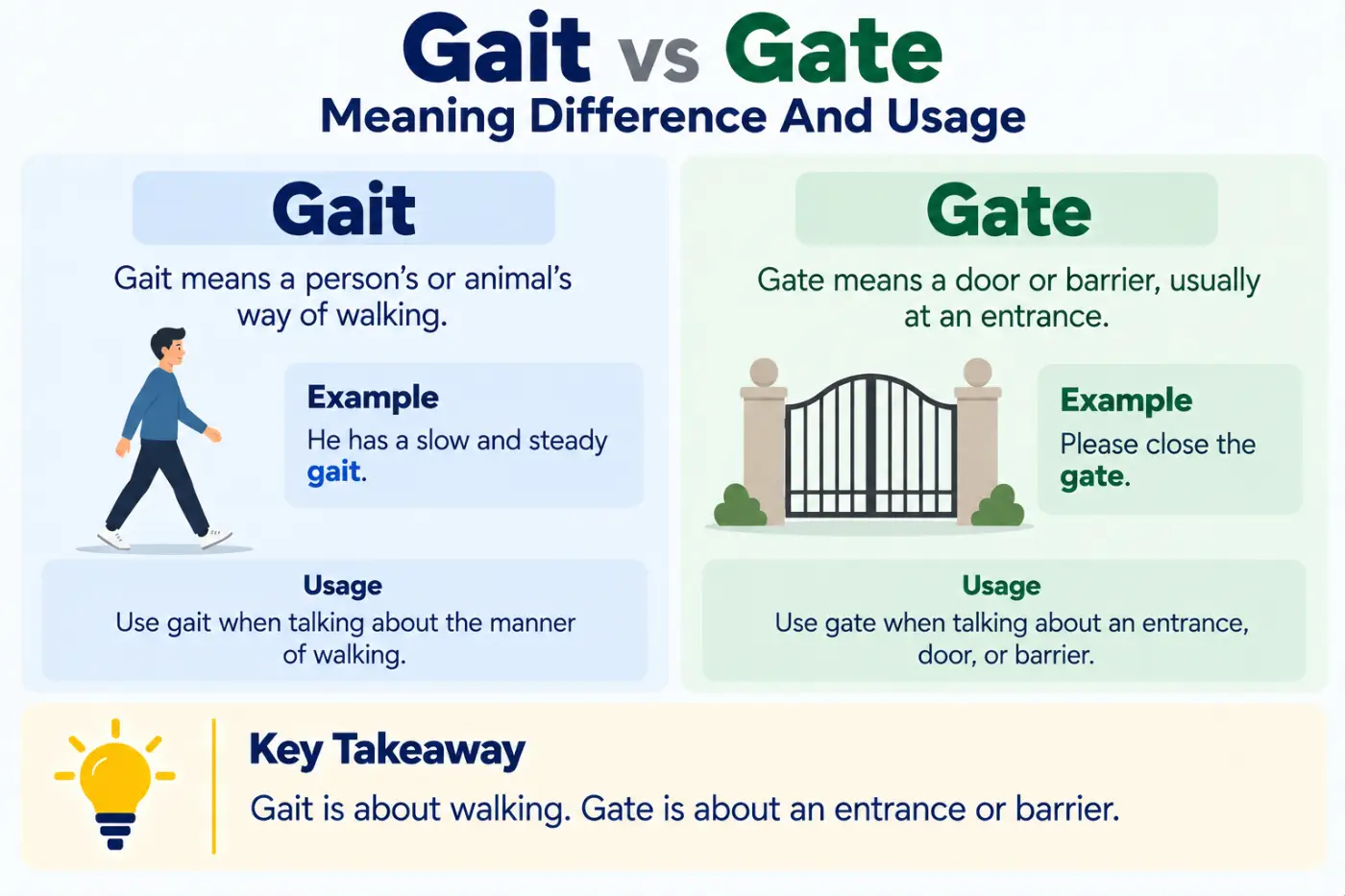
gait vs gate is a classic English word confusion because the two words sound alike in standard American English but have completely different meanings. Gait refers to the way a person or animal walks or moves, while gate refers to a movable barrier or an opening that allows people or vehicles to enter or leave. Neither spelling is wrong. They simply belong to different parts of the vocabulary.
The confusion comes from pronunciation. In many English accents, gait and gate are pronounced the same way, making them homophones. When you hear someone use one of these words, the sound alone won’t tell you which spelling belongs on the page. You need the meaning and context.
That distinction matters in school writing, workplace communication, medical descriptions, sports discussions, construction, travel, and everyday conversation. This guide explains the meanings, grammar, pronunciation, origins, common mistakes, and natural examples. It also gives you a simple memory trick so you can choose the right word without second guessing yourself.
Quick Definition
Gait means a person’s or animal’s manner or pattern of walking or moving. Gate means a movable barrier that closes an entrance or opening. The two words are homophones in many varieties of English, so they can sound identical while having completely different spellings, meanings, and grammatical uses.
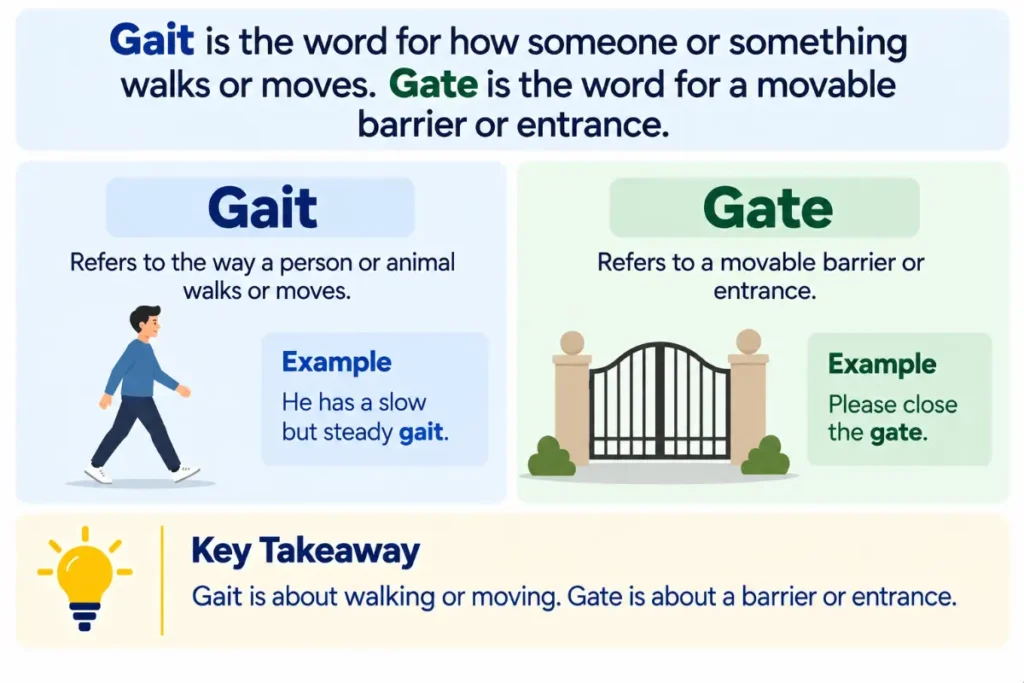
Quick Answer
Gait is the word for how someone or something walks or moves. Gate is the word for a movable barrier or entrance.
For example, you might say, The horse has a smooth gait. You might also say, Please close the gate. The pronunciation can be identical, but the meaning makes the correct spelling clear.
Comparison Table Gait Vs Gate
| Word | Meaning | Part of Speech | Origin | Usage Frequency | Formality | Common Contexts | Example |
|---|---|---|---|---|---|---|---|
| Gait | A manner or pattern of walking or moving | Noun | Middle English and related Germanic forms | Common | Neutral to formal | Walking, horses, medicine, sports, movement analysis | The runner has a steady gait. |
| Gate | A movable barrier or controlled entrance | Noun | Old English | Very common | Neutral | Homes, fences, airports, stadiums, roads, buildings | The gate is locked. |
Both words are legitimate English words. The issue isn’t choosing the correct spelling from two versions of the same word. The issue is choosing the correct word for the meaning you intend.
Meaning And Definition
Meaning Of Gait
Gait means a particular way of walking or moving. It can describe humans, animals, and sometimes machines or other moving systems when their movement has a recognizable pattern.
You might hear someone say:
The doctor noticed that the patient had an unusual gait.
Here, gait describes the person’s manner of walking.
The word is also common when talking about horses.
The horse has a smooth gait.
In this context, gait refers to the horse’s pattern and style of movement.
The term appears frequently in medical, physical therapy, sports, veterinary, and scientific contexts because professionals sometimes need to describe movement carefully. A person’s gait can change because of injury, pain, age, balance problems, muscle weakness, or other physical factors. In ordinary conversation, however, gait simply means the way someone walks.
Gait can also describe different styles of movement. For example, a person may have a slow gait, quick gait, uneven gait, or steady gait.
The word doesn’t describe a physical object. It describes movement.
Meaning Of Gate
Gate refers to a movable structure that controls access through an opening. A gate can be part of a fence, wall, yard, building, airport area, stadium, road, or other property.
For example:
Please close the gate.
The gate keeps the dog inside the yard.
We waited at the airport gate.
The construction gate was locked after sunset.
Gate can refer to something small such as a garden gate or something large enough for vehicles to pass through.
The word can also describe an entrance point rather than the physical barrier itself. At an airport, for example, passengers may say, My flight leaves from Gate 12. In that context, gate identifies a designated boarding area.
Gate also appears in many compound terms and technical expressions. The basic idea remains connected to an opening, entrance, access point, or barrier.
The Key Difference
The most useful distinction is simple.
- Gait describes movement. It tells you how a person or animal walks or moves.
- Gate describes access. It refers to a barrier, entrance, or controlled opening.
- Gait is usually a noun. You might describe someone’s gait as slow, unusual, steady, or graceful.
- Gate is also usually a noun. You might describe a gate as open, locked, wooden, metal, large, or narrow.
- The pronunciation can be identical. In many English varieties, both words sound like the same one syllable word.
- The context determines the spelling. If you’re talking about walking, choose gait. If you’re talking about an entrance or barrier, choose gate.
Consider these two sentences.
The doctor examined his gait.
The doctor opened the gate.
The pronunciation may sound similar, but the meanings are completely different.
Why These Words Are Confused
The main reason is that gait and gate are homophones in many forms of English. Homophones are words that have the same pronunciation but different meanings or spellings.
English has many examples of this pattern.
Two, too, and to can sound alike.
Right and write can sound alike.
Pair and pear can sound alike.
Gait and gate belong to the same general group.
This creates a special challenge for spelling. If you’re writing from memory after hearing a word, pronunciation alone isn’t enough. You have to connect the sound with the intended meaning.
This is especially common in dictation, text messages, speech to text, classroom notes, and fast typing. A person may know both words perfectly well but still choose the wrong spelling when writing quickly.
Context solves the problem.
If the sentence says, The horse has a beautiful ___, the movement meaning tells you to use gait.
If the sentence says, Please close the ___ behind you, the entrance meaning tells you to use gate.
Which Form Is Correct?
Both gait and gate are correct spellings. They are not competing spellings of the same word.
Use gait when you mean a way or pattern of walking or moving.
Use gate when you mean a barrier, entrance, or controlled opening.
This distinction is supported by standard dictionary treatment of the words as separate entries with separate meanings. Pronunciation guides also recognize that English spelling and pronunciation do not always match perfectly. Merriam Webster’s pronunciation guidance explains that English has many cases in which different spellings represent the same sound and notes that spelling often reflects the history of a word rather than its modern pronunciation alone.
So there isn’t a single correct spelling between the two. The correct choice depends on what you mean.
Sentence Examples
Here are natural examples using gait.
- The doctor watched the patient’s gait as he walked across the room.
- The horse has a smooth and comfortable gait.
- Years of training helped improve the runner’s gait.
- The physical therapist noticed a change in her gait.
- The dog’s unusual gait caught the owner’s attention.
- His gait became slower after the long hike.
- The athlete worked on her gait to improve her running efficiency.
- The veterinarian examined the horse’s gait carefully.
- The runner has a relaxed gait that helps conserve energy.
- The instructor demonstrated the correct walking gait.
Now look at examples using gate.
- Please close the gate when you leave.
- The children ran through the garden gate.
- We waited near the airport gate for our flight.
- The farm gate was covered with fresh paint.
- The security guard opened the gate for the truck.
- Someone left the backyard gate open.
- The stadium gate opened thirty minutes before the event.
- The dog escaped because the gate wasn’t locked.
- We entered through the main gate.
- The automatic gate closes after each vehicle passes.
The meaning becomes obvious once you see the words in context.
Common Mistakes
Writing Gate When You Mean Walking Style
A sentence such as The doctor examined his gate uses the wrong word if you’re describing the person’s walking pattern.
The correct sentence is:
The doctor examined his gait.
The mistake happens because gate is much more familiar in everyday writing. People often choose the more familiar spelling when they hear the sound.
Writing Gait For An Entrance
You might see a sentence such as Please close the gait.
That is incorrect if you mean a physical barrier.
The correct sentence is:
Please close the gate.
A gate can close. A gait describes movement.
Confusing Gait With Gaited
Gaited is a legitimate word related to movement, especially in discussions of horses. A gaited horse is one that performs particular types of movement or has distinctive gaits.
This word can make the spelling relationship easier to understand because gait is clearly connected with movement.
Assuming Similar Sound Means Similar Meaning
The fact that two words sound identical doesn’t mean they are related in modern meaning.
Gait and gate have different definitions and different historical paths. Their similar pronunciation is not a reason to treat them as interchangeable.
Trusting Speech To Text Without Checking Context
Speech recognition systems can sometimes select the wrong homophone because the sound alone doesn’t provide enough information.
If you dictate a sentence about a horse’s movement, check that the system selected gait rather than gate.
Context remains the best final check.
Pronunciation Guide
Gait and gate are commonly pronounced the same way in standard American English.
Both can be represented with the IPA pronunciation /ɡeɪt/.
They are one syllable words.
An easy pronunciation guide is:
GAYT.
The vowel sound is the long A sound found in words such as day, rain, and name.
The pronunciation is straightforward, but the spelling creates the challenge. Gait contains ai, while gate contains a followed by a silent e pattern.
The words therefore demonstrate an important feature of English. Two words can have the same pronunciation while using different spellings.
Merriam Webster’s pronunciation guidance notes that English spelling does not always correspond directly to pronunciation and that different spelling patterns can represent the same sound.
Are Gait And Gate Homophones?
Yes. In accents where they share the pronunciation /ɡeɪt/, gait and gate are homophones.
A homophone is a word that sounds like another word but has a different meaning or spelling.
This is why you can’t solve the spelling question by saying the words aloud. You need to think about the sentence.
Etymology And Word Origin
Gait and gate look similar and sound alike, but their histories are different.
Gait entered English through Middle English and is connected to older Germanic language forms associated with walking, going, or a manner of movement. Over time, its meaning became closely tied to a person’s or animal’s way of walking.
Gate has a much older history in English. It comes from Old English geat, a word associated with an opening or passage. The word is related to older Germanic forms connected with an entrance or opening.
The modern meanings developed along different paths.
Gait became associated with the manner of movement.
Gate became associated with a physical opening or barrier.
Their modern pronunciation happens to overlap, but their historical development explains why their meanings remain separate.
This is a useful reminder that English spelling often carries historical information. A word’s modern pronunciation doesn’t always reveal where its spelling came from or how its meaning developed.
American English
Both words are standard in American English.
Gait is common in discussions about walking, running, horses, physical therapy, medicine, sports, and movement.
Gate is an everyday word used for entrances, fences, airports, stadiums, homes, roads, and security areas.
American speakers normally pronounce both words alike. The distinction appears in writing rather than in ordinary speech.
For a US audience, the easiest rule is still the simplest one. Movement takes gait. An entrance or barrier takes gate.
British English
British English also uses both words as standard vocabulary. The meanings remain the same.
Gait describes a way of walking or moving. Gate describes an entrance, barrier, or opening.
The pronunciation can vary slightly among British accents, as it can across English generally. In many British varieties, however, the two words remain homophones.
There is no standard British spelling change that turns one into the other.
Australian English
Australian English uses gait and gate with the same basic meanings found in American and British English.
Gait commonly appears in discussions about horses, walking, running, medicine, and physical movement.
Gate commonly refers to entrances, barriers, fences, airports, and controlled access points.
The distinction is semantic rather than regional.
Canadian English
Canadian English also maintains the same distinction.
Gait refers to movement or walking style, while gate refers to an entrance or barrier.
Canadian speakers may pronounce the two words alike, depending on accent and speech pattern. The spelling still depends on meaning.
There is no major Canadian spelling variant that changes this distinction.
Grammar Rules And Part Of Speech
Both words are primarily nouns.
How Gait Works In A Sentence
Gait usually describes a pattern or manner of movement.
You can use adjectives before it.
She has a steady gait.
He has an unusual gait.
The horse has a smooth gait.
You can also use it with verbs such as have, observe, examine, change, improve, or analyze.
The therapist examined his gait.
Her gait changed after the injury.
The athlete improved her running gait.
In these examples, gait identifies the movement pattern being described.
How Gate Works In A Sentence
Gate usually refers to a physical structure or access point.
It can appear with verbs such as open, close, lock, unlock, enter, leave, approach, or pass through.
Please lock the gate.
The children opened the gate.
We walked through the gate.
The truck passed through the gate.
Gate can also be modified by adjectives.
The wooden gate was damaged.
The main gate is closed.
The security gate opened automatically.
Can Either Word Be A Verb?
Gate can appear as a verb in specialized contexts, especially in technical or scientific writing, where it can mean to control or restrict something.
Gait is overwhelmingly used as a noun in ordinary modern English. Related forms such as gaited and gaiting occur in specialized contexts.
For everyday writing, remembering both words as nouns is enough.
Gait In Medical And Sports Contexts
Gait has a particularly useful role in health and movement discussions.
Professionals may describe a person’s gait to explain how they walk. Terms such as walking pattern, stride, balance, speed, and movement can appear alongside it.
For example:
The therapist evaluated the patient’s gait.
The athlete changed her gait during the training session.
The doctor noticed an uneven gait.
In horse riding and veterinary contexts, gait can describe a horse’s particular movement pattern. Different breeds and training systems can involve different recognized gaits.
This specialized usage makes gait a useful word to recognize even if you don’t use it often in everyday conversation.
Gate In Travel And Public Places
Gate is also especially common in travel.
At an airport, passengers wait at designated gates before boarding. You might hear:
Our flight leaves from Gate 18.
The boarding gate changed.
Please proceed to the assigned gate.
The word can also refer to entrances at stadiums, theaters, schools, amusement parks, and other public places.
The main gate opens at six.
We entered through the north gate.
The stadium has several gates.
In these contexts, gate clearly relates to access rather than movement style.
Real Life Usage Examples
Daily Conversation
My dog has an unusual gait after running for a long time.
Please make sure the backyard gate is closed.
The first sentence describes movement. The second describes a physical barrier.
Workplace Communication
The physical therapist documented a change in the patient’s gait.
The delivery driver should enter through the east gate.
These examples show how the words can appear naturally in professional communication without sounding technical or unusual.
Academic Writing
Researchers analyzed changes in walking gait during the experiment.
The study site was accessible through a secured gate.
Academic writing may use gait in technical movement research and gate in descriptions of physical locations or controlled access.
News Writing
The horse’s unusual gait attracted attention during the competition.
Police closed the main gate while the investigation continued.
Both words can appear in journalism, but their meanings remain completely separate.
Literature And Storytelling
The old man moved with a slow and careful gait.
She pushed open the wooden gate and stepped into the garden.
In storytelling, gait helps describe a character’s movement while gate helps establish a setting or entrance.
Related And Confused Terms
Walk
Walk is the broad everyday term for moving on foot. Gait is more specific because it focuses on the manner or pattern of walking.
Stride
Stride refers to the way someone takes steps or the distance covered by a step. It can be part of someone’s overall gait.
Pace
Pace refers mainly to the speed of movement. Someone can have a steady gait but a fast or slow pace.
Entrance
Entrance refers to a place or means of entering. A gate can serve as an entrance, but not every entrance is a gate.
Door
A door is a movable barrier that usually closes an opening in a building, room, or vehicle. A gate is more commonly associated with fences, outdoor areas, entrances, and controlled access.
Fence
A fence is a structure used to enclose or divide an area. A gate provides a controlled opening within or through such a barrier.
Homophone
A homophone is a word that shares pronunciation with another word but differs in meaning or spelling. Gait and gate are a useful example.
Movement Pattern
Movement pattern is a broader expression for how a person or animal moves. Gait is a specific term often used for walking or running patterns.
These related terms help put the main distinction into perspective. Gait belongs to the vocabulary of movement. Gate belongs to the vocabulary of access and physical openings.
How To Remember The Difference
A simple memory trick can save you from this mistake.
Think of gait as connected to going.
Gait describes how someone goes from one place to another.
Think of gate as connected to getting in or out.
A gate controls access.
You can also use a sentence pair:
The horse has a smooth gait.
The horse walked through the gate.
The horse has a way of moving. It also passes through an entrance.
Another useful trick is visual. Picture a person walking. That image represents gait. Then picture a fence with an opening. That image represents gate.
When you connect each spelling to a concrete picture, the difference becomes much easier to remember.
Why The Spelling Looks Different
Gait contains ai while gate contains a and a silent e.
Both spelling patterns can represent the /eɪ/ sound.
You see the same general sound pattern in words such as rain, train, day, name, and late, even though English uses several spelling patterns to represent that sound.
This is one reason spelling by sound alone can be unreliable.
If someone says, The horse has a beautiful gait, you can’t determine the spelling from the pronunciation alone. You need to understand the meaning.
That’s the heart of the issue.
Expert Editor Insight
An experienced editor treats gait and gate as a meaning problem rather than a spelling problem. Both spellings are correct, so a standard spellchecker may not catch an error if you use one in place of the other. Context is the real test. If the sentence describes walking, running, or animal movement, check for gait. If it describes an entrance, barrier, fence opening, airport area, or controlled access point, gate is the natural choice. When proofreading, don’t just read the words individually. Read the sentence for meaning.
Conclusion
gait vs gate becomes easy once you connect each word with its meaning. Gait describes the way a person or animal walks or moves. Gate describes a barrier, entrance, or controlled opening. Both are correctly spelled English words, so the challenge isn’t deciding which spelling is valid. The challenge is choosing the word that matches your meaning.
The words are often pronounced the same, which explains why they cause so many writing mistakes. Reading the surrounding sentence carefully gives you the answer. If you’re talking about walking, running, or animal movement, think gait. If you’re talking about an entrance or barrier, think gate.
A useful editing trick is to replace the word with a simple phrase. If you mean way of walking, use gait. If you mean entrance or barrier, use gate. That quick test can prevent the error before you hit send.
FAQs
Is gait a real word?
Yes. Gait is a standard English noun that refers to a person’s or animal’s manner or pattern of walking or moving. It is especially common in medical, physical therapy, sports, veterinary, and horse related contexts. For example, a doctor may examine a patient’s gait, while a rider may describe a horse’s gait.
Is gate the correct word for walking?
No. If you mean the way someone or something walks or moves, gait is the correct word. Gate refers to an entrance, opening, or movable barrier. For example, The runner has a steady gait describes movement, while Please close the gate describes a physical barrier. The two words sound alike in many accents but have different meanings.
Are gait and gate pronounced the same?
In many English accents, yes. Both are commonly pronounced /ɡeɪt/. They are therefore homophones in those varieties of English. The identical pronunciation is the main reason people confuse them in writing. You cannot always determine the spelling simply by hearing the word. The intended meaning provides the clue.
What does gait mean in medical language?
In medical language, gait refers to a person’s manner or pattern of walking. A healthcare professional may observe someone’s gait when assessing movement, balance, coordination, or changes in walking behavior. The word is broader than simply taking a step. It describes the overall pattern of movement involved in walking.
What does gate mean?
Gate usually means a movable barrier that controls an opening or entrance. It can be part of a fence, wall, building, stadium, airport, or other location. Gate can also refer to a designated access point, such as an airport boarding gate. The central idea is controlled entry or passage.
Why do people confuse gait and gate?
People confuse these words mainly because they can sound exactly the same. They also have similar letter patterns and are both short nouns. When someone hears the word without seeing it written, pronunciation doesn’t reveal which spelling is intended. Context solves the problem by showing if the sentence concerns movement or access.
What is an easy way to remember the difference?
Think of gait as connected to movement. If you’re describing how someone walks or how a horse moves, use gait. Think of gate as an entrance. If you’re talking about a barrier, doorway like opening, fence entrance, or airport access point, use gate. The meaning should guide the spelling.
Is gait used only for humans?
No. Gait can describe the movement of animals as well as humans. It is especially common when discussing horses and other animals whose movement has recognizable patterns. You can say that a horse has a smooth gait or that a veterinarian examined an animal’s gait. The word focuses on the manner or pattern of movement.
