
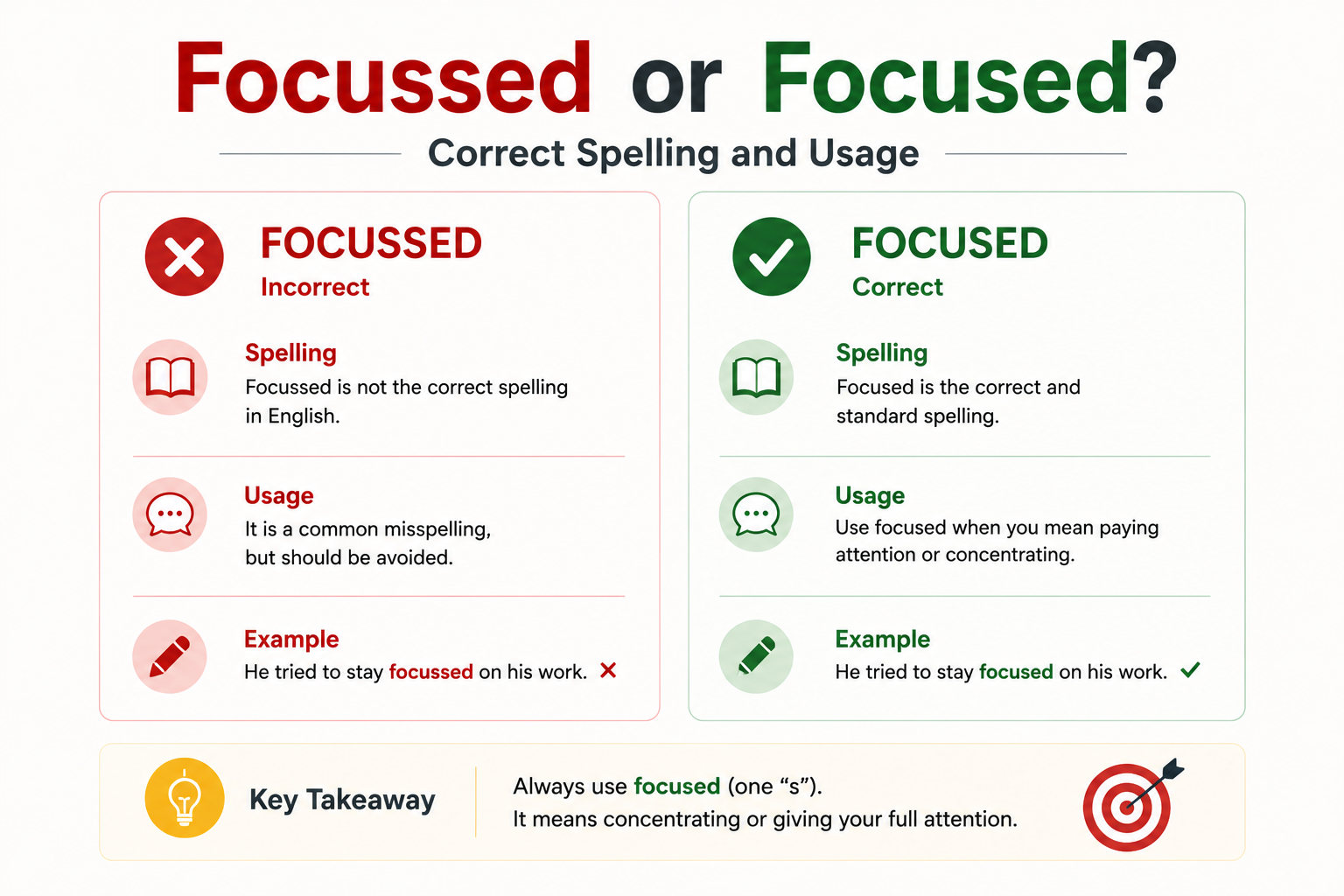
focussed or focused can look like a simple spelling choice until you notice that both forms appear in real English writing. The good news is that both spellings are legitimate. Focused is the standard form in American English and is also widely used in British English. Focussed is a recognized British spelling that follows a different spelling convention for doubling the final consonant before an ending.
The confusion comes from a genuine difference in English spelling practice rather than from one form being a simple typo. American English generally prefers focused while British English commonly accepts focussed alongside focused. You may therefore see one form in a US workplace email and another in a British newspaper without either writer making a basic spelling error.
The choice becomes much easier once you understand the regional pattern. This guide explains the meaning of the word its grammar pronunciation spelling history regional use common mistakes and practical examples. It also shows when each form makes sense so you can choose the spelling that fits your audience instead of guessing.
Quick Definition
Focused and focussed have the same meaning and grammatical function. Both are forms of the verb focus and can work as the past tense or past participle. Focused is preferred in American English while focussed is a common British English variant. Neither form changes the basic meaning of the word.
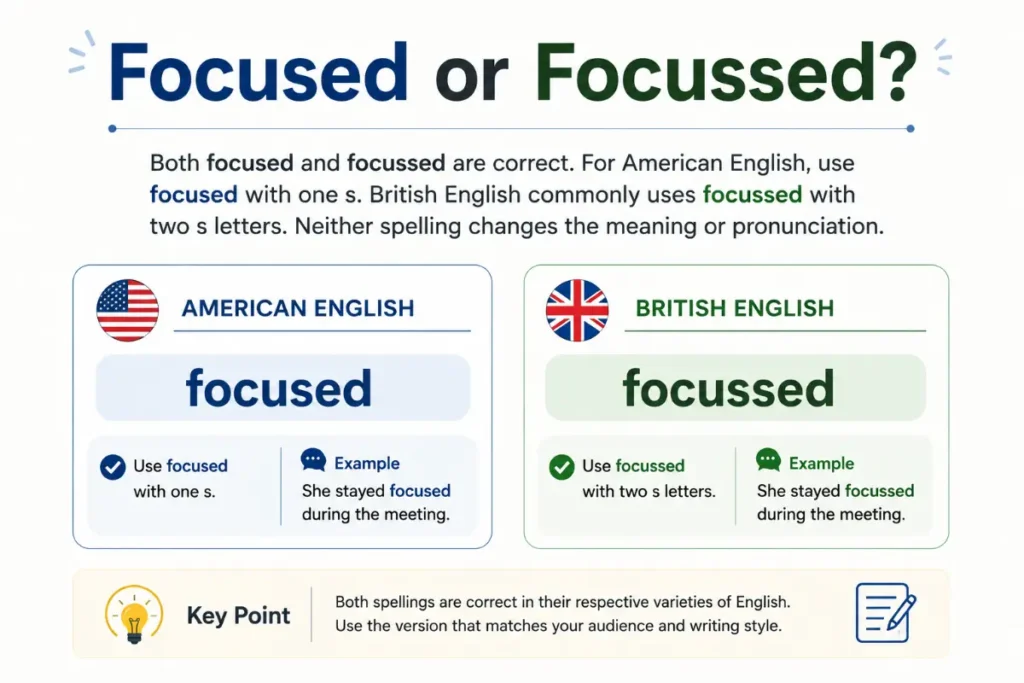
Quick Answer
Both forms are correct in standard English but they belong to different spelling preferences. Focused is the usual choice for American English. Focussed is widely accepted in British English and some other varieties that follow British spelling conventions.
The meaning does not change. Both forms can describe directing attention toward something or being strongly concentrated on a particular goal.
For US writing choose focused. For British writing either form may appear depending on the style guide and house preference.
Comparison Table
| Form | Meaning | Part of Speech | Origin | Commonness | Formality | Common Contexts | Example |
| Focused | Directed attention toward something or strongly concentrated | Verb form or adjective | From focus with an English past tense or participle ending | Very common in US English | Standard | American English business school academic writing everyday speech | She stayed focused on the task. |
| Focussed | Same basic meaning as focused | Verb form or adjective | From focus with consonant doubling under British spelling conventions | Common in British English | Standard | British English publishing education journalism | She stayed focussed on the task. |
Meaning and Definition
Meaning of Focused
Focused means directed toward a particular person thing task goal or subject. It can describe an action that happened in the past or a state of concentration.
For example you might say that a student stayed focused during a difficult exam. The sentence tells the reader that the student kept attention on the task instead of becoming distracted.
The word can also describe something designed around a particular purpose.
The meeting was focused on customer needs.
Here focused works as an adjective that describes the meeting. It tells us what the meeting concentrated on.
Focused can therefore appear in several common structures. It may describe physical attention mental concentration or the main purpose of an activity.
Meaning of Focussed
Focussed has the same basic meaning as focused. It is not a separate word with a different definition. The extra s reflects a spelling preference rather than a change in meaning.
A British writer might write that a student remained focussed during an exam. An American writer would normally write that the student remained focused during the same exam.
The pronunciation remains essentially the same. The grammatical role remains the same. The difference is mainly written form and regional convention.
Is Focussed Incorrect
No. Calling focussed simply wrong would give an incomplete picture of English spelling.
Focussed is established in British English and follows a broader pattern found in some words that end in a single consonant after a stressed vowel. British spelling conventions often double the final consonant before certain endings.
American English usually does not double the final s in focus before the ending ed. As a result focused is the normal American form.
This distinction matters because English has more than one standard spelling system. A spelling can be less common in one variety without being incorrect in another.
Key Differences Explained
Spelling
The visible difference is simple. One form has a single s before ed and the other has a double s.
Focused contains one s.
Focussed contains two s letters.
That small difference reflects regional spelling conventions.
Meaning
There is no meaningful difference in definition. Both forms describe concentration attention or direction toward a particular subject.
If you change focused to focussed in a sentence the meaning stays the same.
Grammar
Both forms can serve as the past tense or past participle of focus.
She focused on the report.
She focussed on the report.
Both sentences use the word as a verb.
Both forms can also function as adjectives.
He is focused on the project.
He is focussed on the project.
Again the grammatical meaning stays the same.
Pronunciation
The spelling difference does not create a major pronunciation difference. Most speakers pronounce the two forms the same way.
This is useful to remember because hearing the word cannot reliably tell you which spelling convention the writer follows.
Formality
Neither form is inherently more formal. The appropriate choice depends mainly on the variety of English and the style expected by the audience.
A US academic paper normally uses focused. A British publication may use focussed or focused depending on its editorial style.
Context
Focused is especially common in American workplaces schools universities websites and general writing.
Focussed appears regularly in British English contexts. It may also occur in writing influenced by British spelling traditions.
Regional Usage
The strongest distinction is geographic. American English strongly favors focused. British English accepts both but has traditionally used focussed more often than American English.
Which Form Should You Use
If you are writing for a US audience choose focused. It is the spelling most readers will expect in American English.
If you are writing for a British audience you may use focussed. You may also see focused in British publications because British English does not reject the single s form.
The safest approach for professional writing is consistency. Do not switch between focused and focussed randomly in the same document. Follow the spelling convention used by your publication school employer or chosen style guide.
This is one of those cases where a spelling checker alone may not answer the real question. A checker can tell you that a form exists or that another form is more common in its language setting. It cannot always tell you which regional convention best fits your audience.
Why American English Usually Uses Focused
American English often uses a simpler spelling pattern for words ending in a consonant followed by ed or ing. Focus is treated as a base that takes the ending without doubling the final s.
That produces focused.
The same general preference can be seen in other American spellings where consonant doubling differs from British usage.
British spelling has retained more instances of consonant doubling in certain word formations. That helps explain why focussed appears naturally in British writing.
The difference is not random. English spelling developed through several historical traditions and later developed regional standards. American English and British English share the same language but do not always use identical spelling rules.
Why British English Uses Focussed
British spelling conventions often double a final consonant in certain situations before adding an ending. The exact pattern depends on the word and the ending involved.
Focussed reflects that convention.
This does not mean British writers are adding an unnecessary letter. From within the British spelling system the form has a recognizable logic.
You may notice a similar pattern in other British forms such as labelled and travelled compared with the American forms labeled and traveled.
The patterns are not identical in every word. That is why it is better to learn established spelling conventions rather than apply one doubling rule mechanically to every English word.
Sentence Examples
Here are natural examples using the American spelling.
- She stayed focused during the entire meeting.
- I need to stay focused if I want to finish this assignment tonight.
- The team is focused on improving customer service.
- He focused his attention on the most urgent problem.
- The teacher asked the students to remain focused during the experiment.
- We need a focused discussion instead of a long conversation about unrelated issues.
- She has remained focused on her career goals.
- The report is focused on the causes of the problem.
- Try to stay focused while you read the instructions.
- The company has become more focused on serving small businesses.
The British spelling works in exactly the same kinds of sentences.
She stayed focussed during the entire meeting.
The team is focussed on improving customer service.
He remained focussed on the task.
The meaning does not change when the spelling changes.
Common Mistakes and Spelling Confusion
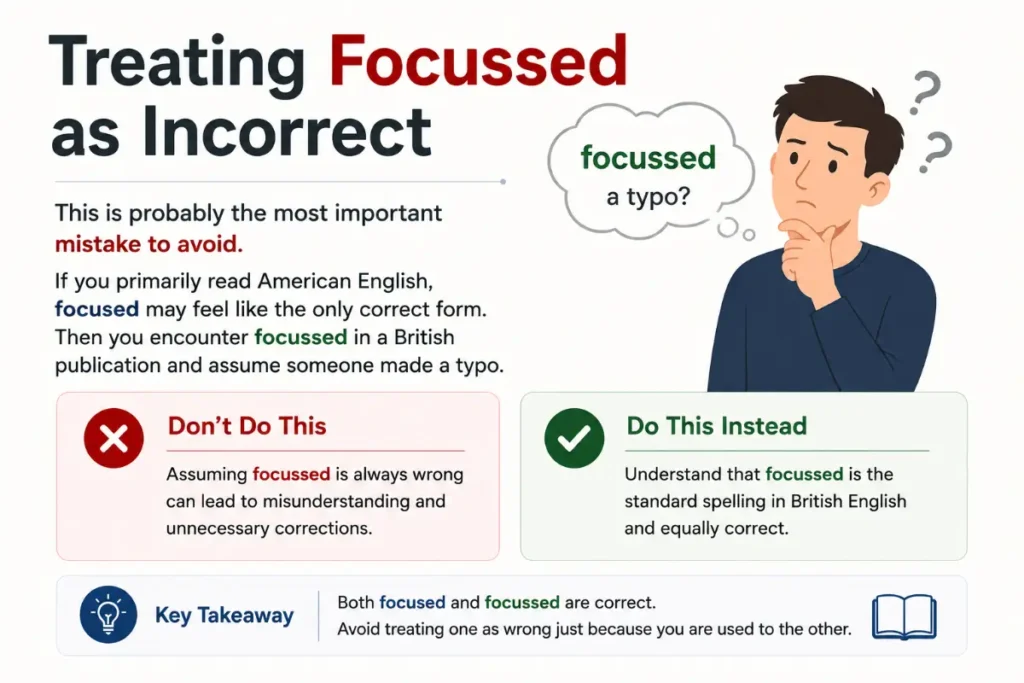
Treating Focussed as Always Wrong
This is the biggest mistake. Focussed is not simply an incorrect spelling. It is a recognized British variant.
If you are writing American English however focused is the expected choice.
Treating Focused as American Only
Focused is strongly associated with American English but it is not limited to the United States. British English also uses focused.
So it would be misleading to say that British writers must use focussed.
Switching Forms in One Document
A document can look inconsistent if it uses focused in one paragraph and focussed in another without a reason.
Choose one spelling convention and keep it consistent.
Adding Extra Letters Automatically
Some writers assume that every word ending in a vowel plus consonant must double the final consonant before an ending. English does not work that simply.
Consonant doubling depends on the word structure spelling tradition stress pattern and specific ending.
Assuming Pronunciation Reveals Spelling
The spoken word does not normally tell you which spelling the writer uses. Focused and focussed are pronounced in essentially the same way.
This is a useful reminder that English spelling cannot always be reconstructed from sound alone.
Pronunciation Guide
The word is commonly pronounced /ˈfoʊkəst/.
A simple pronunciation guide is:
FOH kuhst.
The main stress falls on the first syllable.
The word can be heard as two syllables in ordinary speech.
FOH
kuhst
The spelling difference does not normally create a different pronunciation. Both focused and focussed are pronounced essentially the same way.
A common learner mistake is to pronounce every written letter too strongly. The doubled s in focussed does not require a special extra sound. The two spellings represent the same basic spoken word.
If you hear someone say focused you generally cannot know from pronunciation alone which spelling they would use in writing.
Etymology and Word Origin
Focus comes from Latin focus meaning hearth or fireplace. The word later developed a figurative sense connected with a central point of attention.
English adopted focus as a noun and later developed the verb focus meaning to direct attention or bring something into concentration.
The past forms focused and focussed developed through English spelling conventions rather than through different meanings or separate vocabulary roots.
The modern distinction is therefore mainly orthographic. Orthography simply means the conventional system used to write a language.
The historical path also explains why focus belongs to a larger family of words connected with central attention concentration and direction.
Regional Usage
American English
Focused is the standard spelling most Americans expect. It appears widely in education business communication journalism technical writing and everyday conversation.
For a US audience focused is usually the easiest and most natural choice. If you are preparing an American resume school paper website or professional report this is the form to use.
British English
British English uses both focused and focussed. Focussed has a long established place in British spelling and can be found in formal and informal writing.
Focused is also common in modern British usage. A British writer therefore has more than one accepted option.
House style can determine the final choice. A newspaper publisher university or organization may prefer one form for consistency.
Australian English
Australian English generally follows British spelling traditions in many areas. Focussed can therefore appear in Australian writing.
Focused is also widely recognized and used. The important point is that the double s does not create a different meaning.
Canadian English
Canadian English combines influences from British and American English. Both focused and focussed can be encountered.
In Canadian professional writing the preferred form may depend on the publication or institutional style. Writers should follow the spelling convention used by the organization or publication they are writing for.
Grammar Rules and Part of Speech
Focused and focussed can function as verb forms.
The base verb is focus.
The simple past can be written as focused or focussed depending on spelling convention.
She focused on her studies.
She focussed on her studies.
The past participle can appear after helping verbs.
She has focused on her studies for months.
She has focussed on her studies for months.
Both forms can also function as adjectives.
He is focused on the goal.
He is focussed on the goal.
In this construction the word describes a state of concentration or attention.
The word commonly appears with the preposition on.
She focused on the assignment.
They are focused on customer service.
He remained focused on the problem.
Another common pattern uses focus with an object.
She focused her attention on the speaker.
The verb can therefore describe the direction of attention toward a particular subject.
Punctuation
The spelling itself does not create any special punctuation rule.
If focused appears at the beginning of a sentence as part of an adjective phrase the normal punctuation rules apply.
Focused on the task she ignored the noise around her.
A comma follows the introductory phrase because it helps separate that phrase from the main clause.
The punctuation comes from sentence structure rather than the spelling of focused.
Real Life Usage Examples
Daily Conversation
You need to stay focused if you want to finish this today.
I was so focused on the movie that I forgot to check my phone.
These examples show how naturally the word appears in ordinary speech. It often describes attention concentration or mental effort.
Email and Workplace Communication
The team remains focused on meeting the project deadline.
Our next meeting will stay focused on the main customer concerns.
In workplace writing the word often describes priorities. It can sound direct and professional without being overly formal.
Academic Writing
The study focused on how sleep affects student performance.
The second section is focused on the relationship between language and memory.
Academic writing uses the word to identify the subject or scope of research.
News Writing
The investigation focused on the events surrounding the incident.
The new policy is focused on reducing delays in public services.
News writing commonly uses the word to explain the central subject of an action or policy.
Literature and Storytelling
He remained focused as the storm grew louder outside.
She stayed focussed on the narrow path despite the darkness.
In storytelling the word can describe concentration under pressure. The spelling depends on the English variety used by the writer.
Related and Confused Terms
Concentrated
Concentrated often describes intense attention or mental effort. It can also describe something physically made stronger by removing water or another substance.
She concentrated on the final question.
Attentive
Attentive means paying close attention. It often describes a person listening carefully.
The students were attentive during the lecture.
Absorbed
Absorbed suggests deep involvement. Someone absorbed in a book may pay little attention to what is happening around them.
He was absorbed in the story.
Dedicated
Dedicated describes strong commitment to a person task cause or goal. It suggests commitment rather than attention alone.
She is dedicated to helping young students.
Intent
Intent can mean strongly determined or focused on doing something.
He was intent on finding the answer.
Distracted
Distracted is close to the opposite of focused. It describes attention being pulled away from the main task.
I was too distracted to finish the report.
Centered
Centered can describe something organized around a central point or a person who feels calm and mentally balanced.
The discussion was centered on safety.
Attentive to
Attentive to is a useful phrase when you want to emphasize careful awareness.
Good editors are attentive to small spelling differences.
These related expressions overlap with the idea of concentration but they are not interchangeable in every sentence. Choosing the right word depends on the exact meaning you want to express.
How Style Guides Affect the Choice
Professional writing often follows a style guide. A style guide provides consistent rules for spelling punctuation capitalization and other editorial choices.
If your employer uses American English then focused is usually the natural choice.
If a British publication uses British spelling then focussed may be preferred.
The key point is consistency. A reader should not have to wonder why a document changes spelling conventions halfway through.
This matters especially in long reports websites academic projects and books. Small spelling differences can become noticeable when they appear many times.
If you are editing someone else’s work do not automatically change focussed to focused simply because your personal preference favors the single s form. First identify the intended variety of English.
How Spellcheckers Handle the Two Forms
Modern spelling tools often recognize both forms because both have established usage.
The result you see can depend on the language setting. A tool configured for US English may prefer focused. A tool configured for UK English may accept focussed without treating it as an error.
This is a good example of why spelling software is helpful but not a complete substitute for editorial judgment.
A spellchecker can identify many mechanical problems. It may not understand the audience style publication standards or regional convention behind a particular spelling choice.
For important documents check the language setting before editing. If your document is meant for US readers select an American English setting. If it is intended for British readers select the appropriate British English setting.
Expert Editor Insight
An experienced editor first identifies the intended variety of English before correcting a spelling difference like this. Focused is the natural default for American English while focussed remains a legitimate British form. The real editing problem is inconsistency rather than the mere presence of the double s. A useful professional habit is to set the document language before proofreading so your spelling tool supports the same regional convention you intend to use.
Final Takeaway
focussed or focused is not a simple case of right versus wrong. Both forms are established, but focused is the normal choice for American English while focussed is a recognized British spelling. Both forms mean the same thing and perform the same grammatical roles.
If you write for a US audience, use focused consistently. If you follow British spelling, focussed may be appropriate, although focused is also accepted there. The easiest editing tip is to decide your English variety before proofreading and keep the same spelling system throughout the document.
FAQs
Is focussed a correct spelling?
Yes. Focussed is a recognized spelling in British English. It has the same meaning and grammatical function as focused. American English normally prefers focused. If you are writing for a US audience focused is the more natural choice. If your document follows British spelling conventions focussed can be completely appropriate.
Which is correct focused or focussed?
Both are correct in standard English but usage depends largely on regional spelling preference. Focused is the usual American English form. Focussed is widely accepted in British English. British writers also use focused. The safest approach is to follow the spelling convention of your audience and keep that choice consistent throughout the document.
Does focussed mean something different from focused?
No. The two forms have the same basic meaning. Both describe directing attention toward something or being concentrated on a subject goal or task. The difference is spelling rather than meaning. The double s in focussed reflects a British spelling convention while focused follows the spelling normally preferred in American English.
How do you pronounce focused and focussed?
Both forms are generally pronounced the same way. The common pronunciation is /ˈfoʊkəst/ and can be approximated as FOH kuhst. The double s in focussed does not create a special extra sound. Because the spoken forms are essentially the same you cannot normally identify the written spelling simply by hearing someone say the word.
Is focused an American spelling?
Focused is strongly associated with American English and is the usual spelling in the United States. However it is not exclusively American. British English also uses focused alongside focussed. The important distinction is that US style normally favors the single s form while British style allows the double s form as an established variant.
Is focussed more formal than focused?
No. Neither spelling is automatically more formal. The difference mainly reflects regional spelling conventions. A British writer can use focussed in formal writing and an American writer can use focused in a formal report. Formality comes from the context sentence structure word choice and purpose rather than from choosing one spelling over the other.
Why does British English sometimes double the s?
British English has spelling conventions that double certain final consonants before some endings. Focussed reflects that broader pattern. The rule does not apply mechanically to every English word, so individual word forms still need to be learned. American English often uses a simpler spelling in comparable cases, which is why focused is the standard US form.
Should I use focused or focussed in a US essay?
Use focused in a US essay. It is the spelling American readers generally expect and it fits standard American English usage. Focussed is not likely to cause a serious comprehension problem, but it can look out of place in a document written consistently in American English. Matching the spelling to your audience is the better editorial choice.
