
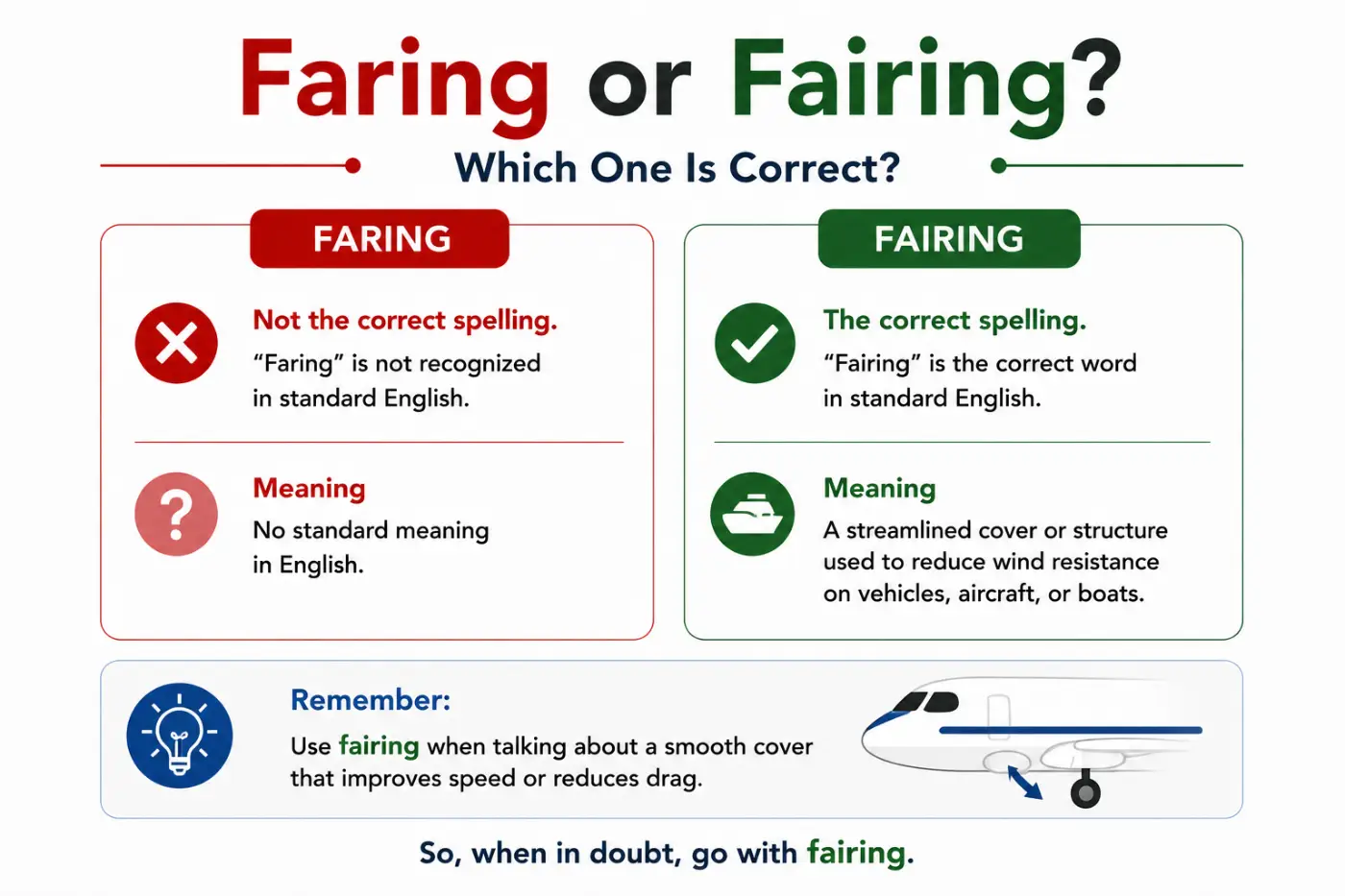
faring or fairing can be confusing because the two words look and sound very similar. One letter changes the spelling, yet that small difference changes the meaning completely. The good news is that you don’t need to memorize a complicated grammar rule. You only need to identify what you’re trying to say.
Faring comes from fare and usually appears when someone asks how a person group project business or situation is doing. You might ask how your friend is faring after starting a new job. Fairing has a different job. It’s a noun used for a structure or covering designed to improve the shape and airflow around something such as an aircraft motorcycle bicycle or spacecraft.
The confusion often comes from pronunciation. In many accents the two forms sound alike or almost alike. That makes context especially important. Once you connect faring with fare and fairing with fair or streamlining the difference becomes much easier to remember. This guide explains the meanings grammar pronunciation origins common mistakes and practical examples so you can choose the right word with confidence.
Quick Answer
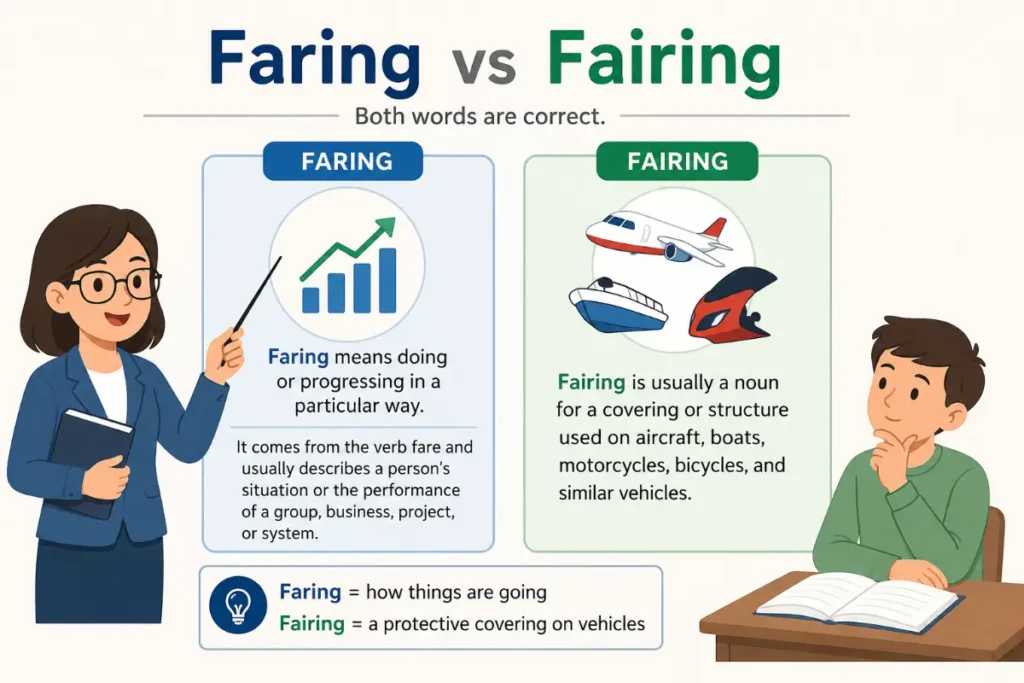
Faring and fairing are both correct English words, but they have completely different meanings. Faring is the present participle of the verb fare and usually describes how someone or something is doing or progressing. Fairing is a noun used mainly for a structure or covering that makes a vehicle or machine more streamlined.
The easiest way to choose is to look at the sentence. If you mean doing or progressing use faring. If you mean a protective or aerodynamic covering use fairing.
Featured Snippet Definition
Faring is the present participle of fare and means doing progressing or being treated in a particular way. Fairing is a noun that refers to a structure added to a vehicle aircraft machine or other object to make its shape smoother or more aerodynamic. Both words are correct but they belong to different word families and contexts.
Quick Comparison
| Form | Meaning | Part of Speech | Word Family | Common Use | Formality | Typical Context | Example |
|---|---|---|---|---|---|---|---|
| Faring | Doing or progressing in a particular way | Present participle of a verb | Fare | Describing performance or progress | Neutral | Conversation, work, education, news | How is she faring at her new school? |
| Fairing | A covering or structure that improves shape or airflow | Noun | Fair | Describing equipment or design | Neutral to technical | Aviation, motorcycles, bicycles, spacecraft, engineering | The motorcycle has a new fairing. |
Meaning and Definition
Meaning of Faring
Faring is the present participle of fare. The verb fare has a useful but slightly formal meaning. It describes how someone or something is doing, progressing, or being affected by a situation.
For example, if someone asks, How are you faring at your new job? they’re asking how things are going for you. The question is close to How are you doing? or How are you getting along?
Cambridge Dictionary identifies faring as the present participle of fare. It gives fare the sense of succeeding or being treated in a particular way. Examples such as people faring well or badly show that the word commonly describes a result or condition.
The word often appears with adverbs such as well badly better worse or poorly.
The students are faring well this semester.
The local businesses are faring better than expected.
The older system is faring poorly under heavy use.
Faring can describe people animals organizations products plans and situations. It doesn’t necessarily describe physical travel. That point matters because fare has historical connections with journeys and movement but its modern verb use often focuses on condition or success.
Meaning of Fairing
Fairing is a noun. In technical English it describes a structure or covering that gives an object a smoother shape and can reduce drag or improve airflow.
You may see fairings on motorcycles aircraft bicycles race cars and spacecraft. A motorcycle fairing can cover parts of the machine and help manage airflow. Aircraft and spacecraft use specialized fairings for aerodynamic purposes. A payload fairing can surround and protect a spacecraft payload during launch.
The meaning comes from the verb fair in an older technical sense connected with making something smooth regular or properly shaped. Etymological evidence places the engineering noun fairing in the nineteenth century and connects it with shipbuilding and streamlining.
So fairing belongs to the language of design engineering transportation and machinery.
The Key Difference
The simplest distinction is this.
- Faring describes performance or progress. It comes from fare. Think about how someone or something is doing.
- Fairing names a physical structure. It usually refers to a covering or shaped component designed to improve airflow or smooth an object’s form.
- Faring is a verb form. More precisely it is the present participle of fare. It can appear in progressive verb constructions or function in related participial structures.
- Fairing is usually a noun. It names a component rather than an action.
- The surrounding words give you the answer. Words such as well badly better and worse often point toward faring. Words such as motorcycle aircraft aerodynamic body panel and spacecraft often point toward fairing.
A useful mental picture makes this easier. Faring is about how something is going. Fairing is about a thing that helps something move through air more smoothly.
Which Word Fits Your Sentence
Start by asking one simple question.
Are you talking about how something is doing or a physical part of something?
If you mean progress use faring.
How is your brother faring in college?
The company is faring better this year.
If you mean a physical covering or aerodynamic component use fairing.
The mechanic replaced the damaged fairing.
The aircraft has a lightweight fairing around the equipment.
This test works because the two words come from different roots and serve different grammatical roles. Faring belongs to the fare family. Fairing belongs to the fair family and developed a specialized engineering meaning.
Sentence Examples
Here are natural examples of faring in everyday and professional contexts.
- How are you faring in your new position?
- The students are faring well after the change in teaching methods.
- Small businesses are faring better this year.
- How is your team faring against the stronger competition?
- The new employee seems to be faring well so far.
- The project is faring worse than the manager expected.
- Local farmers are faring better after the recent rainfall.
- The older software is not faring well on modern devices.
- She wondered how her former classmates were faring.
- The company has been faring reasonably well despite the difficult market.
Now look at examples with fairing.
- The mechanic repaired the motorcycle fairing.
- The aircraft received a redesigned fairing.
- The cyclist removed the front fairing before the race.
- Engineers tested the new fairing in a wind tunnel.
- The spacecraft uses a large payload fairing to protect its cargo during launch.
Notice the pattern. The first group describes performance or progress. The second group names a physical component.
Common Mistakes
Several mistakes appear because the words sound so similar.
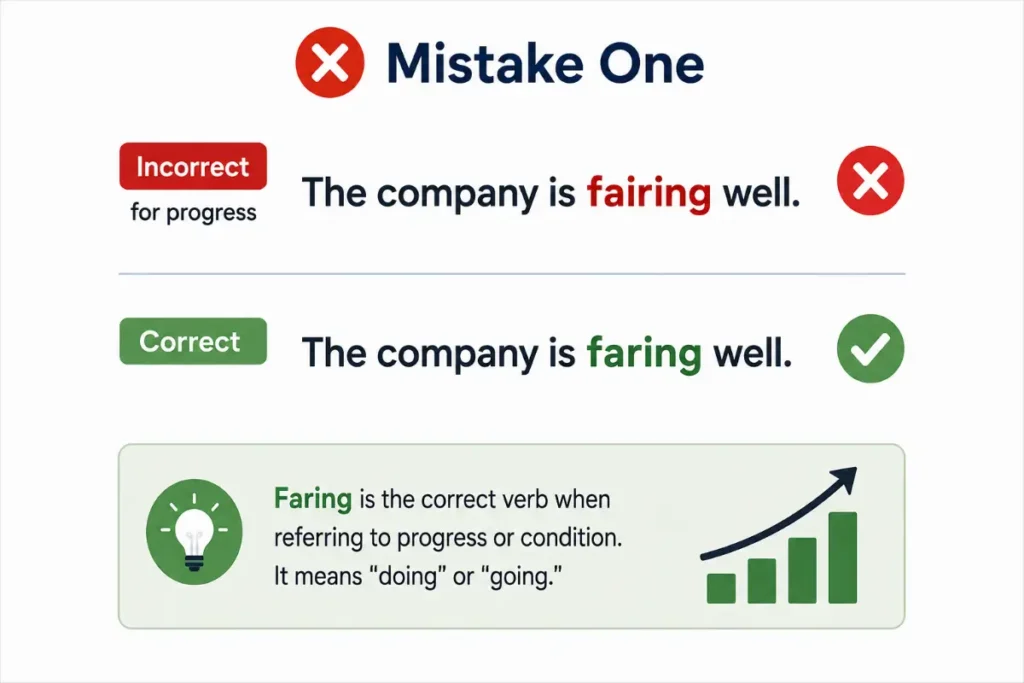
Using Fairing When You Mean Progress
Incorrect meaning:
How is your business fairing?
The intended word is faring.
Correct:
How is your business faring?
The sentence asks about the condition or progress of the business.
Using Faring for a Machine Part
Incorrect:
The motorcycle needs a new faring.
Correct:
The motorcycle needs a new fairing.
Here the word refers to the physical covering or shaped component.
Assuming Fair Means Good in Every Context
The spelling fairing can tempt people to connect it with the adjective fair meaning reasonable or attractive. In the technical noun fairing the historical connection is more specific. It refers to shaping or smoothing a structure rather than simply making something good or pleasant.
Treating Faring as a Travel Word Only
Because fare has an old connection with traveling and journeys some readers may assume faring only relates to movement. Modern English uses fare in another important sense that describes how someone or something is doing. Faring commonly carries that meaning today.
Choosing by Sound Alone
Pronunciation won’t always solve this problem. The two words can sound alike in ordinary speech. Instead of relying on sound choose the word according to meaning.
Pronunciation Guide
Faring is commonly pronounced like fairing in many varieties of English. The difference is mainly visible in spelling and meaning rather than a strong pronunciation contrast.
Faring comes from fare. Cambridge gives the pronunciation of fare as /feər/ in UK usage and /fer/ in US usage.
A simple American English guide is:
FAIR ing
The word has two main sound parts.
FAIR + ing
Fairing is pronounced in the same basic way.
This creates the central challenge. If you hear a sentence without seeing it written down you may not know which spelling the speaker means. Context does the heavy lifting.
For example:
How is the company faring?
The context tells you that the speaker is asking about performance.
The company replaced the damaged fairing.
The context tells you that the speaker means a physical component.
The pronunciation alone cannot reliably distinguish the two in ordinary speech. Good spelling depends on understanding the meaning and grammatical role.
Etymology and Word Origin
Faring comes from fare. The verb fare has a long history that reaches back to Old English faran meaning to journey or travel. Historical sources also connect the verb with senses involving being or existing in a particular condition. The word is related to a wider Germanic family associated with movement and going.
That history helps explain why fare has several meanings in modern English. We still see the travel sense in words and expressions connected with journeys. We also use fare to describe how someone or something performs or develops.
The form faring is simply the present participle of that verb. The underlying word family includes forms such as fared and related compounds such as seafaring and wayfaring.
Fairing has a different history. Etymological evidence records the engineering noun from the nineteenth century. It developed from fair as a shipbuilding term associated with making surfaces smooth or regular and correcting curves. From there the idea extended into streamlining and aerodynamic design.
That difference in history explains why the two words should not be treated as spelling variants. They are separate words with separate meanings.
Regional Usage
American English
Both words are standard in American English. Faring is used when discussing how a person group organization or situation is doing. Fairing appears most often in technical and transportation contexts.
In everyday American conversation faring can sound slightly more formal than doing or getting along. It is still natural and fully understandable.
Fairing is much more specialized. You’re more likely to see it in discussions about motorcycles aircraft spacecraft bicycles engineering or vehicle design.
British English
British English also uses both forms with the same basic distinction. Faring continues to function as the present participle of fare. Fairing is used as a technical noun for shaped structures and coverings.
The main regional pronunciation difference concerns the vowel sound in fare. That difference doesn’t change the spelling distinction.
Australian English
Australian English follows the same basic vocabulary distinction. Faring is connected with fare and describes progress or condition. Fairing is used for technical structures and vehicle components.
There is no major Australian spelling variant that turns one word into the other.
Canadian English
Canadian English also uses both words according to their separate meanings. Writers should choose faring for the verb form and fairing for the technical noun.
As in American English the surrounding context usually makes the intended meaning clear.
Grammar Rules and Part of Speech
Understanding the grammar makes this pair much easier.
Faring is the present participle of fare. The most common pattern uses a form of be plus faring.
How are you faring?
The students are faring well.
The company has been faring better recently.
In these sentences faring forms part of the verb phrase. The adverb after it tells us how the subject is doing.
Faring can also appear in a clause after verbs or expressions that describe observation.
We’re interested in how the new system is faring.
The report examines how local businesses are faring.
The word often works naturally with adverbs of degree or result. Common combinations include faring well faring badly faring better faring worse and faring poorly. Cambridge examples show this same pattern in real English usage.
Fairing is generally a countable noun. You can talk about a fairing or several fairings.
The mechanic installed a new fairing.
The aircraft has several fairings.
In technical writing the noun may appear inside a compound expression.
Payload fairing.
Engine fairing.
Motorcycle fairing.
Aircraft fairing.
Because fairing names a physical object it normally works with noun structures rather than progressive verb structures.
Real Life Usage Examples
Daily Conversation
Faring often appears in questions about progress.
How are you faring at your new job?
I heard you moved recently. How are you faring?
These sentences sound somewhat more polished than How are you doing? but they remain natural.
Fairing is less common in casual conversation unless someone is discussing a vehicle or machine.
The bike looks great after you replaced the fairing.
That fairing got scratched during the trip.
Workplace Communication
Faring can work well in professional communication when you need a concise way to discuss progress.
The new branch is faring better than expected.
We should review how the project is faring after the first month.
Fairing appears in technical workplaces.
The engineering team redesigned the front fairing.
The new fairing reduced the amount of exposed equipment.
Academic Writing
Academic writing often uses faring when researchers describe how groups or systems perform.
The study examined how students were faring after the policy change.
The researchers found that smaller firms were faring better under the new conditions.
Fairing may appear in engineering research.
The researchers tested the fairing under different airflow conditions.
The revised fairing produced a smoother airflow pattern.
News Writing
Journalists sometimes use faring when describing economic social or organizational performance.
Local retailers are faring better than expected.
The industry is faring poorly because of weaker demand.
Fairing is more likely to appear in transportation or technology reporting.
The aircraft’s fairing was damaged during testing.
Engineers completed work on the new payload fairing.
Literature and Storytelling
Faring can give a sentence a slightly reflective tone.
He wondered how his old friends were faring after all those years.
She wrote to ask how the family was faring.
Fairing is more likely to appear in stories involving machines vehicles or technical settings.
The damaged fairing rattled as the motorcycle moved down the road.
The pilot watched the technicians inspect the aircraft fairing.
Related and Confused Terms
Several words and expressions sit close to these meanings.
- Fare. This is the base verb behind faring. It can describe how someone or something is doing or progressing. It also has noun meanings related to transportation and food.
- Fared. This is the past tense and past participle of fare. You might say The team fared well in the tournament.
- Doing. This is a much more common everyday alternative to faring when asking about someone’s condition or progress.
- Progressing. This emphasizes movement toward a goal or improvement over time.
- Performing. This focuses more directly on results or effectiveness.
- Fair. This is the word behind the technical history of fairing. It has many other meanings including reasonable attractive or acceptable.
- Streamlining. This describes the process of shaping something to reduce resistance and improve movement through air or another medium.
- Aerodynamic covering. This is a plain descriptive phrase for one major function of a fairing. It can help readers understand the technical meaning quickly.
These relationships also reveal why the spelling difference matters. Faring connects to performance through fare. Fairing connects to physical design through fair and streamlining.
A Simple Memory Trick
Use this two part memory rule.
Faring means doing.
Fairing means a thing.
If you can replace the word with doing or progressing the form you need is faring.
How is the team faring?
How is the team doing?
Those sentences are close in meaning.
If you can replace the word with covering component or streamlined structure the form you need is fairing.
The motorcycle needs a new fairing.
The motorcycle needs a new body covering.
This technique works because it focuses on meaning rather than spelling alone. That is especially helpful when two words sound alike.
Another useful trick is to connect faring directly with fare.
Fare becomes faring.
The spelling keeps the connection visible.
For fairing think of fair plus ing. In technical language the word developed from the idea of making a surface smooth or regular.
Why The Confusion Is So Common
English has many pairs that create trouble because pronunciation does not always give you enough information. Faring and fairing are especially tricky because their spoken forms can be nearly identical.
Visual similarity adds another layer. Both words contain the same final ing pattern and share the same basic sound at the beginning.
There is also a semantic trap. Fare and fair are both common English words. Writers may know both but still select the wrong family when typing quickly.
This is where context matters more than memory. A sentence about a company’s performance points toward fare. A sentence about a motorcycle’s body points toward fairing.
From a language processing perspective this is a useful example of context based disambiguation. A reader or language system can often determine the intended word from nearby terms even when the spoken form does not provide enough information.
Words such as well badly better worse and poorly strongly support the progress meaning. Words such as aircraft motorcycle body panel airflow drag and spacecraft strongly support the technical meaning.
Formal and Informal Usage
Faring is perfectly acceptable in formal writing. However it can sound slightly more formal than common alternatives such as doing or progressing.
In an academic paper you might write:
The study investigated how participants were faring after the intervention.
In a casual conversation you might simply say:
How are you doing?
Both are natural. The choice depends on tone.
Fairing is neutral within technical contexts. It is not especially formal or informal. Its specialized meaning makes it common in engineering aviation automotive design cycling and related fields.
In general writing you shouldn’t use fairing as a fancy substitute for faring. They are not interchangeable. Choosing the more technical looking word does not make a sentence stronger. It simply changes the meaning.

Expert Editor Insight
An experienced editor would check the word through context rather than treating this as a simple spelling error. If the sentence describes performance or progress the editor expects the fare family. If it names a physical component the fair family is appropriate. Spellcheck software may not catch every misuse because both forms are legitimate words. That is why context based proofreading matters. A useful final check is to replace the word mentally with doing or component. The answer usually becomes obvious.
Conclusion
faring or fairing becomes easy to separate once you focus on meaning instead of sound. Faring comes from fare and describes how a person group business project or situation is doing or progressing. Fairing is a noun that usually names a shaped covering or component designed to improve airflow or streamline an object. Both forms are correct, but they belong to different word families.
The quickest memory trick is simple. Think faring means doing and fairing means a thing. If the sentence is about performance use the word connected with fare. If it describes a physical component on a vehicle aircraft bicycle or spacecraft use the technical noun.
When proofreading, don’t rely on pronunciation because the two words can sound alike. Look at the surrounding words and ask what the sentence actually means. That small habit will help you choose the right form every time.
FAQs
What is the difference between faring and fairing?
Faring is the present participle of fare and usually describes how someone or something is doing or progressing. Fairing is a noun that describes a physical covering or structure used to smooth the shape of an object or improve airflow. The two words can sound alike but they have different meanings and grammatical roles.
Is faring a real English word?
Yes. Faring is a standard English word and is the present participle of fare. It commonly appears in expressions such as faring well faring badly faring better and faring worse. It describes performance progress or condition. For example How are you faring at your new job? asks how well someone is doing in that situation.
Is fairing a real English word?
Yes. Fairing is also a legitimate English word. It is mainly a noun used for a shaped covering or structure that helps streamline an object. You may encounter it in discussions of aircraft motorcycles bicycles spacecraft and engineering. A payload fairing is one specialized example used in aerospace contexts.
How do you know which spelling to use?
Look at the meaning of the sentence. If you are describing how someone or something is doing use faring. If you are naming a physical structure or covering use fairing. A sentence about a company’s performance needs faring. A sentence about a motorcycle component needs fairing. Meaning is more reliable than pronunciation for choosing between them.
Do faring and fairing sound the same?
In many varieties of English they sound the same or very similar. That makes the distinction difficult to hear in conversation. The spelling becomes clear from context. If someone says a team is doing well the written form is faring. If someone discusses a motorcycle component the written form is fairing. The surrounding words usually provide the needed clue.
Can faring describe a business?
Yes. Faring can describe the performance or condition of a business. For example you can say The company is faring well this year. You can also say The local stores are faring worse than expected. This use comes from fare meaning to succeed or be treated in a particular way. It is natural in reports news writing and professional discussion.
What is a fairing on a motorcycle?
A motorcycle fairing is a shaped body component that covers parts of the motorcycle and can help manage airflow. Its design may also protect components and influence the appearance of the motorcycle. The technical meaning belongs to fairing rather than faring. The same general word is used for related streamlined structures on other vehicles and machines.
Is faring appropriate in formal writing?
Yes. Faring is acceptable in formal writing and can work especially well when discussing progress or performance. It may sound slightly more formal than doing in casual American English. For example a report might say The participants were faring well after the program. The word is clear and established and does not need to be replaced simply because the writing is formal.
