
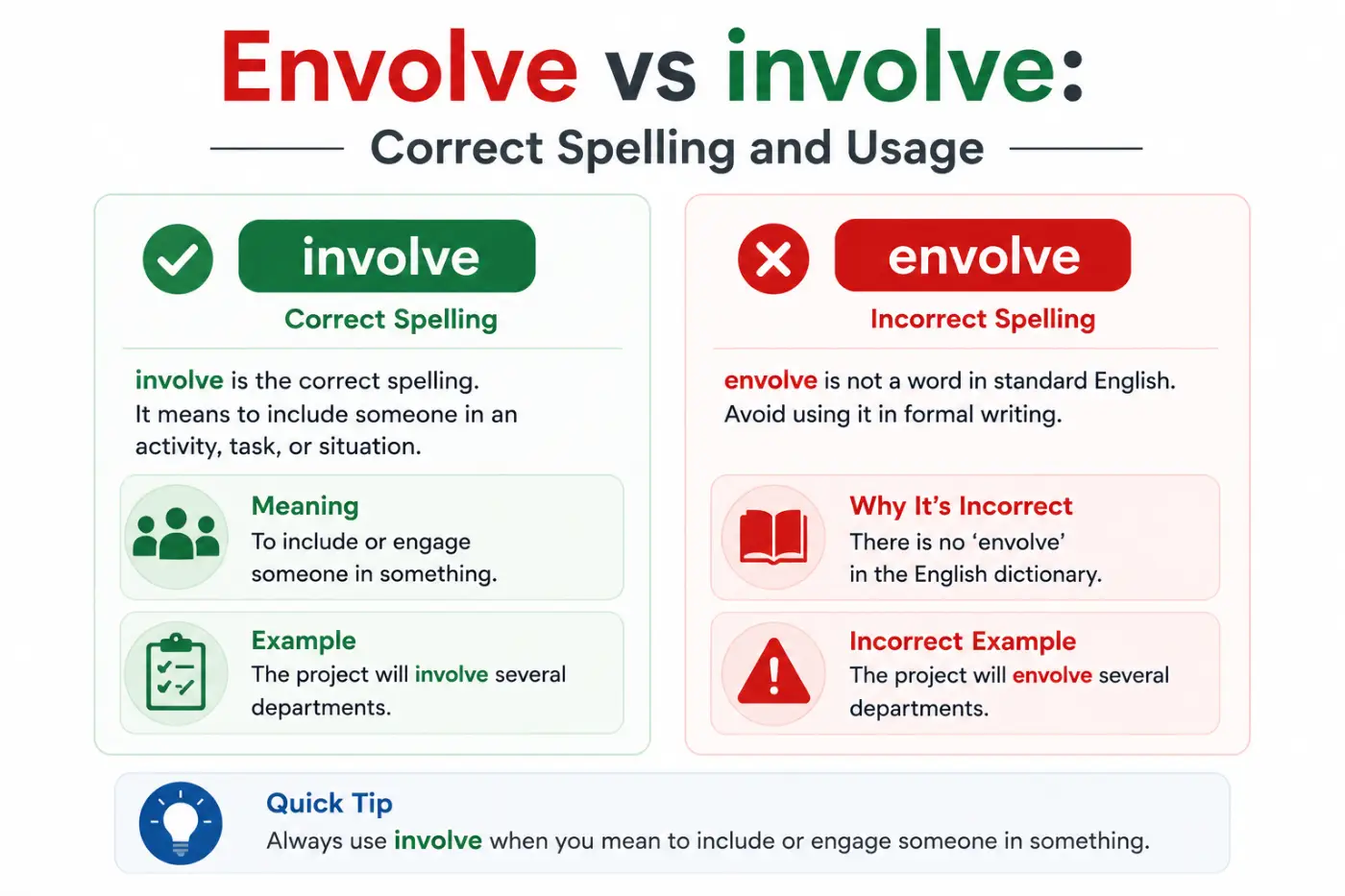
envolve vs involve can be confusing because the two forms look almost identical. The correct standard English form is involve. Envolve is normally a spelling mistake when you want to say that someone or something is included in an activity, process, or situation. One small letter makes the difference, so it’s easy to type the wrong form without noticing.
The confusion often comes from the way English spelling and pronunciation work. When you hear the word in conversation, the spelling isn’t obvious from the sound alone. Fast typing can make the problem even more common, especially when a writer adds an extra vowel because the word looks as if it could follow another familiar spelling pattern.
Once you know the correct form, the difference becomes much easier to remember. This article explains the meaning, grammar, pronunciation, word origin, common mistakes, and everyday usage of involve. You’ll also see clear examples that show how native English speakers use the word in conversations, schoolwork, professional communication, and formal writing.
Quick Definition
Involve is the standard English verb used to mean include someone or something in an activity, situation, process, or result. It can also mean to require something as a necessary part of an activity or to make a situation more complicated. Envolve is not the standard spelling of this verb.
Quick Answer
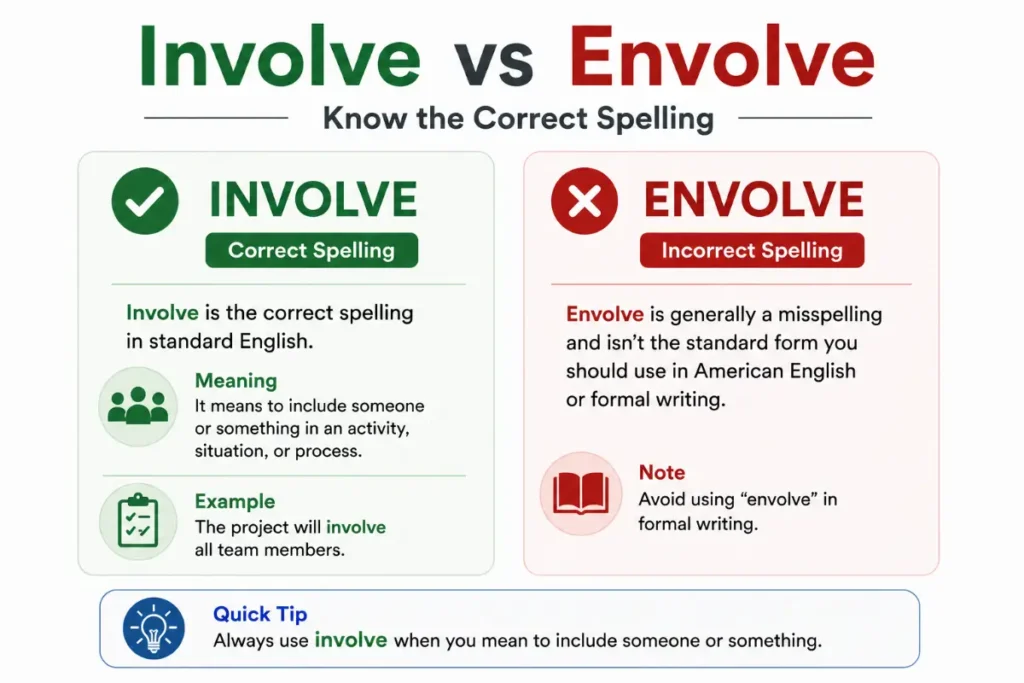
The correct standard English form is involve. Envolve is normally a spelling error when you mean include, require, or make part of a situation.
For example, you can say, The project will involve several departments. You should not write, The project will envolve several departments. The difference is small on the page but important in correct English writing.
Comparison Table envolve vs involve
| Form | Meaning | Part of Speech | Origin | Usage Frequency | Formality | Common Contexts | Example |
|---|---|---|---|---|---|---|---|
| Involve | To include, require, or make part of a situation | Verb | From Latin through French into English | Very common | Neutral and formal | Conversation, education, work, business, academic writing | The project will involve several teams. |
| Envolve | No standard meaning as the usual English verb intended here | Nonstandard spelling | Not the standard spelling of involve | Uncommon | Not appropriate in standard writing | Typing errors and spelling mistakes | Please change envolve to involve. |
Meaning and Definition
Meaning of Envolve
Envolve is not the standard English spelling of the verb used to mean include or require. In ordinary modern English, a writer who types envol ve or writes envolve usually intends to write involve.
This distinction matters because a familiar looking sequence of letters is not enough to make a form a standard word. English contains many words that look similar but have different meanings, and some apparent alternatives are simply errors.
You may encounter envolve in informal online writing, comments, messages, or drafts. Its appearance in those places does not establish it as a standard alternative. If you are writing an essay, email, report, application, article, or professional message, use involve.
The mistake often comes from pronunciation. The word involve begins with the short i sound in standard American pronunciation, while the written form can tempt learners to add an e because several English words contain similar letter patterns. Typing quickly can also lead to an extra vowel.
Meaning of Involve
Involve is a versatile verb with several related meanings. Its central idea is connection. When something involves a person, activity, object, or idea, that person or thing becomes part of the situation.
Consider this sentence.
The job involves working with customers.
Here, working with customers is a necessary part of the job.
Now consider another example.
The teacher involved the students in the discussion.
Here, the teacher included the students as active participants.
The word can also describe something that requires effort, time, skill, or a particular action.
Learning a new language involves regular practice.
In this sentence, regular practice is a necessary part of the learning process.
Involve can also describe situations that contain several connected parts.
The investigation involved several witnesses.
This tells us that several witnesses became connected to the investigation.
The word therefore works across many settings. You can use it for people, activities, responsibilities, processes, emotions, decisions, and complicated situations.
Key Differences Explained
- Spelling. Involve is the standard spelling. Envolve is normally an incorrect spelling when the intended meaning is include or require.
- Meaning. Involve has established meanings in modern English. Envolve does not normally function as an alternative spelling with those meanings.
- Grammar. Involve is a verb. It can take a direct object and can also appear in common patterns such as involve someone in something.
- Pronunciation. Involve is pronounced with an initial short i sound. Adding an e can encourage an incorrect pronunciation in addition to the spelling mistake.
- Formality. Involve works comfortably in casual speech and formal writing. It is common in professional and academic English.
- Context. You can use involve to describe participation, requirements, connections, processes, and consequences.
- Regional usage. Standard American English uses involve. British Canadian and Australian English also use involve as the standard form.
- Standard usage. Professional editors dictionaries spelling tools and educated usage generally treat involve as the appropriate form for the meanings discussed here.
The easiest way to handle the confusion is to focus on the word family. Think of involved, involvement, and involving. These related forms reinforce the spelling pattern and make the standard form easier to remember.
Which Form Is Correct?
Involve is the correct form for standard English when you mean to include someone or something, require something as part of an activity, or connect someone or something to a situation.
The spelling reflects the established English form inherited through earlier stages of the language. It is not simply a modern spelling preference. The verb has a long history and has maintained its basic spelling pattern as it developed into modern English.
A useful dictionary based approach is to check the headword rather than relying only on a spelling suggestion. Standard dictionaries list involve as a verb with meanings connected to including, requiring, or connecting. A form that appears because of a typing error should not be treated as an accepted variant simply because search engines can understand it.
That distinction is especially useful for students and professional writers. Search technology can often understand misspelled words from context, but good writing still requires the standard form.
Sentence Examples
Here are natural examples showing how the correct verb works in different situations.
- The new project will involve several members of our team.
- Learning to drive involves practice and patience.
- The teacher wants to involve every student in the activity.
- This position involves speaking with customers every day.
- The decision may involve several important factors.
- She became involved in the community after moving to the city.
- The science experiment involves measuring the temperature carefully.
- I don’t want to involve my family in the disagreement.
- The repair will involve replacing one of the damaged parts.
- Good communication involves listening as well as speaking.
These examples show why involve is such a useful verb. It can describe participation, responsibility, requirements, and relationships without changing its basic grammatical identity.
Here are examples of the common spelling mistake. These are shown only to demonstrate what needs correction.
- The project will envolve three departments.
Correct form: The project will involve three departments.
- The course may envolve several difficult assignments.
Correct form: The course may involve several difficult assignments.
Common Mistakes and Misspellings
The spelling confusion usually comes from sound, visual patterns, or fast typing. Here are several errors worth watching for.
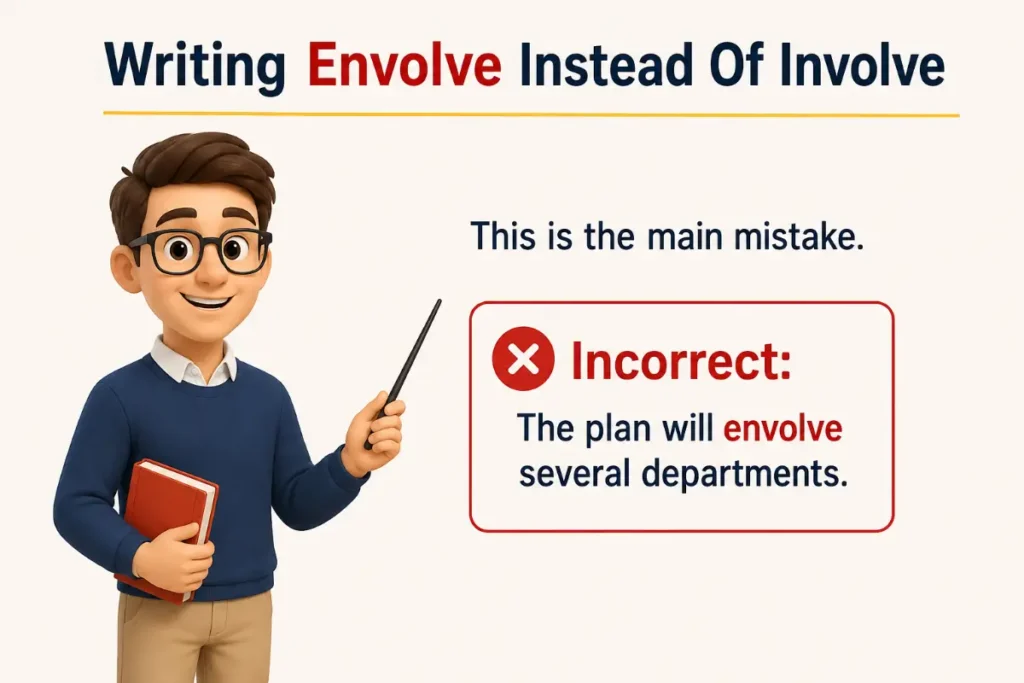
- Envolve instead of involve. This is the main mistake. Writers may insert e because the spelling looks familiar or because they are writing quickly. The correction is involve.
- Involv instead of involve. Some writers drop the final e. This can happen when typing quickly or when the writer focuses on the consonant sounds. The standard form ends with e.
- Involvement spelled incorrectly. Because the noun has a different ending, learners sometimes produce forms such as envolvement. The standard noun is involvement.
- Involving spelled incorrectly. The standard present participle is involving. The spelling changes when ing is added but the base form remains involve.
- Involved used with the wrong structure. English commonly uses involved in to show participation. For example, She was involved in the project. Learners sometimes omit in or use an unsuitable preposition.
NLP can help explain one part of the confusion. Language models and search systems often use surrounding words to infer intended meaning. If someone writes envol ve project management, the surrounding context can strongly suggest involve. Human readers do something similar. However, contextual understanding does not turn a misspelling into a standard form.
Pronunciation Guide
Involve is commonly pronounced /ɪnˈvɑːlv/ in American English.
A simple pronunciation guide is:
in VAHLV.
The stress falls on the second syllable. The first part sounds like in. The second part contains the main stress and ends with the v sound followed by the l and v sounds.
The word has two main syllables.
involve = in + volve.
The vowel in the first syllable is the short i sound found in words such as in and it.
A common learner mistake is to pronounce the beginning with a long e sound or to add an extra syllable. Another mistake is to pronounce every written letter too strongly. Natural English pronunciation often reduces some sounds in connected speech.
You can practice by saying these phrases aloud.
Involve the team.
Involve the students.
The job involves travel.
The project involves research.
The goal is not to exaggerate each sound. Aim for a natural rhythm and place the strongest stress on the second syllable.
Etymology and Word Origin
Involve has a long linguistic history. The English verb traces back through French to Latin.
The Latin verb involvere carried the sense of rolling or wrapping something inward. It came from Latin elements connected with the idea of turning or rolling and the prefix in.
From this physical idea of wrapping or rolling something into something else, the word developed broader figurative meanings. Being wrapped up in something could suggest being connected with it or caught up in it.
English eventually developed involve as a verb connected with participation connection inclusion and requirement.
That history helps explain several modern meanings. When you involve someone in an activity, you bring that person into it. When an activity involves effort, that effort forms part of the situation.
The modern word therefore carries an idea of connection at its core.
Regional Usage
American English
In American English, involve is a standard and very common verb. People use it in ordinary conversation as well as professional academic and formal writing.
For example, an American speaker might say, The job involves a lot of travel. A manager might write, The process involves three departments.
The spelling does not change in standard American English.
British English
British English also uses involve as the standard spelling. The meanings and basic grammar remain the same.
British speakers may use the word in contexts involving work education personal relationships public issues and formal discussion. Envolve is not a standard British alternative to involve.
Australian English
Australian English follows the same standard spelling. Involve appears naturally in everyday speech professional writing education and public communication.
There is no established Australian spelling variant that replaces involve with envolve for the meanings discussed in this article.
Canadian English
Canadian English also uses involve as the standard form and Canadian writers use it across casual professional academic and government related contexts.
The spelling remains the same as in American and British English. The main issue for learners is therefore not regional variation but recognizing the standard word.
Grammar Rules and Part of Speech
Involve is a transitive verb in many of its most common uses. That means it often takes an object.
The project involves research.
Here, research is the object of the verb.
Another common structure is involve someone in something.
The manager involved the staff in the decision.
In this pattern, the person becomes an active participant in something.
You can also use involve in the passive voice.
Several students were involved in the competition.
This structure is extremely common because involved can describe participation or connection.
Another useful pattern is involve doing something.
The job involves working with children.
Notice that working follows the verb in the ing form. You would not normally write, The job involves to work with children.
Compare these sentences.
The course involves reading several books.
The course requires students to read several books.
Both sentences are grammatical, but the structures differ.
Involve also works in the present participle form involving.
The plan is involving several new departments.
This sentence is possible in specific contexts but often sounds less natural than a simpler construction. Native speakers frequently use involves for general descriptions and is involving for an action that is currently developing.
The past forms are involved and involved. The noun is involvement.
Examples include:
She involves her team in important decisions.
She involved her team in the decision.
Her team was involved in the decision.
Her involvement helped the project succeed.
Punctuation does not change because of the verb itself. Use normal punctuation based on the structure of the sentence.
In formal writing, involve is especially useful when you need a precise word for participation or requirements. Still, avoid using it repeatedly in nearby sentences. Words such as include, require, contain, cover, demand, and engage may express the intended meaning more naturally in some contexts.
Real Life Usage Examples
Daily Conversation
In everyday speech, involve often describes participation or effort.
My weekend plans involve visiting my grandparents.
This recipe involves a lot of preparation.
The word sounds natural because it gives a clear sense of what a situation includes.
Email and Workplace Communication
Professional communication uses involve frequently because work tasks often connect several people or steps.
The new schedule will involve changes to the current workflow.
Please involve the sales team before you finalize the proposal.
In these examples, the verb communicates responsibility and participation clearly without sounding overly formal.
Academic Writing
Academic writers often use involve when explaining research methods processes or requirements.
The study involves interviews with university students.
Effective language learning involves regular exposure to meaningful communication.
The verb works well in academic writing because it can describe relationships between different parts of a process.
News and Journalism
News writing commonly uses involve to describe people events investigations and developing situations.
The investigation involved several local agencies.
The incident involved two vehicles and caused delays on the road.
The word allows journalists to describe connections without making the sentence unnecessarily complicated.
Literature and Storytelling
Storytellers use involve to describe characters becoming connected to events.
He never expected to become involved in the mystery.
Her decision involved the whole family.
In a story, the word can quietly signal that a character has been drawn into a larger situation.
Related and Confused Terms
Several words overlap with involve, but each carries a slightly different meaning.
- Include. Include usually means to contain something as part of a whole. The price includes breakfast.
- Require. Require focuses on something that is necessary. The job requires experience.
- Engage. Engage can mean to attract someone’s attention or participation. The activity engaged the students.
- Contain. Contain means to have something inside or as a component. The package contains three items.
- Participate. Participate means to take part in an activity. Students participated in the discussion.
- Concern. Concern can mean to relate to or affect someone or something. The issue concerns public safety.
- Entail. Entail means to involve something as a necessary part or consequence. The change may entail additional costs.
- Involvement. Involvement is the noun form. It describes participation or connection. Her involvement improved the project.
These terms belong to the same semantic neighborhood, but they are not interchangeable in every sentence. Good writing depends on choosing the word that expresses the exact relationship you mean.
How To Remember The Correct Spelling
A simple memory trick can help you avoid the extra e.
Think of the word as:
in + volve = involve.
The first part is in. The rest is volve. There is no extra e after the n.
You can also connect the word with its related forms.
involve
involved
involving
involvement
Seeing the same spelling pattern across the word family makes the standard form easier to recognize.
Another useful trick is to remember a sentence rather than an isolated spelling.
Good communication involves listening.
If you can picture that sentence, the spelling becomes easier to recall.
For students, writing the correct form several times in meaningful sentences is usually more useful than memorizing a letter sequence without context.
Involve In Formal Writing
Involve is fully suitable for formal English. You can use it in essays reports research papers workplace emails business documents applications and professional explanations.
For example:
The position involves regular communication with clients.
The research involves analysis of data from several sources.
The proposal involves changes to the current policy.
Still, strong formal writing depends on precision. If include expresses your meaning more directly, use include. If require is the exact idea, use require. And If participation is the focus, participate or engage may work better.
Good editing is not about choosing the longest or most formal word. It is about choosing the clearest word.
Why The Extra E Appears
The extra e in envolve is easy to understand as a spelling pattern error. English contains many words where vowel combinations can appear before consonants, so learners may create a spelling that looks plausible even though native usage does not support it.
Pronunciation can contribute to the mistake too. When people learn a word mainly by hearing it, they may construct the spelling from their own understanding of its sounds. This becomes especially common with English words whose spelling does not map perfectly to pronunciation.
Typing habits add another layer. If a writer has seen similar words with an e in the middle, the brain may produce that pattern automatically. In cognitive language processing, familiar letter sequences can influence how people predict the next part of a word.
The best solution is not to overthink the mistake. Learn the standard form and reinforce it through repeated exposure.
Expert Editor Insight
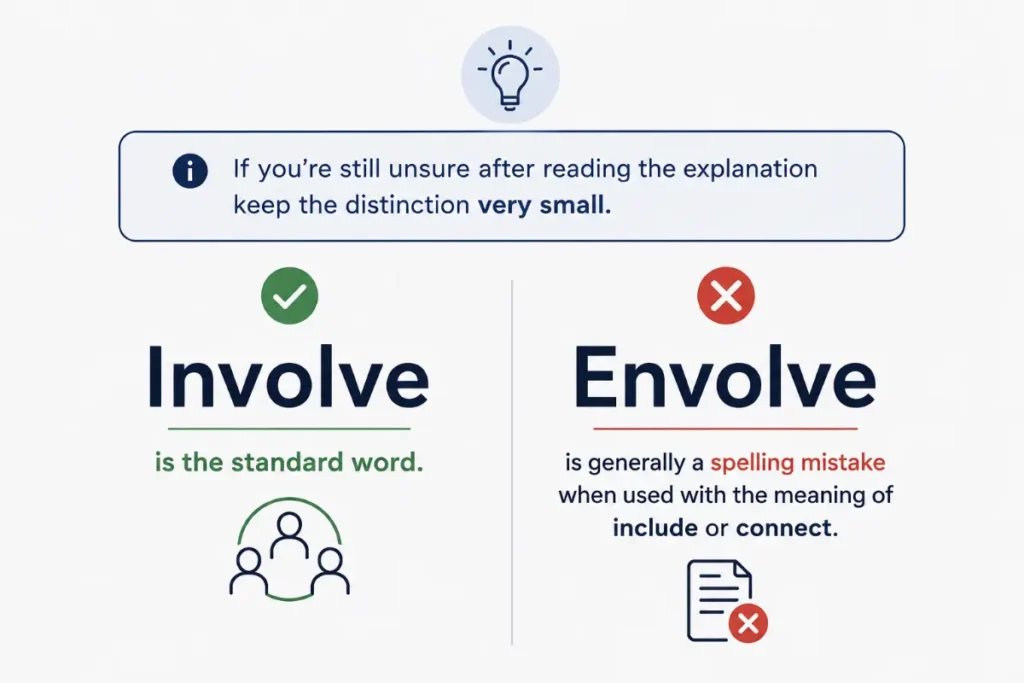
An experienced editor would usually correct envolve immediately when the intended meaning is include, require, or connect. The form looks close enough to the standard word that readers can understand it, but professional writing depends on standard spelling rather than reader guesswork. Spelling tools may flag the incorrect form while context aware systems may infer the intended word. A practical editing tip is to check the related forms involved, involving, and involvement. If those forms look familiar, they can help you remember that the base verb is involve.
Final Takeaway
envolve vs involve has a straightforward answer. Involve is the standard English verb, while envolve is normally a spelling mistake when the intended meaning is to include, require, or connect. The correct form appears in everyday speech as well as professional academic and formal writing.
The verb has several useful meanings, but they all connect to the basic idea of bringing something into a situation or making it part of a process. Its related forms include involved, involving, and involvement.
For an easy memory trick, keep the spelling as involve and connect it with the familiar word involved. When proofreading, pay special attention to the middle of the word and remove the extra e if you see envolve.
FAQs
Is envolve a real English word?
Envolve is not the standard English form of the verb used to mean include or require. In most ordinary writing, it is simply a spelling error for involve. If you are writing an essay, email, report, application, or professional document, use involve. A proper name or unusual specialized use would need to be considered separately from normal English vocabulary.
What does involve mean?
Involve is a verb that commonly means to include someone or something in an activity or situation. It can also mean to require something as part of a process or to connect someone with an event. For example, The job involves travel means travel is a necessary part of the job.
Which is correct: envolve or involve?
Involve is the correct standard spelling for the meanings discussed here. Envolve is normally an incorrect spelling. The difference is easy to miss because the forms look similar. The best way to remember the standard form is to focus on involve and its related words involved, involving, and involvement. These forms all reinforce the same spelling pattern.
How do you pronounce involve?
Involve is commonly pronounced /ɪnˈvɑːlv/ in American English. A simple pronunciation guide is in VAHLV. The main stress falls on the second syllable. The first syllable uses a short i sound. Avoid adding an extra syllable or changing the first vowel into a long e sound.
Can involve be used in formal writing?
Yes. Involve is completely suitable for formal writing. It appears naturally in academic papers, reports, business communication, professional documents, and official explanations. The word can describe participation, requirements, connections, and processes clearly. Still, choose a more specific word such as include or require when that word communicates your intended meaning more precisely.
What is a synonym for involve?
Useful synonyms include include, require, engage, contain, concern, entail, and participate, although they do not all work in the same grammatical structures. Include emphasizes having something as part of a whole. Require emphasizes necessity. Participate emphasizes taking part. The right synonym depends on the exact meaning of the sentence.
Why do people write envolve?
People may write envolve because the two forms look very similar and the extra e can seem natural during fast typing. Pronunciation can also make spelling less obvious because spoken English does not provide a clear letter by letter guide. Learners may also transfer familiar spelling patterns from other English words. Regular exposure to involve and its related forms helps prevent the mistake.
Is involve common in American English?
Yes. Involve is a common verb in American English and appears in casual conversation, education, workplaces, journalism, academic writing, and formal communication. It can describe people taking part in something, activities requiring certain actions, or situations involving several connected elements. The spelling remains involve in standard American English.
