
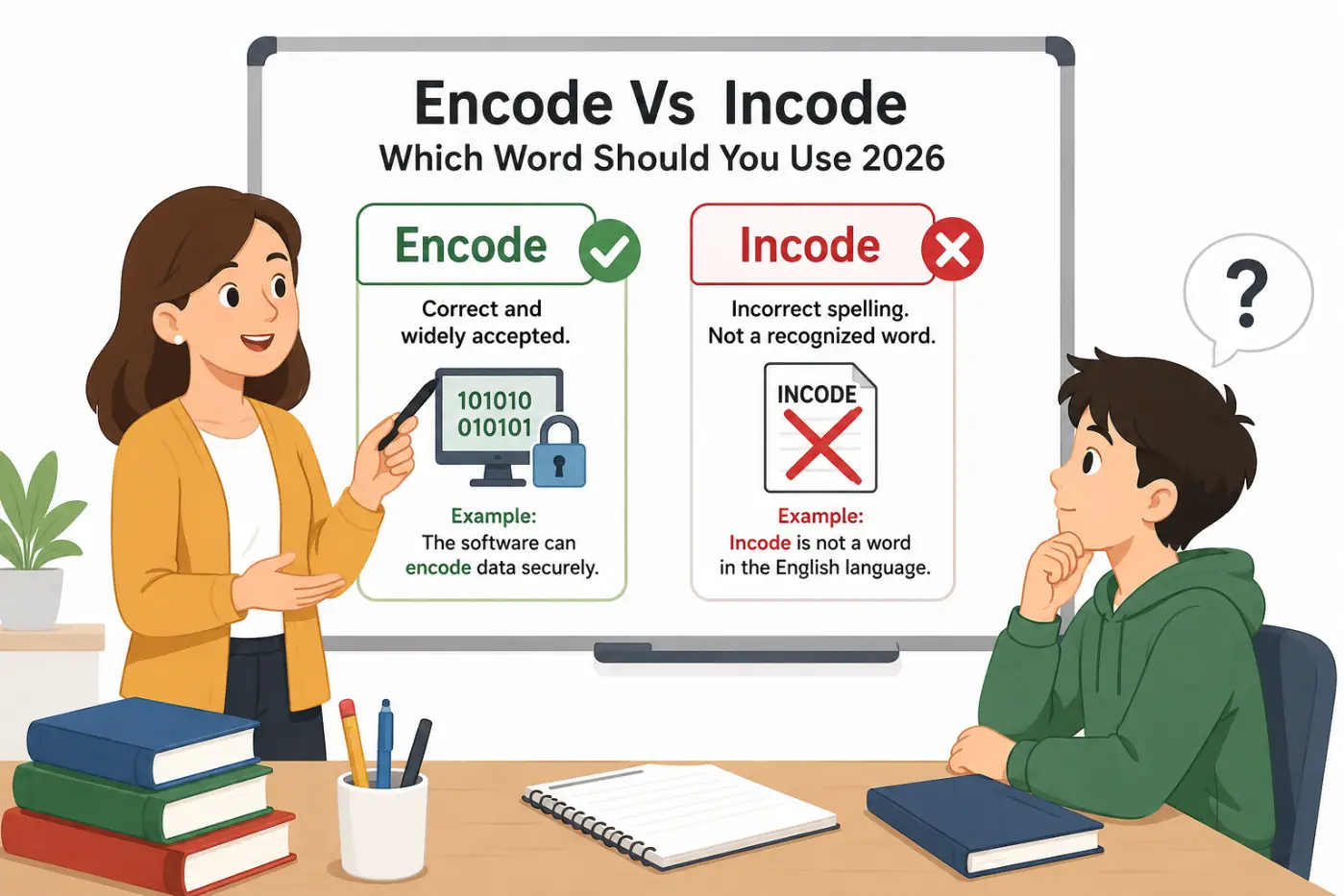
If you’ve typed encode vs incode into a search box you’re probably trying to settle a simple but surprisingly confusing spelling question. Encode is the standard English word. Incode is not normally accepted as the standard spelling of the same word. In technical writing especially you’ll almost always want encode when you mean to convert information into a particular format or representation.
The confusion is understandable because English has many words beginning with in and encode looks as if it could have a matching form with an in prefix. There’s also a real word family around code including encode decoding encoding and encoded. That family makes the correct pattern easier to recognize once you understand how the word works.
This distinction matters most in programming documentation data processing cybersecurity communications and technical writing. A spelling error in those settings can make an otherwise clear sentence look careless or create confusion about what action you mean. Below you’ll learn the definition grammar pronunciation origin common mistakes and natural examples so you can use the right form with confidence.
Quick Definition
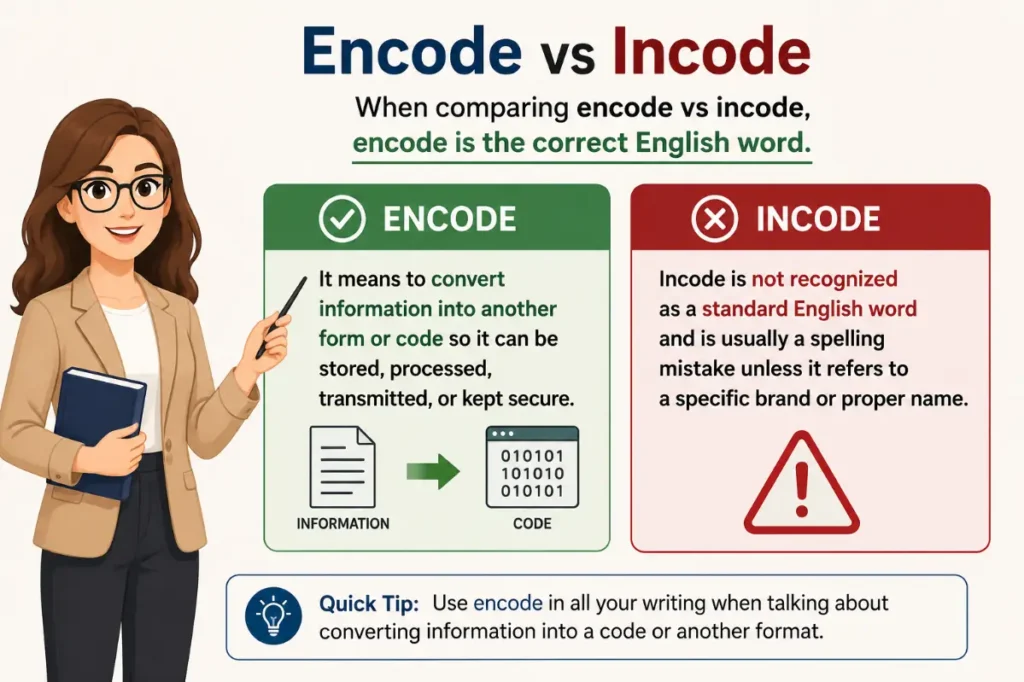
Encode is the standard English verb meaning to convert information into a particular form or code so it can be stored transmitted processed or understood in a specified way. Incode is generally not the standard spelling of this verb. In technical and general English writing use encode when referring to the process of encoding information.
Quick Answer
Encode is the correct standard form. Incode is generally incorrect when you mean to convert information into a code or another representation.
You can use encode in ordinary English and technical contexts. For example you might encode a message before sending it or encode a video into a different format. The related noun and adjective forms include encoding encoded and encoder.
Comparison Table
| Standard Form | Meaning | Part of Speech | Origin | Usage Frequency | Formality | Common Contexts | Example |
|---|---|---|---|---|---|---|---|
| Encode | Convert information into a code or representation | Verb | Formed from en plus code | Common | Neutral to technical | Programming data storage communications media | The program can encode the file automatically. |
| Incode | Not normally the standard English form of this verb | Nonstandard form | Usually a mistaken formation based on in plus code | Uncommon in standard usage | Not recommended | Spelling errors informal text mistaken technical writing | Use encode instead of incode in standard writing. |
Meaning and Definition
Meaning of the Incorrect Form
Incode is generally not the standard English verb you want when describing the process of converting information into a code or format.
A person might write incode because the word seems logically possible. English contains many words beginning with in and people often form new words by adding familiar prefixes. The problem is that English word formation doesn’t work by freely attaching any prefix to any base word.
In technical writing this matters because code already has an established verb form. That form is encode.
For example:
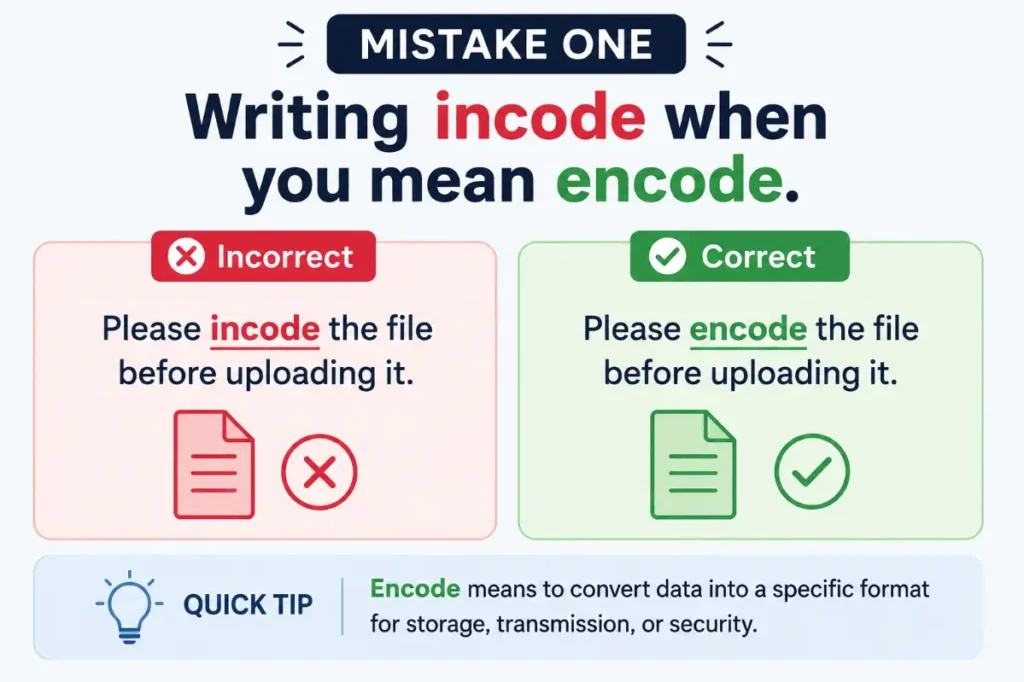
Incorrect: The software will incode the data.
Correct: The software will encode the data.
The second sentence uses the established English term.
You may occasionally encounter incode as a name or as a rare specialized formation in particular sources. A specialized or invented use doesn’t make it the standard equivalent of encode. If your goal is clear general English or conventional technical English use encode.
Meaning of the Correct Form
Encode is a verb meaning to change information into a particular code representation or format.
The basic idea is transformation.
A system takes information in one form and represents it in another form according to a defined scheme.
For example a computer program can encode text so it can be stored or transmitted using a particular character encoding. A media application can encode video into a format suitable for playback or distribution.
The word also appears outside computing.
A person can encode a message using a system of symbols. In communication research encoding can refer to the process of turning an idea into a form that can be communicated.
The exact meaning depends on the context but the central idea remains the same. Information is represented in a particular coded form.
That distinction is useful because encoding isn’t automatically the same thing as encryption.
Encryption is designed to protect information from unauthorized access. Encoding usually focuses on representation compatibility storage transmission or processing. An encoded piece of information may be completely readable to anyone who knows the encoding scheme.
For example Base64 encoding changes binary data into text characters. It doesn’t by itself provide secrecy.
That technical distinction is worth remembering when writing documentation because using encode as a loose synonym for encrypt can create a misleading statement.
Key Differences Explained
- Spelling. The established English verb is encode. Incode is generally a nonstandard formation when used with the same intended meaning.
- Meaning. Encode means to convert information into a code representation or format. Incode doesn’t normally carry a recognized standard meaning in this context.
- Grammar. Encode functions as a verb. It can take a direct object such as data message text image or file.
- Pronunciation. Encode has a clear stress pattern with the main emphasis on the second syllable.
- Formality. Encode works in everyday explanations as well as technical academic and professional writing.
- Context. The word is especially common in computing communications data processing media and information technology.
- Regional usage. Major varieties of English use encode as the standard form. There isn’t a meaningful American versus British spelling distinction here.
- Technical meaning. Encoding represents information in another form. It should not automatically be treated as encryption.
- Word family. Encode connects naturally with encoding encoded encoder and decoding.
The important point is that this isn’t a case like two legitimate English words with different meanings. In ordinary standard usage the choice is straightforward.
Which Form Is Correct?
Encode is the standard form.
The word is built around code with the prefix en. English uses en in several verbs that convey the idea of putting something into a particular state or form. Encode fits this established word formation pattern.
The corresponding verb is not normally formed by replacing en with in.
That distinction is especially important for technical vocabulary because programmers engineers writers and documentation teams tend to rely on established terminology. Using a familiar technical term correctly makes instructions easier to understand and reduces ambiguity.
If you’re writing a sentence such as The application will encode the data before transmission you’re using the standard verb naturally.
If you write The application will incode the data most readers will likely interpret it as a spelling mistake rather than a deliberate technical term.
A good dictionary based approach is to check the headword rather than deciding from spelling alone. Standard dictionaries recognize encode as an English verb. That established entry is stronger evidence than the fact that a nonstandard form appears occasionally online.
How Encode Works in a Sentence
Encode is normally a transitive verb when you describe converting a specific object.
For example:
The application encodes the message.
Here the subject is the application and the object is the message.
You can also use the passive form.
The message was encoded before transmission.
The word can describe a process in the present tense.
The system encodes every file automatically.
It can describe a completed action.
The software encoded the video overnight.
It can also appear in technical instructions.
Encode the text using UTF 8.
The noun form is encoding.
The adjective or past participle is encoded.
The person or system that performs the action can be called an encoder in suitable contexts.
These related forms make the word family fairly predictable.
Sentence Examples
Here are ten natural examples using the standard form.
- The application can encode the video automatically.
- We need to encode the data before sending it to the server.
- The system encodes each message before transmission.
- The developer used a library to encode the text correctly.
- The camera can encode high quality video in several formats.
- Please encode the file using the required character format.
- The software encoded the audio successfully.
- The researchers encoded the responses for statistical analysis.
- This tool can encode binary data as readable text.
- The device encodes the information before storing it.
Here are five examples showing the common mistake.
- Incorrect: The program will incode the message.Correct: The program will encode the message.
- Incorrect: We need to incode the data first.Correct: We need to encode the data first.
- Incorrect: The software automatically incodes the file.Correct: The software automatically encodes the file.
- Incorrect: The developer incoded the text using a special format.Correct: The developer encoded the text using a special format.
- Incorrect: This tool can incode the image.Correct: This tool can encode the image.
These incorrect examples are useful for spotting the error but they shouldn’t be treated as standard usage.
Common Mistakes and Misspellings
Using Incode Instead of Encode
This is the central mistake. Writers see code and assume that in plus code should produce a valid verb.
The established form is encode.
Confusing Encode With Encrypt
This is a meaning problem rather than a spelling problem.
Encoding changes representation. Encryption is intended to protect information through a cryptographic process.
For example a file can be encoded in Base64 without being secret.
Confusing Encode With Decode
These verbs describe opposite directions in many contexts.
To encode is to convert information into a particular representation.
To decode is to convert encoded information back into an understandable or usable form.
For example a program might encode data before transmission and decode it after receiving it.
Using Encoding and Encryption as Exact Synonyms
Technical writing benefits from precision. Saying that a system encrypts information when it merely encodes it can give readers the wrong idea about security.
If secrecy matters use encryption terminology accurately.
Assuming Prefixes Work Automatically
English contains many productive prefixes but that doesn’t mean every combination becomes a standard word.
A familiar prefix plus a familiar root can look convincing while still producing a nonstandard form. That’s exactly what happens with incode in ordinary English.
Pronunciation Guide
The standard pronunciation of encode is commonly represented in IPA as /ɪnˈkoʊd/ in American English.
You can break it into two syllables.
en CODE
The main stress falls on the second syllable.
The first syllable sounds like a short in or en sound while the second syllable rhymes closely with words such as road and mode.
Say it naturally as:
en CODE
A common pronunciation mistake is to stress the first syllable too heavily. The word normally gives stronger emphasis to code.
The pronunciation itself doesn’t cause much confusion. The spelling is the bigger issue because people may try to create a matching form based on the familiar prefix in.
If you remember the sound and connect it directly to the established spelling you’ll avoid most errors.
Etymology and Word Origin
The history of encode is closely connected to the word code.
Code ultimately comes through French from Latin roots associated with a codex or written collection. Over time code developed broader meanings involving systems of rules symbols and methods of representing information.
English later formed the verb encode from en plus code.
The prefix en is used in English word formation to convey the idea of putting something into a particular condition or form. Similar structures appear in verbs such as enclose and enlarge although each word has its own historical development.
Encode therefore has a clear connection to the idea of putting information into a code.
The modern computing sense developed as coded information became increasingly important in communications and digital technology. Today the verb is common in discussions of character encoding data formats multimedia communications and software systems.
Its history also explains why code appears in several related forms.
Code can refer to the representation system itself.
Encode describes the act of creating or applying that representation.
Encoded describes information that has already been converted.
Encoding names the process.
Decoder and decoding describe the reverse process in suitable contexts.
This word family is useful because once you understand one member the others become much easier to recognize.
Regional Usage
American English
Encode is standard American English. It appears frequently in technology documentation programming discussions academic writing and general explanations of communication systems.
The spelling does not change in American usage.
For example:
The program encodes the file before uploading it.
American technical writers also distinguish carefully between encoding and encryption when discussing data security.
British English
British English uses encode as well. There is no major British spelling alternative that changes the word to incode.
Technical documentation in the United Kingdom uses the same established terminology found in American English.
Australian English
Australian English also uses encode as the standard form. Computing education professional documentation and general technical writing follow the same basic terminology.
There is no established Australian spelling variant that makes incode the normal alternative.
Canadian English
Canadian English likewise uses encode. The word functions in the same way and retains the same spelling.
Regional English differences can affect many words but this isn’t one of those cases. The standard form remains stable across the major English varieties discussed here.
Grammar Rules and Part of Speech
Encode is a verb.
It can describe an action performed by a person a program a device or another system.
The most common structure is:
Subject + encode + object
For example:
The program encodes the image.
Here the program performs the action and the image receives the action.
The verb can also appear in different tenses.
Present: The software encodes the file.
Past: The software encoded the file.
Future: The software will encode the file.
Present perfect: The software has encoded the file.
The passive voice is also common in technical writing.
The data was encoded before transmission.
The form encoded acts as the past participle.
The continuous form is encoding.
The system is encoding the video.
The third person singular form is encodes.
The application encodes the data automatically.
The verb can be followed by an object describing what gets transformed.
Common objects include data text messages files images audio video information and signals.
You can also use encode with a prepositional phrase describing the resulting format or system.
The program encoded the text in UTF 8.
In technical writing it’s wise to identify the specific encoding method when that detail matters. Words such as UTF 8 Base64 and other established encoding schemes refer to specific technical systems rather than vague ideas of changing data.
Encode Versus Encrypt
This distinction deserves special attention because the two words frequently appear together.
Encoding changes the representation of information. Encryption changes information in a way intended to restrict access to people or systems that have the necessary key or method for decryption.
Imagine you have a sentence that needs to be represented using a different character system. You might encode it.
Now imagine you need to send sensitive information so unauthorized readers can’t understand it. You might encrypt it.
The goals are different.
Encoding is commonly used for compatibility storage transmission processing or representation.
Encryption is primarily about confidentiality and security.
A piece of encoded information may be easy to reverse if someone knows the encoding method. Encrypted information requires the appropriate cryptographic process for practical recovery.
This difference matters in software documentation because saying encode when you really mean encrypt can give users a false impression of security.
A careful technical writer chooses the term based on the actual operation being performed.
Encode Versus Decode
Encode and decode are closely related but point in opposite directions in many systems.
Encoding takes information and converts it into a selected representation.
Decoding interprets or converts that encoded representation back into a usable form.
Consider a simple communication process.
A sender encodes information.
The information travels through a system.
A receiver decodes the information.
The exact details depend on the technology involved but the basic relationship is easy to understand.
That’s why the related words encoding and decoding appear together so often in technical documentation.
For example:
The application encodes the data before transmission.
The receiving application decodes the data after transmission.
The two verbs describe different stages of the same broader process.
Real Life Usage Examples
Daily Conversation
Although encode is strongly associated with technology it can appear in ordinary explanations.
- The app needs to encode the file before you send it.
- I think the message was encoded in a different format.
People who use technology regularly may encounter the word without thinking of it as specialized vocabulary.
Email and Workplace Communication
Technical teams often use the word in concise professional instructions.
- Please encode the data before uploading the file.
- The new version can encode the reports automatically.
In workplace communication clarity matters more than using complicated language. If encode accurately describes the process it’s the natural choice.
Academic Writing
Researchers can use the term when discussing information processing communication or data analysis.
- The researchers encoded the responses before analyzing the results.
- The system was designed to encode the collected information in a standardized format.
Academic writing benefits from defining specialized terms when the audience may not know them.
News and Journalism
Technology reporting may use the term when discussing digital media or communication systems.
- The device can encode video for online distribution.
- The platform encodes uploaded media into several playback formats.
Journalistic writing generally favors the standard technical term because readers need to understand exactly what a system does.
Literature and Storytelling
Encode can also appear in fiction involving computers communication puzzles or secret messages.
- The engineer encoded the message before sending it across the network.
- They discovered that the old document had been encoded using a forgotten system.
The word can fit naturally into a story as long as the technical meaning is clear from context.
Related and Confused Terms
Code
Code is the base word behind encode. It can refer to a system of symbols instructions rules or representation.
Encoding
Encoding is the process of converting information into a particular representation. It can also refer to the resulting practice or method.
Encoded
Encoded describes information that has already been converted into a particular representation.
Encoder
An encoder is a person device program or component that performs encoding.
Decode
Decode generally refers to converting encoded information back into an understandable or usable form.
Decoder
A decoder is something that performs decoding.
Encryption
Encryption is a security process designed to protect information from unauthorized access. It shouldn’t be treated as an exact synonym for encoding.
Decryption
Decryption is the process of recovering information from encrypted data using the appropriate cryptographic method.
These terms often appear together in technical material but each has a specific role. Using the right one makes your writing much clearer.
Why Incode Looks Like It Could Be Correct
The mistaken form has a certain visual logic.
English has many words beginning with in. Think of words such as include and insert. A writer who sees code may instinctively assume that adding in produces a valid verb.
But vocabulary isn’t simply a mathematical equation where every prefix can attach to every root.
English word formation depends on history established usage and accepted patterns. Some combinations become standard words. Others never become part of the normal vocabulary.
That’s why a word can look perfectly reasonable and still be wrong.
This is especially common with technical vocabulary. Programming contains many terms that look like ordinary English compounds but actually have fixed conventional forms. Once a term becomes established in documentation and software communities its exact spelling matters.
The best approach isn’t to guess from appearance. Check the established word form and learn its related family.
For this term the family provides a strong clue.
Encode.
Encoding.
Encoded.
Encoder.
Decode.
Decoding.
Once you see that pattern in context the single form becomes much easier to remember.
An Easy Memory Trick
Think of the phrase en plus code.
The standard verb is formed with en rather than in.
You can also connect it with encoding.
If you know the common technical term encoding you already have a strong clue that the verb is encode.
The relationship looks like this:
Encode → encoding → encoded → encoder
That sequence is much more useful than memorizing an isolated spelling.
Another practical trick is to remember the opposite pair.
Encode → decode.
You’ll rarely see incode used as the normal counterpart to decode. The established technical vocabulary points clearly toward encode.
Expert Editor Insight
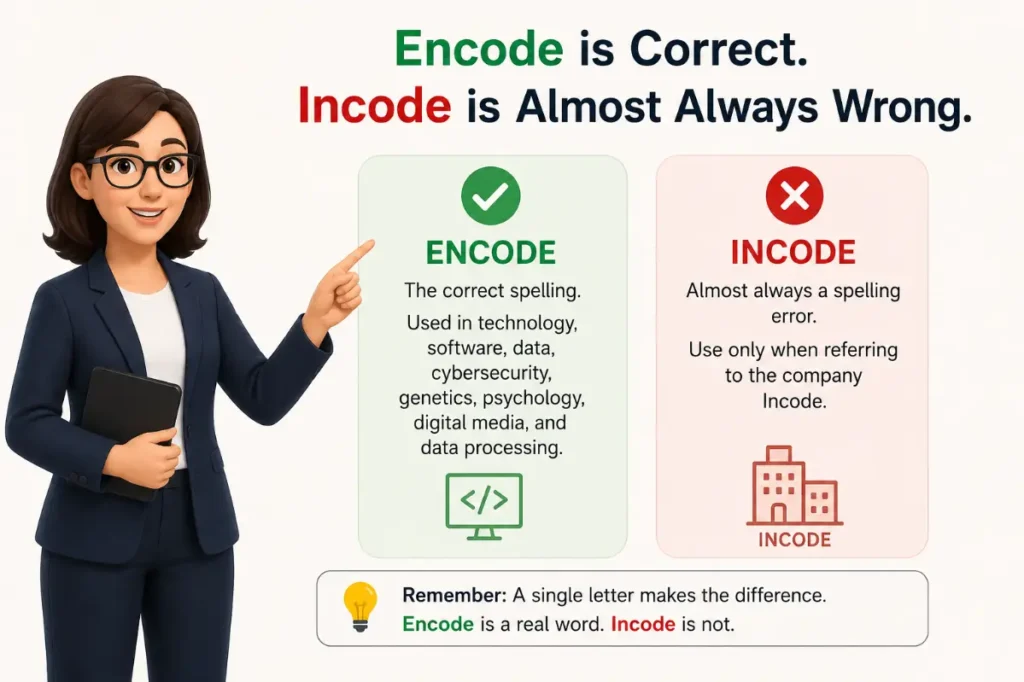
A professional editor would normally change incode to encode when the writer intends the standard verb for converting information into a coded representation. The error is easy to make because the prefix in is familiar and the resulting word looks plausible at first glance. In technical documents editors also check meaning rather than spelling alone. They look for distinctions such as encoding versus encryption and encoding versus decoding because a technically incorrect word can change the meaning of an instruction. Spelling tools may flag the nonstandard form while terminology checkers can help maintain consistent technical vocabulary across a document.
Conclusion
Encode vs incode has a clear answer. Encode is the standard English form for describing the conversion of information into a particular code representation or format. Incode is generally a nonstandard form when used with that meaning and should be avoided in polished writing.
The word works as a verb and appears often in computing data processing communications media and technical documentation. It also belongs to a useful family that includes encoding encoded encoder decoding and decoder. Remembering that family makes the spelling much easier.
There’s one practical tip worth keeping. Don’t assume a familiar prefix can attach to every English word. Learn the established form as encode and connect it with encoding and decode. That simple pattern will help you choose the right word quickly and keep your technical writing clear.
FAQs
Is incode a correct English word?
Incode is not normally the standard English form used for converting information into a code or representation. In that context the established verb is encode. You may encounter incode in unusual names or specialized contexts but those uses don’t make it a standard replacement for encode. For ordinary English technical writing and professional communication choose encode.
What does encode mean?
Encode means to convert information into a particular code format or representation. Computers commonly encode text data images audio and video so the information can be stored transmitted or processed using a specified system. The exact process depends on the encoding method. Encoding is different from encryption because encoding primarily changes representation rather than providing confidentiality.
Why do people write incode instead of encode?
People may create incode because the form looks logical. English contains many words beginning with in and code naturally suggests the idea of a coded representation. However English doesn’t allow every prefix to combine freely with every root. The established verb is encode. Familiarity with the word family encoding encoded and encoder can make the standard spelling easier to remember.
How do you pronounce encode?
Encode is commonly pronounced /ɪnˈkoʊd/ in American English. It has two syllables and the main stress falls on the second syllable. An easy guide is en CODE. The first part is short and the second part sounds like code. Avoid putting the strongest stress on the first syllable. The standard pronunciation is consistent across common technical usage.
Is encode used in programming?
Yes. Encode is very common in programming and software development. Developers may encode text data files images audio or other information into a particular representation. Common discussions include character encoding and data encoding. The exact method depends on the task. Technical writers should identify the encoding scheme when precision matters because different encoding methods can produce different results.
Is encode the same as encrypt?
No. Encoding and encryption serve different purposes. Encoding changes information into another representation so a system can store process or transmit it. Encryption is designed to protect information from unauthorized access. Encoded data may be easily converted back when the encoding method is known. Encrypted data requires the appropriate cryptographic process and key for secure recovery.
Is encode the opposite of decode?
In many technical contexts encode and decode describe opposite stages of a process. Encoding converts information into a selected representation while decoding interprets or converts that representation back into a usable form. For example a sender may encode a message before transmission and a receiving system may decode it afterward. The exact process depends on the technology involved.
Is encode appropriate in formal writing?
Yes. Encode is fully appropriate in formal professional and academic writing when the meaning fits the context. It is especially common in technical documents research papers programming guides and discussions of digital information. If your audience may not know the term explain the specific encoding method or process. Avoid replacing it with the nonstandard form simply because it looks familiar.
