
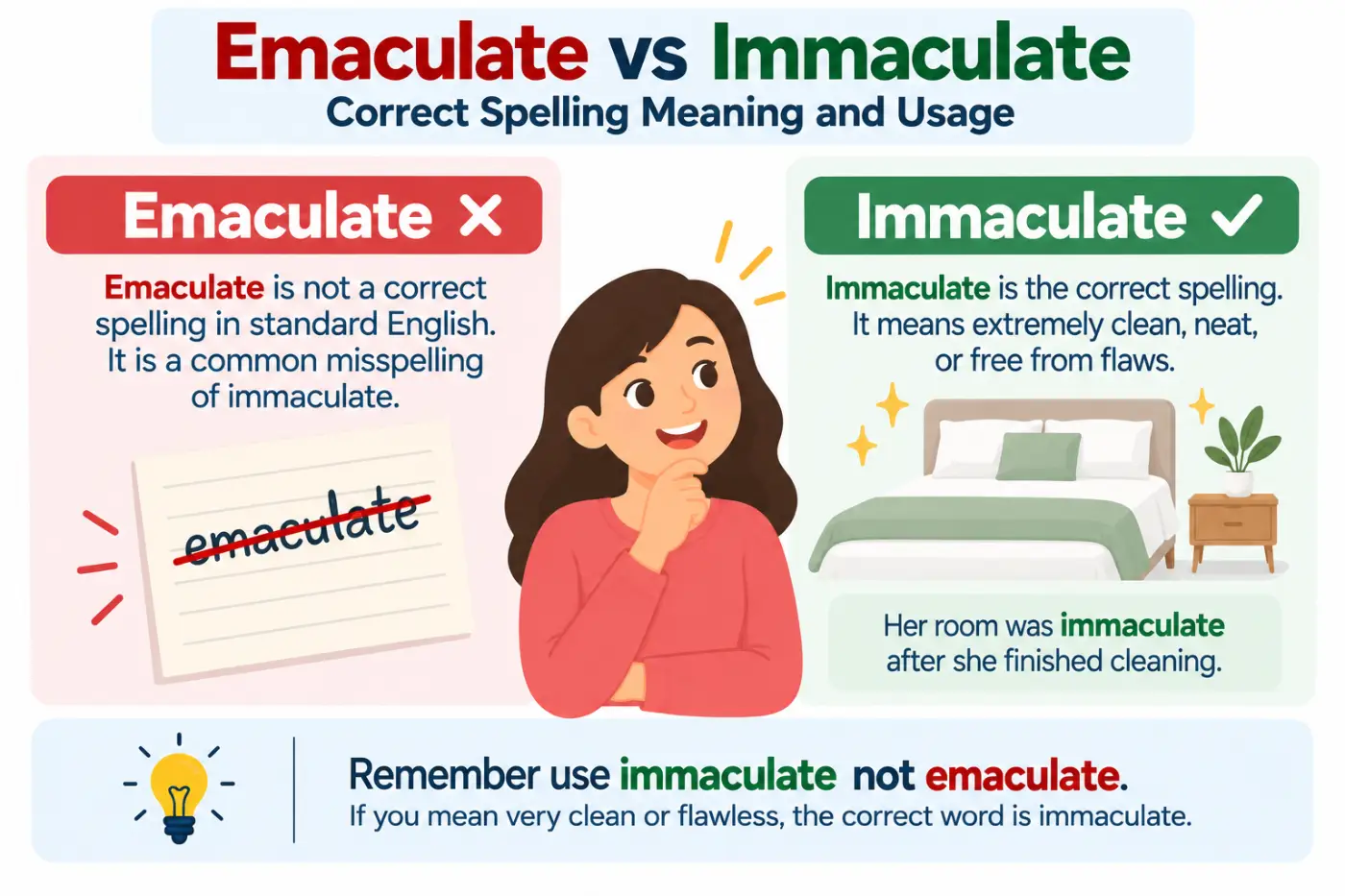
The spelling emaculate vs immaculate can be confusing because the two forms look almost identical. The correct standard English word is immaculate. Emaculate is generally a misspelling and does not have the same status as the established adjective used to describe something perfectly clean pure or without flaws.
The mistake is easy to make because the word contains several sounds that can blur together in normal speech. The opening sound can also make the first part seem like it begins with e rather than im. Once you see the word connected to its Latin history and recognize the prefix in the standard spelling the pattern becomes much easier to remember.
The correct word has several useful meanings. You can describe an immaculate room as perfectly clean. You can describe an immaculate record as free from mistakes or failures and You can also use it more broadly for something flawless or perfectly maintained. This guide explains the spelling meaning pronunciation grammar origin regional usage common errors and practical examples so you can use the word with confidence.
Quick Definition
Immaculate is the standard English spelling. It means perfectly clean pure or free from flaws and mistakes. Emaculate is normally a spelling error rather than an accepted alternative. The correct form begins with im and contains double m followed by aculate.
Quick Answer
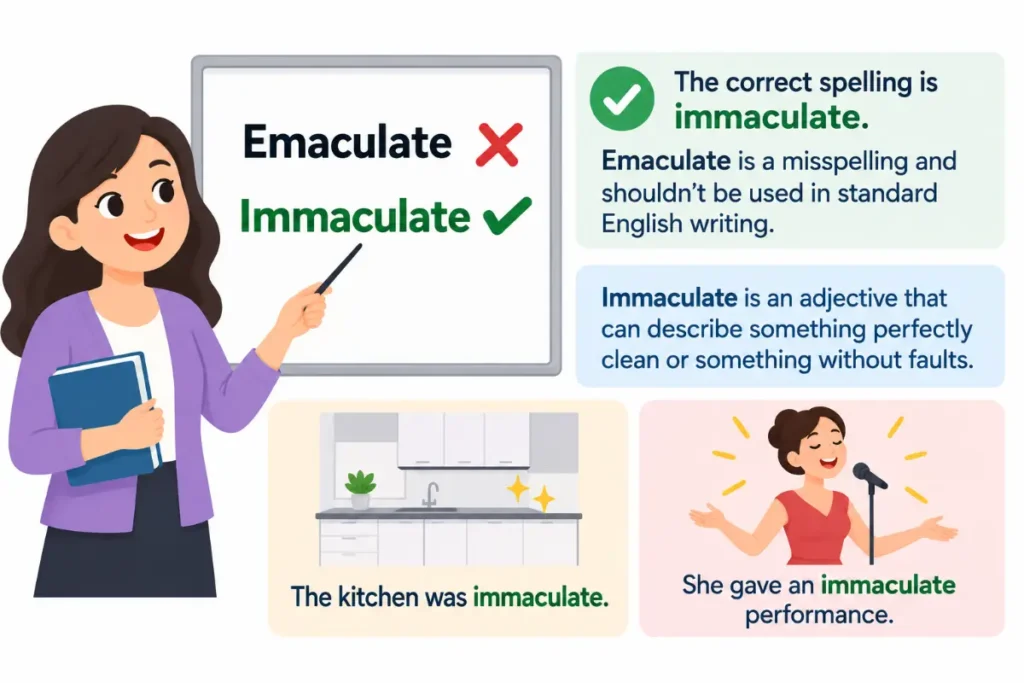
Use immaculate in standard English. Emaculate is generally an incorrect spelling of the word.
Immaculate is an adjective that describes something exceptionally clean pure flawless or free from mistakes. You might say The kitchen was immaculate or She has an immaculate record.
Comparison Table
| Correct Form | Meaning | Part of Speech | Origin | Usage Frequency | Formality | Common Contexts | Example |
|---|---|---|---|---|---|---|---|
| Immaculate | Perfectly clean pure or without flaws | Adjective | Latin immaculatus through French and English | Common | Neutral to formal | Cleanliness appearance records performance writing | Her apartment was immaculate. |
| Emaculate | No standard meaning as the intended adjective | Nonstandard spelling | Common misspelling of immaculate | Occurs mainly as an error | Not standard | Typing errors informal writing drafts | Emaculate should be corrected to immaculate. |
Meaning and Definition
Meaning of the Incorrect Form
Emaculate is normally a misspelling of immaculate. It isn’t the standard English adjective used to describe something perfectly clean or free from flaws.
The form can appear because the writer remembers the general sound and shape of the word but doesn’t remember the exact opening letters. This is a common kind of spelling error. A person may know exactly what they want to say and still type the wrong form because spelling and pronunciation don’t always line up neatly in English.
It’s useful to separate recognition from production here. You might understand immaculate immediately when you read it but still hesitate when you need to write it from memory. That doesn’t mean the two forms have different meanings. It usually means one form has been written incorrectly.
You may occasionally encounter unusual spellings in usernames names fictional terms or other personal labels. A person can intentionally create a name using almost any combination of letters. That special use doesn’t turn emaculate into a standard English spelling.
For essays reports applications emails published writing and other polished communication use immaculate.
Meaning of the Correct Form
Immaculate is an adjective. Its basic meaning is something that is perfectly clean or completely free from dirt marks or stains.
For example:
The hotel room was immaculate.
Here the word tells us that the room was exceptionally clean and well kept.
The meaning can extend beyond physical cleanliness. Immaculate can describe something without faults errors or defects.
She has an immaculate professional record.
In this sentence the word means that her record is free from mistakes or problems.
The word can also describe appearance.
He arrived in an immaculate suit.
The focus here is on a very neat polished and well maintained appearance.
In some contexts immaculate can also mean morally pure or free from wrongdoing. This sense is more elevated and less common in ordinary conversation.
The word therefore has a useful range. Its central idea is freedom from something undesirable. That undesirable thing might be dirt a stain a mistake a defect or a moral fault depending on context.
Key Differences Explained
- Spelling. Immaculate is the standard spelling. Emaculate is normally an error.
- First letters. The correct form begins with im rather than em.
- Double consonant. The standard spelling contains double m.
- Meaning. Immaculate has established meanings involving cleanliness purity perfection and freedom from flaws. The misspelled form does not have an independent standard meaning.
- Grammar. Immaculate is an adjective. It describes a noun or pronoun.
- Pronunciation. The first syllable begins with a sound closer to im than em.
- Formality. Immaculate is suitable for ordinary conversation and formal writing. It can sound especially polished when used figuratively.
- Context. The word works naturally when describing rooms clothes records work performance appearance and other things that can be judged as exceptionally clean or flawless.
- Regional usage. Major English varieties use the same standard spelling.
- Standard usage. Immaculate belongs to standard English. Emaculate is normally treated as a spelling mistake.
The biggest trap is the first vowel. If you remember the word only by sound you may be tempted to write emaculate. Seeing the correct form repeatedly and connecting it with its root can help lock the spelling into memory.
Which Form Is Correct?
Immaculate is correct.
The standard spelling begins with im and contains two m letters. The word ultimately comes from Latin immaculatus which means unstained or spotless. That historical form helps explain the spelling because the double m is not an accidental feature added by modern writers.
English often keeps traces of a word’s older structure even after pronunciation changes. This is one reason spelling can’t always be predicted perfectly from sound.
Dictionary based usage also supports immaculate as the established English adjective. Standard dictionaries define it around ideas such as being free from physical marks or flaws and being free from faults or imperfections.
A useful linguistic clue is the relationship between immaculate and the noun macula which refers to a spot or stain in Latin based vocabulary. The prefix im expresses negation in this word. The underlying idea is therefore something without a spot or stain.
That connection gives you more than a spelling trick. It explains why the word has meanings connected to spotless condition and freedom from flaws.
If you are proofreading a sentence and see emaculate the safest correction is simple. Change it to immaculate.
Sentence Examples
The following examples show how the standard adjective works in natural English.
- Her kitchen was immaculate after she finished cleaning.
- He arrived at the interview wearing an immaculate suit.
- The hotel staff kept every room immaculate.
- She maintained an immaculate record throughout her career.
- The old car looked immaculate after its professional detailing.
- His handwriting was neat and almost immaculate.
- The chef kept the entire preparation area immaculate.
- The garden looked immaculate before the guests arrived.
- The report was carefully checked and appeared immaculate from an editorial standpoint.
- The museum displayed an immaculate collection of restored furniture.
The incorrect spelling may appear in sentences such as these.
- Her kitchen was emaculate after cleaning.
- He wore an emaculate suit to the ceremony.
- The hotel room looked emaculate.
- She has an emaculate record.
- The car was emaculate after the detailing.
In all five examples the intended word should be immaculate.
How the Word Works in Different Contexts
Immaculate is especially useful because it can move naturally from a literal meaning to a figurative one.
When you use it for a physical object the meaning usually relates to cleanliness or condition.
The bathroom was immaculate.
The room contains no dirt or visible disorder.
When you describe clothing the focus shifts toward neatness and presentation.
She wore an immaculate white dress.
The dress looks exceptionally clean and well maintained.
When you describe a record the meaning becomes figurative.
The pitcher has an immaculate record this season.
Here the word suggests an absence of failures or blemishes in the relevant record.
The same pattern appears with reputation performance work and organization. The object doesn’t need to be physically clean. Instead it needs to be free from the kind of flaw that matters in that context.
That flexibility is one reason the word remains useful in polished English.
Common Mistakes and Misspellings
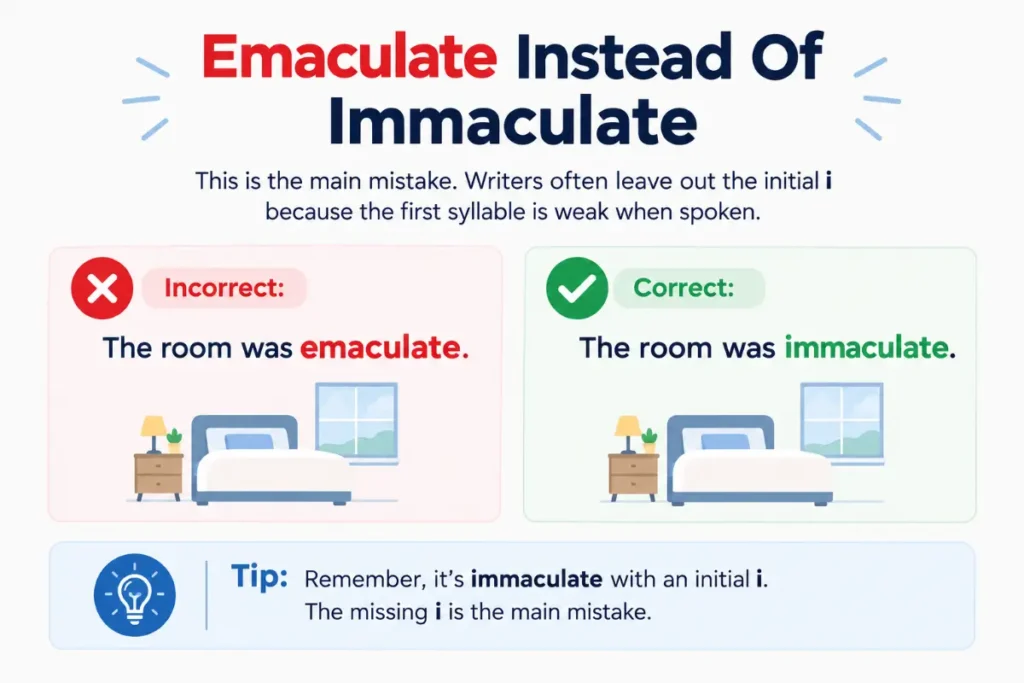
Writing Emaculate Instead of Immaculate
This is the central spelling error.
Incorrect: The office was emaculate.
Correct: The office was immaculate.
The mistake probably comes from the way the opening syllable is heard. The writer may remember a vowel sound but not the exact letters.
Using One M
Another possible error is writing imaculate.
Incorrect: The room was imaculate.
Correct: The room was immaculate.
The double m is part of the established spelling and should remain.
Writing Immaculant
Some learners create imaculant or immaculate like forms because they associate the word with adjectives ending in ant.
The correct form is immaculate.
Confusing It With Immaculately
Immaculate is an adjective while immaculately is the corresponding adverb.
Adjective: The room is immaculate.
Adverb: The room was cleaned immaculately.
They are related but perform different grammatical jobs.
Confusing Immaculate With Perfect
These words overlap but aren’t always identical.
Perfect can mean complete or without any defect. Immaculate often emphasizes spotless cleanliness or a complete absence of flaws.
Calling a room immaculate strongly suggests exceptional cleanliness. Calling it perfect could express a broader judgment.
Pronunciation Guide
Immaculate is commonly pronounced /ɪˈmækjələt/ in American English.
A simple pronunciation guide is:
ih MAK yuh luht.
The strongest stress falls on the second syllable.
The word can be divided into four syllables:
im mac u late.
In natural American speech the unstressed vowels can become softer. That means the spoken form may sound less distinct than the written spelling suggests.
The opening sound is especially relevant to the spelling question. It begins with a short vowel sound represented by i rather than the long or open sound that might lead someone to write emaculate.
Another point can help learners. The c in the middle is part of the spelling pattern associated with the macul family. Don’t try to spell the word entirely from its sound. English has many words whose pronunciation doesn’t provide enough information to reconstruct the spelling perfectly.
A good practice method is to say the word slowly and then write it from memory:
ih MAK yuh luht
Then check the written form:
immaculate
This connects pronunciation and spelling without treating them as identical systems.
Etymology and Word Origin
The history of immaculate provides a useful clue to its modern spelling and meaning.
The word comes from Latin immaculatus which means unstained or spotless. It is formed from in meaning not and macula meaning spot or stain. In Latin the negative prefix changes form before certain sounds which helps explain the double m in the word.
The word passed into English through French influence and became established as an English adjective.
Its original idea of being without a stain remains visible in modern usage. From physical cleanliness the meaning developed into broader ideas of freedom from faults imperfections or wrongdoing.
That semantic development is common in language. A physical idea can become a figurative one over time. A spotless object can lead naturally to the idea of a spotless record or spotless reputation.
The relationship with macula also appears in specialized vocabulary. In medical and scientific contexts macula refers to a spot or distinct area. That technical family isn’t necessary for everyday spelling but it provides an interesting linguistic connection.
The history therefore supports both major features of the modern word. The spelling preserves the older double m pattern and the meaning still centers on the absence of a spot or flaw.
Regional Usage
American English
Immaculate is standard American English. It is used to describe physical cleanliness as well as appearance records performance and reputation.
An American speaker might say the house is immaculate after cleaning. The word also appears naturally in professional and formal writing.
The misspelled form isn’t an American spelling variant.
British English
British English uses immaculate with the same standard spelling and broadly the same meanings.
There is no meaningful British spelling difference that turns the incorrect form into an accepted variant. British writers can use the word in everyday speech formal prose journalism and literature.
Australian English
Australian English also uses immaculate as the standard form. The adjective can describe cleanliness appearance quality and figurative perfection.
There is no established Australian spelling variant involving emaculate.
Canadian English
Canadian English follows the same standard spelling. Immaculate is suitable for casual and formal communication.
The spelling remains unchanged across Canadian English and the other major varieties discussed here.
In short the spelling difference isn’t regional. If you see emaculate in English writing it is normally an error regardless of the writer’s variety of English.
Grammar Rules and Part of Speech
Immaculate is an adjective.
Its main job is to describe a noun or pronoun.
The room is immaculate.
Here immaculate describes the room.
You can also place it directly before a noun.
She entered an immaculate office.
The adjective tells us about the condition of the office.
It can also appear after linking verbs such as seem look remain become and appear.
The house looked immaculate.
Her record remains immaculate.
The uniform appeared immaculate.
These structures are completely natural because the adjective describes the subject through the linking verb.
The word can also be modified by adverbs.
The room was exceptionally immaculate.
The apartment looked almost immaculate.
The garden was remarkably immaculate.
Still be careful with intensifiers. Since immaculate already expresses a very strong positive condition some combinations can feel excessive. In ordinary writing you don’t always need to strengthen it.
Immaculate can also have a figurative object.
He has an immaculate record.
The company has maintained an immaculate safety record.
In these examples the word doesn’t describe physical cleanliness. It means the record has no relevant faults or negative events.
Punctuation doesn’t change the spelling or grammar of the word. If the adjective appears in the middle of an ordinary sentence you don’t need special punctuation.
The immaculate room impressed everyone.
If an adjective phrase becomes parenthetical in a more complex sentence punctuation can depend on the overall sentence structure. That is a general punctuation issue rather than something unique to immaculate.
Literal and Figurative Uses
One reason learners may encounter the word often is that it works on two levels.
The literal sense is closely connected with cleanliness.
The floors were immaculate.
The figurative sense moves toward perfection or freedom from faults.
She has an immaculate record.
The first sentence concerns physical condition. The second concerns performance or history.
This distinction matters because immaculate doesn’t always mean physically spotless. If you see it describing a reputation a record performance or piece of work you should read it figuratively.
For example:
His immaculate timing impressed the audience.
Timing cannot literally be scrubbed clean. The writer means that his timing was exceptionally precise.
Likewise:
The lawyer presented an immaculate argument.
The argument isn’t physically clean. The adjective suggests that the argument was free from obvious weaknesses or errors.
This ability to move from concrete to abstract meaning makes the word expressive without being difficult to understand.
Real Life Usage Examples
Daily Conversation
Immaculate can sound natural in casual speech when someone wants to emphasize exceptional cleanliness.
Your kitchen is immaculate.
Her apartment is always immaculate before guests arrive.
The word can sound a little stronger than simply clean. That strength is often exactly why people choose it.
Email and Workplace Communication
The word works well in professional descriptions.
The office was left immaculate after the renovation team finished.
The department has maintained an immaculate safety record.
In workplace writing it can communicate a high standard of cleanliness or performance.
Academic Writing
Academic writing uses the word less often than everyday descriptive language but it can appear when the meaning fits.
The researcher maintained an immaculate record of the experimental observations.
The archive was preserved in immaculate condition.
The word should still be chosen for precision. If clean or accurate communicates the idea better use the simpler word.
News and Journalism
Journalists may use immaculate when describing appearance condition or an exceptional record.
The historic building has been restored to immaculate condition.
The athlete entered the final with an immaculate record.
The adjective can add a strong descriptive note without requiring a long explanation.
Literature and Storytelling
Writers often use immaculate to create a vivid image.
The old house stood immaculate against the dusty road.
She kept the silver necklace immaculate for decades.
In storytelling the word can create contrast. A spotless object placed in a messy setting immediately gives the reader a clear visual impression.
Immaculate Compared With Similar Words
Spotless
Spotless means completely clean or free from marks. It is probably one of the closest everyday alternatives.
The kitchen was spotless.
The kitchen was immaculate.
Both work naturally, although immaculate can sound slightly more elevated.
Pristine
Pristine often means extremely clean or in its original untouched condition.
The beach remained pristine.
It can suggest a lack of human damage or disturbance more strongly than immaculate.
Flawless
Flawless means without faults or defects. It is especially useful for performance appearance design or quality.
Her performance was flawless.
This doesn’t necessarily involve cleanliness.
Perfect
Perfect is much broader. It can describe something that has no faults or meets an ideal standard.
The word doesn’t specifically carry the cleanliness association that immaculate often does.
Clean
Clean is the simplest everyday choice for the physical meaning.
The room is clean.
Immaculate is stronger and suggests an unusually high level of cleanliness.
Neat
Neat usually means orderly tidy or well arranged.
A neat room may still have a few imperfections. An immaculate room suggests a much higher standard.
Pure
Pure focuses on freedom from contamination or unwanted elements. It can be physical moral or abstract.
Its meaning overlaps with immaculate in some contexts but not all.
Unblemished
Unblemished means without marks flaws or damage. It is often used for reputations records surfaces or appearances.
An unblemished record is close in meaning to an immaculate record.
Choosing among these words depends on what kind of perfection you want to express. Good writing doesn’t simply replace one word with a synonym. It chooses the word that fits the exact shade of meaning.
Why The Spelling Is Easy To Miss
English spelling can create problems when pronunciation and written form don’t provide the same information.
The beginning of immaculate is a good example. A speaker who has only heard the word may not immediately know that it starts with im. The unstressed first syllable is short and can pass quickly in normal conversation.
The double m creates another challenge. Repeated consonants are easy to omit when typing quickly.
There is also a visual issue. Words beginning with em are common enough that the brain may accept emaculate at a glance. Once a familiar pattern appears on the screen people sometimes read what they expected to see rather than inspecting every letter.
This is one reason proofreading should involve more than spellcheck. Automated tools are useful but they can’t replace attention to words that look plausible.
A misspelling such as emaculate can be especially easy to overlook because it resembles the intended word so closely.
A Simple Memory Trick
The best way to remember the spelling is to connect the word with its beginning and its double m.
Think:
im plus maculate
Then remember that the middle contains mm.
You can also connect the word with its meaning. Immaculate means without a spot or flaw. The historical connection with Latin macula gives you a useful mental image of something without a stain.
Imagine a perfectly clean white shirt.
It has no mark.
It is immaculate.
Now picture the written word:
immaculate
The visual pattern and the meaning reinforce each other.
This method works better than repeatedly staring at the spelling because it gives your memory several points of connection.
Expert Editor Insight
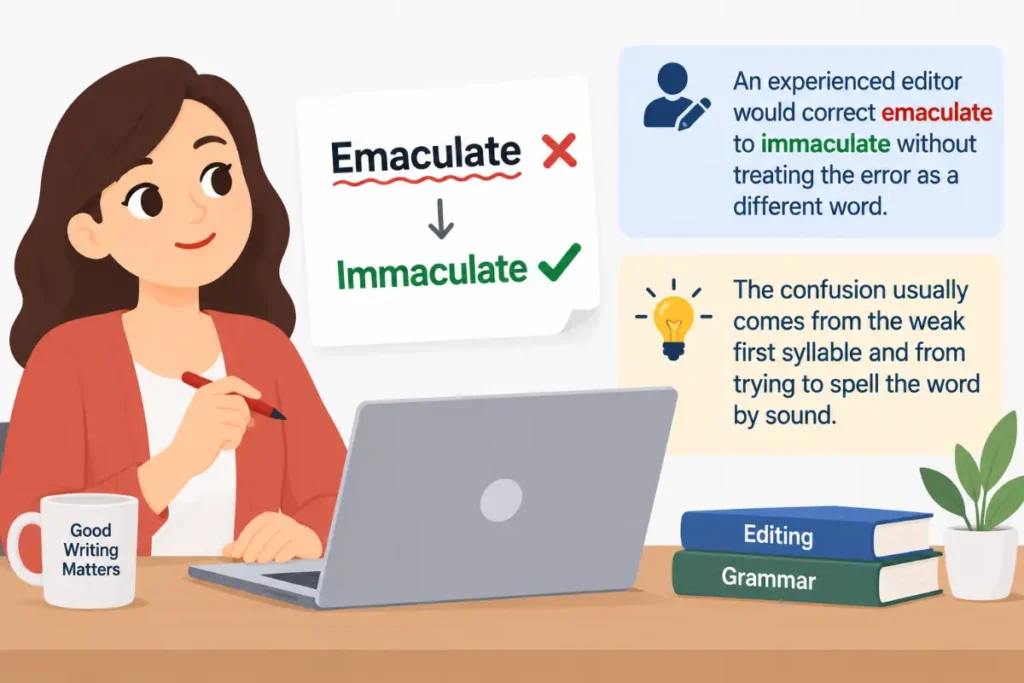
An experienced editor would usually treat emaculate as a straightforward spelling error because the intended word is clear from context. The most useful proofreading check is to look closely at the beginning and middle of the word rather than relying on how it sounds. Professional spelling tools may flag the incorrect form immediately but a careful editor still checks the surrounding sentence and intended meaning. The practical tip is to remember immaculate as a word built around the idea of being without a spot or flaw. That meaning connects naturally with its historical root and helps preserve the correct spelling.
Conclusion
Emaculate vs immaculate has a clear answer. Immaculate is the correct standard spelling, while emaculate is normally a misspelling. The correct adjective describes something perfectly clean, spotless, pure, or free from flaws, depending on the context.
The word can describe a clean room, polished clothing, an excellent record, a strong performance, or something that appears completely free from defects. Its meaning reaches beyond physical cleanliness, which gives it more range than simple words such as clean or neat.
For an easy spelling reminder, focus on the beginning im and the double m. Connecting the word with its idea of being without a spot or flaw can make the spelling stick. When you see emaculate in a draft, correct it to immaculate before publishing or submitting your work.
FAQs
Is emaculate a real word?
Emaculate is not normally recognized as the standard English adjective for something perfectly clean or free from flaws. It is generally a misspelling of immaculate. You may see unusual forms used as names or personal labels but those special cases don’t establish a standard dictionary spelling. In normal English writing use immaculate when describing something spotless flawless or exceptionally well maintained.
What does immaculate mean?
Immaculate means perfectly clean spotless or free from flaws. It can describe a physical object such as a room or piece of clothing. It can also have a figurative meaning when describing a record reputation performance or argument. In those contexts it suggests that the subject is free from mistakes defects or other undesirable features.
Which is correct emaculate or immaculate?
Immaculate is the correct standard spelling. The other form is normally a spelling mistake caused by confusion over the first vowel and the double m. The standard adjective begins with im and contains two m letters. Use immaculate in school assignments workplace communication formal writing published material and everyday English when you want to describe something spotless or without flaws.
How do you pronounce immaculate?
Immaculate is commonly pronounced /ɪˈmækjələt/ in American English. An easy guide is ih MAK yuh luht. The strongest stress falls on the second syllable. The first vowel is short and unstressed which can contribute to spelling confusion. Learning the pronunciation together with the visual spelling can help you avoid replacing the initial im with em.
Can immaculate describe a person?
Yes. Immaculate can describe a person’s appearance clothing grooming or sometimes a reputation or record. For example someone may arrive wearing an immaculate suit. The word can also describe a person in a figurative sense when discussing an unblemished record or reputation. It doesn’t usually mean that the person themselves is physically spotless in every sense.
Is immaculate a formal word?
Immaculate works in both everyday and formal English. You can use it in conversation to describe a very clean room or outfit and in professional writing to describe excellent condition or an unblemished record. It can sound somewhat polished because it is stronger than simple words such as clean or neat. Still it isn’t limited to formal writing.
What is a synonym for immaculate?
Common alternatives include spotless pristine flawless perfect clean neat pure and unblemished. The best choice depends on context. Spotless is especially close when discussing cleanliness. Flawless works better for performance or quality. Pristine can suggest an untouched or original condition. Unblemished often describes records reputations or surfaces. Immaculate can cover several of these meanings depending on the sentence.
Why do people spell immaculate incorrectly?
The spelling can be difficult because the first unstressed syllable is easy to hear incorrectly. The double m can also be overlooked during typing. People who have learned the word mainly through speech may try to reconstruct the spelling from its sound. A helpful solution is to remember the initial im and the double m while connecting the word with its meaning of being without a spot or flaw.
