
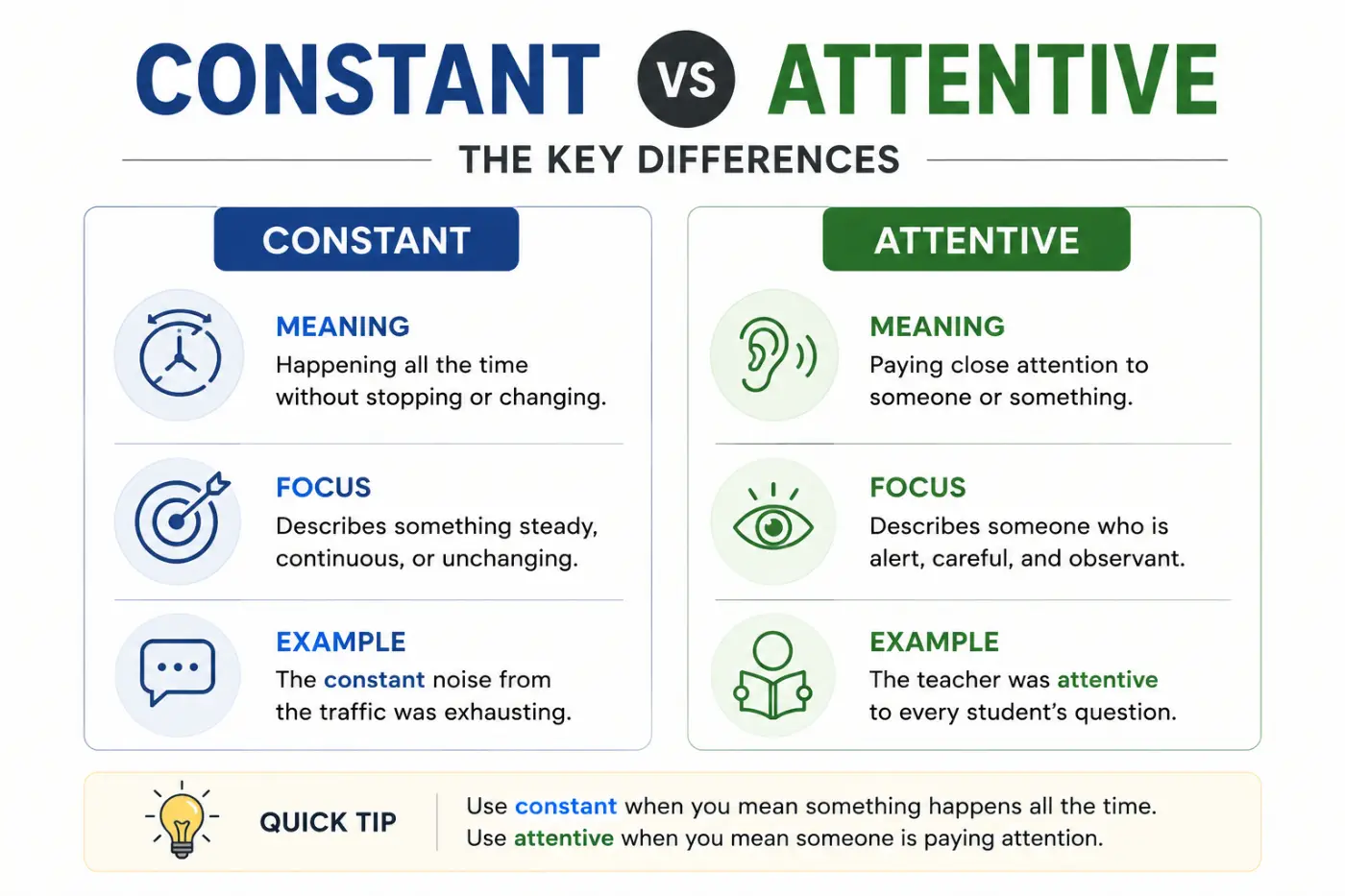
If you’re searching for constant vs attentive the key differences are simple once you focus on what each word describes. Constant describes something that stays the same or happens again and again. Attentive describes someone who pays close attention or carefully notices and responds to something.
These words can appear in similar situations because both can suggest care focus or regular presence. For example a teacher can give constant support and also be attentive to a student’s needs. The two adjectives overlap in some contexts but they don’t carry the same idea.
The easiest way to remember the difference is this. Constant focuses on steadiness or repeated presence. Attentive focuses on attention and awareness. This distinction helps you choose the right word in conversations emails school writing workplace communication and formal prose.
Quick Answer
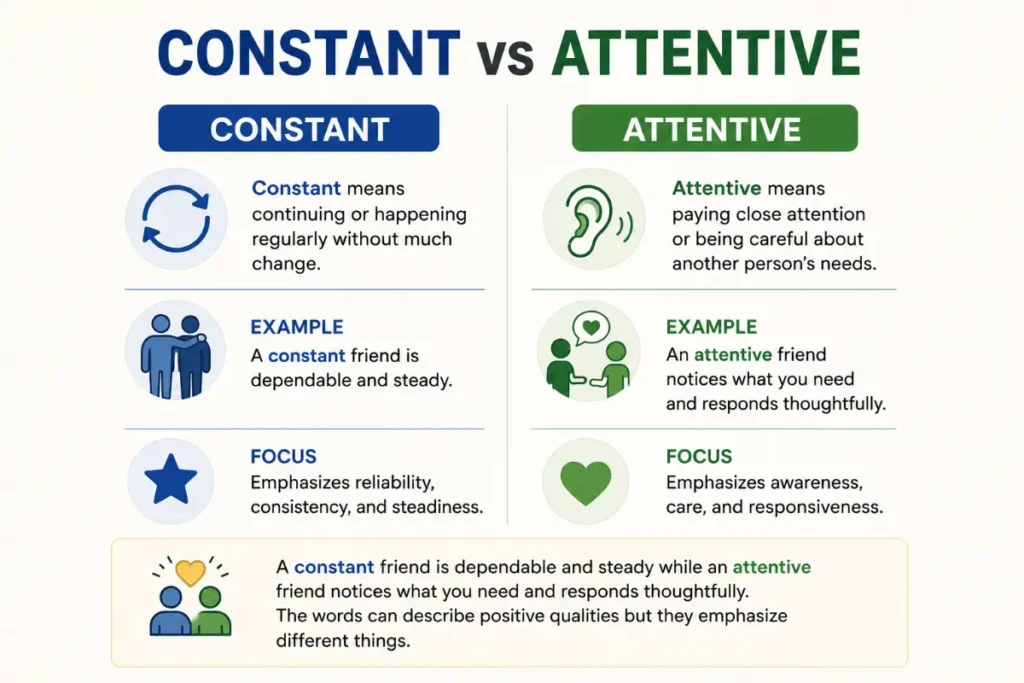
Constant means continuing or happening regularly without much change. Attentive means paying close attention or being careful about another person’s needs. A constant friend is dependable and steady while an attentive friend notices what you need and responds thoughtfully. The words can describe positive qualities but they emphasize different things.
Quick Answer For Everyday Use
Use constant when you want to emphasize that something stays present steady or frequent. You might say that someone offers constant support or that a machine runs at a constant speed.
Use attentive when you want to show that someone listens watches notices or responds carefully. You might describe an attentive student an attentive employee or an attentive parent.
A simple memory trick works well.
Constant is about consistency. Attentive is about attention.
That small distinction can save you from using a word that sounds close but doesn’t quite express your meaning.
Comparison Table
| Word | Meaning | Part of Speech | Origin | Usage | Formality | Common Contexts | Example |
|---|---|---|---|---|---|---|---|
| Constant | Continuing regularly or staying unchanged | Adjective and noun | Latin through French | Very common | Neutral to formal | Support change speed noise friendship conditions | She gave me constant support. |
| Attentive | Paying close attention or caring carefully for someone’s needs | Adjective | Latin through French | Very common | Neutral to formal | Students employees listeners service relationships | The nurse was attentive to every patient. |
The table shows the central distinction. Constant describes duration frequency stability or dependability. Attentive describes mental focus awareness or thoughtful care.
What Constant Means
Constant has several closely related meanings. The most common meaning in everyday English is something that continues regularly or happens again and again. It can also describe something that remains stable and does not change.
Merriam Webster defines the adjective in terms of continual occurrence regularity invariability and steadfastness. Cambridge also gives senses connected with frequent activity and staying the same.
Consider these examples.
- She heard constant noise from the construction site.
- His constant encouragement helped me finish the project.
- The car maintained a constant speed.
- They remained constant friends for many years.
The first two examples focus on something happening repeatedly or continuously. The third focuses on something staying unchanged. The fourth uses constant to describe loyalty and steady attachment.
So constant isn’t limited to time. It can describe a stable quality or relationship too.
The word can also function as a noun. In ordinary writing you might say that a close friend has become a constant in your life. In mathematics and science constant has a more technical meaning for a value that remains fixed within a particular context.
What Attentive Means
Attentive describes someone who pays careful attention. It can refer to listening watching observing or noticing details. It can also describe someone who takes care of another person’s needs in a thoughtful way.
Merriam Webster gives meanings connected with being mindful observant and considerate of another person’s comfort. Cambridge similarly explains attentive as listening carefully and as being helpful and caring toward another person.
Here are a few natural examples.
- The students were attentive during the lesson.
- She was attentive to every detail in the report.
- The waiter was attentive without being intrusive.
- He is an attentive listener.
- The manager remained attentive to customer concerns.
In each case the word points toward awareness. The person is noticing something and responding appropriately.
That makes attentive especially useful when you want to describe behavior. An attentive person doesn’t simply remain present. They actively notice what is happening.
The Main Difference Between Constant And Attentive
The biggest difference is the quality each word highlights.
Constant highlights consistency.
Attentive highlights attention.
Imagine a friend who checks on you every day. You could call that friend constant because the support is regular and dependable.
Now imagine a friend who notices that you’re unusually quiet and asks if something is wrong. That friend is attentive because they notice details and respond to them.
The same person can be both.
A constant friend stays by your side over time. An attentive friend notices what you need in the moment.
That is why replacing one word with the other can change the meaning of a sentence.
Compare these examples.
She gave me constant support.
This tells us that her support was steady and ongoing.
She gave me attentive support.
This sounds less natural in ordinary English. It suggests support provided with careful attention but doesn’t express the same strong idea of steady presence.
Now compare these.
The teacher was constant with her students.
This is possible in a narrow sense but sounds unusual without more context.
The teacher was attentive to her students.
This is natural because teachers can listen carefully observe students and respond to their needs.
The difference becomes much clearer when you ask one simple question.
Are you talking about consistency or attention?
If the answer is consistency choose constant.
If the answer is attention choose attentive.
Constant And Attentive In Context
Context often determines which word sounds natural.
A workplace provides a useful example. Suppose an employee checks every report carefully and catches small errors before they become problems. You might describe that employee as attentive.
If the employee keeps providing reliable support throughout a long project you might describe that support as constant.
The same distinction appears in relationships.
A constant partner is steady loyal and dependable. An attentive partner notices small things such as changes in mood preferences or needs.
In education an attentive student listens carefully and follows the lesson. A constant student is not a common phrase but constant effort is perfectly natural because effort can continue steadily over time.
In customer service an attentive employee notices what customers need. Constant service might refer to service that remains available or continues regularly.
The words therefore depend heavily on the noun they modify.
Grammar And Part Of Speech
Both constant and attentive are primarily adjectives.
An adjective describes a noun or gives information about a person place thing or idea.
You can place both words before a noun.
constant attention
constant support
You can also use both after linking verbs.
The noise was constant.
The audience was attentive.
One useful grammatical pattern is particularly important with attentive.
We commonly use attentive to before the thing receiving attention.
She was attentive to the customer’s concerns.
He is attentive to detail.
The doctor was attentive to the patient’s needs.
This pattern is extremely common in both everyday and professional English.
With constant the grammar is more flexible.
The noise was constant.
They faced constant pressure.
She provided constant support.
The temperature remained constant.
The word can describe an ongoing condition a repeated event a stable measurement or a dependable quality.
How Constant Changes Meaning
One reason constant can confuse learners is that it has more than one closely related meaning.
The first is frequent or continual.
His constant interruptions made the meeting difficult.
Here the interruptions happen repeatedly.
The second is unchanging.
The laboratory kept the temperature constant.
Here the temperature stays at the same level.
The third is steady or faithful.
She has been a constant friend for decades.
Here the word describes reliability and loyalty.
These meanings are connected by one basic idea. Something does not easily disappear change or become irregular.
Cambridge distinguishes senses involving frequent activity and staying the same. Merriam Webster also recognizes meanings involving regular occurrence invariability and steadfast attachment.
How Attentive Changes Meaning
Attentive also has more than one shade of meaning but they remain closely connected.
The first is focused on something.
The children were attentive during the story.
The second is careful and observant.
She was attentive to small changes in the data.
The third is thoughtful toward another person.
The staff were attentive to the guests.
These meanings all involve noticing and responding.
Merriam Webster includes meanings related to being mindful and observant as well as being considerate of another person’s comfort. Cambridge likewise recognizes both careful listening and helpful care.
Pronunciation Guide
The pronunciation of both words is straightforward for most American English speakers.
Constant
IPA: /ˈkɑn.stənt/
An easy guide is KAHN stuhnt.
The main stress falls on the first syllable.
Attentive
IPA: /əˈten.tɪv/
An easy guide is uh TEN tiv.
The main stress falls on the second syllable. Merriam Webster gives the American pronunciation as /əˈten-tiv/. Cambridge gives /əˈten.t̬ɪv/ for American English.
A common mistake is putting too much stress on the first syllable of attentive. Keep the strongest beat on ten.
The words also have different sound patterns. Constant begins with a stronger first syllable while attentive has a lighter opening sound followed by the stressed middle syllable.
Etymology And Word Origin
The history of both words helps explain why they carry their modern meanings.
Constant entered English through French from Latin roots connected with the idea of standing firm. Etymonline traces it to Latin constare meaning to stand together. The word developed meanings connected with firmness stability faithfulness and later something fixed or continually present.
That history fits modern usage well. When something is constant it stays firm or remains reliably present.
Attentive comes through Old French from Latin attendere meaning to give heed. Etymonline connects the deeper Latin structure with the idea of directing attention toward something. The modern sense developed around careful observation and later included caring for another person’s needs.
The roots give us a useful conceptual picture.
Constant has the idea of standing firm.
Attentive has the idea of directing attention toward something.
Modern English has moved far beyond those original roots but the central ideas remain surprisingly clear.
American English Usage
Both words are standard and common in American English.
Constant appears frequently in conversations about time frequency stability relationships work conditions and physical measurements.
Attentive appears often when Americans describe students workers listeners caregivers service employees friends and partners.
There is no major American spelling difference that separates the two words from standard British English. The core meanings remain the same across major English varieties.
American pronunciation does differ slightly from British pronunciation in some cases. Cambridge lists /ˈkɑn.stənt/ for American constant and /əˈten.t̬ɪv/ for American attentive.
British Canadian And Australian Usage
British English uses both words in essentially the same ways as American English.
Canadian English also uses the same standard forms and meanings.
Australian English follows the same general distinction as well.
There is no useful regional spelling rule that changes constant into another standard form or changes attentive into another standard form. The important issue is meaning rather than regional spelling.
The pronunciation may vary by speaker and accent but the vocabulary distinction remains stable.
Ten Natural Sentence Examples
Here are ten examples that show how native speakers normally use these adjectives.
- The constant rain made it difficult to plan the picnic.
This uses constant because the rain continues repeatedly.
- Maria gave me constant encouragement during the exam week.
The focus is on steady support.
- The machine must remain at a constant temperature.
Here constant means unchanged.
- His constant questions slowed the meeting down.
The questions happen again and again.
- She has been a constant source of support for her family.
The word suggests dependable presence.
- The students were attentive throughout the lesson.
The students were focused and listening carefully.
- Our manager is attentive to small details.
The manager notices details carefully.
- The nurse was attentive to every patient’s needs.
The nurse was careful and responsive.
- He became more attentive after receiving feedback from his teacher.
The sentence describes improved focus.
- The audience remained attentive during the long presentation.
The audience continued listening carefully.
Notice how naturally the words fit different situations. Constant often works with things that continue. Attentive often works with people who notice and respond.
Common Mistakes
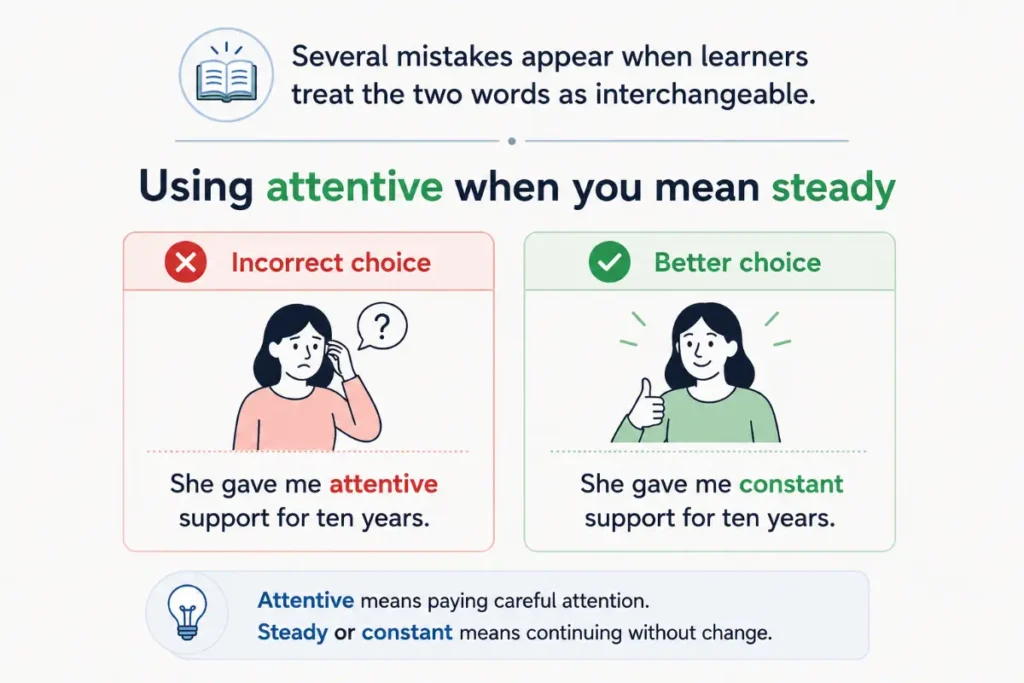
Several mistakes appear when learners treat the two words as interchangeable.
- Using attentive when you mean steady
Incorrect choice: She gave me attentive support for ten years.
Better choice: She gave me constant support for ten years.
The intended idea is long lasting and dependable support.
- Using constant when you mean focused
Awkward choice: The students were constant during the lecture.
Better choice: The students were attentive during the lecture.
Students can be attentive because they listen and focus.
- Forgetting the preposition after attentive
Less natural: She was attentive the customer’s needs.
Correct: She was attentive to the customer’s needs.
The adjective commonly takes to when you identify the thing receiving attention.
- Assuming constant always means nonstop
Constant can mean frequent or recurring rather than literally uninterrupted.
For example constant messages can mean messages that arrive very frequently. It doesn’t necessarily mean a person receives a message every single second.
- Treating the words as interchangeable synonyms
They can both suggest a positive quality in some contexts but they don’t express the same concept. A person can be constant because they are dependable and attentive because they notice what others need.
Related Words And Useful Distinctions
Several nearby words can help you understand the semantic space around these adjectives.
- Consistent
Consistent means behaving or happening in a steady and reliable way. It is close to constant when discussing performance habits or results.
- Steady
Steady suggests stability and lack of sudden change. A steady worker is reliable while a steady temperature remains stable.
- Continuous
Continuous means continuing without interruption. It can overlap with constant but often emphasizes uninterrupted duration.
- Frequent
Frequent means happening often. It focuses on how often something happens rather than how stable or unchanged it is.
- Focused
Focused describes concentrated attention. It is closely related to attentive when someone gives their full mental attention to something.
- Observant
Observant describes someone who notices details. An observant person may see things that others overlook.
- Mindful
Mindful means paying careful attention and being aware of something. It often has a thoughtful tone and overlaps with attentive.
- Watchful
Watchful describes someone who carefully observes something, often because they need to notice possible problems or changes.
These related terms show why vocabulary choices matter. Words can live close together in meaning while still doing different jobs in a sentence.
Constant And Attentive In Workplace Writing
Both words work well in professional writing but they communicate different qualities.
Use constant when describing ongoing support effort communication pressure change or stability.
The team maintained constant communication throughout the project.
The equipment requires constant monitoring.
Use attentive when describing people and their behavior toward details customers colleagues or responsibilities.
The supervisor was attentive to employee concerns.
The editor was attentive to small grammar errors.
In workplace writing the difference can affect tone. Calling someone attentive usually praises their care and awareness. Calling someone constant can praise reliability but may sound unusual if the person rather than their behavior is the focus.
For example She is an attentive manager sounds natural.
She is a constant manager does not sound natural in ordinary American English.
However She is a constant presence on the team sounds perfectly natural because constant describes her reliable presence.
Constant And Attentive In Academic Writing
Academic writing uses both terms but often in different roles.
Constant can describe stable variables repeated conditions or ongoing factors.
The study was conducted under constant environmental conditions.
Participants reported constant exposure to background noise.
Attentive can describe behavior or mental focus.
Attentive readers may notice a subtle difference in the author’s argument.
The students remained attentive during the experiment.
In academic prose precision matters. If you’re describing something that remains stable use constant. If you’re describing careful attention use attentive.
Constant And Attentive In Relationships
The difference becomes especially easy to see in personal relationships.
A constant friend is someone who remains loyal dependable and present. The word carries a sense of stability.
An attentive friend is someone who listens notices details and responds to your needs.
You might say:
She has been a constant friend through every difficult period in my life.
She is an attentive friend who always remembers the little things.
Both descriptions are positive but they praise different qualities.
One praises staying power.
The other praises awareness.
That’s a useful distinction because relationships often involve both.
Constant And Attentive In Customer Service
Customer service provides another clear contrast.
An attentive employee listens carefully and notices what a customer needs.
A constant service might mean service that remains available or continues regularly. However constant service is less common than phrases such as consistent service or reliable service when discussing customer experience.
This illustrates an important editing principle. A word can be grammatically possible but still fail to sound natural in a particular context.
Good English isn’t only about choosing a word that technically fits. It is also about choosing the word native speakers normally expect in that situation.
How Native Speakers Think About The Difference
Native speakers usually don’t stop to analyze these words consciously. Context guides the choice.
If someone says constant noise you immediately picture noise that keeps happening.
If someone says attentive listener you picture someone who listens carefully.
This is why memorizing isolated dictionary definitions isn’t always enough. It helps more to learn the typical combinations in which a word naturally appears.
Some useful combinations include:
constant support
constant pressure
These patterns give you a better feel for natural English.
Can Constant And Attentive Ever Overlap
Yes but the overlap is limited.
Imagine a caregiver who checks on an older family member every day and carefully notices changes in their condition. You could describe the caregiver as constant because they provide steady support. You could also call them attentive because they notice details and respond to needs.
The same person can possess both qualities.
Still the adjectives don’t become synonyms.
A person can be constant without being attentive. Someone might always be present but fail to notice what others need.
A person can also be attentive without being constant. Someone might listen carefully during one conversation but not remain consistently involved over time.
That contrast captures the difference beautifully.
Constant asks how steady the presence is. Attentive asks how carefully someone pays attention.
Expert Editor Insight
An experienced editor would usually make the choice based on the noun and the intended meaning rather than treating the two adjectives as interchangeable. Constant works naturally with ideas such as support pressure noise change presence and stability. Attentive works naturally with people and behavior involving listening observation care and detail. Grammar tools may not flag a sentence if both choices are technically possible, so context remains essential. A useful editing habit is to replace the adjective mentally with its core idea. If you mean steady choose constant. If you mean paying close attention choose attentive.
A Simple Memory Trick
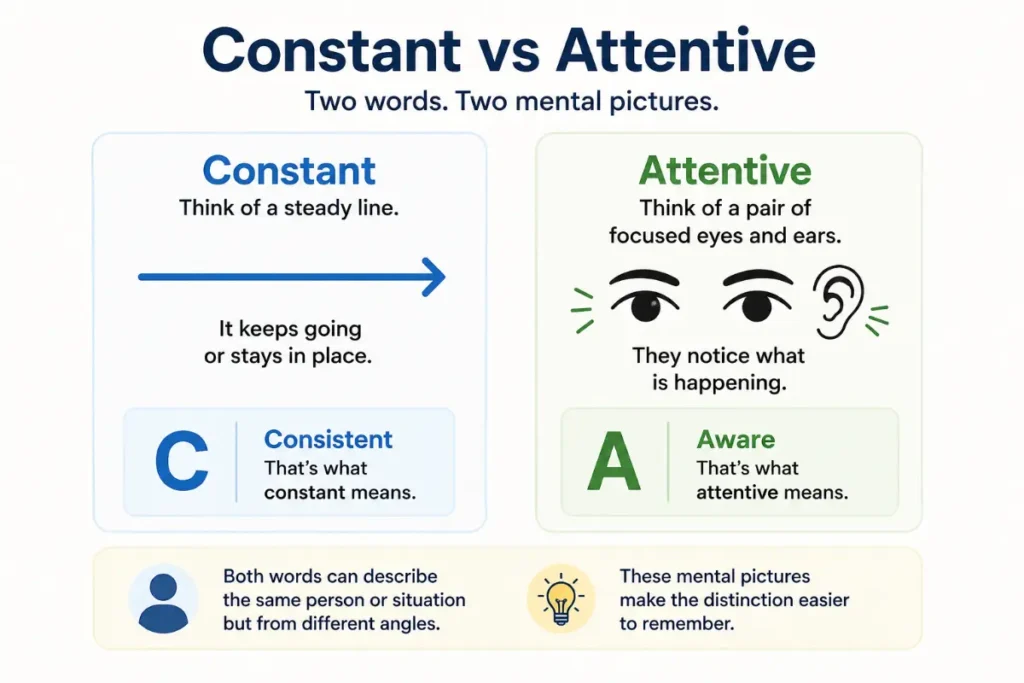
Think of constant as a steady line. It keeps going or stays in place. Think of attentive as a pair of focused eyes and ears. They notice what is happening. This mental picture makes the distinction easier to remember than a long definition. You can also remember the first letters of the key ideas. Constant means consistent. Attentive means aware. The two words can describe the same person or situation but from different angles.
Final Takeaway
When comparing constant vs attentive the key differences come down to one simple idea. Constant describes steadiness regularity stability or dependable presence. Attentive describes careful attention awareness and thoughtful response.
The words are both useful but they don’t replace each other freely. Use constant for ongoing support frequent events stable conditions or loyal presence. Use attentive for people who listen carefully notice details or respond to needs.
A quick editing trick can help. Ask yourself what you want to emphasize. If the answer is steady choose constant. If the answer is carefully noticing choose attentive. That small test will guide you toward the natural choice in most sentences.
FAQs
Is constant the same as attentive?
No. Constant usually describes something that continues regularly stays unchanged or remains dependable. Attentive describes someone who pays close attention notices details or responds carefully to another person’s needs. A person can be both constant and attentive but the words highlight different qualities.
What does constant mean in simple English?
Constant means continuing regularly or staying the same. For example constant support means support that continues steadily. A constant temperature means a temperature that does not change. The word can also describe someone who is dependable and faithful such as a constant friend.
What does attentive mean in simple English?
Attentive means paying close attention. An attentive student listens carefully. An attentive caregiver pays close attention to another person’s needs. The word can also suggest thoughtfulness because an attentive person doesn’t simply notice something but often responds to it appropriately.
Is attentive to grammatically correct?
Yes. Attentive to is a common grammatical pattern. You can say She was attentive to the customer’s needs or He is attentive to detail. The preposition to connects the adjective with the person thing detail or concern receiving attention.
Can constant describe a person?
Yes but the construction matters. You can describe someone as a constant friend or a constant presence. The word suggests steadiness loyalty or reliable presence. Saying She is a constant person is possible but less natural because the intended meaning isn’t immediately clear.
Is attentive appropriate in formal writing?
Yes. Attentive is a standard adjective that works well in formal academic professional and general writing. Expressions such as attentive to detail and attentive to customer needs are natural. The word is not limited to casual conversation.
What is a synonym for attentive?
Useful synonyms include focused, observant, mindful, watchful, alert, and engaged. The best choice depends on context. Observant emphasizes noticing details while focused emphasizes concentration. Mindful often adds a sense of careful awareness.
Why do people confuse constant and attentive?
People may confuse them because both can describe positive qualities involving care reliability or ongoing behavior. Their meanings can overlap in real situations. A dependable person may also pay close attention. Still the central distinction remains clear. Constant emphasizes consistency while attentive emphasizes attention.
