
cheer vs chear is a spelling comparison that looks simple but has an interesting history. If you’re writing an email, essay, article, school assignment, or everyday message, choose cheer. That’s the standard modern spelling. Chear is an old form that you may still encounter in historical writing.
The confusion is understandable because chear isn’t a random spelling mistake from the beginning. It was used in older English before spelling became as standardized as it is today. The two forms are also closely connected in pronunciation and meaning. That can make an unfamiliar historical spelling look like a modern alternative.
This guide gives you the complete answer without making the distinction complicated. You’ll learn what cheer means, how it works as a noun and verb, why chear appears in older texts, how to pronounce the word, how its meaning developed, which expressions use it, and how to avoid the common spelling mistake.
Short Answer
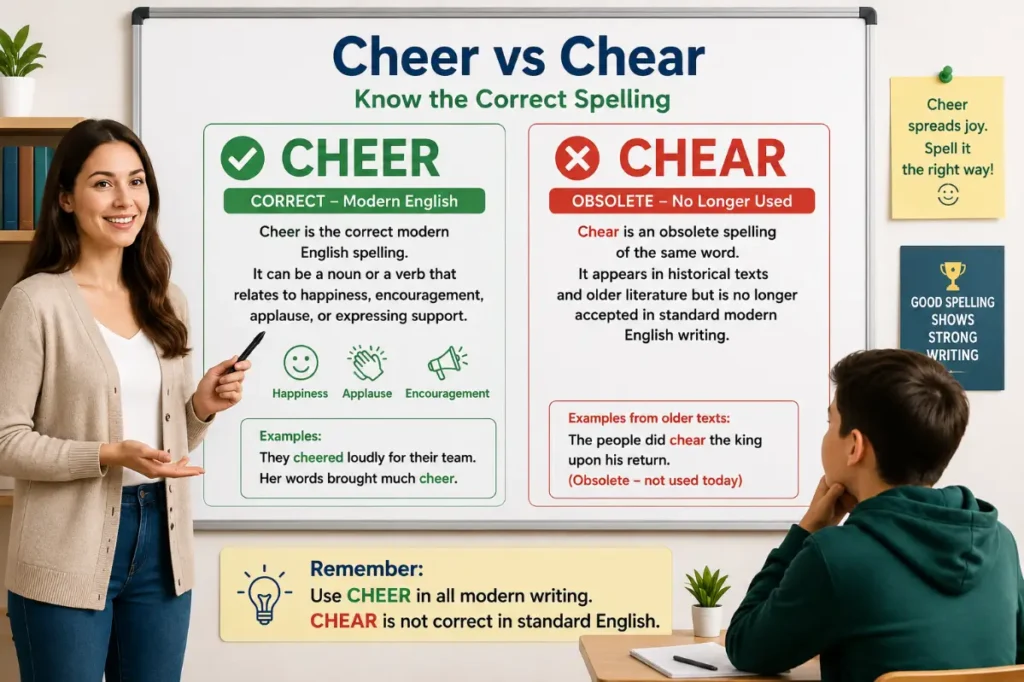
cheer is the standard spelling in modern English. Chear is an archaic spelling that appears mainly in older English texts. Cheer works as both a noun and a verb and can describe happiness, encouragement, applause, approval, or enthusiastic support. If you’re writing modern English, choose cheer.
Table Of Contents
- Short Answer
- Introduction
- What Cheer Means
- What Chear Means
- Cheer As A Noun
- Cheer As A Verb
- Common Expressions With Cheer
- Why Chear Appears In Older Texts
- Spelling Difference Explained
- Pronunciation Guide
- Grammar And Word Forms
- US And UK Usage
- Formal And Informal Usage
- Real Life Examples
- Common Mistakes
- Memory Tips
- Related Words And Expressions
- Professional Writing Tips
- Frequently Asked Questions
- Key Takeaways
- Conclusion
What Cheer Means
Cheer is a standard modern English word with several related meanings. It can describe happiness or a positive emotional state. It can also mean a shout that expresses approval, excitement, or encouragement. As a verb, it can mean to encourage someone, make someone happier, or show enthusiastic support.
For example:
The crowd gave a huge cheer.
Here cheer is a noun. It describes the enthusiastic sound made by a group of people.
Her kind words brought me cheer.
Here cheer means happiness or emotional comfort.
The fans cheered when the team scored.
In this sentence cheer is a verb. It describes the action of expressing enthusiasm.
The good news cheered him.
Here the verb means that the news made him happier.
The word therefore has a useful range of meanings. Context tells the reader which sense applies.
What Chear Means
Chear is an obsolete or archaic spelling of cheer. It isn’t the spelling you should normally use in modern English.
Older English texts contain the form because spelling conventions were much less standardized than they are now. Writers and printers often used different spellings for the same word. Some forms survived while others gradually disappeared.
Chear belongs to that older spelling tradition.
You may still encounter it when reading historical poetry, old books, manuscripts, archived documents, or exact reproductions of older texts.
For example:
The original text used the spelling chear.
In this sentence the form is being discussed as a historical spelling.
However, if you’re writing a modern sentence such as:
The crowd gave a loud cheer.
you should use cheer.
Writing:
The crowd gave a loud chear.
would normally be treated as a spelling error in modern English.
The one word form can also appear in historical discussion or in proper names. A company, product, title, or creative work can choose its own spelling. That doesn’t change the standard spelling rule for ordinary modern English.
Cheer As A Noun
As a noun, cheer can express several closely related ideas.
One common meaning is a shout of approval or enthusiasm.
The stadium erupted in cheer.
The audience responded with a loud cheer.
The children gave three cheers for their teacher.
Another meaning refers to happiness or positive spirit.
The decorations brought holiday cheer to the house.
Her kindness added some cheer to a difficult day.
The expression good cheer carries this meaning clearly.
They faced the problem with good cheer.
Here the phrase suggests a positive and hopeful attitude.
Cheer can also refer to encouragement or emotional support.
His words gave me some cheer.
The message brought cheer to the whole team.
These meanings connect naturally. Happiness can encourage people. Encouragement can create happiness. A cheer from a crowd can communicate both support and excitement.
Cheer As A Verb
As a verb, cheer has two major modern uses.
The first means to shout or express enthusiastic support.
The fans cheered for their team.
Everyone cheered when she crossed the finish line.
The crowd cheered loudly.
The second means to make someone happier or more hopeful.
The good news cheered her.
His visit cheered his grandmother.
The sunny weather cheered everyone up.
The verb also appears in several common constructions.
Cheer For
Use cheer for when you support a person, group, or team.
We cheer for the home team.
Millions of people cheered for the athletes.
Cheer On
Use cheer on when you encourage someone while they are doing something.
Her friends cheered her on during the race.
We stood beside him and cheered him on.
Cheer Up
Use cheer up when someone becomes happier or when you try to make someone happier.
Cheer up. Things will get better.
The music helped cheer me up.
She cheered up after hearing the good news.
These expressions are common in everyday American English and are worth learning as complete phrases.
Common Expressions With Cheer
Several expressions containing cheer appear frequently in modern English.
Good Cheer
Good cheer refers to happiness, optimism, or a pleasant positive spirit.
The family celebrated the holiday in good cheer.
The expression can sound slightly traditional depending on the context but remains understandable and established.
Cheer Up
Cheer up is one of the most common expressions.
The music helped cheer me up.
It can encourage someone directly or describe a change in mood.
Cheer On
Cheer on means to encourage someone through enthusiastic support.
Her parents cheered her on from the sidelines.
The crowd cheered the runners on.
Three Cheers
Three cheers means three enthusiastic expressions of approval or celebration.
The phrase often appears in celebrations, speeches, and playful situations.
Cheers
Cheers has several meanings. It can be used as a toast and in some varieties of English it can also serve as an informal way to say thanks or goodbye.
In American English, cheers is familiar as a toast. The informal thank you or goodbye use is more strongly associated with British English.
Why Chear Appears In Older Texts
The history of chear becomes easier to understand once you consider how English spelling developed.
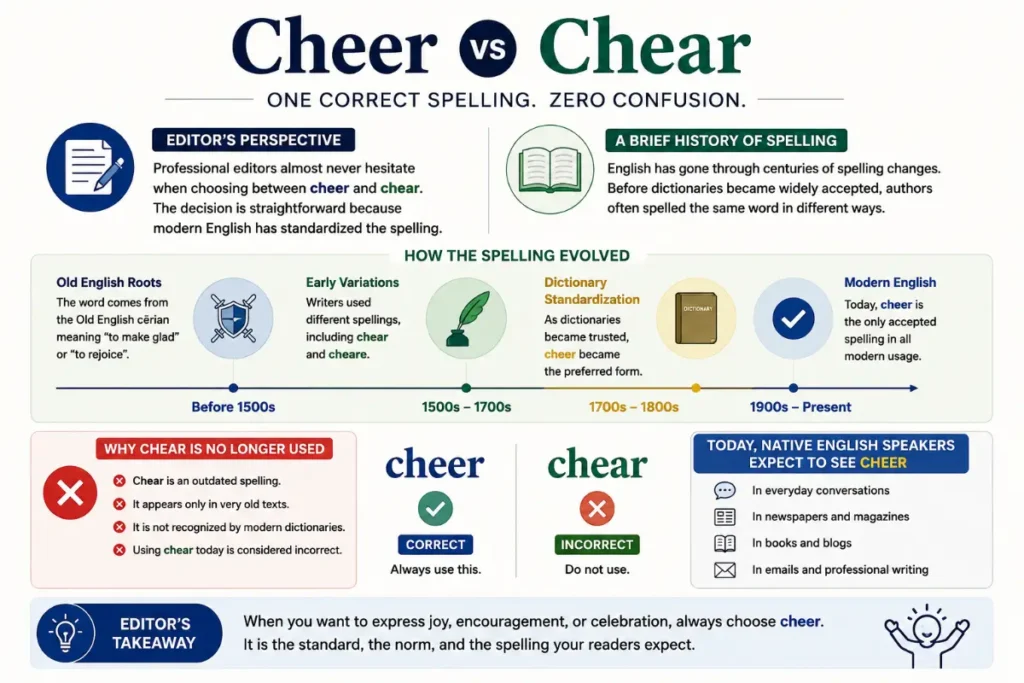
Modern spelling can seem fixed, but English spelling changed gradually over centuries. Before dictionaries and modern editorial standards became widespread, writers and printers often spelled words differently.
Chear was one of those historical forms.
The modern word cheer has roots that pass through Middle English and French. Earlier forms were associated with the face, expression, or countenance. Over time, the word developed meanings connected with mood, happiness, encouragement, and emotional state.
That development explains why modern cheer has several related meanings.
Historical spelling also explains why you may see chear in older literature. A writer from an earlier period wasn’t necessarily making a mistake according to the spelling conventions of that time.
This distinction matters when reading historical English.
A spelling can be correct for a historical source and still be inappropriate in modern writing.
Spelling Difference Explained
The visible difference between the two forms is small.
Cheer uses double e.
Chear uses e followed by a.
That single difference determines their status in modern writing.
Cheer is standard.
Chear is archaic.
There isn’t a modern meaning that requires chear instead of cheer.
There isn’t a separate pronunciation that requires the older spelling.
Instead, the difference comes from the history of English spelling.
The practical rule is simple. Use cheer in modern writing. Use chear only when you have a clear historical reason to preserve or discuss the older form.
Pronunciation Guide
In American English, cheer is commonly pronounced /tʃɪr/.
The first sound is the familiar ch sound found in words such as chair and child. The vowel is similar to the sound found in near for many American speakers. The final r is pronounced in standard American English.
You can think of the pronunciation as:
cheer.
It is one syllable.
British English commonly uses a pronunciation represented as /tʃɪə/. In many British accents, the final r isn’t pronounced when the word stands alone.
The historical spelling chear doesn’t represent a separate modern pronunciation. That’s one reason spelling can be confusing here.
The important lesson is that pronunciation and spelling don’t always match perfectly in English. You can hear the correct sound and still need to remember the correct written form.
Grammar And Word Forms
Cheer works as both a noun and a verb.
As a noun:
The cheer was deafening.
The crowd’s cheer filled the stadium.
As a verb:
The fans cheer every weekend.
The students cheered for their teacher.
The team is cheering loudly.
The word changes according to normal English grammar.
Present tense:
I cheer.
She cheers.
Past tense:
They cheered.
Present participle:
They are cheering.
Past participle:
They have cheered.
The word also forms a useful family of related words.
Cheerful describes someone or something that shows happiness or positive energy.
She has a cheerful personality.
Cheery is an informal adjective meaning cheerful or bright in mood.
He gave us a cheery smile.
Cheerfully is an adverb.
She cheerfully accepted the challenge.
Cheerfulness refers to the quality of being cheerful.
Her natural cheerfulness lifted everyone’s mood.
These related words reinforce the modern spelling pattern.
US And UK Usage
American and British English both use cheer as the standard modern spelling.
There isn’t a major regional spelling difference in this word.
American English:
The fans cheered for the team.
British English:
The fans cheered for the team.
American English:
Her message brought some cheer.
British English:
Her message brought some cheer.
The bigger regional difference appears in the word cheers.
British English uses cheers informally as a way to say thanks or goodbye.
For example:
Cheers for helping me.
Cheers. See you tomorrow.
American speakers understand these expressions but don’t use them with the same frequency or cultural familiarity.
The spelling cheer itself remains standard across both varieties.
Formal And Informal Usage
Cheer is completely acceptable in formal writing when its meaning fits the sentence.
A news report can describe a crowd’s cheer.
An academic paper can discuss cheer in literature.
A business report can mention renewed cheer among employees.
A personal message can say that someone’s words brought cheer.
Some expressions are more conversational.
Cheer up.
Let’s cheer them on.
Let’s give them three cheers.
These aren’t grammatically incorrect or careless. They’re simply more natural in everyday speech than in highly formal prose.
Chear is different because its issue isn’t formality. Its issue is historical status.
Modern professional writing should generally avoid chear unless you’re discussing historical English or reproducing an original historical source.
Real Life Examples
Everyday Conversation
I always cheer for the underdog.
The speaker supports a person or team that isn’t expected to win.
Cheer up. It’s not the end of the world.
The speaker is encouraging someone who feels discouraged.
Sports
The fans cheered when the final score appeared.
Cheered describes the crowd’s enthusiastic reaction.
We were cheering for our school team.
The verb describes active support for the team.
School
The teacher’s encouragement brought cheer to the students.
Cheer means happiness or positive emotional energy.
The students cheered when the class ended early.
The verb describes their enthusiastic reaction.
Workplace
The good news brought some cheer to the office.
Here cheer means happiness or relief.
Everyone cheered when the project was completed.
The verb describes a collective expression of excitement.
Writing And Literature
The poet describes a scene filled with good cheer.
The phrase presents cheer as happiness and positive spirit.
An editor may preserve chear when quoting an old manuscript.
The older spelling is retained because historical accuracy matters.
Common Mistakes
Using Chear In Modern Sentences
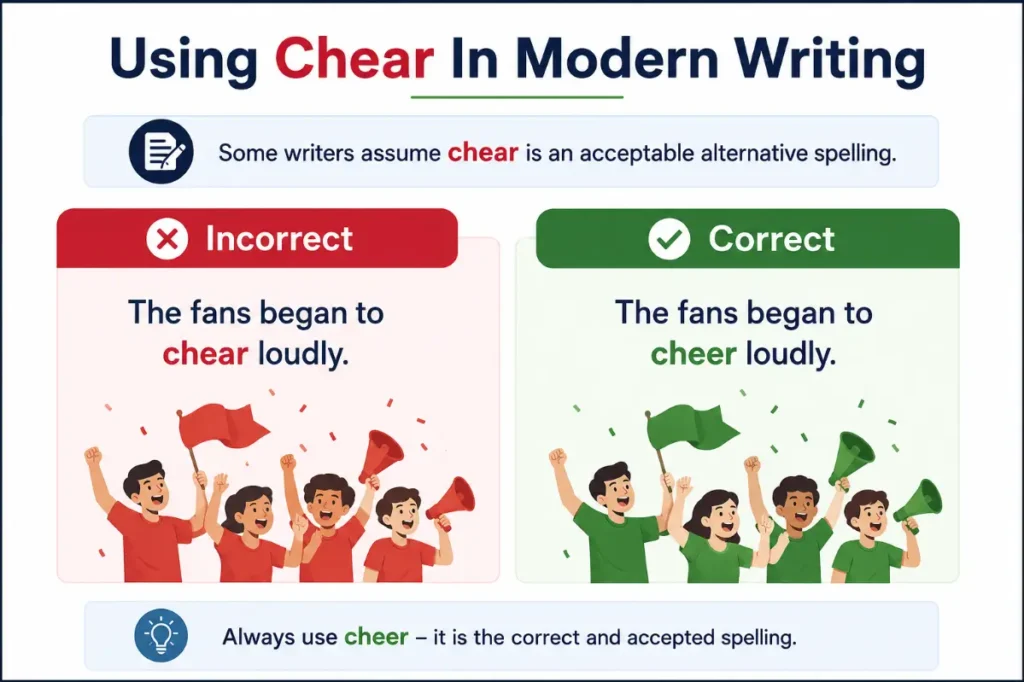
Incorrect:
The crowd gave a loud chear.
Correct:
The crowd gave a loud cheer.
The modern noun requires the standard spelling.
Writing Chear Up
Incorrect:
I hope this will chear you up.
Correct:
I hope this will cheer you up.
The phrasal expression uses the modern spelling.
Assuming Chear Is A Modern Alternative
The fact that an older spelling exists doesn’t mean modern writers can use it freely. Many historical forms have disappeared from ordinary English.
Trusting Sound Alone
The pronunciation won’t reliably tell you which spelling to use. English contains many words whose spelling cannot be predicted perfectly from pronunciation.
Treating Historical Writing As Modern Style
An old book can preserve old spelling. That doesn’t mean you should copy the spelling into a modern article or essay.
Memory Tips
The easiest way to remember the correct spelling is to focus on the double e.
Think:
cheer
cheerful
cheering
cheered
cheerfully
These modern forms all reinforce the same spelling pattern.
You can also connect cheer with peer because both use the double e spelling.
Another useful memory aid is the phrase cheer up. If you can remember cheer up you already have the correct spelling in one of the most common expressions.
When you encounter chear in an old book, think historical spelling rather than modern alternative.
Related Words And Expressions
Cheer belongs to a broad word family connected with happiness, encouragement, and support.
Cheerful
Cheerful means happy, positive, or pleasant in mood.
She has a cheerful personality.
Cheery
Cheery means cheerful or bright in mood and often has a friendly informal tone.
He gave us a cheery smile.
Cheerfully
Cheerfully is the adverb form.
She cheerfully accepted the challenge.
Cheering
Cheering can describe something encouraging or the act of shouting support.
The results were cheering.
The crowd was cheering.
Cheered
Cheered is the past form of cheer.
The good news cheered everyone.
Cheerleader
A cheerleader is someone who performs organized routines and supports a sports team through cheers. The word can also describe someone who strongly supports another person, group, idea, or organization.
Cheer Up
Cheer up means become happier or make someone happier.
The good news cheered him up.
Cheer On
Cheer on means encourage someone through enthusiastic support.
Her friends cheered her on.
Learning these related forms can make the spelling easier to remember.
Professional Writing Tips
If you’re editing an article, report, essay, or business document, use cheer as the default modern form.
When you see chear, don’t immediately assume the writer made a random mistake. Look at the context first.
If it appears in your own modern sentence, change it to cheer.
If you’re writing about historical English, explain that chear is an older form.
This approach is especially useful when working with literature, archives, manuscripts, historical newspapers, and old books.
Good editing isn’t simply about replacing unfamiliar words. It also means understanding why a form appears and preserving the right details when context demands it.
Why The Confusion Persists
At first glance, chear looks perfectly plausible. It contains the same consonants as cheer and changes only the vowel sequence.
English also has many genuine spelling variations. American and British English differ in words such as color and colour or center and centre. That can lead readers to assume that every unfamiliar spelling represents a regional difference.
Chear isn’t a modern regional variant.
It isn’t the American form.
It isn’t an Australian or Canadian alternative.
It’s a historical spelling connected with the development of the word.
That distinction is useful because not every spelling difference represents two living forms of English.
Dictionary Evidence
Modern dictionary treatment makes the distinction clear.
Merriam Webster identifies chear as an archaic variant of cheer. That label tells modern writers that the form belongs to historical usage rather than ordinary contemporary writing.
Etymological references also describe chear as an obsolete spelling of cheer and connect the word’s history with older forms of English and French.
Modern dictionaries define cheer as both a noun and a verb. The noun can refer to happiness, encouragement, approval, or an enthusiastic shout. The verb can describe encouraging someone, becoming happier, or expressing support.
The evidence supports a straightforward modern rule.
Use cheer today.
Treat chear as historical.
A Closer Look At The Word Origin
The history of cheer is more interesting than its spelling difference suggests.
The word developed through Middle English forms associated with older French words connected with the face, expression, or countenance. This connection between facial expression and emotional condition helped the word develop meanings related to mood and spirit.
Over time, cheer became connected with happiness, comfort, encouragement, and positive feeling.
The verb developed from these ideas and eventually gained meanings associated with encouraging someone or expressing enthusiastic support.
That history explains why modern English can use cheer for both an emotional state and an outward expression of support.
For example, a person’s cheerful expression can show a positive mood. A crowd’s cheer can show support. A friend’s kind words can bring cheer.
One word connects all these ideas.
When Chear Can Appear Today
There are only a few sensible reasons to write chear today.
First, you may be quoting an older source exactly.
Second, you may be discussing the history of English spelling.
Third, you may be studying historical literature where the original form matters.
For example, if an original poem contains chear, a scholarly edition may preserve that spelling.
A modern writer shouldn’t use the form simply to sound old fashioned.
Writing:
The celebration was filled with chear.
doesn’t automatically make the sentence literary. It simply makes the spelling look outdated.
Historical accuracy and artificial old fashioned spelling are two very different things.
Key Takeaways
- Cheer is the standard modern spelling.
- Chear is an obsolete or archaic spelling.
- Cheer works as both a noun and a verb.
- Cheer can describe happiness, encouragement, approval, applause, or enthusiastic support.
- Common expressions include cheer up, cheer on, cheer for, good cheer, and three cheers.
- American and British English both use cheer as the modern spelling.
- Chear may appear in historical books, old poetry, manuscripts, or preserved quotations.
- Pronunciation doesn’t provide a reliable clue because the forms are historically connected.
- Use cheer in modern academic, professional, personal, and online writing.
- Preserve chear only when historical context or an exact quotation requires it.
Conclusion
cheer vs chear has a straightforward answer for modern English. Cheer is the correct standard spelling for contemporary writing, while chear is an archaic form that mainly belongs to older texts and historical discussions. If you’re writing a school assignment, professional document, email, article, or everyday message, cheer is the form you want.
Cheer can function as both a noun and a verb. It can describe happiness, encouragement, approval, applause, or enthusiastic support. You can cheer for a team, cheer someone on, cheer up a friend, or describe a loud cheer from a crowd. Its history also explains why older sources sometimes contain chear.
The best practical rule is easy to remember. Keep the double e in cheer when you’re writing modern English. If you encounter chear in an old source, don’t automatically call it a mistake. Check the context first. It may be a genuine historical spelling that belongs exactly where you found it.
Frequently Asked Questions
Is chear a real word?
Yes, chear is a real historical English form. Modern dictionaries describe it as archaic or obsolete rather than as a normal contemporary spelling. You may encounter it in older literature, historical documents, or discussions of English spelling. In modern writing, however, use cheer. The older spelling shouldn’t be treated as an equal alternative to the standard form.
Is cheer the correct modern spelling?
Yes. Cheer is the standard modern spelling. It works as both a noun and a verb and can refer to happiness, encouragement, approval, applause, or enthusiastic support. If you’re writing an essay, email, article, report, application, or everyday message, cheer is the appropriate form. Chear should generally be reserved for historical contexts.
Why did people spell cheer as chear?
English spelling wasn’t always standardized. Writers and printers used different spellings for many words, particularly before modern dictionaries and editorial conventions became widespread. Chear was one historical form of cheer. Over time, cheer became the established spelling while chear became obsolete. That’s why older texts can contain a form that looks incorrect to modern readers.
Do cheer and chear have the same pronunciation?
They represent the same historical word and don’t have a meaningful modern pronunciation difference. Cheer is commonly pronounced /tʃɪr/ in American English. British English commonly uses /tʃɪə/. The spelling chear doesn’t require a different modern pronunciation. This is another example of why English pronunciation alone can’t always tell you how a word should be spelled.
Can I use chear in an essay?
You normally shouldn’t use chear in a modern essay. Use cheer unless your essay specifically discusses historical English or contains an exact quotation that preserves the older spelling. If you’re writing your own modern sentences, chear will generally look like a spelling mistake. Historical context is the main reason to retain the older form.
What does cheer mean as a noun?
As a noun, cheer can mean a shout of approval or encouragement, a feeling of happiness, positive emotional energy, or something that creates a happier mood. For example, The crowd gave a loud cheer uses cheer for an enthusiastic shout. In the expression good cheer, it refers to a positive and cheerful state of mind.
What does cheer mean as a verb?
As a verb, cheer can mean to shout in support of someone or something. It can also mean to make someone happier or more hopeful. For example, The fans cheered for the team describes enthusiastic support. The good news cheered her describes an improvement in mood. The verb also appears in expressions such as cheer up and cheer on.
Is chear used in American English?
No. Chear isn’t a standard modern American English spelling. American English uses cheer. If you encounter chear in an American publication, it will usually appear because the writer is discussing an old text, preserving a historical quotation, using a proper name, or making a spelling mistake. It isn’t a normal regional American variant.
Is chear used in British English?
Chear isn’t a standard modern British English spelling either. British English uses cheer. British English does have some distinctive uses of cheers, including informal meanings connected with thanks and goodbye. Those differences don’t make chear a modern British spelling. The older form remains historical rather than contemporary.
What is an easy way to remember cheer?
Remember the double e in cheer. You can connect it with cheerful, cheering, cheered, and cheerfully. The phrase cheer up is another useful memory aid. If you see chear in an old book, treat it as a historical form. For modern writing, remember one simple rule: use cheer.
