
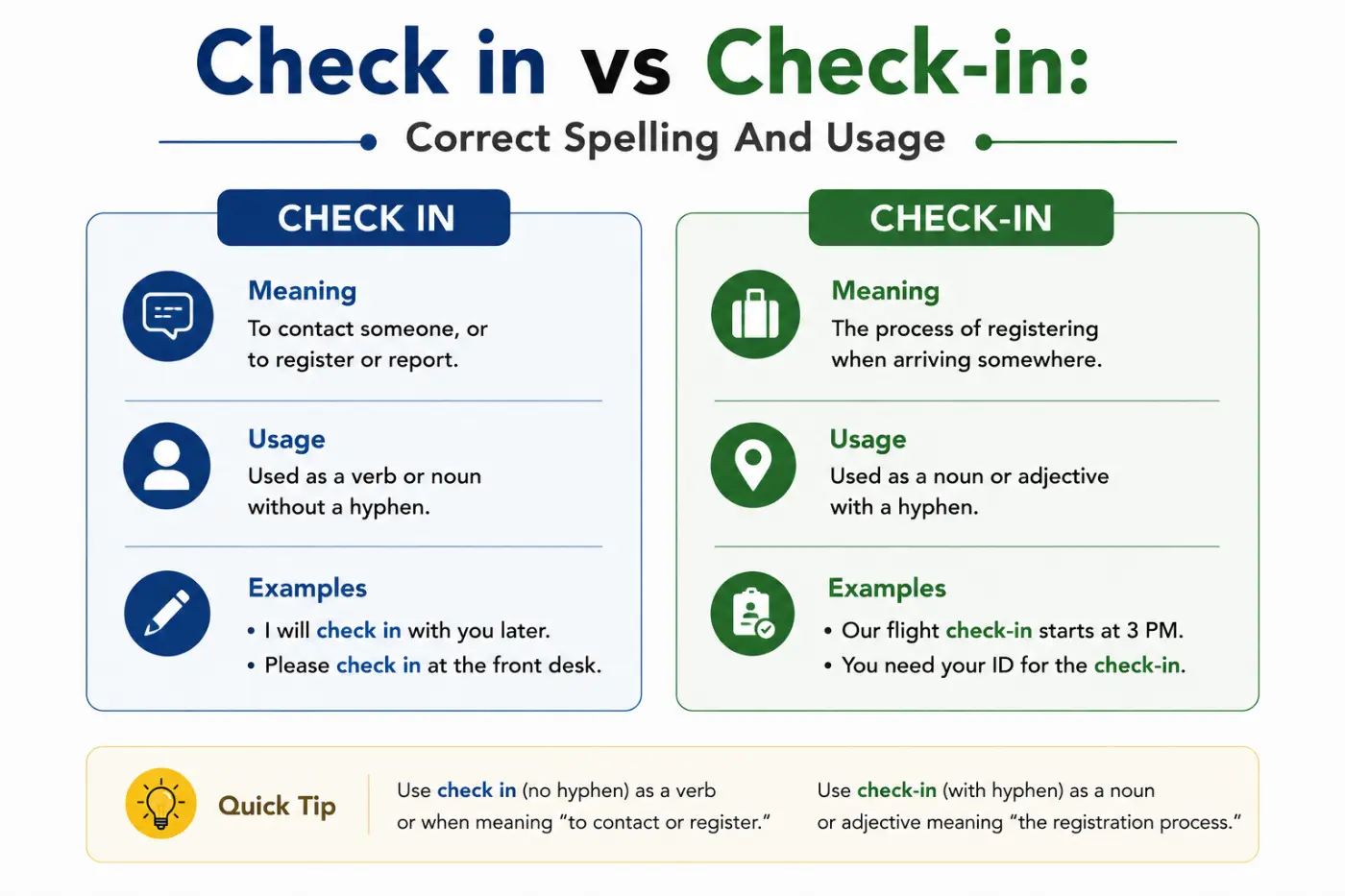
Check in vs check-in depends on how the expression functions in your sentence. Use check in as a verb when you mean to report your arrival, register at a hotel or airport, contact someone briefly, or confirm that something is going well. Use check-in as a noun when you mean the act, process, place, or event connected with checking in. You can also use it before another noun as a compound modifier.
This distinction causes confusion because the two forms sound exactly the same when spoken. The difference only becomes visible in writing. English has many expressions that change their spacing or punctuation when they move from a verb phrase to a noun or modifier. That pattern can make this pair seem trickier than it really is.
Once you know the grammatical job of the expression, the choice becomes much easier. This guide explains the meanings, spelling, grammar, pronunciation, capitalization, American and British usage, common mistakes, professional writing rules, and natural examples. By the end, you should be able to choose the right form without stopping to think about it.
Short Answer
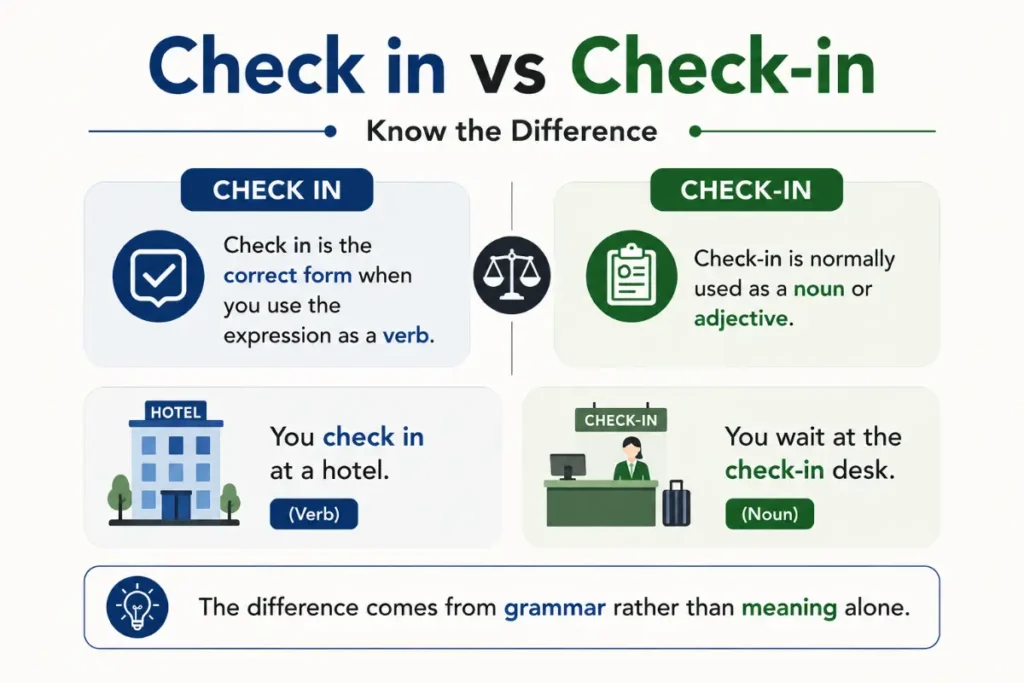
Check in is the correct form when you use the expression as a verb. Check-in is normally used as a noun or adjective. You check in at a hotel, but you wait at the check-in desk. The difference comes from grammar rather than meaning alone.
Table Of Contents
- The Core Difference.
- What The Verb Form Means.
- What The Noun Form Means.
- What The Adjective Form Means.
- Comparison Table.
- Grammar Rules.
- Common Sentence Patterns.
- Real Life Examples.
- Pronunciation.
- Common Mistakes.
- Check In With And Check In On.
- Check Into And Check In At.
- Formal And Informal Usage.
- American And British English.
- Word Origin.
- Memory Tips.
- Related Expressions.
- Professional Editing Tips.
- Frequently Asked Questions.
- Key Takeaways.
- Conclusion.
The Core Difference
The simplest rule is this.
Check in is a verb phrase.
Check-in is usually a noun or an adjective.
Consider these two sentences.
I need to check in at the hotel.
The check-in desk opens at three.
In the first sentence the expression describes an action. You are doing something. Therefore the words stay separate.
In the second sentence the expression names a thing or service. It describes the process or location associated with arrival. Therefore the hyphenated form works as a noun.
The same distinction appears in many other English expressions. For example, you can log in to an account, but you may use a login page. You can sign up for a service, but you may complete a signup form in informal usage. English often keeps the verb phrase open while allowing a related noun or modifier to develop a different written form.
The important point is that spelling follows grammatical function.
What The Verb Form Means
The verb phrase check in has several common meanings.
The first meaning involves reporting your arrival.
You check in at an airport before a flight. You may also check in at a conference, event, office, or other location.
For example:
We need to check in at the hotel before dinner.
The second meaning involves confirming your presence or status.
For example:
Please check in with your supervisor when you arrive.
The third meaning involves contacting someone briefly to make sure everything is fine or to exchange an update.
For example:
I wanted to check in and see how you’re doing.
This use has become especially common in workplace communication. A manager might check in with an employee after a difficult assignment. A friend might check in with someone who has been sick. A project leader might check in with a team before a deadline.
The fourth meaning can involve confirming information or progress.
For example:
I’ll check in with the design team and get back to you.
The exact meaning comes from context. The basic grammatical point remains unchanged. When the expression performs an action in the sentence, write it as two words.
What The Noun Form Means
The noun check-in refers to the act or process of checking in. It can also refer to the place or point where that process happens.
For example:
Online check-in is available from noon.
The airport check-in was crowded.
We completed check-in before heading to security.
Major dictionaries recognize check-in as a noun for the process or area associated with arrival at an airport or similar location. Cambridge also gives the noun pronunciation as /ˈtʃek.ɪn/ and identifies the verb as the phrasal verb check in.
The noun can appear in several common combinations.
Check-in desk.
Check-in counter.
Online check-in.
Hotel check-in.
Early check-in.
Late check-in.
These combinations make the noun function easy to recognize. If another word directly describes the process or place, you’re often looking at the noun.
What The Adjective Form Means
The hyphenated form can also work as an adjective before a noun.
For example:
The check-in desk is on the left.
Please visit the check-in counter.
The hotel has a strict check-in policy.
Here check-in describes another noun. It tells the reader what kind of desk, counter, or policy you mean.
This is called a compound modifier. The hyphen helps readers see that the two words work together as one modifier before the noun.
Compare these sentences.
I need to check in.
The check-in desk is closed.
The first sentence contains a verb phrase. The second contains a compound modifier.
That difference is the heart of the spelling rule.
Comparison Table
| Form | Grammar Role | Main Meaning | Example | Correct Usage |
|---|---|---|---|---|
| check in | Verb phrase | Report arrival or make contact | We need to check in at noon. | Use for an action. |
| checked in | Past tense verb phrase | Reported arrival or made contact | We checked in early. | Use for a completed action. |
| checking in | Present participle | Reporting arrival or making contact | She is checking in now. | Use in continuous structures. |
| check-in | Noun | The process or place of arrival registration | Check-in begins at two. | Use as a thing or process. |
| check-in | Adjective | Describes a related noun | The check-in desk is busy. | Use before a noun. |
| check into | Verb phrase | Enter and register at a place | We checked into the hotel. | Use when the destination is stated. |
| check in with | Verb phrase | Contact or report to someone | I’ll check in with my manager. | Use for communication. |
| check in on | Verb phrase | Contact someone to see how things are going | I’ll check in on Dad later. | Use for a welfare or status check. |
Grammar Rules
Understanding the grammar makes the spelling almost automatic.
Use The Open Form For The Verb
When check carries the tense of the sentence, keep in separate.
Present tense:
I check in online.
Past tense:
I checked in early.
Continuous form:
We are checking in now.
Perfect form:
They have checked in already.
Modal form:
You should check in before noon.
The particle in stays separate because the expression is a phrasal verb.
Use The Hyphenated Form As A Noun
When the expression names a process, event, or location, use check-in.
For example:
Check-in starts at three.
The check-in was quick.
Our check-in took less than five minutes.
The noun can be singular or used in broader noun phrases.
Use The Hyphenated Form Before A Noun
When it functions as a compound modifier, the hyphen helps show that the words belong together.
For example:
The check-in desk is downstairs.
She missed the check-in deadline.
The airline changed its check-in procedure.
In these examples the expression describes another noun.
Do Not Hyphenate The Verb
A common mistake is writing:
Please check-in at the counter.
In standard usage the better form is:
Please check in at the counter.
The same rule applies to other verb forms.
We checked in early.
She is checking in now.
They will check in tomorrow.
The hyphen does not belong in these verb phrases.
Common Sentence Patterns
A few sentence patterns cover most everyday uses.
Check In At A Place
Use check in at when you identify the location where someone reports arrival.
We checked in at the hotel.
Please check in at the front desk.
Passengers should check in at the airport two hours before departure.
Cambridge identifies hotel and airport arrival as major meanings of the verb phrase. It also recognizes checking in online for flights.
Check In With A Person
Use check in with when you mean contact someone or report to them.
I’ll check in with Sarah tomorrow.
Please check in with your supervisor before leaving.
The manager checks in with the team every Monday.
This pattern is common in American workplace English because it sounds friendly and direct.
Check In On Someone
Use check in on when you want to see how someone is doing or make sure something is okay.
I called to check in on my grandmother.
Can you check in on the kids?
She stopped by to check in on her neighbor.
This pattern focuses on someone’s condition or situation.
Check Into A Hotel
You can use check into when the destination is expressed as the object of the verb.
We checked into the hotel at four.
They checked into a small motel near the airport.
She checked into her room after lunch.
Cambridge records check into as a phrasal verb for arriving and registering at a hotel or similar place.
There is a useful distinction between check in at the hotel and check into the hotel. Both can be correct. The first emphasizes the location of the action. The second treats the hotel as the destination or place entered.
Real Life Examples
Everyday Conversation
I need to check in before we leave.
This sentence describes an action. The speaker needs to report arrival or complete a registration process.
Let’s check in with Mike before we make a decision.
Here the expression means contact Mike and get an update.
Travel
Passengers should check in online before arriving at the airport.
The airline offers online check-in through its website.
The first sentence uses the verb. The second uses the noun.
Please check in at least two hours before your flight.
The verb remains open because it describes what passengers need to do.
Hotels
We checked in around six in the evening.
The expression describes the completed action of registering at the hotel.
The check-in desk was crowded.
The expression is now a noun modifier because it describes the desk.
The hotel allows early check-in.
Here the hyphenated form describes a type of check-in.
Workplace Communication
I’ll check in with you tomorrow.
This means the speaker plans to contact the other person and discuss an update.
Let’s have a quick check-in after lunch.
Here the expression is a noun describing a short meeting or conversation.
That distinction is increasingly common in professional communication. The noun use is especially useful when people need a compact term for a brief status conversation.
I wanted to check in about the project.
This is a normal professional sentence. The verb phrase means contact someone to ask for an update.
We have a team check-in at 10 a.m.
The noun refers to the scheduled conversation.
Please check in with me if you have any questions.
Again the verb stays open.
Academic Context
Students must check in before the examination begins.
The expression describes an action.
The final check-in will take place before the course ends.
Here the expression functions as a noun.
Customer Service
A representative will check in with you shortly.
The verb means contact or follow up with the customer.
Your check-in time is listed in the confirmation email.
The noun refers to a scheduled arrival process.
Pronunciation
The verb and noun sound essentially the same in ordinary speech.
The verb check in is commonly pronounced /tʃek ɪn/.
The noun check-in is commonly pronounced /ˈtʃek.ɪn/.
The main difference in dictionaries is not a completely different sound. The noun receives stronger stress as a lexical unit while the verb behaves like a normal phrasal verb.
You can think of the pronunciation like this.
Check in.
The first word sounds like check. The second sounds like in.
In rapid speech the expression can sound almost like one word. That is one reason people sometimes write the verb with a hyphen.
Spelling and pronunciation do not always match perfectly in English. The written form depends on grammar as much as sound.
Common Mistakes
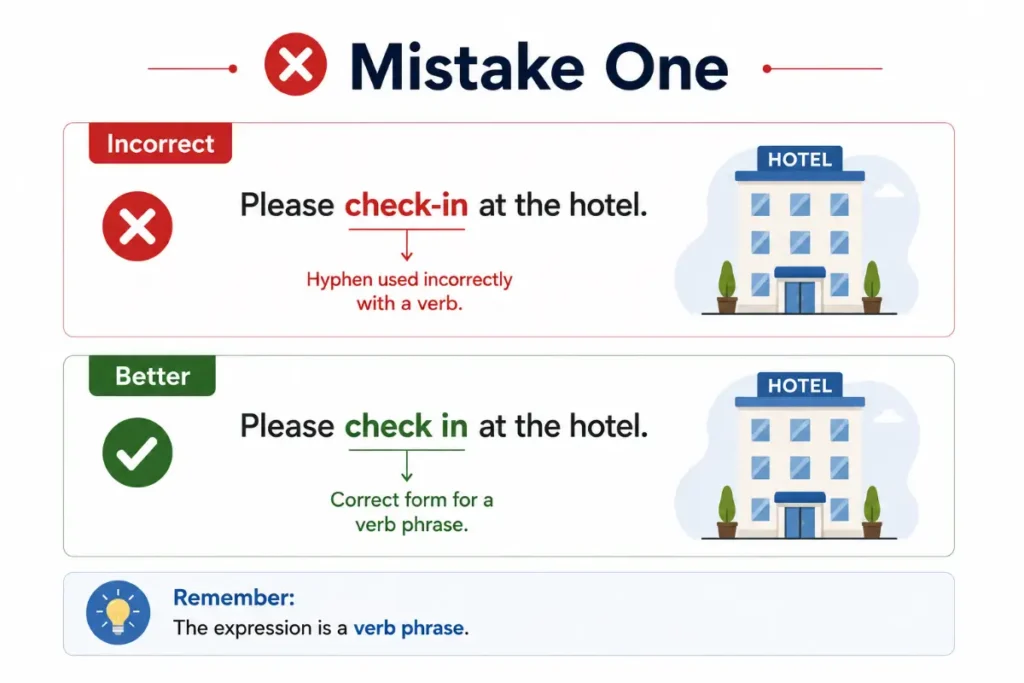
Mistake One
Please check-in at the hotel.
Better:
Please check in at the hotel.
The expression is a verb phrase.
Mistake Two
We will check-in at noon.
Better:
We will check in at noon.
The modal structure will check requires the verb phrase.
Mistake Three
The check in desk is closed.
Better:
The check-in desk is closed.
The expression modifies desk, so the hyphenated compound modifier is appropriate.
Mistake Four
Our check in was delayed.
Better:
Our check-in was delayed.
Here the expression functions as a noun.
Mistake Five
I need to check-in with my manager.
Better:
I need to check in with my manager.
The phrase describes an action involving communication.
Why The Confusion Happens
The confusion is understandable because spoken English does not give you a visible space or hyphen. You hear the same basic sound in all these examples.
I need to check in.
The check-in starts at three.
The check-in desk is open.
Only the grammatical role changes.
Another reason is that English has a long history of converting phrases into compounds. Some expressions remain open as verbs while related nouns become closed or hyphenated. This creates pairs that look inconsistent until you understand the grammar.
The safest approach is not to memorize the spelling as an isolated fact. Instead ask what role the expression plays.
If it describes something you do, use check in.
If it describes another noun, use check-in as a compound modifier.
Check In With And Check In On
These two expressions look similar but they communicate slightly different ideas.
Check in with someone usually means contact them, speak with them, or report to them.
For example:
I’ll check in with my manager before the meeting.
The manager wants to check in with the sales team.
Check in on someone usually means contact them to see how they are doing or to make sure everything is okay.
For example:
I’ll check in on Grandma tonight.
The nurse checked in on the patient.
The difference is subtle but useful. With often focuses on communication or coordination. On often focuses on someone’s condition, progress, or welfare.
Check Into And Check In At
Both forms can describe hotel arrival. We checked in at the hotel. We checked into the hotel. The first construction uses at to identify the location. The second uses into to treat the hotel as the destination entered. The choice can depend on the structure and emphasis of the sentence. You can also say: We checked in at the front desk. The second sentence is not interchangeable with: We checked into the front desk. That would suggest that the front desk itself is the place being entered. Normally you check in at a desk but check into a hotel or similar accommodation. This small distinction helps you sound more natural.
Formal And Informal Usage
The verb phrase is perfectly acceptable in formal and informal English. You can use it in a business email: I will check in with the team tomorrow. You can use it in academic writing: Participants must check in before the session begins and You can also use it in everyday conversation: I’ll check in later. The noun check-in is also standard. It appears frequently in travel writing, hotel information, business communication, and workplace language. In formal writing, clarity matters more than avoiding the expression. There is no need to replace a perfectly standard phrase with an unnecessarily complicated alternative.
For example:
Please check in upon arrival.
This is clearer than:
Please report your arrival status upon reaching the premises.
Good editing favors the first sentence because it says the same thing more naturally.
American And British English
The basic distinction remains the same in American and British English. American English uses check in as the verb and check-in as a noun or compound modifier. British English follows the same pattern. The meaning also remains largely consistent across both varieties. Travelers check in at airports and hotels. People check in with friends, colleagues, managers, and family members.
Word Origin
The expression developed from the ordinary meanings of check and in. The verb check has a long history in English and is connected to ideas of stopping, examining, controlling, or verifying. The particle in adds a sense of entering or being within a particular setting. Over time the combination developed the specialized meaning of reporting your arrival and registering at a place. Travel made the expression especially common because airports and hotels needed a simple way to describe the arrival process. The phrase later expanded beyond physical arrival. You can now check in with a colleague. You can check in about a project. The modern expression therefore covers both physical registration and communication. The noun check-in developed from the verb phrase and became useful for naming the process itself. That is a common pattern in English. A verb phrase can produce a related noun that takes different spacing or punctuation.
Memory Tips
The easiest memory trick is to think about action versus thing.
If you do it, write two words.
I need to check in.
If you name it, use the hyphenated form.
The check-in was quick.
If you describe something, use the hyphenated form before the noun.
The check-in desk is open.
You can also use the question test.
Ask yourself:
Am I telling someone what to do?
If yes, use check in.
Am I naming the process or place?
Use check-in.
Am I describing a noun?
Use check-in.
This simple test works in most everyday situations.
Related Expressions
Several English expressions are closely connected with this topic.
Check Out
The verb check out means to leave a hotel after completing the required process. The related noun is checkout or check-out depending on the style and context.
For example:
We need to check out by noon.
The checkout process was easy.
This pair follows a similar grammatical pattern.
Sign In
Sign in works as a verb when you enter an account or system. Please sign in to your account. The noun sign-in can describe the process or information used to access something.
Log In
Log in is the verb. You need to log in first. The related noun is commonly login. The spelling patterns aren’t identical across every English expression. That’s why grammar and established usage matter more than trying to apply one mechanical rule to every pair.
Follow Up
As a verb phrase, follow up means take additional action. I’ll follow up tomorrow. The noun follow-up refers to the later action or communication. This is another useful comparison because it shows how English can preserve a two word verb while using a hyphenated noun.
Professional Writing Tips
If you’re writing an email, report, website, policy, or customer message, choose the form based on grammatical function.
Write:
Please check in upon arrival.
Not:
Please check-in upon arrival.
Write:
The check-in desk closes at 9 p.m.
Not:
The check in desk closes at 9 p.m.
Write:
I’ll check in with the client tomorrow.
Not:
I’ll check-in with the client tomorrow.
Write:
We scheduled a brief check-in.
Expert Editor Tip
Don’t memorize this pair as a spelling rule alone. Treat it as a grammar decision. Ask what the expression is doing in the sentence. If it tells the reader about an action, keep it open. If it names a process or modifies another noun, use the hyphenated form. This approach works better than relying on how the expression sounds because spoken English doesn’t reveal the difference.
Key Takeaways
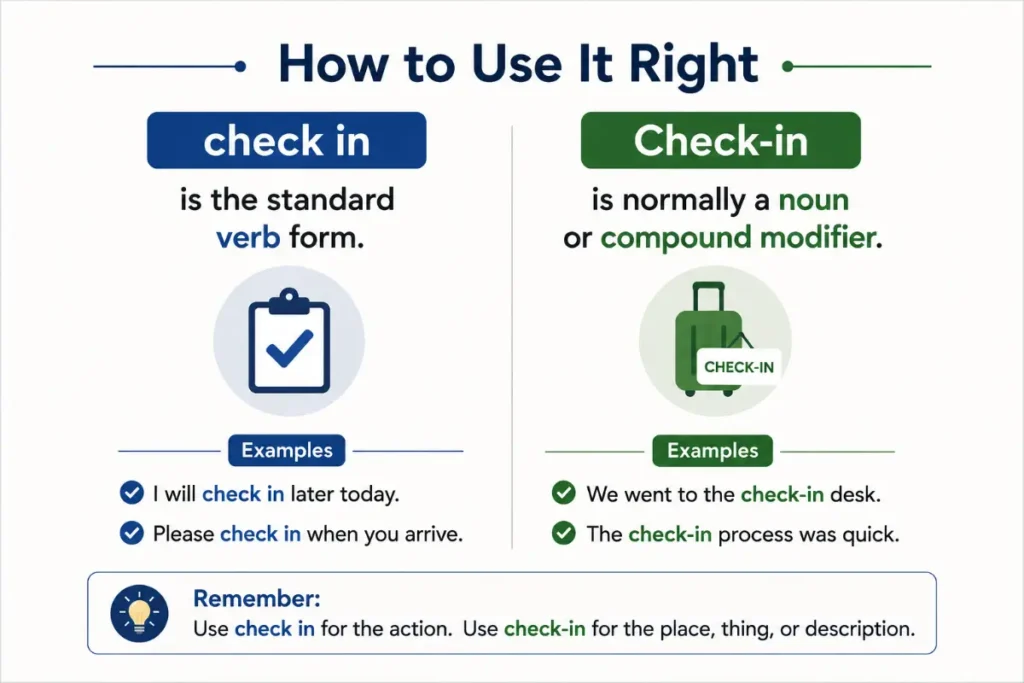
- Check in is the standard verb form.
- Check-in is normally a noun or compound modifier.
- Use check in when describing an action.
- Use check-in when naming the process or place.
- Use check-in before a noun when the two words work together as a compound modifier.
- Use check in with someone for contact or communication.
- Use check in on someone when you want to see how they are doing.
- Use check into a hotel when the hotel is the destination.
- Use check in at a hotel when focusing on the location where the registration happens.
- American and British English follow the same basic spelling distinction.
Conclusion
Check in vs check-in is not really a choice between two competing spellings. The correct form depends on the grammatical role. Use check in when the expression works as a verb, such as in Please check in at the front desk. Use check-in when it functions as a noun or compound modifier, such as in The check-in desk is open.
The easiest way to remember the difference is to focus on action and thing. If someone needs to do something, use the open verb form. If you’re naming the process or describing a related noun, use the hyphenated form. This rule also helps explain familiar patterns such as sign in and sign-in or follow up and follow-up.
For everyday writing, don’t let pronunciation fool you. The two forms sound almost identical, so the grammatical job of the expression is your best guide. Check the role first and the spelling will usually take care of itself.
Frequently Asked Questions
Is check in one word or two words?
The verb is written as two words: check in. For example, you can check in at a hotel or check in online for a flight. The noun is normally written check-in, as in the check-in desk or online check-in. The difference comes from grammatical function. The verb describes an action while the noun names the process or place.
Is check-in always hyphenated?
When check-in functions as a noun or compound modifier, the hyphenated form is standard in many common uses. Examples include check-in desk, check-in time, and online check-in. The verb does not take the hyphen. You should write check in, checked in, and checking in when the expression functions as a verb.
Should I write check in at a hotel?
Yes. When you describe the action of registering at a hotel, use the two word verb phrase. For example, you can write We need to check in at the hotel. You can also use check into the hotel when the hotel functions as the destination. Both structures are standard, but they use slightly different grammatical patterns.
What is the difference between check in and check-in?
The main difference is grammatical function. Check in is a verb phrase used for actions such as reporting your arrival or contacting someone. Check-in is usually a noun or compound modifier. It can refer to the registration process or describe something related to that process, such as a check-in desk or check-in time.
Can I say check in with someone?
Yes. Check in with someone is a common and natural expression. It usually means contacting someone to get an update, share information, or confirm that everything is going well. For example, I will check in with my manager tomorrow. The verb remains two separate words because the expression describes an action.
What does check in on someone mean?
Check in on someone means to contact or visit them to see how they are doing or to make sure everything is okay. For example, I called to check in on my neighbor. The expression often focuses on someone’s welfare or situation. It differs slightly from check in with someone, which usually emphasizes communication or coordination.
Is check-in used in professional writing?
Yes. Check-in is completely appropriate in professional writing when it functions as a noun or compound modifier. You might write We have a weekly check-in or The check-in process begins at 8 a.m. The verb remains open in sentences such as I will check in with the team tomorrow. Grammar determines the form.
Can check in start a sentence?
Yes. Check in can begin a sentence when it functions as a verb. For example, Check in at the front desk when you arrive. It can also appear at the beginning of a sentence in other structures. The position of the expression does not change its spelling. Keep it open when it functions as a verb.
Is check in used for flights?
Yes. Check in is widely used for flights and airport procedures. Passengers check in before boarding so the airline can confirm their travel details and handle the required process. You can also check in online. The related noun is check-in, as in online check-in or the airport check-in desk.
Is check-in used for hotels?
Yes. Hotels commonly use check-in as a noun for the arrival and registration process. For example, a hotel may have a check-in time or check-in desk. When describing the action, use check in. You can write Guests can check in after 3 p.m. You can also say Guests can check into the hotel after 3 p.m.
