
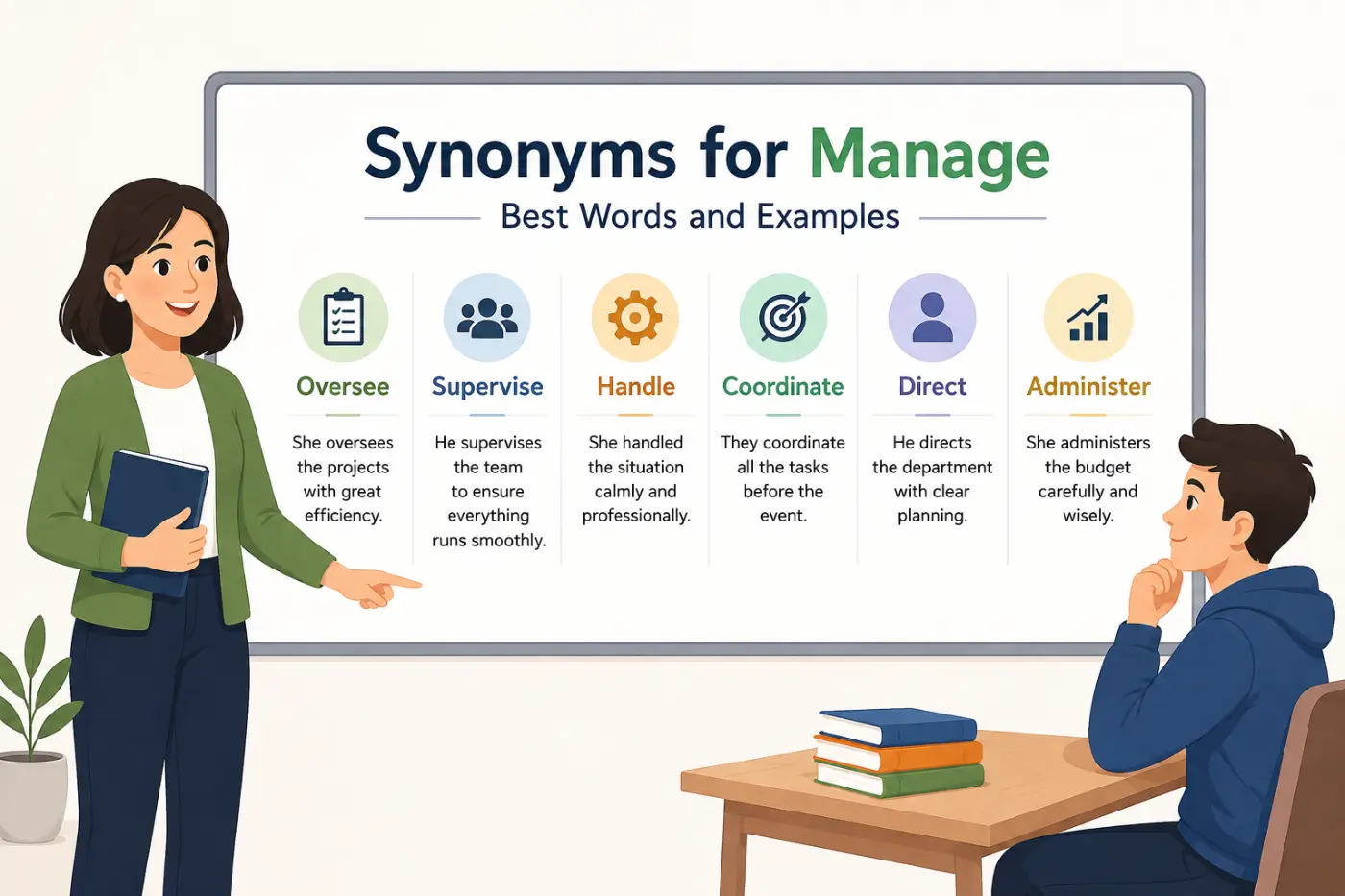
Finding the right synonyms for manage can make your writing stronger and more natural. You might be writing an email, updating your resume, finishing an essay, or sending a message to a coworker. The word manage works in many situations, but using it too often can make your writing feel repetitive. Choosing a better alternative helps you match the tone and express your ideas more clearly.
The best synonym depends on what you’re trying to say. You might lead a team, handle a difficult customer, run a business, coordinate a project, or control your spending. While these words are related, each has its own meaning and works best in different situations.
This guide explains the meaning and origin of manage, introduces more than 30 useful alternatives, compares similar words, and shows how to use each one with practical examples. By the end, you’ll know which synonym fits your writing, no matter the context.
Short Answer
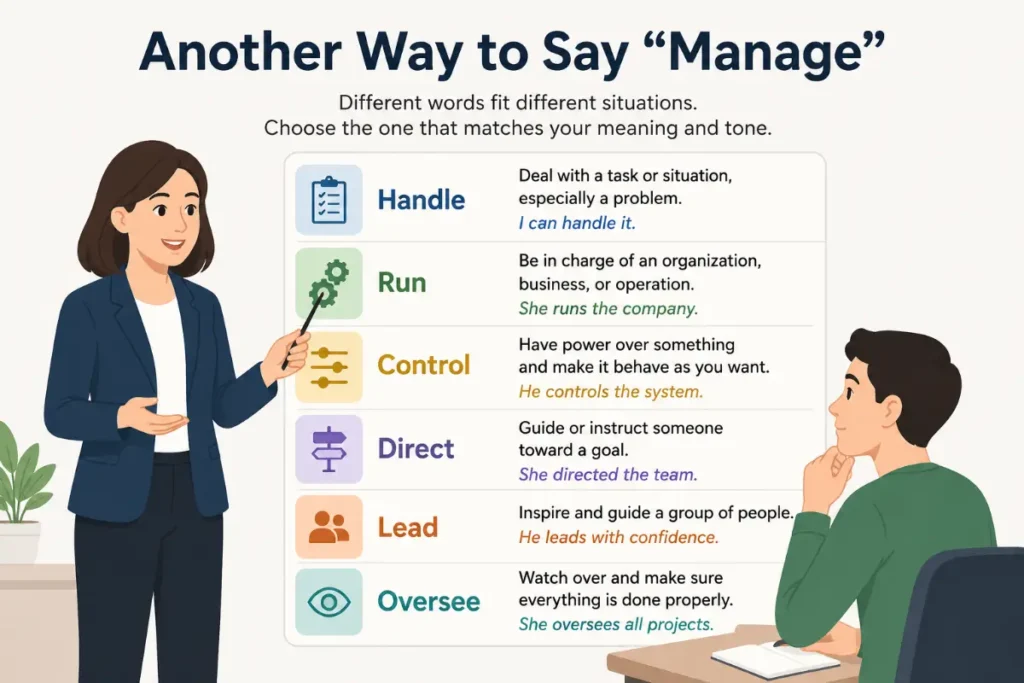
Another way to say “manage” is to use a word that matches your exact situation. Words like handle, run, control, direct, lead, and oversee all work, but each has a slightly different meaning and tone.
What Does Manage Mean?
The word manage means to take care of something successfully. It often describes being responsible for people, work, money, time, or difficult situations.
You can manage many different things.
- A manager manages employees.
- A student manages homework and deadlines.
- A family manages household expenses.
- A business manages customer service.
- A person manages stress during a busy week.
The word is flexible because it can describe leadership, organization, control, planning, or simply dealing with a situation.
Here are a few everyday examples.
- She manages a team of twelve employees.
- We managed the project from start to finish.
- He managed his time wisely.
- They managed the emergency calmly.
- I can manage the task without extra help.
Where Does the Word Manage Come From?
Many people use manage every day without knowing its history. The word comes from the Italian verb maneggiare, which meant to handle or train a horse by hand. That word developed from the Latin word manus, meaning hand. As the word spread into French and later English during the sixteenth century, its meaning became much broader. Instead of only handling horses, it began to describe handling almost any responsibility or task. Today, manage can refer to leading people, organizing work, controlling resources, solving problems, or successfully dealing with challenges. That history explains why so many modern synonyms still relate to handling, directing, organizing, and controlling something.
Why Use Synonyms for Manage?
Repeating the same word several times can make writing sound flat. Imagine reading this paragraph. She managed the office while managing several projects and managed to finish everything before Friday. Nothing is technically wrong, but it becomes repetitive. Now compare it with this version. She ran the office while overseeing several projects and completed everything before Friday. The second version flows more naturally because each word fits its specific purpose.
Using different synonyms for manage also helps you:
- Make your writing more interesting.
- Match the tone of your audience.
- Sound more professional in resumes and business writing.
- Improve clarity in essays.
- Avoid unnecessary repetition.
- Express small differences in meaning.
Master List of Synonyms for Manage
| Word | Meaning | Tone | Example |
|---|---|---|---|
| Handle | Deal with | Everyday | She handled the complaint. |
| Run | Be in charge | Everyday | He runs a restaurant. |
| Lead | Guide a team | Professional | She leads the department. |
| Direct | Guide operations | Formal | He directed the project. |
| Oversee | Supervise | Formal | She oversees operations. |
| Supervise | Monitor work | Professional | The teacher supervised the exam. |
| Control | Keep in charge | Neutral | He controlled the budget. |
| Govern | Rule or regulate | Formal | The committee governs the organization. |
| Operate | Run something | Professional | They operate warehouses. |
| Conduct | Carry out | Formal | She conducted the meeting. |
Synonyms Grouped by Style
Choosing the right word is often more important than choosing a longer word. These groups make it easier to find one that fits your situation.
Simple Everyday Synonyms
These words work in daily conversation, school writing, and most emails.
| Word | Best Use |
|---|---|
| Handle | Problems and tasks |
| Run | Businesses and organizations |
| Organize | Events and schedules |
| Plan | Future activities |
| Guide | Helping people |
| Balance | Multiple responsibilities |
| Arrange | Meetings and travel |
| Take care of | Everyday responsibilities |
| Look after | People or places |
| Cope with | Difficult situations |
Professional Synonyms
These fit resumes, business reports, LinkedIn profiles, and workplace communication.
| Word | Best Use |
|---|---|
| Lead | Teams and departments |
| Direct | Large projects |
| Oversee | Ongoing operations |
| Supervise | Employees |
| Coordinate | Multiple teams |
| Administer | Programs and systems |
| Execute | Plans and strategies |
| Facilitate | Meetings and collaboration |
| Monitor | Performance and progress |
| Head | Departments or organizations |
Formal Synonyms
These often appear in academic papers, legal writing, government documents, and official reports.
| Word | Best Use |
|---|---|
| Govern | Rules and organizations |
| Conduct | Research and meetings |
| Command | Military or leadership |
| Regulate | Laws and industries |
| Operate | Systems and businesses |
| Steer | Long term direction |
| Maintain | Processes and equipment |
Informal and Conversational Alternatives
These sound natural in conversations, blogs, text messages, and relaxed writing.
| Word | Best Use |
|---|---|
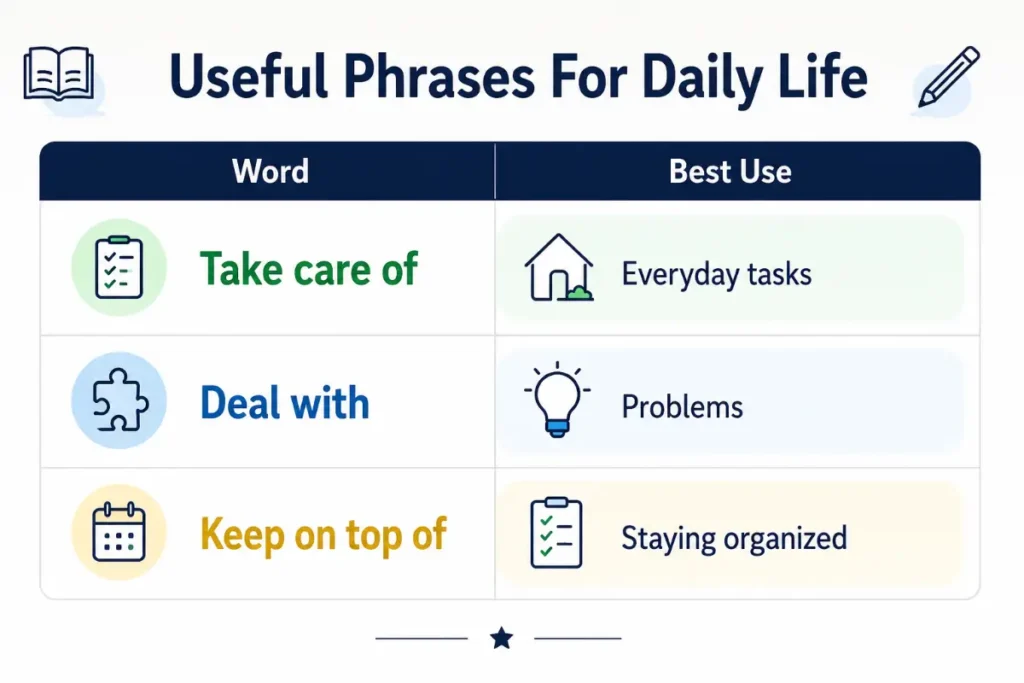
| Take care of | Everyday tasks |
| Deal with | Problems |
| Keep on top of | Staying organized |
| Stay in control of | Difficult situations |
| Sort out | Solving issues |
| Figure out | Finding a solution |
| Keep things running | Daily operations |
| Look after | Caring for people or places |
Which Synonym Is the Most Common?
Some alternatives appear much more often than others.
| Situation | Best Choice |
|---|---|
| General writing | Handle |
| Business | Lead |
| Resume | Oversee |
| Project management | Coordinate |
| Team leadership | Direct |
| Customer service | Handle |
| School essay | Organize |
| Difficult problems | Resolve |
| Daily conversation | Take care of |
| Casual speaking | Deal with |
Each of these words highlights a different skill. Someone who leads people isn’t always the same person who handles customer complaints. Someone who coordinates projects isn’t necessarily the one who controls every decision. Choosing the most accurate synonym makes your writing stronger, more natural, and easier for readers to understand.
Which Synonyms for Manage Show More or Less Authority?
Not every synonym carries the same level of responsibility. Some simply mean dealing with a task, while others suggest leading an entire organization. The table below moves from the least amount of authority to the greatest.
| Intensity | Word | Best Use | Example |
|---|---|---|---|
| Very Mild | Deal with | Everyday tasks | I dealt with the customer request. |
| Very Mild | Take care of | Personal responsibilities | She took care of the paperwork. |
| Mild | Handle | Problems and daily work | He handled the complaint professionally. |
| Mild | Organize | Events and schedules | They organized the fundraiser. |
| Mild | Arrange | Plans and appointments | We arranged the meeting. |
| Medium | Coordinate | Multiple people or tasks | She coordinated the project timeline. |
| Medium | Guide | Helping others | He guided the new employees. |
| Medium | Supervise | Watching over work | She supervised the training session. |
| Medium | Oversee | Departments or projects | He oversees company operations. |
| Strong | Direct | Leading major efforts | She directed the expansion project. |
| Strong | Lead | Teams and organizations | He leads the sales department. |
| Very Strong | Govern | Countries or organizations | The board governs the association. |
| Very Strong | Command | Military or high authority | She commanded the rescue team. |
As responsibility increases, the words sound more formal and more powerful.
Which Part of Speech Is Manage?
Most people know manage as a verb, but related forms can also improve your writing.
| Word | Part of Speech | Example |
|---|---|---|
| Manage | Verb | She manages the office well. |
| Managed | Verb | He managed the project last year. |
| Managing | Verb | They are managing several accounts. |
| Management | Noun | Good management improves productivity. |
| Manager | Noun | The manager approved the request. |
| Manageable | Adjective | The workload feels manageable now. |
Knowing these forms helps you vary your writing naturally instead of repeating the same word.
Do Americans and Britons Use Different Words?
The word manage means the same thing in American and British English. Most synonyms also work on both sides of the Atlantic.
Still, a few preferences appear more often in one region than another.
| Word | American English | British English | Notes |
|---|---|---|---|
| Run | Very common | Very common | Used for businesses and organizations. |
| Manage | Very common | Very common | Standard everywhere. |
| Supervise | Common | Common | Used in workplaces. |
| Oversee | Common | Common | Often found in professional writing. |
| Coordinate | Very common | Common | Widely used in project management. |
| Organize | Standard spelling | Organise | Only the spelling changes in British English. |
| Program | Standard spelling | Programme | When talking about events or TV, British English often uses programme. |
The meanings stay the same. Only a few spellings change.
Which Word Should You Use in Different Situations?
The best synonym depends on your audience and your purpose.
Best Word for a Resume
Resumes should show responsibility, leadership, and measurable results.
Good choices include:
- Led
- Oversaw
- Directed
- Coordinated
- Supervised
- Administered
- Executed
Instead of writing:
Managed customer service operations.
You could write:
Oversaw customer service operations for a team of 20 employees.
Or:
Led a cross functional team that improved response times by 30 percent.
These alternatives sound stronger because they describe specific leadership.
Best Word for an Essay
Essays usually need clear and precise language.
Strong choices include:
- Organized
- Directed
- Coordinated
- Conducted
- Controlled
- Governed
Example:
The city government regulates public transportation.
Instead of:
The city government manages public transportation.
Both are correct, but regulates tells readers exactly how the government is involved.
Best Word for an Email
Professional emails usually sound best with simple language.
Good choices include:
- Handle
- Coordinate
- Organize
- Take care of
- Follow up on
Example:
I’ll handle the client meeting tomorrow.
Or:
Sarah will coordinate the presentation schedule.
These sound friendly without becoming too formal.
Best Word for Text Messages
Casual conversations call for simple expressions.
Examples include:
- Take care of
- Deal with
- Sort out
- Look after
- Keep on top of
Example:
Don’t worry. I’ll take care of it.
Or:
I’ll sort it out this afternoon.
Best Word for Speaking
Natural conversations usually favor everyday vocabulary.
Instead of saying:
I administered the project.
Most people simply say:
I handled the project.
Or:
I ran the project.
Simple words usually sound more natural in speech.
Real Life Example Sentences
Seeing words in context makes them much easier to remember.
Workplace
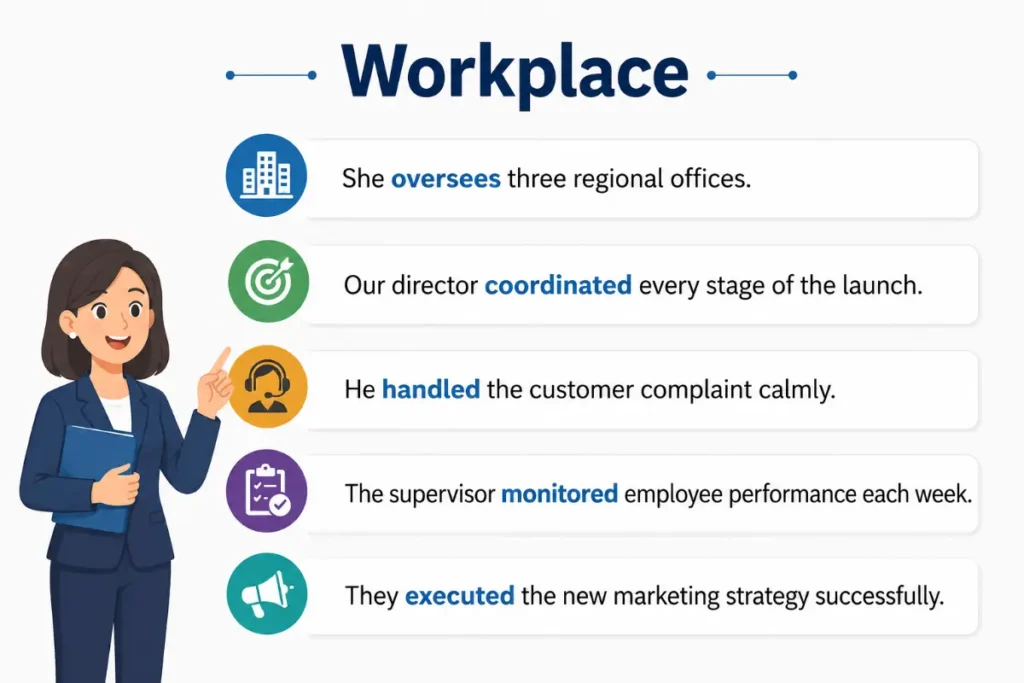
She oversees three regional offices. Our director coordinated every stage of the launch. He handled the customer complaint calmly. The supervisor monitored employee performance each week. They executed the new marketing strategy successfully.
School
The teacher organized the science fair. Maria managed her study schedule carefully. The class president led the meeting. Our group coordinated the research project together. principal supervised the examination.
Business
The CEO directs long term planning. The company operates more than fifty stores. The finance department controls spending carefully. The board governs the nonprofit organization. She headed the expansion into new markets.
Everyday Life
Dad takes care of the grocery shopping. My sister looks after our grandparents every weekend. I balanced work and college classes for two years. We arranged everything before the guests arrived. He dealt with the problem without complaining.
Difficult Situations
She coped with the stress surprisingly well. The firefighters controlled the wildfire quickly. Our guide navigated the group through heavy traffic. The counselor helped students manage anxiety before exams. The nurse handled the emergency with confidence.
Handle vs Manage
These two words are close in meaning, but they are not always interchangeable.
| Handle | Manage |
|---|---|
| Usually focuses on a single task or problem. | Often refers to ongoing responsibility. |
| Sounds more conversational. | Slightly broader and more formal. |
| Often means solving something. | Often means being responsible over time. |
Examples:
She handled the customer complaint.
This focuses on one situation.
She manages customer service.
This describes an ongoing job. A customer service manager usually manages the department but handles individual complaints.
Lead vs Oversee
People often confuse these two professional terms.
| Lead | Oversee |
|---|---|
| Actively guides people. | Supervises work without always doing it directly. |
| Often inspires a team. | Monitors progress and quality. |
| Usually involves daily leadership. | Often involves higher level responsibility. |
Examples:
She leads the engineering team.
She monitors the department and makes sure everything runs properly. Many executives oversee departments while team leaders lead employees.
Organize vs Coordinate
These words overlap but focus on different parts of a project.
Organize usually means putting everything in order before work begins.
Coordinate means making sure different people or activities work together smoothly.
Examples:
She organized the conference schedule.
She coordinated speakers volunteers and vendors throughout the event.
A large event often requires someone to organize it first and coordinate it later.
Control vs Govern
These words both involve authority, but they are used in different settings.
Control usually refers to keeping something under direction or preventing problems.
Govern usually refers to creating rules or exercising official authority.
Examples:
The technician controlled the machine remotely.
The board governs the organization.
In everyday writing, control is much more common than govern.
Common Mistakes When Using Manage and Its Synonyms
Choosing the wrong synonym can change your meaning completely. Here are some mistakes to avoid.
Using Lead for Every Situation
Not every responsibility involves leadership.
Incorrect: She leads customer complaints.
Better: She handles customer complaints.
Using Govern for Small Tasks
Govern sounds very formal.
Incorrect: I govern my homework every night.
Better: I manage my homework every night.
Using Control for People
Control sometimes sounds too forceful when talking about people.
Instead of: She controls her employees.
Try: She supervises her employees.
Or: She leads her team.
These choices sound more respectful and accurate.
Using Execute in Casual Conversation
Execute is common in business writing but sounds unnatural in everyday speech.
Formal: We executed the project successfully.
Casual: We finished the project successfully.
Using Oversee When You Mean Do the Work
Someone who oversees work usually supervises others. Someone who handles work often completes the task personally. Understanding that difference makes your writing much more precise.
Antonyms of Manage
Sometimes the opposite word communicates your meaning better.
| Antonym | Meaning |
|---|---|
| Neglect | Fail to care for something |
| Ignore | Pay no attention |
| Mismanage | Manage badly |
| Abandon | Leave completely |
| Disorder | Cause confusion |
| Disorganize | Remove order |
| Lose control | Fail to stay in charge |
| Fail | Not succeed |
Example:
Poor planning caused the team to mismanage the project.

Quick Tips for Choosing the Right Word
Use these simple rules whenever you’re unsure.
- Use handle for everyday tasks and problems.
- Use lead when people follow you.
- Use oversee when supervising departments or long term operations.
- Use coordinate when several people or teams work together.
- Use organize before an event or project begins.
- Use run for businesses, stores, or organizations.
- Use control when limiting or directing something.
- Use guide when helping someone learn or improve.
- Use take care of in casual conversations.
- Use administer or govern only in formal or official contexts.
Conclusion
Choosing the right synonyms for manage is about more than avoiding repetition. The best word helps readers understand your exact role, responsibility, or action. Sometimes handle is the clearest choice. Other times, lead, oversee, coordinate, or organize tells a more accurate story.
Before you replace the word manage, think about what you really mean. Are you leading people, solving a problem, planning an event, supervising a team, or simply taking care of a task? Once you answer that question, the right synonym becomes much easier to choose.
Keep this guide handy whenever you’re writing a resume, email, essay, report, or social media post. A small word choice can make your writing sound clearer, more confident, and more natural..
Frequently Asked Questions
What’s another way to say manage?
Some of the best alternatives are handle, lead, oversee, run, coordinate, organize, direct, and supervise. The best choice depends on your situation and the tone you want.
What are the best synonyms for manage on a resume?
The strongest synonyms for manage on a resume include led, oversaw, directed, coordinated, supervised, administered, and headed. These words highlight leadership and responsibility more clearly than the general word managed.
Is handle the same as manage?
Not exactly. Handle usually refers to dealing with a specific task, issue, or problem. Manage often describes an ongoing responsibility, such as managing a department, project, or team.
What’s the difference between lead and manage?
Lead focuses on guiding and motivating people toward a goal. Manage focuses on planning, organizing, and making sure work gets done. Many managers both lead people and manage daily operations.
Which synonym sounds the most professional?
Words like oversee, direct, coordinate, administer, and supervise often sound more professional in business writing because they describe specific responsibilities.
Can I use run instead of manage?
Yes, in many situations. You can say someone runs a business, runs a department, or runs a store. However, run does not fit every context. For example, you usually manage stress rather than run stress.
How do I choose the right synonym for manage?
Start by thinking about the action you’re describing. If you’re solving a problem, handle is usually a good fit. Matching the word to the situation makes your writing more accurate and natural.
