
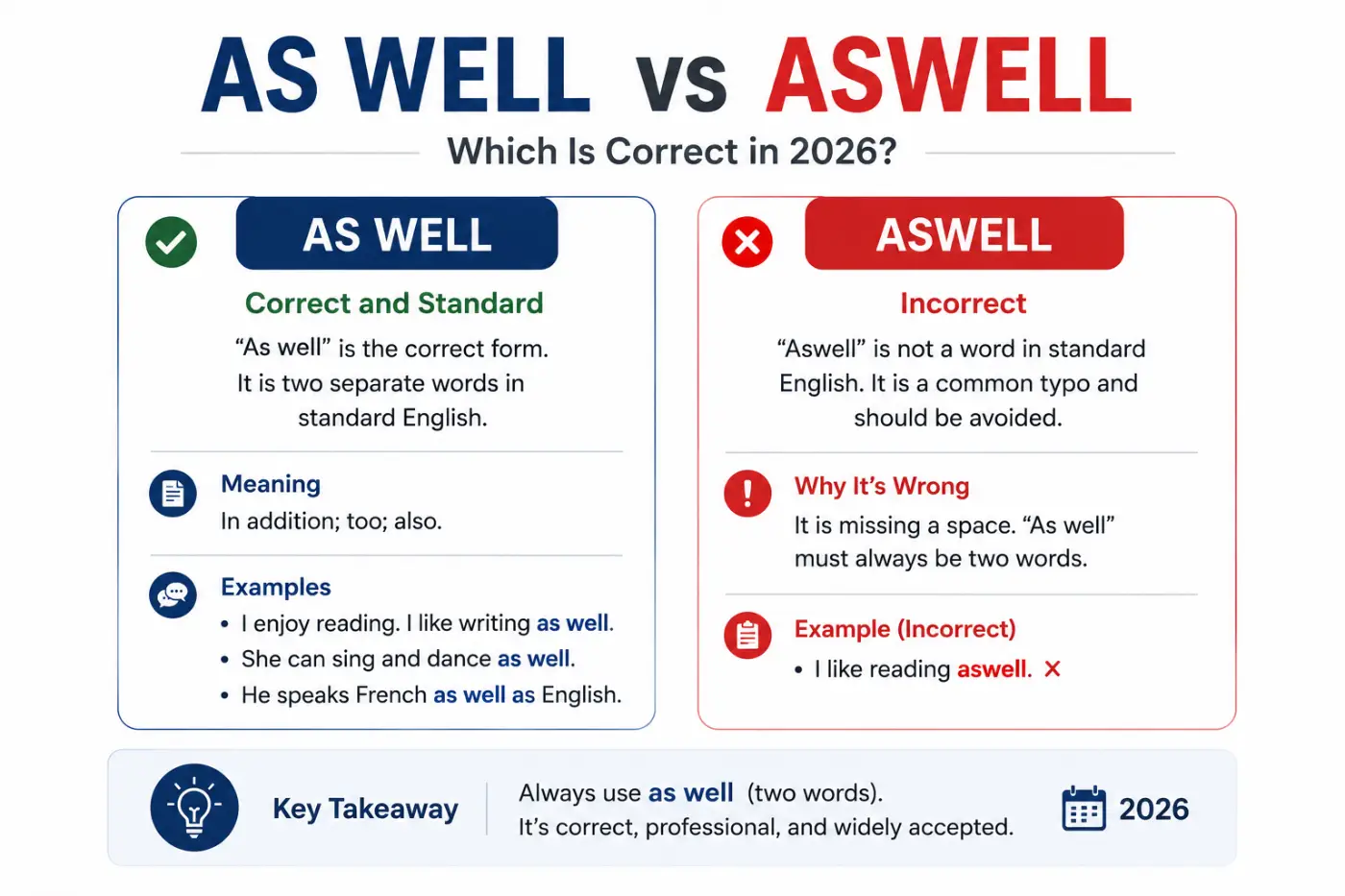
If you’re wondering aswell vs as well which is correct, the answer is simple: as well is the correct standard form. It is written as two separate words when it means also or too. Aswell is not the standard spelling in English and is generally treated as a misspelling.
This small spacing mistake happens because the phrase is usually pronounced smoothly as one unit.
You’ll see as well in everyday conversation, emails, academic writing, journalism, and formal prose. The phrase can mean also, too, or in some contexts equally well.
Its position in a sentence can change depending on the meaning and emphasis. In this guide, you’ll learn why the two words stay separate, how to use them naturally, where they belong in a sentence, how to pronounce them, and which common mistakes cause people to write them as one word. You’ll also see practical examples that make the rule easy to remember.
Quick Definition
As well is the correct standard spelling. It is a two word adverbial phrase that commonly means also or too. Aswell is not accepted as the standard English spelling. If you mean also, write as well with a space.
Quick Answer
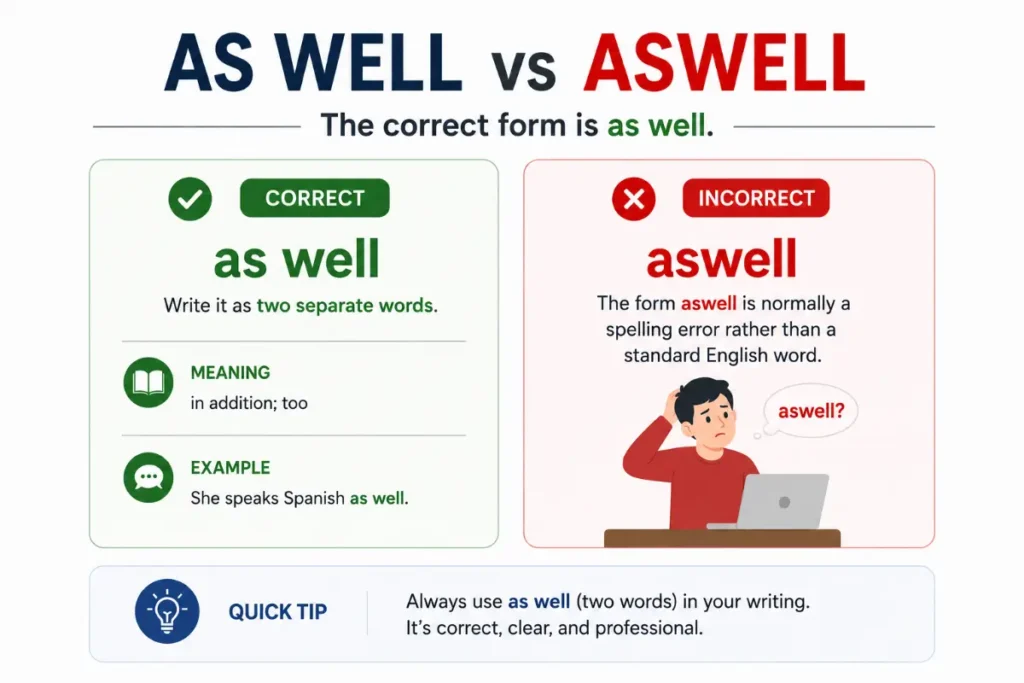
The correct form is as well. Write it as two separate words.
For example: She speaks Spanish as well. The form aswell is normally a spelling error rather than a standard English word.
Comparison Table
| Correct Form | Meaning | Part of Speech | Origin | Usage Frequency | Formality | Common Contexts | Example |
|---|---|---|---|---|---|---|---|
| As well | Also or too | Adverbial phrase | Old English and later Middle English development | Very common | Neutral | Conversation and writing | I want to go as well. |
| Aswell | No standard meaning | Not a standard part of speech | Spelling error from merging two words | Uncommon in edited English | Incorrect | Informal typing and spelling mistakes | I want to go aswell. |
Meaning and Definition
Meaning of aswell
Aswell does not function as a standard English word meaning also or too. In ordinary edited English, dictionaries do not treat it as the accepted spelling of the phrase as well.
When you see aswell, it is almost always the result of joining two words that should remain separate. This can happen during fast typing, informal messaging, proofreading errors, or because the phrase sounds connected in speech.
It’s similar to other spacing errors where a familiar phrase starts to look like one word. English contains many compound words, so writers sometimes assume that a frequently used phrase should eventually become one. That assumption doesn’t work here.
For standard English, use as well.
Meaning of as well
As well most commonly means also or too.
For example:
I want coffee as well.
This means:
I want coffee too.
The phrase can also appear in the expression as well as. In that structure, it adds another person or thing to the sentence.
For example:
She speaks English as well as French.
Here, as well as has a different grammatical function from the simple phrase as well at the end of a sentence.
The phrase has been part of English for centuries. Its modern use developed from the older meanings of well, which could refer to a satisfactory or good manner. Over time, as well developed its familiar sense of addition or similarity.
Key Differences Explained
- Spelling.
As well contains two separate words. Aswell incorrectly combines them into one. - Grammar role.
As well usually functions as an adverbial phrase. It often adds information to a sentence. - Meaning.
The phrase commonly means also or too. The single form aswell has no standard equivalent meaning. - Tone.
As well works naturally in casual conversation and formal writing. It isn’t restricted to one particular style. - Context.
You can use as well in emails, essays, reports, conversations, articles, and professional communication. The important point is simply to keep the words separate.
Which Spelling Is Correct?
As well is the correct spelling.
The linguistic reason is straightforward. As and well remain separate words when they form this adverbial phrase. Standard dictionaries such as Merriam Webster and the Oxford English Dictionary record as well rather than aswell as the normal English form.
English does contain many words that started as separate expressions and later became compounds. That historical process does not make every frequently used phrase a single word. Spelling follows established usage and convention.
A useful editorial test is substitution. Replace as well with also or too. If the sentence still makes sense, you’re probably using the phrase in its common adverbial sense.
For example:
I enjoyed the movie as well.
I enjoyed the movie too.
The meaning stays almost the same.
Now compare:
I enjoyed the movie aswell.
The meaning is understandable, but the spelling is not standard.
Major English dictionaries support the two word form. That gives the rule a strong reference point beyond personal preference.
Sentence Examples
Here are natural examples showing how as well works in everyday English.
- I’d like to order dessert as well.
- She wants to attend the meeting as well.
- Tom speaks German as well.
- We enjoyed the concert as well.
- Please send me a copy as well.
- My brother is coming with us as well.
- The new policy affects small businesses as well.
- You should check the spelling as well.
- The restaurant serves vegetarian meals as well.
- I was surprised by the result as well.
These sentences show one of the most common patterns. The phrase appears near the end of the sentence and adds another person, thing, or fact.
Now look at common incorrect examples. - I’d like to order dessert aswell.
- She wants to attend aswell.
- Tom speaks German aswell.
- Please send me a copy aswell.
- We enjoyed the concert aswell.
In every example, the intended meaning is clear. The problem is the spelling. Simply put a space between as and well.
Common Mistakes and Misspellings
People make several predictable mistakes with this phrase.
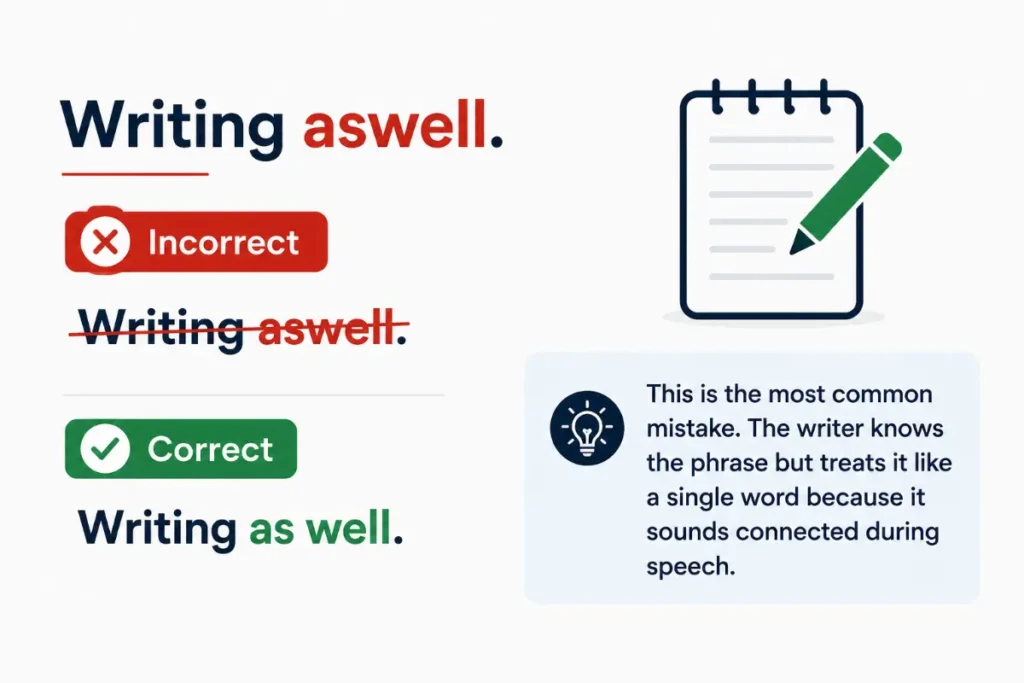
- Writing aswell.
This is the most common mistake. The writer knows the phrase but treats it like a single word because it sounds connected during speech. - Writing as well as when only as well is needed.
These structures aren’t interchangeable. As well can mean also. As well as usually introduces another element. - Confusing as well with also.
Both can express addition, but their placement can differ. Also often appears before the main verb while as well frequently appears at the end. - Adding unnecessary punctuation.
Writers sometimes add a comma before as well at the end of a simple sentence. Usually no comma is needed. - Changing the phrase to aswell during fast typing.
This is especially common when someone types from sound rather than from visual spelling.
The NLP side of the problem is interesting. Human language processing doesn’t always treat every spoken word boundary as a separate written unit. In connected speech, as well can sound like a single rhythmic chunk. That creates a spelling trap.
People also encounter genuine compound words such as already, almost, and always. The brain can use those familiar patterns as a rough analogy and incorrectly merge another frequent expression.
Pronunciation Guide
The common pronunciation of as well is approximately:
IPA: /əz wel/
A stronger pronunciation of as can appear in careful speech:
/æz wel/
The phrase has two syllables:
as well
In natural American English, the vowel in as often becomes a relaxed schwa sound. It can therefore sound closer to uhz well than a strongly pronounced az well.
That connected pronunciation can explain the spelling mistake. Speakers don’t usually pause between the two words.
A useful pronunciation guide is:
uhz WELL
The stress normally falls more strongly on well.
Avoid pronouncing the phrase as a single invented word. English speakers hear it as two words even when the transition between them is very smooth.
Etymology and Word Origin
The history of as well helps explain why the phrase remains two words.
The word as has deep Germanic roots and developed through Old English forms connected with comparison, manner, and degree. The word well also comes from Old English and has long been associated with being in a good or satisfactory manner.
The modern phrase developed through the broader history of English expression. Well gradually took on several grammatical roles beyond its basic adjective sense. It became a common adverb and later appeared in established expressions such as as well.
The meaning of as well eventually developed a strong sense of addition. When someone says:
She came as well.
The phrase means that she came in addition to someone or something already mentioned.
English spelling preserves the two word structure. Historical origin doesn’t require the phrase to become one word simply because speakers pronounce it smoothly.
Regional Usage in American English
American English uses as well frequently. You’ll hear it in everyday conversation and see it throughout edited writing. Americans often use too in casual speech, but as well remains completely natural.
For example:
I’ll bring some snacks as well.
The phrase works comfortably in professional emails, reports, articles, and academic writing.
Regional Usage in British English
British English also uses as well as the standard form. The phrase is common in both spoken and written English.
British writers may use as well in places where American writers might choose too or also. The spelling itself doesn’t change.
Regional Usage in Australian English
Australian English follows the same standard spelling. As well is written as two words and commonly expresses addition.
There is no standard Australian spelling aswell for this meaning.
Regional Usage in Canadian English
Canadian English also uses as well. Canadian writing follows the same basic grammatical and spelling convention here.
The regional differences among these varieties are mostly about preference and sentence rhythm. They don’t create a different spelling rule for this phrase.
Grammar Rules and Part of Speech
As well generally functions as an adverbial phrase.
Its most familiar meaning is also or too.
Consider:
I want to come as well.
The phrase adds the speaker to the group of people who want to come.
It can appear in several positions, but the end of the sentence is especially common.
She ordered a salad as well.
It can also appear after an auxiliary or modal structure.
You can come as well.
In some contexts, the phrase can occur earlier for emphasis.
As well as the cost, we considered the time involved.
This example uses the larger construction as well as. That structure deserves separate attention because it doesn’t simply mean also in every sentence.
When as well as connects nouns or noun phrases, it generally means in addition to.
The course covers grammar as well as vocabulary.
When it connects clauses or actions, its grammatical behavior can become more complex.
For simple everyday use, remember one reliable rule: if you mean also or too, write as well as two words.
Punctuation usually isn’t required before the phrase when it appears naturally at the end of a sentence.
I enjoyed it as well.
Not:
I enjoyed it, as well.
A comma can appear in special structures for emphasis or to separate larger sentence elements, but don’t add one automatically.
Real Life Usage Examples
Daily Talk
- I’m hungry as well.
- She wants to come as well.
These examples sound natural in ordinary conversation. In casual speech, too may sound slightly shorter, but as well is perfectly normal.
- Please send the updated file to Sarah as well.
- I’d appreciate a copy of the final report as well.
Professional email writing often benefits from the simple clarity of this phrase.
Academic Writing
- The study examines cost as well as performance.
- The researchers considered age and experience as well.
Academic writing uses both as well and as well as. The surrounding grammar determines which construction fits.
News
- The storm affected coastal areas as well.
- Officials discussed transportation as well as public safety.
News writing often uses the phrase to add another fact without making the sentence unnecessarily long.
Literature
- He remembered the promise as well.
- She knew the truth as well.
In narrative writing, as well can quietly add information and preserve the rhythm of a sentence.
Expert Editor Insight
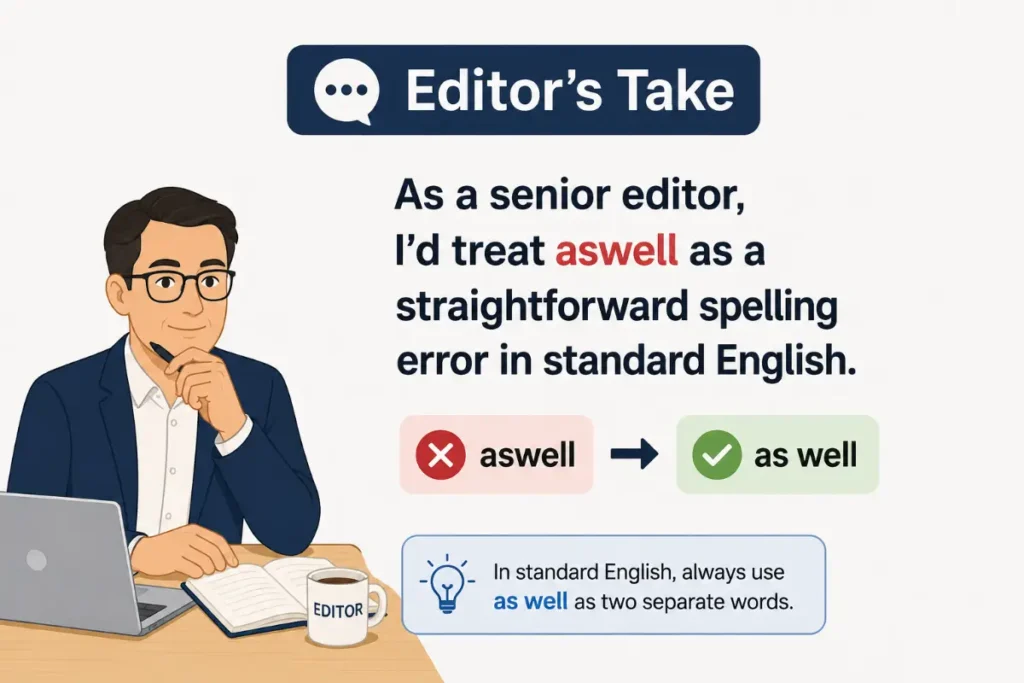
As a senior editor, I’d treat aswell as a straightforward spelling error in standard English. Native speakers understand the intended meaning immediately, but edited content should use as well. Grammar checkers and spell checkers commonly flag the merged form because mainstream dictionaries and established language databases recognize the two word phrase. My practical tip is simple: if you can replace the phrase with too or also, keep as and well separate. That quick substitution test catches the error before publication.
Conclusion
The correct form is as well. Write it as two separate words when you mean also or too. Aswell is normally a spelling error caused by the way the phrase sounds in connected speech. The phrase works across American, British, Australian, and Canadian English, so this isn’t a regional spelling difference.
The easiest way to remember the rule is to replace as well with too or also. If the meaning stays intact, keep as and well separate. One small space makes the difference between standard English and a common spelling mistake.
FAQs
Is aswell a real word?
No. Aswell isn’t the standard English spelling of the phrase meaning also or too. In edited American English, British English, Australian English, and Canadian English, the accepted form is as well. You may encounter the merged form in informal messages or online writing, but that doesn’t make it a standard spelling. Use the two word form in school, work, publishing, and professional communication.
What does as well mean?
As well usually means also or too. It adds another person, thing, or fact to something already mentioned. For example, She wants to join as well means She wants to join too. The phrase can also appear in as well as, which has a related but distinct grammatical function. Context determines the exact role of the expression.
aswell vs as well which is correct?
As well is correct. The phrase should contain a space between as and well when it means also or too. Aswell is generally a spelling mistake caused by treating the spoken phrase as one unit. Standard dictionaries and edited English use as well. If you’re writing an essay, email, article, report, or formal document, always use the two word form.
How do you pronounce as well?
As well is commonly pronounced /əz wel/ in natural American English. The first word often has a reduced vowel, so it can sound like uhz well in connected speech. The phrase contains two syllables, with the stronger emphasis usually falling on well. Because the two words flow together in normal speech, some writers mistakenly combine them when spelling the phrase.
Can as well start a sentence?
Yes, but the construction needs to fit the sentence. The phrase is more commonly placed later in a sentence when it means also or too. You might see As well as studying, she works part time at the beginning of a sentence. In that example, as well as introduces an additional activity. Simple as well usually sounds most natural near the end.
What is a synonym for as well?
The closest common synonyms are also and too when as well means an additional person or thing. For example, I want one as well has nearly the same meaning as I want one too or I also want one. Other related words don’t always work because expressions such as finally and eventually describe time or sequence rather than addition.
Why do people misspell as well?
The main reason is pronunciation. In normal speech, as well flows together so smoothly that it can sound like one word. Fast typing can reinforce the mistake. English also contains many genuine compound words, so writers may assume a frequently used expression should be combined. Spell checkers and careful proofreading can catch this simple spacing error.
Is as well suitable for formal writing?
Yes. As well is completely acceptable in formal English. You can use it in academic papers, professional emails, reports, journalism, business documents, and edited articles. It isn’t an informal expression. The key requirement is spelling it correctly as two words. In some formal contexts, also may create a more compact sentence, but as well remains grammatically standard and natural.
