
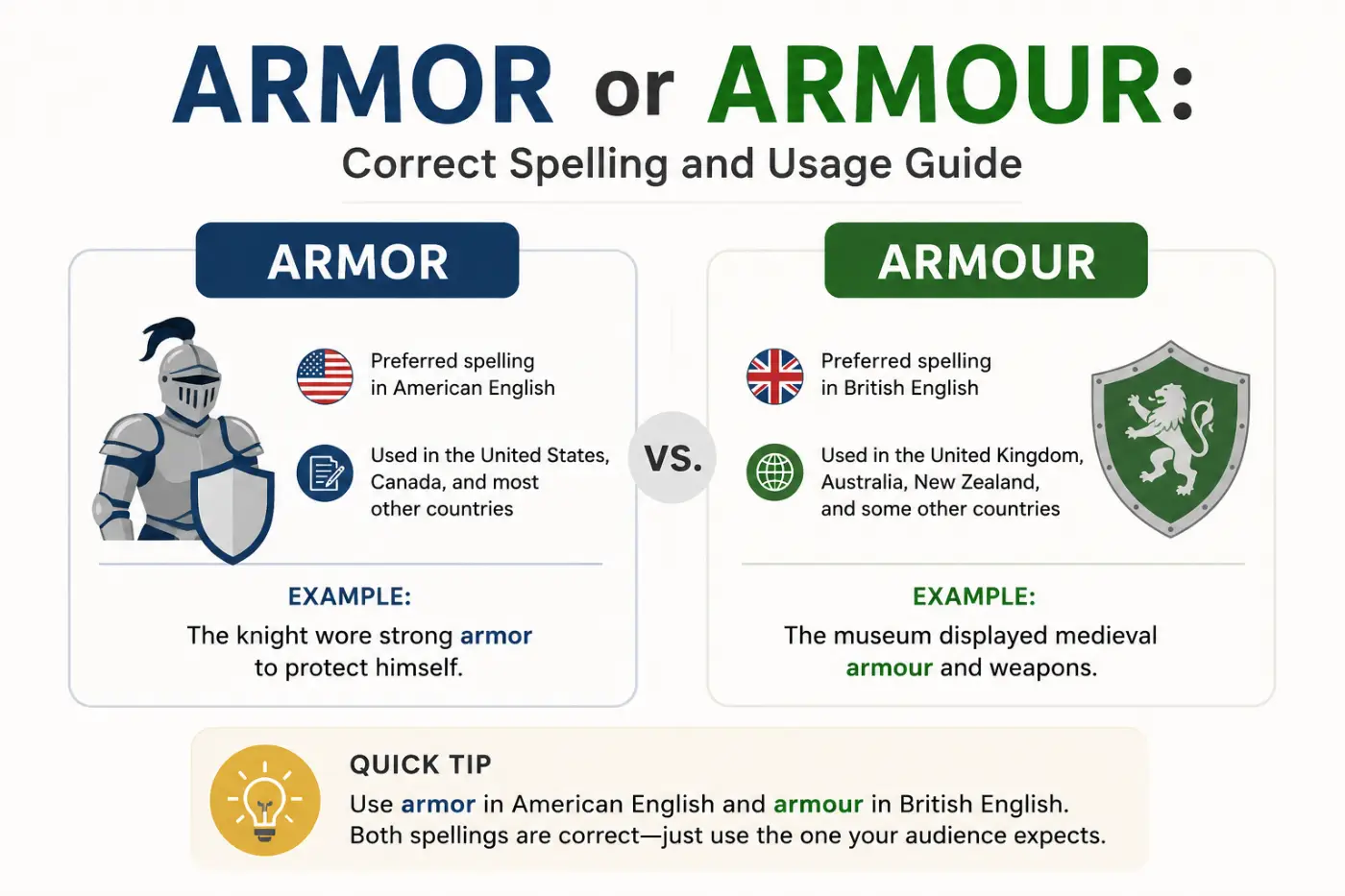
Have you ever typed armor or armours and wondered which form is correct? The answer depends on how you’re using the word. Armor is the standard American English spelling for protective covering. Armour is the British spelling. Armours is a different grammatical form that can refer to multiple types or sets of armour or serve as a verb form in specific contexts.
The confusion usually comes from the extra s at the end of armours. English often forms plurals by adding s, so it may seem natural to treat armours as the regular plural of armor. However, armor is commonly an uncountable noun when you mean protective material in general. You normally say that a soldier wears armor rather than saying that a soldier wears armors.
In this guide, you’ll learn the difference between armor, armour, and armours in clear everyday English. We’ll look at American and British usage, grammar, pronunciation, meanings, sentence examples, and common mistakes. By the end, you’ll know exactly which form to use and why.
Quick Definition
Armor is the standard American English spelling for protective covering worn by people or used to protect vehicles and other objects. Armour is the standard British spelling and is also common in many Commonwealth varieties. Armours is not simply the British spelling of American armor. It is normally a plural noun or a third person singular verb form of armour.
Quick Answer
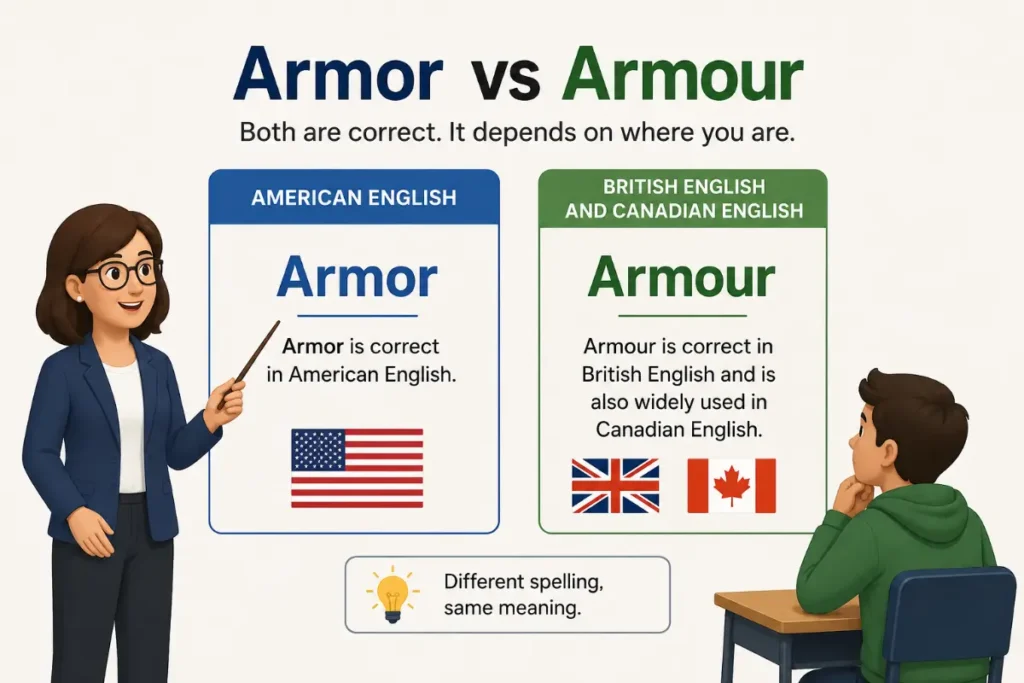
If you’re writing for an American audience, use armor. If you’re following British English conventions, use armour.
The form armours has a different grammatical job. It can be the plural of armour in contexts where individual types or sets are being discussed. It can also be the third person singular form of the verb armour.
Comparison Table Armor Or Armours
| Correct Form | Meaning | Part of Speech | Origin | Usage Frequency | Formality | Common Contexts | Example |
|---|---|---|---|---|---|---|---|
| armor | Protective covering used for protection | Noun and verb | Middle English through Old French and Latin roots | Very common in American English | Standard | Military history, vehicles, safety, figurative writing | The soldier wore heavy armor. |
| armour | Same basic meaning as armor | Noun and verb | Middle English through Old French and Latin roots | Very common in British English | Standard | British writing, history, military contexts, figurative writing | The knight wore a suit of armour. |
| armours | More than one type or set of armour in specialized contexts | Plural noun | Plural form of armour | Less common | Standard in appropriate contexts | Museum descriptions, specialist writing, historical collections | The museum contains several ceremonial armours. |
| armours | Protects or covers with armour | Third person singular verb | Verb form of armour | Uncommon outside specialist writing | Standard | Technical or descriptive writing | The vehicle armours its exposed components. |
Meaning And Definition
Meaning Of Armor
Armor is a noun that refers to a strong protective covering. Historically, it often meant metal clothing worn by soldiers or warriors. Today, the word can describe protective material used on people, vehicles, ships, and other objects.
Cambridge defines armor as a strong covering that protects a person, animal, or vehicle. It also uses the word for military vehicles protected by strong material. Oxford gives similar meanings and includes historical body protection, protective metal covering for military vehicles, and military vehicles used in warfare.
The word can also be used figuratively.
For example:
- She developed an emotional armor after years of criticism.
- Humor became his armor during difficult conversations.
- Confidence can act like armor in stressful situations.
In these examples, nobody is wearing metal. The word describes something that provides psychological or emotional protection.
For American readers, armor is the normal spelling. You will see it in phrases such as body armor, armor plate, armor protection, armored vehicle, and suit of armor.
Meaning Of Armour
Armour has the same basic meaning as armor. The main difference is spelling.
British English normally uses armour, while American English normally uses armor. Cambridge explicitly identifies armor as the US spelling of armour and identifies armour as the UK spelling of armor.
For example:
- The knight wore a suit of armour.
- The museum displays medieval armour.
- The tank was protected by heavy armour.
Canadian English also commonly uses armour. Oxford notes that Canadian English usually uses armour, while American English uses armor.
So armor and armour are spelling variants of the same word. Neither one represents a different kind of protective equipment.
Meaning Of Armours
This is where the comparison becomes more interesting.
Armours is not simply another spelling of armor. It is formed by adding s to armour.
As a noun, armours can refer to multiple kinds or sets of armour. This use is relatively specialized because armour is commonly treated as an uncountable noun when referring to protective material generally.
For example:
- The collection contains several ceremonial armours.
- Historians compared the armours used by different armies.
- The gallery displays tournament armours from different periods.
The Getty Art and Architecture Thesaurus also uses forms such as parade armours and tournament armours for groups of specialized historical protective equipment.
Armours can also function as a verb. The verb armour means to protect something with armour. Its third person singular present form is armours.
For example:
- The material armours the outer surface.
- The company armours vehicles for extreme conditions.
This distinction matters because someone searching for armor or armours may actually be comparing a base noun with a grammatical form rather than two spelling variants.
Key Differences Explained
Spelling
Armor is the American spelling.
Armour is the British spelling and is widely used in Canadian and other Commonwealth English contexts.
Armours contains an additional s and has a different grammatical function.
Grammar Role
Armor can function as a noun and as a verb.
Armour can also function as a noun and as a verb.
Armours can function as a plural noun or as the third person singular present form of the verb armour.
Meaning
Armor and armour have the same basic meaning.
Armours usually refers to multiple examples or types of armour or describes something that protects another object when used as a verb.
Tone
All three forms can appear in formal writing when the context is appropriate.
The choice between armor and armour usually depends on the English variety you’re following rather than on formality.
Context
American newspapers, American textbooks, American websites, and most US business writing normally use armor.
British newspapers, British books, and British educational materials normally use armour.
Specialist historical writing may use plural forms such as armours when discussing separate suits or types.
Which Spelling Is Correct
Both armor and armour are correct spellings.
For American English, armor is the preferred form. For British English, armour is the standard form. Cambridge and Oxford both support this regional distinction.
The linguistic reason is straightforward. English developed different spelling conventions on opposite sides of the Atlantic. The extra u in words such as armour, colour, and favour is characteristic of many British spelling conventions. American English often uses shorter forms such as armor, color, and favor.
That doesn’t make one version more correct than the other.
The real mistake is using the wrong regional convention for the style you’re following.
If you’re writing an article for readers in the United States, choose armor.
An editor doesn’t normally change armour to armor because one is grammatically superior. The editor changes it to match the publication’s chosen variety of English.
Sentence Examples
Examples With Armor
- The knight wore a suit of armor during the ceremony.
- The soldiers received new body armor before deployment.
- The tank has reinforced armor around its main compartment.
- The museum has a rare collection of medieval armor.
- The animal’s thick shell acts as natural armor.
- She used humor as emotional armor during difficult moments.
- The vehicle was designed with additional armor for protection.
- The warrior’s armor was decorated with intricate patterns.
- Modern body armor is much lighter than historical metal protection.
- His calm attitude became a kind of armor against criticism.
Examples With Armours
- The museum displays ceremonial armours from several centuries.
- Researchers compared the armours used by different European armies.
- The exhibition contains tournament armours made for mounted combat.
- The collection includes several decorative armours from the period.
- The material armours the surface against impact.
The first four examples use armours as a plural noun. The final example uses armours as a verb.
Common Mistakes And Misspellings
Several forms can cause confusion because English spelling often creates patterns that look more complicated than they really are.
Armor And Armour
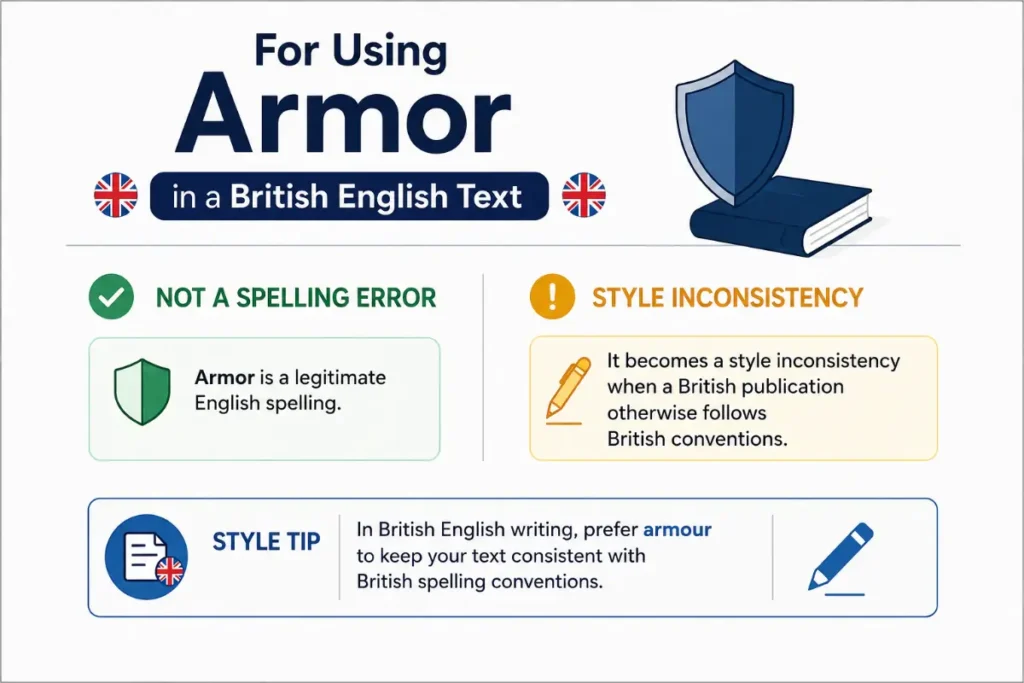
This is not a spelling mistake. It is a regional spelling difference.
American English uses armor.
British English uses armour.
Armor And Armours
These forms aren’t interchangeable.
Use armor when referring to the protective material generally in American English.
Use armours only when the grammatical context calls for it.
Armour And Armors
This combination mixes regional conventions.
If you’re using British spelling, armour is the normal form.
If you’re using American spelling, armor is the normal form.
The plural forms can follow the selected spelling system when a countable plural is actually needed.
Armored And Armoured
American English uses armored.
British English uses armoured.
Cambridge and Oxford both identify this regional spelling distinction.
Armory And Armoury
American English commonly uses armory.
British English commonly uses armoury.
This is another example of the same spelling pattern.
Why People Mix These Forms
From an NLP perspective, spelling confusion often develops from pattern recognition. Readers learn that British English frequently adds u to words such as colour and favour. They may then apply the pattern mechanically to related words.
Another source of confusion is morphology.
A person may see armour and assume that adding s creates a normal everyday plural. But English often treats material and substance nouns as uncountable. Armour commonly works this way.
That means you usually say:
The soldiers wore armor.
You don’t normally need:
The soldiers wore armors.
The plural becomes useful when you’re talking about separate types, sets, or examples.
Pronunciation Guide
The pronunciation of armor and armour is essentially the same in American English.
Cambridge gives the American pronunciation as /ˈɑːr.mɚ/. In British English, the pronunciation is commonly represented as /ˈɑː.mə/.
A simple pronunciation guide for American English is:
AR mer
The word has two syllables.
The first syllable sounds like ar.
The second sounds like the unstressed mer in many American pronunciations.
For British English, the final sound is less strongly pronounced with an r.
A common mistake is to pronounce the word as if it were connected to the word arm followed by a strongly stressed second syllable. Native speakers usually produce it as one smooth two syllable word.
The spelling difference doesn’t create a major pronunciation difference for most speakers.
Etymology And Word Origin
The history of armor reaches far back into European languages.
Oxford traces armour through Middle English to Old French armure and ultimately to Latin armatura. Latin armare meant to arm or equip with weapons and came from arma, referring to weapons or equipment used in warfare.
The word entered English during the Middle English period through French influence.
That history explains why the word is closely connected to other terms involving weapons, military equipment, and protection.
Over centuries, the meaning expanded.
Originally, the word was strongly connected with physical protection used in warfare. It later became useful for describing protective coverings on ships, military vehicles, and other objects.
The figurative meaning also became common.
Today, you might say that someone has armor around their emotions. You might describe skepticism as armor against manipulation. These uses take the physical idea of protection and apply it to an abstract situation.
English often develops words this way. A concrete object becomes a metaphor for an abstract quality.
Regional Usage In The US
American English normally uses armor.
You’ll see it in phrases such as body armor, armor plating, suit of armor, and armored vehicle.
Oxford’s American English dictionary lists armor as the standard American form and identifies Canadian English as a variety that usually uses armour.
For a US audience, armor is the safest and most natural choice.
Regional Usage In The UK
British English normally uses armour.
British writers commonly use phrases such as body armour, suit of armour, armoured vehicle, and heavy armour.
Cambridge lists armour as the UK spelling of armor.
If you’re preparing content for British readers, changing every instance to armor can make the text look distinctly American.
Regional Usage In Australia
Australian English generally follows British spelling conventions in many areas. As a result, armour is the expected spelling in Australian writing.
You’ll commonly encounter forms such as armoured, armoury, and body armour alongside armour.
The key point is consistency. If the rest of your article follows British style, keep the u.
Regional Usage In Canada
Canadian English often uses armour.
Oxford specifically notes that Canadian English usually uses armour. Cambridge also identifies armour as a Canadian British spelling form.
Canadian usage can sometimes sit between American and British conventions. That’s why a Canadian publication may use armour even though American readers are more accustomed to armor.
Grammar Rules And Part Of Speech
Armor and armour can work as nouns.
As nouns, they commonly refer to protective material.
For example:
The soldier wore armor.
The knight wore armour.
They can also function as verbs.
For example:
The manufacturer armored the vehicle.
The manufacturer armoured the vehicle.
The American verb is armor.
The British verb is armour.
The third person singular forms are armors and armours.
For example:
The new material armors the vehicle.
The new material armours the vehicle.
However, this verb use is much less common in everyday conversation than the noun.
Noun Usage
When referring to armor as a general substance or category, the noun is commonly uncountable.
Natural:
The soldiers wore heavy armor.
Less natural in ordinary usage:
The soldiers wore heavy armors.
A plural becomes useful when the writer needs to distinguish separate examples, categories, or sets.
For example:
The museum contains several ceremonial armours.
Sentence Placement
The noun can appear after a verb.
The knight wore armor.
It can also appear before another noun.
The armor plates were damaged.
It can appear in figurative expressions.
His confidence was his armor.
Punctuation
The word itself does not require special punctuation.
If it appears at the beginning of a sentence, capitalize it because it begins the sentence.
If it appears in the middle of a sentence as an ordinary noun, use lowercase unless a proper name or title requires capitalization.
Real Life Usage Examples
Daily Talk
- I watched a movie about knights in armor.
- That motorcycle jacket has built in protective armor.
- The supplier confirmed that the vehicle armor meets the requested specifications.
- I’ve attached the report on the new body armor materials.
Academic Writing
- Medieval armor changed considerably as weapons became more powerful.
- Researchers examined how animal armor evolved as a defensive adaptation.
News Writing
- The military introduced new armor for its vehicles.
- Officials discussed improvements to protective body armor.
Literature
- The knight entered the hall wearing polished armor.
- Her silence became a kind of armor against the world.
These examples show how the word moves comfortably between technical writing and everyday language
Expert Editor Insight
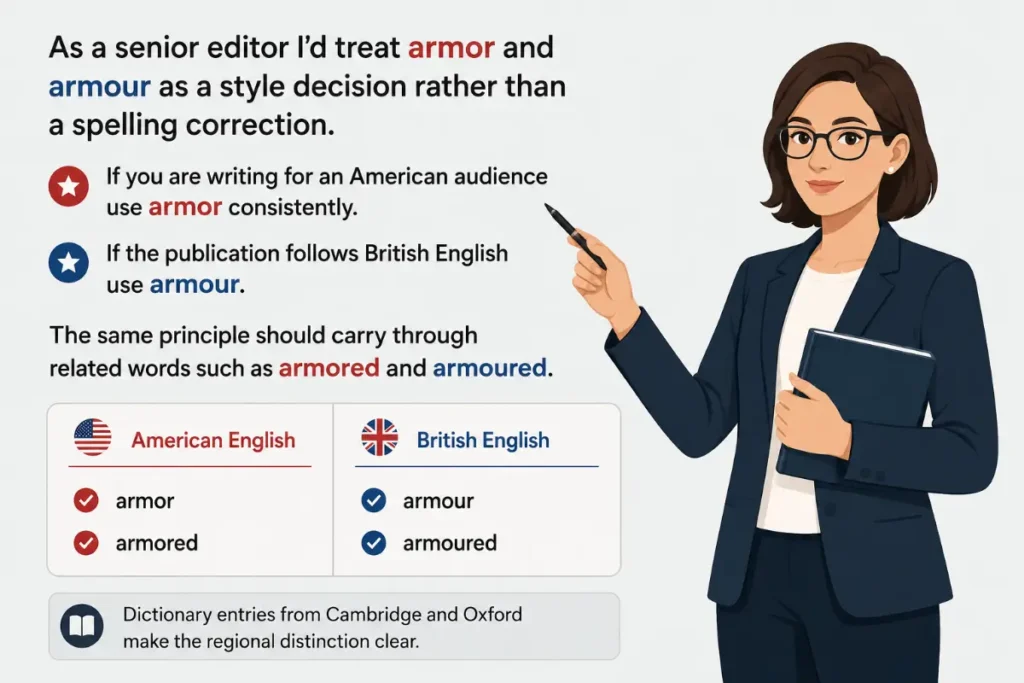
As a senior editor, I’d make the regional decision before editing the rest of the article. If your publication follows American English, choose armor and maintain that form in related words such as armored and armory. If your publication follows British English, choose armour and maintain forms such as armoured and armoury. Dictionary evidence supports this regional distinction rather than treating one spelling as an error.
One practical tip is to check the style of the surrounding document instead of checking the word in isolation. A document that uses color, favor, and center will usually fit better with armor. A document that uses colour, favour, and centre will usually fit better with armour.
Final Takeaway
Armor and armour are both correct. Armor is the standard American English spelling, while armour is the standard British spelling and is also widely used in Canadian and other Commonwealth varieties. Armours is different because it can be a plural noun or a third person singular verb form.
If you’re writing for a US audience, choose armor and keep related forms consistent. If you’re following British style, choose armour. The easiest editing rule is simple: match the spelling to your chosen variety of English and don’t mix styles within the same document.
FAQs
Is Armours A Real Word?
Yes. Armours is a real English form. It can function as the plural of armour in specialized contexts where writers discuss separate types or sets of protective equipment. It isn’t simply the British spelling of American armor.
What Does Armor Mean?
Armor means protective covering used to protect a person, animal, vehicle, ship, or other object from injury or damage. Historically, it often referred to metal protection worn by warriors. Today, it can describe body protection, vehicle protection, and even figurative emotional protection. American English normally uses armor, while British English normally uses armour.
Armor Or Armours Which Is Correct?
Both forms can be correct, but they don’t normally serve the same purpose. Armor is the standard American spelling of the noun and verb. Armours is a grammatical form that can represent multiple sets or types of armour, or the third person singular form of the verb armour. For ordinary American writing, use armor.
How Do You Pronounce Armor?
In American English, armor is commonly pronounced /ˈɑːr.mɚ/. You can think of it as AR mer with two syllables. British English usually has a pronunciation closer to /ˈɑː.mə/. The spelling difference between armor and armour doesn’t normally create a major difference in pronunciation.
Can Armor Start A Sentence?
Yes. Armor can begin a sentence normally because it is an ordinary noun. For example, you could write Armor protected the soldiers during the battle. Capitalization is required because the word begins the sentence, not because armor is a proper noun. In ordinary writing, there is no special punctuation rule attached to the word.
What Is A Synonym For Armor?
Depending on the context, possible alternatives include protection, shielding, defensive covering, protective gear, and protective equipment. These aren’t perfect replacements in every sentence. Armor often suggests a physical protective layer associated with warfare or defense. In figurative writing, words such as shield or defense can sometimes work better.
Why Do People Misspell Armor?
The most common confusion comes from regional spelling differences. Writers exposed to British English may learn armour, while American English uses armor. The extra u can also feel natural because English contains many familiar British forms with that pattern. People may then mix regional conventions within the same document. Consistency is the easiest way to avoid the problem.
Is Armor Used In Formal Writing?
Yes. Armor is completely appropriate in formal American English. It appears in academic writing, journalism, military writing, historical research, technical documents, and professional publications. The British equivalent armour is equally appropriate in formal British English. The choice depends mainly on the regional style of the document rather than on the level of formality. Oxford and Cambridge both recognize the regional distinction
