
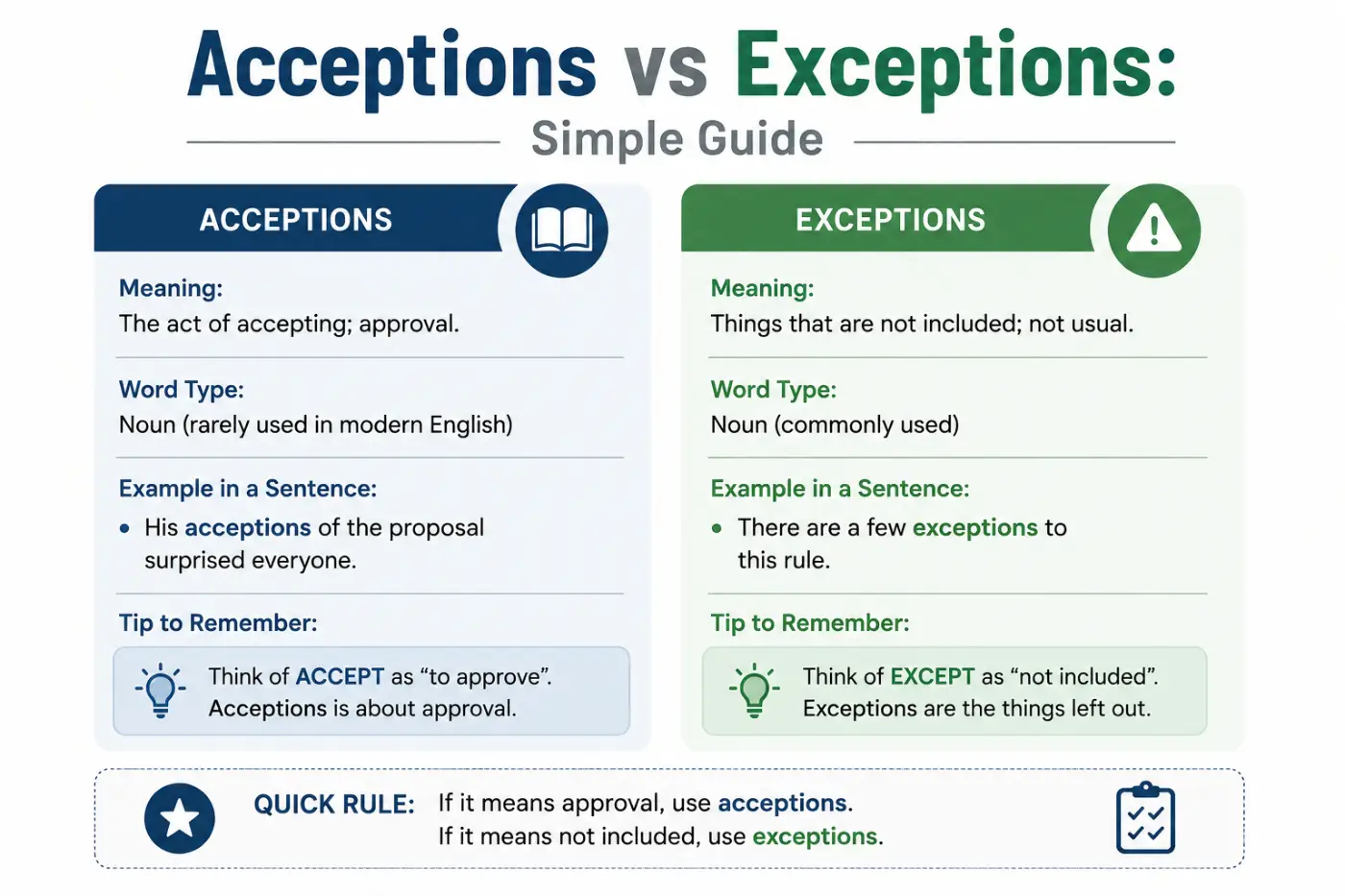
Imagine you’re writing an email, essay, resume, or text when you suddenly pause over a word that looks almost right. Acceptions vs exceptions can be confusing because the two words look and sound similar, yet they have very different meanings. If you type acceptions when you mean exceptions, your sentence can quickly take on a completely different meaning.
The confusion is understandable because acception is a real English word. It isn’t simply a misspelling of exception. However, acception is rare in modern English, while exception is common in everyday writing and speech. That difference in frequency makes it easy to choose the wrong word without noticing.
Answer box: Acception is a rare noun that can refer to a particular meaning or sense of a word. Exception refers to something outside a rule, general statement, or usual pattern. In everyday American English, exception is far more common.
What is the difference between acception and exception?
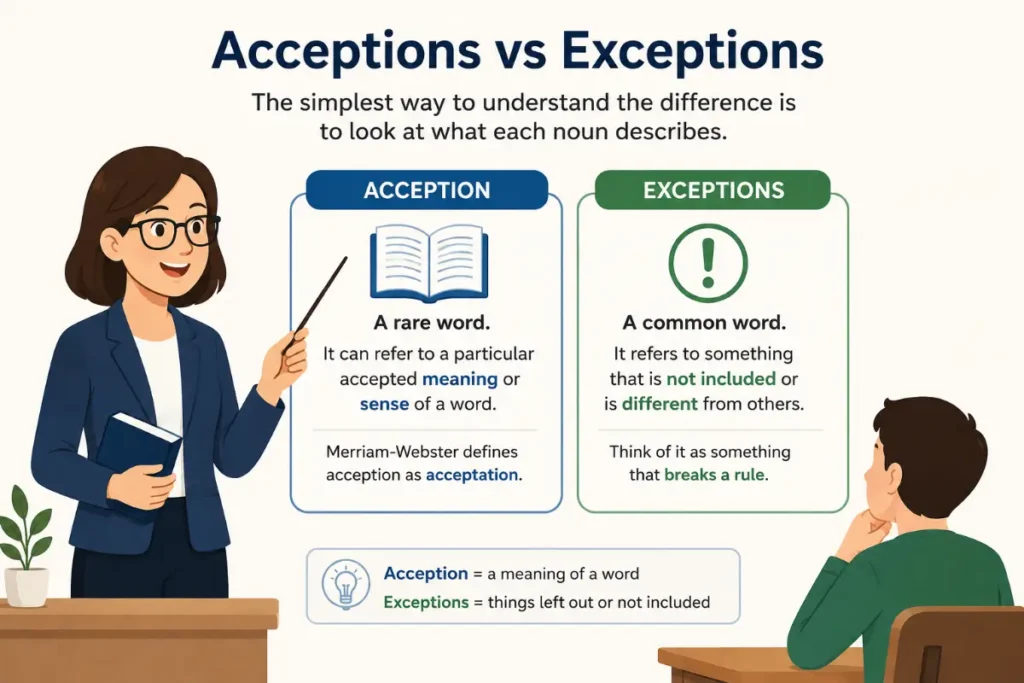
The simplest way to understand acceptions vs exceptions is to look at what each noun describes. Acception is a rare word. It can refer to a particular accepted meaning or sense of a word. Merriam Webster defines acception as acceptation, and historical usage connects it with a word’s accepted or received sense.
Exception is a common word. It describes something that is left out, excluded, or not covered by a general rule. It can also describe a person or thing that does not fit the normal pattern.
Compare these two ideas:
| Word | Basic meaning | Common today? |
|---|---|---|
| Acception | A particular meaning or accepted sense | Rare |
| Acceptions | Particular meanings or accepted senses | Very rare |
| Exception | Something outside a rule or general pattern | Very common |
| Exceptions | Things outside rules or general patterns | Very common |
So if you’re talking about rules, unusual cases, exclusions, special cases, or things that don’t fit a pattern, exceptions is almost certainly the word you need. If you’re discussing the specific meanings of a word in a technical linguistic or historical context, acceptions may be appropriate.
What does acception mean?
Acception is a noun with a specialized and uncommon meaning. One sense refers to a particular meaning, interpretation, or accepted sense of a word. In this use, a word can have several acceptions, meaning several recognized senses.
For example:
The word has several acceptions in older English texts. That sentence means the word has several meanings or senses in those texts.
Acception can also be connected with the idea of acceptance, although this use is rare and often historical. Modern readers are much more likely to understand acceptance than acception when the intended meaning is approval or agreement.
This creates an important writing rule. If you mean approval, use acceptance. If you mean something that does not follow a rule, use exception. The distinction becomes much clearer once you stop judging the words by their spelling and focus on the idea behind them.
What does exception mean?
Exception is a common noun used in everyday English, academic writing, business communication, law, technology, and ordinary conversation.
Its central meaning is something that does not belong to a general rule, group, statement, or pattern.
For example:
Here, exceptions are cases that do not follow the general rule.
You can also use exception for something that is left out.
Everyone attended the meeting with one exception.
The sentence means everyone attended except one person.
Another common use appears in the phrase make an exception.
The store normally closes at six, but the manager made an exception.
The manager allowed something that normally would not be allowed.
Exception also appears in take exception to, which means to object to something or feel offended by it.
She took exception to his comment.
That use is common in formal English and can sound stronger than simply saying that someone disagreed.
Where did acception and exception come from?
The history of acceptions vs exceptions helps explain why the words look so similar.
Acception comes from older forms connected with Latin acceptio, which developed through French and Middle English. Merriam Webster records its first known English use in the 14th century.
Exception also has a long history. It comes from Middle English forms that trace back through Old French to Latin exceptio. The Latin verb excipere carried the idea of taking out or excluding.
The two words therefore share a distant family resemblance. Their beginnings are related to ideas involving taking, receiving, or excluding, but their modern meanings developed in different directions.
That is one reason the spelling can feel confusing.
The important point for modern writers is simple. Similar endings do not mean similar meanings.
How do you pronounce acception and exception?
Acception and exception can sound very similar, especially when spoken quickly. In American English, acception is generally pronounced like ak SEP shun. Exception is commonly pronounced like ik SEP shun. The middle sound is similar, and both words have three syllables. That similarity can make them difficult to distinguish in conversation.
Because acception is rare, many people have heard exception hundreds of times but may never have heard acception used naturally. If you encounter acception in an older book, academic text, or specialized discussion, don’t assume it is a spelling error just because it sounds unusual.
Why do people confuse acception and exception?
The spelling is the biggest reason. words end in ception. Both contain similar letters. Their pronunciations are also close. There is another problem. The common word exception is familiar, while acception is not.
A reader may see acception and automatically assume someone made a spelling mistake. In many ordinary situations, that assumption will be correct because the writer probably meant exception.
However, context matters.
Consider:
There are several exceptions to this rule.
This is ordinary English.
Now consider:
The term has several acceptions in medieval texts.
This is specialized language about meanings.
The second sentence is possible, but most everyday readers would find senses or meanings clearer.
That leads to a useful editing principle: a word can be technically correct and still be a poor choice for your audience.
What are the best synonyms for acception and exception?
The right synonym depends on the sense you intend. For acception, useful alternatives include meaning, sense, interpretation, definition, and usage when discussing the meaning of a word. For exception, alternatives include exclusion, special case, outlier, departure, irregularity, and anomaly.
The following list gives more than 20 useful alternatives and conversational substitutes. Some are exact synonyms, while others work only in certain contexts.
| Word | Meaning | Tone | Example |
|---|---|---|---|
| Meaning | What a word or statement expresses | Simple | What is the meaning of this word? |
| Sense | A particular meaning of a word | Simple | The word has another sense here. |
| Definition | An explanation of a word’s meaning | Simple | Check the definition first. |
| Interpretation | The meaning someone gives to something | Everyday | Her interpretation was different. |
| Usage | How a word is used | Everyday | Modern usage has changed. |
| Explanation | A clear account of meaning | Everyday | His explanation was easy to understand. |
| Understanding | The way someone understands an idea | Everyday | My understanding is different. |
| Reading | A particular interpretation of text | Everyday | That is one possible reading. |
| Significance | Importance or meaning | Formal | The term has historical significance. |
| Connotation | An associated idea or feeling | Formal | The word has a negative connotation. |
| Denotation | The direct dictionary meaning | Formal | The denotation is fairly clear. |
| Interpretation | A particular way of understanding something | Formal | The court considered that interpretation. |
| Acceptation | An accepted meaning or sense | Formal | The older acceptation differs from the modern one. |
| Definition | The established meaning of a term | Formal | The definition varies by field. |
| Exclusion | The act of leaving something out | Formal | The exclusion applies to contractors. |
| Omission | Something left out | Formal | The omission was intentional. |
| Out of the ordinary | Not usual or expected | Informal | Nothing out of the ordinary happened. |
Some of these terms should not replace exception in every sentence. For example, anomaly usually means something unusual, but it does not always mean something formally excluded from a rule.
Likewise, meaning can replace acception when you are discussing a word’s sense, but it does not replace exception.
What are synonyms by intensity?
Synonyms can also be grouped by how strong or technical they sound.
For a mild difference, use words such as difference, variation, special case, or departure.
For word meaning, start with the plain terms meaning and sense. Move toward more specialized terms such as interpretation, connotation, or denotation when the subject requires them.
For example:
This is a small variation from the normal pattern.
This sounds mild.
This is an exception to the rule.
This clearly says the normal rule does not apply.
The result is an anomaly.
This suggests something unusual that may need investigation.
Choosing the right level of intensity makes your writing more precise.
Which synonyms work by part of speech?
Acception and exception are nouns, so their closest replacements are usually nouns.
For acception, noun alternatives include:
- Meaning.
- Sense.
- Interpretation.
- Definition.
- Usage.
- Acceptation.
For exception, noun alternatives include:
- Exclusion.
- Special case.
- Outlier.
- Anomaly.
- Irregularity.
- Deviation.
- Departure.
You can also change the sentence structure and use related adjectives or verbs.
For example:
This case is an exception to the rule.
Can become:
This case does not follow the rule.
Or:
This case is unusual.
The second and third versions are often easier for general readers.
What is the difference between exception and exclusion?
Exception and exclusion are close, but they are not always interchangeable.
An exception is a case that does not follow a general rule.
An exclusion is something deliberately left out or prevented from being included.
Compare:
Children under five are an exception to the admission fee.
This means the general fee rule does not apply to children under five.
Children under five are excluded from the admission fee.
This sentence is awkward because the intended idea is usually that they are exempt from the fee. Exclusion focuses more directly on being left out.
A clearer sentence would be:
Children under five are excluded from the fee.
The choice depends on the structure of the situation.
What is the difference between exception and anomaly?
An exception is often connected to a rule.
An anomaly is usually connected to an unusual result or pattern.
For example:
The company allows no exceptions to this policy.
The focus is on a rule.
The unusually high result was an anomaly.
The focus is on something that looks unusual.
You can sometimes use either word, but they create different impressions.
Exception says, “This does not follow the general rule.”
Anomaly says, “This looks unusual compared with the expected pattern.”
That distinction matters in academic writing, business reports, statistics, and technical discussions.
What is the difference between exception and outlier?
An outlier is a data point or example that stands noticeably apart from the rest.
For example:
Most students scored between 70 and 85, but one score of 20 was an outlier.
You could not automatically replace outlier with exception. The score might be an exception to an expected pattern, but outlier specifically emphasizes its distance from the other data.
In simple writing, exception is broader.
In statistics and data analysis, outlier is often more precise.
What is the difference between acceptance and acception?
This is one of the most useful distinctions to remember.
Acceptance is the normal modern word for the act of accepting something or agreeing to receive or approve it.
We received her acceptance of the offer.
Acception is a rare word. In specialized or historical usage, it can refer to a particular meaning or accepted sense. Merriam Webster treats it as equivalent to acceptation.
So if you mean approval, use acceptance.
If you mean a particular meaning of a word in a specialized context, acception may be correct. For most modern readers, acceptance will be the clearer choice when talking about accepting something.
Which word is best for a resume?
For a resume, exception is normally the useful word of the two.
You might write:
Maintained accurate records with few exceptions.
You would almost never need acceptions on a standard American resume.
If you are applying for a job in linguistics, historical language studies, lexicography, or another specialized field, you might encounter the term acception in your academic or professional work.
Even then, use it only when you specifically mean a word sense.
For most resumes, plain language is stronger.
Developed a clear process for handling unusual cases.
This is usually more useful to a hiring manager than a rare word.
Which word is best for an essay?
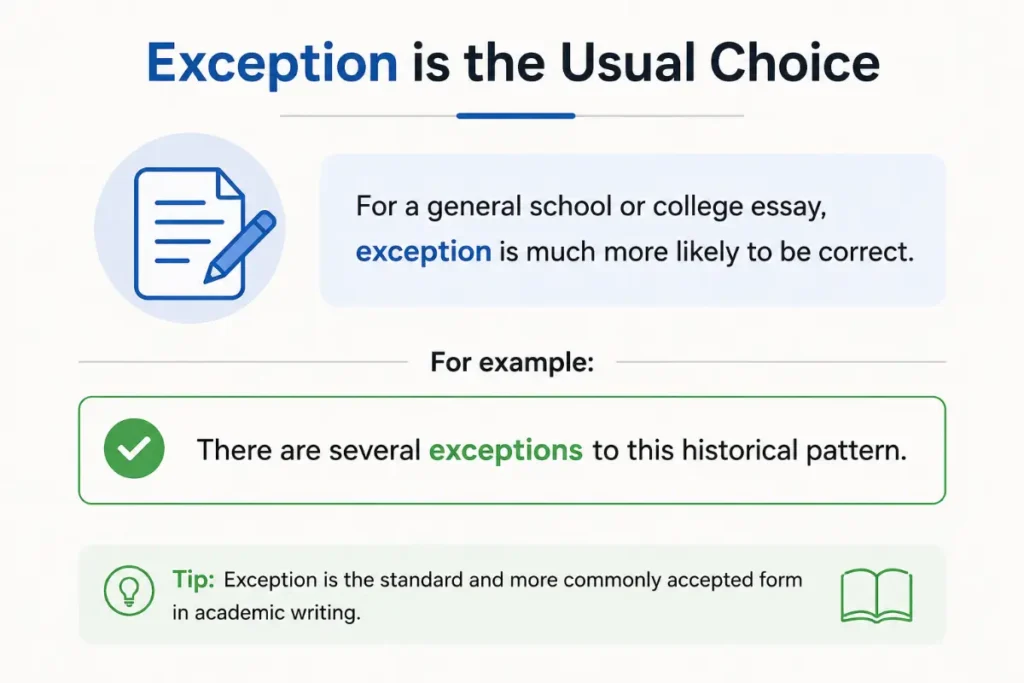
For a general school or college essay, exception is much more likely to be correct.
For example:
There are several exceptions to this historical pattern.
If your essay discusses linguistics, dictionaries, semantics, or the history of English, acception may appear in a specialized discussion.
For example:
The term had a different acception in early English texts.
Still, meaning or sense may be clearer for a broad audience.
A good essay does not use rare words just to sound academic. Precision matters more than complexity.
Which word is best for an email?
Use exception when you mean a special case or departure from a rule.
We normally require payment in advance, but we can make an exception this time.
This is natural business English.
If you are writing about the meaning of a word, use meaning, sense, or interpretation in most emails.
I think we are using the term in a different sense.
That sounds clearer than using the rare noun acception.
Which word is best for texting?
For texting, exception is the clear choice when you mean something unusual or outside a rule.
Everyone can come except Jake, so he’s the exception.
For a word’s meaning, say meaning or sense.
What does this word mean in this sentence?
That is much more natural than using acception.
Texting usually favors familiar words. Rare vocabulary can make a short message sound unnecessarily formal.
Which word is best when speaking?
In everyday speech, use exception for something outside a rule.
There’s always an exception.
For word meaning, say meaning, sense, or interpretation.
I think you’re using the word in a different sense.
Although acception is a legitimate historical or specialized term, it is uncommon enough that many listeners may not recognize it.
Clear communication usually wins over rare vocabulary.
What are some examples of acception in real sentences?
Because acception is rare, it helps to see it in a specialized setting.
The word has several acceptions in the older text.
Scholars disagree about the exact acception of the term in this passage.
The translator chose a different acception of the word.
This acception appears mainly in historical sources.
The dictionary records an older acception that is no longer common.
Notice the context in each sentence. The word refers to a meaning or sense. You would not use it to describe a special case in a rule.
Incorrect:
There are several acceptions to this grammar rule.
Better:
There are several exceptions to this grammar rule.
The first sentence uses the wrong noun because the subject is a rule rather than a word sense.
What are some examples of exception in real situations?
Exception appears in many everyday situations.
Everyone received a certificate, with one exception.
There are a few exceptions to this rule.
The teacher made an exception for students who were absent.
This restaurant is usually closed on Sundays, but today is an exception.
Most people preferred the first option, but Maria was an exception.
The policy applies to all employees without exception.
I normally avoid spicy food, but this dish is an exception.
There is an exception to the rule for emergency cases.
The new model is an exception to the company’s usual design style.
He rarely misses a deadline, so this mistake was an exception.
The law contains several exceptions.
We can make an exception this once.
These examples show why exception is so common. It works naturally in personal conversation, business writing, education, law, rules, policies, and general descriptions.
What are common mistakes with acception and exception?
The most common mistake is using acception when you mean exception.
For example:
There are no acception to the rule.
The correct sentence is:
There are no exceptions to the rule.
Another common mistake is using acception when you mean acceptance.
Incorrect:
Thank you for your acception of our offer.
Better:
Thank you for your acceptance of our offer.
A third mistake is using exception when you mean the meaning of a word.
For example:
This word has several exceptions in the dictionary.
If you mean several meanings, better choices are:
This word has several meanings.
Or:
This word has several senses.
In a highly specialized linguistic context, acceptions may also work.
When should you not use acception?
Avoid acception when a familiar word communicates your idea more clearly.
Do not use it when you mean:
Acceptance.
Use acceptance.
Do not use it when you mean:
A special case outside a rule.
Use exception.
Do not use it when you mean:
A definition or ordinary word meaning.
Use meaning or sense.
Do not use it simply because it looks like a more sophisticated version of exception.
Rare vocabulary should solve a communication problem, not create one.
When should you not use exception?
Do not use exception when you are talking about accepting an offer, idea, person, or situation.
For example:
We received your exception to the offer.
That does not mean what most writers intend.
Use:
We received your acceptance of the offer.
Also avoid exception when you simply mean the meaning of a word.
The word has several exceptions.
If you mean several meanings, say:
The word has several meanings.
The surrounding words usually make the intended meaning clear.
What are the antonyms of exception?
The best opposite of exception depends on the context.
For something that follows a rule, possible opposites include rule, norm, standard case, general case, and usual case. For something ordinary rather than unusual, normality, regularity, or generality may work.
examples:
This is an exception to the rule.
A contrasting sentence could be:
This is the normal case.
Or:
This follows the general rule.
There is no single antonym that works perfectly in every sentence.
What are the antonyms of acception?
Because acception is rare and has more than one historical sense, its opposite depends on the intended meaning.
If acception refers to an accepted meaning or interpretation, possible contrasts include rejection, misinterpretation, or denial, depending on context.
If the word is being used in an older sense connected with acceptance, rejection may be the clearest opposite.
For modern writing, it is usually better to choose the exact word that describes the opposite idea rather than searching for a direct antonym of a rare term.
Is acception a real word or a mistake?
Acception is a real English word, but it is rare.
Major dictionary evidence supports its existence. Merriam Webster lists acception as a noun and gives acceptation as its definition. Historical and linguistic sources also use acception to refer to a word sense or accepted meaning.
So calling it a misspelling in every situation would be inaccurate.
At the same time, its rarity matters.
If you see acception in a casual email, social media post, school assignment, or everyday message, the writer may have intended exception or acceptance.
If you see it in a historical language study or specialized linguistic discussion, it may be intentional.
The context tells you more than the spelling does.
Is exception always the correct word?
No.
Exception is correct when you mean a case that does not follow a general rule, something excluded, or an unusual case within a general pattern.
It is not the right choice for every similar sounding word.
For example:
We appreciate your acceptance.
Here, acceptance is correct.
There are exceptions to the policy.
“Exceptions” is the appropriate word in this context.
The term has several senses.
Here, senses is usually better than either word.
This is why good editing starts with meaning.
What is the easiest way to remember the difference?
Use the first letters as a memory aid.
Think of accept when you see acception.
Think of except when you see exception.
The relationship is not a perfect modern spelling rule, but it can help you remember the basic distinction.
Acception connects with an accepted sense or meaning.
Exception connects with something excepted or left outside a rule.
You can also ask yourself one simple question:
Am I talking about a meaning or something outside a rule?
If the answer is meaning, consider sense, meaning, interpretation, or, in specialized contexts, acception.
If the answer is outside a rule, choose exception.
How does American English use these words?
American English strongly favors exception in normal communication.
You’ll see it in phrases such as:
an exception to the rule
make an exception
with one exception
without exception
no exceptions
take exception to something
These expressions are familiar to American readers.
Acception, by contrast, is uncommon in ordinary American English.
That does not make it wrong. It simply means that writers should think carefully about audience and context.
If your audience is not familiar with specialized linguistic vocabulary, meaning or sense will usually communicate faster.
Is there a UK difference?
There is no major US versus UK difference that changes the basic distinction.
British and American English both use exception for something outside a general rule or pattern. Cambridge and Oxford both give this meaning in their English dictionaries.
Acception is also rare in both varieties.
You may encounter it more often in historical, linguistic, philosophical, or specialized texts than in everyday conversation.
So this is not mainly a regional spelling problem.
It is a vocabulary and meaning problem.
What phrases commonly use exception?
Some phrases are especially useful to learn because they make correct usage almost automatic.
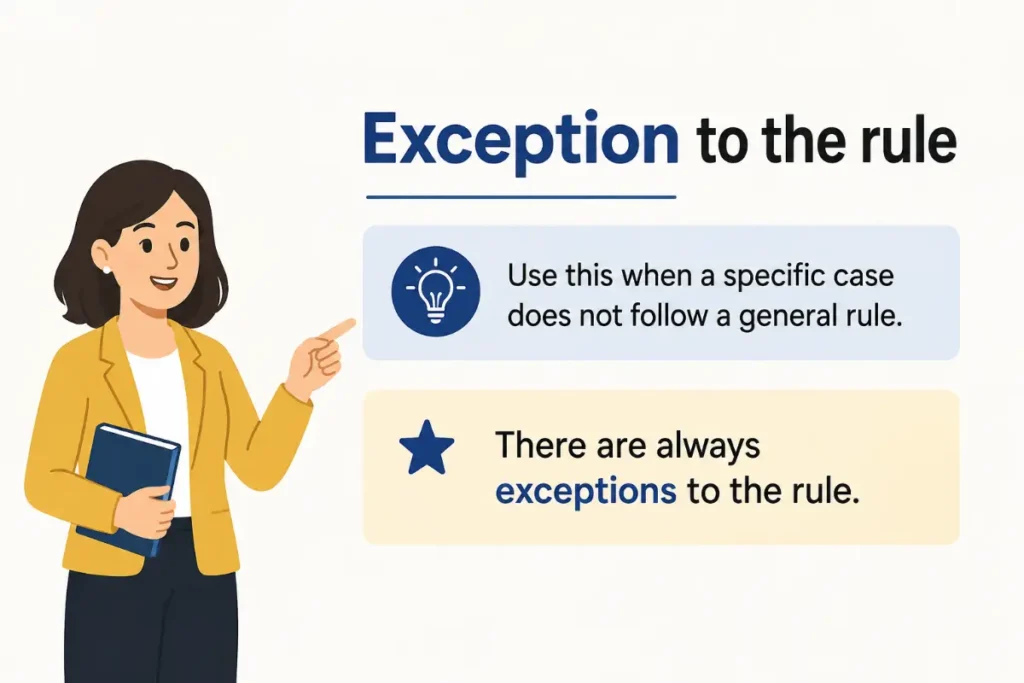
Exception to the rule
Use this when a specific case does not follow a general rule.
There are always exceptions to the rule.
Make an exception
Use this when someone agrees to treat one case differently.
The manager decided to make an exception.
With the exception of
Use this to identify something that is not included.
Everyone came with the exception of John.
Without exception
Use this to mean every case or person is included.
All applications were reviewed without exception.
No exception
Use this to say that the usual pattern applies here too.
Her latest book is excellent, and this one is no exception.
Take exception to
Use this to express objection or offense.
He took exception to the criticism.
These phrases are far more useful for everyday writers than the rare noun acception.
What should you choose in common writing?
If you are writing for a general audience, use the familiar word whenever it expresses the idea accurately.
For a rule:
exception
For approval:
acceptance
In word meaning:
meaning or sense
For a specialized historical discussion of a word sense:
acception
This approach keeps your writing clear without sacrificing accuracy.
Quick tips for choosing the right word
- Use exception for something outside a rule.
- Use acceptance for approval or agreement.
- Use meaning or sense for the meaning of a word.
- Use acception only when its specialized meaning is actually useful.
- Remember that rare words are not automatically better words.
- Check the sentence around the word before deciding.
- If a general reader might misunderstand a rare term, choose a simpler alternative.
- In technical writing, use acception only when you specifically need its linguistic meaning.
- In everyday writing, exception will usually be the word you need when discussing unusual cases.
- Read the sentence aloud. If the word sounds unfamiliar, ask if a clearer alternative would communicate the idea better.
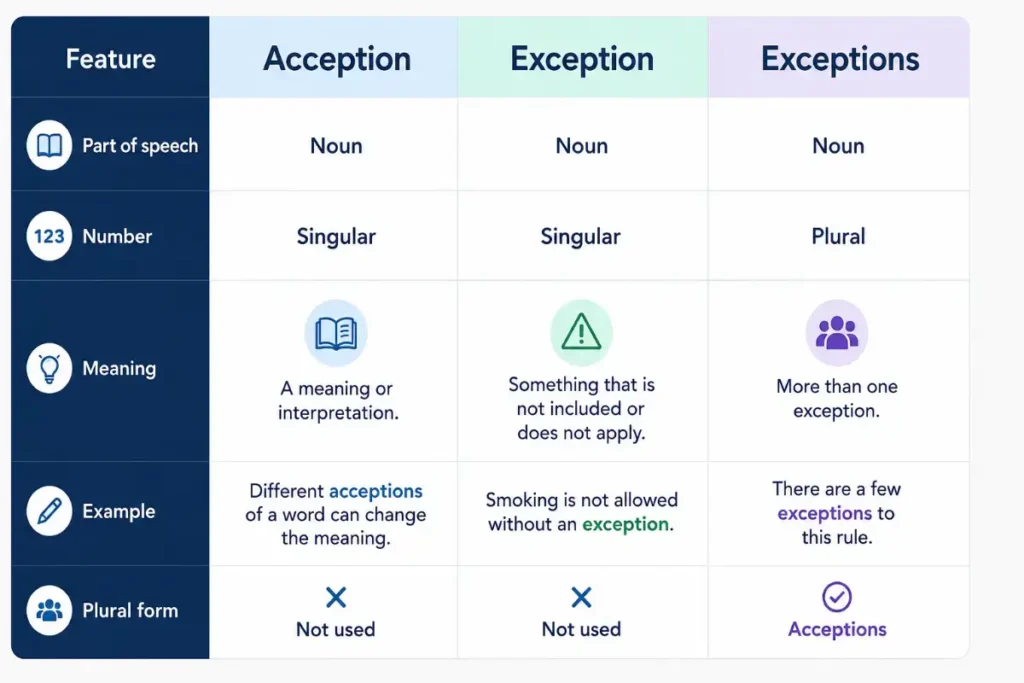
A quick comparison of acception and exception
| Feature | Acception | Exception |
|---|---|---|
| Part of speech | Noun | Noun |
| Plural | Acceptions | Exceptions |
| Main modern use | Rare and specialized | Common |
| Main idea | A particular meaning or accepted sense | A case outside a rule |
| Common in conversation | No | Yes |
| Common in academic writing | Specialized contexts | Yes |
| Common in business writing | Rare | Yes |
| Common in legal writing | Rare | Yes |
| Common in everyday emails | Rare | Yes |
| Related word | Acceptance or acceptation | Except |
| Best simple substitute | Meaning or sense | Special case |
| Pronunciation | ak SEP shun | ik SEP shun |
Conclusion
Acceptions refers to particular meanings or accepted senses of a word, and the term is rare in modern English. Exceptions refers to cases that are outside a rule, pattern, group, or general statement, and it is a normal part of everyday English.
If you’re writing a normal email, essay, resume, text, or conversation, you’ll almost always want exceptions when you mean special cases or situations that don’t follow the rule. If you mean a word’s meaning, choose meaning or sense in most situations. Reserve acception for specialized contexts where that exact term adds useful precision.
The best word isn’t the rarest one. It’s the one that makes your meaning immediately clear.
Frequently Asked Questions
Is acception a correct English word?
Yes, acception is a real English word, but it is rare and specialized. It can refer to a particular accepted meaning or sense of a word.
What is the difference between acception and exception?
Acception can refer to a particular meaning or sense, while exception refers to something outside a general rule or pattern. Exceptions is much more common in modern English.
Should I use acceptance or acception?
Use acceptance when you mean approval, agreement, or the act of accepting something. Use acception only in its rare specialized sense, especially when discussing a particular word meaning.
What is the plural of acception?
The plural of acception is acceptions. The plural of exception is exceptions.
What’s another way to say exception?
Common alternatives include special case, outlier, anomaly, exclusion, irregularity, and departure, depending on the sentence.
Is exception more common than acception?
Yes. Exception is a common word in everyday English, while acception is rare and mostly appears in specialized, historical, or linguistic contexts.
How can I remember acception and exception?
Think of acception as connected with an accepted sense or meaning, and exception as connected with something left outside a rule. For most everyday situations involving special cases, choose exception.
