
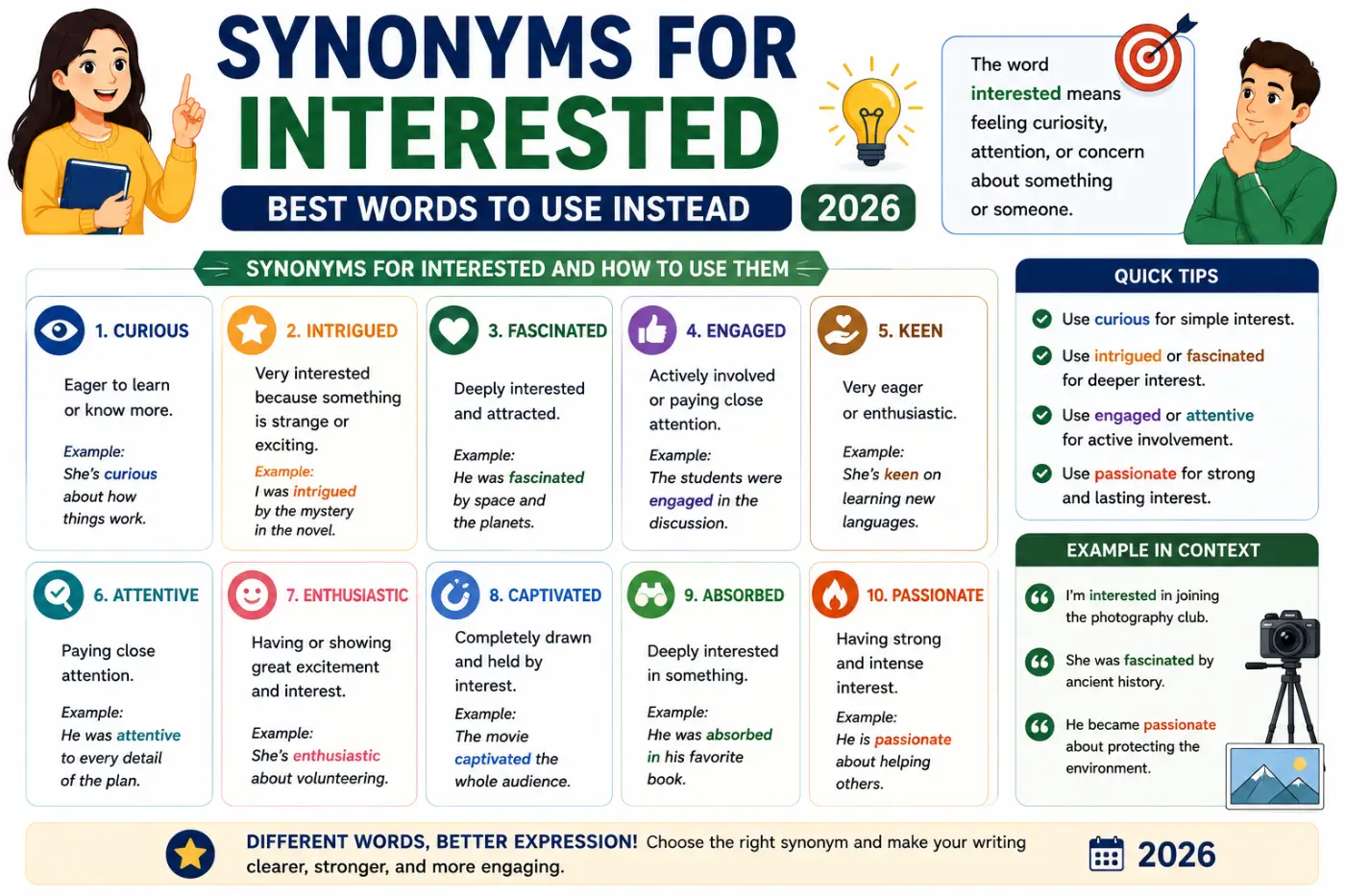
Finding the right words can be tricky when you’re writing an email, an essay, a resume, or even a simple text message. You may want to say someone is interested, but using the same word repeatedly can make your writing feel flat. That’s where synonyms for interested become useful. They help you show different levels of curiosity, excitement, attention, or involvement.
The word interested can describe many feelings. A person can be slightly curious about a topic, deeply passionate about a subject, eager to learn more, or fully committed to an activity. Choosing a better word helps readers understand the exact feeling you want to express.
This guide explains the meaning and history of the word interested, provides a complete synonym list, compares similar words, and shows which options work best in resumes, essays, emails, conversations, and everyday writing.
Short Answer
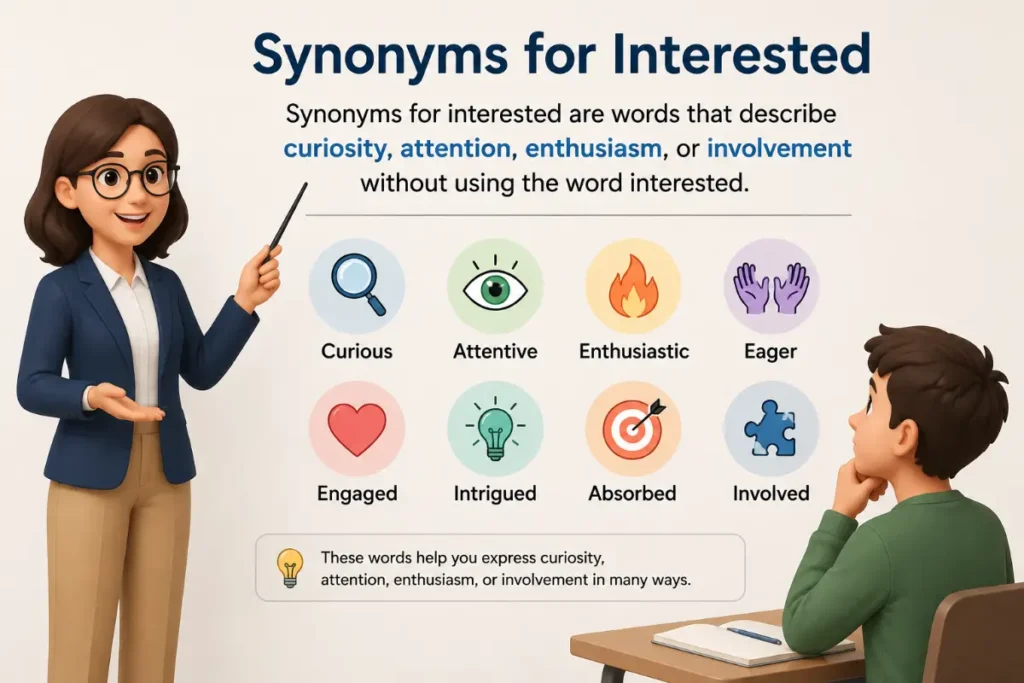
Synonyms for interested are words that describe curiosity, attention, enthusiasm, or involvement without using the word interested itself. The best choice depends on the situation, tone, and level of interest you want to show.
What Does Interested Mean in Simple English?
The word interested means paying attention to something because it matters to you or because you want to know more about it. It can describe a feeling of curiosity, attraction, concern, or involvement.
For example:
- “She is interested in science” means she wants to learn about science or enjoys the subject.
- “He is interested in the job” means he wants to know more about the position or may want to apply.
- “They are interested in buying the house” means they are considering the purchase.
The meaning changes slightly depending on context. Sometimes interested shows simple curiosity. Other times it shows strong desire or commitment.
Word Origin Of Interested
The word interested comes from the Latin word interesse, which means “to be between,” “to matter,” or “to be important.” The idea behind the word developed from something being personally important or connected to someone. English adopted the word through Old French and later Latin influenced forms. Over time, interested moved beyond financial or legal meanings and became a common word for describing curiosity and attention. Originally, the word was often connected to having a personal stake in something. For example, a person with an interest in a business had something to gain or lose. Today, the meaning is much broader. A student can be interested in history. A customer can be interested in a product. A friend can be interested in your story. The shared idea is connection. Something catches your attention because it matters to you.
Why Use Different Words Instead Of Interested?
Using different words helps your writing sound more natural and specific.
Compare these examples:
“I am interested in this position.”
I’m thrilled about this opportunity.
“I am eager to contribute to this position.”
All three sentences show interest, but each creates a different impression.
The first sentence is polite and neutral.
The second shows enthusiasm.
The third suggests motivation and readiness.
Strong writers choose words based on the message they want to send.
Popular Alternatives To Interested You Can Use
| Word | Meaning | Tone | Example |
|---|---|---|---|
| Curious | Wanting to learn more | Simple | I’m curious about how this works. |
| Intrigued | Showing strong curiosity | Everyday | She was intrigued by the new idea. |
| Fascinated | Extremely interested | Strong | He was fascinated by space. |
| Engaged | Actively involved | Professional | The students were engaged in the discussion. |
| Eager | Excited and ready | Strong | She was eager to start the project. |
| Enthusiastic | Showing excitement | Positive | He is enthusiastic about the opportunity. |
| Passionate | Having deep interest | Strong | She is passionate about design. |
| Drawn to | Naturally attracted | Everyday | He is drawn to creative work. |
| Motivated | Having a reason to act | Professional | She is motivated to improve her skills. |
| Exploring | Looking into something | Neutral | They are exploring new career options. |
Simple Synonyms For Interested
Simple words work best when you want clear everyday communication. They are easy to understand and fit most casual situations.
Curious
Curious is one of the closest alternatives to interested. It focuses on wanting to know more.
Example:
“I’m curious about the new technology.”
This means the person wants information or wants to explore the topic.
Curious works well for:
- Conversations.
- School writing.
- Personal messages.
- Questions.
It does not always show strong excitement. Someone can be curious without feeling deeply connected.
Drawn To
Drawn to means naturally attracted to something.
Example:
“She was drawn to photography because she loved telling stories through images.”
This phrase sounds more emotional than curious. It suggests a natural connection.
Open To
Open to shows willingness rather than strong excitement.
Example:
“I’m open to learning new methods.”
This works well when someone is ready to consider an idea but has not fully committed.
Into
Into is a casual expression that means someone enjoys something.
Example:
“He’s really into hiking.”
This word works well in conversations and texts but usually does not belong in formal writing.
Everyday Synonyms For Interested
Everyday writing often needs words that feel natural but still show personality.
Intrigued
Intrigued suggests that something has caught your attention because it feels interesting or unusual.
Example:
“The article about ancient inventions left me intrigued.”
It creates a stronger feeling than curious. A curious person wants answers. An intrigued person feels pulled toward discovering those answers.
Engaged
Engaged means actively paying attention or participating.
Example:
“The audience remained engaged throughout the presentation.”
This word is common in education, business, and professional settings.
Excited
Excited shows positive energy and anticipation.
Example:
“She is excited about starting her new job.”
Use excited when the feeling is emotional and enthusiastic.
Eager
Eager means ready and enthusiastic about doing something.
Example:
“The applicants were eager to join the training program.”
Eager often suggests action. A person who is eager usually wants to move forward.
Formal Synonyms For Interested
Formal writing needs words that sound professional and precise. These choices work well in resumes, business emails, academic papers, and reports.
Motivated
Motivated describes someone who has a reason or goal behind their interest.
Example:
“I am motivated to contribute my skills to your organization.”
This is stronger than simply saying interested because it shows purpose.
Invested
Invested suggests that someone has given time, effort, or emotion to something.
Example:
“The company is invested in employee development.”
This word works well in professional communication.
Committed
Committed shows dedication over time.
Example:
“She is committed to improving customer service.”
Someone can be interested in something without being committed. Commitment suggests deeper involvement.
Attentive
Attentive focuses on careful attention.
Example:
“The manager was attentive to customer feedback.”
It works well when describing listening, observation, or care.
Strong Synonyms For Interested
Some situations need stronger words because interested feels too weak.
Fascinated
Fascinated means something captures your attention deeply.
Example:
“The children were fascinated by the science experiment.”
This word shows a powerful level of curiosity.
Captivated
Captivated means completely holding someone’s attention.
Example:
“The speaker captivated the audience with her story.”
It suggests that someone is unable to look away or stop paying attention.
Passionate
Passionate describes deep enthusiasm and emotional connection.
Example:
“He is passionate about environmental protection.”
Passionate is one of the strongest alternatives because it shows lasting dedication.
Devoted
Devoted shows complete dedication.
Example:
“She is devoted to helping young writers improve.”
This word is stronger than interested and should be used when someone gives serious time and effort.
Synonyms For Interested By Level Of Intensity
Not every situation needs a powerful word. Using a very strong synonym when the feeling is mild can make your writing sound exaggerated. The right choice depends on how much attention, excitement, or commitment someone has.
Mild Interest
These words show a small amount of curiosity or attention.
| Word | Level | Example |
|---|---|---|
| Curious | Mild | I’m curious about how this process works. |
| Aware | Mild | She is aware of the changes happening in the industry. |
| Open to | Mild | He is open to new ideas. |
| Considering | Mild | They are considering several options. |
| Exploring | Mild | She is exploring different career paths. |
Mild words work well when someone has started thinking about something but has not developed a strong connection yet.
Example:
“I’m curious about learning Spanish.”
This does not mean the person has started studying every day. It only means they want to know more.
Moderate Interest
These words show a clear level of attention or involvement.
| Word | Level | Example |
|---|---|---|
| Interested | Moderate | She is interested in marketing. |
| Intrigued | Moderate | He was intrigued by the unusual idea. |
| Engaged | Moderate | The audience stayed engaged during the presentation. |
| Drawn to | Moderate | She felt drawn to creative writing. |
| Attracted | Moderate | He was attracted to the company’s mission. |
These words fit most daily situations because they show interest without sounding too intense.
Strong Interest
These words show excitement, dedication, or deep involvement.
| Word | Level | Example |
|---|---|---|
| Eager | Strong | She is eager to begin her new role. |
| Enthusiastic | Strong | The team is enthusiastic about the project. |
| Fascinated | Strong | He is fascinated by ancient cultures. |
| Passionate | Strong | She is passionate about education. |
| Devoted | Very strong | He is devoted to scientific research. |
Use these words carefully. Strong words create a bigger emotional impact. Saying “I’m passionate about every task” may sound unrealistic on a resume. It is better to save passionate for topics that genuinely matter to you.
Synonyms For Interested By Part Of Speech
Most alternatives for interested are adjectives, but some related words appear as verbs, phrases, or nouns. Understanding these forms helps you choose the correct word.
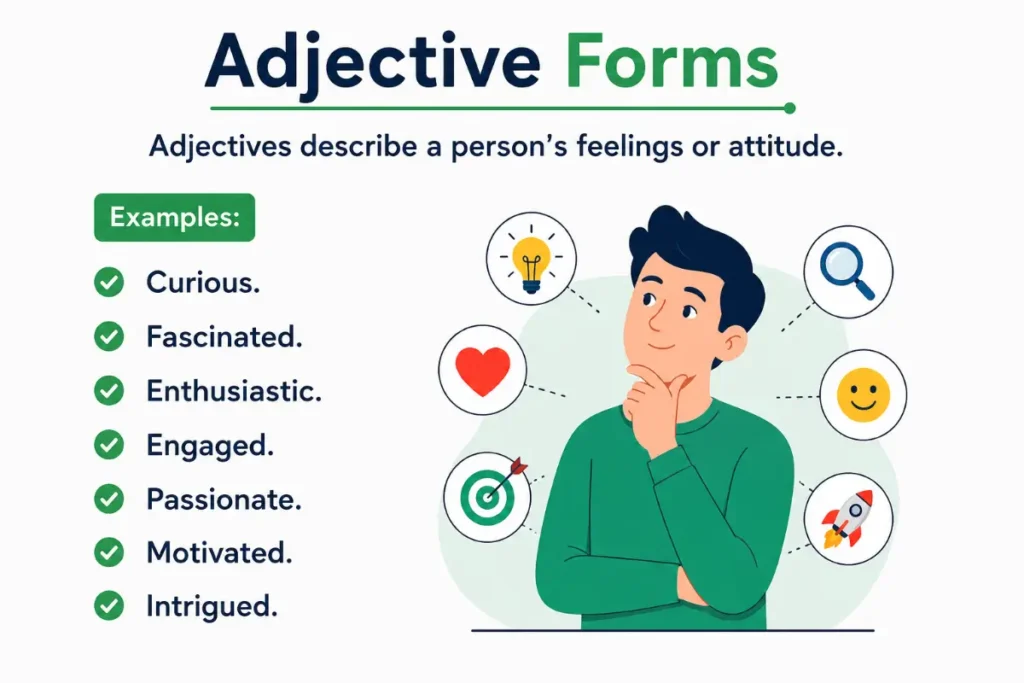
Adjective Forms
Adjectives describe a person’s feelings or attitude.
Examples:
- Curious.
- Fascinated.
- Enthusiastic.
- Engaged.
- Passionate.
- Motivated.
- Intrigued.
Sentence:
“She is fascinated by marine life.”
The adjective describes her feeling toward the subject.
Verb Forms
Verbs describe the action of showing attention or involvement.
Examples:
- Explore.
- Follow.
- Study.
- Investigate.
- Examine.
- Pursue.
Sentence:
“He wants to explore new opportunities.”
These words work well when someone actively takes steps instead of only feeling interest.
Noun Forms
Nouns describe the feeling or state of interest.
Examples:
- Curiosity.
- Enthusiasm.
- Passion.
- Attention.
- Focus.
- Commitment.
Sentence:
“Her curiosity led her to learn more about the topic.”
US And UK Differences For Interested Synonyms
Most words connected with interested work the same way in American and British English. However, a few expressions have different popularity depending on the region.
Keen
Keen is commonly used in British English to mean very interested or eager.
Example in British English:
“He is keen to join the team.”
American speakers understand keen, but they may use eager or excited more often.
Into
Into is common in American and British casual speech.
Example:
“She is really into painting.”
This expression is informal and should usually stay out of professional writing.
Enthusiastic
Enthusiastic works naturally in both American and British English.
Example:
“The students were enthusiastic about the competition.”
It is a safe choice for formal and informal situations.
Best Synonyms For Interested By Context
The best word changes depending on where you use it. A word that works in a text message may sound too casual in a job application.
Best Words For A Resume
A resume should show motivation, skills, and commitment. The word interested alone can sound passive because it only describes a feeling.
Better choices include:
- Motivated.
- Eager.
- Passionate.
- Committed.
- Skilled.
- Dedicated.
Weak resume example:
“I am interested in improving customer experiences.”
Stronger resume example:
“I am motivated to improve customer experiences through creative solutions.”
The second sentence shows action and purpose.
Another example:
Weak:
“I am interested in joining your marketing team.”
Strong:
“I am eager to contribute my marketing skills to your growing team.”
The stronger version tells the employer what you can offer.
Best Words For Essays
Academic writing needs clear and thoughtful language. Avoid overly casual expressions like into or hooked.
Good choices include:
- Curious.
- Fascinated.
- Engaged.
- Intrigued.
- Drawn to.
Example:
Basic:
“I was interested in psychology from a young age.”
Better:
“I was fascinated by psychology from a young age because I wanted to understand human behavior.”
The second sentence explains the reason behind the interest.
Best Words For Emails
Professional emails need polite and natural language.
Good choices include:
- Interested.
- Curious.
- Eager.
- Excited.
- Open to.
Example:
“I’m interested in discussing this opportunity further.”
This sounds professional and respectful.
A stronger version:
“I’m excited to discuss how I can contribute to this project.”
Use excited when you want to show positive energy.
Best Words For Texting
Texts allow more casual language.
Good options include:
- Into.
- Curious.
- Excited.
- Hooked.
- Interested.
Examples:
“I’m really into that new show.”
I’d love to know your thoughts.
“I’m hooked on this podcast.”
These expressions sound natural in everyday conversations.
Best Words For Speaking
In conversations, simple words usually sound best.
Natural choices include:
- Curious.
- Into.
- Excited.
- Interested.
- Fascinated.
Example:
“I’m really curious about what happens next.”
“I’m fascinated by how people learn languages.”
People usually prefer simple words when speaking because they sound genuine.
15 Real Life Examples Using Interested Synonyms
Different situations require different levels of meaning. These examples show how each word changes the feeling.
- The student was curious about how volcanoes form.
- She was fascinated by the history of ancient civilizations.
- He was eager to start his first day at the company.
- The team was enthusiastic about the new design idea.
- I’m intrigued by the way this technology works.
- She became passionate about protecting animals.
- The audience stayed engaged during the entire lecture.
- He was drawn to photography because it helped him express emotions.
- The manager was attentive to customer concerns.
- They were invested in creating a better workplace.
- I’m open to trying a different approach.
- She was hooked on the mystery novel after the first chapter.
- He is really into fitness and healthy cooking.
- The researcher was devoted to finding a solution.
- She was motivated to improve her communication skills.
Interested vs Curious What’s The Difference?
Interested and curious are close, but they do not mean exactly the same thing.
| Interested | Curious |
|---|---|
| Shows attention or attraction | Shows a desire to learn more |
| Can include enjoyment or commitment | Usually focuses on questions and discovery |
| Works in professional situations | Often sounds more personal |
Examples:
“I’m interested in the job.”
This means you may want the position.
“I’m curious about the job.”
This means you want more information about it.
A person can be curious without becoming interested. Curiosity often comes first. Interest may develop later.
Interested vs Fascinated What’s The Difference?
Fascinated is much stronger than interested.
| Interested | Fascinated |
|---|---|
| General attention | Deep attention |
| Neutral feeling | Strong emotional response |
| Common in daily communication | Used for things that strongly capture attention |
Examples:
“I’m interested in astronomy.”
This means you like the subject.
“I’m fascinated by astronomy.”
This means astronomy strongly captures your imagination.
Do not replace interested with fascinated unless the feeling is truly intense.
Interested vs Excited What’s The Difference?
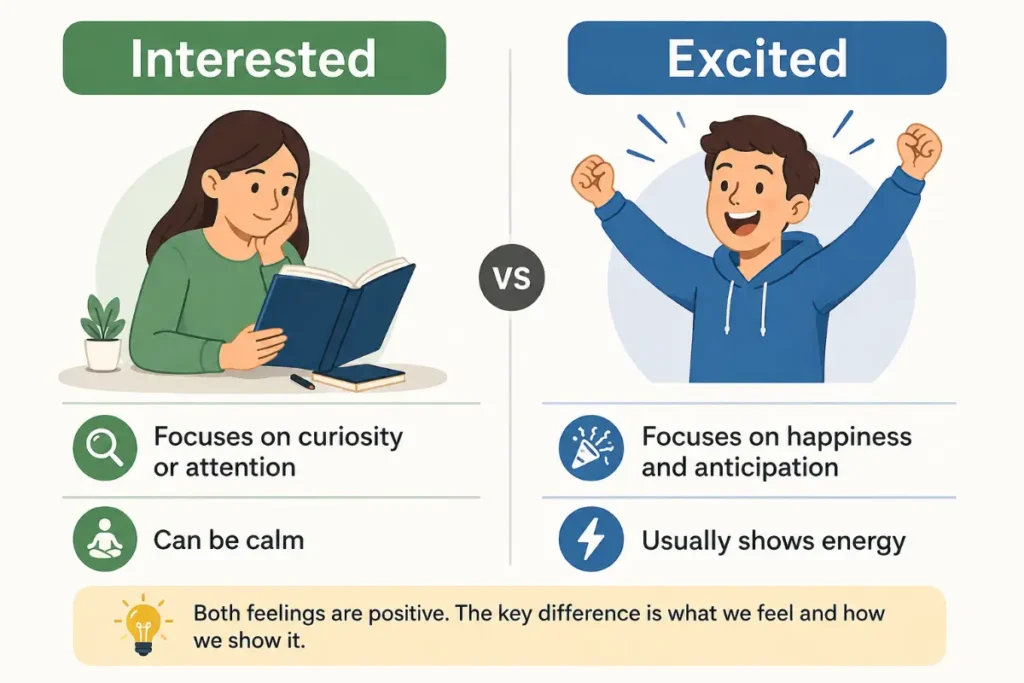
These words are often confused because both show positive feelings.
| Interested | Excited |
|---|---|
| Focuses on curiosity or attention | Focuses on happiness and anticipation |
| Can be calm | Usually shows energy |
| Works for learning and exploring | Often connects with upcoming events |
Examples:
“I’m interested in the course.”
This means you want to learn more.
“I’m excited about the course.”
This means you feel happy and eager about it.
Common Mistakes When Choosing Synonyms For Interested
Using synonyms correctly requires understanding their emotional strength. Many writing mistakes happen because people choose words that do not match the situation.
Using Passionate Too Often
Passionate is powerful. It suggests deep dedication.
Incorrect:
“I am passionate about answering emails.”
Better:
“I am passionate about customer communication.”
Passion fits meaningful areas, not ordinary tasks.
Using Excited In Formal Writing
Excited sounds positive, but some professional situations need a calmer tone.
Casual:
“I’m excited about this opportunity.”
Formal:
“I’m eager to contribute to this opportunity.”
Both are correct, but the second sounds more professional.
Using Into In Professional Documents
Into is natural in conversation but too casual for resumes or formal letters.
Casual:
“I’m into digital marketing.”
Professional:
“I have a strong interest in digital marketing.”
Choosing A Strong Word For A Small Feeling
Avoid exaggerating.
Example:
“I’m fascinated by office software.”
This sounds unusual unless you truly have deep interest in software systems.
A simpler choice:
“I’m interested in office software.”
When Not To Use Interested Synonyms
Sometimes the original word interested is actually the best choice.
Use interested when:
- You want a neutral tone.
- You are writing a polite email.
- You do not want to exaggerate your feelings.
- You are unsure about the reader’s expectations.
Example:
“I am interested in learning more about your services.”
This sentence is clear, professional, and natural.
A stronger word may change the meaning.
“I am passionate about learning more about your services.”
This sounds like a deeper personal connection that may not be true.
Antonyms Of Interested
Understanding opposite words can help you choose the right expression. The opposite of interested describes a lack of attention, curiosity, or involvement.
| Antonym | Meaning | Example |
|---|---|---|
| Bored | Not interested or entertained | The students looked bored during the long lecture. |
| Uninterested | Not showing interest | He seemed uninterested in the discussion. |
| Indifferent | Not caring strongly about something | She was indifferent to the final result. |
| Apathetic | Showing little emotion or concern | The group appeared apathetic about the issue. |
| Distracted | Unable to focus | He was distracted during the meeting. |
| Unconcerned | Not worried or involved | They were unconcerned about the minor changes. |
Be careful with uninterested and disinterested.
Many people use these words as if they mean the same thing, but they have different meanings.
Uninterested means someone does not care or does not want to pay attention.
Example:
“She was uninterested in the conversation.”
Disinterested means someone is neutral and does not have a personal benefit or preference.
Example:
“The judge remained disinterested while reviewing the case.”
A judge should be fair and impartial, not uninterested.
Quick Tips For Choosing The Right Synonym
Choosing the right word becomes easier when you think about the feeling behind the sentence.
Match The Strength Of The Feeling
Ask yourself how strong the interest is.
Small curiosity:
“I’m curious about photography.”
Strong attraction:
“I’m fascinated by photography.”
Deep dedication:
“I’m passionate about photography.”
The word should match the person’s actual level of interest.
Consider Your Audience
Think about who will read or hear your words.
A friend may appreciate:
“I’m really into this show.”
An employer may prefer:
“I’m highly interested in this opportunity.”
A teacher may prefer:
“I am fascinated by this topic.”
The best word depends on the situation.
Choose Action Words For Professional Writing
Professional writing often becomes stronger when you show what you will do.
Instead of:
“I am interested in helping your company.”
Try:
“I am eager to contribute my skills to your company.”
Instead of only describing a feeling, show motivation.
Avoid Repeating The Same Word
Repeating interested many times can make writing feel boring.
Example:
I’m excited about marketing, drawn to design, and fascinated by research.
Better:
“I’m interested in marketing, fascinated by design, and eager to explore research.”
Different words create a clearer picture.
How To Use Synonyms For Interested Naturally In Writing
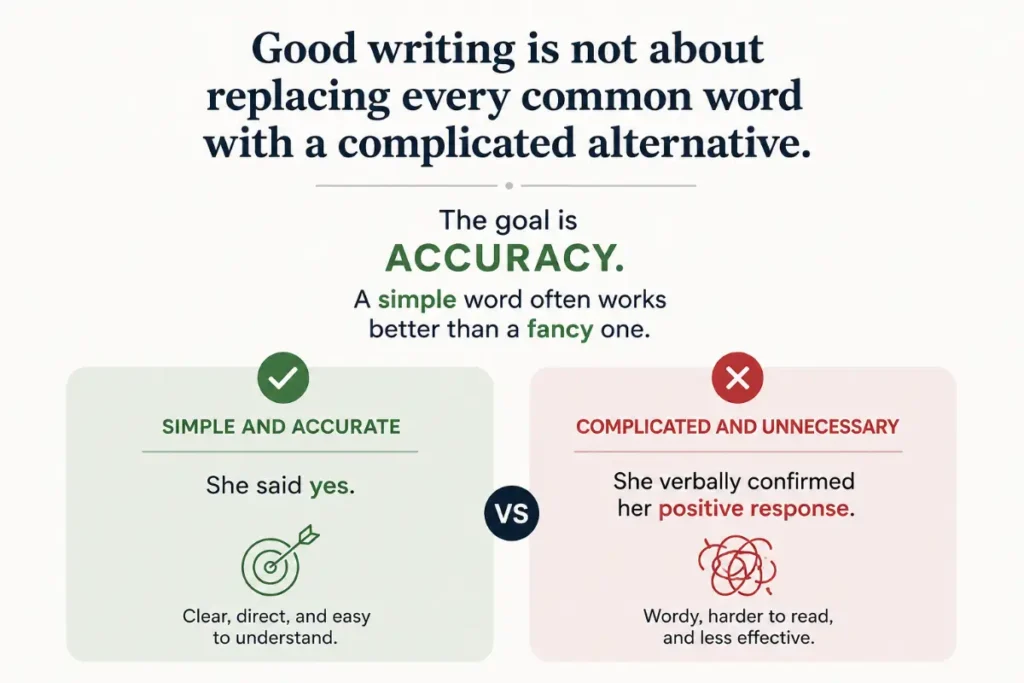
Good writing is not about replacing every common word with a complicated alternative. The goal is accuracy. A simple word often works better than a fancy one.
Compare:
“The child was fascinated by the colorful insects.”
“The child was interested in the colorful insects.”
Both sentences are correct. The first shows stronger attention. The second sounds more neutral.
Strong vocabulary does not mean using the biggest word. It means choosing the word that fits.
Conclusion
The word interested is useful because it works in almost every situation, but it does not always show the exact feeling you want to express. A person can be curious, eager, fascinated, motivated, or passionate, and each word creates a different impression.
The best synonyms for interested add clarity to your writing by showing the level and type of attention someone has. Use simple choices for everyday conversations, stronger words for emotional situations, and professional options for resumes and workplace communication.
Good word choices help readers understand not only what someone likes but also how deeply they care. When you choose a synonym that matches the real feeling, your writing becomes more natural, precise, and memorable.
Frequently Asked Questions
What are the best synonyms for interested?
The best synonyms for interested include curious, intrigued, fascinated, eager, enthusiastic, engaged, motivated, passionate, and invested. The right choice depends on the situation and the level of interest you want to show.
What’s another way to say interested?
Another way to say interested is curious, intrigued, fascinated, eager, or enthusiastic. Synonyms for interested help you express different levels of curiosity, attention, and excitement.
What is a professional word for interested?
Professional words for interested include motivated, eager, engaged, invested, and committed. These words often work better in resumes, cover letters, and workplace emails because they show purpose.
Can I use fascinated instead of interested?
You can use fascinated instead of interested when something strongly captures your attention. Fascinated is much stronger and suggests deep curiosity or excitement.
What is a casual way to say interested?
Casual ways to say interested include into, curious about, excited about, and hooked on. These expressions sound natural in conversations and text messages.
What is the difference between interested and enthusiastic?
Someone can take an interest in a topic without feeling highly enthusiastic about it.
