
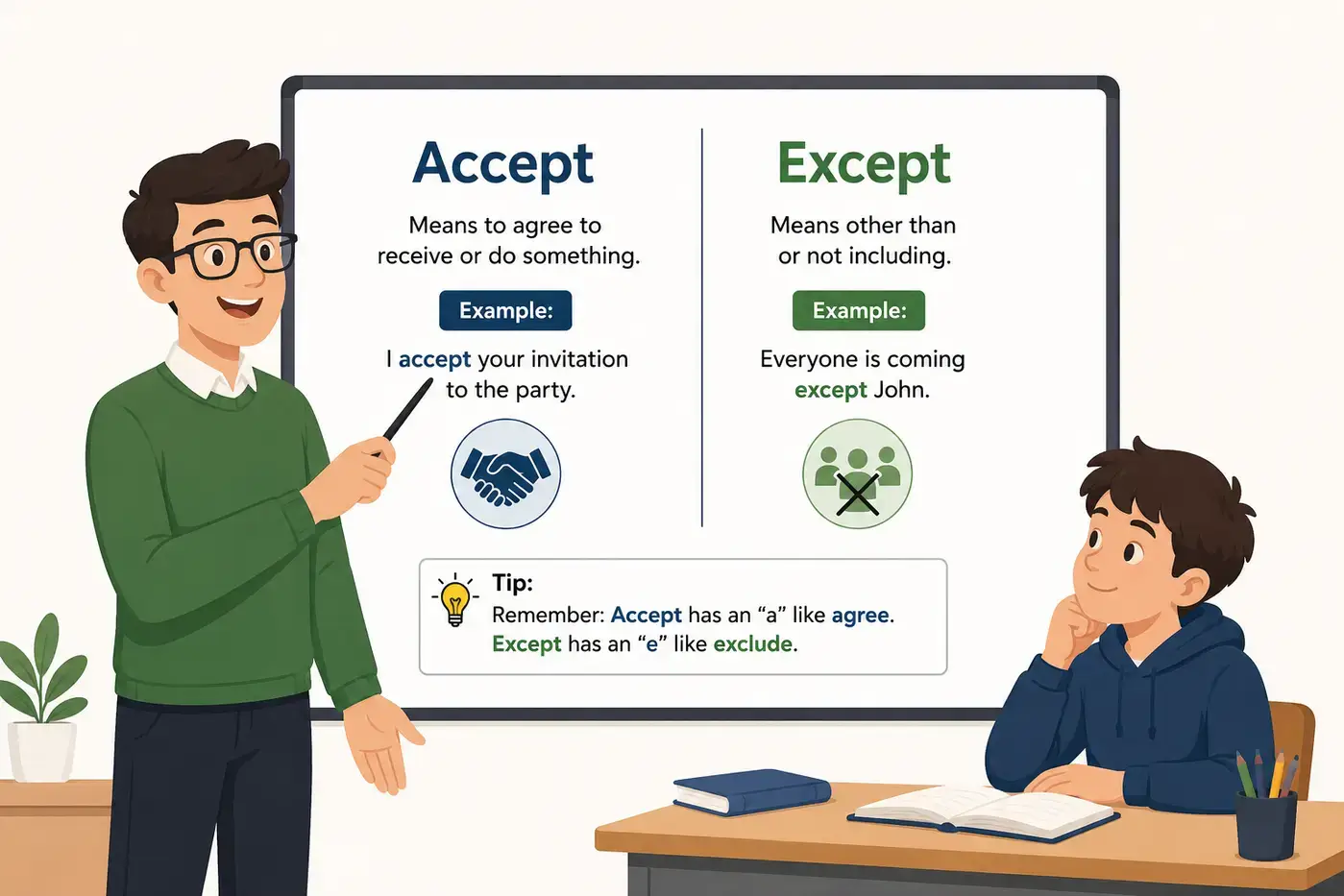
Writing an email, finishing an essay, or sending a quick text can make you stop and wonder which word is correct. If you’ve searched for accept vs except, you’re facing one of the most common word mix-ups in English. The two words look almost identical, but they have completely different meanings.
Many students, professionals, and native English speakers accidentally confuse these words because they sound similar and differ by only two letters. A small spelling mistake can completely change the meaning of a sentence, especially in school assignments, business emails, and formal writing.
The good news is that learning the difference is much easier than it seems. Once you understand what each word means and how it’s used, you’ll know exactly when to use accept and except with confidence.
Quick Answer
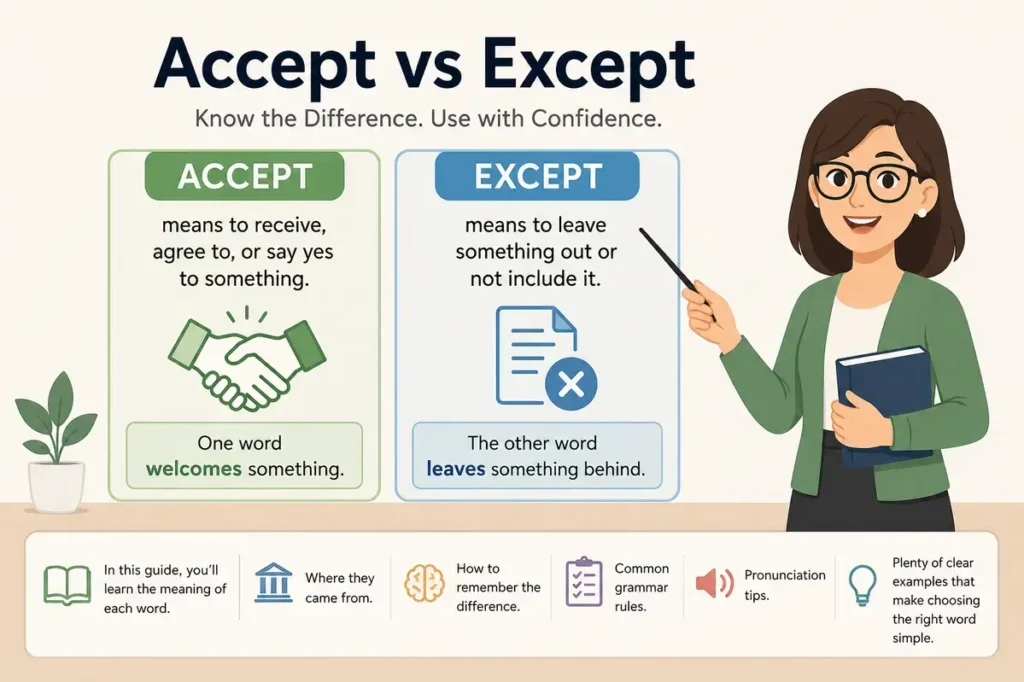
Accept means to receive, agree to, or say yes to something. Except means to leave something out or not include it. One word welcomes something. The other leaves something behind. In this guide, you’ll learn the meaning of each word, where they came from, how to remember the difference, common grammar rules, pronunciation, and plenty of clear examples that make choosing the right word simple.
What Is the Difference Between Accept and Except?
The easiest way to understand accept vs except is to remember that the words have opposite jobs.
Accept is about receiving or agreeing.
Except is about excluding or leaving something out.
Compare these examples.
| Word | Meaning | Example |
|---|---|---|
| Accept | Receive or agree to something | I accept your invitation. |
| Except | Leave out or exclude | Everyone came except Sarah. |
Notice how changing one word completely changes the sentence.
Correct
- I accepted the job offer.
- Everyone finished the test except Jack.
Incorrect
- I excepted the job offer.
- Everyone finished the test accept Jack.
These mistakes happen because the words sound similar, not because they have similar meanings.
What Does Accept Mean?
The word accept means to receive something willingly or to agree with it. It often shows approval, permission, agreement, or willingness. People usually use accept when talking about offers, invitations, gifts, apologies, ideas, responsibilities, payments, or facts.
Here are some common situations.
| Situation | Example |
|---|---|
| Receiving an offer | She accepted the promotion. |
| Agreeing | I accept your decision. |
| Taking a gift | He accepted the present with a smile. |
| Admitting a fact | They accepted the truth. |
| Receiving payment | The store accepts credit cards. |
In every example, someone is receiving, agreeing, or allowing something.
What Does Except Mean?
The word except means to leave someone or something out. It shows that one person or thing does not belong to the group being discussed. It usually appears before a noun or pronoun.
Examples include:
- Everyone passed except Ben.
- The restaurant is open every day except Monday.
- I enjoyed every chapter except the last one.
- All the lights were on except the kitchen light.
- Every answer was correct except number seven.
Think of except as creating one exception.
Accept vs Except in One Simple Sentence
One sentence can help you remember the difference forever.
I accepted every invitation except the one for Friday.
In this sentence:
- Accepted means received and agreed to.
- Except means leaving one invitation out.
The two words work together, but they perform completely different jobs.
Where Do Accept and Except Come From?
Many comparison articles explain the meanings but skip the history. Knowing where these words came from makes them much easier to remember.
The Origin of Accept
The word accept comes from the Latin word acceptare, which means to receive willingly or to take gladly. It later entered Old French before becoming part of Middle English. Through the centuries, its meaning stayed remarkably consistent. It has always been connected with receiving, approving, agreeing, or welcoming something.
That is why modern English uses accept in phrases like these.
- accept an invitation
- accept responsibility
- accept an apology
- accept a challenge
- accept payment
Although English has changed over hundreds of years, this core meaning has remained almost the same.
The Origin of Except
The word except comes from the Latin exceptus, meaning taken out or excluded. Unlike accept, this word has always carried the idea of removing something from a larger group.
That original meaning still appears clearly in modern English.
- Everyone arrived except Emma.
- All rooms are available except Suite 201.
- Every answer was correct except one.
Once you know the Latin roots, remembering these words becomes much easier.
One word means receive.
The other means leave out.
Why Are Accept and Except So Easy to Confuse?
These words confuse writers for several reasons.
They Look Nearly Identical
Only the first two letters are different.
- accept
- except
When people type quickly, they often choose the wrong one without noticing.
They Sound Similar
In fast conversation, the beginning sounds can seem almost identical, especially for English learners. That makes spelling mistakes more common than pronunciation mistakes.
Spell Check Often Misses the Error
Since both are real English words, grammar checkers may not flag the mistake.
For example:
- I except your apology.
This sentence is grammatically correct but logically wrong because the writer meant accept.
They Have Opposite Meanings
Many confusing word pairs have related meanings.
These two do not.
| Word | Main Idea |
|---|---|
| Accept | Receive or agree |
| Except | Exclude or leave out |
Thinking of them as opposites makes them much easier to remember.
Is Accept a Verb or a Noun?
Most of the time, accept is a verb.
Examples include:
- I accept your offer.
- She accepted the invitation.
- They accepted the results.
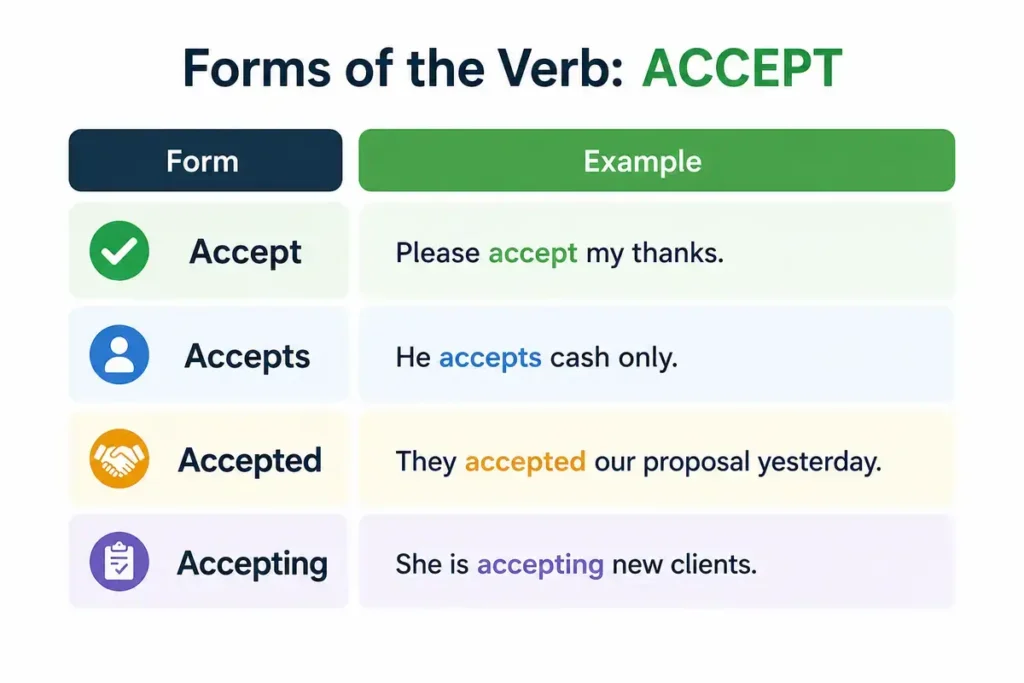
Different verb forms include:
| Form | Example |
|---|---|
| Accept | Please accept my thanks. |
| Accepts | He accepts cash only. |
| Accepted | They accepted our proposal yesterday. |
| Accepting | She is accepting new clients. |
There is no common noun form called accept.
Instead, English uses related nouns such as:
- acceptance
- acceptability
- acceptation (rare and mainly used in linguistics)
Is Except a Verb or a Preposition?
Most people use except as a preposition.
Examples:
- Everyone came except Liam.
- We work every day except Sunday.
It can also act as a conjunction.
Examples:
- I would go except I’m busy today.
- She never complains except when she’s exhausted.
A less common use is as a verb.
Example:
- The rule excepts emergency workers.
This meaning appears mostly in legal or formal writing and is uncommon in everyday English.
How Do You Pronounce Accept and Except?
The pronunciation is another reason people confuse these words.
| Word | Pronunciation | Sounds Like |
|---|---|---|
| Accept | ak SEPT | receive |
| Except | ik SEPT | leave out |
The second part of each word sounds exactly the same. The only difference is the first vowel sound. Even native English speakers sometimes mix them up while speaking quickly.
How Can You Remember Accept vs Except?
Simple memory tricks work better than complicated grammar rules.
Trick One: A Is for Agree
The word accept starts with A.
Think of:
- Agree
- Approve
- Allow
All three ideas match accept.
Example:
- I accept your apology because I agree to move forward.
Trick Two: EX Means Out
The beginning of except is EX.
Many English words beginning with ex involve going out or away.
Think of:
- Exit
- Exclude
- Expel
Those words all suggest removal.
So except also means something is left out.
Trick Three: Welcome vs Leave Out
Picture two doors.
At one door, someone is invited inside.
That is accept.
At the other door, one person stays outside while everyone else enters.
That is except.
This simple image helps many learners remember the difference for years.
Accept vs Except Grammar Chart
Here is a quick comparison that summarizes everything covered so far.
| Feature | Accept | Except |
|---|---|---|
| Part of speech | Usually a verb | Usually a preposition |
| Main meaning | Receive or agree | Leave out or exclude |
| Common use | Offers, gifts, invitations, ideas, responsibility | Lists, groups, exceptions |
| Memory idea | Agree and receive | Exclude and leave out |
| Example | I accepted the offer. | Everyone came except Mia. |
What Are the Most Common Situations for Accept and Except?
Understanding real situations helps the meanings stick.
You Use Accept When You…
- receive an invitation
- agree with an idea
- take responsibility
- receive payment
- welcome feedback
- admit the truth
- approve a proposal
- forgive someone by accepting an apology
Examples:
- She accepted the scholarship.
- We accept online payments.
- He accepted the challenge.
- I finally accepted the truth.
You Use Except When You…
- exclude one person
- remove one item
- mention an exception
- describe something missing
- compare one member with the rest of a group
Examples:
- Every student passed except Noah.
- All stores are open except one.
- Everything worked except the printer.
- Everyone agreed except me.
Quick Practice
Choose the correct word before checking the answers.
- Please _____ my sincere apology.
- Everyone finished the race _____ Olivia.
- The museum accepts cash and cards _____ American Express travelers checks.
- I gladly _____ the award.
- Every room was clean _____ the kitchen.
Answers
- accept
- except
- except
- accept
- except
By now, you should have a clear understanding of these words, including their meanings, origins, grammar, pronunciation, and the simple memory tricks that make them easy to remember. In the next section, you’ll explore an extensive synonym guide, grouped by tone and usage, along with context based recommendations, regional notes, and practical examples that show exactly which word fits every situation.
What Are the Best Synonyms for Accept?
The word accept has many synonyms, but each one carries a slightly different meaning. Some sound friendly and casual, while others fit formal writing or business communication. Choosing the right synonym depends on the situation, your audience, and the level of formality.
Simple and Everyday Synonyms for Accept
These words work well in everyday conversations and informal writing.
| Word | Meaning | Tone | Example |
|---|---|---|---|
| Receive | Get something | Neutral | She received the package today. |
| Take | Get or hold something | Casual | I’ll take the ticket. |
| Agree | Say yes | Neutral | We agreed to the plan. |
| Welcome | Gladly receive | Friendly | They welcomed the new student. |
| Approve | Say something is acceptable | Neutral | The manager approved the request. |
| Allow | Give permission | Neutral | The teacher allowed extra time. |
| Admit | Recognize something is true | Neutral | He admitted his mistake. |
| Believe | Accept something as true | Casual | I believe your story. |
Formal Synonyms for Accept
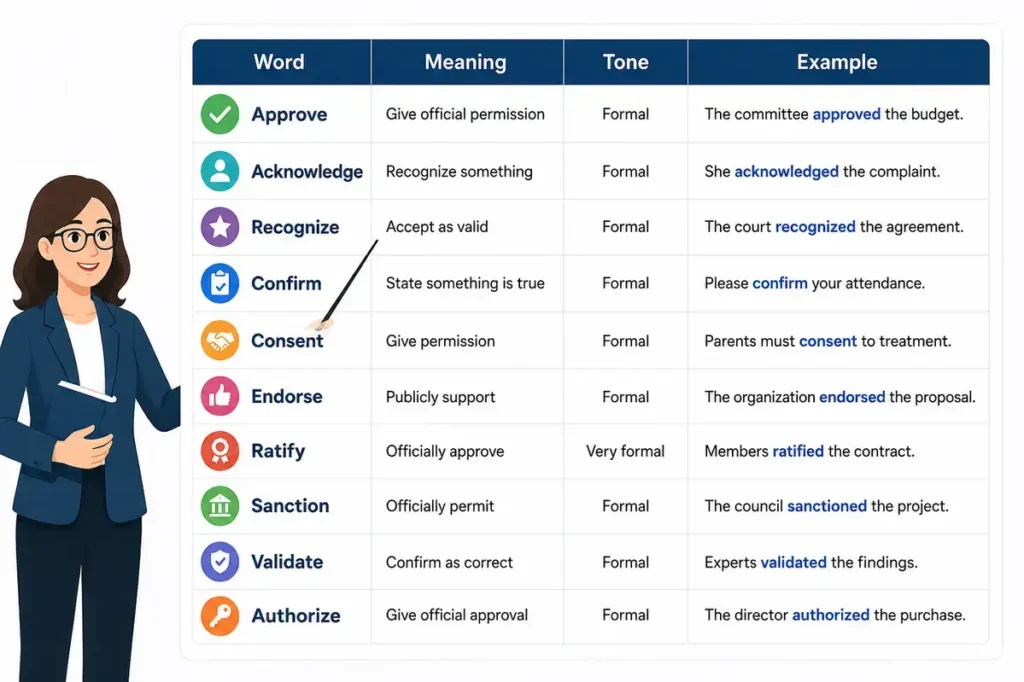
These words are common in business, academic, legal, and professional writing.
| Word | Meaning | Tone | Example |
|---|---|---|---|
| Approve | Give official permission | Formal | The committee approved the budget. |
| Acknowledge | Recognize something | Formal | She acknowledged the complaint. |
| Recognize | Accept as valid | Formal | The court recognized the agreement. |
| Confirm | State something is true | Formal | Please confirm your attendance. |
| Consent | Give permission | Formal | Parents must consent to treatment. |
| Endorse | Publicly support | Formal | The organization endorsed the proposal. |
| Ratify | Officially approve | Very formal | Members ratified the contract. |
| Sanction | Officially permit | Formal | The council sanctioned the project. |
| Validate | Confirm as correct | Formal | Experts validated the findings. |
| Authorize | Give official approval | Formal | The director authorized the purchase. |
Friendly and Conversational Alternatives
These words sound natural in everyday speech.
| Word | Meaning | Tone | Example |
|---|---|---|---|
| Go for | Choose willingly | Casual | I decided to go for the offer. |
| Say yes to | Agree | Very casual | She said yes to the invitation. |
| Be okay with | Agree comfortably | Casual | I’m okay with that idea. |
| Embrace | Accept enthusiastically | Friendly | He embraced the opportunity. |
| Go along with | Agree to something | Casual | They went along with the suggestion. |
Slang and Informal Expressions
These expressions appear mostly in conversations and social media.
| Expression | Meaning | Tone | Example |
|---|---|---|---|
| Be down with | Agree with | Slang | I’m down with that plan. |
| Roll with | Accept without complaint | Slang | We just rolled with the changes. |
| Take it | Accept something | Informal | I’ll take it. |
| Cool with | Comfortable with | Slang | She’s cool with the schedule. |
| Buy into | Accept an idea | Informal | Not everyone bought into the rumor. |
What Are the Best Synonyms for Except?
Unlike accept, except has fewer direct synonyms because it serves a specific grammatical purpose. Still, several words and phrases express a similar idea.
Everyday Synonyms for Except
| Word | Meaning | Tone | Example |
|---|---|---|---|
| Excluding | Leaving out | Neutral | Everyone came excluding one guest. |
| Leaving out | Omitting | Casual | We’re leaving out desserts today. |
| Other than | Apart from | Neutral | Everyone other than Jake agreed. |
| Aside from | In addition to excluding | Neutral | Aside from one mistake, the report was excellent. |
| But | Except for | Casual | Everyone but Liam finished. |
Formal Alternatives
| Word | Meaning | Tone | Example |
|---|---|---|---|
| Excluding | Leaving out | Formal | Excluding taxes, the total is lower. |
| Excluding the fact that | Leaving one idea out | Formal | Excluding that issue, everything is ready. |
| With the exception of | Formal way to say except | Very formal | With the exception of one file, everything transferred successfully. |
| Save | Except | Literary | Everyone save the captain escaped. |
| Apart from | Separate from | Formal | Apart from one delay, the trip went smoothly. |
Synonyms by Strength
Not every synonym carries the same level of certainty or emotion.
Accept Synonyms From Mild to Strong
| Strength | Word |
|---|---|
| Mild | Receive |
| Mild | Take |
| Mild | Agree |
| Moderate | Approve |
| Moderate | Welcome |
| Moderate | Admit |
| Strong | Embrace |
| Strong | Endorse |
| Strong | Validate |
| Very Strong | Ratify |
Notice how the stronger words suggest more confidence, authority, or official approval.
Except Alternatives From Simple to Formal
| Strength | Word |
|---|---|
| Everyday | But |
| Everyday | Other than |
| Neutral | Aside from |
| Neutral | Excluding |
| Formal | With the exception of |
| Very Formal | Save |
Synonyms by Part of Speech
Understanding grammar makes choosing the right word much easier.
Accept
| Part of Speech | Examples |
|---|---|
| Verb | accept, receive, approve, admit, acknowledge, endorse |
| Noun (related) | acceptance, approval, acknowledgment |
| Adjective (related) | acceptable, approved |
Except
| Part of Speech | Examples |
|---|---|
| Preposition | except, excluding, aside from |
| Conjunction | except, unless (not always interchangeable) |
| Verb (rare) | except, exclude |
Accept vs Except in American and British English
One nice thing about these words is that there is almost no difference between American and British English.
Both countries spell and pronounce the words almost the same.
| English Variety | Accept | Except |
|---|---|---|
| American English | ✔ Standard | ✔ Standard |
| British English | ✔ Standard | ✔ Standard |
| Canadian English | ✔ Standard | ✔ Standard |
| Australian English | ✔ Standard | ✔ Standard |
Unlike words such as color and colour, or center and centre, these spellings never change across major English varieties.
Which Word Should You Use in Different Situations?
Understanding the context makes the choice much easier.
Accept or Except in a Resume
On a resume, accept appears much more often.
Examples:
- Accepted leadership responsibilities.
- Accepted a promotion after six months.
- Accepted employee recognition awards.
Using except on a resume is uncommon because resumes rarely describe exclusions.
Accept or Except in an Essay
Essays commonly use both words.
Use accept when discussing ideas, beliefs, evidence, or conclusions.
Example:
- Most scientists accept this explanation.
Use except when mentioning exceptions.
Example:
- Every country except one signed the agreement.
Accept or Except in Emails
Professional emails frequently use accept.
Examples:
- I accept your proposal.
- We accept your terms.
- Please accept my sincere thanks.
- I gladly accept the invitation.
Use except only when excluding someone or something.
Example:
- Everyone received the updated document except the finance team.
Accept or Except in Text Messages
People often shorten sentences, making these words easier to confuse.
Correct examples:
- I accept your apology.
- Everyone’s coming except Mia.
- I’ll accept the offer.
- Everything looks good except the last photo.
Reading the sentence one extra time can prevent an embarrassing typo.
in Everyday Conversation
In speaking, context usually makes the meaning clear.
Examples:
- I accepted the new job yesterday.
- Everyone was excited except my brother.
- She accepted my invitation immediately.
- Everything tasted great except the soup.
Real Life Example Sentences
Here are original examples showing these words in different situations.
School
- The teacher accepted my late assignment.
- Every student passed except one.
Workplace
- Our manager accepted the proposal after reviewing it.
- Everyone attended the meeting except Daniel.
Family
- My parents accepted my decision to move.
- Everyone came to dinner except my cousin.
Shopping
- The store accepts debit cards.
- Every item was on sale except electronics.
Travel
- The airline accepted our luggage without extra fees.
- Every flight arrived on time except ours.
Sports
- The coach accepted responsibility for the loss.
- Every player scored except the goalkeeper.
Healthcare
- The clinic accepts most insurance plans.
- All appointments were confirmed except Friday’s.
Friendship
- She accepted my apology immediately.
- Everyone agreed except Alex.
Business
- The client accepted our final quote.
- Every department approved the project except accounting.
Daily Life
- I accepted the challenge because I wanted to grow.
- Everything was perfect except the weather.
Similar Words That People Also Confuse
Learning related comparisons helps build stronger vocabulary.
Accept vs Receive
Although they’re close, they are not identical.
| Accept | Receive |
|---|---|
| Implies willingness | Simply means getting something |
| Can involve agreement | Does not always imply approval |
| Accept an apology | Receive a package |
Example:
- I received the gift but didn’t accept it.
Receiving happens automatically.
Accepting is a choice.
Accept vs Approve
These words overlap but are different.
| Accept | Approve |
|---|---|
| Personal agreement | Official permission or support |
| Can involve people or objects | Often involves authority |
| Accept an invitation | Approve a budget |
Example:
- The director approved the proposal.
- The team accepted the decision.
The director gives permission.
The team agrees with the outcome.
Except vs Exclude
These words are closely related but serve different grammatical roles.
| Except | Exclude |
|---|---|
| Usually a preposition | Usually a verb |
| Describes an exception | Describes the action of leaving something out |
| Everyone came except Sam. | They excluded Sam from the list. |
The meaning is similar, but the grammar changes.
Except vs Besides
These words are often confused because they can both appear in lists.
| Except | Besides |
|---|---|
| Leaves something out | Adds something extra |
| Everyone came except Tom. | Besides Tom, Anna also came. |
One removes.
The other adds. By now, you have a complete understanding of the vocabulary surrounding accept vs except, including dozens of related words, formal and informal alternatives, context based usage, regional notes, and practical examples. The final section covers common mistakes, easy decision tips, antonyms, additional practice, FAQs, and a concise conclusion that ties everything together.
What Are the Most Common Mistakes With Accept and Except?
Even people with strong English skills occasionally mix up accept and except because the words look and sound alike. The mistake usually happens while typing quickly rather than because the writer doesn’t know the meaning. Here are the most common errors.
Using Accept Instead of Except
Incorrect
- Everyone was invited accept James.
- All the lights were off accept the hallway.
- I liked every chapter accept the ending.
Correct
- Everyone was invited except James.
- All the lights were off except the hallway.
- I liked every chapter except the ending.
Whenever you’re talking about leaving someone or something out, except is the correct choice.
Using Except Instead of Accept
Incorrect
- I except your apology.
- She excepted the scholarship.
- We except online payments.
Correct
- I accept your apology.
- She accepted the scholarship.
- We accept online payments.
If you’re receiving, agreeing, approving, or saying yes, use accept.
Thinking They Mean Nearly the Same Thing
This is one of the biggest misunderstandings.
The words are not close synonyms.
They describe completely different actions.
| Word | Main Idea |
|---|---|
| Accept | Receive, agree, approve |
| Except | Leave out, exclude |
When Should You Not Use Accept?
Avoid accept when you’re describing an exception or omission.
Incorrect examples include:
- Every player accepted John.
- All rooms are available accepted Room 5.
- Everyone accepted Lily attended the meeting.
Each sentence should use except because one person or thing is being excluded.
When Should You Not Use Except?
Don’t use except when you’re talking about agreement or receiving something.
Incorrect examples include:
- She excepted the award.
- Please except this invitation.
- We except your payment.
Each sentence should use accept because someone is receiving or agreeing to something.
What Are the Antonyms of Accept?
Several words express the opposite meaning of accept.
| Antonym | Meaning | Example |
|---|---|---|
| Reject | Refuse to accept | She rejected the offer. |
| Decline | Politely refuse | He declined the invitation. |
| Refuse | Say no | They refused the request. |
| Deny | State something isn’t true or allowed | The company denied responsibility. |
| Oppose | Be against something | Many residents opposed the plan. |
What Are the Antonyms of Except?
Since except means to leave something out, its opposites focus on including everything.
| Antonym | Meaning | Example |
|---|---|---|
| Include | Put in | Include everyone’s name. |
| Contain | Have inside | The box contains every part. |
| Encompass | Cover everything | The policy encompasses all employees. |
| Involve | Include as part of something | The project involves several teams. |
How Do You Choose the Right Word Every Time?
If you pause for just a second before writing, choosing the correct word becomes much easier. Ask yourself one simple question. Am I receiving something or leaving something out? If you’re receiving, agreeing, approving, or saying yes, choose accept. If you’re excluding someone or creating an exception, choose except. This quick question solves nearly every accept vs except mistake.
Easy Memory Tricks That Actually Work
Simple memory tricks are easier to remember than grammar rules.
A Means Agree
The letter A in accept can remind you of:
- Agree
- Approve
- Allow
If one of those words fits your sentence, accept is probably correct.
EX Means Exclude
The letters EX appear in words like:
- Exit
- Exclude
- Expel
Each one suggests something moving out.
That’s exactly what except does.
Think About Doors
Imagine two doors.
One door welcomes people inside.
That’s accept.
The other keeps one person outside while everyone else enters.
That’s except.
Quick Decision Checklist
Before you finish writing, check these questions.
- Am I talking about receiving or agreeing?
- Am I talking about leaving someone or something out?
- Could I replace the word with receive or agree?
- Could I replace the word with excluding or other than?
- Does the sentence still make sense after the replacement?
If the replacement works, you’ve chosen the right word.
Practice Quiz
Choose the correct word.
- Please _____ this certificate.
- Every employee arrived _____ Maria.
- We gladly _____ your invitation.
- All the answers were correct _____ number eight.
- The university _____ applications online.
- Everyone agreed _____ the new manager.
- I can’t _____ your explanation without more evidence.
- Every room was cleaned _____ the storage area.
- She happily _____ the promotion.
- Everything looked perfect _____ one small detail.
Answers
- accept
- except
- accept
- except
- accepts
- except
- accept
- except
- accepted
- except
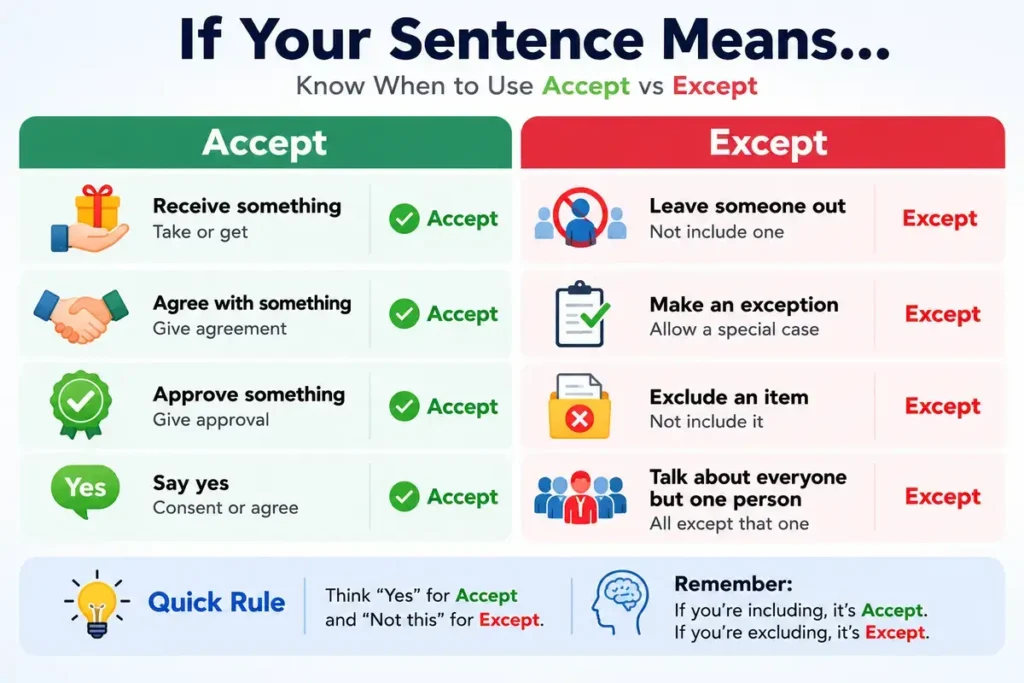
Accept vs Except Cheat Sheet
| If Your Sentence Means… | Use |
|---|---|
| Receive something | Accept |
| Agree with something | Accept |
| Approve something | Accept |
| Say yes | Accept |
| Leave someone out | Except |
| Make an exception | Except |
| Exclude an item | Except |
| Talk about everyone but one person | Except |
Conclusion
Understanding accept vs except is much easier than it first appears. Although the words look and sound similar, their meanings are completely different. Accept is about receiving, agreeing, approving, or saying yes. Except is about leaving someone or something out of a group.
A simple habit can prevent almost every mistake. Pause for a moment and ask yourself if you’re welcoming something or excluding it. If you’re receiving or agreeing, choose accept. If you’re creating an exception, choose except. After a little practice, the correct choice will become automatic, and you’ll write with more confidence in emails, essays, business documents, and everyday conversations.
Frequently Asked Questions
Is it accept or except my apology?
The correct phrase is accept my apology. In this accept vs except comparison, accept is correct because you’re receiving or agreeing to the apology.
What’s another way to say accept?
Common alternatives include receive, agree to, approve, acknowledge, embrace, and welcome. The best choice depends on your sentence and the level of formality.
Can except be used as a verb?
Yes, but it’s rare. In modern English, except is usually a preposition or conjunction. The verb form appears mostly in legal or highly formal writing.
Why do people confuse accept and except?
People confuse them because they look alike, sound similar, and differ by only two letters. Understanding the core meanings makes the accept vs except distinction much easier to remember.
Is accept always a verb?
Almost always. The word accept functions as a verb in everyday English. Related nouns include acceptance and acceptability.
How can I remember accept vs except?
Remember that A stands for agree and EX reminds you of exclude. One word welcomes something, while the other leaves something out.
Is there any difference between American and British English?
No. Both American and British English use accept and except with the same spellings and meanings.
