
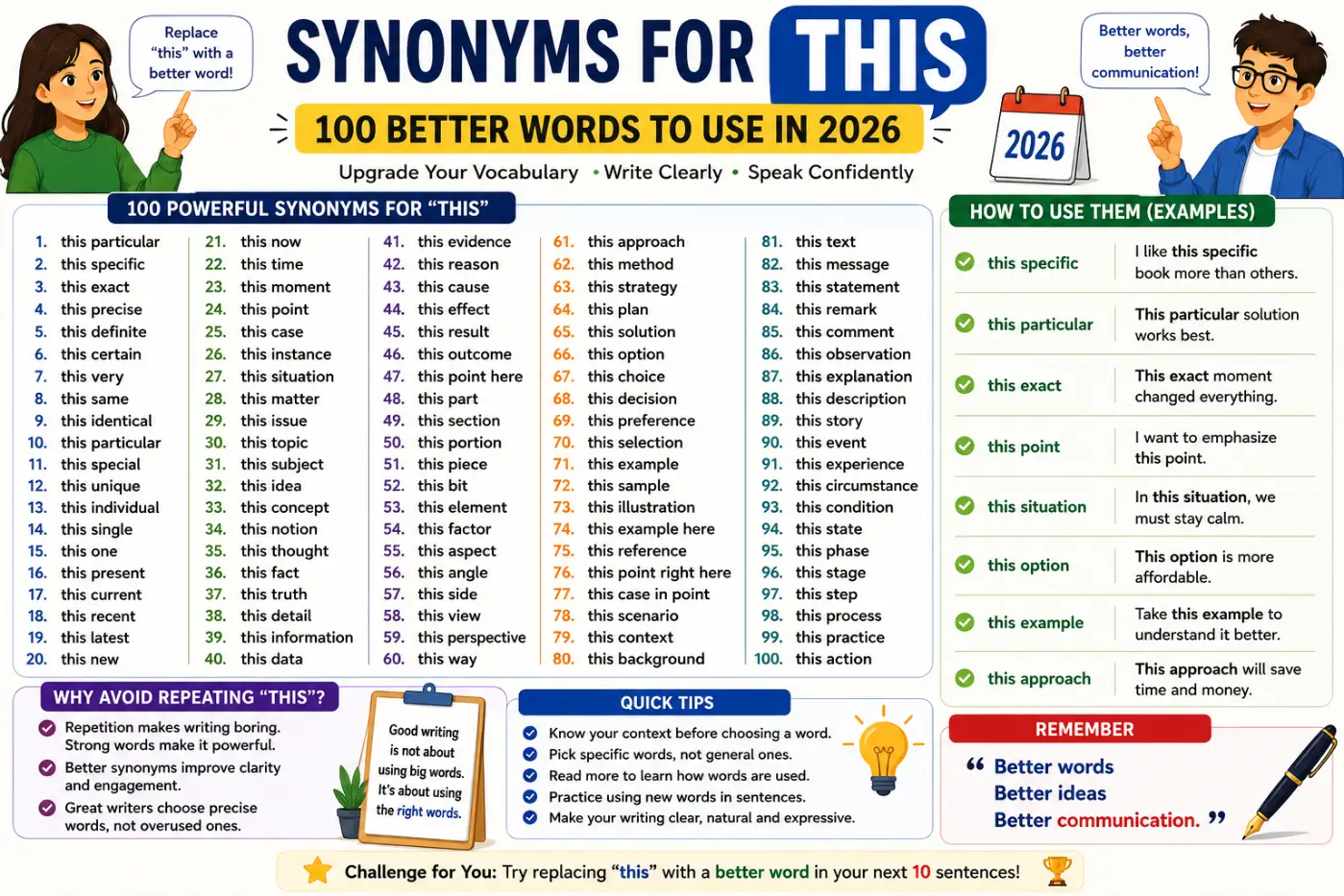
Finding the right synonyms for this can instantly make your writing clearer, more professional, and less repetitive. Many writers rely on the word this so often that paragraphs begin to sound repetitive. The good news is that English offers dozens of natural alternatives, but the best choice depends on what this refers to. In some cases, replacing this with a more specific word improves readability. In others, keeping this is actually the better option.
The confusion comes from the fact that this serves several grammatical functions. It can act as a determiner, a pronoun, or part of a transitional phrase. Because of that, there isn’t one universal replacement. A synonym that works perfectly in an academic paper may sound awkward in casual conversation. Likewise, a substitute that fits business writing may not suit creative storytelling.
This guide explains the best synonyms for this, when to use them, when not to replace this, and how experienced editors choose the most natural alternative. You’ll also discover practical examples, grammar tips, common mistakes, and context-specific recommendations that help your writing sound polished without feeling forced.
Quick Definition
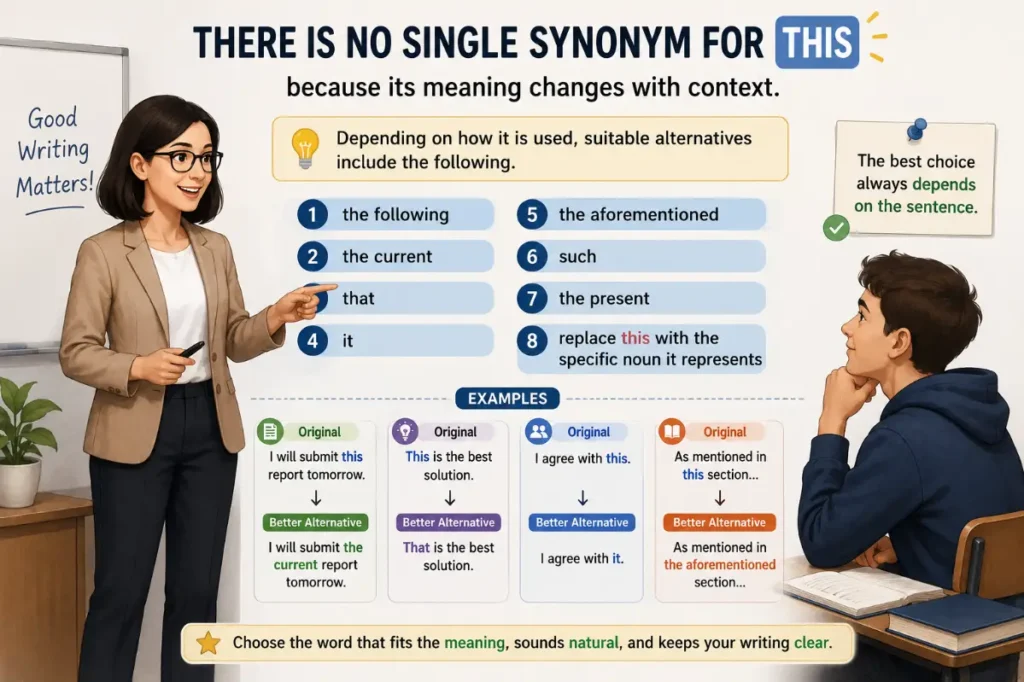
There is no single synonym for this because its meaning changes with context. Depending on how it is used, suitable alternatives include the following, the current, that, it, the aforementioned, such, the present, or replacing this with the specific noun it represents. The best choice always depends on the sentence.
Quick Answer
If you’re looking for synonyms for this, remember one simple rule:
- Replace this only when another word makes the sentence clearer.
- Choose a synonym that matches the grammatical role of this.
- In many situations, repeating the actual noun is stronger than using a substitute.
- Avoid replacing this simply to avoid repetition if the result sounds unnatural.
For example:
Correct:
- This report explains the results.
Also correct:
- The report explains the results.
Less natural:
- The aforementioned explains the results.
The second sentence is clearer because it names the noun directly.
Synonyms for This Comparison Table
| Alternative | Meaning | Part of Speech | Origin | Usage Frequency | Formality | Common Contexts | Example |
|---|---|---|---|---|---|---|---|
| this | Refers to something nearby or just mentioned | Pronoun or determiner | Old English | Very high | Neutral | Everyday English | This book is excellent. |
| that | Refers to something farther away or previously mentioned | Pronoun or determiner | Old English | Very high | Neutral | Conversation and writing | That idea worked well. |
| it | Refers to an already identified thing | Pronoun | Old English | Extremely high | Neutral | Everyday communication | It solved the problem. |
| the following | Introduces information that comes next | Phrase | Middle English | High | Formal | Academic and business writing | Consider the following points. |
| the present | Refers to the current item or situation | Adjective | Latin | Moderate | Formal | Legal and official documents | The present agreement remains valid. |
| the current | Refers to the existing item or situation | Adjective | Latin | High | Formal | Reports and journalism | The current policy applies today. |
| the aforementioned | Refers to something already mentioned | Adjective | Latin | Low | Very formal | Legal writing | The aforementioned clause applies. |
| such | Refers back to a previously described thing | Determiner | Old English | Moderate | Formal | Academic writing | Such behavior is unacceptable. |
| the stated | Refers to information already expressed | Adjective | Middle English | Moderate | Formal | Reports and documentation | The stated objective remains unchanged. |
| said | Refers to something already identified | Adjective | Old English | Low | Very formal | Legal writing | Said property shall remain protected. |
Meaning of This
The word this is one of the most common words in English. It points to a person, object, idea, event, or situation that is close in space, time, or discussion.
Examples include:
- This chair is comfortable.
- This week has been busy.
- This is exactly what I wanted.
- I enjoyed this movie.
- This surprised everyone.
In each example, this identifies something specific that the speaker expects the listener or reader to recognize.
Etymology
The word comes from Old English “þis”, which developed from earlier Germanic languages. It has remained one of the core demonstrative words in English for more than a thousand years, making it one of the language’s oldest continuously used terms.
How Native Speakers Use This
Native speakers use this constantly because it creates a direct connection between the speaker and the subject. Instead of sounding repetitive, it often makes communication smoother.
For example:
- This coffee tastes amazing.
- This chapter is difficult.
- This decision changed everything.
Replacing this in these sentences usually makes them less natural.
Meaning of Common Synonyms for This
Unlike spelling comparisons, synonyms for this are context dependent. Each alternative has a different purpose.
That
That usually refers to something farther away or something mentioned earlier.
Examples:
- That building is beautiful.
- I remember that conversation.
It
It replaces a noun that has already been identified.
Examples:
- The laptop arrived yesterday.
- It works perfectly.
The Following
This phrase introduces information that comes next.
Examples:
- Please read the following instructions.
- Consider the following examples.
Such
Such refers back to a previously described type or quality.
Examples:
- Such mistakes are common.
- Such opportunities are rare.
The Current
This expression emphasizes the existing or present version.
Examples:
- The current policy expires next year.
- The current design is easier to maintain.
The Present
Often used in legal or official documents.
Examples:
- The present agreement begins today.
- The present report summarizes the findings.
The Aforementioned
A very formal reference to something already mentioned.
Examples:
- The aforementioned contract remains effective.
- The aforementioned evidence supports the claim.
Most editors recommend using this phrase sparingly because it sounds formal and can reduce readability.
Synonyms for This by Writing Style
Choosing the right replacement depends more on your audience than on the dictionary.
Everyday Conversation
Natural alternatives include:
- It.
- That.
- The thing.
- This one.
- The one.
Example:
Instead of:
- This is great.
You might say:
- That’s great.
Academic Writing
More formal choices include:
- The following.
- Such.
- The current.
- The present.
- The discussed concept.
Business Writing
Professional documents often use:
- The following.
- The current.
- The proposed.
- The stated.
- The referenced.
Legal Writing
Legal documents frequently include:
- The present.
- Said.
- The aforementioned.
- Such.
- The referenced.
These expressions are acceptable in legal contexts but usually sound overly formal in everyday English.
Key Differences Between This and Its Alternatives
Although many people search for synonyms for this, no replacement carries exactly the same meaning in every sentence.
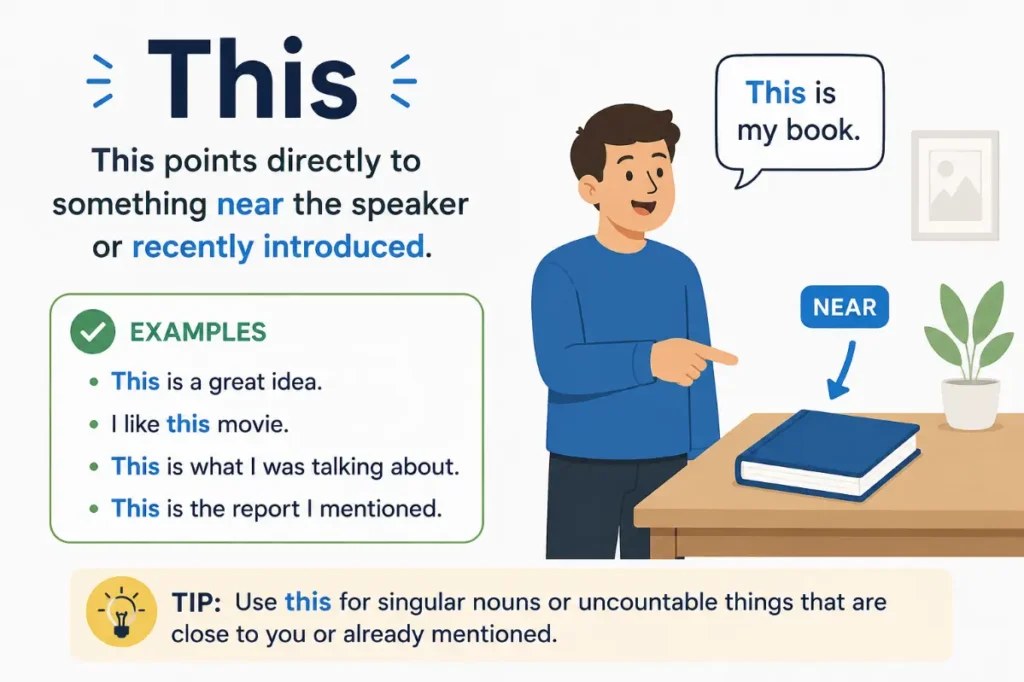
- This points directly to something near the speaker or recently introduced.
- That usually creates more distance.
- It assumes the noun has already been identified.
- The following introduces new information instead of referring backward.
- Such refers to a category rather than one specific item.
- The current emphasizes time rather than location.
- The present is mostly reserved for formal writing.
- The aforementioned refers back to earlier text and is rarely used in everyday English.
Experienced editors generally prefer the simplest option that keeps the meaning clear. Often, repeating the noun itself produces a smoother sentence than replacing this with an elaborate expression.
Which Synonym for This Is Correct?
A common question is, “Which synonym for this is correct?”
The answer is simple: the correct synonym is the one that preserves the original meaning and fits the grammar of the sentence. There is no single replacement that works every time.
Professional editors rarely replace this automatically. Instead, they ask three questions:
- What does this refer to?
- Is the reference clear to the reader?
- Will another word improve clarity or make the sentence sound awkward?
For example:
Correct:
- This solution saves time.
Also correct:
- The solution saves time.
Correct in another context:
- That solution saved time.
Incorrect:
- The aforementioned solution saves time. (Too formal for everyday writing.)
The goal is not to avoid this. The goal is to make your writing as clear as possible.
Examples Using This
Here are ten natural examples that show how native speakers use this.
- This recipe is easy to follow.
- This phone has an excellent camera.
- I can’t believe this happened today.
- This road leads to the city center.
- This chapter explains the main idea.
- This meeting should finish by noon.
- This opportunity doesn’t come often.
- This answer makes perfect sense.
- This painting belongs to my grandmother.
- This decision will affect everyone.
Notice that this points directly to something specific.
Examples Using Synonyms for This
Now compare sentences that naturally use alternatives.
- That restaurant serves amazing food.
- It changed my perspective completely.
- Please review the following information carefully.
- Such behavior is unacceptable in the workplace.
- The current version includes several improvements.
- The present document outlines company policies.
- The stated objective remains unchanged.
- The referenced article explains the concept well.
- The report summarizes the findings.
- That was exactly what I expected.
Each alternative fits a different situation instead of acting as a universal replacement.
Common Mistakes When Looking for Synonyms for This
Many writers search for synonyms for this because they want to avoid repetition. Unfortunately, replacing every instance of this often creates awkward writing.
The most common mistakes include:
1. Replacing Every Instance of This
Poor:
- The aforementioned proposal will improve productivity.
Better:
- This proposal will improve productivity.
Or:
- The proposal will improve productivity.
Simple language usually reads better.
2. Confusing This With That
Although the two words are closely related, they are not interchangeable in every sentence.
Compare:
- This book is on my desk.
- That book is on your desk.
The choice depends on perspective.
3. Using Formal Alternatives in Casual Writing
Expressions such as the aforementioned or said belong mainly in legal documents. Casual conversation sounds much more natural with:
- this
- that
- it
4. Losing the Original Meaning
Consider this example:
Original:
- This discovery changed science.
Incorrect replacement:
- Such discovery changed science.
Correct replacement:
- The discovery changed science.
The grammar changes when you substitute another word.
5. Forgetting the Reader
The purpose of a synonym is to improve readability, not to impress readers with complicated vocabulary. If this is already the clearest choice, leave it unchanged.
Pronunciation Guide
Since this article discusses synonyms for this, it helps to understand how the original word is pronounced.
This
IPA:
/ðɪs/
Syllables:
this (one syllable)
Sounds:
- Begins with the voiced th sound /ð/.
- Uses the short i vowel.
- Ends with an s sound.
Common Pronunciation Mistakes
Learners sometimes replace the voiced th with:
- d
- z
- t
Instead of saying:
- dis
- zis
- tis
Practice the tongue gently between the teeth while voicing the sound.
Pronunciation of Common Alternatives
| Word | IPA |
|---|---|
| that | /ðæt/ |
| it | /ɪt/ |
| such | /sʌtʃ/ |
| current | /ˈkɝːənt/ |
| present | /ˈprɛzənt/ |
| following | /ˈfɑːloʊɪŋ/ |
Etymology and Word Origin
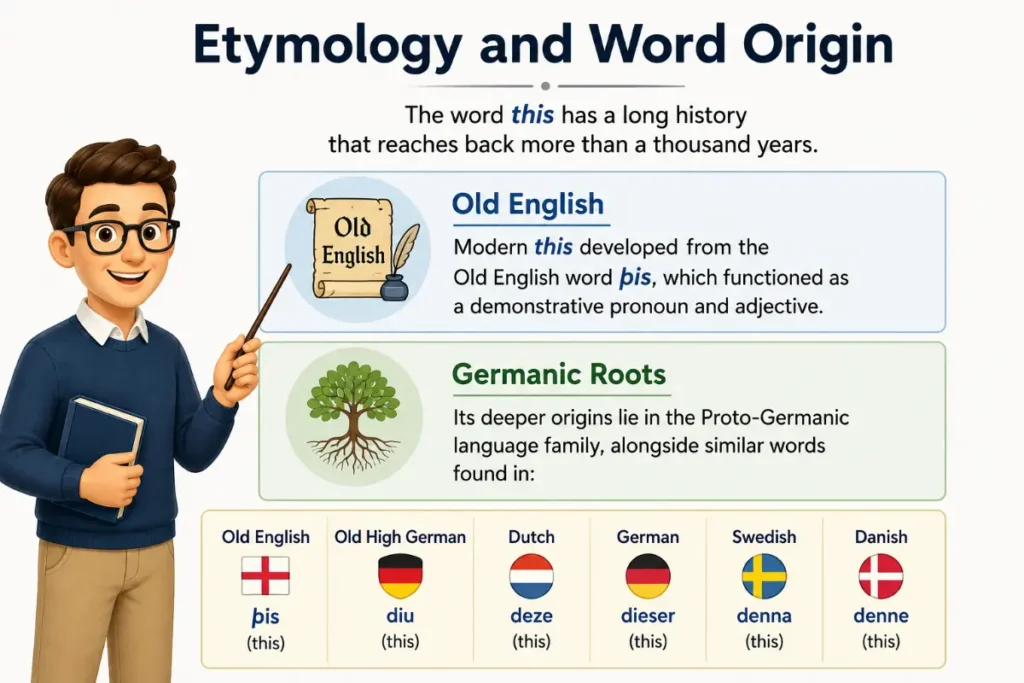
The word this has a long history that reaches back more than a thousand years.
Old English
Modern this developed from the Old English word þis, which functioned as a demonstrative pronoun and adjective.
Germanic Roots
Its deeper origins lie in the Proto-Germanic language family, alongside similar words found in:
- German
- Dutch
- Swedish
- Danish
Although spellings changed over centuries, the basic meaning remained remarkably stable.
Evolution Through English
Old English:
- þis
Middle English:
- this
Modern English:
- this
Unlike many English words borrowed from French or Latin, this has remained Germanic throughout its history. Many alternatives have different origins. Examples include:
| Word | Origin |
|---|---|
| this | Old English |
| that | Old English |
| it | Old Norse influence and Old English development |
| current | Latin |
| present | Latin |
| following | Old English |
| aforementioned | Latin and Middle English combination |
| stated | Latin through French |
Understanding these origins explains why some alternatives sound formal while others feel conversational.
Regional Usage
One advantage of this is its consistency across major English varieties.
American English
American English freely uses:
- this
- that
- it
Formal alternatives appear mostly in business, government, and legal writing.
British English
British English follows nearly identical patterns. Writers still prefer direct language over unnecessary formal substitutions.
Canadian English
Canadian English combines American and British influences, but this remains the preferred everyday choice.
Australian English
Australian English strongly favors simple, natural wording. Expressions like the aforementioned are uncommon outside official documents.
Regional Preference Summary
| Region | Preferred Style |
|---|---|
| United States | Simple and direct |
| United Kingdom | Clear and natural |
| Canada | Neutral modern English |
| Australia | Conversational English |
Across all four regions, there is no special regional synonym that replaces this.
Grammar Rules for This
Understanding grammar helps you decide when this should stay and when another expression works better.
This as a Demonstrative Determiner
When this appears before a noun, it functions as a determiner.
Examples:
- This computer is fast.
- This lesson is helpful.
- This article answers common questions.
This as a Pronoun
Sometimes this stands alone.
Examples:
- This is amazing.
- This belongs to Sarah.
- This explains everything.
Singular Form
This is singular.
Plural:
- these
Examples:
- This book
- These books
Agreement Rules
Always match the verb correctly.
Correct:
- This is correct.
- These are correct.
Incorrect:
- This are correct.
Can This Be Removed?
Sometimes yes.
Original:
- This report explains the findings.
Revised:
- The report explains the findings.
Removing this often improves conciseness.
When Not to Remove It
Keep this when it establishes emphasis or points directly to something.
Example:
- This is exactly what we needed.
Replacing it weakens the sentence.
Synonyms for This in Different Contexts
One reason people search for synonyms for this is that the ideal replacement changes with the situation.
Academic Writing
Suitable alternatives include:
- The following.
- Such.
- The present.
- The current.
- The discussed.
Example:
- The following experiment demonstrates the principle.
Business Communication
Common replacements include:
- The current.
- The proposed.
- The referenced.
- The attached.
- The report.
Technical Writing
Technical documents often repeat the actual noun instead of replacing this.
Example:
Instead of:
- This component improves efficiency.
You may write:
- The component improves efficiency.
Precision is more important than avoiding repetition.
Creative Writing
Creative writers usually keep this because it creates immediacy.
Example:
- This moment changed her life forever.
The sentence feels more personal than:
- The present moment changed her life forever.
Professional writers choose the alternative that sounds natural for the audience instead of searching for a universal substitute.
Real Life Usage Examples
Understanding synonyms for this becomes much easier when you see them in real situations. Native speakers rarely replace this just to avoid repetition. Instead, they choose the word that sounds most natural for the context.
Daily Conversation
- This coffee tastes better than yesterday’s.
- That’s exactly what I wanted to hear.
- It looks much cleaner now.
- This restaurant serves amazing pizza.
- The place has become one of my favorites.
Academic Writing
- The following section explains the research method.
- Such findings support the original hypothesis.
- The current study expands previous research.
- The present analysis focuses on language development.
- The report concludes with several recommendations.
Professional Communication
- The attached document contains the revised proposal.
- The current policy takes effect next month.
- The report summarizes this quarter’s performance.
- The referenced agreement remains valid.
- Please review the following action items.
Literature
Authors often keep this because it creates immediacy.
Examples include:
- This night would change everything.
- This memory stayed with her forever.
- This promise became his greatest burden.
- This silence spoke louder than words.
- This journey shaped her future.
Media and Journalism
News organizations prefer clear, direct language.
Examples:
- This decision affects thousands of workers.
- The current forecast predicts heavy rain.
- The report highlights growing concerns.
- The investigation continues this week.
- That announcement surprised investors.
Related Words and Confused Terms
People searching for synonyms for this often look for similar demonstratives, transition words, or alternatives that improve sentence variety.
Closely Related Words
- This.
- That.
- These.
- Those.
- It.
- Such.
- The following.
- The current.
- The present.
- The same.
Context Based Alternatives
Depending on your sentence, you might replace this with a more descriptive noun instead.
Instead of:
- This is important.
Write:
- The recommendation is important.
Instead of:
- This changed everything.
Write:
- The discovery changed everything.
Replacing the pronoun with the actual noun often creates stronger, more precise writing.
Commonly Confused Terms
| Word | Difference |
|---|---|
| this | Refers to something near or recently mentioned. |
| that | Refers to something farther away or previously mentioned. |
| these | Plural form of this. |
| those | Plural form of that. |
| it | Refers to a previously identified noun. |
| such | Refers to a type or category already described. |
Expert Language Insight
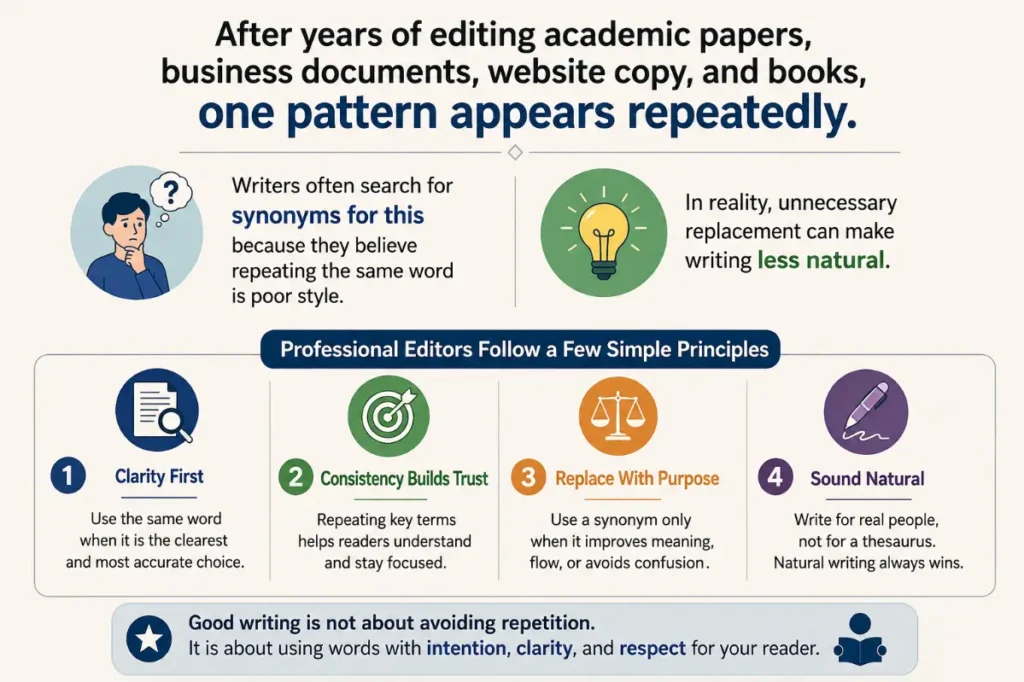
After years of editing academic papers, business documents, website copy, and books, one pattern appears repeatedly. Writers often search for synonyms for this because they believe repeating the same word is poor style. In reality, unnecessary replacement can make writing less natural. Professional editors follow a few simple principles.
Use This When It Is the Clearest Choice
If readers immediately understand the reference, keep this.
Example:
- This solution reduces costs.
There is nothing wrong with that sentence.
Repeat the Noun When Clarity Matters
Instead of replacing every occurrence with another pronoun, simply repeat the noun.
Weak:
- This improved sales.
Better:
- The marketing campaign improved sales.
Readers never have to guess what this means.
Avoid Overly Formal Substitutes
Expressions such as the aforementioned, said, and the present belong mainly in legal or highly technical writing. For most audiences, simple language creates stronger communication.
Think About the Reader
Every editing decision should help the reader understand the message faster.
Ask yourself:
- Does this clearly identify the subject?
- Would repeating the noun improve clarity?
- Does the replacement sound natural?
If the answer to the third question is no, leave this exactly where it is.
Conclusion
Finding the right synonyms for this is less about memorizing a list of replacements and more about understanding context. Because this can function as both a demonstrative pronoun and a determiner, no single synonym works in every sentence. The strongest writers choose alternatives based on meaning, grammar, audience, and purpose rather than trying to eliminate repetition at all costs.
For everyday communication, this, that, and it remain the most natural choices. In academic, professional, or legal writing, expressions such as the following, such, the current, and the present may be appropriate when they improve precision. In many situations, repeating the specific noun is even clearer than using a substitute.
The most practical recommendation is simple: use this confidently when it communicates your meaning clearly. Replace it only when another word genuinely improves readability or removes ambiguity. Clear writing always outperforms complicated writing, and choosing the right word for the context will make your message stronger, more natural, and easier for readers to understand.
Frequently Asked Questions
What is the best synonym for this?
There is no universal synonym for this. Depending on the sentence, suitable alternatives include that, it, the following, such, the current, or repeating the noun itself. Always choose the option that preserves the original meaning and improves clarity.
Can I replace this in every sentence?
No. In many cases, this is already the clearest and most natural word. Replacing it simply to avoid repetition may make your writing awkward or overly formal.
Is that a synonym for this?
Sometimes. That is closely related to this, but they are not interchangeable in every context. This usually refers to something closer in space, time, or discussion, while that often refers to something more distant or previously mentioned.
Is it better to repeat the noun instead of using this?
Often, yes. Repeating the noun can eliminate ambiguity and improve readability, especially in academic, technical, and professional writing where precision matters.
Which synonym works best in academic writing?
Academic writing commonly uses the following, such, the current, or repeats the noun. These options help maintain clarity without making the text unnecessarily complex.
Is the aforementioned a good replacement for this?
Only in highly formal documents such as legal contracts or official reports. In everyday writing, it usually sounds stiff and outdated. Most professional editors recommend simpler alternatives.
What part of speech is this?
This can function as either a demonstrative determiner before a noun or a demonstrative pronoun when it stands alone.
Examples:
- This book is interesting. (Determiner)
- This is interesting. (Pronoun)
Why do writers search for synonyms for this?
Most writers want to reduce repetition and improve style. However, experienced editors focus on clarity first. Sometimes the best revision is not a synonym but replacing this with the specific noun it represents.
