
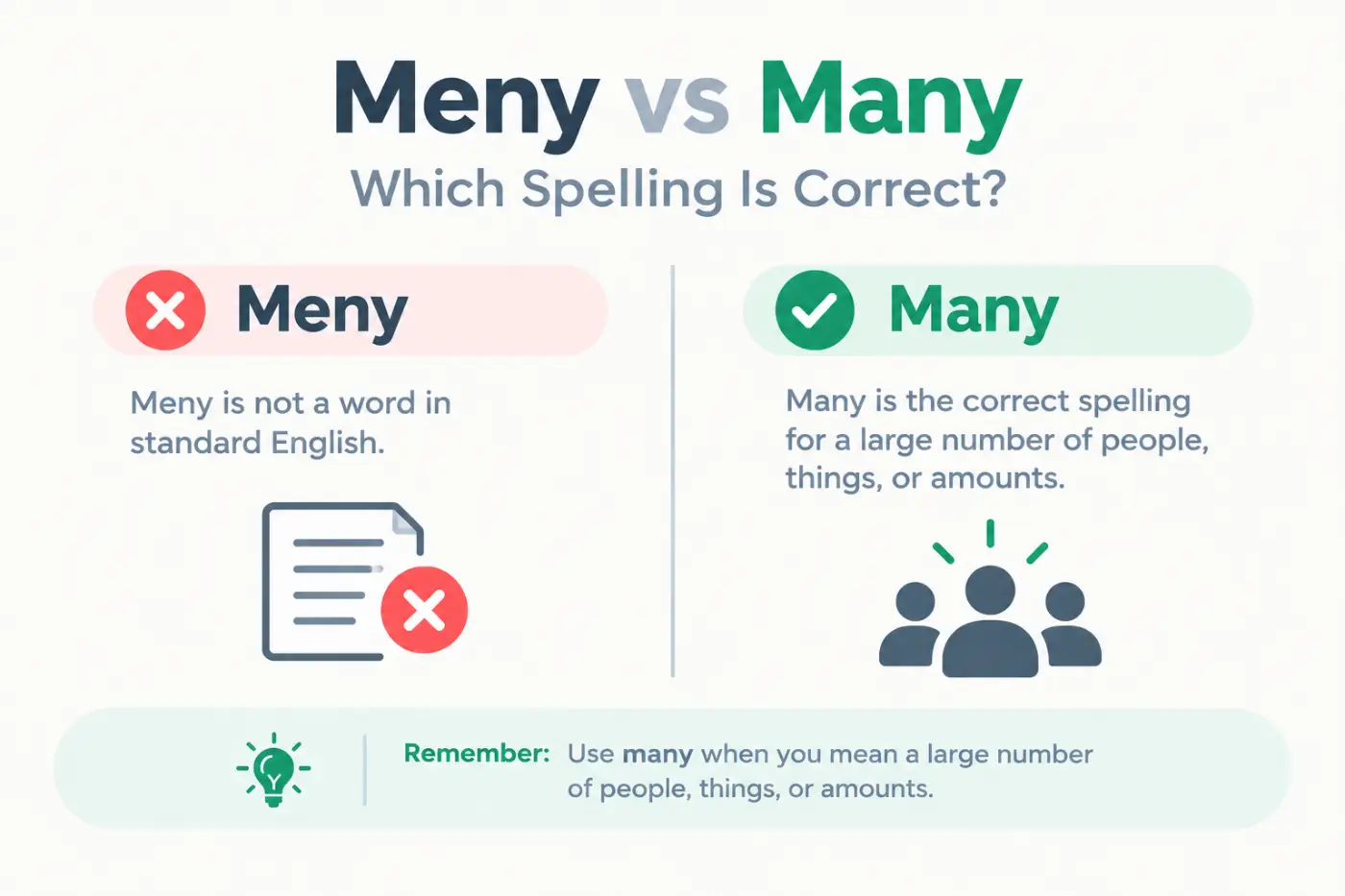
If you’re unsure about meny vs many which spelling is correct, the answer is simple. Many is the correct spelling in standard English when you want to talk about a large number of people, things, or ideas. Meny is generally a spelling mistake in this context.
The confusion often comes from typing quickly or remembering a word by the way it sounds. In everyday American English, many appears in questions, statements, emails, school assignments, business documents, and casual conversations. You might use it to describe many friends, many choices, many opportunities, or many reasons for doing something.
The good news is that you don’t need to memorize a complicated grammar rule to get this right. Once you understand what the word means and how it works in a sentence, choosing the correct spelling becomes much easier. You’ll also learn how to pronounce it, recognize common mistakes, and use it naturally in different situations.
Quick Answer
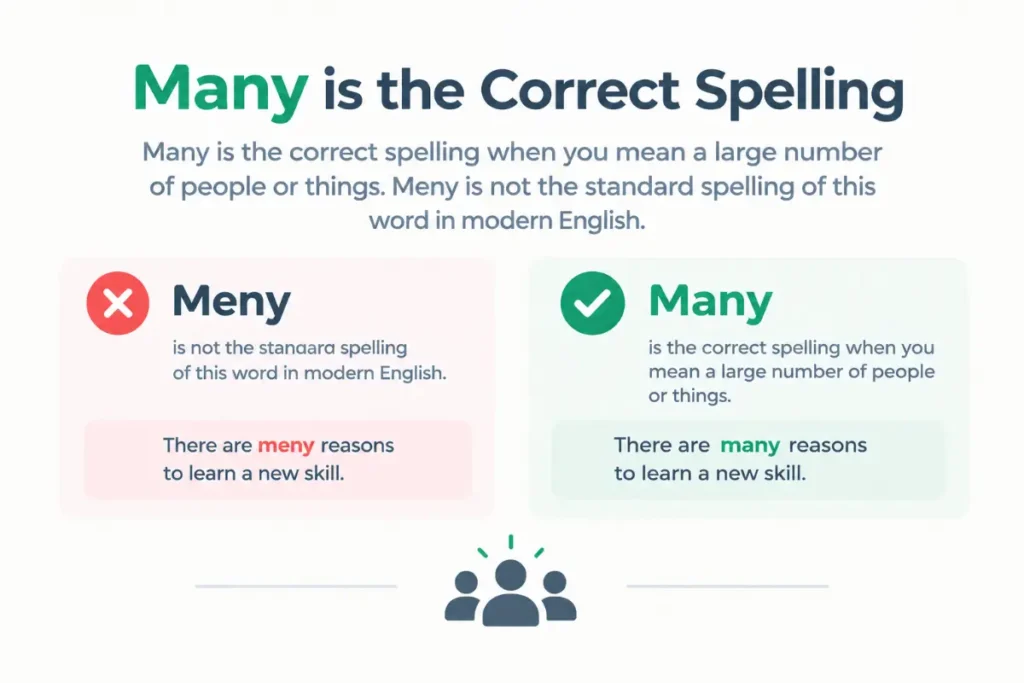
Many is the correct spelling when you mean a large number of people or things. Meny is not the standard spelling of this word in modern English. For example, write There are many reasons to learn a new skill, not There are meny reasons to learn a new skill.
Comparison Table for Meny and Many
| Feature | Many | Meny |
|---|---|---|
| Standard spelling | Correct | Incorrect in ordinary usage |
| Meaning | A large number | No standard meaning as the intended word |
| Part of speech | Determiner or pronoun | Not normally used as an English word in this context |
| Pronunciation | /ˈmɛni/ | Usually an attempted spelling of many |
| Formality | Suitable for formal and informal writing | Avoid as a substitute for many |
| Common contexts | People, objects, choices, events, and ideas | Typing errors and spelling mistakes |
| Example | Many students passed the test. | Meny students passed the test. |
The distinction is straightforward. Use many in standard English whenever you want to express a large number. The other spelling doesn’t serve as a standard alternative.
Meaning and Definition
What Does Many Mean
Many describes a large number of people, objects, events, or other countable things. It helps you talk about quantity without stating an exact number.
For example, you can say, Many people enjoy reading, or We received many applications for the job. Both sentences describe a large number without specifying the total.
The word can also refer to a group of people or things already understood from the conversation. Consider the sentence, Many were invited, but only a few attended. Here, the word replaces a longer phrase because the reader already knows which people the sentence refers to.
In everyday American English, this word serves several useful purposes.
- It describes a large quantity of countable things.
- It helps form questions about quantity.
- It appears in negative statements about numbers.
- It allows writers to compare quantities without giving exact figures.
- It can replace a noun phrase when the intended meaning is clear.
For example, How many books do you own? asks about quantity. I don’t have many free hours this week describes a limited number of available hours. Both sentences use the word correctly.
What Does Meny Mean
In ordinary English writing, meny is generally a misspelling of many. It doesn’t carry the standard meaning of a large number, and it shouldn’t replace the correct form in schoolwork, emails, articles, or professional documents.
Someone might type the incorrect version because they are writing quickly, have made a typing error, or haven’t learned the standard spelling. A spelling checker may flag it, although the exact result depends on the software and its dictionary.
There is a useful distinction between a misspelling and a word that has a separate identity. A name, username, brand, or specialized term can use unusual letter combinations. That doesn’t make the same spelling a valid substitute for the ordinary English word.
For example, if a person uses Meny as a company name, the name may be intentional. However, that special use doesn’t change the standard spelling of the word used to describe quantity.
When you want to express a large number, choose many.
Key Differences Explained
The main difference comes down to spelling and standard usage. However, understanding a few related points can help you avoid similar errors.
Spelling
The correct word contains the letters M, A, N, and Y in that order. The incorrect version replaces the letter A with E.
- Correct spelling: many.
- Common misspelling: meny.
A simple way to remember the word is to connect its spelling with familiar expressions such as many people, many times, and many things. Seeing the correct form in common phrases helps reinforce the spelling.
Meaning
The standard word expresses quantity. The mistaken form doesn’t express that meaning in standard English.
Compare these sentences.
- Correct: Many customers visited the store.
- Incorrect: Meny customers visited the store.
The first sentence communicates that a large number of customers visited. The second contains a spelling error that may distract readers or make the sentence appear less polished.
Grammar
The word many usually works with plural countable nouns. These are nouns that you can count individually, such as books, chairs, people, and days.
For example, many chairs is correct because chairs are countable and the noun is plural. In contrast, many water is generally incorrect when referring to water as a substance. In that situation, use much water or a lot of water.
Pronunciation
The standard pronunciation of many is /ˈmɛni/. It has two syllables, with the stress on the first syllable.
In American English, the first vowel sounds like the short E in bed. The second syllable sounds like the ending of happy. The incorrect spelling can lead some learners to wonder about a different vowel sound, but the standard word is pronounced with the short E sound.
Formality
The word many works in casual conversation and formal writing. You can use it in a text message, a school essay, a business report, or an academic paper.
The misspelling meny is not an accepted formal alternative. Correcting it makes your writing clearer and more professional.
Context and Regional Usage
American, British, Canadian, and Australian English all use many as the standard spelling. There is no meaningful regional spelling difference between these varieties.
The word can sound more formal than a lot of in some everyday sentences, but both expressions are useful. For example, Many residents attended the meeting may suit a news report, while A lot of people came to the meeting sounds natural in conversation.
Which Form Is Correct
Many is the correct form for standard English. It follows the established spelling used in dictionaries and ordinary written communication. The spelling meny doesn’t serve as a recognized alternative for the same quantity word.
The reason is not a special grammatical exception. It’s simply the conventional spelling of the word. English spelling often requires you to remember the letter sequence rather than guess every word from its sound.
You can confirm the distinction by checking a reputable English dictionary. A standard dictionary entry for many explains its use in describing a large number or amount of countable items. The mistaken spelling shouldn’t be treated as an interchangeable form.
In practice, follow these rules.
- Use many before plural countable nouns, as in many questions.
- Use many in questions about countable quantities, as in How many tickets do we need?
- Use many in negative statements, as in We don’t have many options.
- Use many as a pronoun when the noun is understood, as in Many were disappointed.
- Correct meny when it appears accidentally in ordinary writing.
These rules cover the situations most readers will encounter.
Ten Natural Example Sentences
The following examples show how to use the correct word in different situations.
1. Everyday conversation. Many people prefer coffee in the morning.
2. Text messages. I’ve got many things to finish before dinner.
3. Workplace communication. Many employees requested additional training this year.
4. School assignments. Many students find mathematics easier with regular practice.
5. Academic writing. Many studies examine the effects of sleep on learning.
6. Formal writing. Many factors contributed to the final decision.
7. Social situations. Many of our friends are coming to the party.
8. Online communication. Many users shared their opinions in the comments.
9. News reporting. Many residents reported power outages after the storm.
10. Personal storytelling. Many years ago, my grandfather lived in a small farming town.
Each sentence uses the same standard spelling. The surrounding words change, but the meaning stays consistent.
Common Spelling Mistakes
Spelling errors often happen when people rely on memory, type too quickly, or confuse similar letter patterns. Here are five mistakes to watch for.
Using Meny Instead of Many
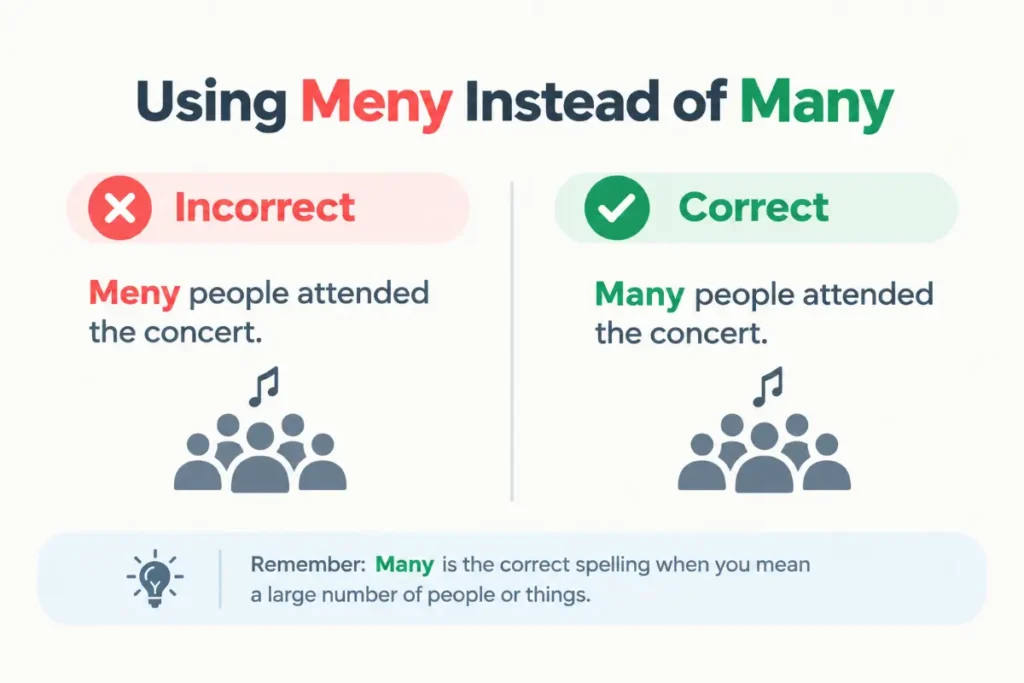
Incorrect: Meny people attended the concert.
Correct: Many people attended the concert.
The error replaces the A with an E. Both letters appear in common English words, so the wrong form may slip through when someone writes without checking.
Writing Many With an Extra Letter
Incorrect: Manny people attended the event.
Correct: Many people attended the event.
The spelling Manny can be a proper name. However, it isn’t the standard spelling of the quantity word. Keep the distinction clear when writing about numbers.
Confusing Many With Much
Incorrect: We don’t have many time left.
Correct: We don’t have much time left.
This is a grammar error rather than a spelling error. Use many with plural countable nouns and much with uncountable nouns in the intended sense.
Using Many With a Singular Countable Noun
Incorrect: Many student joined the club.
Correct: Many students joined the club.
The word many normally takes a plural countable noun when it directly describes that noun. Adding the plural ending makes the sentence grammatically correct.
Confusing Many With Any
Incorrect: Do you have many questions? No, I don’t have many.
Correct: Do you have any questions? No, I don’t have any.
Both words can appear in questions and negative sentences, but they serve different purposes. Many emphasizes quantity, while any asks about the presence of something or refers to an unspecified amount or number.
Pronunciation Guide
The word many has two syllables and a clear stress pattern. Learning its sound can help you remember the spelling, especially if English isn’t your first language.
IPA and Syllable Breakdown
- IPA: /ˈmɛni/.
- Syllables: man y in spelling, with the spoken vowel sounds represented by /mɛ/ and /ni/.
- Stress: The first syllable receives the stress.
- Simple pronunciation guide: Say the first part like the word men, then finish with a sound similar to the ending of happy.
The pronunciation guide describes the sound, not an alternative spelling. Always write the word with A in the first syllable.
Common Pronunciation Errors
Some learners pronounce the first vowel too much like the A in name. That sound doesn’t match the usual American pronunciation of many. Others may focus so much on the written letters that they pronounce the word slowly or unnaturally.
To practice, say these phrases aloud.
- Many people.
- Many choices.
- How many days.
- Too many questions.
The word becomes easier to recognize when you hear it in a natural phrase. Still, pronunciation alone isn’t always enough to determine spelling because English contains many words whose sounds don’t match their letters in a simple way.
Etymology and Word Origin
The word many has a long history in English. Its spelling and meaning developed through earlier forms of the language rather than appearing as a modern invention.
It comes from Old English manig, which meant many or numerous. The word is related to forms found in other Germanic languages, reflecting a shared historical vocabulary. Over time, its written form changed, eventually becoming the modern English many.
This history helps explain why the spelling follows an established pattern rather than a simple rule that lets you choose the letters from their sounds. English has absorbed words from many sources, and common words can preserve spelling patterns shaped by centuries of use.
The important point for modern readers is simple. Historical forms can help explain a word’s development, but modern writing follows the accepted spelling used today.
Regional Usage
The spelling stays the same across the major varieties of English. Differences in accent may affect how a speaker sounds, but they don’t change the standard written form.
American English
In the United States, many is the standard spelling. It appears in everyday speech, business writing, education, journalism, and formal documents.
For example, an American writer might say, Many families visit the park on weekends. The same spelling applies in a school essay or a workplace report.
British English
British English also uses many. The spelling doesn’t change to meny, and there is no accepted regional rule that makes the latter correct for ordinary quantity expressions.
A British writer can use the word in sentences such as Many people use public transportation or How many tickets have you sold?
Australian English
Australian English follows the same standard spelling. Writers use many in casual messages, news reports, schoolwork, and formal communication.
Canadian English
Canadian English also uses many. The spelling matches both American and British English in this case.
In all four varieties, the main consideration is grammatical context. Choose many for countable quantities, and use other quantity words when the sentence calls for them.
Grammar Rules and Part of Speech
Understanding how the word functions in a sentence helps you use it correctly. Many can act as a determiner before a noun or as a pronoun when the noun is already clear.
Many as a Determiner
A determiner comes before a noun and helps establish its quantity or reference. In many books, the word tells you that the number of books is large without giving an exact count.
Examples include many friends, many opportunities, and many reasons. The noun that follows is normally plural and countable.
Many as a Pronoun
The word can also stand alone when the noun is understood from the context.
For example, Several people applied for the position, and many were qualified. The second part refers to many applicants, so the writer doesn’t need to repeat the noun.
This structure is useful in formal writing because it can make sentences shorter without losing meaning.
Many in Questions
Use the phrase how many to ask about the number of countable items.
- How many students are in the classroom?
- How many days will the trip take?
- How many copies should I print?
These questions seek a number or an estimate. For uncountable nouns, use how much instead. For example, ask How much milk do we need?
Many in Negative Sentences
The word often appears with not, don’t, doesn’t, or didn’t.
For example, We didn’t receive many applications. This sentence means the number of applications was small or lower than expected.
In everyday American conversation, speakers also use a lot of in similar contexts. The best choice depends on the sentence and the tone you want.
Many in Positive Sentences
The word works naturally in positive statements, especially when the writer wants to emphasize a large number.
For example, Many people volunteered to help after the flood. This sentence highlights the number of volunteers without stating an exact total.
In casual speech, a lot of people volunteered may sound more relaxed. Both are grammatically acceptable.
Punctuation and Sentence Position
The word doesn’t need special punctuation. Place it wherever the sentence structure requires it, usually before a plural countable noun or in a position where it functions as a pronoun.
For example, Many of the guests arrived early is correct. So is I have many questions. Neither sentence needs a comma simply because it contains the word.
Real Life Usage Examples
Daily Conversation
People use this word to talk about quantity, experiences, and everyday choices.
- Many people take a walk after dinner.
- I have many errands to run before the weekend.
In conversation, the word often appears in questions such as How many people are coming? It also appears in statements such as I’ve visited that place many times.
Email and Workplace Communication
In professional settings, the word can help describe workload, results, requests, or shared concerns.
- Many team members contributed to the project.
- We received many requests for additional information.
These sentences are direct and suitable for work emails. They communicate quantity without sounding overly formal.
Academic Writing
Students and researchers use the word to describe groups, observations, or ideas.
- Many researchers have studied the relationship between sleep and memory.
- Many students benefit from clear examples and regular practice.
In academic writing, use the word only when the claim fits the evidence. If you have an exact count, a specific number may communicate the finding more precisely.
News and Journalism
News writing often uses the word to refer to people affected by an event or a group involved in an issue.
- Many residents left the area before the storm arrived.
- Many local businesses reported higher operating costs.
A journalist should avoid using vague quantity words when precise figures are available and relevant. The word is useful, but accuracy matters more than general emphasis.
Literature and Storytelling
Writers use the word to describe experiences, people, memories, and events without listing every individual item.
- Many winters passed before the old house was repaired.
- She had many reasons to remember that summer.
The word can create a sense of scale. It lets a writer suggest abundance, repetition, or a long history without slowing the story down with exact numbers.
Related and Confused Terms
Several words describe quantity or appear in similar sentence patterns. Understanding the differences can improve your grammar and make your writing more precise.
1. Much. Use this with uncountable nouns in common quantity expressions, such as much time or much water. It differs from many, which usually describes plural countable nouns.
2. A lot of. This phrase works with countable and uncountable nouns. You can say a lot of books or a lot of water. It often sounds natural in casual American English.
3. Numerous. This means many or a large number. It often sounds more formal. For example, Numerous applicants submitted their resumes suits a professional report.
4. Several. This refers to more than two people or things, but it usually suggests a smaller or less specific number than many. The exact quantity depends on context.
5. Few. This describes a small number of countable things. For example, Few seats were available suggests that there weren’t many seats.
6. A few. This also describes a small number, but it often carries a more positive meaning. I have a few ideas suggests that the speaker has some ideas to share.
7. Any. This word appears in questions and negative sentences and can refer to an unspecified amount or number. Do you have any questions? asks about the presence of questions rather than emphasizing a large quantity.
8. Manny. This spelling can be a personal name. It is not the standard quantity word, so don’t use it in place of many unless you are referring to someone whose name is Manny.
These distinctions matter because choosing the right quantity word improves clarity. A sentence can contain the correct spelling and still have a grammar problem if the word doesn’t fit the noun or meaning.
Expert Editor Insight
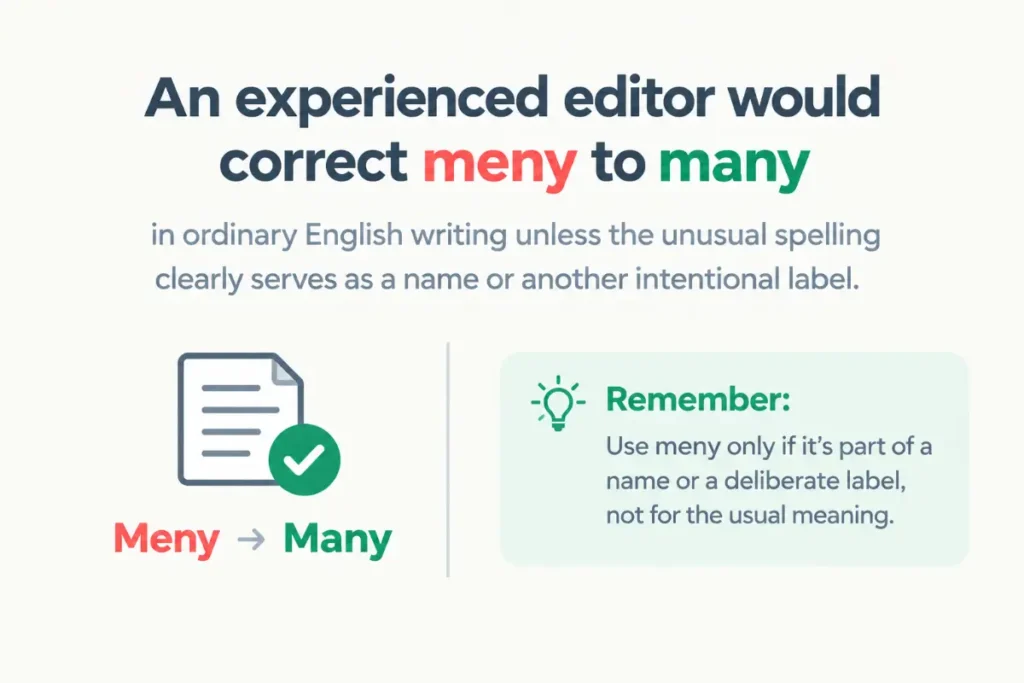
An experienced editor would correct meny to many in ordinary English writing unless the unusual spelling clearly serves as a name or another intentional label. The mistake is easy to miss during fast typing because readers often recognize a word from its overall shape rather than examining each letter. Spell checkers can help, but they don’t replace careful proofreading. My practical advice is to review common words in context, especially in titles, emails, and published material. Read the sentence once for meaning and again for spelling. That second pass often catches small errors that the first pass overlooks.
Conclusion
Meny vs many which spelling is correct has a simple answer. Many is the standard spelling for describing a large number of people or things, while meny is generally a misspelling in ordinary English. The correct word works with plural countable nouns and appears in questions, statements, emails, academic papers, and everyday conversations.
Remember the A in many, and pay attention to the noun that follows it. Use many books or many people, but use much time when referring to time as an uncountable quantity. A quick spelling check before sending or publishing your writing can help you catch this small error and keep your message clear.
FAQs
Is Meny a Real English Word?
Meny isn’t the standard English spelling of the quantity word many. You may encounter it as a name, brand, username, or another intentional label, but those special uses don’t make it a standard alternative in ordinary sentences. If you want to describe a large number of people or things, write many.
What Does Many Mean?
Many means a large number of people or things. It usually appears with plural countable nouns, such as many books, many students, and many choices. It can also stand alone when the noun is clear from the surrounding sentence. The word works in both casual conversation and formal writing.
Which Spelling Is Correct for Everyday Writing?
Use many in everyday writing. It is the accepted spelling in American English and other major English varieties. The form meny is generally a spelling mistake when used to express quantity. Remember the A in the middle of the correct word, and check your sentence for plural countable nouns when needed.
How Do You Pronounce Many?
The usual American pronunciation is /ˈmɛni/. It has two syllables, with the stress on the first. The opening vowel sounds like the short E in bed. You can practice by saying phrases such as many people and how many days. Hearing the word in context can help reinforce its standard spelling.
Can Many Start a Sentence?
Yes. You can start a sentence with many when the grammar supports it. For example, Many people enjoy spending time outdoors is correct. You can also write Many were surprised by the result when the reader already knows which group you mean. Starting a sentence with this word doesn’t require special punctuation.
What Is a Synonym for Many?
Useful alternatives include numerous, several, and a lot of. They don’t always mean exactly the same thing. Numerous often sounds more formal, while a lot of is common in conversation. Several usually suggests a smaller or less clearly defined number. Choose the expression that best matches your intended meaning.
Why Do People Confuse Meny and Many?
People often confuse these forms because they type quickly, rely on memory, or misremember the vowel. English spelling doesn’t always follow a predictable sound pattern, so a word can be easy to recognize but difficult to spell from memory. Repeated exposure to the correct form and a quick proofreading pass can reduce this mistake.
Is Many Appropriate in Formal Writing?
Yes. Many is suitable for academic papers, business reports, formal emails, news articles, and other professional documents. It can describe a large number without requiring an exact figure. However, if a report needs precise evidence, use a specific number when one is available. Never replace the standard spelling with meny in ordinary formal writing.
