
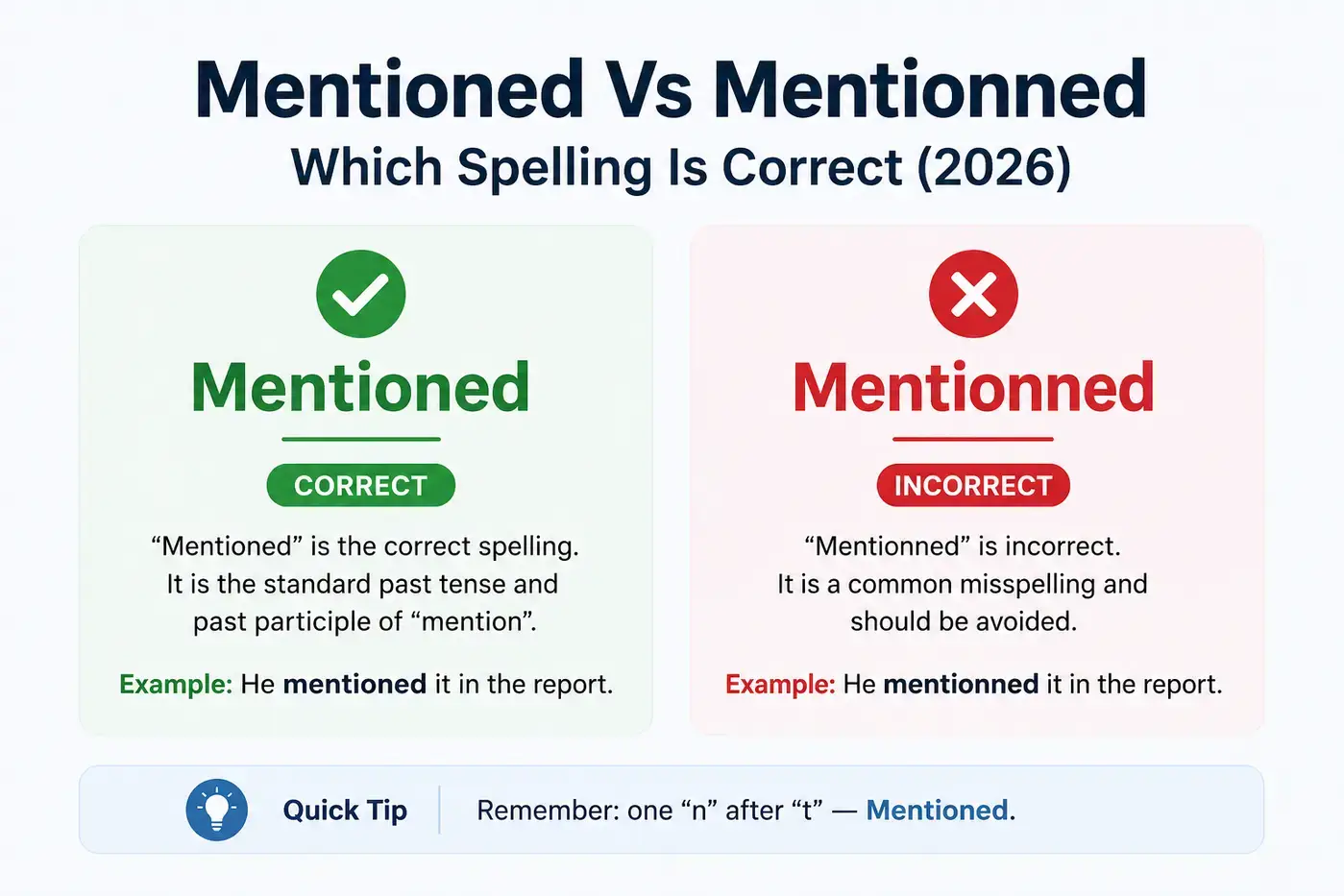
The spelling mentioned vs mentionned often confuses writers, but only one form is correct in standard English. Mentioned is the correct spelling, while mentionned adds an extra letter n and is considered a misspelling.
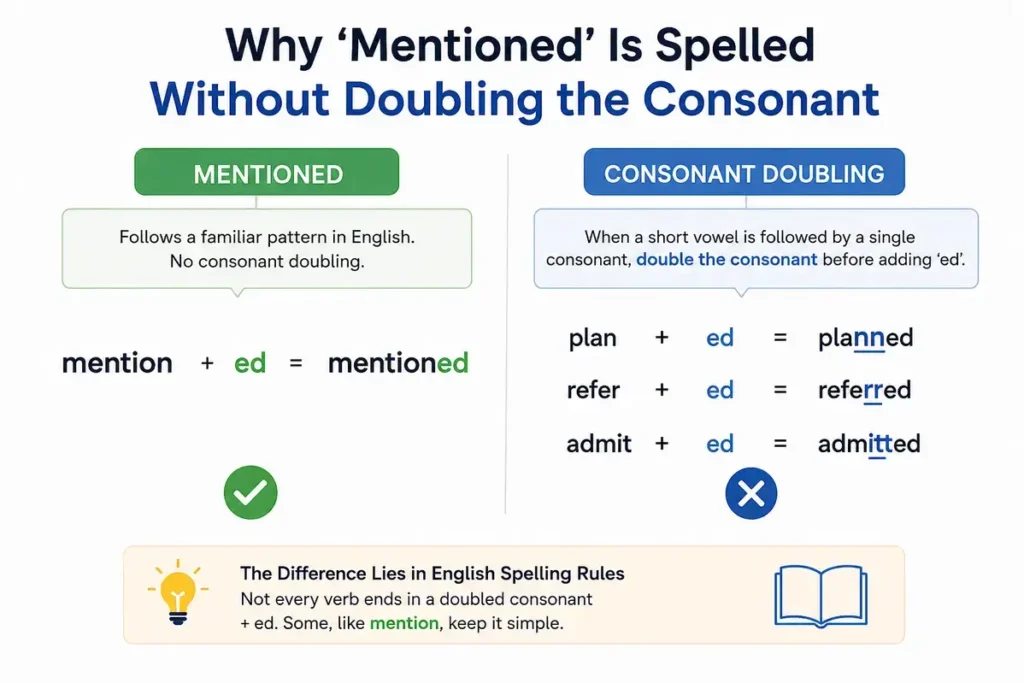
The confusion comes from how English forms the past tense of verbs. Some verbs double their final consonant before adding ed, while others do not. The verb mention follows the second pattern because its final syllable is unstressed. You simply write mention, mentioned, and mentioning without doubling the final n.
This spelling rule matters in everyday messages, school assignments, professional emails, and academic writing. Even one extra letter can make your writing look less polished, although readers may still understand your meaning. Fortunately, once you understand how English handles final consonants, this mistake becomes easy to avoid.
Quick Answer
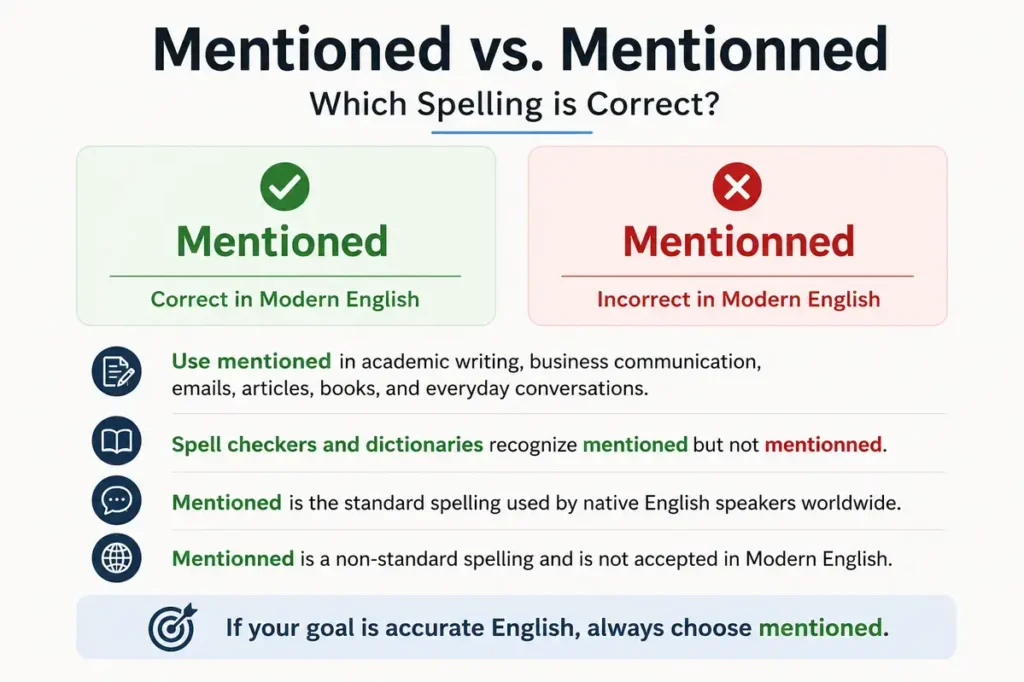
The correct spelling is mentioned, the past tense and past participle of the verb mention. It means to refer to a person, subject, idea, or event in speech or writing. Mentionned is a misspelling in standard English and should not appear in your own writing.
Comparison Table
| Feature | Mentioned | Mentionned |
|---|---|---|
| Correct spelling | Yes | No |
| Meaning | Referred to something | No standard English meaning as a form of mention |
| Part of speech | Verb form | Misspelling |
| Grammar | Past tense and past participle | Incorrect verb form |
| Word formation | Mention plus ed | Adds an unnecessary n |
| American English | Standard | Nonstandard |
| British English | Standard | Nonstandard |
| Formal writing | Appropriate | Should be corrected |
| Everyday use | Conversations and messages | A spelling error |
| Example | She mentioned the deadline. | She mentionned the deadline. |
Meaning and Definition
What Does Mentioned Mean
Mentioned means referred to someone or something, brought up a subject, or briefly spoke or wrote about an idea. The word usually describes a reference rather than a detailed explanation.
For example, if your coworker mentioned a meeting, they brought it up in conversation. They might have shared the time and place, or they might have made only a passing reference to it.
The word serves two main grammatical roles. It can describe a completed action in the past, and it can work with a helping verb to form a perfect tense.
1. Past tense. Sarah mentioned the new schedule yesterday.
2. Present perfect tense. Sarah has mentioned the new schedule several times.
3. Past perfect tense. Sarah had mentioned the new schedule before the manager sent the email.
In each sentence, the spelling remains the same. The surrounding words tell you how the verb functions in the sentence.
What Does Mentionned Mean
Mentionned is an incorrect spelling of the English verb form mentioned. It does not have a separate standard English meaning, and it should not replace the accepted form in schoolwork, professional documents, or everyday communication.
You might see this spelling in an online comment or an unedited message. That does not make it correct. If someone writes, “He mentionned the problem,” the intended meaning is clear, but the spelling needs correction.
The distinction is straightforward. Use mentioned when you mean that someone referred to a person, thing, or idea in the past.
Which Form Is Correct
Use mentioned in every standard English context. The verb mention forms its regular past tense by adding ed. It does not double its final n.
The easiest way to confirm the spelling is to begin with the base verb. Write mention first, then add ed. The result is mentioned.
Established dictionary entries support this usage. Merriam Webster and Cambridge list mention as an English verb and use mentioned in its past tense and past participle forms. Neither an extra n nor a regional spelling change is needed.
You can apply this rule in a quick message or a carefully edited report. The context may change, but the spelling stays the same.
Ten Natural Sentence Examples
These examples show how the correct form works in different situations.
1. Everyday conversation. My sister mentioned a great restaurant near her office.
2. Text message. You mentioned the movie last week, so I watched it last night.
3. Workplace communication. The supervisor mentioned the revised deadline during the morning meeting.
4. School assignment. The student mentioned two causes of the American Revolution in her essay.
5. Academic writing. The researchers mentioned several limits of their study in the discussion section.
6. Formal email. As mentioned in our previous conversation, the updated report is ready for review.
7. Social situation. Alex mentioned your name when we talked about the neighborhood party.
8. Online communication. The post mentioned a new feature that many users had requested.
9. News reporting. Officials mentioned road safety as a priority during the public meeting.
10. Storytelling. He mentioned the old photograph, but he never explained why it mattered to him.
Each example uses the same spelling. The verb fits naturally into a wide range of sentences because it describes a common action in communication.
Common Spelling Mistakes
The extra n is not the only possible typing error. Similar mistakes can happen when people type quickly, rely on sound, or mix up familiar letter patterns.
Mentionned Instead of Mentioned
Incorrect. She mentionned the change in her email.
Correct. She mentioned the change in her email.
The incorrect version doubles the final n without a valid spelling reason. Keep the base verb intact and add ed.
Menitioned Instead of Mentioned
Incorrect. The report menitioned the missing documents.
Correct. The report mentioned the missing documents.
This error inserts an extra i. It often comes from typing the letters in the wrong order. Check the middle of the word if the spelling looks unfamiliar.
Mentoined Instead of Mentioned
Incorrect. He mentoined the problem during lunch.
Correct. He mentioned the problem during lunch.
This version switches the positions of two letters. The intended word remains recognizable, but the spelling is incorrect.
Mentiond Instead of Mentioned
Incorrect. The teacher mentiond the assignment.
Correct. The teacher mentioned the assignment.
This mistake leaves out the letter e from the past tense ending. Remember to write the full ending ed.
Mentioning Instead of Mentioned
Incorrect for a completed past action. She is mentioning the issue yesterday.
Correct. She mentioned the issue yesterday.
This is a verb form error rather than a simple extra letter. Use mentioned for a completed past action. Use mentioning in patterns such as “She is mentioning the issue now.”
Key Differences Explained
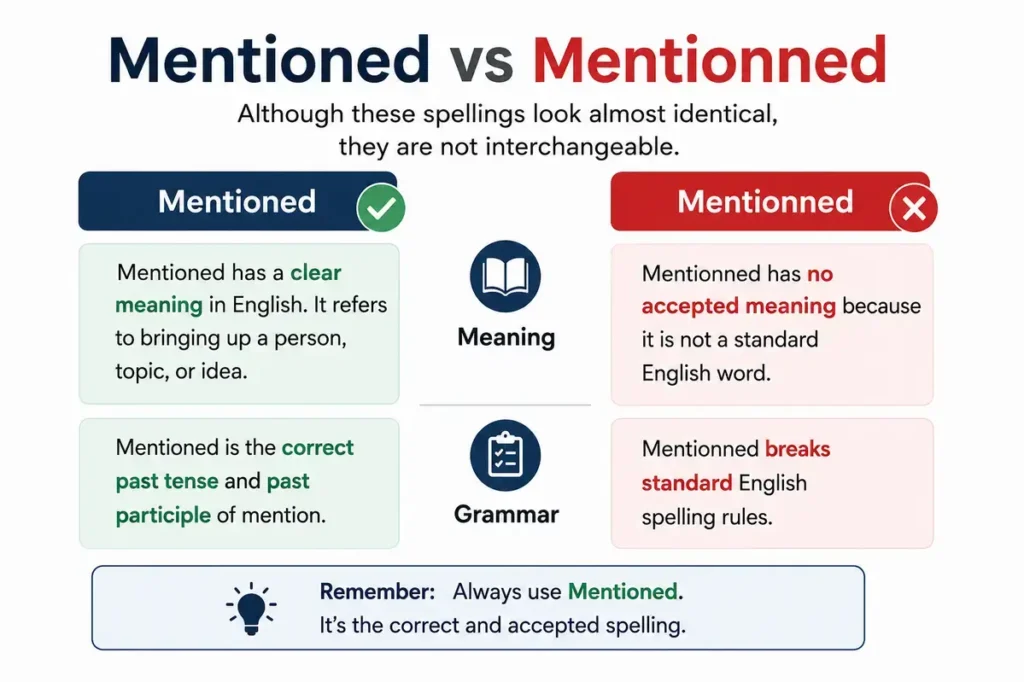
The two forms differ by one letter, but only one follows standard English spelling.
Spelling
The correct form keeps the original spelling of the base verb and adds ed.
1. Base verb. Mention.
2. Past tense. Mentioned.
3. Past participle. Mentioned.
4. Present participle. Mentioning.
Notice that the base verb already contains the letter n at the end. You do not need to add another one when forming the past tense.
Meaning
The correct form communicates a reference to something. The misspelled version has no separate accepted meaning in standard English.
For example, “The teacher mentioned the test” tells readers that the teacher brought up the test. It does not suggest that the teacher explained every question or reviewed the entire subject.
Grammar
Mentioned is a regular verb form. You can use it as the simple past or as the past participle after a helping verb.
Correct examples include “They mentioned the cost” and “They have mentioned the cost.”
The spelling does not change between these uses.
Pronunciation
The two written forms do not represent two different standard English pronunciations. In normal speech, the intended word is pronounced the same way regardless of the spelling mistake.
The extra written n does not create an extra spoken syllable. Therefore, pronunciation alone is not a reliable way to spot this error.
Formality and Context
The accepted form works in casual conversation, business writing, academic work, news reports, and formal documents. You do not need a more formal alternative just because the situation is professional.
The incorrect form should be fixed in every one of these settings. Although readers may understand the intended message, the spelling can distract them from your point.
Pronunciation Guide
The base verb mention is commonly pronounced /ˈmen.ʃən/ in American English. The first syllable carries the main stress.
The past tense mentioned adds the regular ed ending. In ordinary speech, that ending sounds like /d/, so the full pronunciation is commonly represented as /ˈmen.ʃənd/.
An easy pronunciation guide is MEN shənd. Say the first part clearly, then finish with a soft second syllable. The word has two syllables, and the stress falls on the first one.
A common mistake is to assume that a written extra consonant must change the sound. It does not. The misspelled form is not a separate standard English word with its own accepted pronunciation.
If you are learning English, focus on the spoken form and the written form separately. Listen to how the word sounds, then remember its spelling as mention plus ed.
Etymology and Word Origin
The word mention has roots in Latin and entered English through French. Its history helps explain the word’s meaning, although you do not need to know its origin to spell the past tense correctly.
The English verb developed from words associated with making a reference or bringing something to mind. Its central meaning has remained connected to speaking or writing about a person, subject, or event.
The modern English spelling is mention. Adding the regular past tense ending gives mentioned. English has retained this form rather than adopting the spelling pattern used in some other languages.
French provides a useful comparison. The French verb mentionner means to mention or refer to something, and its past participle is mentionné. French spelling and accent rules differ from English rules. Writers who know French might find the double consonant in the French verb familiar, but English uses a different form.
The practical lesson is simple. A word’s spelling in another language does not determine its spelling in English. Use the accepted English form when writing for an English speaking audience.
Regional Usage
The spelling stays the same across the major varieties of English. American, British, Canadian, and Australian writers all use mentioned as the standard past tense and past participle of mention.
American English
In the United States, mentioned is the correct form for conversations, school assignments, business emails, reports, and published writing. The extra n is an error, not an accepted American spelling variation.
For example, “The manager mentioned the change during the meeting” is correct in American English.
British English
British English uses the same spelling. There is no standard British alternative that doubles the n.
For example, “The teacher mentioned the new timetable” follows standard British usage.
Canadian English
Canadian English also uses mentioned. Although Canadian spelling includes some differences from American and British conventions, this verb form does not change.
Australian English
Australian English follows the same rule. Writers should use mentioned in both casual and formal communication.
The takeaway is clear. You do not need to adjust this spelling for a different English speaking country. The correct form remains unchanged across these regions.
Grammar Rules and Part of Speech
Understanding how the verb works can help you avoid spelling and grammar errors at the same time.
The Past Tense
Use mentioned to describe an action that happened in the past.
For example, “I mentioned the issue during yesterday’s meeting.” The word yesterday places the action in the past, so the simple past form fits naturally.
You can also use the word without a time expression when the context makes the timing clear. “She mentioned your suggestion” is a complete and natural sentence.
The Past Participle
The same spelling appears after helping verbs such as has, have, and had.
1. Present perfect. I have mentioned that concern before.
2. Past perfect. They had mentioned the delay before we arrived.
3. Passive voice. The concern was mentioned during the review.
In each case, mentioned remains unchanged. The helping verb or sentence structure determines how it functions.
Sentence Position
The word usually follows the subject and appears before the object or topic being discussed.
For example, “Maya mentioned the schedule” places the subject first, followed by the verb and then the object.
You can also place it in a phrase at the beginning of a sentence. “As mentioned earlier, the office will close at noon” is a common construction in professional writing.
Using Mentioned With a Direct Object
The verb often takes a direct object, which identifies the person or thing someone referred to.
For example, “He mentioned the budget” tells you what he brought up. You can also mention a person, a concern, a suggestion, or a previous conversation.
Using Mention With To
When you identify the person receiving the information, use to where the sentence calls for it.
For example, “She mentioned the problem to her manager” is correct. The phrase to her manager identifies the person she spoke to about the problem.
Do not confuse this pattern with the phrase mentioned about. In many ordinary sentences, mention takes a direct object without about. Write “She mentioned the problem,” rather than “She mentioned about the problem.”
Punctuation and Formal Writing
The spelling itself does not change with punctuation or formality. You can use mentioned in a sentence ending with a period, in a question, or in a longer sentence with several clauses.
For formal writing, choose the word that communicates the action clearly. If you mean that someone briefly referred to an issue, mentioned is often appropriate. If you mean that they explained it fully, a more precise verb such as explained or discussed may communicate the idea better.
Real Life Usage Examples
The following examples show how the word appears in common forms of communication.
Daily Conversation
People often use the word when referring to something discussed earlier.
1. “You mentioned that your brother was visiting this weekend.”
2. “She mentioned a good book while we were having coffee.”
Both sentences refer to information brought up during a conversation.
Email and Workplace Communication
The word works well in professional messages because it connects current information to an earlier discussion.
1. “As mentioned in our call, I have attached the updated schedule.”
2. “The team mentioned two concerns during the project review.”
These examples are clear and suitable for ordinary workplace communication.
Academic Writing
Students and researchers use the word to refer to ideas or findings raised in written work.
1. “The author mentioned three possible causes of the decline.”
2. “Several limitations were mentioned in the final section of the report.”
In academic writing, use the verb carefully. If you need to show that a source provides detailed evidence, explained, argued, or demonstrated may be more accurate.
News and Journalism
News reports often use mentioned to describe a statement made during a public event or interview.
1. “The mayor mentioned housing costs during the press conference.”
2. “Officials mentioned traffic concerns but did not announce a new policy.”
The word reports that a subject came up. It does not claim that officials made a formal promise or provided a complete explanation.
Literature and Storytelling
In a story, the word can introduce a detail that becomes relevant later.
1. “He mentioned the locked room, then quickly changed the subject.”
2. “Her grandmother had mentioned the village many times, but she had never visited it.”
These examples show how a brief reference can add context, create curiosity, or connect different parts of a narrative.
Related and Confused Terms
Several words share a meaning with mentioned, but each one serves a slightly different purpose. Choosing the right verb helps you communicate more clearly.
1. Referred to. This phrase means directed attention to a person, thing, or subject. For example, “The speaker referred to the earlier report.” It often works as a direct alternative to mentioned.
2. Brought up. This informal phrase means introduced a topic into a conversation. For example, “She brought up the schedule during lunch.” It sounds natural in everyday speech.
3. Discussed. This word suggests a more detailed exchange of ideas. For example, “We discussed the budget for an hour.” A mention can be brief, but a discussion usually involves more explanation.
4. Stated. This means expressed something clearly in speech or writing. For example, “The report stated that costs had increased.” It often suits formal or factual writing.
5. Noted. This means observed, recorded, or pointed out something. For example, “The editor noted a spelling error.” It can suggest that someone paid attention to a particular detail.
6. Cited. This means referred to a source, fact, or example, often to support a point. For example, “The researcher cited three earlier studies.” It has a more specific role in academic and formal writing.
7. Explained. This means made something easier to understand by providing details or reasons. For example, “The teacher explained the rule.” It is more suitable than mentioned when the person gave a clear explanation.
8. Mentioning. This is the present participle of mention. For example, “She is mentioning the same concern again.” Use it in grammatical patterns that call for the ing form rather than the past form.
These words overlap in meaning, but they are not always interchangeable. Choose the one that best describes what actually happened.
Expert Language Insight
An experienced editor looks at both spelling and meaning. The spelling error is easy to fix, but the surrounding sentence deserves attention too. If a writer says that someone mentioned a problem, the sentence should describe a brief reference. If the person gave reasons, evidence, or a detailed explanation, a more precise verb may serve the reader better. Spellcheck tools can catch many extra letter errors, but they may miss mistakes that form a different valid word. Read the sentence in context, confirm the base verb, and make sure the chosen word matches the intended meaning.
Conclusion
The spelling mentioned vs mentionned comes down to one simple rule. Mentioned is correct, while mentionned is a spelling error in standard English. The verb mention forms its past tense and past participle by adding ed without doubling the final n. This rule applies across American, British, Canadian, and Australian English.
When you write, start with the base verb and add the correct ending. That small habit can prevent mistakes in emails, essays, reports, and everyday messages. If you are unsure, read the word slowly and check its base form. Remember that clear writing starts with small details, and getting this spelling right is an easy win.
FAQs
Is Mentionned a Real Word in English?
Mentionned is not the standard English spelling of the past tense or past participle of mention. You may encounter it in online posts, informal messages, or text written by someone who has made a spelling error. For standard English writing, use mentioned. The extra n does not create a different accepted form of the verb.
What Does Mentioned Mean?
Mentioned means referred to a person, subject, idea, or event in speech or writing. It is the past tense and past participle of mention. For example, “He mentioned the meeting yesterday” means he brought the meeting up in conversation. The word does not necessarily mean that he explained the meeting in detail.
Which Spelling Is Correct for American English?
American English uses mentioned. The spelling with two consecutive n letters before ed is incorrect for this verb. You should use the standard form in school assignments, work emails, reports, articles, and personal messages. British, Canadian, and Australian English follow the same spelling, so there is no regional variation to memorize.
How Do You Pronounce Mentioned?
The word has two syllables, with stress on the first. A simple pronunciation guide is MEN shənd. In American English, its pronunciation is commonly represented as /ˈmen.ʃənd/. The final ed sounds like /d/, rather than forming a separate syllable. Adding an extra n in writing does not create a different standard pronunciation.
Can Mentioned Start a Sentence?
Yes. The word can start a sentence when the grammar supports that use. For example, “Mentioned in the report, the issue later received public attention” is possible, though the structure may sound awkward in some contexts. A more natural formal construction is “As mentioned in the report, the issue later received public attention.”
What Is a Synonym for Mentioned?
Useful alternatives include referred to, brought up, noted, stated, and cited. The best choice depends on the meaning. Use brought up for a casual conversation, cited for a reference to a source, and explained when someone provided details. These words overlap, but they do not all mean exactly the same thing.
Why Do People Misspell Mentioned?
People often add an extra n because English contains many verbs that double a final consonant before adding ed. Words such as planned and stopped can make the incorrect pattern look familiar. Fast typing and spelling habits can also cause the mistake. Remembering the base verb mention helps prevent the error.
Is Mentioned Appropriate in Formal Writing?
Yes. Mentioned is a standard verb form that works in formal writing, including reports, academic papers, business correspondence, and news articles. However, make sure it expresses the right level of detail. If a source provides a full explanation or strong evidence, verbs such as explained, reported, or demonstrated may describe the action more accurately.
