

If you’ve ever paused while writing a sentence such as I meant to tell you or I ment to tell you, you’re not alone. The two forms look almost identical, but only one is correct for this meaning. Meant or ment is a common spelling question because the sound at the end of meant can make the final letters easy to mix up.
The correct choice is meant. It is the past tense and past participle of the verb mean, which can express an intention, a definition, or the significance of something. For example, you might say that you meant to send an email, that a word meant something different in the past, or that a kind gesture meant a lot to you. In all these cases, the spelling remains the same.
The confusion often comes from English spelling patterns. Many regular verbs form their past tense by adding ed, while other verbs change in less predictable ways. Mean belongs to the second group. Its past tense is meant, just as the past tense of keep is kept. Learning this pattern will help you spell the word correctly in texts, emails, school assignments, reports, and everyday conversations.
Quick Answer
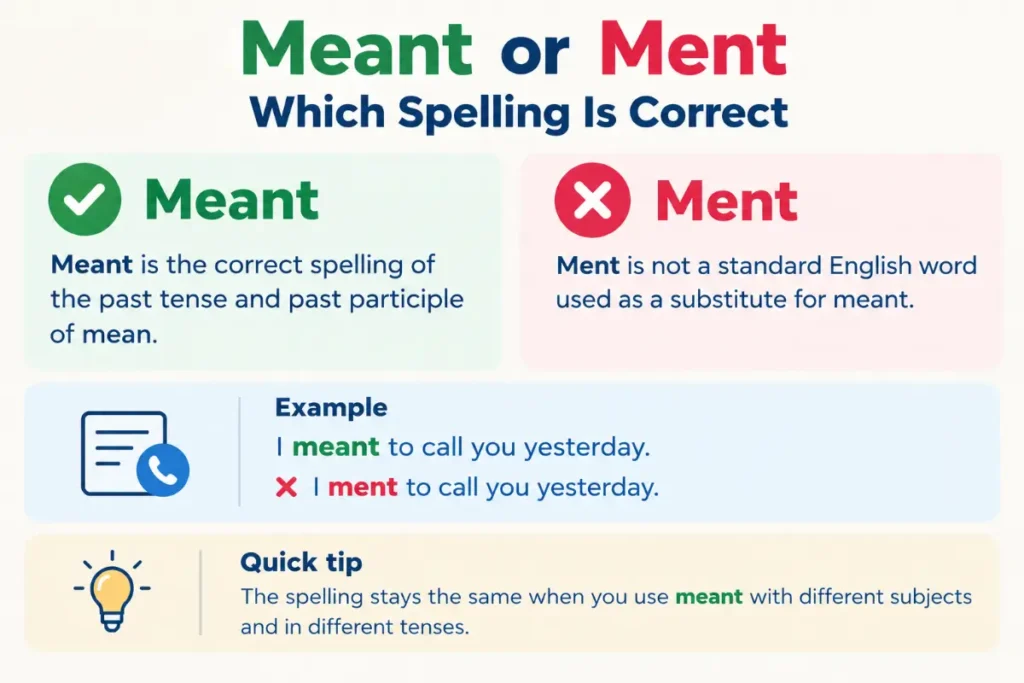
Meant is the correct spelling of the past tense and past participle of mean. Ment is not a standard English word used as a substitute for meant. Write I meant to call you yesterday, not I ment to call you yesterday. The spelling stays the same when you use meant with different subjects and in different tenses.
What Is the Difference Between Meant and Ment
The main difference is that meant is a standard English verb form, while ment is not a standard spelling of that verb form. Meant can refer to something someone intended, what a word expressed, or the importance of an event or action. Ment does not carry these meanings as an accepted substitute.
For example, consider these sentences.
- I meant to bring my notebook.
- She meant what she said.
- His support meant a lot to me.
- What did you mean by that comment?
The first three sentences use meant correctly. The fourth uses mean because the question refers to the base form after the helping verb did.
That last point matters. Correct spelling depends on grammar as well as letters. You need meant for a past statement, but you usually need mean after did in a question or negative statement.
| Form | Status | Meaning or function | Example |
|---|---|---|---|
| Meant | Correct | Past tense of mean | I meant to call. |
| Meant | Correct | Past participle of mean | I have meant to ask you. |
| Ment | Incorrect for this verb form | Nonstandard spelling of meant | I ment to call. |
| Mean | Correct base form | To intend or signify | What do you mean? |
| Meaning | Correct related form | What a word or action expresses | The meaning is clear. |
Meaning and Definition of Meant
Meant is the past tense and past participle of mean. The verb mean has several related uses, and the intended meaning depends on the sentence.
Meant as an Expression of Intention
The most familiar use describes what someone planned, intended, or wanted to do.
For example, I meant to call you yesterday means the speaker intended to call but may not have done so. The sentence does not necessarily say why the call did not happen. It simply describes the earlier intention.
Here are other examples.
- I meant to finish the report before lunch.
- She meant to send the invitation last week.
- We meant to stop by your house.
- He meant to apologize after the meeting.
In each sentence, meant refers to a past intention. The action may have happened later, or it may never have happened.
Meant as a Statement of Significance
Meant can also describe the importance or effect of something.
For example, Her advice meant a lot to me expresses how valuable the advice was to the speaker. It does not refer to a plan. Instead, it describes the personal significance of an experience or action.
Consider these sentences.
- Your message meant more than you realize.
- The award meant everything to him.
- Their support meant a great deal to our family.
- That small act of kindness meant so much to her.
In these examples, meant expresses value, importance, or emotional significance.
Meant as a Description of Meaning
The verb mean can describe the message or definition conveyed by a word, sign, gesture, or statement.
For example, The warning meant that we needed to leave means the warning communicated a particular message.
Other examples include the following.
- The red light meant that the road was closed.
- Her silence meant something different to each person.
- The old expression meant something else in that period.
- His words meant more than their literal definition suggested.
In each case, meant explains what something communicated or represented in the past.
Why Ment Is Usually Incorrect
English spelling can be unpredictable. Some verbs form their past tense by adding ed, while others change their spelling. Mean is an irregular verb, so its past tense is not formed by simply adding ed.
The correct forms are mean, meant, and meant. The base form is used in the present tense and after certain helping verbs. Meant is used for the past tense and as the past participle.
Compare these examples.
- Present tense: I mean what I say.
- Past tense: I meant what I said.
- Present perfect: I have meant to speak with you.
- Past perfect: I had meant to tell you earlier.
Writing ment in these sentences would be a spelling error. It does not become correct because the sentence is informal, the writer is sending a text message, or a spell checker fails to catch it.
There is one useful distinction. The letters ment do appear in standard English words such as payment, movement, and agreement. In these words, ment is part of a suffix or an established word spelling. That does not make it a valid replacement for meant.
Which Form Is Correct in American English
Meant is the correct form in standard American English. It is also standard in British, Canadian, and Australian English. There is no regional spelling difference for this verb.
Use meant when describing a past intention or explaining what something signified in the past. Use mean for the base form, and use meaning when you need the related noun or the present participle.
For example, an American employee might write, I meant to attach the file to my email. A British student might write, I meant to ask the teacher a question. Both sentences follow the same spelling rule.
The form ment is not an accepted regional alternative in ordinary English. It may appear in a typo, a social media post, a username, a brand name, or a deliberately invented expression. Those special cases do not change the standard spelling rule.
Grammar Rules for Using Meant
Understanding the grammar behind the word makes it easier to choose the right form. Meant does not change according to the subject. You can use it with I, you, he, she, it, we, and they.
Use Meant for the Simple Past
The simple past describes an intention, meaning, or situation connected to an earlier time.
Examples include the following.
- I meant to reply last night.
- You meant well.
- She meant to arrive early.
- They meant no harm.
The word meant stays the same in every sentence. You do not write he ments or they ment.
Use Meant After Have Has or Had
Meant also works as a past participle. It appears after forms of the helping verb have.
Examples include these sentences.
- I have meant to ask you something.
- She has meant to contact the office for weeks.
- They had meant to leave before sunset.
- We have always meant to thank you.
The helping verb determines the tense of the whole phrase. Have meant and has meant usually form the present perfect. Had meant forms the past perfect.
Use Mean After Did
A common grammar mistake occurs when writers use the past form after did. In standard English, did already marks the past tense, so the main verb usually stays in its base form.
Correct: What did you mean?
Incorrect: What did you meant?
Correct: I did not mean to offend you.
Incorrect: I did not meant to offend you.
This rule also applies to questions and negative statements. The helping verb did carries the past tense, so the main verb uses mean rather than meant.
Use Mean After Modal Verbs
Modal verbs such as will, would, can, could, should, and might are followed by the base form of the main verb.
For example.
- I will mean what I say.
- I didn’t know what you would mean by that.
- What could this message mean?
- I should mean to explain that more clearly.
The fourth sentence is grammatically possible in a very unusual sense but sounds unnatural in ordinary conversation. A more natural version would be I should explain that more clearly.
The key grammar rule remains the same. Use mean after a modal verb, not meant.
Use Meant in Passive and Descriptive Constructions
Meant can appear in expressions such as was meant to, is meant to, and meant for. These phrases can describe a purpose, expectation, or intended use.
Examples include the following.
- This room was meant to be a study.
- The instructions are meant for beginners.
- The gift was meant for your sister.
- The message was meant to reassure everyone.
Notice that the tense of the whole expression depends on the helping verb. Was meant describes a past situation, while is meant can describe a current purpose.
Pronunciation Guide
Meant and ment are easy to confuse in writing because they look and sound similar. In standard American English, meant is pronounced /mɛnt/. It rhymes with sent, bent, and tent.
The word has one syllable. The vowel sounds like the vowel in bed or send, followed by the final consonant cluster /nt/.
A simple way to practice it is to say these words aloud.
- Mean.
- Meant.
- Sent.
- Bent.
- Lent.
Mean has a long vowel sound, while meant has the short vowel sound found in bed. The final sound of meant is the same as the ending in sent.
Do not add an extra syllable to meant. It is not pronounced as two separate parts. In ordinary American speech, it is a single syllable.
Pronunciation can help you recognize the word, but it cannot always tell you how to spell it. English contains many words that sound alike or nearly alike. That is why learning the verb forms is more reliable than trying to spell the word by sound alone.
Etymology and Word Origin
Meant comes from the verb mean, an old English word with a long history. The modern verb has developed several related meanings, including intending, signifying, and expressing a particular idea.
The past tense meant follows an irregular pattern. English inherited many irregular verbs from earlier stages of the language, and some kept older forms rather than adopting the regular ed ending. Mean and meant belong to this group.
The same pattern appears in other common verbs. Keep becomes kept, sleep becomes slept, and feel becomes felt. These verbs do not form their past tense by simply adding ed.
This history helps explain the spelling, but you do not need to memorize the full history to use the word correctly. Remembering mean, meant, meant is enough for everyday writing.
Regional Usage in English
American English
In the United States, meant is the standard past tense and past participle of mean. It appears in everyday speech, schoolwork, workplace communication, books, news writing, and formal documents.
Examples include I meant to call, That meant a lot, and What did you mean? The spelling does not change based on the level of formality.
British English
British English uses meant in the same way. There is no standard British spelling that replaces it with ment.
For example, I meant to ask you a question is correct in both American and British English.
Canadian English
Canadian English also uses meant as the standard form. Writers follow the same verb pattern found in American and British English.
Australian English
Australian English follows the same rule. Meant is the accepted past tense and past participle, and ment is not a standard substitute.
Across these major varieties of English, the spelling rule stays consistent. If you are writing for an international audience, meant is the safe and correct choice.
Ten Correct Example Sentences
These examples show how meant works in everyday situations. Each sentence uses the standard spelling and demonstrates a different context.
1. I meant to call you after work. The speaker intended to make a call but is referring to an earlier plan.
2. She meant every word of her apology. This means her apology was sincere and reflected what she truly felt.
3. Your advice meant a lot to me. The advice was valuable or emotionally important to the speaker.
4. I never meant to hurt your feelings. The speaker says that causing emotional pain was not the intention.
5. What did you mean by that comment? This is a question about the message or intention behind someone’s words. Mean is correct because did already marks the past tense.
6. The sign meant that visitors had to stop. The sign communicated a rule or instruction.
7. We had meant to book the tickets earlier. The sentence describes a plan that existed before another past event or point in time.
8. This gift was meant for you. The gift was intended for the person being addressed.
9. He has always meant to thank his teachers. The sentence describes an intention that has continued over time.
10. I meant what I said during the meeting. The speaker confirms that the earlier statement reflected their actual thoughts.
Common Spelling and Grammar Mistakes
The wrong form can appear because of typing errors, confusion about irregular verbs, or a misunderstanding of how English suffixes work. These are the most useful mistakes to watch for.
Writing Ment Instead of Meant
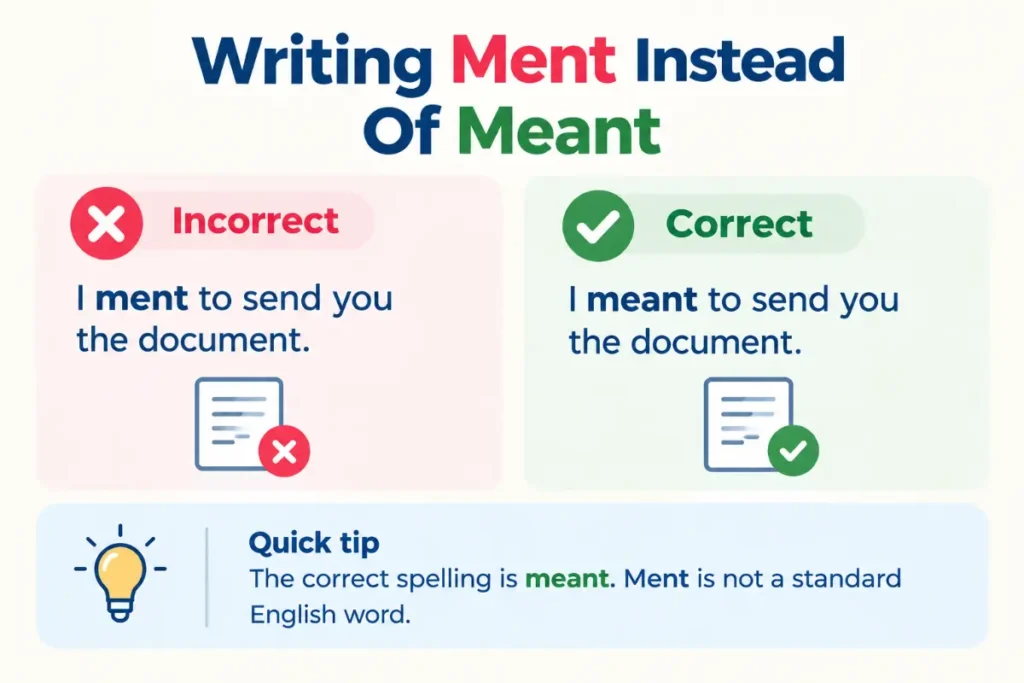
Incorrect: I ment to send you the document.
Correct: I meant to send you the document.
The error comes from leaving out the letter a. The correct spelling contains the letter sequence mea before the final nt.
Adding Ed to Create Meanted
Incorrect: I meanted to tell you the truth.
Correct: I meant to tell you the truth.
Mean is an irregular verb. It does not take the regular ed ending to form its past tense.
Using Meant After Did
Incorrect: Did you meant to leave early?
Correct: Did you mean to leave early?
Did already marks the past tense. The main verb returns to its base form.
Using Meant After Will
Incorrect: I will meant to call tomorrow.
Correct: I will mean to call tomorrow.
Will is followed by the base form of the verb. In natural conversation, a clearer sentence would often be I will call tomorrow or I intend to call tomorrow.
Confusing Meant With Meaning
Incorrect: I am meant what you said.
Correct: I understand what you said.
Meaning can function as a noun or as the ing form of mean, depending on the sentence. Meant is the past tense or past participle. The forms cannot be exchanged freely.
Five Incorrect Examples and Their Corrections
The following examples show how spelling and grammar errors can appear in real writing.
1. Incorrect: I ment to tell you yesterday. Correct: I meant to tell you yesterday. The writer needs the past tense of mean.
2. Incorrect: She ment no harm. Correct: She meant no harm. The correct phrase describes an absence of bad intention.
3. Incorrect: What did he meant? Correct: What did he mean? Did takes the past tense, so the main verb stays in its base form.
4. Incorrect: I have ment to ask you. Correct: I have meant to ask you. The present perfect requires the past participle meant.
5. Incorrect: They meanted to help. Correct: They meant to help. Mean forms its past tense irregularly and does not use meanted.
These corrections cover the main patterns. If you remember the base form, past tense, and past participle, you can avoid nearly all of these mistakes.
Related Words and Expressions
Learning related forms helps you understand the verb and choose the right word in context.
Mean
Mean is the base form. It can describe an intention, a definition, or significance.
Example: What do you mean?
Meaning
Meaning is a noun that refers to the idea or message expressed by a word, sentence, action, or event. It can also be the ing form of mean.
Example: The meaning of the sentence is clear.
Means
Means can be the third person singular form of mean, as in She means well. It can also be a noun referring to a method or resource, as in a means of transportation.
Meant To
Meant to commonly describes an intention or an expected action.
Example: I meant to finish the task before noon.
Meant For
Meant for describes something intended for a particular person or purpose.
Example: This seat is meant for guests.
Meant Well
Meant well means that someone had good intentions, even if the result was not helpful.
Example: He meant well, but his advice made the situation worse.
Mean Well
Mean well is the present form of the same expression.
Example: She means well, even when she gives blunt advice.
Intend
Intend is a synonym for mean when the idea is about a plan or purpose.
Example: I intend to finish the project today.
Signify
Signify means to express, represent, or indicate something. It is useful when discussing the meaning of a sign, action, or symbol.
Example: A red light signifies that drivers must stop.
Real Life Usage in Different Situations
Daily Conversation
In everyday conversation, meant often appears when people explain their intentions or clear up misunderstandings.
- I meant to text you earlier, but I got busy.
- I didn’t mean it that way.
The first sentence describes an earlier plan. The second uses mean after didn’t because the helping verb carries the past tense.
Workplace Emails
Professional messages often use meant to explain a missed action or clarify a statement.
- I meant to attach the revised file to my previous email.
- The note was meant to explain the changes to the schedule.
The first sentence acknowledges an intended action. The second describes the purpose of the note.
Academic Writing
In school and academic writing, meant can explain what an author, researcher, or historical source intended to communicate.
- The author meant to criticize the policy rather than the people affected by it.
- The symbol meant something different in the original text.
The first example describes the author’s intention. The second explains a change in meaning.
News and Journalism
Journalists may use meant when reporting a person’s stated intention or explaining the effect of a decision.
- The mayor said the proposal was meant to improve public transportation.
- The delay meant that several flights arrived late.
The first sentence describes the stated purpose of a proposal. The second explains the consequence of a delay.
Literature and Storytelling
Writers use meant to show characters’ intentions, emotions, and interpretations.
- She meant to tell him the truth, but fear stopped her.
- His final words meant more to her than he had realized.
The first sentence describes an intention that was not carried out. The second expresses the emotional significance of the character’s words.
Expert Editor Insight
An experienced editor checks both spelling and sentence structure. If a writer uses ment in place of meant, the editor corrects the spelling. If the writer uses meant after did, the editor also fixes the grammar. Spell checkers can catch many misspellings, but they may miss errors involving valid words in the wrong grammatical position. Reading the full sentence is the best way to catch both problems.
How to Remember the Correct Spelling
A good memory trick connects the spelling to other familiar words. Meant rhymes with sent, bent, and lent. These words share the same short vowel sound and end in nt.
You can also remember the three main forms of the verb together.
- Mean is the base form.
- Meant is the simple past tense.
- Meant is the past participle.
Say the forms aloud as you practice. Then write a short sentence with each one.
- I mean what I say.
- I meant what I said.
- I have meant to ask you.
Another useful trick is to connect meant with intention. If you are describing what someone intended in the past, write meant. If you are asking about an earlier statement with did, use mean instead.
For example, I meant to help is correct, but Did you mean to help is also correct. The difference comes from the grammar of the sentence, not from a change in the meaning of the verb.
Key Takeaways
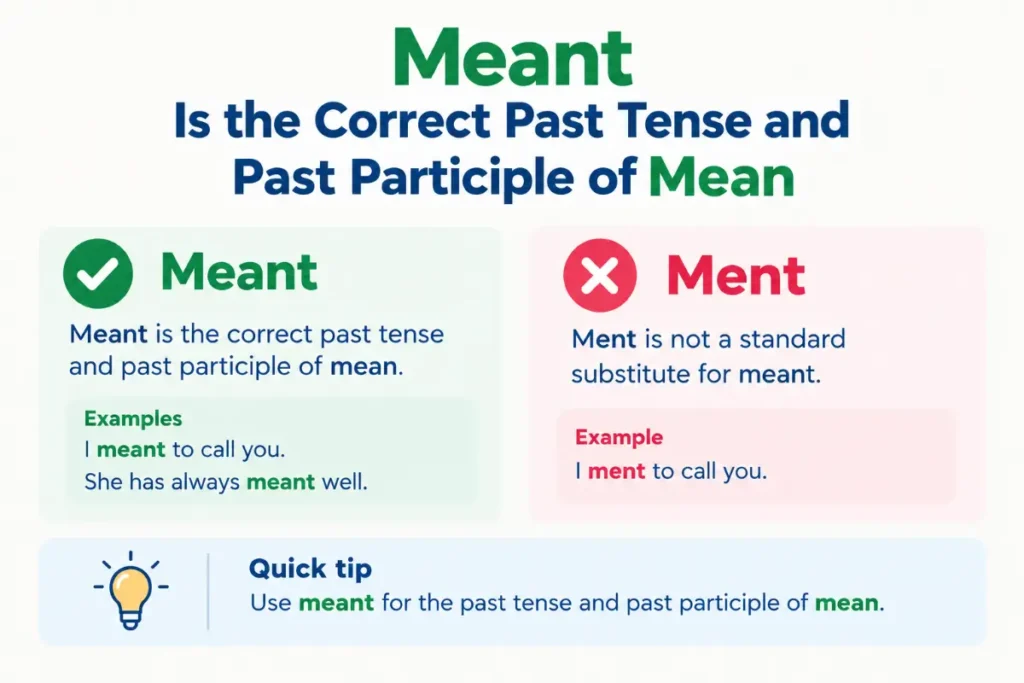
- Meant is the correct past tense and past participle of mean.
- Ment is not a standard substitute for meant.
- Mean can express intention, significance, or the message conveyed by something.
- Use meant for past statements such as I meant to call.
- Use mean after did, as in What did you mean?
- Use meant after have, has, and had when the sentence requires the past participle.
- The correct spelling is the same in American, British, Canadian, and Australian English.
- Meant rhymes with sent and has one syllable.
- Remember the pattern mean, meant, meant to avoid common spelling and grammar errors.
- Always check the complete sentence when a spelling or grammar tool misses an error.
Conclusion
The correct choice in meant or ment is meant when you need the past tense or past participle of mean. It describes an earlier intention, explains what something communicated, or expresses the importance of an action or experience. Ment is not a standard spelling for these meanings.
Remember the three verb forms: mean, meant, meant. Also remember that did takes the base form, as in What did you mean? This small grammar rule will help you avoid another common mistake. Before sending a message or submitting a document, read the sentence once to check both spelling and verb form. A quick review can make your writing clearer and more accurate.
Frequently Asked Questions
Is meant or ment the correct spelling?
Meant is the correct spelling when you need the past tense or past participle of mean. Ment is not a standard substitute for this verb form. Write I meant to call you rather than I ment to call you. The same rule applies in formal writing, casual messages, school assignments, and professional emails.
Is ment ever a real word?
The letters ment appear in many standard English words, including payment, movement, and agreement. However, ment is not the accepted past tense of mean. If you want to describe an earlier intention or explain what something signified, use meant. A special name or invented term does not change this standard spelling rule.
What does meant mean?
Meant is the past tense and past participle of mean. It can describe an intention, as in I meant to call, or significance, as in Your help meant a lot. It can also explain what a statement, sign, or action communicated, as in The warning meant we had to leave.
How do you pronounce meant?
In standard American English, meant is pronounced /mɛnt/. It has one syllable and rhymes with sent, bent, and tent. The vowel is the short sound heard in bed. Although the pronunciation can help you recognize the word, you should learn its spelling as part of the irregular verb pattern mean, meant, meant.
Can you use meant at the beginning of a sentence?
Yes. Meant can start a sentence when the sentence structure calls for it. For example, Meant as a warning, the message sounded harsh is possible in a literary context, although a clearer everyday version would be The message was meant as a warning. The word’s position does not change its spelling.
What is a synonym for meant?
The best synonym depends on the intended meaning. When meant describes an intention, you can often use intended, planned, or wanted. When it describes significance, words such as mattered or signified may fit. For example, I meant to call can become I intended to call, while Your support meant a lot can become Your support mattered a lot.
Why do people spell meant incorrectly?
People often write ment because the two forms look similar and the word is easy to type incorrectly. English also has many words ending in ment, which can make the wrong spelling look familiar. Learning that mean is an irregular verb and remembering its forms, mean, meant, meant, helps prevent this mistake.
Is meant appropriate in formal writing?
Yes. Meant is standard English and is appropriate in academic writing, business communication, reports, journalism, and formal documents. You do not need a more formal replacement simply because the word refers to an intention or meaning. The main requirement is to use the correct spelling and place it in a grammatically correct sentence.
