
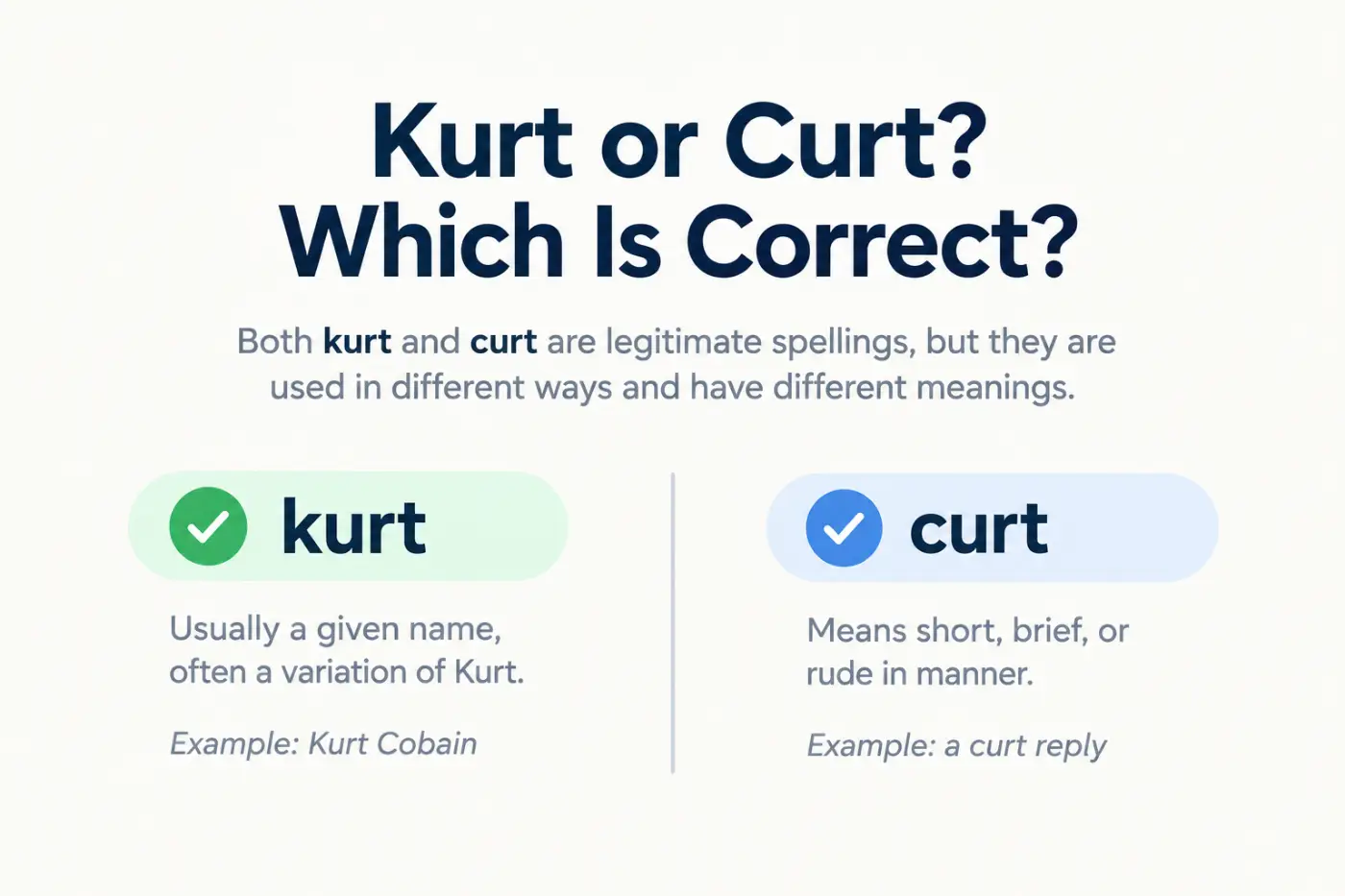
If you have seen kurt or curt and wondered if one is simply a spelling mistake, the answer is more interesting than that. Both forms exist, but they do not mean the same thing. Kurt is primarily a personal name, while curt is an English adjective used to describe speech or behavior that is very brief and can sound rude or unfriendly.
The confusion often comes from pronunciation and spelling. The two forms can sound alike or very similar in ordinary speech, especially in American English. They also differ by only one letter, so a quick typo can easily turn one into the other. The capital letter in Kurt gives you an important clue, but context is still the best guide.
Once you understand the meaning of curt, the difference becomes easy to spot. You can use curt to describe a short answer, an abrupt reply, or a person who speaks in a noticeably brief way. Kurt normally refers to a person whose given name is Kurt. This distinction also helps with capitalization, grammar, pronunciation, and professional writing.
Quick Answer
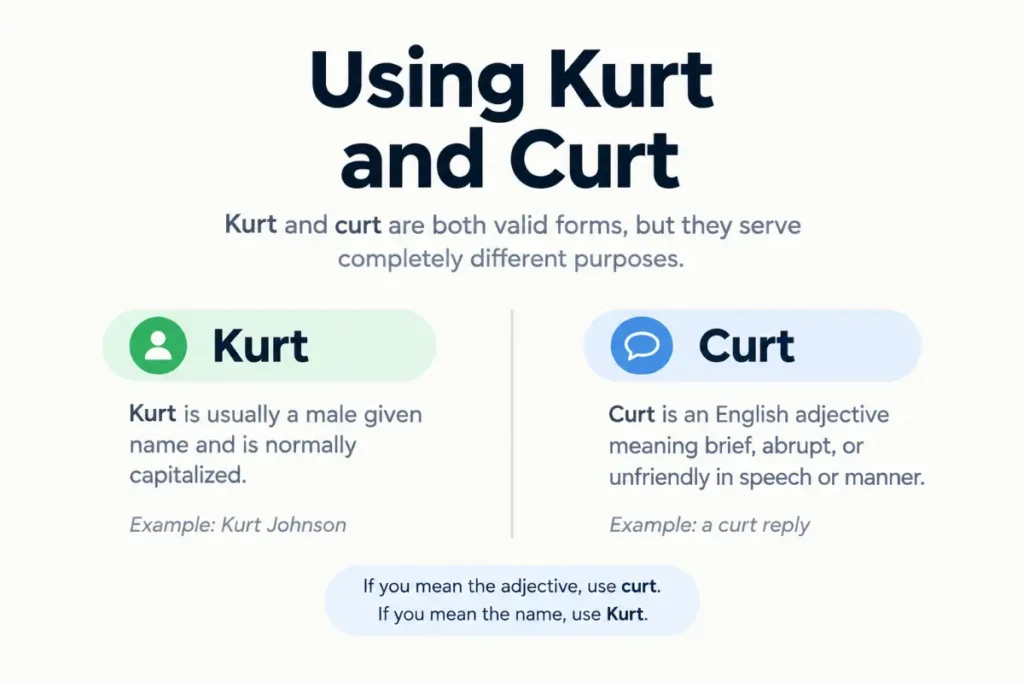
Kurt and curt are both valid forms, but they serve completely different purposes. Kurt is usually a male given name and is normally capitalized. Curt is an English adjective meaning brief, abrupt, or unfriendly in speech or manner. If you mean the adjective, use curt. If you mean the name, use Kurt.
Meaning Of Curt
Curt is an adjective. It describes speech, writing, or behavior that is very brief and can seem rude, impatient, cold, or unfriendly.
A curt answer gives little explanation and may sound as if the speaker wants to end the conversation quickly.
For example:
- His curt reply made me think he was annoyed.
- The manager gave me a curt answer and returned to work.
- She sounded curt on the phone.
- His email was polite overall but slightly curt.
Curt does not simply mean short. That distinction matters.
A short answer can be perfectly friendly.
For example:
Yes.
Thanks.
Sure.
Those answers are brief, but they are not automatically curt.
Curt usually carries an extra feeling of abruptness or lack of warmth. The word often suggests that someone could have responded more politely or fully but chose not to.
Compare these two sentences.
She gave me a short answer.
She gave me a curt answer.
The first sentence tells you about length. The second tells you about both length and tone.
That emotional meaning is one of the most useful things to remember about the word.
Meaning Of Kurt
Kurt is primarily a masculine given name. It is used as a personal name in several European language traditions and is familiar in English speaking countries as a male first name.
Because it is a name, it normally begins with a capital letter.
For example:
Kurt called me yesterday.
Kurt is joining the team next week.
I met Kurt at the conference.
In these sentences, the word identifies a particular person. It is not describing the person’s behavior.
You may also encounter Kurt as part of a full name. For example, a person may be named Kurt Smith, Kurt Johnson, or Kurt Wagner.
The meaning of a personal name is different from the dictionary meaning of an adjective. You should not treat Kurt as an alternative spelling of curt when you mean brief or abrupt.
For example, this sentence is incorrect if you are describing someone’s tone:
His response was kurt.
The correct spelling is:
His response was curt.
The capitalized form would normally signal that you are referring to someone’s name rather than describing a response.
The Main Difference
The clearest distinction is simple.
Curt is an adjective describing a brief and sometimes unfriendly manner.
Kurt is usually a personal name.
The difference becomes even clearer in a comparison.
| Form | Meaning | Part of Speech | Capitalization | Common Context | Example |
|---|---|---|---|---|---|
| Kurt | A masculine given name | Proper noun | Usually capitalized | Names and personal references | Kurt arrived early. |
| curt | Brief and potentially unfriendly | Adjective | Lowercase | Speech writing and behavior | His reply was curt. |
There is no need to memorize a complicated rule. Start with meaning.
If you are naming a person, Kurt may be correct.
If you are describing a reply, tone, manner, or style as brief and abrupt, curt is correct.
Which Form Is Correct
Both forms are correct when used for their proper purposes.
Curt is the standard English adjective. It has nothing to do with the spelling of a person’s name.
Kurt is a proper name. It should be capitalized when it is used as someone’s given name.
This means the question is not really about choosing one spelling over the other. It is about identifying what you are trying to say.
Consider this example:
Kurt was curt during the meeting.
Both words are correct in the same sentence.
Kurt identifies the person.
Curt describes his manner.
That sentence is a useful memory tool because it shows the two forms working side by side.
You could also write:
I emailed Kurt because his response was curt.
Again, the name identifies the person and the adjective describes the response.
Why The Words Get Confused
The confusion usually comes from three things.
First, the words contain almost the same letters. Only the vowel changes.
Second, they can sound similar in speech.
Third, people often type quickly and rely on sound when spelling a word they have heard rather than seen in writing.
There is also a simple language pattern behind the mistake. English contains many pairs that sound alike or nearly alike but have different spellings and meanings. Context usually resolves the problem.
If someone writes:
Her answer was Kurt.
A reader may pause because Kurt normally looks like a person’s name. If the writer means that her answer was brief and unfriendly, the intended word is almost certainly curt.
The same problem can happen in reverse.
I spoke with curt yesterday.
If the intended meaning is a person’s name, the writer needs Kurt.
Spelling And Capitalization
Capitalization gives you one of the fastest clues.
Kurt is normally capitalized because it is a proper noun when used as a personal name.
Curt is normally lowercase because it is an adjective.
Compare:
Kurt joined the meeting.
His response was curt.
The capital letter is not the only difference, but it is a strong visual signal.
English capitalization rules require proper names to begin with a capital letter. Common adjectives do not normally receive a capital letter unless they appear at the beginning of a sentence or as part of a proper name.
For example:
Kurt left early.
His message was curt.
Curt was the last word in the sentence.
In the third example, Curt is capitalized only because it starts the sentence. That does not turn it into a name.
Grammar And Part Of Speech
Curt is an adjective.
That means it describes a noun or functions after a linking verb.
You can place it before a noun:
a curt reply
a curt response
a curt message
a curt remark
a curt tone
You can also use it after a linking verb:
His response was curt.
Her manner seemed curt.
The reply sounded curt.
The adjective usually describes communication or behavior. It can describe a person indirectly, but the most natural use often focuses on the person’s manner or speech.
For example:
He was curt with me.
This means he spoke to me in a brief and possibly unfriendly way.
Kurt is normally a proper noun.
It can function as the subject or object of a sentence:
Kurt called this morning.
I emailed Kurt yesterday.
We invited Kurt to the meeting.
The grammatical roles are completely different. One word describes something. The other identifies a person.
How To Use Curt Correctly
Curt commonly appears with words related to communication.
These include reply, response, answer, remark, message, tone, manner, and comment.
Here are some natural examples:
- The customer gave a curt reply.
- His answer was curt but accurate.
- She sent a curt email after the meeting.
- The receptionist sounded curt on the phone.
- His curt manner made the conversation uncomfortable.
- The teacher gave a curt response to the repeated question.
- I thought her message sounded curt, but she may simply have been busy.
That final example shows an important point. Calling someone’s message curt is an interpretation of tone. It does not always prove that the person intended to sound rude.
A short written message can sound colder than the writer intended because text does not carry facial expressions, voice tone, or body language.
That is especially common in email and text messages.
How To Use Kurt Correctly
Use Kurt when you are referring to a person whose given name is Kurt.
For example:
- Kurt is coming to dinner tonight.
- I spoke with Kurt this morning.
- Kurt sent the report before lunch.
- We met Kurt at the conference.
- Kurt works in the sales department.
The name can appear in direct address as well.
Hi Kurt.
Thanks for your help, Kurt.
Kurt, could you send me the file?
The same capitalization rule applies in all of these examples.
If the word is a person’s name, capitalize it.
Ten Natural Sentence Examples
These examples show how the adjective works in everyday and professional situations.
- His curt response ended the conversation almost immediately.
The word describes the response as brief and lacking warmth.
- She sounded curt when I asked about the schedule.
Here the adjective describes her tone rather than her personality.
- The email was short but not curt.
This sentence makes a useful distinction between simple brevity and an unfriendly tone.
- My manager gave me a curt answer because the meeting was already running late.
The context explains why the answer may have been abrupt.
- I didn’t mean to sound curt in my message.
The speaker recognizes that written communication can sometimes appear colder than intended.
- The customer became upset after receiving a curt reply from the support team.
The adjective describes the reply and helps explain the customer’s reaction.
- His curt manner made it difficult to ask another question.
The word describes his general way of communicating.
- The professor’s answer was direct rather than curt.
This shows that direct and curt are not always the same.
- She gave a curt nod and walked away.
Curt can describe a brief action or manner when it conveys an abrupt quality.
- The editor removed the curt wording and made the email more professional.
This example shows how word choice can affect tone in workplace communication.
Common Mistakes
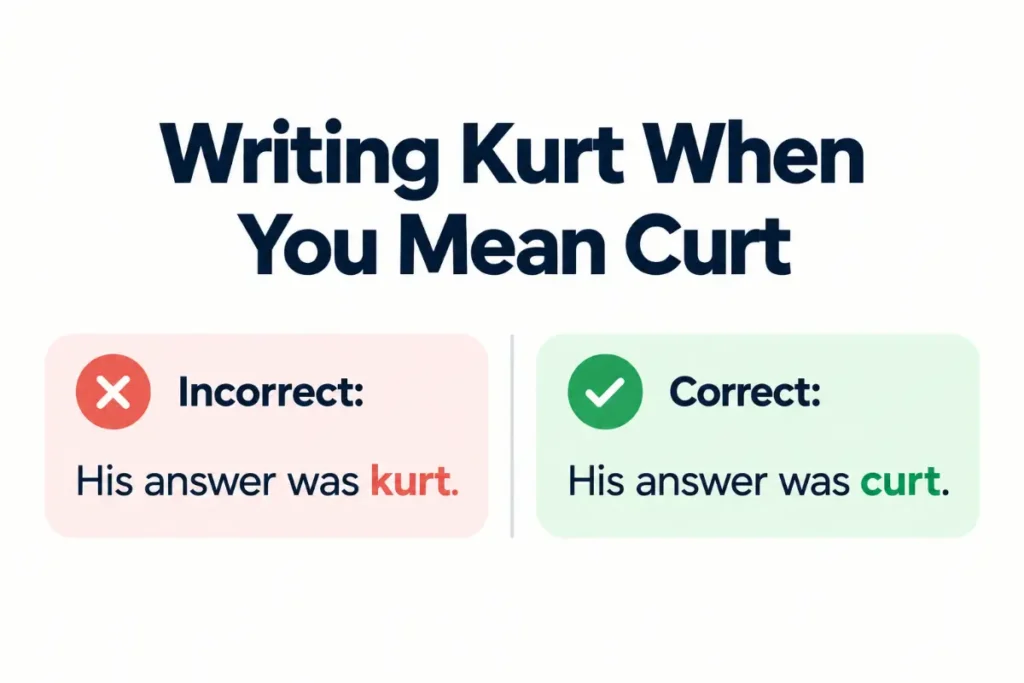
Writing Kurt When You Mean Curt
Incorrect:
His answer was kurt.
Correct:
His answer was curt.
The mistake usually comes from hearing the word and guessing the spelling.
Writing Curt When You Mean A Person Named Kurt
Incorrect:
I spoke with Curt after lunch.
This sentence is not automatically wrong because Curt can exist as a personal name in some naming traditions. However, if the person’s established name is Kurt, changing the spelling to Curt is an error.
Correct:
I spoke with Kurt after lunch.
Names should always be spelled according to the person’s actual name.
Capitalizing Curt Without A Reason
Incorrect:
Her response was Curt.
Correct:
Her response was curt.
The adjective is lowercase unless it begins a sentence or appears in a proper name.
Assuming Curt Means Simply Short
This is a meaning error rather than a spelling error.
Curt often suggests that something is brief and abrupt. It can also imply a lack of friendliness.
A short answer can be neutral. A curt answer often carries a negative tone.
Assuming The Words Are Different Spellings Of One Word
They are not.
Kurt is primarily a personal name.
Curt is an English adjective.
They should not be treated as alternate spellings of the same word.
Pronunciation Guide
In standard American English, curt is pronounced with one syllable.
Its IPA pronunciation is /kɝːt/.
The vowel is the same general sound heard in words such as bird and word in many American accents. The final sound is a clear t.
Kurt, when used as the common English pronunciation of the given name, is also generally pronounced as one syllable and sounds very similar to curt.
That similarity explains much of the spelling confusion.
The safest approach is to rely on context.
If someone says they spoke with Kurt, you are probably hearing a name.
If someone says the reply was curt, you are hearing an adjective that describes the reply.
Written context is especially helpful because capitalization and surrounding words reveal the intended meaning.
Etymology And Word Origin
Curt has a long history in English. It comes through French from Latin roots associated with something shortened or cut short. That history fits its modern meaning because curt language is brief and shortened rather than fully developed or explained.
The modern adjective developed the sense of being brief in speech or manner. Over time, it also gained the common suggestion of abruptness or lack of politeness.
Kurt has a different history because it is a personal name rather than the same English adjective. It is commonly associated with Germanic naming traditions and is used as a given name in German and Scandinavian contexts as well as in English speaking communities.
The shared sound does not mean the two forms share the same modern grammatical function.
American English Usage
In American English, curt is a standard adjective.
You may see it in everyday conversation, workplace writing, reviews, journalism, and fiction.
For example:
His reply was curt.
The manager sounded curt during the call.
The article described her response as curt.
Kurt is also familiar in the United States as a male given name.
There is no general American spelling rule that turns curt into Kurt or Kurt into curt. The correct form depends on the meaning and context.
British English Usage
British English uses curt with essentially the same meaning as American English.
The word can describe a brief and abrupt reply, tone, or manner.
Kurt remains a personal name rather than an alternative spelling of the adjective.
There is no major British versus American distinction that changes the basic rule.
The same principle applies in both varieties.
Australian And Canadian English
Australian and Canadian English also use curt as a standard adjective with the same basic meaning.
Kurt remains a personal name.
The distinction is therefore not a major regional spelling issue. If you are writing for an American audience, the standard forms remain straightforward.
The main challenge is not regional usage. It is recognizing the difference between a proper name and an adjective.
Real Life Usage
Daily Conversation
Imagine asking a friend how a coworker reacted to an idea.
You might say:
Why was he so curt with you?
The word suggests that the coworker responded briefly and perhaps impatiently.
If your friend says:
I talked to Kurt after work.
The capitalized name identifies a person.
Workplace Communication
In an office, you might write:
The client sent a curt email after the delay.
That sentence describes the client’s tone.
You could also write:
Kurt will handle the client call tomorrow.
Here Kurt is simply the employee’s name.
Academic Writing
An academic writer might describe a character or historical figure as curt if that person’s communication was brief and abrupt.
For example:
The author’s description presents the speaker as curt and impatient.
The word works as an adjective and fits formal analysis.
News Writing
Journalists may use curt to describe a public figure’s response.
For example:
The official gave a curt response to questions from reporters.
The adjective helps readers understand the tone of the response.
Literature And Storytelling
Curt is useful when an author wants to show character through dialogue.
For example:
No, he said curtly before leaving the room.
The reader understands that the character is not interested in continuing the conversation.
Kurt, by contrast, would identify the character if Kurt were his name.
Related And Confused Terms
Several words are closely related to the meaning of curt.
Brief
Brief means short in length or duration. It does not automatically suggest rudeness.
A brief meeting can be friendly and productive.
Concise
Concise means expressing something clearly using few words. It is usually positive.
A concise explanation may be helpful and efficient.
Abrupt
Abrupt describes something sudden or unexpected. It can also describe speech or behavior that feels unfriendly.
An abrupt response may be similar to a curt response.
Blunt
Blunt describes speech that is very direct and may lack softness or tact.
A blunt person may say exactly what they think.
Terse
Terse means using very few words. It can be neutral or negative depending on context.
His terse answer contained only three words.
Brusque
Brusque describes speech or behavior that is quick and direct in a way that can seem rude.
It is closely related to curt.
Short
Short can describe the length of a response without saying anything about the speaker’s attitude.
His answer was short.
That sentence does not necessarily suggest irritation.
Polite
Polite is often the opposite of the negative tone suggested by curt.
A polite response can still be brief.
That is why brief and curt should not be treated as perfect synonyms.
Curt Versus Similar Tone Words
Understanding the nearby words can help you use curt more precisely.
Curt usually combines brevity with a cold or abrupt quality.
Terse emphasizes few words.
Brief emphasizes short length.
Blunt emphasizes directness.
Brusque emphasizes rough or abrupt manner.
Rude emphasizes a lack of politeness.
These meanings overlap, but they are not identical.
For example:
His answer was brief.
This simply tells you that the answer was short.
His answer was terse.
This emphasizes the limited number of words.
His answer was blunt.
This suggests directness and possibly a lack of tact.
His answer was curt.
This suggests a short response that may sound impatient or unfriendly.
His answer was rude.
This directly judges the response as impolite.
Choosing the right word gives the reader a more precise picture of what happened.
Formal And Informal Usage
Curt is acceptable in both everyday and formal English.
You might use it in a casual conversation:
Why was she so curt?
You might also use it in a professional report:
The manager gave a curt response to the employee’s request.
The word is not slang. It is a standard adjective.
Still, tone matters. Calling someone’s response curt can sound critical because the word often carries a negative judgment.
In professional communication, use it carefully when describing another person’s behavior.
For example, instead of writing:
Your email was curt.
You might write:
Your email was very brief.
If you are giving feedback and need to address tone directly, curt can be useful, but it may sound sharper.
Direct Does Not Always Mean Curt
This distinction is especially useful in workplace writing.
Someone can be direct without being curt.
For example:
Please send the report by Friday.
That is direct. It gives a clear instruction without unnecessary words.
Now consider:
Send it by Friday.
Depending on the context, this may sound curt.
The difference comes from tone, wording, relationship, and context. A concise message is not automatically rude.
This is why editors consider more than sentence length when judging tone.
How To Remember The Difference
The easiest memory trick is to connect curt with short communication.
Curt describes a short and possibly unfriendly response.
Kurt identifies a person.
You can remember the capital letter too.
Kurt is a name, so it normally starts with a capital K.
Curt is an adjective, so it normally uses a lowercase c.
Another useful trick is to remember the sentence:
Kurt was curt.
The first word identifies the person.
The second word describes his manner.
That sentence puts the two forms next to each other and makes the distinction easy to remember.
Expert Editor Insight
An experienced editor would not treat these forms as ordinary spelling variants. The first question is always context. If the sentence describes a reply, tone, message, or manner, curt is the natural adjective. If it identifies a person, Kurt may be the correct name. Editors also pay attention to capitalization because a capital K can signal a proper name. In digital writing, spellcheckers may catch an obvious typo, but they cannot always understand the intended meaning because both forms are legitimate in different contexts.
Key Takeaways
- Curt is a standard English adjective.
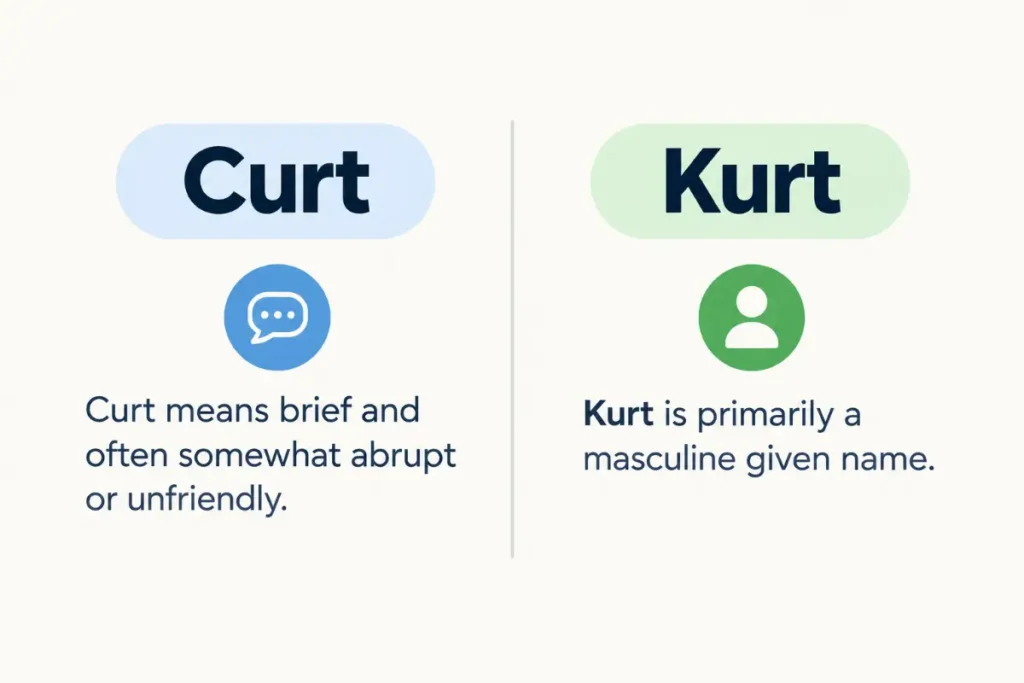
- Curt means brief and often somewhat abrupt or unfriendly.
- Kurt is primarily a masculine given name.
- Kurt normally begins with a capital letter.
- Curt normally begins with a lowercase letter.
- The two forms are not alternate spellings of the same English word.
- A short response is not automatically curt.
- Curt adds a sense of abruptness or lack of warmth.
- The name Kurt and the adjective curt can sound very similar.
- Context is the best way to determine the intended form.
- The sentence Kurt was curt is an easy way to remember the difference.
- Professional writers should consider tone before describing someone’s response as curt.
Conclusion
The difference between kurt or curt is simple once you focus on meaning. Kurt is normally a person’s given name, while curt is an adjective that describes speech or behavior that is brief and can seem abrupt or unfriendly. They may sound very similar, but they have different grammatical roles and different uses.
Use Kurt when you are naming a person. Use curt when you are describing a reply, message, tone, answer, remark, or manner. Capitalization provides another useful clue because names normally begin with a capital letter.
The easiest editing trick is to ask what the word is doing in the sentence. If it identifies a person, check the name. If it describes brief and unfriendly communication, use curt. That quick meaning check will prevent most mistakes.
FAQs
Is Kurt or curt the correct spelling?
Both are correct, but they have different meanings. Kurt is normally a male given name and uses a capital letter. Curt is an adjective meaning brief and potentially unfriendly or abrupt. The correct form depends on what you are trying to say.
Is curt a real English word?
Yes. Curt is a standard English adjective. It describes speech, writing, or behavior that is very brief and may sound abrupt, impatient, or unfriendly. It is not a misspelling of Kurt and should be written with a lowercase c unless it begins a sentence.
Is Kurt an English word?
Kurt is primarily used as a personal name rather than as an ordinary English vocabulary word. It is a recognized given name with roots associated with Germanic naming traditions. When it is used as someone’s name, it is capitalized.
What does curt mean?
Curt means very brief and often somewhat abrupt or unfriendly. It commonly describes a reply, answer, message, tone, remark, or manner. The word suggests more than simple brevity because it can imply impatience or a lack of warmth.
How do you pronounce curt?
Curt is a one syllable word pronounced /kɝːt/ in standard American English. The name Kurt is also commonly pronounced as one syllable and can sound very similar. Context and spelling therefore help distinguish the two forms in writing.
Can curt describe a person?
Yes, but it usually describes the person’s manner or way of speaking rather than functioning as a simple label for their personality. For example, you can say that someone was curt with you. This means the person spoke in a brief and possibly unfriendly way.
Is curt appropriate in formal writing?
Yes. Curt is a standard adjective and works in formal writing. It can appear in reports, academic analysis, journalism, workplace communication, and professional correspondence. Because it can sound critical, writers should use it carefully when judging another person’s tone.
Why do people confuse Kurt and curt?
The forms are easy to confuse because they contain almost the same letters and can sound very similar. People may also spell the adjective from memory after hearing it. Context usually resolves the issue. A person’s name is Kurt, while the adjective describing an abrupt response is curt.
