
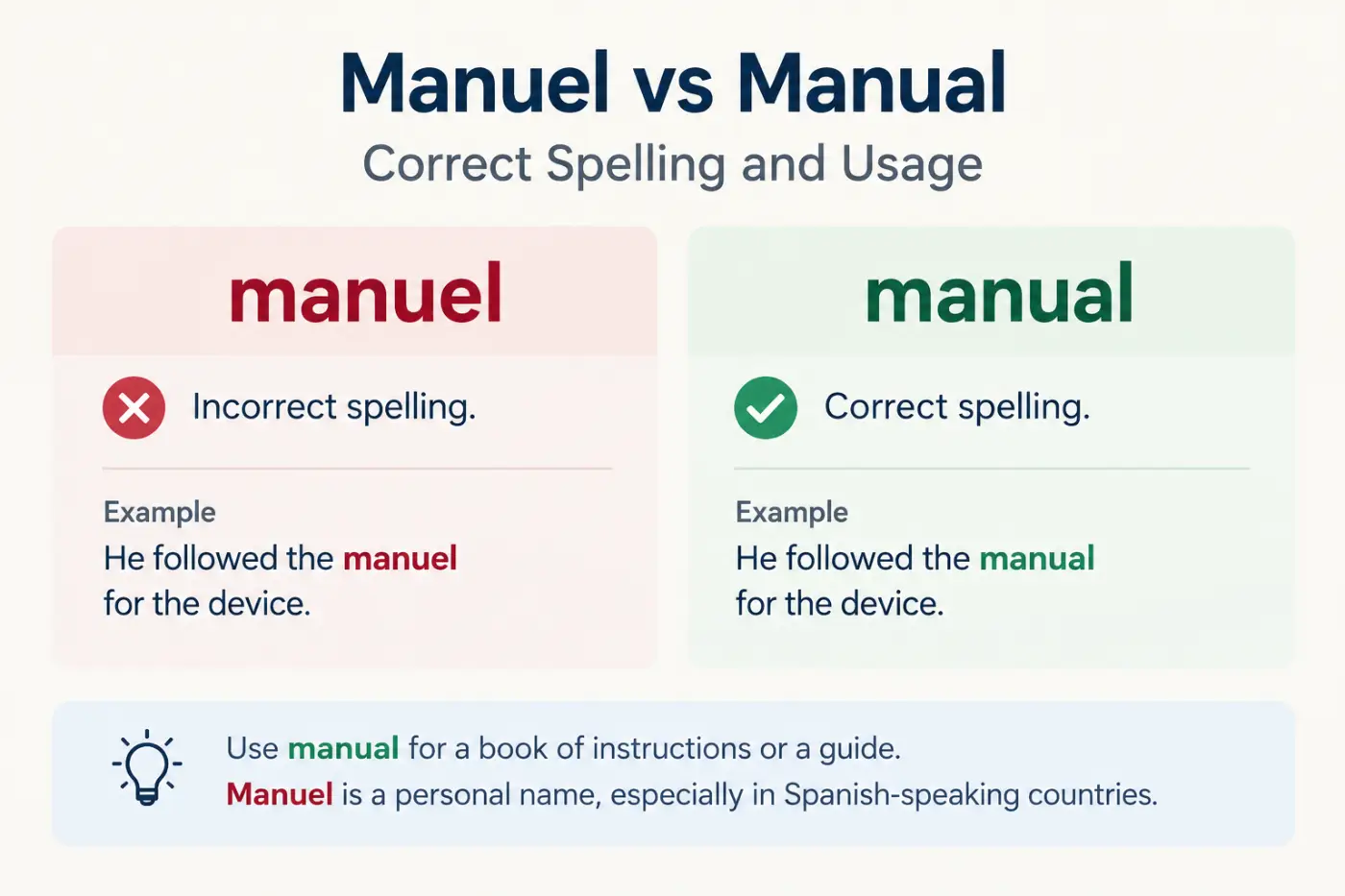
manuel vs manual is a common spelling question because the two forms are pronounced very similarly in some contexts. If you’re trying to describe something done by hand, operated by hand, or a book of instructions, the correct English word is manual. The spelling Manuel is mainly used as a personal name, so using it in place of the ordinary English word creates a spelling error.
The confusion makes sense. The letters are almost identical, and the pronunciation of manual can sound like Manuel, especially in quick speech. English also contains many words whose spelling isn’t obvious from pronunciation alone. That can make a missing or misplaced letter easy to overlook.
This guide explains the difference clearly. You’ll learn what each form means, how to pronounce manual, how the word works as an adjective and noun, why Manuel sometimes appears in English writing, and which spelling to choose in everyday, academic, workplace, and formal contexts.
Quick Answer
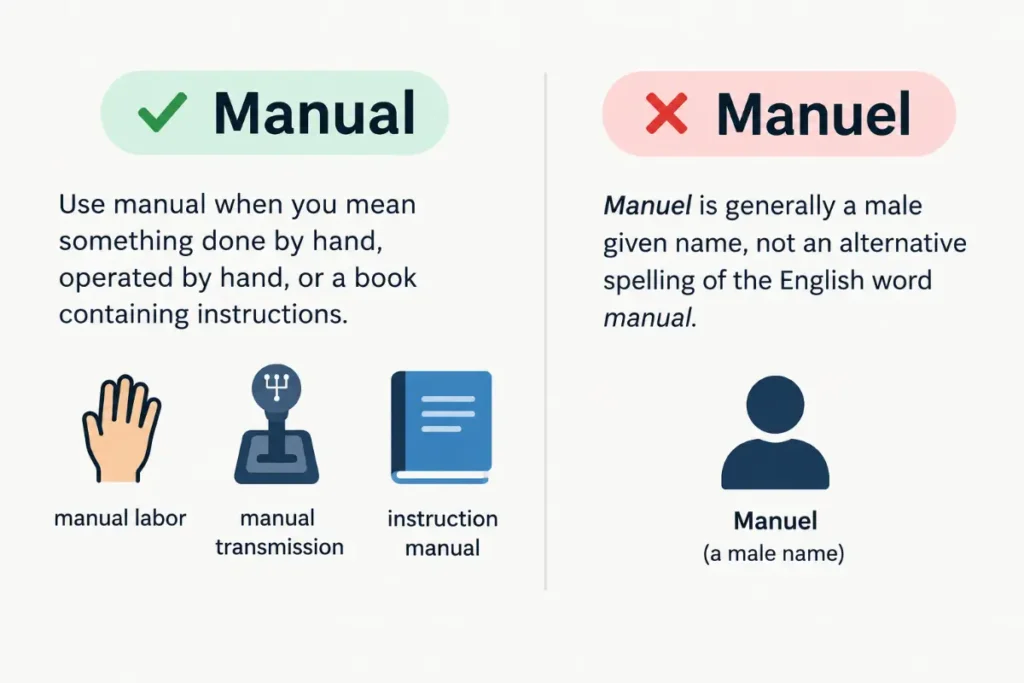
Manual is the correct spelling when you mean something done by hand, operated by hand, or a book containing instructions. Manuel is generally a male given name, not an alternative spelling of the English word manual. Use manual in phrases such as manual labor, manual transmission, and instruction manual.
Quick Answer for Writers
If you’re writing a normal English sentence and mean “done by hand” or “a book of instructions,” choose manual.
For example:
The machine requires manual adjustment.
Please read the instruction manual.
If you’re referring to a person named Manuel, use the capitalized proper name:
Manuel called me after lunch.
The capital letter matters because the two forms have different grammatical functions. Manual is an ordinary English word. Manuel is primarily a personal name.
Comparison Table
| Form | Meaning | Part of Speech | Origin | Usage Frequency | Formality | Common Contexts | Example |
|---|---|---|---|---|---|---|---|
| manual | Done by hand, operated by hand, or a book of instructions | Adjective and noun | Latin through French | Common | Standard in all varieties of English | Work, machines, instructions, technology, cars | Please read the manual before using the device. |
| Manuel | A male given name | Proper noun | A personal name used in several languages | Common as a name | Standard as a personal name | Names, biographies, personal references | Manuel joined the meeting at noon. |
The important point is that these forms aren’t two spellings of the same ordinary English word. They belong to different categories.
Meaning and Definition
What Does Manual Mean?
Manual has several closely related meanings, all connected to the idea of the hand or human effort.
As an adjective, it can describe something done with the hands rather than automatically. For example, manual sorting means sorting something by hand.
It can also describe a machine or system that a person operates directly rather than through an automatic process. A manual transmission requires the driver to change gears.
The word can also describe physical work. Manual labor refers to work that involves physical effort, often using the hands or body.
As a noun, manual commonly means a book or document that provides instructions for using something. An instruction manual, user manual, or service manual explains how a product, machine, system, or process works.
These meanings are closely connected to the historical idea of the hand. Oxford traces the word to Late Middle English, from Old French manuel and Latin manualis, from manus, meaning “hand.”
Meaning of Manuel
Manuel is primarily a male given name. It is not the standard spelling of the English adjective or noun manual.
For example:
Manuel works in our accounting department.
I met Manuel at the conference.
Here, Manuel identifies a particular person, so it functions as a proper noun.
There can also be historical and cultural uses of the name, including names of kings and other notable people. That doesn’t make it an alternative spelling of manual.
Key Differences Explained
The difference becomes easy to remember once you separate meaning from sound.
- Manual is an English vocabulary word.
- Manuel is primarily a personal name.
- Manual can function as an adjective or noun.
- Manuel functions as a proper noun when used as a person’s name.
- Manual is used in phrases such as manual labor, manual control, and manual transmission.
- Manuel is used to identify a person, as in Manuel arrived early.
- Manual is normally lowercase unless it begins a sentence or appears in a title that requires capitalization.
- Manuel is capitalized because personal names are proper nouns.
The two forms may sound close, but spelling follows meaning here.
Which Form Is Correct?
If you’re talking about something done by hand, something operated by hand, physical work, or a book of instructions, manual is correct.
The spelling manuel is not a standard lowercase alternative for these meanings.
Consider these examples:
The employee entered the information manually.
The employee entered the information manuelly.
The first sentence is correct. The second contains a spelling error in the related adverb. The correct adverb is manually.
Likewise:
I need to read the manual.
Not:
I need to read the manuel.
The second form may look plausible because manual contains a sound sequence that resembles a personal name. However, standard English uses manual for this meaning.
How Manual Works in English
Manual as an Adjective
As an adjective, manual describes something involving the hands or human physical effort.
Examples include:
- manual labor
- manual work
- manual control
- manual operation
- manual adjustment
- manual input
- manual sorting
- manual transmission
- manual gearbox
- manual process
The adjective often contrasts with words such as automatic, automated, electronic, or computerized.
For example:
The old system required manual data entry.
Here, manual tells us that a person had to enter the information rather than an automated system doing it.
Manual as a Noun
As a noun, manual usually means a book or document that gives instructions.
For example:
I checked the manual before installing the software.
The technician kept the service manual nearby.
This use is especially common with products, machines, software, vehicles, equipment, and workplace procedures.
Manual as a Word for Physical Work
Another common use appears in the phrase manual labor.
In American English, manual labor is the usual spelling. In British English, manual labour is common because labour follows the British spelling convention.
For example:
He spent several years doing manual labor.
The spelling of manual itself does not change between American and British English.
Sentence Examples
Here are 10 natural examples showing how the standard word works in real sentences.
- The technician made a manual adjustment to the machine.
- Please read the instruction manual before operating the equipment.
- The old factory relied on manual labor for much of the production process.
- I prefer a manual transmission because I enjoy controlling the gears.
- The employee entered the customer information manually.
- The software update requires manual installation.
- She kept the user manual in a drawer beside the computer.
- The teacher gave us a manual explaining the laboratory procedures.
- The company is replacing several manual processes with automated systems.
- You can switch the device from automatic mode to manual mode.
These examples show that the word fits many settings. It isn’t limited to physical work or printed instruction books.
Examples With the Common Error
The incorrect lowercase form may appear when someone is trying to write the standard English word.
Incorrect:
Please check the manuel before starting the machine.
Correct:
Please check the manual before starting the machine.
Incorrect:
The company still uses manuel data entry.
Correct:
The company still uses manual data entry.
Incorrect:
I bought a manuel transmission car.
Correct:
I bought a manual transmission car.
Incorrect:
The technician made a manuel adjustment.
Correct:
The technician made a manual adjustment.
Incorrect:
Read the manuel carefully.
Correct:
Read the manual carefully.
The problem in each case is spelling, not grammar. The intended meaning is usually clear from context, but standard written English requires manual.
Common Mistakes and Misspellings
1. Writing Manuel for Manual
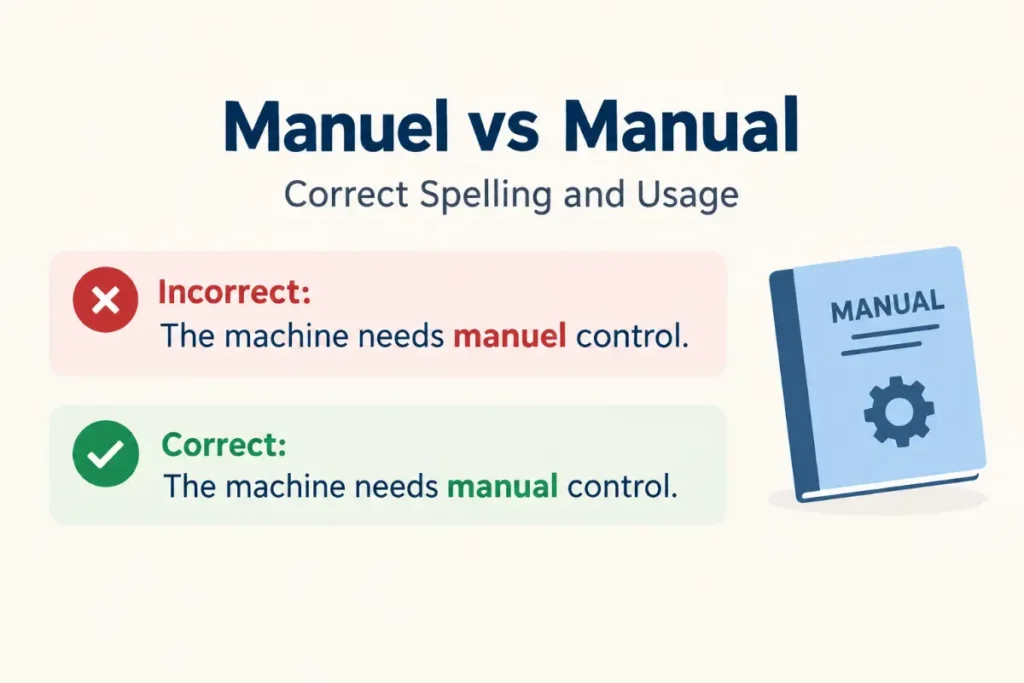
Incorrect: The machine needs manuel control.
Correct: The machine needs manual control.
This mistake usually happens because the two forms look and sound similar. Remember that manual is the ordinary English word.
2. Using Lowercase manuel
Incorrect: Please give me the manuel.
Correct: Please give me the manual.
A lowercase manuel isn’t the standard spelling of the word meaning an instruction book. If Manuel is a person’s name, the capital letter is appropriate.
3. Writing Manuel Labor
Incorrect: The job requires manuel labor.
Correct: The job requires manual labor.
The phrase manual labor is well established in American English. British English commonly uses manual labour.
4. Misspelling Manually
Incorrect: The information must be entered manuelly.
Correct: The information must be entered manually.
The adverb comes from manual plus the standard adverb ending -ly. The spelling retains the a in manual.
5. Confusing a Person’s Name With the English Word
Consider:
Manuel read the manual.
Both words are correct in the same sentence, but they have different meanings.
The first Manuel is a person’s name. The second manual is an instruction book.
This is a useful example because it shows why capitalization and context matter.
Pronunciation Guide
The standard English pronunciation of manual is approximately:
IPA: /ˈmæn.ju.əl/
A simple pronunciation guide is:
MAN-yoo-uhl
The word normally has three syllables:
MAN · you · ul
The main stress falls on the first syllable.
The first part sounds like man. The middle sound resembles you, followed by a light unstressed vowel.
The related adverb manually is pronounced approximately:
MAN-yoo-uh-lee
Its IPA form is /ˈmæn.ju.ə.li/.
Why the Pronunciation Causes Confusion
The sound of manual can be close to the personal name Manuel. In ordinary speech, unstressed vowels can be reduced, and listeners may not clearly hear every sound.
That creates a spelling trap.
If you’re writing from memory, don’t rely only on how the word sounds. Think about its meaning first. If you mean “done by hand” or “instruction book,” write manual.
Etymology and Word Origin
The history of manual helps explain its meaning.
The word entered English through French and ultimately comes from Latin. Oxford traces it to Old French manuel and Latin manualis, related to Latin manus, meaning “hand.”
The connection to the hand remains clear in modern English.
A manual task is traditionally something performed by hand.
Manual dexterity refers to skillful use of the hands.
A manual control is operated by a person rather than automatically.
A manual as an instruction book is also connected historically to something that can be held or handled.
Dictionary.com similarly traces the modern English word to Latin manualis and explains its development through French into English.
The personal name Manuel should not be treated as simply a misspelled version of this modern English word. It has its own history as a personal name.
Regional Usage
American English
Manual is standard in American English.
Common American expressions include:
- manual labor
- manual work
- manual transmission
- manual control
- manual process
- instruction manual
- user manual
- service manual
British English
Manual is also standard in British English.
The major difference you may notice is not the spelling of manual itself. British English commonly uses manual labour, while American English generally uses manual labor.
British English also commonly uses manual for a car with a driver operated gearbox.
Australian English
Australian English uses manual in the same basic senses. The word can describe physical work, hand operated equipment, and instruction books.
There is no standard Australian spelling change from manual to manuel.
Grammar Rules and Part of Speech
Understanding the grammatical role makes the distinction easier.
Manual as an Adjective
As an adjective, manual normally comes before a noun.
Examples:
manual work
manual process
manual control
manual transmission
manual adjustment
It describes the type or method of an activity, system, machine, or process.
You can also use it after certain linking verbs when the grammar and meaning allow it:
The controls are manual.
Here, manual is still an adjective.
Manual as a Noun
As a noun, manual refers to an instruction book or similar guide.
Examples:
Where is the manual?
I read the manual.
The manual explains the installation process.
It can be singular or plural:
one manual
two manuals
The plural is manuals, not manueles or another altered form.
Manually as an Adverb
The related adverb is manually.
It describes how an action is performed.
The records were entered manually.
You must reset the device manually.
The technician adjusted the settings manually.
This is useful to remember because the spelling keeps the same base:
manual → manually
Not:
manuel → manuelly
Manuel as a Proper Noun
When Manuel is a person’s name, it is a proper noun.
For example:
Manuel is waiting outside.
I sent the document to Manuel.
Manuel’s car is parked near the office.
The possessive form is Manuel’s.
This is a completely different grammatical use from the common noun manual.
Real Life Usage Examples
Daily Conversation
People commonly use manual when discussing cars, appliances, devices, and instructions.
Do you drive a manual or an automatic?
I can’t find the manual for this coffee maker.
In American English, manual can refer to a manual transmission, although stick shift is also a common informal expression.
Workplace Communication
The word appears often in workplace instructions and process descriptions.
This task still requires manual approval.
We’re trying to reduce manual data entry.
In professional writing, manual is useful when you need to distinguish human performed work from automated work.
Academic Writing
Academic and technical writing can use the word to describe research methods, processes, records, or physical work.
The researchers performed a manual review of the records.
Manual coding was used to classify the responses.
The word is neutral and appropriate for formal writing.
News and Journalism
Journalistic writing may use manual to explain how a process was performed.
Workers completed the inspection manually.
The new system is expected to replace several manual tasks.
The word is especially common in reporting about technology, manufacturing, transportation, and employment.
Literature and Storytelling
In storytelling, manual can describe physical effort or an object that contains instructions.
He opened the old manual and searched for the repair instructions.
Years of manual work had made his hands strong.
The meaning remains the same even in creative writing.
Related and Confused Terms
Several words are closely associated with manual and can help you understand its meaning.
1. Manually
Manually is the adverb form.
The settings must be changed manually.
It tells the reader that someone performs the action by hand rather than through an automated process.
2. Automatic
Automatic is often the opposite of manual when discussing machines and controls.
The system has manual and automatic modes.
A manual system requires direct human control, while an automatic system performs an operation with little or no direct control at that moment.
3. Automated
Automated describes a process controlled by technology or software rather than requiring a person to perform each step.
The company replaced the manual process with an automated system.
4. Mechanical
Mechanical can refer to machines, physical mechanisms, or processes involving machinery.
It isn’t always the opposite of manual. A machine can be mechanical and still require manual operation.
5. Physical
Physical is broader than manual. It can describe anything related to the body or material world.
The job involves physical activity.
Not every physical activity is specifically manual.
6. Handbook
A handbook is a reference book that provides information, rules, guidance, or procedures.
It overlaps with one meaning of manual, but the words aren’t always interchangeable.
The employee handbook explains company policies.
The equipment manual explains how to operate the machine.
7. Guide
A guide gives directions or useful information about a topic or task.
A manual is a type of instructional document, while guide is a broader term.
8. Instruction Manual
An instruction manual is a document explaining how to use, assemble, operate, or maintain something.
The phrase is especially common with products and equipment.
The instruction manual explains how to install the filter.
Manual Transmission and Automatic Transmission
One area where the word appears often is driving.
A manual transmission requires the driver to select gears using a gear lever and clutch system. An automatic transmission changes gears automatically.
In American English, people may also say manual car or stick shift.
For example:
She learned to drive a manual car in college.
My next car will probably have an automatic transmission.
Oxford notes that manual can refer to a vehicle with a system of gears operated by the driver and identifies stick shift as an informal North American expression.
This is another setting where writing manuel would be incorrect.
Manual Labor and Manual Work
The phrase manual labor refers to work involving physical effort, often using the hands.
Examples include construction, warehouse work, farming, manufacturing, maintenance, and other physically demanding jobs.
Manual labor can require considerable physical strength.
The company introduced equipment to reduce manual labor.
In British English, manual labour is the common spelling.
The adjective can also appear in:
- manual worker
- manual job
- manual skills
- manual work
- manual task
Cambridge uses manual labor and manual worker in its American English material and describes the term as involving physical work rather than mental work.
Manual in Technology and Business
Modern technology has given manual another very common use.
A task is often called manual when a person must perform it directly instead of letting software or an automated system handle it.
For example:
The employee must enter the information manually.
The old system required manual approval.
We want to eliminate manual data entry.
The update needs manual installation.
This usage is especially common in software, administration, accounting, customer service, data management, and office work.
The meaning still connects to human action. The task doesn’t necessarily involve physical labor. Someone can perform a manual task entirely on a computer.
Why People Confuse the Two Forms
The confusion has a simple explanation: manual and Manuel are visually and phonetically close.
Several factors can contribute to the mistake.
- Similar pronunciation: The two forms can sound very similar in ordinary speech.
- Similar spelling: Both begin with manu and contain similar vowel sounds.
- Fast speech: Unstressed vowel sounds can become less distinct.
- Name familiarity: People may already know Manuel as a personal name, which makes the spelling feel natural.
- Memory based spelling: When someone remembers a sound rather than the written form, the name spelling can sometimes appear automatically.
This is a classic spelling problem where pronunciation alone isn’t enough to determine the correct written form.
A Simple Memory Trick
Use this rule:
Manual has A for action by hand.
Think:
manual = by hand
Then connect the word to familiar phrases:
manual labor
manual control
manual transmission
instruction manual
If you’re writing the name of a person, think:
Manuel = a person’s name
You can also remember the sentence:
Manuel read the manual.
The first word is a person’s name. The second is the English word for an instruction book.
That one sentence makes the spelling difference easy to see.
Formal and Informal Usage
Manual is completely appropriate in formal writing.
You can use it in:
- academic papers
- business reports
- technical documentation
- workplace emails
- instruction sheets
- journalism
- educational materials
- professional correspondence
There is no need to replace manual with a more complicated word simply to sound formal.
For example:
The system requires manual verification.
This is clear and professional.
In less formal conversation, people may use alternatives such as by hand.
I entered the information by hand.
Both expressions are natural. Manual is often more compact, especially when it modifies a noun.
Expert Editor Insight
An experienced editor would treat manual as the standard choice whenever the sentence refers to hand performed work, human controlled processes, or an instruction book. The form Manuel would stand out as a spelling error unless the text is referring to a person with that name. In editing software, spellcheckers may catch the mistake, but context based tools can sometimes struggle with proper names because both forms can appear legitimately in English. The safest method is to check the meaning first, then choose the spelling.
Is Manuel Ever Correct?
Yes, but context matters.
Manuel is correct when it is a person’s name.
For example:
Manuel is my neighbor.
I spoke with Manuel yesterday.
Manuel’s presentation was excellent.
It can also appear in historical names and other proper names.
What you should not do is treat Manuel as a second spelling of manual.
If your sentence means “done by hand,” “operated by hand,” “physical,” or “instruction book,” use manual.
Can Manual Start a Sentence?
Yes. Manual can start a sentence like any other adjective or noun.
As an adjective:
Manual labor remains an important part of the industry.
As a noun:
Manual instructions were included with the equipment.
When it starts a sentence, it is capitalized because it is the first word of the sentence, not because the word itself normally requires a capital letter.
Compare this with Manuel:
Manuel arrived early.
The capital M is required because it is a person’s name.
Can Manual Be Used Before a Noun?
Yes. This is one of its most common grammatical roles.
Examples include:
- manual process
- manual task
- manual work
- manual labor
- manual control
- manual operation
- manual transmission
- manual adjustment
- manual input
- manual installation
In each phrase, manual modifies the noun that follows it.
The meaning is generally related to human action, hand operation, or the absence of automation.
Is Manual Appropriate in Formal Writing?
Yes. Manual is a standard word in formal American English and is widely used in technical, academic, business, and professional contexts.
For example:
The researchers conducted a manual review of the records.
The equipment requires manual calibration.
Employees must complete the manual verification process.
There is no style problem with these sentences. The word is precise and widely understood.
Is Manuel a Real Word?
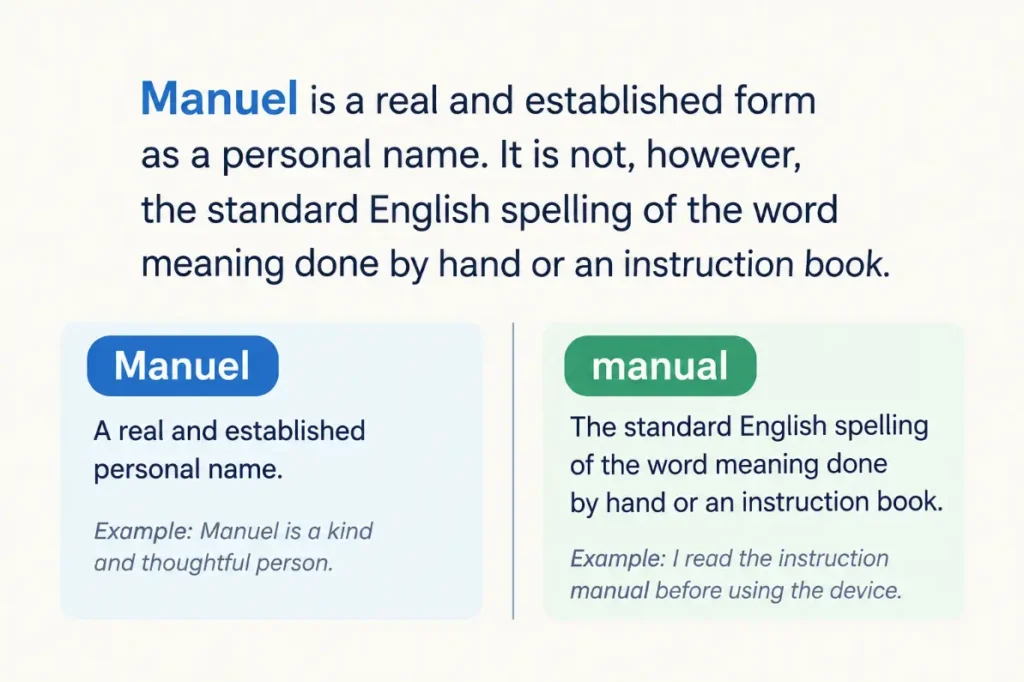
Manuel is a real and established form as a personal name. It is not, however, the standard English spelling of the word meaning done by hand or an instruction book.
This distinction is important. Calling manuel a “fake word” would be inaccurate because it has a legitimate use as a name.
The issue is context.
If you’re writing:
Manuel arrived at the office.
the form is correct.
If you’re writing:
The machine requires manuel adjustment.
the form is incorrect because the intended word is manual.
Conclusion
Manuel vs manual becomes easy to distinguish once you focus on meaning. Manual is the standard English word for something done by hand, operated by hand, physical work, or a book of instructions. Manuel is primarily a personal name and should be capitalized when used that way.
The spelling difference isn’t a regional variation in ordinary English. American, British, Canadian, and Australian English all use manual for the standard vocabulary word. British English may use manual labour instead of American manual labor, but the spelling manual remains unchanged.
For a quick memory trick, connect manual with hand. If you’re talking about a person named Manuel, use Manuel. If you’re talking about a task, machine, process, or instruction book, choose manual.
FAQs
Is manuel a correct spelling of manual?
No. If you mean something done by hand, operated by hand, physical work, or an instruction book, the standard spelling is manual. Manuel is primarily a male given name. The two forms may sound similar, but they have different meanings and grammatical functions.
What does manual mean?
Manual can mean done or operated by hand, involving physical work, or performed by a person rather than automatically. As a noun, it commonly means a book or document containing instructions for using or operating something. Examples include manual labor, manual control, manual transmission, and instruction manual.
What does Manuel mean?
Manuel is primarily a male personal name. It is used as a proper noun and is normally capitalized. For example, Manuel called this morning uses the word correctly as a person’s name. It isn’t an alternative spelling for the English word manual when that word means done by hand or an instruction book.
How do you pronounce manual?
Manual is commonly pronounced approximately MAN-yoo-uhl, with three syllables and primary stress on the first syllable. Cambridge gives the IPA pronunciation /ˈmæn.ju.əl/ for both American and British English. The related adverb manually is pronounced approximately MAN-yoo-uh-lee.
Is manual a noun or an adjective?
It can be both. As an adjective, manual describes something done by hand or operated directly, as in manual control. As a noun, it commonly means an instruction book, as in read the manual. Its grammatical role depends on how it functions in the sentence.
What is the plural of manual?
The plural is manuals. For example, The company printed several manuals for its new equipment. The word does not change to manuel or take an unusual plural ending. The same spelling applies in American and British English.
Why do people confuse manual and Manuel?
The two forms are easy to confuse because they look and sound similar. Manual contains a sequence of sounds that can resemble the personal name Manuel, especially in quick speech. The best way to avoid the mistake is to connect the spelling with meaning: manual means related to the hand, while Manuel is normally a person’s name.
Is manual suitable for formal writing?
Yes. Manual is fully appropriate in formal writing, including academic, technical, workplace, and professional contexts. Phrases such as manual review, manual process, manual verification, and instruction manual are standard. You don’t need to replace the word with a more complicated expression simply to make formal writing sound professional.
