
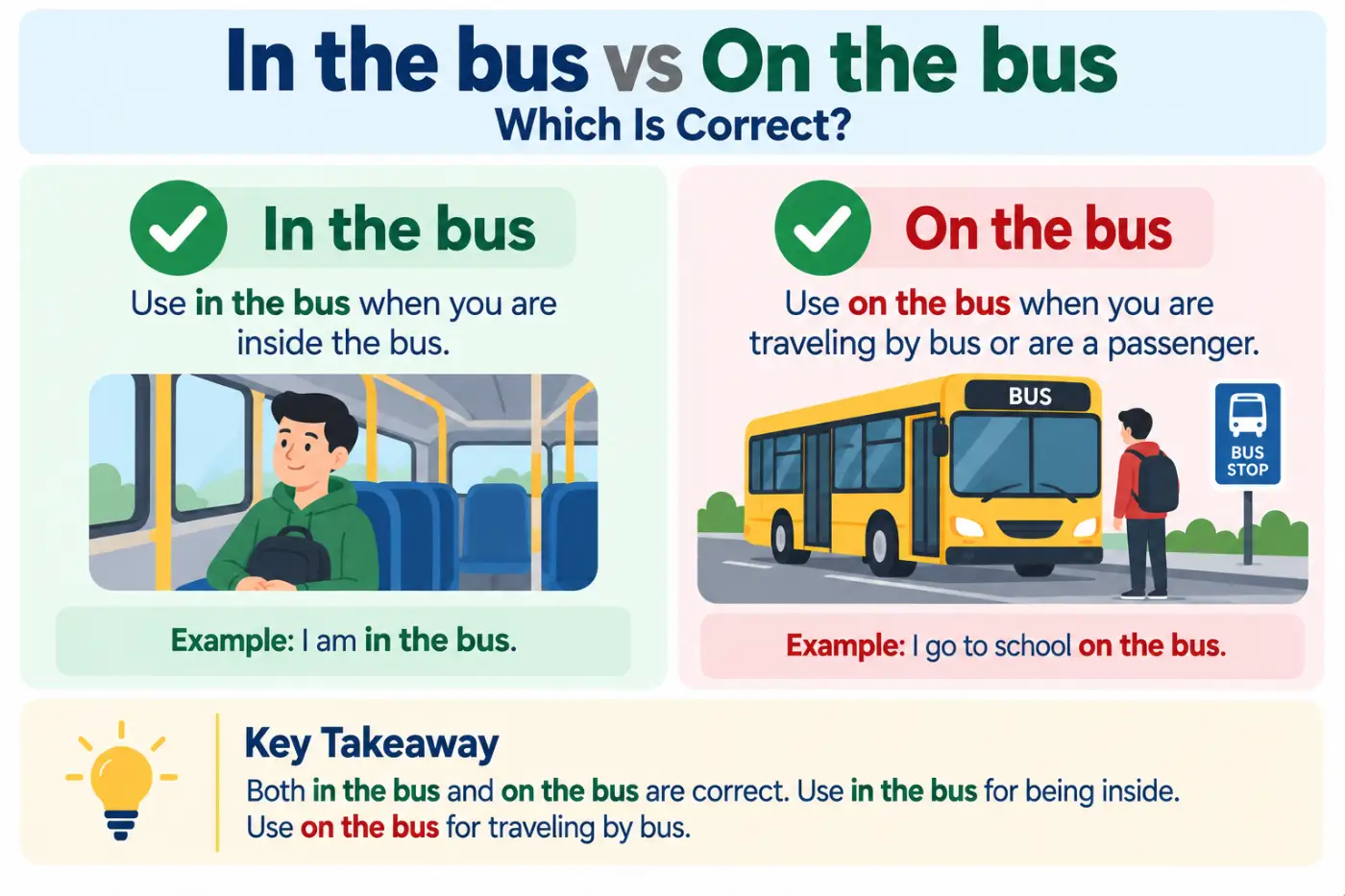
in the bus vs on the bus is a common English usage question because both phrases can look reasonable. In standard American English, on the bus is normally the natural choice when you mean that someone is traveling as a passenger and In the bus can also be correct, but it usually focuses on being physically inside the vehicle rather than riding it.
The confusion comes from the way English uses prepositions for transportation. We often say on the bus, on the train, and on the plane, yet we normally say in a car or in a taxi. That pattern can feel inconsistent at first. However, there is a useful idea behind it. English often treats larger forms of public transportation as something you board and ride.
Once you understand that distinction, choosing the right phrase becomes much easier. This guide explains the grammar behind both forms, shows when each one works, compares American and British usage, and gives natural examples from everyday speech, work, school, and formal writing. You’ll also learn a simple editing trick that can help you choose the right preposition without memorizing a long list of rules.
Quick Definition
Use on the bus when you mean that someone is riding or traveling by bus. Use in the bus when you specifically mean that someone is physically inside the vehicle. In ordinary American English, on the bus is the standard choice for talking about a passenger’s trip, while in the bus usually emphasizes location inside the vehicle.
Quick Answer
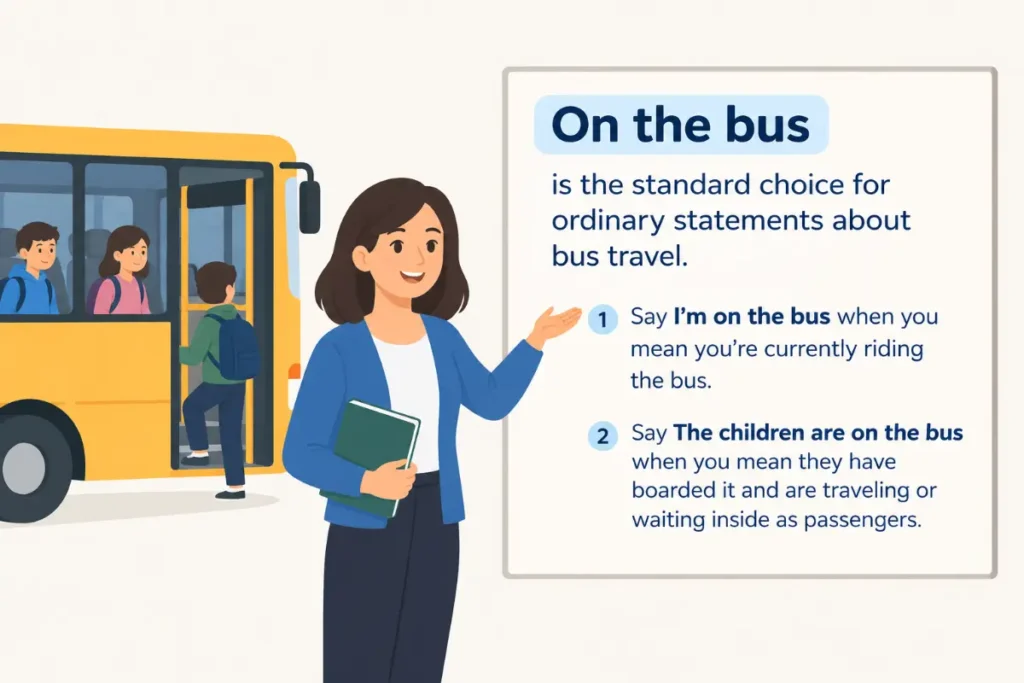
On the bus is the usual phrase when someone is traveling as a passenger.
For example, you can say, I’m on the bus now.
In the bus can also be grammatically correct when the focus is on the interior of the vehicle. For example, The children are waiting in the bus focuses on their physical location inside it.
The difference is mainly about meaning and perspective, not a simple correct versus incorrect rule.
Comparison Table for Bus Prepositions
| Form | Main Meaning | Grammar Role | Typical Usage | Formality | Common Contexts | Naturalness in US English | Example |
|---|---|---|---|---|---|---|---|
| On the bus | Riding or traveling by bus | Prepositional phrase | Passenger travel | Neutral | Daily conversation, school, work, travel | Very common | I’m on the bus now. |
| In the bus | Physically inside the bus | Prepositional phrase | Interior location | Neutral | Describing people or objects inside a vehicle | Less common for travel | The students are in the bus. |
| By bus | Traveling using a bus | Prepositional phrase | Method of transportation | Neutral | Travel plans, directions, formal writing | Very common | We traveled by bus. |
| On a bus | Riding a particular bus or any bus | Prepositional phrase | Passenger travel | Neutral | General statements and travel | Very common | She met him on a bus. |
Meaning and Definition
Meaning of On the Bus
On the bus normally means that someone is riding a bus or is present as a passenger during a journey.
Consider this sentence.
I’m on the bus.
Most native speakers understand that the person has boarded a bus and is traveling or waiting to travel. The sentence doesn’t simply describe physical position. It identifies the person’s current transportation situation.
You can also use the phrase when talking about another person.
My sister is on the bus.
The meaning is clear. She has boarded the bus and is traveling or waiting to depart.
The same idea appears in many common expressions.
I left my phone on the bus.
He fell asleep on the bus.
We talked on the bus.
They met on the bus.
In each example, the bus is being treated as a vehicle that people board and ride.
Meaning of In the Bus
In the bus focuses more directly on the inside of the vehicle.
For example:
There are six children in the bus.
This sentence draws attention to the children’s physical location. The writer is describing where they are rather than emphasizing the fact that they are passengers traveling by bus.
You might also use the phrase when contrasting the inside of a bus with its surroundings.
It was cold outside, but everyone was warm in the bus.
The focus here is clearly the interior space.
However, in the bus can sound less natural if your only meaning is that someone is riding the bus. If a friend asks where you are and you reply, I’m in the bus, the listener may understand you, but I’m on the bus sounds more natural in ordinary American English.
The Main Difference Explained
The easiest way to understand the distinction is to think about activity versus physical location.
- On the bus usually describes transportation or passenger status. You’re riding the bus.
- In the bus usually describes physical location. You’re inside the bus.
- By bus describes the method of transportation. You traveled by bus.
These meanings can overlap. A person who is on the bus is obviously also physically inside it. The choice of preposition depends on which idea the speaker wants to emphasize.
Compare these sentences.
I’m on the bus.
I’m in the bus.
The first sentence naturally answers a question such as, How are you getting home? It can also answer, Where are you right now? The second sentence sounds more focused on physical location and can feel unusual in ordinary travel conversation.
Now compare these:
We went to Chicago by bus.
We spent six hours on the bus.
The first sentence describes the method of transportation. The second describes the experience of riding the vehicle.
That three way distinction is worth remembering.
On often describes riding.
In often describes being inside.
By often describes the method of travel.
Why English Says On the Bus
English prepositions for transportation don’t follow one single physical rule.
We say:
- on the bus.
- on the train.
- on the plane.
- on the subway.
- on the ship.
Yet we usually say:
- in the car.
- in a taxi.
- in a truck.
- in a van.
This difference partly reflects how English speakers conceptualize the vehicle. Larger public forms of transportation are commonly treated as vehicles that passengers board. Cars and similar smaller vehicles are commonly treated as enclosed spaces that passengers enter.
You shouldn’t treat this as a strict mathematical rule. Language contains established patterns that developed through long use. That’s why the most useful approach is to learn common transportation expressions as natural combinations.
If you’re unsure during everyday conversation, on the bus is the safe and natural choice for a passenger traveling by bus.
Is In the Bus Ever Correct
Yes. It isn’t automatically wrong.
The phrase can be useful when the sentence focuses on the interior of the vehicle.
For example:
There was a strange smell in the bus.
The passengers were quiet in the bus.
We found three bags in the bus.
These sentences place attention on the inside area.
Still, native speakers often choose on the bus when talking about passengers during a journey.
Compare these examples.
The children are on the bus.
This naturally means the children have boarded and are traveling.
The children are in the bus.
This emphasizes their physical position inside the vehicle.
The difference can be subtle. In many everyday situations, both phrases can be understood. The preferred choice depends on what the speaker wants to communicate.
Which Form Should You Use
For most everyday situations involving bus travel, choose on the bus.
If you’re telling someone how you’re traveling, use:
I’m on the bus.
If you’re asking where someone is, use:
Are you on the bus?
If you’re describing an experience, use:
I met an old friend on the bus.
If you’re describing something left behind, use:
I left my wallet on the bus.
Use in the bus when the interior itself matters.
For example:
There’s a lot of luggage in the bus.
The heater is broken in the bus.
Someone left a jacket in the bus.
Even in these examples, another phrase may sometimes sound more natural. For instance, many speakers would say, There’s a lot of luggage on the bus, because the luggage is associated with the passenger space rather than simply the physical interior.
The context decides the best choice.
Grammar and Part of Speech
Both on and in are prepositions. When they combine with a noun phrase such as the bus, they create a prepositional phrase.
In on the bus, the preposition on connects the subject or action to the bus.
She is on the bus.
In in the bus, the preposition in expresses a position inside the vehicle.
She is in the bus.
The phrase can appear in different parts of a sentence.
At the beginning:
On the bus, I saw my old teacher.
In the middle:
I met my old teacher on the bus.
At the end:
I saw my old teacher on the bus.
The position can change the rhythm or emphasis without changing the basic meaning.
You can also combine these expressions with common verbs.
I got on the bus.
She stayed on the bus.
He fell asleep on the bus.
They waited on the bus.
The verb get on is especially common because boarding a bus is described with on.
The opposite movement is usually expressed with get off.
I got on the bus at noon.
I got off the bus downtown.
That pairing is extremely useful for learners.
Get On the Bus and Get In the Bus
One of the most common mistakes comes from confusing the preposition used with transportation.
For standard American English, you normally say:
I got on the bus.
She got on the train.
We got on the plane.
You generally don’t say:
I got in the bus.
The phrase get in is much more natural with smaller vehicles.
I got in the car.
She got in the taxi.
He got in the truck.
This creates a useful pattern.
Get on often goes with larger public transportation.
Get in often goes with smaller enclosed vehicles.
Again, this is a usage pattern rather than an absolute physical law. English contains exceptions and special contexts. Still, this pattern works extremely well in ordinary American conversation.
The same distinction appears with the opposite actions.
I got off the bus.
I got out of the car.
She got off the train.
She got out of the taxi.
Learning these pairs together makes transportation grammar much easier.
Common Mistakes
Saying In the Bus When You Mean Riding
A learner may say:
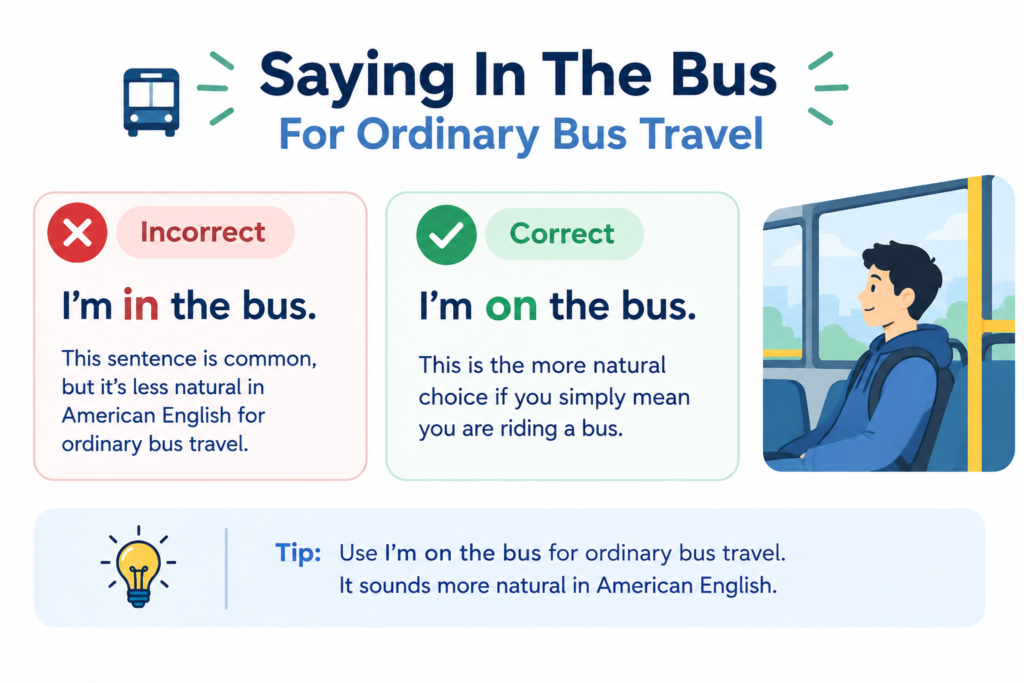
I’m in the bus.
If the intended meaning is simply that the person is traveling as a passenger, the more natural American English form is:
I’m on the bus.
The first sentence isn’t always grammatically impossible. It simply gives more attention to physical location.
Saying On the Car
Another common transfer error is:
I’m on the car.
For a passenger inside a car, standard English normally uses:
I’m in the car.
You can say someone is on a car if the person is physically sitting or standing on the outside surface. That is a different meaning.
Saying Get In the Bus
For ordinary boarding, say:
I got on the bus.
Use get in with smaller vehicles such as cars and taxis.
Saying By the Bus
Learners sometimes confuse by with on.
I went to work by the bus.
This sentence can occur in some contexts, but by bus is the standard expression when you mean the transportation method in a general sense.
I went to work by bus.
If you’re identifying a particular vehicle, by the bus can mean something entirely different.
She is waiting by the bus.
Here by means near or beside the bus.
Confusing Location With Transportation Method
These sentences answer different questions.
Where are you?
I’m on the bus.
How are you traveling?
I’m going by bus.
Where is the driver?
He is in the bus.
The grammar becomes much clearer when you first identify the question your sentence answers.
Sentence Examples
Here are natural examples using the preferred expression for passenger travel.
- I’m on the bus and should be home in twenty minutes.
- She called me while she was on the bus.
- We met on the bus after school.
- He usually reads on the bus during his morning commute.
- I left my umbrella on the bus.
- Are you already on the bus?
- The students were talking quietly on the bus.
- I fell asleep on the bus and missed my stop.
- She sent me a message while she was on the bus.
- We spent almost two hours on the bus because of traffic.
Now consider examples where the interior is the main focus.
- Several boxes were stacked in the bus.
- There were no empty seats in the bus.
- The children stayed in the bus while the teacher spoke to the driver.
- We found the missing backpack in the bus.
- It was warm in the bus despite the cold weather outside.
These examples show why it would be misleading to label one form as always correct and the other as always wrong.
In the Bus or On the Bus in Everyday Questions
People often ask this question because they want a phrase they can use immediately in conversation.
If someone asks:
Where are you?
Say:
I’m on the bus.
If someone asks:
How are you getting there?
Say:
I’m going by bus.
If someone asks:
Did you ride the bus today?
Say:
Yes, I was on the bus for about an hour.
If you’re talking about something physically located inside the vehicle, you can use in.
Where did you find the bag?
It was in the bus.
This distinction makes your speech sound more natural because you’re choosing the preposition according to the meaning rather than translating directly from another language.
Regional Usage
American English
American English strongly favors on the bus for passengers who are riding or traveling. You’ll hear it in ordinary conversation, schools, workplaces, transportation announcements, and everyday writing.
Americans also commonly use by bus to describe the method of transportation.
I went downtown by bus.
For physical location, in the bus remains possible when the interior is the focus.
British English
British English also commonly uses on the bus for passengers. The basic distinction between riding and physical location works in much the same way.
You can therefore expect sentences such as:
I’m on the bus.
She left her bag on the bus.
The transportation pattern is not a major US versus UK spelling difference. Both varieties share the common use of on with buses.
Australian English
Australian English generally follows the same pattern. Speakers commonly use on the bus when referring to bus travel.
The phrase by bus is also standard for describing a method of transportation. The broader grammar pattern remains familiar to English speakers in Australia.
Canadian English
Canadian English likewise uses on the bus for ordinary passenger travel. In the bus can appear when physical location inside the vehicle matters.
The distinction therefore remains mainly semantic rather than regional.
Pronunciation Guide
The phrase on the bus is straightforward to pronounce.
The word on is commonly pronounced /ɑn/ in American English, though its vowel can change slightly depending on the speaker and surrounding sounds.
Bus is commonly pronounced /bʌs/.
Together:
on the bus
A natural spoken version may sound smoother than the carefully separated written words. Native speakers often connect small function words during conversation.
The main pronunciation issue isn’t usually the phrase itself. The bigger challenge is choosing the correct preposition before speaking.
Learners sometimes translate directly from their first language and choose in because a bus is physically enclosed. English usage focuses more on the established transportation pattern.
A useful speaking exercise is to practice these pairs aloud.
I’m on the bus.
I’m in the car.
The contrast helps build a natural sense of the pattern.
Etymology and Word History
The prepositions on and in have very old roots in English and related Germanic languages. Their modern transportation uses developed through ordinary language patterns rather than through a single modern grammar rule.
The older meaning of on was connected with position and contact with a surface or location. Over time, English expanded its use into many expressions involving states, activities, and modes of transport.
The preposition in has long expressed position inside an area, container, or enclosed space.
Transportation phrases developed as established expressions over centuries. English speakers came to describe riding larger public vehicles with on while smaller enclosed vehicles commonly took in.
That history is useful because it shows why translating the physical idea alone can lead you astray. A bus is physically enclosed, yet the conventional passenger expression is on the bus.
Language isn’t always a diagram of physical reality. Sometimes established usage wins.
Real Life Usage Examples
Daily Conversation
A friend might text:
I’m on the bus now. I’ll call you when I get home.
Another person might say:
I was on the bus when you called.
These sound completely natural in American English.
Workplace Communication
A coworker could write:
I’m on the bus and may arrive a few minutes late.
Another message might say:
I’ll join the meeting as soon as I get off the bus.
The expressions remain natural even in professional communication.
Academic Writing
An academic discussion about transportation might say:
Students who travel on the bus often spend that time reading.
Another sentence could be:
The researchers collected responses from passengers traveling by bus.
Academic writing often uses by bus when describing transportation as a method and on the bus when describing the passenger experience.
News Writing
A news report might say:
Several passengers were on the bus when the incident occurred.
Another report might describe the transportation method:
The group traveled by bus from the city center.
The distinction remains clear because each phrase serves a different purpose.
Literature and Storytelling
A story might say:
She sat quietly on the bus and watched the rain slide down the windows.
Another passage could focus on location:
The old suitcase was hidden in the bus beneath a row of seats.
The first example emphasizes the travel experience. The second emphasizes the object’s physical location.
Related and Confused Terms
By Bus
By bus describes the method of transportation.
We traveled by bus.
It doesn’t necessarily tell the listener where the speaker is at that moment.
On a Bus
On a bus is useful when referring to an unspecified bus or a bus in general.
I met an interesting person on a bus.
The meaning can be similar to on the bus, but the article changes the reference.
On the Train
The same transportation pattern applies to trains.
I’m on the train.
This describes riding the train.
On the Plane
For ordinary passenger travel, English uses on.
She’s on the plane now.
In the Car
Cars normally take in when the passenger is inside.
I’m in the car.
This contrast is one of the best ways to remember the bus pattern.
Get On
It commonly describes boarding buses, trains, planes, and other larger forms of transportation.
Get on the bus before the doors close.
Get Off
It describes leaving a bus or similar form of transportation.
Get off the bus at the next stop.
Get In
It commonly describes entering a smaller vehicle.
Get in the car.
The phrase can also have other meanings, so context matters.
A Simple Memory Rule
If you want one practical rule, remember this:
Ride it and use on. Enter a smaller vehicle and use in. Describe the method and use by.
So you get on a bus, ride on a bus, and travel by bus.
You get in a car and travel by car.
You get on a plane and travel by plane.
This isn’t a rule you need to analyze every time you speak. With repeated exposure, these combinations become familiar chunks of English.
That is how fluent speakers often handle prepositions. They don’t mentally calculate the grammar each time. They recognize common patterns.
Expert Editor Insight
An experienced editor would usually preserve on the bus when the writer means passenger travel and reserve in the bus for a sentence that specifically focuses on the interior. The mistake often comes from applying physical logic instead of established English usage. Grammar and spelling tools may not flag either phrase because both can be grammatically possible. Context is the real test. If you can replace the phrase with riding the bus and keep the intended meaning, on is usually the natural choice.
Conclusion
in the bus vs on the bus can both be grammatically possible, but they usually serve different purposes. On the bus is the natural choice when you mean riding or traveling as a passenger. In the bus focuses more on being physically inside the vehicle. For most everyday conversations about bus travel, on is the expression you’ll want.
The larger pattern is easy to remember. You usually get on a bus, train, or plane, while you get in a car or taxi. You can also use by bus when you’re describing the method of transportation. These patterns are common across major varieties of English, including American and British English.
When you’re editing your own sentence, ask what you’re trying to describe. If the idea is riding, choose on. If the focus is the interior, in may fit better. That simple three way check will keep your transportation phrases natural.
FAQs
Is on the bus grammatically correct?
Yes. On the bus is fully standard English and is the usual expression for someone who is riding or traveling as a passenger. You can use it in casual conversation, professional communication, school writing, and formal contexts. For example, I’m on the bus tells the listener that you have boarded the vehicle and are currently traveling or waiting to travel.
Is in the bus grammatically correct?
Yes, but its meaning and naturalness depend on context. In the bus usually emphasizes physical location inside the vehicle. For example, There were several boxes in the bus focuses on where the boxes were located. If you simply mean that someone is traveling by bus, on the bus normally sounds more natural in American English.
Should I say I am on the bus or I am in the bus?
For ordinary passenger travel, say I am on the bus. This tells the listener that you have boarded the bus and are traveling or waiting to travel. I am in the bus can be understood, but it places more emphasis on physical location inside the vehicle. In everyday American English, on is usually the natural choice.
Why do we say on the bus instead of in the bus?
English transportation expressions developed as established patterns. Larger public vehicles such as buses, trains, and planes commonly use on because passengers board and ride them. Smaller enclosed vehicles such as cars and taxis commonly use in. The distinction isn’t based only on physical location. It also reflects conventional English usage.
Is it correct to say I got in the bus?
For standard American English, I got on the bus is the natural expression when you mean that you boarded it. I got in the bus may be understood, but it sounds less natural for ordinary passenger travel. English normally uses get on with buses and trains and get in with cars and similar smaller vehicles.
What is the difference between on the bus and by bus?
On the bus describes your location or passenger experience. For example, I was on the bus means you were riding it. By bus describes the method of transportation. I traveled by bus means the bus was your means of travel. Both expressions are correct, but they answer different questions and serve different grammatical purposes.
Do British speakers say on the bus?
Yes. British English commonly uses on the bus for passengers who are riding or traveling by bus. This pattern is also common in American, Canadian, and Australian English. There is no major regional difference here. Speakers across these varieties generally understand on the bus as the normal expression for passenger travel.
Is on the bus suitable for formal writing?
Yes. On the bus is completely appropriate in formal writing when the context calls for it. It can appear in reports, academic writing, professional communication, journalism, and other formal contexts. If you need to describe transportation as a method rather than passenger location, by bus may be more suitable. The choice depends on the intended meaning.
