
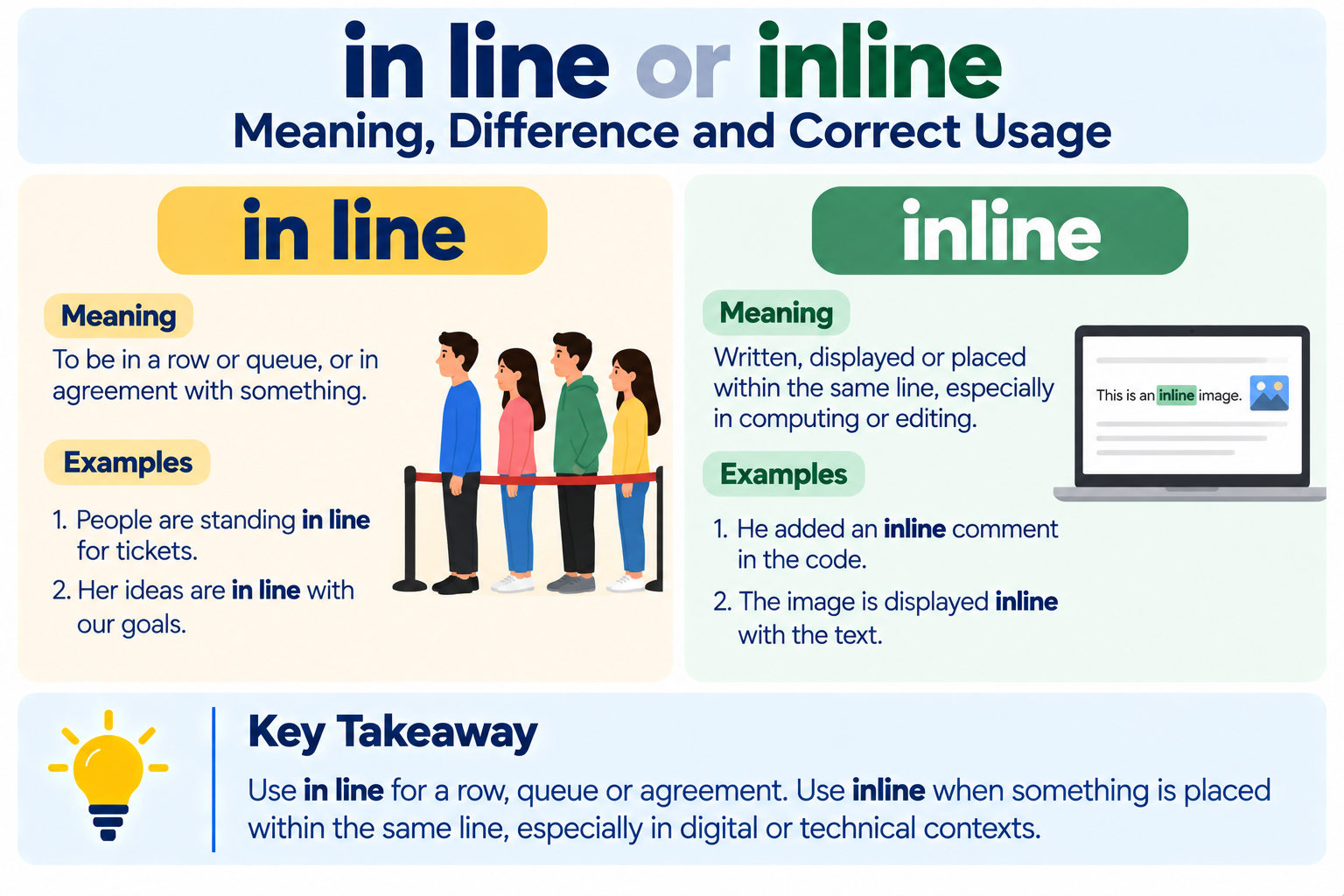
The confusion between in line or inline usually comes from the fact that the two forms look almost identical. They are both correct English expressions, but they do different jobs. In line is normally a two word phrase that describes position, arrangement, agreement, or waiting in a queue, while inline is usually a single adjective or adverb meaning contained within something or placed directly into a surrounding context.
That small space can change the meaning of a sentence. You might say that people are waiting in line at a store, but you might describe an inline image that appears directly inside an email. You can also say that a comment is in line with company policy, where the phrase means consistent with or in agreement with something.
This distinction matters in emails, technical writing, websites, academic work, business documents, and everyday conversation. The best choice depends on what you mean rather than on a simple spelling rule. Once you understand the core meanings and grammatical patterns, choosing between the two forms becomes much easier.
Quick Definition
In line is generally a two word phrase used for physical position, a queue, alignment, or agreement with something. Inline is usually a single word used as an adjective or adverb for something inserted directly into another element or kept within the same flow. The correct form depends on meaning and sentence structure.
Quick Answer
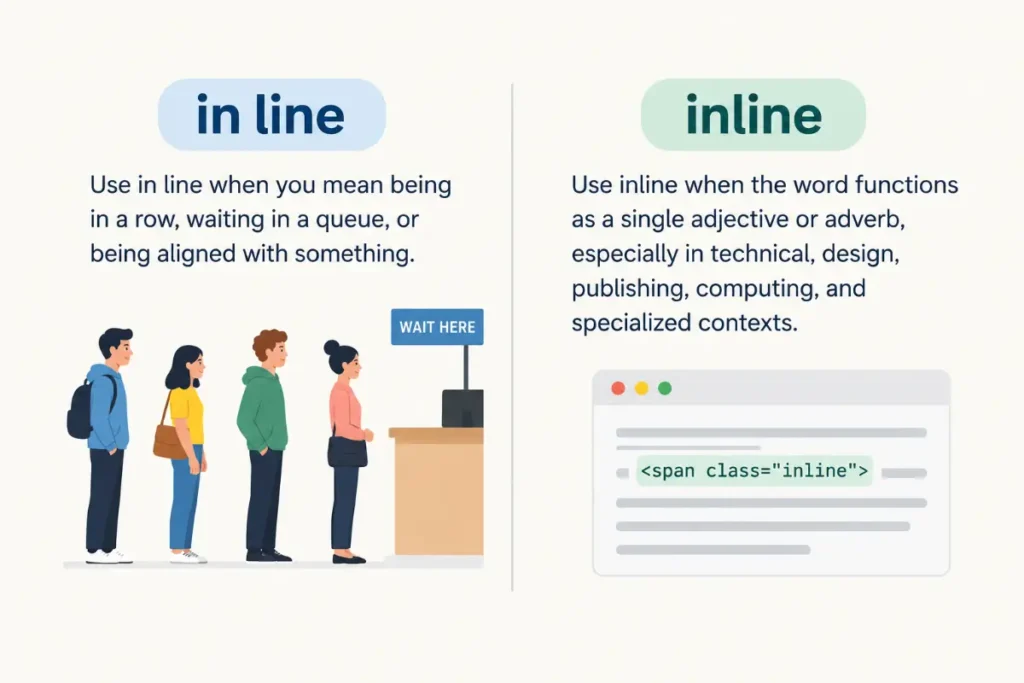
Use in line when you mean positioned in a row, waiting in a queue, aligned with something, or consistent with an idea, rule, or expectation.
Use inline when you mean placed directly within another element or kept within the normal flow of surrounding content. Technical writing commonly uses inline for code, images, styles, elements, and other content.
For example, you can say:
We waited in line for coffee.
The article contains an inline image.
Both forms are correct. The meaning determines the spelling.
Comparison Table
| Form | Meaning | Part of Speech | Origin | Usage Frequency | Formality | Common Contexts | Example |
|---|---|---|---|---|---|---|---|
| In line | In a row, queue, alignment, or agreement | Prepositional phrase or idiomatic phrase | English phrase built from in and line | Very common | Neutral | Queues, physical position, agreement, expectations | We waited in line for tickets. |
| Inline | Placed directly within something or within the same flow | Adjective or adverb | Modern compound formation from in and line | Common in technical contexts | Neutral to technical | Computing, web design, documents, images, code | The page contains an inline image. |
The table highlights the central distinction. The two word phrase has several everyday meanings, while the single word is especially common when describing content or elements placed directly within a larger structure.
Meaning And Definition
Meaning Of In Line
The phrase in line has several established meanings.
The most familiar meaning describes people or objects arranged one behind another.
We stood in line outside the theater.
Here the phrase refers to a queue. American English commonly uses in line for this meaning.
The phrase can also describe physical alignment.
The chairs are in line with the windows.
In this sentence, the chairs have been arranged along the same position or direction as the windows.
Another meaning involves agreement or consistency.
The decision is in line with company policy.
Here the phrase does not describe physical position. It means the decision agrees with or follows the policy.
You can also use the expression to describe something that matches expectations.
The results were in line with our expectations.
This use is common in business, academic, and professional writing.
So, in line can describe physical position, a queue, alignment, agreement, or consistency. The surrounding words tell you which meaning applies.
Meaning Of Inline
Inline usually describes something that appears directly within another element or remains within the same flow.
In technical writing, you may see terms such as inline code, inline image, inline style, and inline element.
For example:
The developer added an inline image to the article.
The image appears directly within the surrounding content rather than being treated as a separate block.
In web development, inline can describe an element that occupies space within the normal flow of surrounding content. The term also appears in discussions of HTML and CSS.
Inline can also describe content inserted directly into text.
The editor added an inline comment.
The comment appears within the document rather than being placed separately at the end.
The word is therefore strongly associated with the idea of something being inserted into or remaining within an existing structure.
The Core Difference
The easiest way to understand the distinction is to ask what relationship you are describing.
- Use in line for position. If people are standing in a queue, they are in line.
- Use in line for alignment. If one object follows the position or direction of another, it may be in line with it.
- Use in line for agreement. If an action follows a rule or expectation, it can be in line with that rule or expectation.
- Use inline for inserted content. If an image, comment, code fragment, or other element appears directly inside surrounding content, inline is often the correct form.
- Use inline for technical descriptions. Computing, web development, and digital publishing frequently use inline as a specialized term.
A useful comparison is this:
The customers are in line.
The website contains an inline image.
The proposal is in line with the budget.
The developer wrote inline code.
The meaning changes because the grammatical structure changes.
When To Use In Line
Use the two word form when you are describing a queue or a position.
For example:
We waited in line for twenty minutes.
The students stood in line outside the classroom.
There were hundreds of people in line before the doors opened.
In these sentences, in line refers to people waiting in an ordered sequence.
The phrase can also describe alignment.
The picture is in line with the center of the page.
The two buildings are in line with the main road.
Here the idea is physical arrangement.
Another major use is agreement or consistency.
The proposal is in line with our long term goals.
The results are in line with previous research.
Her decision was in line with the company rules.
This construction is usually in line with followed by a noun phrase.
The phrase can also appear in expressions related to expectations.
Sales were in line with expectations.
The findings were in line with what researchers predicted.
This use is especially common in business and academic writing.
When To Use Inline
Use the single word when something is placed directly within another element or follows the same continuous flow.
Technical and digital contexts provide many examples.
The article includes an inline image.
The developer inserted an inline code sample.
The editor added an inline comment.
The page uses inline styling.
The system displays the message as inline content.
In each case, the word describes content that is integrated directly into something else.
The term is particularly useful in computing because technical writing often needs a precise way to distinguish content that appears within a larger structure from content that appears separately.
For example, a code example displayed inside a paragraph can be called inline code. A larger code section displayed separately may be described differently.
The same idea appears in digital publishing. An image that sits directly within an article can be described as an inline image. A large image displayed as a separate section may be treated as a block element or separate visual component.
Grammar And Part Of Speech
The two forms behave differently in sentences.
How In Line Works
In line is generally a phrase rather than a single adjective.
Consider:
We stood in line.
The phrase functions as part of the sentence and describes where we stood.
You can also use it with with.
The plan is in line with our goals.
Here in line with works as a phrase meaning consistent with or aligned with.
The phrase can also describe physical alignment.
The shelf is in line with the cabinet.
The grammar is straightforward, but the meaning changes according to context.
How Inline Works
Inline is generally used as an adjective or adverb.
As an adjective:
The page contains an inline image.
The developer added inline code.
As an adverb:
The element displays inline.
In technical contexts, inline may modify a noun that describes content or behavior occurring within another structure.
This is one reason the single word appears frequently in technical documentation. It works efficiently as a descriptive term.
In Line With Meaning
One of the most important expressions to learn is in line with.
It usually means consistent with, compatible with, or following something.
For example:
The decision is in line with company policy.
The results are in line with earlier findings.
The spending plan is in line with the approved budget.
The new design is in line with the brand guidelines.
In these sentences, nobody is standing in a physical row. The phrase describes agreement or consistency.
This construction is especially useful in professional writing because it communicates alignment without sounding overly complicated.
However, context still matters.
The workers stood in line with the entrance.
Here the phrase can describe physical position.
The workers acted in line with company policy.
Here it describes behavior that follows a policy.
The same words can therefore produce different meanings depending on the noun and verb around them.
Inline In Technical Writing
Inline is particularly important in technology related writing.
You may encounter it in programming, web development, digital publishing, documentation, and user interface discussions.
Inline Code
Inline code appears directly within ordinary text.
For example, a technical guide might tell a reader to run a specific command and place that command directly inside the paragraph. That command can be described as inline code.
Inline Images
An inline image appears within surrounding content.
This differs from a separate image that occupies its own section or layout area.
Inline Styles
In web development, inline style refers to styling information applied directly to an HTML element. It differs from styles stored in a separate stylesheet.
Inline Elements
In web development, inline is also used to describe elements that participate in the surrounding line of content rather than behaving like larger block level structures.
The technical meaning remains connected to one basic idea. Something is placed directly within or along the flow of another structure.
Common Mistakes
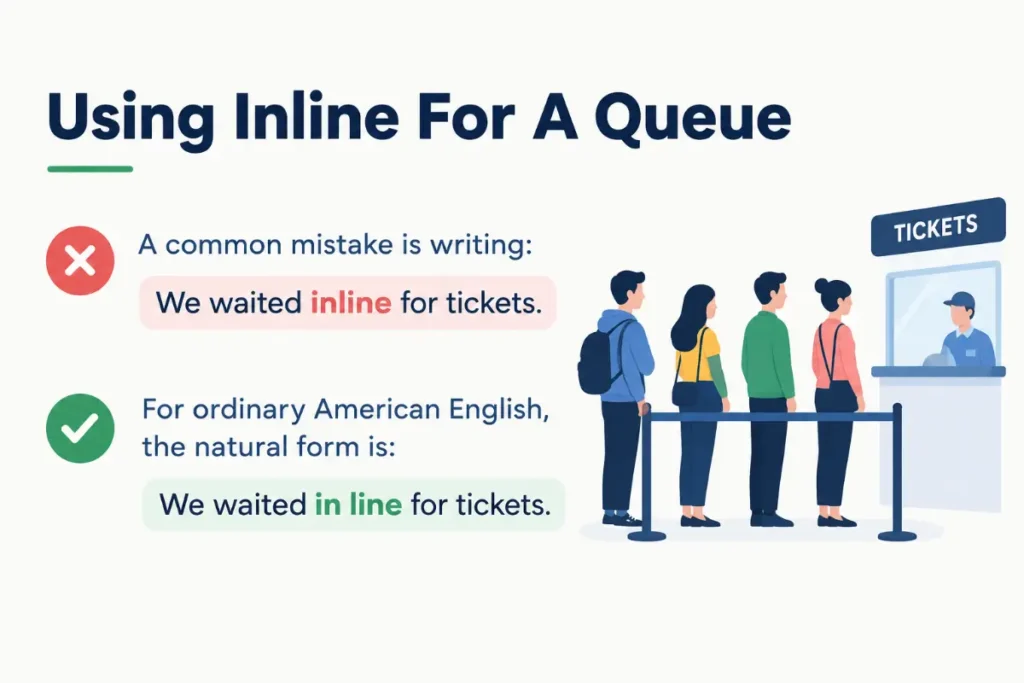
Mistake One Using Inline For A Queue
Incorrect:
We waited inline for the concert.
Standard American English normally uses:
We waited in line for the concert.
The two word form is appropriate because the sentence describes a queue.
Mistake Two Using In Line For Embedded Content
Incorrect:
The article contains an in line image.
Preferred in technical usage:
The article contains an inline image.
Here inline works as a compound adjective describing the image.
Mistake Three Confusing In Line With In Line With
The phrase in line can describe position.
The cars are in line.
The longer expression in line with can describe agreement or alignment.
The decision is in line with the policy.
Leaving out with can change the intended structure.
Mistake Four Treating Inline As A Universal Replacement
Inline should not replace in line simply because modern technical writing often uses the single word.
You would not normally write:
The customers stood inline outside the store.
The standard phrase is:
The customers stood in line outside the store.
The correct choice depends on meaning.
Mistake Five Separating A Technical Compound
Technical English commonly uses compound terms such as inline code and inline image. Splitting the compound can make the phrase look inconsistent or unclear.
If inline is functioning as a compound adjective before a noun, the single word is generally the natural form.
Why The Confusion Happens
The confusion is easy to understand because English frequently turns phrases into compounds over time.
A word such as inline can develop as a specialized compound because speakers and writers repeatedly use the same concept in technical contexts. Meanwhile, the original phrase in line remains common for physical position and other everyday meanings.
Readers also see both forms frequently online. A developer may write about inline code in one paragraph while a general article discusses people waiting in line in another.
The visual similarity makes the distinction easy to miss.
This is a useful example of how English meaning cannot always be determined by spelling alone. The surrounding words matter.
From an NLP perspective, the context provides important clues. The words surrounding the expression help identify the intended sense. Terms such as queue, people, tickets, and waiting strongly support the everyday meaning. Words such as code, image, element, style, and content strongly support the technical meaning.
You do not need to think about NLP terminology while writing, though. The practical rule is much simpler. Look at what the phrase describes.
Pronunciation Guide
In line is normally pronounced as two words.
A simple American English approximation is:
in line
The stress usually falls naturally on line when the phrase is emphasized.
Inline is pronounced as a single compound word:
IN line
The pronunciation difference is subtle because the two expressions contain the same basic sounds.
That means pronunciation alone will not always tell you which form to write. Context provides the stronger clue.
If you hear someone say that customers are waiting in line, you know the phrase describes a queue.
If a programmer talks about inline code, the technical context makes the intended meaning clear.
This is another reason learners can confuse the forms. They sound very similar even though their grammatical behavior differs.
Etymology And Word Development
The expression in line is built from ordinary English words that have been used together for a long time. The noun line has a broad history connected with ideas such as a cord, row, boundary, or sequence. The preposition in adds the relationship of being within or positioned along something.
Inline developed as a compound expression from the same basic components. Its modern technical uses grew as English needed concise terms for things placed directly within a larger structure.
This kind of word formation is common in English. A frequently used phrase can develop into a single compound when a specialized meaning becomes established.
The modern distinction therefore reflects both ordinary grammar and the development of technical vocabulary.
Regional Usage
American English
American English strongly favors in line for people waiting in a queue.
For example:
We waited in line for the tickets.
The single word inline is common in technical and digital contexts.
American professional writing also frequently uses in line with to mean consistent with or aligned with something.
British English
British English generally uses the same distinction for physical alignment and technical contexts.
One notable difference is the common British use of queue where American English often uses line for people waiting.
A British speaker may therefore say:
We waited in the queue.
An American speaker is more likely to say:
We waited in line.
This difference can affect which form learners encounter.
Australian English
Australian English also uses both forms according to context. Queue is common for people waiting, while inline appears in technical language.
The broader distinction between the phrase for position and the compound for integrated content remains useful.
Canadian English
Canadian English follows patterns that overlap with both American and British usage. Line is common in many Canadian contexts for a waiting queue, while queue also appears.
Inline remains a standard technical term for content or elements placed within another structure.
There is no major regional spelling change that removes the distinction between the two forms.
Formal Writing And Informal Writing
Both forms can appear in formal writing, but their contexts differ.
Use in line in professional writing when you mean agreement, consistency, or alignment.
The revised policy is in line with current requirements.
Use inline in technical or digital writing when describing integrated content.
The report contains an inline chart.
In casual writing, in line is extremely common when discussing queues.
I was in line at the grocery store.
Inline is less likely to appear in ordinary casual conversation unless the topic involves technology or a specialized field.
This difference is useful because vocabulary depends heavily on subject matter. A word can be perfectly normal in one field and unusual in another.
Real Life Usage Examples
Daily Conversation
We were in line for almost an hour before the doors opened.
I’ll wait in line while you find a table.
These examples use the phrase because the subject is a physical queue.
Workplace Communication
The revised schedule is in line with the approved plan.
The document includes an inline comment explaining the change.
The first sentence describes agreement. The second describes content inserted directly into a document.
Academic Writing
The findings are in line with the results of earlier studies.
The author included an inline citation after the statement.
Academic writing can use both forms because they serve different functions.
News Writing
Hundreds of customers stood in line outside the store.
The company said the new policy was in line with existing regulations.
News writing often uses the phrase for queues and the longer expression for consistency.
Technical Writing
The tutorial contains an inline code example.
The developer placed the icon inline with the text.
Technical writing uses the single word frequently because the concept of integrated content is important in computing and digital design.
Email Communication
The updated schedule is in line with what we discussed.
I added an inline note to explain the final change.
Both examples are natural in professional email.
Related And Confused Terms
Queue
Queue refers to a line of people or things waiting for service or processing. It is especially common in British English.
Alignment
Alignment describes the arrangement of things along the same line or position. It overlaps with one meaning of in line.
Inline
Inline describes content placed directly within another structure or flow. It is especially common in technical contexts.
In Line With
In line with means consistent with, compatible with, or aligned with something.
Out Of Line
Out of line can mean physically misaligned or socially inappropriate. It can also describe something that does not match an expectation or standard.
Embedded
Embedded means placed firmly or directly within something else. It often overlaps with the technical idea expressed by inline.
Within The Flow
Within the flow describes something that remains part of the surrounding sequence or layout. This concept often appears in web and document design.
Block
Block is a useful technical contrast to inline. A block element generally occupies its own area rather than staying within the surrounding line of content.
These related terms help show why context matters. The correct expression depends on the relationship between the object and its surroundings.
In Line Or Inline In Digital Content
Digital publishing creates many situations where the distinction matters.
Suppose you are writing an article and place a small image directly inside the text. You might describe it as an inline image.
Now imagine that you are writing about customers waiting outside a store. You would say they are in line.
The difference has nothing to do with the subject being digital or physical by itself. It comes from the meaning of the expression.
A useful test is to replace the expression with a simple phrase.
If you can replace it with in a queue, use in line.
If you can replace it with inside the surrounding content, inline may be appropriate.
If you can replace it with consistent with, use in line with.
For example:
The customers are in a queue.
The image is inside the paragraph.
The plan is consistent with the policy.
These replacements reveal the intended meaning.
A Practical Editing Test
When proofreading, don’t stare at the spelling alone. Look at the noun that follows the expression and the overall meaning of the sentence.
Ask three questions.
- Am I talking about people or objects arranged in a row?
- Am I describing agreement or consistency with something?
- Am I describing content that has been inserted directly into another element or flow?
If the first question is true, in line is likely correct.
If the second question is true, in line with is likely correct.
If the third question is true, inline is likely correct.
This test works better than memorizing a long list of rules because it focuses on meaning.

Expert Editor Insight
An experienced editor would not treat these expressions as competing spellings where one must always replace the other. They represent different grammatical and semantic uses. In ordinary American English, in line is the natural choice for a queue and for expressions such as in line with expectations. Inline is common as a technical compound describing integrated content. Spelling tools may not catch every contextual mistake because both forms are valid words. A careful editor checks the meaning and the sentence structure instead of relying on spellcheck alone.
Conclusion
The choice between in line or inline depends on meaning rather than a simple spelling rule. Use in line for a queue, physical position, or alignment, and use in line with when something agrees with a rule, plan, or expectation. Use inline when content or an element is placed directly within another structure or flow.
The distinction becomes especially useful in technical writing. Inline commonly describes code, images, comments, styles, and other integrated content, while everyday American English uses in line for people waiting in a queue.
A quick editing trick can help. Replace the expression with a simpler phrase. If you mean in a queue or consistent with something, use in line. If you mean inside surrounding content, use inline. That small meaning check will usually give you the right form.
FAQs
Is in line one word or two words?
For most everyday meanings, the phrase is written as two words. You write in line when describing a queue, physical position, or agreement with something. For example, we waited in line and the results were in line with expectations. Inline is a separate compound word with a different meaning, especially in technical contexts.
Is inline always related to technology?
No. Inline has broader uses, but technology is one of the areas where the single word appears most often. It can describe something inserted directly into surrounding content or kept within the same flow. Terms such as inline image, inline code, and inline element are common technical examples. The basic idea is integration within a larger structure.
Should I write in line with or inline with?
Use in line with when you mean consistent with, compatible with, or aligned with something. For example, the decision is in line with company policy. Inline with is not the standard replacement for this phrase. The single word inline has a different function and is mainly used to describe something placed within another element or flow.
Is in line with formal English?
Yes. In line with is a standard expression that works well in professional, academic, business, and everyday English. It commonly means consistent with or aligned with something. For example, the new policy is in line with existing regulations. It can also describe physical alignment, depending on the context and the words around it.
What does inline mean in writing?
In writing and digital publishing, inline generally describes content that appears directly within surrounding material. An inline comment can appear inside a document rather than separately. An inline image can appear within an article or paragraph. The term is especially common in technical writing because it helps distinguish integrated content from content displayed separately.
Do Americans say in line or in a queue?
American English commonly uses in line when talking about people waiting. For example, an American speaker would naturally say we waited in line for tickets. Queue is also understood in the United States but is less common in ordinary conversation for this meaning. British English uses queue much more frequently for a waiting line.
Can inline and in line change the meaning of a sentence?
Yes. The spacing can signal a different grammatical function and meaning. We stood in line describes people waiting in a queue. The page contains inline text describes content integrated into another structure. Because both forms are legitimate, you should choose based on meaning rather than treating one spelling as universally correct.
How can I remember the difference?
Use a simple meaning test. If you mean a queue or physical position, choose in line. If you mean consistency, use in line with. If you mean content placed directly inside another structure, choose inline. Think of inline as a compact technical term for something that stays within the surrounding flow.
