
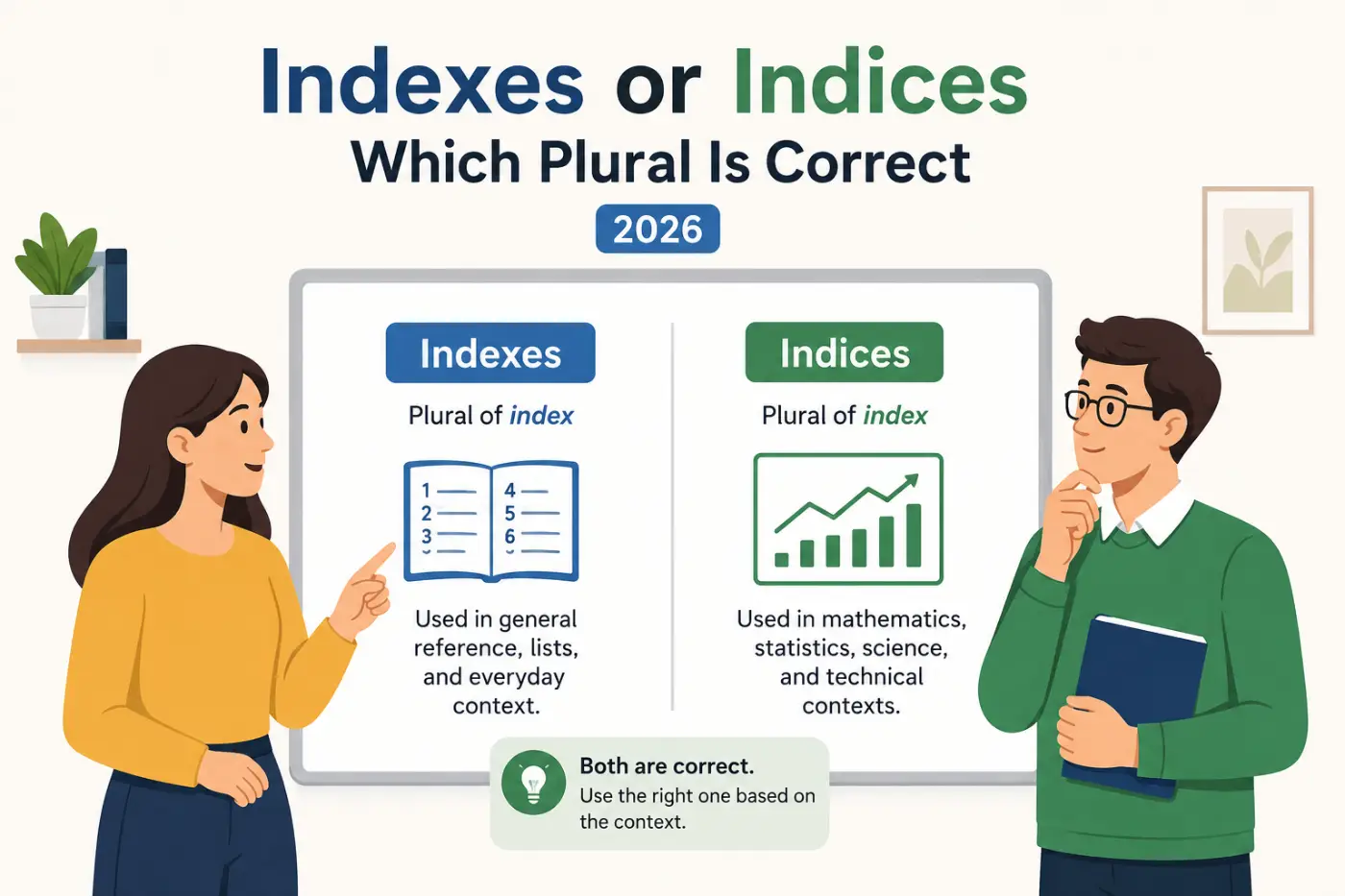
Indexes or indices can be confusing because both forms are correct. The difference isn’t that one is right and the other is wrong. Instead each plural form tends to appear in different contexts and can carry a slightly different sense depending on the subject.
Indexes is the more common choice in general English. You’ll often see it when people talk about lists in books catalogs databases websites or other collections of information. Indices is also standard English but appears more often in mathematics science economics medicine and other technical fields. It can also refer to several mathematical powers or exponents.
The choice becomes much easier once you understand the context. If you’re talking about the alphabetical list at the back of a book you can use indexes. If you’re discussing mathematical expressions or several measurement values you’ll often see indices. This guide explains the meaning grammar pronunciation history regional usage common mistakes and practical examples so you can choose the form that fits your sentence naturally.
Quick Definition
Both indexes and indices are accepted plural forms of index. Indexes is common for lists or collections of references while indices is especially common in mathematics and technical writing. In general English either form can be correct when referring to more than one index. The surrounding context usually determines the better choice.
Quick Answer
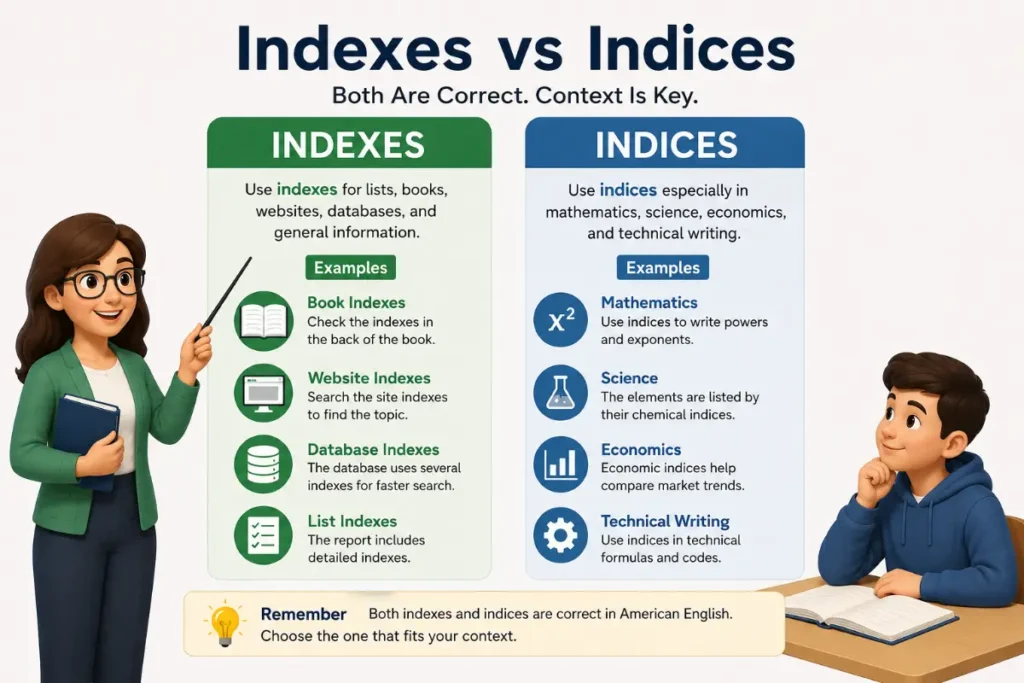
Both forms are correct.
Use indexes for general references to multiple lists or alphabetical guides. For example a library may contain several indexes.
Use indices often in mathematics science economics and technical writing. For example a mathematician may work with several indices in an equation.
There is no universal rule that makes one form correct and the other incorrect. The subject and intended meaning matter.
Comparison Table
| Form | Meaning | Part of Speech | Origin | Usage Frequency | Formality | Common Contexts | Example |
|---|---|---|---|---|---|---|---|
| Indexes | More than one index especially lists or reference guides | Plural noun | Latin index through English | Common | Neutral | Books, catalogs, databases, websites, general writing | The books have detailed indexes. |
| Indices | More than one index or multiple mathematical and technical values | Plural noun | Latin indices through English | Common in technical contexts | Neutral to formal | Mathematics, science, economics, statistics, technical writing | The model uses several economic indices. |
The distinction in the table is a tendency rather than an absolute rule. You may encounter either plural in several fields.
Meaning And Definition
Meaning Of Indexes
Indexes is the regular English plural of index. It usually refers to two or more indexes.
An index can be a list that helps you find information. A book may have an index at the back that lists important subjects and the pages where they appear. A large reference work may contain several indexes organized by topic author name place or subject.
For example:
The encyclopedia contains separate indexes for people and places.
Here indexes simply means more than one index.
The word also appears in digital settings. Websites databases and research platforms may use indexes to organize information so users can locate material more easily.
For example:
The database uses several indexes to speed up searches.
In this sentence the word has a technical computing meaning. It still functions as the ordinary plural form.
Indexes can also describe several indicators or measurements. For example:
The report compares consumer confidence indexes from different years.
In general writing indexes is often the natural choice when the noun refers to lists collections or reference systems.
Meaning Of Indices
Indices is another accepted plural form of index. It comes from the traditional Latin plural form and remains especially common in technical fields.
Mathematics provides one of the clearest examples.
In algebra an index can refer to an exponent or power. The plural may be indices.
For example:
The equation contains several indices.
Indices is also common in statistics economics science and medicine. A scientific paper might discuss several indices that measure different properties of a system.
For example:
The researchers compared three health indices.
In economics you may encounter terms such as price indices and stock market indices. These refer to numerical measures designed to represent changes or conditions within a group of values.
The form is also used in some general contexts. It isn’t restricted to mathematics. However its technical flavor makes it especially common in specialized writing.
The Main Difference
The easiest way to understand the distinction is to focus on usage rather than treating the two words as competing spellings.
- Indexes is common in general English. It works naturally for book guides catalogs databases and other reference lists.
- Indices is common in technical English. Mathematics science economics statistics and medicine often favor it.
- Both forms are grammatically correct. Neither is simply a misspelling of the other.
- Context determines the natural choice. A book publisher may talk about indexes while a mathematician may discuss indices.
- Style guides can influence preference. A particular field or publication may consistently favor one form.
- The meaning of index also matters. The plural can refer to a reference list a numerical indicator a mathematical exponent or another specialized concept.
This means you shouldn’t memorize a rigid rule such as indexes is for English and indices is for math. That shortcut is useful in some situations but isn’t completely accurate.
Which Form Is Correct
Both indexes and indices are correct plural forms of index.
The difference comes from English plural formation and the history of the word. Index entered English through Latin. Traditional Latin plural formation produced indices. English also developed the regular plural indexes.
Over time both forms became established in English. Their modern distribution is influenced heavily by context and convention.
A dictionary entry for index may therefore recognize both plural forms. In ordinary writing you don’t need to treat indices as more correct simply because it resembles the Latin form.
The practical rule is simple. Use the form that matches your audience and subject.
If you’re writing about books or reference lists then indexes will often sound natural.
If you’re writing about mathematical quantities or scientific measurements then indices may fit the established terminology of the field.
When a specific publication or academic style guide has a preferred form follow that convention for consistency.
When To Use Indexes
Indexes is especially useful when you’re discussing reference lists.
Consider these examples:
The publisher created separate indexes for names and subjects.
The textbook includes detailed indexes at the end of each volume.
The library database uses indexes to organize its records.
The website contains several searchable indexes.
The editor reviewed all the indexes before publication.
In these examples the word has a practical reference meaning. Readers can easily understand it as the plural of a list or organizational tool.
Indexes also works well in general business writing.
For example:
The report compares several performance indexes.
That sentence is grammatically correct even though some specialized publications might prefer indices for certain numerical measures.
This is why context matters more than a simple word replacement rule.
When To Use Indices
Indices is particularly common in technical subjects.
Mathematics
Mathematical writing often uses indices to identify positions values variables or exponents.
For example:
The formula uses different indices to identify each variable.
In some mathematical traditions index notation is used to represent components of vectors matrices and tensors.
Economics
Economists frequently use indices for numerical measures.
Examples include price indices and economic indices.
For example:
The researchers compared price indices across several regions.
Statistics
Statistical writing may use indices to describe measures constructed from several values.
For example:
The researchers calculated several indices to compare the groups.
Science
Scientific writing often uses indices for measurements or specialized numerical indicators.
For example:
The study examined several environmental indices.
Medicine
Medical research may use indices to represent standardized measures.
For example:
The researchers evaluated several clinical indices.
In these fields indices often feels natural because it has become part of the established vocabulary.
Why Both Plurals Exist
English has borrowed thousands of words from Latin Greek French and other languages. Some borrowed words kept older plural patterns while also developing regular English plurals.
Index is one example.
The traditional Latin plural is indices. English speakers also created the regular plural indexes by applying the familiar plural ending.
This pattern appears in many borrowed words.
Over time both forms can become standard. Once that happens the question isn’t simply which one follows the original language. The more useful question becomes how English speakers use each form today.
That is exactly what happened with index.
The Latin based plural remained strong in technical language. The regular English plural became common in general usage.
Neither development makes the other form wrong.
Grammar Rules And Part Of Speech
Indexes and indices are both plural nouns.
The singular form is index.
The plural forms are indexes and indices.
For example:
The index is useful.
The indexes are useful.
The index contains several measurements.
The indices contain several measurements.
Because both words are plural nouns they normally take plural verbs when they act as the subject of a sentence.
For example:
The indices show a steady increase.
Not:
The indices shows a steady increase.
The same rule applies to indexes.
The indexes show a steady increase.
Both forms can also appear after numbers.
Three indexes were added to the database.
Three indices were calculated for the study.
The choice of plural does not change the basic grammar of the sentence.
Spelling And Word Formation
The spelling difference comes from the plural ending.
Index → indexes
Index → indices
The first form follows a familiar English pattern by adding es.
The second reflects the historical Latin plural.
You may see additional variations in highly specialized writing or in older texts. Modern standard English generally recognizes both forms.
One common mistake is assuming that indices must always be used because index comes from Latin. English doesn’t work that rigidly. Many borrowed words have developed regular English plurals over time.
Another mistake is assuming that indexes is somehow informal or incorrect. It is a standard plural and is completely appropriate in many contexts.
Sentence Examples
Here are natural examples showing how both forms work.
- The book contains detailed indexes for names and subjects.
- The publisher added separate indexes to the revised edition.
- Several database indexes make the search process faster.
- The library maintains indexes for historical newspapers.
- The report compares several economic indices.
- Researchers calculated three health indices during the study.
- The mathematical model uses different indices to identify the variables.
- The scientist compared environmental indices across several regions.
- The textbook explains how numerical indices are calculated.
- The editors checked all the indexes before the book went to print.
These examples show why context matters. The plural form changes naturally depending on the field and the meaning of index being used.
Common Mistakes
Assuming Indices Is Always More Correct
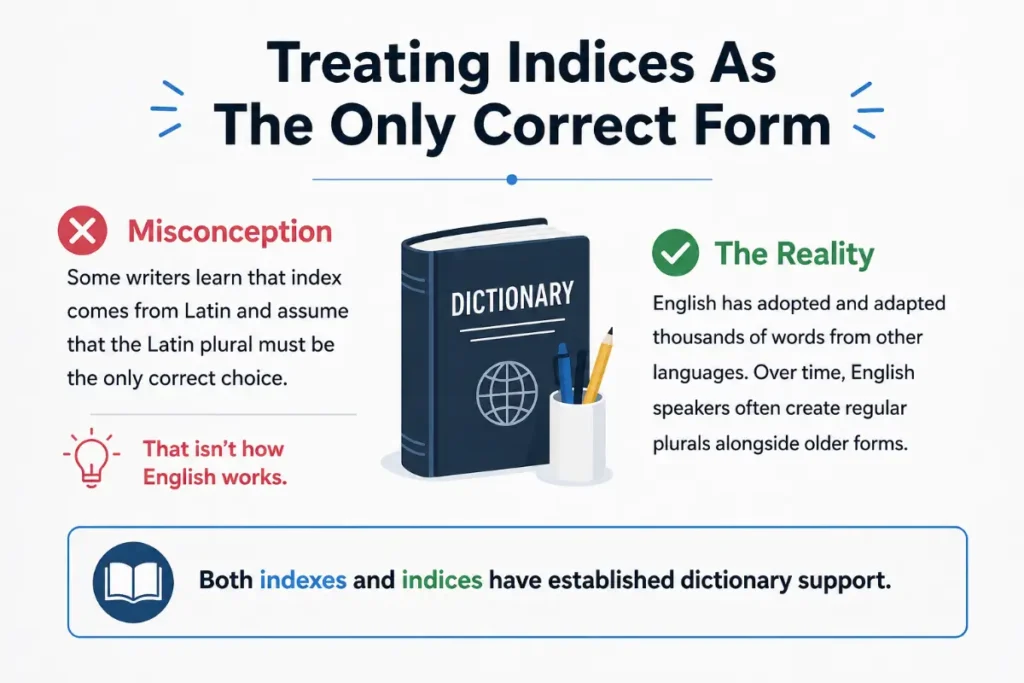
Some writers think indices must be the correct plural because it comes from Latin.
That isn’t true. Indexes is also a standard English plural.
Use the form that fits your context rather than assuming the Latin derived form is automatically superior.
Treating Indexes As A Misspelling
Indexes is not a spelling mistake.
A sentence such as The book contains several indexes is perfectly acceptable.
Some writers may prefer indices in a technical context but that preference does not make indexes incorrect.
Using Indices For Every General Reference List
Indices may sound overly technical when you are simply discussing book guides.
For example:
The book has two indexes.
This is completely natural.
The book has two indices.
This is possible but may sound more formal or technical depending on the audience.
Confusing Index With Indexing
Index is a noun in many contexts while indexing refers to the process of creating or organizing an index.
For example:
The database has several indexes.
The database team is indexing the records.
These words are related but they do different grammatical jobs.
Mixing Styles In One Document
A technical report may use indices in one section and indexes in another section for the same meaning without a clear reason.
Consistency helps readers. If your field or publication follows a particular style choose one form and use it consistently when the meaning is the same.
Pronunciation Guide
The singular word index is commonly pronounced /ˈɪndeks/.
A simple pronunciation guide is:
IN deks
The first syllable receives the main stress.
Indexes is commonly pronounced /ˈɪndeksɪz/.
A simple guide is:
IN dek siz
Indices is commonly pronounced /ˈɪndɪsiːz/.
A simple guide is:
IN dih sees
The pronunciation difference is useful because the two plurals look related but sound quite different.
Some speakers may use a pronunciation influenced by their field or regional accent. The standard distinction remains clear enough in careful speech.
A common mistake is to pronounce indices as if it were simply indexes with different spelling. It isn’t. The two forms have different historical development and commonly differ in pronunciation.
Etymology And Word Origin
Index comes from Latin index which meant an informer or indicator. The word was related to the Latin verb meaning to point out or disclose.
English later adopted index as a term for something that points toward or identifies information.
That basic idea remains visible today.
A book index points readers toward information inside the book.
A database index points a computer system toward stored information.
A price index represents changes in a collection of prices.
A mathematical index can identify a position or power within a mathematical expression.
The plural indices comes from Latin usage. English also developed the regular plural indexes.
This is a good example of how borrowed vocabulary changes after entering English. A word can retain a historical plural while also gaining a regular English plural.
Regional Usage
American English
Both forms are standard in American English. Indexes is common in general writing while indices is strongly established in technical fields such as mathematics economics statistics and science.
American publishers and academic institutions may follow individual style preferences. In technical writing the terminology of the field often matters more than a general rule about plural formation.
British English
British English also recognizes both forms. The same broad distinction appears between general usage and specialized technical usage.
British academic writing may use indices frequently in mathematics science economics and related subjects. Indexes remains natural when referring to several reference lists.
Australian English
Australian English follows the same general pattern. Both plural forms are understood and accepted.
Technical fields may favor indices while general writing often uses indexes for reference lists and similar organizational tools.
Canadian English
Canadian English also uses both forms. There is no major Canadian spelling rule that makes one plural universally correct.
As in American and British English the subject and professional context usually guide the choice.
Usage In Different Fields
The field you’re writing for can give you a strong clue.
Publishing
Publishing often uses indexes for the alphabetical reference sections found in books.
An academic book may have separate indexes for subjects names and geographical locations.
Computing
Computing uses index in several specialized ways. Database indexes are common because they help organize data and improve search operations.
Indexes is therefore very natural in many software and database contexts.
Mathematics
Mathematics frequently uses indices for positions subscripts exponents and related concepts.
The field has established conventions that make indices a familiar technical term.
Economics
Economics often uses indices for numerical measures that represent changes across groups or periods.
Examples include price indices and economic indices.
Science
Scientific writing may use either form depending on the type of index being discussed. Specialized terminology and journal conventions often influence the choice.
Medicine
Medical literature may use indices for standardized measurements and scoring systems. The choice can vary by the specific term and publication.
Related And Confused Terms
Index
Index is the singular form. One book may have one index while another may contain several indexes.
Indexing
Indexing refers to the process of creating or organizing an index.
Indicator
An indicator is something that provides information about a condition or trend. It can overlap with index in some contexts but isn’t always interchangeable.
Catalog
A catalog is an organized collection of information about items. It can help users locate resources but serves a different purpose from an index.
Table Of Contents
A table of contents lists the main sections of a document in order. An index usually points readers to specific subjects or terms.
Database Index
A database index is a data structure used to help a database locate records efficiently.
Price Index
A price index measures changes in prices across a selected group of goods or services.
Mathematical Index
A mathematical index can identify a position or serve a specialized role in notation. Its exact meaning depends on the mathematical system being used.
These terms belong to different semantic areas, so replacing one with another without checking the context can change the meaning.
Indexes Or Indices In Formal Writing
Both forms work in formal writing.
The better choice depends on the subject and established convention.
If you’re writing a book publishing report you might naturally write:
The revised edition contains three indexes.
If you’re writing an economics paper you might write:
The study compares several price indices.
Neither sentence needs correction.
The important point is consistency. Once you choose a form for a particular meaning and context, keep the terminology stable throughout the document unless your field uses different established terms.
Formal writing also benefits from precision. If your readers may not understand a specialized term, consider using a more familiar word or briefly defining it.
Real Life Usage Examples
Daily Conversation
The new book has several useful indexes at the back.
I need to check the indexes before I choose the reference book.
In everyday speech indexes is usually more natural when talking about books or lists.
Email And Workplace Communication
The report includes separate indexes for customers and products.
Our database indexes need to be updated before the migration.
These examples show how the word can move naturally from publishing to technology.
Academic Writing
The researchers compared several economic indices across the study period.
The textbook provides detailed indexes to help students locate key terms.
Academic writing may use either form depending on the discipline.
News And Journalism
Several economic indices showed changes during the reporting period.
The new edition includes expanded indexes for names and subjects.
Journalists usually follow the terminology appropriate to the subject they are covering.
Literature And Storytelling
The old reference book contained several indexes that made research easier.
At the end of the volume the author included detailed indexes of names and places.
Publishing contexts strongly favor the regular English plural.
How Dictionaries Treat The Two Forms
Standard English dictionaries generally recognize both indexes and indices as plural forms of index. The important point is that dictionary recognition does not mean the two forms always have identical frequency or distribution.
English dictionaries often record usage information and field specific senses because words can behave differently across disciplines.
That is useful here. A dictionary may show both plural forms while examples and usage notes help reveal where each one is commonly found.
For practical writing you should therefore consider three things.
- Check the meaning of index in your sentence.
- Consider the field you are writing for.
- Follow the terminology used consistently by your publication institution or professional field.
This approach is more reliable than assuming one plural must replace the other everywhere.
A Useful Editing Test
Here is a simple test editors can use.
Read the sentence and ask what kind of index you mean.
If you mean a list that helps readers find information in a book or collection you can comfortably use indexes.
If you mean numerical measures or a specialized mathematical concept check the terminology of your field. Indices may be the established choice.
If both forms seem possible ask which one your readers will expect.
For a general audience clarity usually matters more than preserving a traditional plural.
For a specialist audience field specific terminology may matter more.
Expert Editor Insight
An experienced editor doesn’t automatically change indexes to indices or indices to indexes. The first step is to identify the meaning and the field. Indexes is natural for many general reference lists and computing contexts while indices is strongly established in mathematics economics and several technical disciplines. Grammar tools may accept both forms because both are standard English plurals. A good editor therefore checks context and house style instead of treating the issue as a simple spelling error.
Final Grammar Check
Before publishing content that uses these forms, check five things.
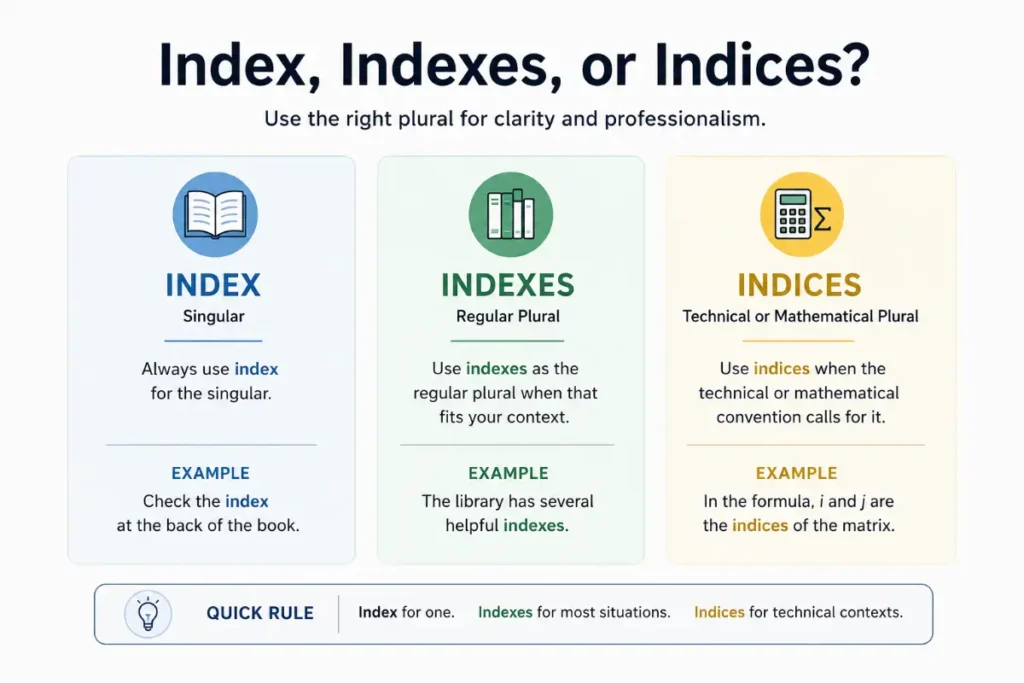
- Make sure the singular is index.
- Use indexes as the regular plural when that fits your context.
- Use indices when the technical or mathematical convention calls for it.
- Don’t spell the plural as indeces or indexs.
- Keep your chosen form consistent within the same context.
Conclusion
indexes or indices has no single winner because both are correct English plurals of index. The practical distinction comes from context. Indexes is especially natural for reference lists in books catalogs databases and general writing. Indices is strongly established in mathematics economics science statistics and other technical fields.
The two forms developed from different plural patterns, with indices preserving a traditional Latin form while indexes follows a regular English pattern. That history explains why both forms exist today.
For an easy editing rule, first identify what index means in your sentence. If you’re discussing book reference lists or general organizational systems, indexes will often fit naturally. If you’re writing about technical measures or mathematical notation, indices may be the established choice. When in doubt, check the terminology used consistently in your field.
FAQs
Is indexes a correct plural of index?
Yes. Indexes is a standard English plural of index. It is especially common when referring to reference lists in books catalogs databases and similar systems. It can also appear in technical contexts. You should not treat indexes as an incorrect version simply because indices is another established plural.
Is indices also a correct plural?
Yes. Indices is a standard plural of index and is especially common in mathematics science economics statistics and other technical fields. It comes from the traditional Latin plural form. Its technical use has become firmly established in English, so it is completely appropriate when it matches the terminology of the subject.
Which form should I use for a book?
Indexes is usually a natural choice when you mean the reference sections found in books. For example a large textbook may contain separate indexes for subjects names and places. Indices can also appear in publishing, but indexes will often sound more familiar to a general English reader when the meaning is a book reference list.
Which form is common in mathematics?
Indices is widely used in mathematical writing. It can refer to positions labels exponents or other specialized notation depending on the mathematical context. For example a mathematical expression may contain several indices. You should follow the terminology used in your course textbook academic field or publication because mathematical conventions can vary by subject.
Which is better for general English?
Indexes is often the more natural choice in general English when you are talking about reference lists or organizational systems. Indices remains correct but can sound more technical. The choice is not a simple matter of formal versus informal English. Meaning audience and subject should guide your decision.
Are indexes and indices pronounced differently?
Yes. Indexes is commonly pronounced roughly like IN dek siz while indices is commonly pronounced roughly like IN dih sees. The spelling reflects their different historical plural patterns. Both pronunciations are standard enough for their respective forms, although accents can affect the exact vowel sounds.
Why are there two plural forms?
Index entered English from Latin and retained the traditional plural indices. English also developed the regular plural indexes by adding the standard plural ending. Both forms became established over time. Their modern use is shaped by context. Technical fields often favor indices while general English frequently uses indexes for reference lists.
Can I use indexes in a technical paper?
Yes, but check the terminology of your field. Indexes is grammatically correct, yet some technical subjects traditionally favor indices for particular meanings. If your paper discusses mathematical variables or established economic measures, indices may be the expected term. Consistency with your discipline and publication style is more useful than applying a universal rule.
