
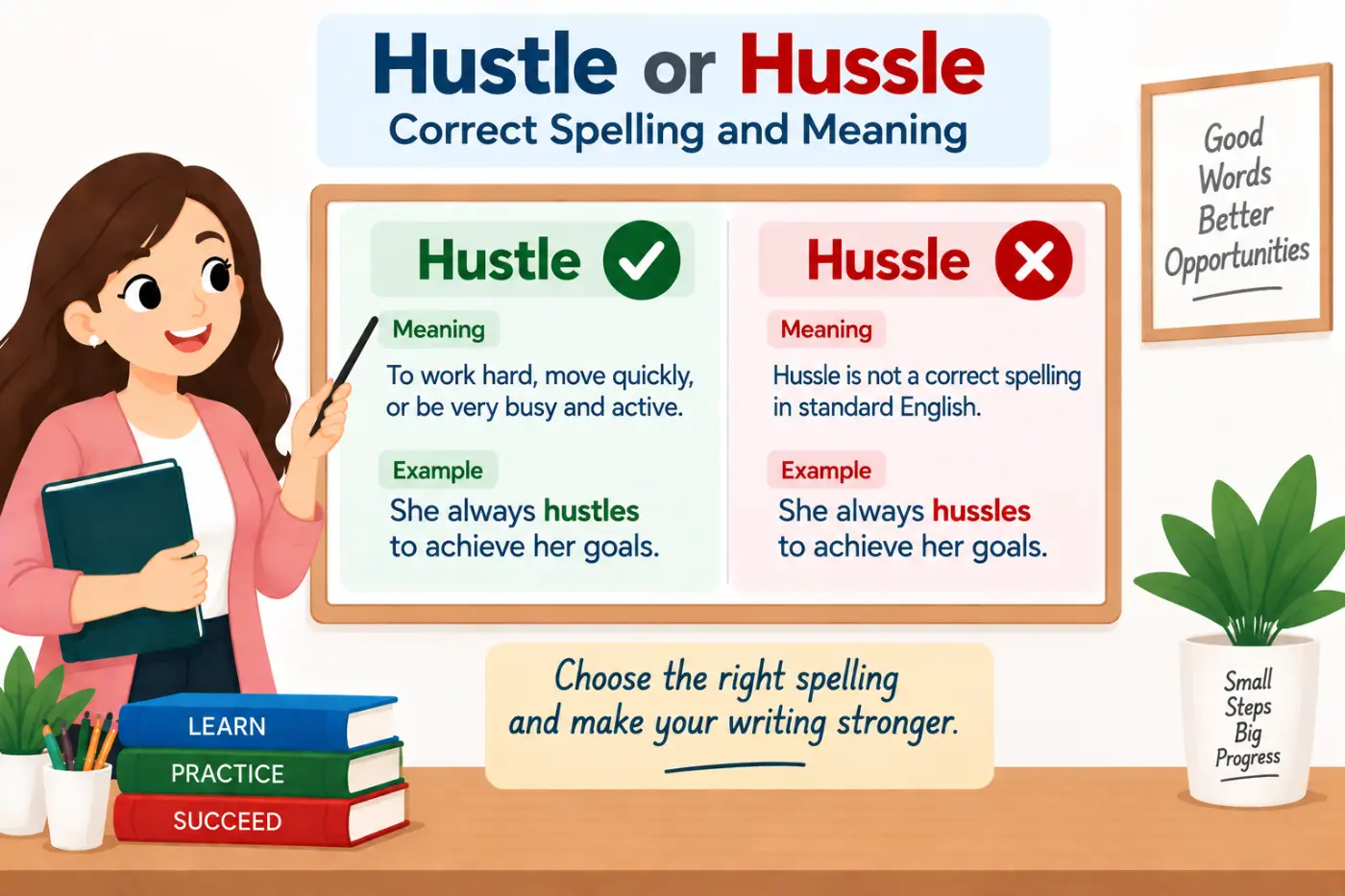
hustle or hussle is an easy spelling question to stumble over because the word contains a sound that can make the middle letters feel uncertain. The correct standard spelling is hustle. Hussle is generally a misspelling and should not be used in standard English writing when you mean hustle.
The confusion often comes from pronunciation. The word is commonly pronounced with a clear s sound followed by a soft ending, so it can be tempting to write an extra s. English also contains many words with double consonants, which can make the spelling pattern feel less predictable. Once you connect the word with its standard spelling and meaning, the problem becomes much easier to avoid.
The word itself has several meanings. It can describe moving quickly, pushing or persuading someone, working energetically, making money through persistent effort, or engaging in a busy activity. It can be a verb or a noun, and modern American English also uses it in informal expressions about work, ambition, and earning money. This guide explains all of these uses in plain English.
Quick Definition
Hustle is the correct standard spelling. It can mean to move quickly, work energetically, push someone to act, or obtain money through active effort. As a noun, it can describe energetic activity, a side job, or a way of making money. Hussle is normally a spelling mistake when the intended word is hustle.
Quick Answer
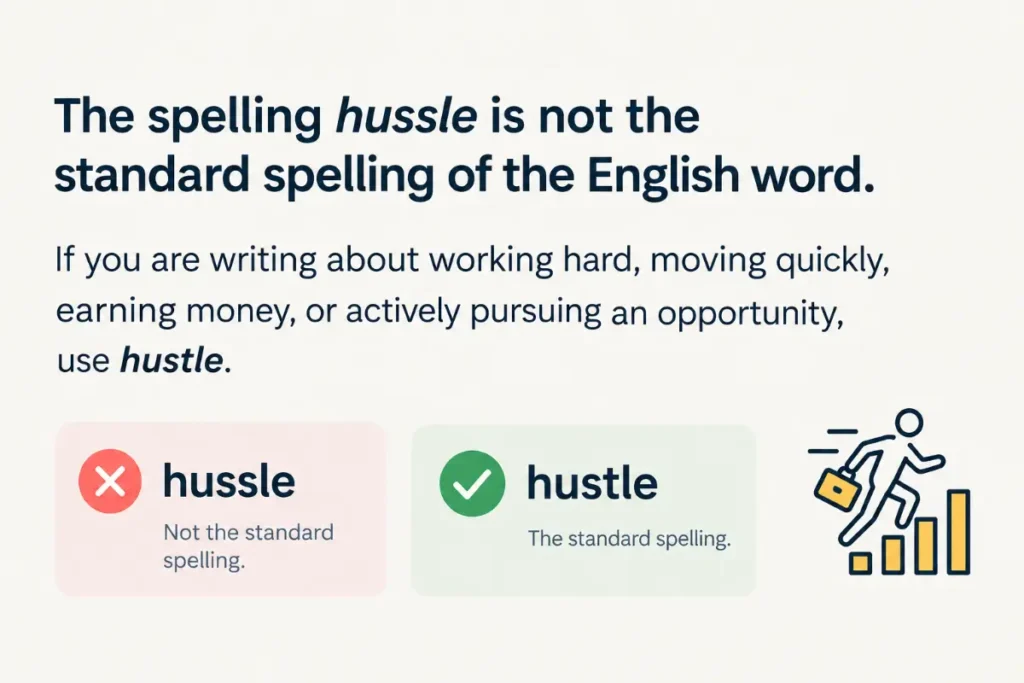
The correct spelling is hustle.
The spelling hussle is not the standard spelling of the English word. If you are writing about working hard, moving quickly, earning money, or actively pursuing an opportunity, use hustle.
For example:
She had to hustle to finish the project.
He started a small side hustle.
The extra s in hussle is the mistake.
Comparison Table For Hustle And Hussle
| Form | Meaning | Part of Speech | Origin | Usage Frequency | Formality | Common Contexts | Example |
|---|---|---|---|---|---|---|---|
| Hustle | To move quickly, work energetically, push for action, or make money through active effort | Verb and noun | English word with roots linked to pushing and jostling | Very common | Neutral to informal depending on meaning | Work, movement, business, sports, everyday speech | I had to hustle to catch the bus. |
| Hussle | No standard meaning as the spelling of this word | Not standard | Usually a spelling error | Uncommon as a standard form | Not standard | Typing mistakes and misspellings | Hussle should be corrected to hustle. |
Meaning And Definition
Meaning Of Hussle
Hussle is generally not the standard spelling of the English word. When someone writes hussle while intending the common word related to hard work, movement, or active effort, the form is usually a spelling mistake.
The mistake is understandable because English has many words with doubled consonants. Words such as little, bottle, and possible contain repeated letters in familiar patterns. A writer may therefore add a second s without realizing that hustle follows a different spelling pattern.
You might see hussle in an informal message, social media post, comment, draft, or search query. Its appearance does not make it the standard spelling.
There can be special cases involving names, usernames, titles, or other proper labels. A particular person or organization might intentionally use Hussle as a name. That does not change the spelling of the ordinary English word.
For standard English writing, the rule is simple. If you mean the common word associated with energetic work or quick movement, write hustle.
Meaning Of Hustle
Hustle has several related meanings, which is one reason the word appears so often in modern English.
As a verb, it can mean to move quickly or make someone move quickly.
For example:
We need to hustle if we want to catch the train.
It can also mean to work energetically, especially when someone is trying to achieve a goal.
She hustled all week to prepare for the event.
In informal American English, hustle can refer to making money through persistent effort. This meaning is especially common in the phrase side hustle.
He started a side hustle selling handmade furniture.
Hustle can also describe pushing, pressuring, or persuading someone.
The salesperson tried to hustle me into buying the more expensive package.
As a noun, hustle can describe energetic activity or determined effort.
The daily hustle of city life can be exhausting.
It can also refer to a way of earning money, especially a secondary source of income.
Her online store became a profitable hustle.
The exact meaning comes from context. That makes hustle a flexible word rather than a word with one fixed definition.
The Key Difference
The main difference is spelling and standard usage.
- Hustle is the standard English spelling. It is the form you should use in school assignments, articles, emails, reports, and professional writing when you mean the common word.
- Hussle is normally a misspelling. It usually happens because the writer adds an unnecessary second s.
- Hustle has several meanings. It can describe quick movement, energetic work, pressure, active effort, or money making.
- Hustle can be a noun or a verb. Its grammatical role depends on the sentence.
- The pronunciation does not justify the extra s. The spoken word does not clearly tell you how many letters belong in the middle.
- Names can be different. If Hussle appears as part of a proper name, it may be intentional. That special use should not be confused with standard spelling.
The simplest rule is this:
One s after the u. Hustle.
Which Form Is Correct?
Hustle is the correct spelling for the standard English word.
The word is established in English and appears in major dictionaries with several meanings related to pushing, moving, working, and energetic activity. The standard spelling contains one s after the u.
The incorrect form is easy to create because the pronunciation does not make the spelling obvious. English spelling often requires writers to remember letter patterns rather than simply writing the sounds they hear.
A useful editing test is to look at the middle of the word.
H U S T L E.
There is only one s.
If you see H U S S L E in ordinary English writing, check the sentence. If the writer means the common verb or noun, the spelling should almost certainly be changed to hustle.
This distinction becomes especially important in polished writing. A spelling checker will usually identify hussle as an error, but manual proofreading still matters because specialized names and usernames can sometimes use unusual spellings intentionally.
How Hustle Works As A Verb
Hustle is often used as a verb to describe energetic action.
One common meaning is to move quickly.
We hustled across the street before the light changed.
Here the word suggests speed and urgency.
Another meaning is to work hard or actively pursue a goal.
She hustled to build her business from the ground up.
This use often carries a sense of determination. It suggests that someone is not sitting around waiting for results. They are actively doing something to make progress.
Hustle can also mean to encourage or pressure someone to move.
The coach hustled the players back onto the field.
The word can carry a stronger meaning in some contexts. It may describe dishonest or aggressive attempts to obtain money or an advantage.
The salesperson was hustling tourists near the entrance.
Because the word has both positive and negative uses, context matters.
Hustle As A Noun
Hustle also works as a noun.
In one sense, it describes busy activity or energetic movement.
The hustle of downtown traffic can be overwhelming.
Here hustle refers to the constant movement and activity around the speaker.
In modern informal American English, hustle can also describe a job, business activity, or income producing effort.
She turned her photography hobby into a side hustle.
The phrase side hustle has become especially common in conversations about work and personal income. It usually refers to work done in addition to a person’s main job or primary source of income.
Hustle can also describe determined effort more generally.
Success took talent, patience, and plenty of hustle.
In this sentence, hustle means energy and hard work.
Hustle In Modern American English
The word has become especially flexible in American informal language.
You might hear someone say:
I’m hustling today.
That can mean the person is busy working hard.
Someone might also say:
I’ve got a new hustle.
That may refer to a new way of earning money or a new business activity.
The phrase side hustle is another common expression. It describes work done alongside a primary job or career.
For example:
She has a full time job and a side hustle.
The word can also describe ambition.
You’ve got to hustle if you want to build something from scratch.
This use gives the word an energetic and determined tone.
Still, hustle does not always mean healthy or admirable effort. In some contexts it can suggest aggressive selling, manipulation, or dishonest activity. The surrounding words tell you which meaning the speaker intends.
Sentence Examples
Here are ten natural examples using the correct spelling.
- I had to hustle to catch the last bus home.
- She hustled all morning to finish the presentation.
- He started a side hustle selling custom furniture online.
- We need to hustle if we want to get there before noon.
- The team showed a lot of hustle during the final quarter.
- She has been hustling to grow her small business.
- The busy streets were full of the usual morning hustle.
- He turned his photography skills into a profitable side hustle.
- The manager told everyone to hustle because the deadline was close.
- Success usually requires patience, skill, and plenty of hustle.
These examples show how flexible the word can be. It works naturally in conversations about movement, work, business, sports, and everyday activity.
Common Spelling Mistakes
Hussle
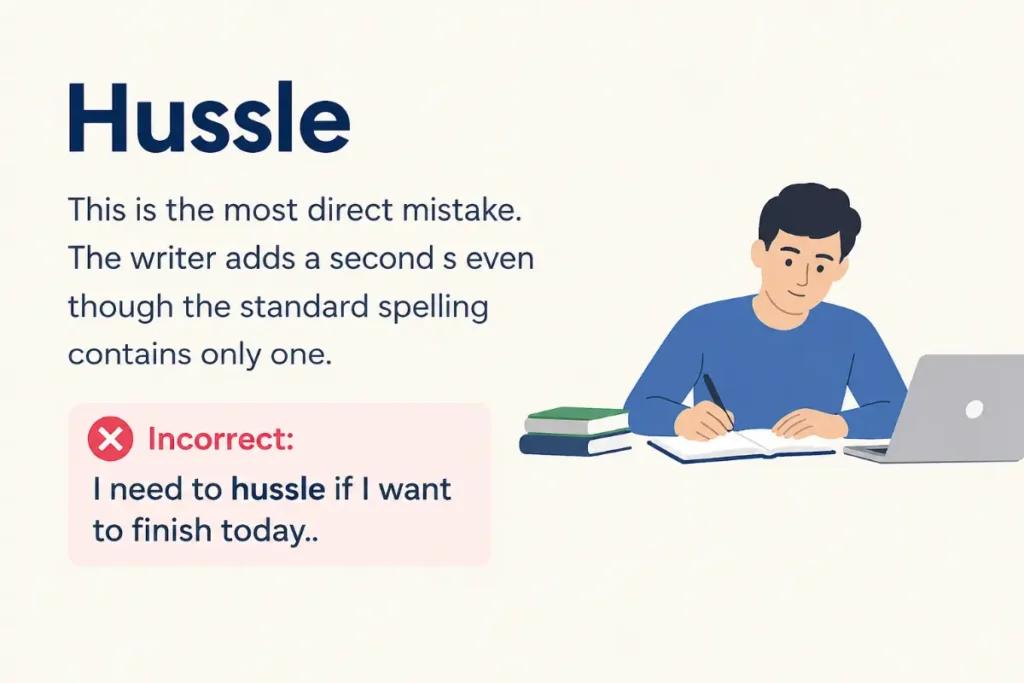
This is the most direct mistake. The writer adds a second s even though the standard spelling contains only one.
Incorrect:
I need to hussle if I want to finish today.
Correct:
I need to hustle if I want to finish today.
Hustel
Some writers reverse the final letters and produce hustel. This can happen when someone relies heavily on pronunciation while spelling the word.
Correct:
She had to hustle home.
Hustlle
This form adds an unnecessary second l.
The standard form has only one l.
Correct:
The hustle of the city never stops.
Husstle
This version combines two common spelling errors by adding an extra s and placing the letters awkwardly.
Correct:
They hustle every day to grow their business.
Hustel
This variation can appear when the writer treats the final consonant and vowel pattern as if it followed a more familiar English spelling pattern.
Correct:
He hustled to finish the job.
The important point is that these forms are spelling mistakes rather than alternative spellings of the ordinary English word.
Why People Write Hussle
There is a straightforward reason this mistake occurs.
English spelling and pronunciation do not always match perfectly. When people hear hustle, they hear a sequence of sounds rather than individual letters. The pronunciation does not announce that only one s belongs in the written form.
Visual pattern recognition also plays a role. English contains many words with double consonants, so a writer may unconsciously insert another s.
Typing speed can make the problem worse. When people write quickly, they often rely on familiar letter patterns rather than consciously checking each word.
From an NLP perspective, a misspelling can still be easy for a language system to interpret because the surrounding words provide context. A search engine may understand that someone typing hussle probably intended hustle. That does not make the spelling standard.
The distinction between recognition and correctness matters. A reader may understand a misspelled word immediately while still expecting the standard form in polished writing.
Pronunciation Guide
Hustle is commonly pronounced /ˈhʌsəl/ in American English.
A simple pronunciation guide is:
HUS uhl.
The first syllable receives the main stress.
You can think of the word as two sound parts:
HUS + uhl.
The middle s sound is clear, but the final vowel is weak. That weak ending is common in English and can make spelling less obvious for learners.
The incorrect spelling does not normally represent a different pronunciation. Adding another s to the written form does not create a standard alternative sound.
One useful pronunciation habit is to say the word slowly while remembering its spelling.
Hus tle.
The letters s t appear together after the first vowel sound. Keeping that visual pattern in mind can help prevent the extra s from slipping into your writing.
Etymology And Word Origin
Hustle has a long history in English.
The word is recorded in English from the Middle English period and is associated with ideas such as pushing, jostling, and moving in a rough or hurried way. Over time, its meanings expanded.
The older sense of pushing or shoving connects naturally with several modern uses. If someone hustles through a crowd, they are moving with energy and urgency. If someone hustles to finish work, the idea shifts from physical movement to energetic effort.
The noun developed related meanings involving activity, movement, and energetic action.
Modern American English later developed additional informal uses connected with earning money, business activity, and determined work. The phrase side hustle is a clear example of this newer everyday usage.
The history helps explain why the word can describe both physical movement and effort. The meanings are different, but they share the central idea of active movement toward a result.
Regional Usage
American English
Hustle is standard and widely used in American English. It appears in everyday speech, business conversations, sports, music, popular culture, and discussions about work.
American English also uses hustle frequently in expressions such as side hustle and hustle culture.
The word can be positive when it describes determination and effort. It can also carry a negative meaning when it refers to aggressive selling or dishonest behavior.
The spelling remains hustle.
British English
British English also uses hustle as a standard word. The basic meanings remain similar, although frequency can vary by context and generation.
British speakers may use other expressions instead of hustle in some situations, especially when discussing work or earning money. Still, the standard spelling does not change.
Hussle is not a standard British spelling of the word.
Australian English
Australian English recognizes hustle as the standard spelling. The word can describe hurried movement, energetic effort, busy activity, or attempts to make money.
As in other varieties, context determines the tone.
There is no general Australian spelling rule that changes hustle to hussle.
Canadian English
Canadian English also uses hustle as the standard spelling. The meanings overlap closely with American English, especially in informal speech.
The word can appear in discussions of work, sports, business, and everyday activity.
Again, hussle is normally treated as a spelling error unless it appears as part of a specific name or title.
Grammar Rules And Part Of Speech
Hustle can function as both a verb and a noun.
As a verb, it can be transitive or intransitive depending on the sentence.
In:
We hustled home.
Hustle is intransitive because it does not take a direct object.
In:
The coach hustled the players onto the field.
Hustled is transitive because it acts on the players.
The word can also appear in continuous forms.
She is hustling to finish the project.
It can appear in the past tense.
He hustled to get there on time.
As a noun, it can be singular or used as part of a compound expression.
The hustle was exhausting.
She has a side hustle.
Because the word is often informal, it appears frequently in conversational writing. Still, its basic grammatical behavior is standard.
Punctuation And Sentence Placement
Hustle does not require special punctuation.
When used as a verb, it fits naturally into ordinary sentence structures.
We need to hustle.
She hustled home.
They are hustling to meet the deadline.
When used as a noun, it can appear as a subject or object.
The hustle never stops.
I respect his hustle.
If hustle appears in a phrase such as side hustle, no special punctuation is needed.
The important issue is not punctuation but meaning. Writers should make sure the context clearly shows which sense they intend.
Formal And Informal Usage
Hustle is a standard English word, but some of its modern uses are strongly informal.
The physical movement sense can work in many contexts.
The workers hustled to clear the area.
The business and money making sense is more conversational.
She started a side hustle.
In formal writing, you may want a more precise word depending on the intended meaning.
Instead of:
The company hustled to finish the project.
You might write:
The company worked quickly to finish the project.
Instead of:
He has a profitable hustle.
You might write:
He operates a profitable side business.
That does not make hustle incorrect. It simply shows that word choice should match the audience and purpose.
Real Life Usage Examples
Daily Conversation
I need to hustle or I’m going to be late.
The morning hustle was crazy today.
These sentences sound natural in casual American speech.
Workplace Communication
The team hustled to complete the project before the deadline.
She runs a small side hustle outside her regular job.
The first example focuses on effort. The second uses the modern income related sense.
Academic Writing
The study examines how informal work activities affect household income.
Researchers observed rapid movement among participants during the final stage.
Academic writing usually favors precise language. Hustle can appear when the concept itself is relevant, but a more exact term may sometimes communicate better.
News Writing
Small business owners are turning personal skills into additional income streams.
The city center was filled with the usual morning activity.
News writers may use hustle in quotations, cultural reporting, or informal features, but they often choose more specific language in factual reporting.
Literature And Storytelling
He hustled through the crowded station before the doors closed.
The city had its own restless hustle after dark.
Creative writing can use the word for energy, urgency, movement, or atmosphere.
Related And Confused Terms
Bustle
Bustle refers to energetic activity or movement, especially in a busy place. The phrase bustle of the city is common. Bustle and hustle can overlap when describing busy environments.
Hurry
Hurry means to move or act quickly because of limited time. It is more direct and neutral than hustle.
Rush
Rush describes moving or acting with great speed. It can refer to people, traffic, work, or emotions.
Grind
Grind is an informal term for persistent and often tiring work. It can overlap with hustle in conversations about ambition and earning money.
Side Business
A side business is an additional business operated alongside a primary job or career. It is more specific and often more neutral than the informal term side hustle.
Effort
Effort refers to the energy someone puts into doing something. It is broader and more neutral than hustle.
Work Ethic
Work ethic describes a person’s attitude toward work and responsibility. It is more formal than hustle and focuses on habits rather than activity.
Ambition
Ambition refers to a strong desire to achieve something. Hustle can express the active effort used to pursue that ambition.
These words overlap, but they are not perfect substitutes. Choosing among them depends on the exact idea you want to express.
When Hustle Has A Negative Meaning
Hustle is not always about honest hard work.
In some contexts, hustle means to pressure someone, deceive someone, or obtain money through dishonest methods.
For example:
The scammer tried to hustle tourists outside the station.
Here hustle has a negative meaning.
The noun can carry the same idea.
He made money through a street hustle.
The exact meaning depends heavily on context.
That is why simply translating hustle as hard work can lead to mistakes. The word has a broad semantic range.
If the sentence involves business, money, selling, or persuasion, check the surrounding words before deciding what hustle means.
Hustle In Sports
Sports provide another common use.
A player who shows hustle is actively chasing the ball, moving into position, defending, or making extra effort.
For example:
The team won because every player showed hustle.
Here hustle means energetic effort and determination.
Coaches and sports commentators often use the word this way because it captures something that goes beyond technical skill. A player may not be the most talented person on the field but can still contribute through effort, speed, and persistence.
This sense is usually positive.
Hustle And Side Hustle
Side hustle is one of the most familiar modern expressions containing the word.
It generally means a secondary way of earning money outside a person’s main job or primary occupation.
For example:
She works as a teacher and has a side hustle selling artwork.
The expression is informal and common in conversations about work, business, freelancing, online selling, creative projects, and extra income.
A side hustle can be small or substantial. The phrase itself does not guarantee a certain income level or amount of work.
In formal writing, additional business activity, secondary employment, freelance work, or independent income may be more precise depending on the situation.
Expert Editor Insight
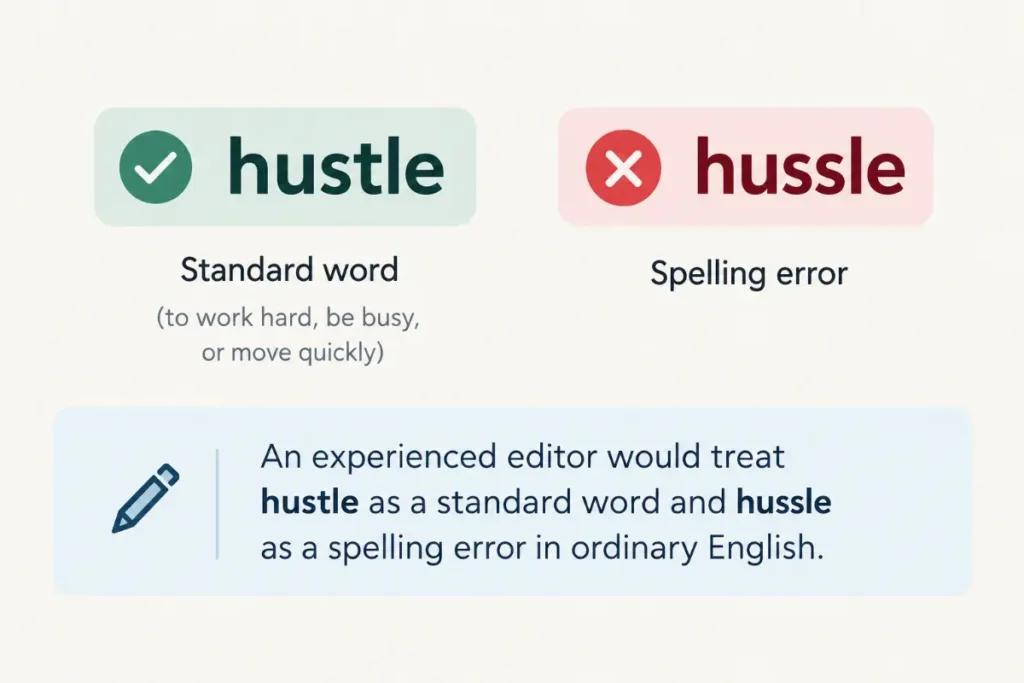
An experienced editor would treat hustle as a standard word and hussle as a spelling error in ordinary English. The confusion is understandable because the spoken form does not clearly reveal the spelling, and English has many words with repeated consonants. Editors also check meaning because hustle can describe quick movement, hard work, busy activity, persuasion, or money making. If the audience is formal, a more precise term may sometimes work better. The most useful proofreading habit is simple: remember that the standard word has one s before the t.
Conclusion
hustle or hussle has a clear answer for standard English. Hustle is the correct spelling, while hussle is normally a misspelling. The standard word can function as both a noun and a verb and can describe quick movement, energetic work, busy activity, determined effort, or money making.
The easiest way to remember the spelling is to focus on the middle of the word. Write hustle with one s before the t. Also remember that the word has several meanings, so context matters when you interpret it.
If you are writing for school, work, publication, or any situation where accuracy matters, choose hustle. If you encounter Hussle as part of a specific name or title, treat that as a separate naming choice rather than an alternative spelling of the ordinary English word.
FAQs
Is hussle a correct spelling?
Hussle is generally not the correct spelling of the standard English word. If you mean quick movement, energetic work, active effort, or a way of earning money, use hustle. Hussle can appear intentionally in names, usernames, titles, or other proper labels, but those special uses do not make it the standard spelling of the ordinary English word.
What does hustle mean?
Hustle has several meanings. As a verb, it can mean to move quickly, work energetically, push someone to act, or actively pursue money or an opportunity. As a noun, it can describe busy activity, determined effort, or an informal way of earning money. The exact meaning depends on the sentence and surrounding context.
Why do people spell hustle as hussle?
The extra s usually comes from confusion about English spelling patterns. People hear the word as a sequence of sounds, and the pronunciation does not clearly indicate the number of written letters. Because many English words contain double consonants, writers may add another s automatically. Fast typing can also make the mistake more likely.
How do you pronounce hustle?
Hustle is commonly pronounced /ˈhʌsəl/ in American English. A simple approximation is HUS uhl, with the main stress on the first syllable. The final vowel is weak, which is common in everyday English speech. The spelling hussle does not represent a different standard pronunciation. The correct written form remains hustle.
Is hustle a noun or a verb?
Hustle can be both a noun and a verb. As a verb, it can describe moving quickly or working energetically, as in We need to hustle. As a noun, it can describe busy activity, determined effort, or a way of earning money, as in Her side hustle is growing quickly.
Is hustle formal or informal?
Hustle is a standard English word, but several of its modern uses are informal. The word can fit ordinary conversation, sports commentary, popular writing, and business discussions. In formal writing, a more specific word may sometimes be better. For example, work quickly, additional employment, or independent business may communicate a precise meaning more clearly.
What is a synonym for hustle?
The best synonym depends on the meaning. For quick movement, hurry or rush may work. For energetic work, effort or hard work may fit. For a business activity, side business or freelance work may be clearer. For busy activity, bustle can work. No single synonym covers every meaning because hustle has several distinct uses.
Is side hustle grammatically correct?
Yes. Side hustle is a standard informal expression used for additional work or a secondary way of earning money alongside a main job or career. For example, I have a side hustle selling handmade products is grammatically natural. In formal documents, additional business activity or secondary employment may be more precise depending on the context.
