
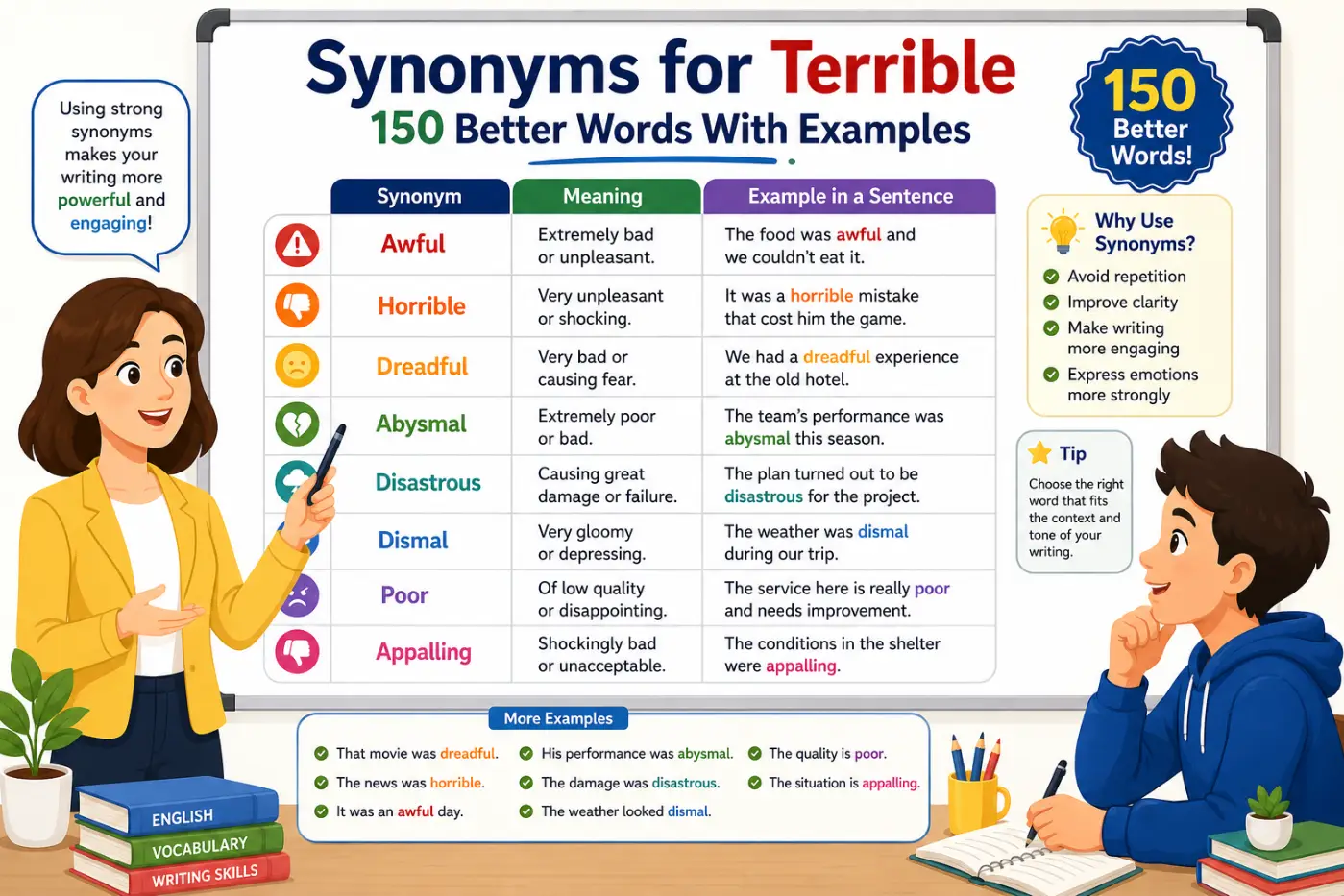
Many writers search for synonyms for terrible because using the same word repeatedly can make their writing feel dull and repetitive. English has a rich vocabulary filled with alternatives that express different levels of negativity, from mild disappointment to complete disaster. Choosing the right word helps readers understand your exact meaning and makes your writing more vivid and engaging.
The challenge is that not every synonym means exactly the same thing. Some words emphasize poor quality, while others describe fear, sadness, failure, shock, or serious consequences. A replacement that works perfectly in a restaurant review may sound unnatural in a business report or a news article. Understanding these subtle differences helps you communicate more accurately and confidently.
This guide explores the best words , explaining what each one means, when to use it, and how it compares with other alternatives. You’ll also find comparison tables, sentence examples, pronunciation, grammar tips, regional usage, expert writing advice, and answers to common questions. By the end, you’ll know which synonym fits every situation and how to use it naturally in your writing.
Quick Definition
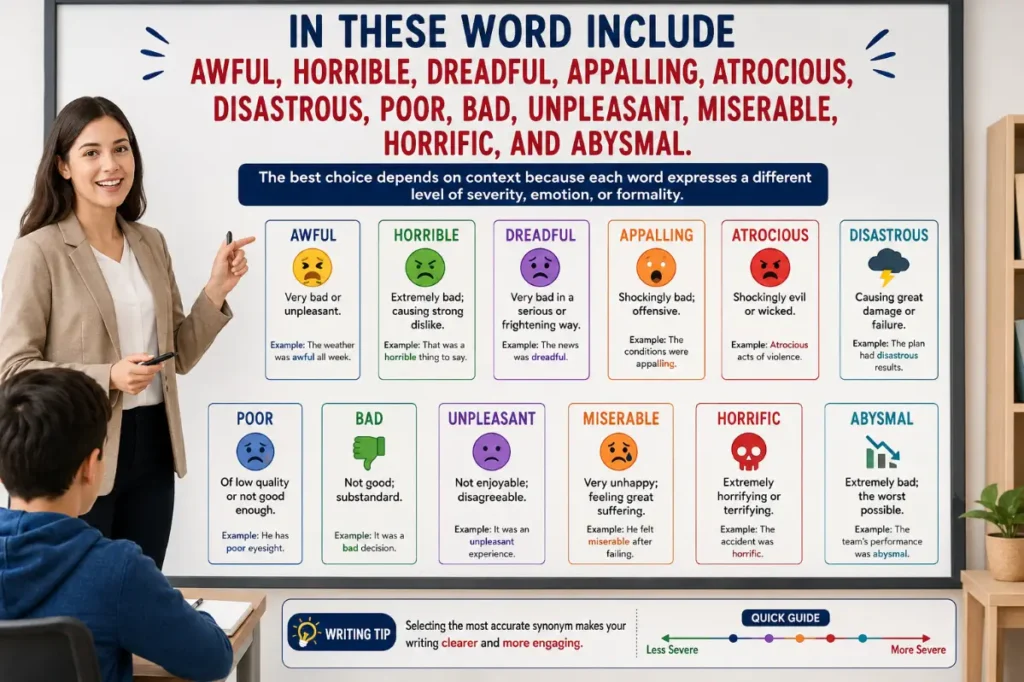
in these word include awful, horrible, dreadful, appalling, atrocious, disastrous, poor, bad, unpleasant, miserable, horrific, and abysmal. The best choice depends on context because each word expresses a different level of severity, emotion, or formality. Selecting the most accurate synonym makes your writing clearer and more engaging.
Quick Answer
If you’re looking for the best synonym for terrible, there isn’t a single perfect replacement. Instead, choose the word that matches your meaning.
| Situation | Best Alternative |
|---|---|
| Poor quality | Awful, bad, lousy, abysmal |
| Scary | Horrific, horrifying, terrifying |
| Very unpleasant | Dreadful, miserable |
| Extremely serious | Catastrophic, disastrous |
| Formal criticism | Appalling, unacceptable |
| Everyday conversation | Awful, horrible, bad |
Comparison Table
| Word | Meaning | Part of Speech | Origin | Usage Frequency | Formality | Common Contexts | Example |
|---|---|---|---|---|---|---|---|
| Terrible | Extremely bad or unpleasant | Adjective | Latin | Very high | Neutral | General writing | The weather was terrible. |
| Awful | Very bad | Adjective | Old English | Very high | Neutral | Everyday speech | That movie was awful. |
| Horrible | Causing disgust or fear | Adjective | Latin | Very high | Neutral | Conversation and news | It was a horrible accident. |
| Dreadful | Extremely unpleasant | Adjective | Old English | High | Neutral | British English | We had dreadful traffic. |
| Appalling | Shockingly bad | Adjective | French | Medium | Formal | Journalism and reports | The conditions were appalling. |
| Atrocious | Extremely poor or cruel | Adjective | Latin | Medium | Formal | Reviews and criticism | The service was atrocious. |
| Disastrous | Leading to failure | Adjective | French | High | Formal | Business and news | The launch was disastrous. |
| Abysmal | Extremely poor | Adjective | Greek | Medium | Formal | Reviews | The performance was abysmal. |
| Miserable | Causing sadness or discomfort | Adjective | Latin | High | Neutral | Feelings and weather | We felt miserable all day. |
| Horrific | Extremely shocking | Adjective | Latin | Medium | Formal | News and crime | Police described horrific injuries. |
Search Intent Analysis
People searching forin these wordare not trying to correct spelling or compare two confusing words. Their primary goal is to expand vocabulary and find better word choices for different situations. The dominant search intent includes:
- Finding stronger alternatives to terrible.
- Understanding subtle differences in meaning.
- Learning when each synonym sounds natural.
- Improving essays, professional writing, and creative writing.
- Avoiding repetitive language.
Because the search focuses on vocabulary improvement, this guide emphasizes meaning, usage, tone, examples, grammar, and context instead of spelling correction.
What Does Terrible Mean
The adjective terrible describes something extremely bad, unpleasant, harmful, disappointing, frightening, or of very poor quality. Depending on context, it can refer to physical conditions, emotions, performance, behavior, events, or experiences.
Examples include:
- The restaurant served terrible food.
- She had a terrible headache.
- They made a terrible mistake.
- The team played a terrible game.
- We experienced terrible weather.
Although the meaning stays broadly negative, the degree of negativity changes with context. A terrible meal is disappointing, while a terrible earthquake describes a tragic event with far greater seriousness.
Etymology of Terrible
The word terrible comes from the Latin terribilis, meaning “causing fear” or “frightening.” It entered Middle English through Old French and originally described something inspiring terror. Over time, English speakers expanded its meaning beyond fear. Today it commonly describes almost anything extremely bad, unpleasant, ineffective, disappointing, or shocking. That historical development explains why terrible still appears in situations involving fear as well as ordinary criticism.
Best Synonyms
Below are the strongest alternatives grouped by meaning instead of alphabetical order.
Awful
Awful is the closest everyday replacement.
Meaning:
Very bad or unpleasant.
Best for:
- Conversation.
- Reviews.
- Casual writing.
Examples:
- The food tasted awful.
- We had awful weather.
- That was an awful decision.
Horrible
Horrible often adds disgust or emotional intensity.
Meaning:
Extremely unpleasant or shocking.
Best for:
- Personal experiences.
- News.
- Serious situations.
Examples:
- It was a horrible accident.
- The smell was horrible.
- She received horrible news.
Dreadful
Dreadful is especially common in British English and sounds slightly more traditional.
Meaning:
Very unpleasant or disappointing.
Examples:
- The hotel was dreadful.
- We had dreadful traffic.
- His excuse was dreadful.
Appalling
Appalling suggests moral outrage or shock.
Meaning:
Shockingly unacceptable.
Best for:
- Journalism.
- Professional writing.
- Official criticism.
Examples:
- The working conditions were appalling.
- Their behavior was appalling.
- The report revealed appalling neglect.
Atrocious
Atrocious expresses extremely poor quality or shocking behavior.
Examples:
- The customer service was atrocious.
- His handwriting was atrocious.
- The acting was atrocious.
Disastrous
Disastrous focuses on harmful results rather than quality alone.
Examples:
- The campaign was disastrous.
- Their investment proved disastrous.
- The meeting ended in disastrous failure.
Abysmal
Abysmal is an excellent choice for formal criticism.
Examples:
- Attendance was abysmal.
- Customer satisfaction remained abysmal.
- The exam scores were abysmal.
Miserable
Miserable emphasizes discomfort, sadness, or unhappiness.
Examples:
- We felt miserable all day.
- It was miserable weather.
- He looked miserable after losing.
Synonyms by Strength
Not every synonym expresses the same level of intensity.
Mild
- Bad.
- Poor.
- Unpleasant.
- Unsatisfactory.
Moderate
- Awful.
- Dreadful.
- Miserable.
- Horrible.
Very Strong
- Atrocious.
- Appalling.
- Abysmal.
- Catastrophic.
- Disastrous.
- Horrific.
Choosing the right intensity prevents exaggeration and makes your writing more believable.
Terrible by Context
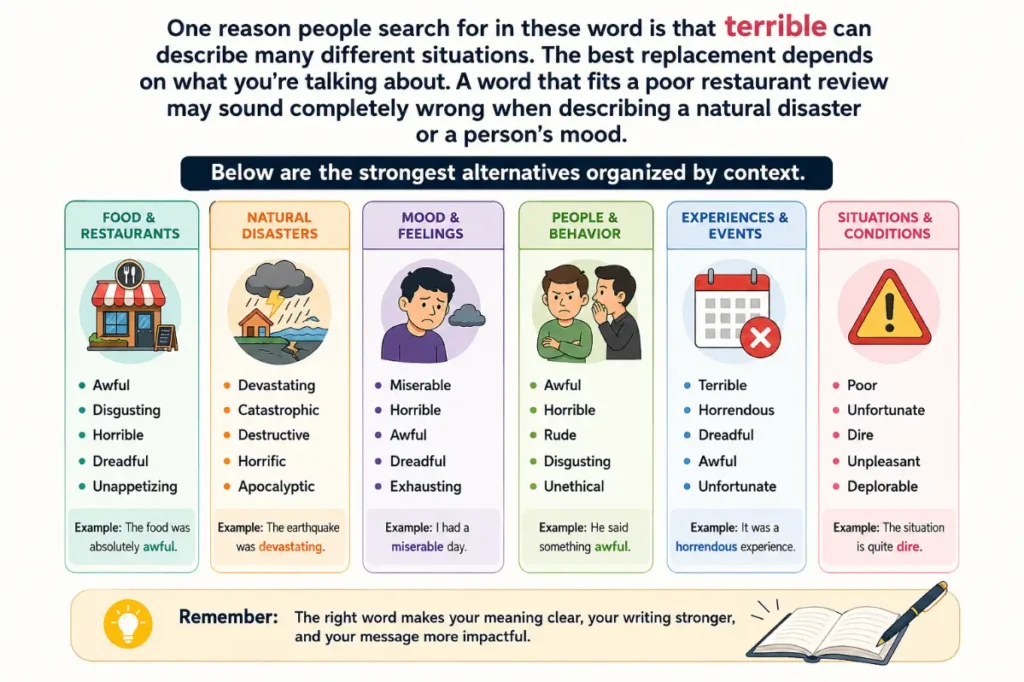
One reason people search for in these word is that terrible can describe many different situations. The best replacement depends on what you’re talking about. A word that fits a poor restaurant review may sound completely wrong when describing a natural disaster or a person’s mood. Below are the strongest alternatives organized by context.
For Poor Quality
Use these words when something performs badly or fails to meet expectations.
- Awful.
- Abysmal.
- Atrocious.
- Poor.
- Lousy.
- Inferior.
- Defective.
- Unsatisfactory.
Examples
- The service was abysmal from beginning to end.
- Their latest product is inferior to last year’s model.
- The restaurant received awful reviews.
- His handwriting is atrocious.
- The report was unsatisfactory.
For Frightening Situations
These words describe events that create fear or horror.
- Horrific.
- Terrifying.
- Horrendous.
- Frightening.
- Alarming.
- Chilling.
Examples
- Witnesses described the crash as horrific.
- It was a terrifying experience.
- The documentary contained chilling footage.
For Serious Disasters
Use stronger words when discussing major failures or tragic events.
- Catastrophic.
- Disastrous.
- Devastating.
- Ruinous.
- Calamitous.
Examples
- The hurricane caused catastrophic damage.
- Their financial decision proved disastrous.
- The wildfire had devastating consequences.
For Emotional Pain
These alternatives focus on feelings instead of quality.
- Miserable.
- Heartbreaking.
- Distressing.
- Painful.
- Upsetting.
Examples
- Losing her pet was heartbreaking.
- The family received distressing news.
- He felt miserable after the interview.
For Formal Writing
Professional writing often requires more precise vocabulary.
- Appalling.
- Inadequate.
- Unacceptable.
- Deficient.
- Unsatisfactory.
- Substandard.
These words commonly appear in business reports, legal writing, journalism, and academic papers.
Key Differences
Although many words share a similar meaning, each creates a different impression.
| Word | Main Focus | Typical Tone | Best Used For |
|---|---|---|---|
| Terrible | General negativity | Neutral | Everyday situations |
| Awful | Strong dislike | Casual | Conversation |
| Horrible | Fear or disgust | Emotional | Personal experiences |
| Dreadful | Unpleasantness | Slightly traditional | British English |
| Appalling | Shock or moral criticism | Formal | News and reports |
| Atrocious | Extremely poor quality | Strong criticism | Reviews |
| Disastrous | Harmful results | Formal | Business and news |
| Catastrophic | Massive destruction | Very formal | Disasters |
| Miserable | Emotional suffering | Personal | Feelings |
| Abysmal | Extremely poor performance | Formal | Evaluations |
Notice that these words are not interchangeable in every sentence.
For example:
The coffee was catastrophic.
This sounds unnatural because catastrophic usually describes events with widespread consequences.
A better choice is:
The coffee was awful.
Likewise:
The earthquake was awful.
This sentence is understandable, but catastrophic or devastating communicates the scale of the event more accurately.
Which Synonym Should You Choose
The easiest way to choose the right alternative is to think about the exact idea you want to express.Use horrible for experiences involving fear or disgus. Use miserable to describe feelings or uncomfortable situations. Using a more precise word immediately improves clarity and makes your writing sound more natural.
Examples Using Terrible
Here are ten natural sentences that use terrible correctly.
- We had terrible weather during our vacation.
- She made a terrible mistake at work.
- The movie received terrible reviews.
- He felt terrible after hearing the news.
- That restaurant serves terrible food.
- Traffic was terrible this morning.
- They experienced terrible flooding.
- The customer service was terrible.
- I have a terrible headache today.
- It was a terrible decision.
Examples Using Stronger Synonyms
These examples show how different words can replace terrible more precisely.
- The acting was atrocious.
- The report revealed appalling conditions.
- The launch became disastrous.
- She looked miserable after the exam.
- The smell was horrible.
- Their performance was abysmal.
- The accident was horrific.
- The presentation was awful.
- The wildfire caused catastrophic destruction.
- His excuse sounded dreadful.
Notice that each sentence communicates a slightly different meaning, even though every word expresses something negative.
Common Mistakes
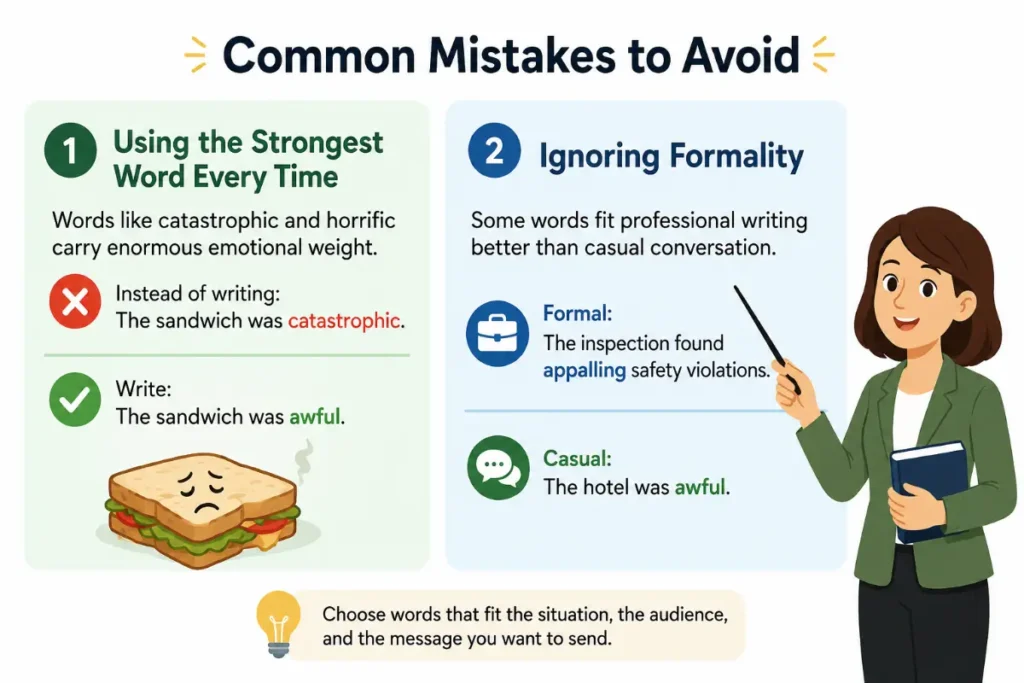
Many writers accidentally misuse synonyms because they focus only on dictionary definitions instead of context.
Using the Strongest Word Every Time
Words like catastrophic and horrific carry enormous emotional weight. Instead of writing: The sandwich was catastrophic. Write: The sandwich was awful.
Ignoring Formality
Some words fit professional writing better than casual conversation. Formal: The inspection found appalling safety violations. Casual: The hotel was awful.
Confusing Emotional and Physical Meanings
Miserable usually describes feelings.
Poor:
The computer was miserable.
Better:
The computer was terrible.
Repeating One Word
Repeating terrible throughout an article weakens the writing. Instead of: The food was terrible. The service was terrible. The atmosphere was terrible. Write: The food was awful. The service was abysmal. The atmosphere was unpleasant. The second version sounds more polished and keeps readers engaged.
Pronunciation Guide
Understanding pronunciation helps you use these words confidently in conversation.
| Word | IPA | Syllables |
|---|---|---|
| Terrible | /ˈterəbəl/ | ter ri ble |
| Awful | /ˈɔːfəl/ | aw ful |
| Horrible | /ˈhɔːrəbəl/ | hor ri ble |
| Dreadful | /ˈdredfəl/ | dread ful |
| Appalling | /əˈpɔːlɪŋ/ | ap pall ing |
| Atrocious | /əˈtroʊʃəs/ | a tro cious |
| Abysmal | /əˈbɪzməl/ | a bys mal |
| Miserable | /ˈmɪzərəbəl/ | mis er a ble |
| Disastrous | /dɪˈzæstrəs/ | di sas trous |
| Catastrophic | /ˌkætəˈstrɑːfɪk/ | cat a stroph ic |
Common Pronunciation Mistakes
- Do not pronounce every written vowel in terrible. Native speakers usually reduce the middle vowel.
- Avoid stressing the first syllable in appalling. The stress falls on the second syllable.
- In American English, atrocious places the primary stress on the second syllable.
- Catastrophic has five syllables, and the strongest stress falls near the middle of the word.
Grammar Rules
All of the primary synonyms discussed in this guide are adjectives. They modify nouns or follow linking verbs.
Examples:
- The decision was disastrous.
- We had awful weather.
- Her performance was abysmal.
- It became a catastrophic failure.
Comparative Forms
Some adjectives use regular comparative forms.
- Bad.
- Worse.
- Worst.
Others usually require more or most in careful writing.
Examples:
- More dreadful.
- More horrific.
- More appalling.
In everyday English, speakers often avoid comparisons with highly intense adjectives because they already express an extreme meaning.
Instead of:
More catastrophic.
Many writers simply rewrite the sentence.
Example:
The second storm caused even greater destruction.
This approach sounds more natural.
Here’s the final installment of the article.
Regional Usage
Most in these word are understood across the English-speaking world, but some appear more frequently in certain regions or carry slightly different tones.
| Word | American English | British English | Canadian English | Australian English | Notes |
|---|---|---|---|---|---|
| Terrible | Very common | Very common | Very common | Very common | Universal choice |
| Awful | Extremely common | Extremely common | Very common | Very common | Everyday conversation |
| Horrible | Very common | Very common | Very common | Very common | Widely used in speech and writing |
| Dreadful | Common | Extremely common | Common | Common | Sounds especially natural in British English |
| Appalling | Common | Very common | Common | Common | Frequently used in journalism |
| Atrocious | Common | Common | Common | Common | Often used in reviews |
| Abysmal | Common | Common | Common | Common | More formal than everyday speech |
| Catastrophic | Very common | Very common | Very common | Very common | Used for disasters and major failures |
| Miserable | Very common | Very common | Very common | Very common | Often describes feelings or weather |
While regional preferences exist, all of these words are acceptable in standard American, British, Canadian, and Australian English. The main difference is tone rather than correctness.
Real Life Usage Examples
Seeing words in realistic situations makes it much easier to choose the right synonym.
Daily Conversation
- The traffic was awful today.
- I feel miserable after staying up all night.
- That restaurant has horrible service.
- The weather is dreadful this weekend.
- We made a terrible mistake.
Academic Writing
- Researchers described the results as disappointing rather than disastrous.
- The report identified appalling safety conditions.
- Student attendance remained abysmal throughout the semester.
- The policy produced undesirable outcomes.
- Several reviewers criticized the poor methodology.
Professional Communication
- Customer satisfaction reached an abysmal level.
- The project suffered a disastrous delay.
- The inspection revealed unacceptable working conditions.
- Sales performance was disappointing.
- Immediate improvements are necessary.
Literature
Authors often avoid repeating terrible by selecting more vivid words. Instead of: The castle looked terrible. A novelist may write: The castle looked dreadful beneath the storm clouds. Or: The castle stood like a horrific reminder of the past. Precise word choice creates stronger imagery and emotional impact.
News and Media
Journalists often choose formal alternatives.
Examples include:
- Appalling living conditions.
- Catastrophic flooding.
- Horrific accident.
- Disastrous economic policy.
- Atrocious human rights abuses.
These words communicate seriousness while matching the tone of professional reporting.
Related Words and Commonly Confused Terms
Many people searching for in these words also look for words with similar meanings or related ideas.
Closely Related Synonyms
- Awful.
- Horrible.
- Dreadful.
- Appalling.
- Atrocious.
- Abysmal.
- Disastrous.
- Catastrophic.
- Miserable.
- Horrific.
- Poor.
- Lousy.
- Inferior.
- Defective.
- Unpleasant.
- Distressing.
- Devastating.
- Unsatisfactory.
- Unacceptable.
- Dire.
Near Synonyms With Different Meanings
Some words seem similar but describe different ideas.
Bad
A broad adjective that can describe almost anything negative. It is less intense than terrible.
Poor
Usually refers to low quality or weak performance rather than emotional intensity.
Unpleasant
Suggests mild discomfort instead of something extremely negative.
Devastating
Focuses on emotional or physical destruction rather than general poor quality.
Dire
Often describes urgent or extremely serious situations that require immediate attention. Knowing these differences helps you avoid awkward or exaggerated writing.
Expert Language Insight
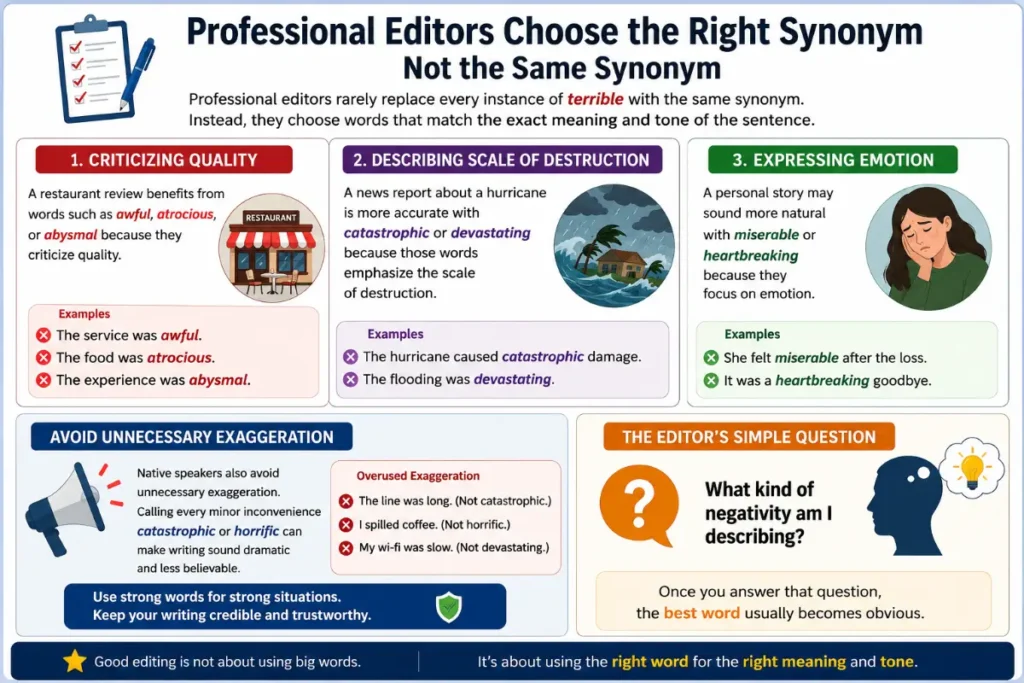
Professional editors rarely replace every instance of terrible with the same synonym. Instead, they choose words that match the exact meaning and tone of the sentence. For example, a restaurant review benefits from words such as awful, atrocious, or abysmal because they criticize quality. A news report about a hurricane is more accurate with catastrophic or devastating because those words emphasize the scale of destruction. A personal story may sound more natural with miserable or heartbreaking because they focus on emotion. Native speakers also avoid unnecessary exaggeration. Calling every minor inconvenience catastrophic or horrific can make writing sound dramatic and less believable. A good editor asks one simple question before choosing a synonym. What kind of negativity am I describing? Once you answer that question, the best word usually becomes obvious.
Tips for Choosing the Best Synonym
- Match the intensity to the situation.
- Consider your audience and writing style.
- Avoid repeating the same adjective.
- Choose formal vocabulary for reports and academic writing.
- Use conversational words in everyday communication.
- Do not exaggerate small problems with extreme adjectives.
- Read the sentence aloud to check that it sounds natural.
- Prefer precision over dramatic language.
These habits will make your writing clearer, stronger, and more professional.
Conclusion
Finding the best in these words is not simply about replacing one word with another. It’s about choosing language that accurately reflects your meaning, audience, and purpose.
For everyday situations, awful and horrible are natural choices. In professional or academic writing, appalling, abysmal, and disastrous often communicate your point more effectively. When describing emotional experiences, miserable or heartbreaking may be the better fit. For large scale tragedies or major failures, catastrophic and devastating provide the necessary level of intensity.
The strongest writers avoid repeating the same adjective. Instead, they select words that match the exact situation, creating clearer, more engaging, and more persuasive writing. Expanding your vocabulary with precise alternatives to terrible is one of the simplest ways to make every sentence sound more natural and profession
Frequently Asked Questions
What is the best synonym for terrible?
There is no single best synonym. Awful is usually the closest everyday replacement, while appalling, atrocious, abysmal, and catastrophic work better in specific contexts. Choose the word that matches the meaning and level of intensity you want to express.
Is awful stronger than terrible?
In everyday conversation, awful and terrible are often interchangeable. The difference is usually one of personal preference rather than meaning. Context determines which word sounds more natural.
What is a formal synonym for terrible?
Formal alternatives include appalling, atrocious, abysmal, disastrous, unacceptable, and deficient. These words frequently appear in academic writing, business reports, journalism, and professional communication.
What is the strongest synonym for terrible?
Words such as catastrophic, devastating, and horrific express a much stronger level of severity than terrible. They should be reserved for situations involving major destruction, tragedy, or extreme consequences.
Can terrible describe people?
Yes. Terrible can describe a person’s behavior, decisions, skills, or actions. However, it is usually better to describe the specific problem. Words such as unkind, careless, incompetent, or irresponsible often communicate the idea more precisely.
Is terrible always negative?
In modern English, terrible almost always has a negative meaning. Historically, it could describe something inspiring fear or awe, but that use is now uncommon outside historical or literary contexts.
How can I avoid repeating terrible in writing?
Build a varied vocabulary and choose synonyms based on context. Instead of using terrible several times, consider awful, poor, abysmal, miserable, appalling, or disastrous. This makes your writing more engaging and more precise.
Which synonym works best in business writing?
Business writing usually benefits from precise, objective language. Depending on the situation, words such as unsatisfactory, poor, substandard, inadequate, abysmal, or disastrous are often more appropriate than the broader adjective terrible.
