
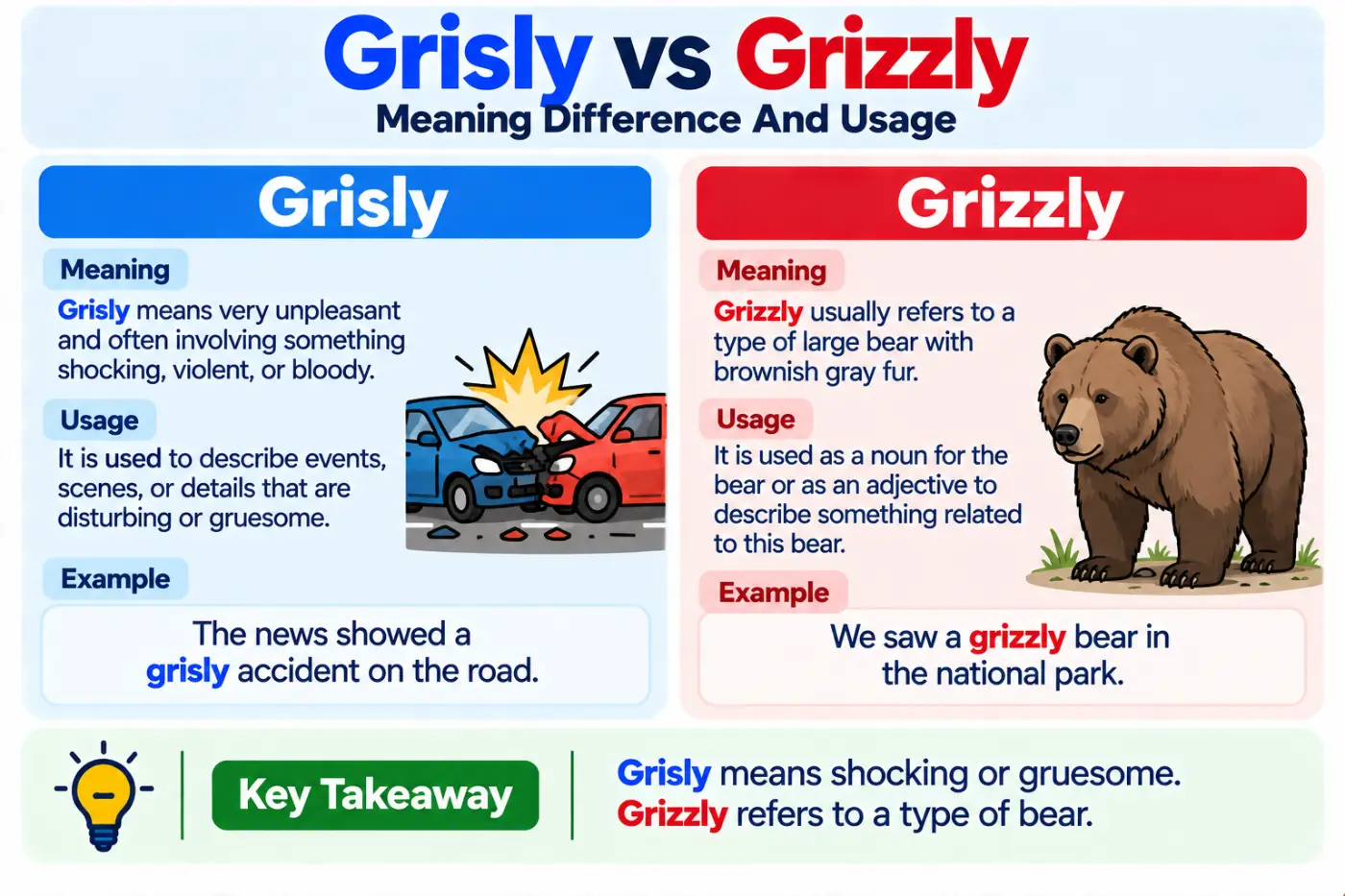
grisly vs grizzly can be confusing because the two words look almost identical and sound very similar in many accents. However, they describe completely different things. Grisly usually describes something horrifying, gruesome, or involving blood and death, while grizzly most often refers to a large North American brown bear or something related to that bear.
The confusion is easy to understand. Both words begin with gri and contain the same number of letters. Their pronunciations are also close enough to cause trouble when you hear them rather than see them in writing. A single letter changes the meaning completely. Calling a scene grisly describes its disturbing nature, while calling something grizzly may connect it with a grizzly bear.
This distinction matters in everyday conversation, news writing, fiction, academic work, and nature writing. A writer describing a violent scene needs the first word. Someone discussing wildlife needs the second. This guide explains their meanings, grammar, pronunciation, origins, regional usage, common mistakes, and natural examples so you can choose the right word without hesitation.
Quick Definition
Grisly means horrifying, gruesome, or unpleasantly associated with blood, violence, or death. Grizzly most commonly refers to a North American brown bear and can also describe something related to that animal. The two words are spelled differently and have different meanings, even though their sounds are similar.
Quick Answer
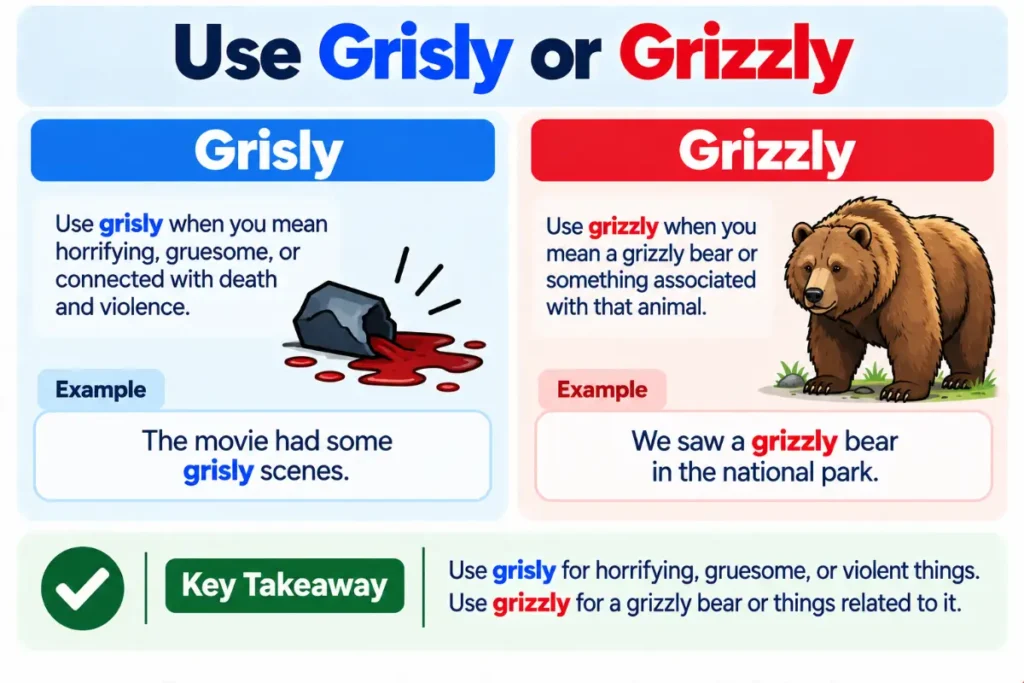
Use grisly when you mean horrifying, gruesome, or connected with death and violence.
Use grizzly when you mean a grizzly bear or something associated with that animal.
For example, a detective might discover a grisly scene. A wildlife researcher might observe a grizzly in the mountains.
Neither word is a misspelling of the other. They are separate words with different histories and meanings.
Comparison Table
| Form | Meaning | Part of Speech | Origin | Usage Frequency | Formality | Common Contexts | Example |
|---|---|---|---|---|---|---|---|
| Grisly | Horrifying, gruesome, or involving death or violence | Adjective | Related to Middle English and the idea of terror or horror | Common | Neutral to formal | Crime reports, fiction, news, descriptions | The investigators found a grisly scene. |
| Grizzly | A North American brown bear or something related to it | Noun or adjective | Related to the word grizzle and the bear’s gray tipped appearance | Common | Neutral | Wildlife, nature, geography, outdoor writing | A grizzly crossed the trail. |
| Grizzly | Gray or streaked with gray in certain descriptive uses | Adjective | Related to grizzle | Less common | Literary or descriptive | Hair, appearance | His grizzly beard had turned mostly gray. |
The table shows why these words cannot normally replace one another. Their similarity is mainly visual and phonetic. Their meanings belong to different semantic groups.
Meaning And Definition
Meaning Of Grisly
Grisly is an adjective that describes something horrifying, gruesome, or deeply unpleasant. It is especially common when the subject involves death, injury, blood, violence, or disturbing physical details.
For example:
The reporter described the grisly discovery.
The adjective tells the reader that the discovery was horrifying or gruesome.
You may also see it in expressions such as:
grisly murder
grisly scene
The word often appears in journalism and fiction because it creates a strong emotional image without requiring the writer to describe every disturbing detail.
It can also describe something figuratively disturbing or unpleasant. However, its strongest and most recognizable use involves horror, death, or violence.
Consider the difference between these two sentences:
The hikers found a strange scene.
The hikers found a grisly scene.
The first simply says the scene was unusual. The second tells you that the scene was horrifying or gruesome.
That emotional force is central to the word.
Meaning Of Grizzly
Grizzly has several connected uses.
The most familiar meaning is a grizzly bear, a large North American brown bear. In this use, grizzly can be a noun.
For example:
We saw a grizzly near the river.
Here grizzly means grizzly bear.
It can also work as an adjective.
The park is home to grizzly bears.
In this sentence, grizzly modifies bears.
The word can also describe something gray or streaked with gray in certain contexts. This older descriptive sense is connected to the word’s history and is much less common in everyday American English than the bear related meaning.
For example:
His grizzly beard showed his age.
That use may sound literary or old fashioned to some readers. Most people encountering grizzly today are likely to think of the animal first.
Key Differences Explained
- Meaning. Grisly means horrifying or gruesome. Grizzly usually refers to a North American brown bear.
- Part of speech. Grisly is normally an adjective. Grizzly can be a noun or an adjective.
- Context. Grisly commonly appears in discussions of death, violence, injury, crime, or horror. Grizzly appears in wildlife, nature, geography, and outdoor contexts.
- Spelling. Grisly contains one z. Grizzly contains two z letters.
- Pronunciation. The words are very similar in sound, but their spelling and meaning remain different.
- Emotional tone. Grisly often carries a disturbing or frightening tone. Grizzly is generally neutral when referring to the animal.
- Word family. Grisly belongs to a word family associated with horror and terror. Grizzly is connected with grizzle and the gray or gray tipped appearance associated with the animal.
- Grammar. Grisly usually modifies a noun. Grizzly can modify a noun or stand alone as a noun referring to the bear.
The simplest distinction is this:
Grisly describes something horrifying. Grizzly describes a bear.
That rule handles most everyday situations.
Which Word Should You Use?
Choose grisly if your sentence describes something gruesome or horrifying.
The police investigated a grisly murder.
Choose grizzly if your sentence refers to the animal.
The photographer captured a picture of a grizzly.
This simple substitution test can help.
If you could replace the word with gruesome, choose grisly.
If you could replace it with grizzly bear, choose grizzly.
For example:
The investigators discovered a grisly scene.
You could say:
The investigators discovered a gruesome scene.
The meaning still works.
Now consider:
The hikers saw a grizzly.
You could expand the sentence to:
The hikers saw a grizzly bear.
Again, the meaning works.
This test is useful because it focuses on meaning rather than spelling.
Grisly In Grammar
Grisly is normally an adjective. It modifies a noun by describing the noun as horrifying, gruesome, or disturbing.
For example:
The detectives examined the grisly evidence.
The word grisly modifies evidence.
It can appear before a noun:
a grisly scene
a grisly discovery
It can also appear after a linking verb in some constructions.
The details were grisly.
Here grisly describes the details.
Because grisly is an adjective, you do not normally use it as a noun.
Incorrect:
The police found a grisly.
Correct:
The police found a grisly scene.
The noun that grisly describes needs to be clear from the sentence.
Grizzly In Grammar
Grizzly can work as both an adjective and a noun.
As an adjective:
The hikers spotted a grizzly bear.
Here grizzly modifies bear.
As a noun:
The hikers spotted a grizzly.
Here grizzly stands for grizzly bear.
This noun use is especially common when the context clearly involves wildlife.
For example:
The guide warned us that a grizzly had been seen nearby.
Readers understand that grizzly refers to a grizzly bear.
The word can also appear in plural form.
Several grizzlies live in the protected area.
The plural is grizzlies, not grizzlys.
That spelling follows the usual English pattern for words ending in consonant plus y. The y changes to ie before the plural ending s.
Pronunciation Guide
The pronunciation of the two words is close enough to create confusion.
Grisly is commonly pronounced approximately /ˈɡrɪzli/.
An easy pronunciation guide is:
GRIZ lee.
The first syllable receives the main stress.
Grizzly is commonly pronounced approximately /ˈɡrɪzli/ as well.
An easy guide is also:
GRIZ lee.
In many varieties of English, the two words are pronounced essentially the same.
That makes this a classic example of a spelling distinction that cannot reliably be solved by listening.
If someone says:
That was a grisly scene.
You may not know which spelling they mean until you understand the context.
The same sound can point to two different written words.
This is called a homophonic relationship when words have the same or nearly the same pronunciation while differing in meaning or spelling. The exact pronunciation can vary across accents, but the basic problem remains.
The practical lesson is simple. When you hear the word, use the context to determine the meaning. When you write it, choose the spelling that matches that meaning.
Etymology And Word Origin
The two words have different histories despite their similar appearance.
The History Of Grisly
Grisly developed from an older English word connected with fear, terror, and something that causes horror. Its history is associated with Middle English forms related to frightening or terrifying.
Over time, the word became strongly associated with things that are horrifying or gruesome. Modern English uses it especially for disturbing scenes involving death, violence, blood, or injury.
That development explains why grisly has such a strong emotional meaning today.
The History Of Grizzly
Grizzly has a different origin. It is connected with the word grizzle, which relates to gray or grayish coloring.
The bear received the name because its fur can have gray tipped hairs that create a grizzled appearance.
That connection is useful because it gives the spelling a logical memory clue.
Grizzly is connected with the bear.
Grizzle relates to gray.
The animal’s fur can have a grayish or grizzled appearance.
The two words therefore developed from entirely different semantic paths. Their similar modern spelling is a coincidence rather than evidence that they share the same meaning.
Why The Words Are So Easy To Confuse
English spelling creates many situations where words look almost identical while meaning very different things.
This pair is especially tricky because the difference is only one letter.
grisly
grizzly
The first contains one z.
The second contains two z letters.
The pronunciation does little to help because the words are commonly pronounced alike.
Visual memory can therefore become unreliable. A writer may know exactly what they mean but still type the wrong spelling.
The confusion becomes more likely when someone hears the word before seeing it in writing.
For example, a student may hear a teacher say:
The story contains a grisly scene.
Later, the student might remember the sound but not the spelling and write grizzly.
That mistake does not necessarily show a lack of vocabulary knowledge. It can simply reflect the close relationship between sound and spelling in the writer’s mental representation of the word.
Common Mistakes And Misspellings
Using Grizzly For A Horrifying Scene
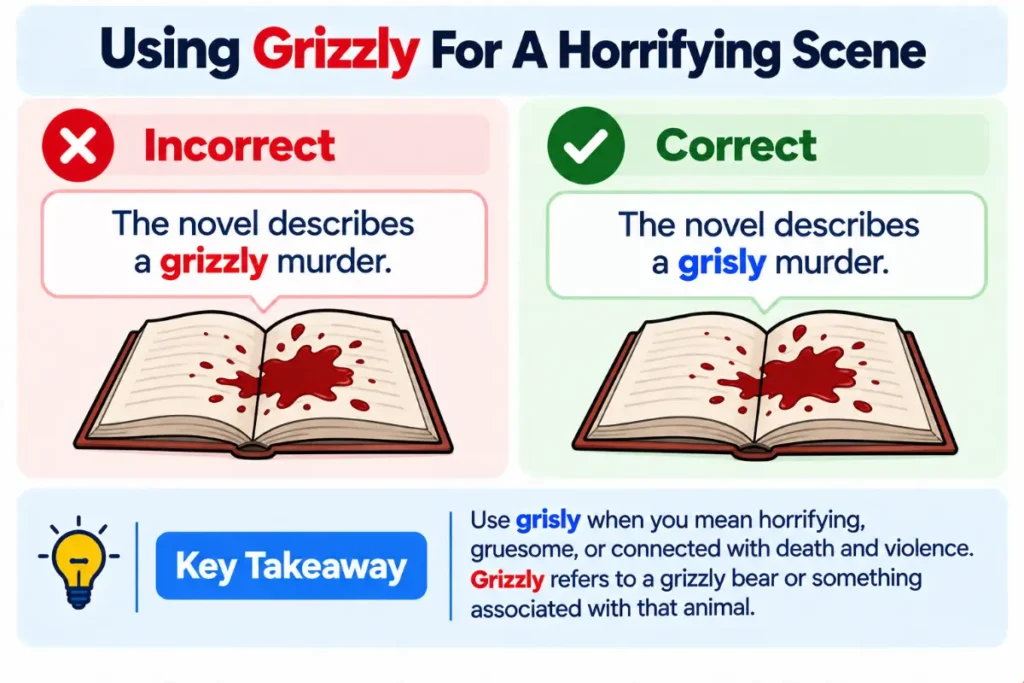
Incorrect:
The novel describes a grizzly murder.
Correct:
The novel describes a grisly murder.
The murder is horrifying, not bear related.
Using Grisly For A Bear
Incorrect:
We saw a grisly near the forest.
Correct:
We saw a grizzly near the forest.
The animal is a grizzly.
Writing Grizly
The form grizly leaves out one z and is incorrect when you mean the bear.
Correct:
grizzly
Remember that the animal word contains two z letters.
Writing Grisley
Some writers add an e because they expect the spelling to follow another familiar English pattern.
Correct:
grisly
The standard adjective does not contain an e after the l.
Confusing Grizzly With Grizzled
Grizzly and grizzled are related in the sense of gray or grayish appearance, but they are not interchangeable.
Grizzled often describes hair or a beard that has become gray or streaked with gray.
For example:
He had a grizzled beard.
Grizzly is most commonly associated with the bear.
Understanding these related forms can make the spelling easier to remember.
Sentence Examples
Here are natural examples using grisly in different contexts.
- The detective arrived at a grisly scene early that morning.
- The documentary included a grisly account of the accident.
- The novel contains several grisly descriptions of the battle.
- The hikers were shocked by the grisly discovery.
- The reporter avoided describing the grisly details on live television.
Now consider examples using grizzly.
- The hikers spotted a grizzly across the valley.
- A grizzly bear can travel long distances while searching for food.
- The guide taught us how to respond if a grizzly approached the campsite.
- Wildlife researchers placed a camera near a trail used by grizzlies.
- We watched the grizzly disappear into the forest.
The contexts make the difference clear. The first group deals with horror or disturbing events. The second group deals with wildlife.
Real Life Usage Examples
Daily Conversation
My brother told me a grisly story about the accident.
We were hiking when someone warned us about a grizzly nearby.
The first sentence describes something disturbing. The second refers to an animal.
Workplace Communication
The news report contained a grisly description of the incident.
The environmental team is studying grizzly populations in the region.
In workplace writing, context usually makes the distinction straightforward.
Academic Writing
The novel uses grisly imagery to portray the effects of war.
Researchers have studied grizzly behavior in several North American ecosystems.
Academic writing can use both words naturally, but they belong to very different subjects.
News Writing
Authorities reported a grisly discovery outside the city.
Officials closed the trail after a grizzly was spotted near the campground.
News writers often rely on precise word choice because a single spelling error can change the meaning of a sentence.
Literature And Storytelling
The old castle had a grisly history filled with violence and tragedy.
A grizzly emerged from the trees as the travelers approached the river.
Both words can create vivid images, but they create completely different pictures in the reader’s mind.
Regional Usage
American English
Both words are standard in American English. Grisly commonly appears in news reports, crime writing, fiction, and descriptions of disturbing events.
Grizzly is especially familiar in the United States because grizzly bears are native to parts of North America and have a strong presence in wildlife discussions.
American readers generally recognize the distinction easily when the spelling is visible.
British English
British English also uses both words with the same basic meanings.
Grisly can describe something gruesome or horrifying.
Grizzly refers to the animal or to related descriptive meanings.
Because grizzly bears are less familiar as an everyday local animal in Britain, the wildlife context may arise more often in books, documentaries, travel writing, and international news.
The spelling distinction remains the same.
Australian English
Australian English follows the same basic distinction.
Grisly describes something horrifying or gruesome. Grizzly generally refers to the North American bear.
Australian English has its own rich vocabulary for local wildlife, but that does not change the meaning of these two words.
Canadian English
Canadian English uses both words in the standard way. Grizzly has particular relevance in Canadian wildlife and outdoor contexts because grizzly bears live in parts of Canada.
Grisly retains its usual meaning related to horror, violence, death, or disturbing events.
There is no major regional spelling difference between the Canadian and American forms.
Formal And Informal Usage
Both words are standard and can appear in formal writing.
Grisly is common in serious reporting and descriptive writing, although it carries a strong emotional tone.
For example:
The report documented the grisly consequences of the accident.
The word is grammatically standard, but the subject itself is disturbing.
Grizzly is equally standard in wildlife writing.
For example:
The study examined the feeding behavior of grizzly bears.
Neither word is slang.
The key issue is not formality but meaning.
A writer should not avoid grisly simply because it sounds dramatic. If something is genuinely horrifying or gruesome, the word may be accurate.
At the same time, writers should avoid using it merely to make ordinary events sound shocking. Precise language is stronger than exaggerated language.
Related And Confused Terms
Gruesome
Gruesome means extremely unpleasant or horrifying, especially when associated with violence, death, or injury. It is one of the closest everyday synonyms for grisly.
Horrific
Horrific means causing horror or extreme shock. It is broader than grisly and does not necessarily involve physical gore.
Gory
Gory describes something involving blood and graphic violence. It is closely related to grisly but often focuses more directly on blood or graphic detail.
Grizzled
Grizzled describes hair, a beard, or another appearance marked with gray or grayish streaks. It is related to the history of grizzly but does not mean the same thing.
Brown Bear
Brown bear is the broader animal category that includes several regional populations. Grizzly bear refers to a North American form of brown bear.
Grizzly Bear
It is the full animal name. In context, grizzly can work as a shortened noun.
Grisly Scene
A grisly scene is a disturbing or gruesome scene. The phrase commonly appears in crime reporting and fiction.
Wildlife
Wildlife is a broad term for animals living in natural environments. It provides the kind of context where grizzly is likely to appear.
These related terms help show the semantic difference between the two words. Grisly belongs to the language of horror and disturbing events. Grizzly belongs mainly to the language of wildlife and animal description.
A Practical Memory Trick
The spelling difference becomes easier if you connect each word with a mental picture.
For grisly, think grisly crime scene.
For grizzly, think grizzly bear.
The bear word has two z letters.
You can also remember the animal through the extra z.
Grizzly has a big bear with two z letters.
That is not a formal spelling rule, but it is a useful memory device.
Another test works well.
Ask yourself:
Am I describing something horrifying or talking about a bear?
If the answer is horrifying, use grisly.
If the answer is bear, use grizzly.
This method works because it focuses on meaning before spelling.
How Context Changes The Meaning
Context is especially important with these words because their pronunciation can be almost identical.
Imagine someone says:
I saw a grizzly.
The listener may immediately think of a bear.
Now imagine:
The story had a grisly ending.
The context points toward horror.
Written language gives you another clue because the spelling makes the distinction visible.
This is why good writers consider the surrounding words. A single word rarely carries meaning in isolation. Nouns, verbs, topics, and sentence structure work together to guide interpretation.
For example:
The wildlife photographer followed the grizzly.
The subject matter makes the animal meaning obvious.
The detective described the grisly discovery.
The crime related context makes the adjective meaning obvious.
Expert Editor Insight
An experienced editor would treat these as two completely separate vocabulary items rather than as spelling variants. The first check is meaning. If the sentence concerns violence, death, blood, or something horrifying, grisly is probably the intended word. If it concerns the North American bear, grizzly is the correct choice. Spelling tools can sometimes catch forms such as grizly, but they may not catch a correctly spelled word used in the wrong context. That is why proofreading for meaning matters as much as proofreading for spelling.
Final Takeaway
grisly vs grizzly is a meaning distinction rather than a simple spelling choice. Grisly describes something horrifying, gruesome, or disturbing, while grizzly usually refers to the North American brown bear. The two words can sound alike, so context and spelling do the heavy lifting when you write them.
A simple memory trick can keep them straight. Think of a grisly scene when you mean something gruesome. Think of a grizzly bear when you mean the animal. If you are proofreading, don’t rely only on spellcheck because both forms are legitimate words. Read the sentence for meaning, then check the spelling. That extra step catches the kind of mistake a basic grammar tool can easily miss.
FAQs
What is the difference between grisly and grizzly?
Grisly means horrifying, gruesome, or disturbing, especially in connection with death, violence, blood, or injury. Grizzly usually refers to a North American brown bear and can also work as an adjective before bear. The words sound very similar in many accents, but they have different meanings and different spellings. The simplest memory aid is grisly for horror and grizzly for the bear.
Is grisly a word?
Yes. Grisly is a standard English adjective. It describes something horrifying, gruesome, or deeply unpleasant. It commonly appears in phrases such as grisly scene, grisly murder, grisly discovery, and grisly details. The word is not a misspelling of grizzly. It has its own meaning and historical development and is widely used in descriptive, journalistic, and literary writing.
Is grizzly only used for bears?
No. Grizzly most commonly refers to the grizzly bear, but it can also work as an adjective describing something associated with that animal. The word has also had descriptive uses connected with gray or streaked coloring. In modern everyday American English, however, the bear meaning is by far the most recognizable. Context usually makes the intended meaning clear.
How do you pronounce grisly and grizzly?
In many standard English accents, grisly and grizzly are pronounced almost exactly the same. They are commonly represented as /ˈɡrɪzli/. You can think of both as sounding roughly like GRIZ lee. Because pronunciation does not reliably separate the words, you need to learn their meanings and spellings together. The written context usually provides the distinction that speech does not.
Why do people confuse these two words?
The confusion comes mainly from their similar appearance and pronunciation. Both words begin with gri and contain the same basic sound pattern. The main spelling difference is one extra z in grizzly. Since the words can sound alike in normal speech, people may remember the pronunciation correctly while choosing the wrong spelling when writing. Context is the best way to separate them.
What is a synonym for grisly?
Useful synonyms for grisly include gruesome, gory, horrific, horrifying, shocking, and macabre. The best choice depends on the exact meaning. Gruesome is especially close when describing something disturbing. Gory emphasizes blood and graphic violence. Horrific is broader and can describe anything that causes extreme horror. Grisly often combines a sense of horror with disturbing physical details.
Is grizzly the same as brown bear?
A grizzly bear is a type of North American brown bear. The term grizzly commonly identifies certain mainland North American populations of brown bear. Brown bear is the broader species name used in zoological classification, while grizzly is a familiar common name for the North American form. The two expressions are therefore related, but they are not simply interchangeable in every scientific context.
Is grisly appropriate in formal writing?
Yes. Grisly is a standard English adjective and can appear in formal writing, journalism, academic discussion, and serious reporting. The issue is not formality but subject matter. Because the word describes something disturbing, use it only when it accurately reflects the situation. In formal writing, precise language is preferable to dramatic wording that exaggerates the facts.
