
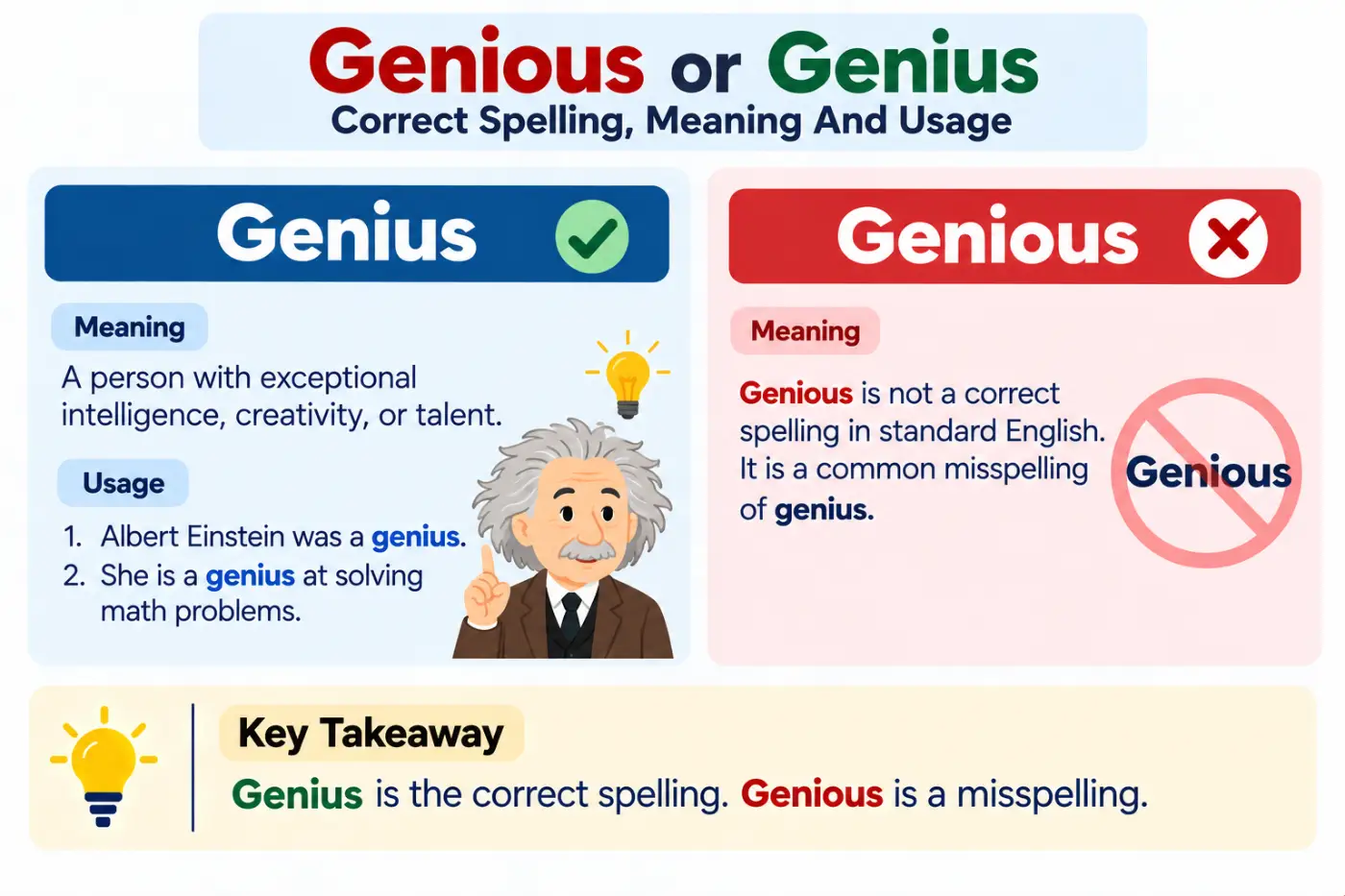
genious or genius is a common spelling confusion because the two forms look and sound close. The correct spelling is genius. Genious is a common misspelling and isn’t the standard spelling of the English word for a person with exceptional intellectual or creative ability.
The confusion is understandable. Many English words use the letter combination iou in the middle, and the pronunciation of genius doesn’t clearly tell you which vowels belong on the page. People also connect the word with terms such as ingenious and ingeniousness, which can make the spelling pattern feel even less obvious. A quick glance can make genious look perfectly reasonable even though standard English uses genius.
In this article you’ll learn what the word means, how to pronounce it, how it works grammatically, where it came from, and how native speakers use it. You’ll also see natural examples, common spelling mistakes, related words, regional usage, and a simple memory trick that can help you write the correct form without stopping to think about every letter.
Quick Definition
Genius is the correct spelling. It is a noun that usually refers to exceptional intellectual or creative ability or to a person who possesses such ability. Genious is not the standard spelling of this word. It is generally a spelling mistake caused by confusion about the vowel pattern in the middle.
Quick Answer
The correct spelling is genius. The spelling genious is incorrect in standard English.
Genius can describe a person with extraordinary intellectual or creative ability. It can also describe exceptional ability itself. For example, You are a genius means the speaker thinks someone has shown remarkable intelligence or skill.
The word can appear in both casual and formal English, but its meaning depends on context. It can describe a person, an exceptional idea, or an unusually high level of ability.
Comparison Table genious or genius
| Form | Meaning | Part of Speech | Origin | Usage Frequency | Formality | Common Contexts | Example |
|---|---|---|---|---|---|---|---|
| Genius | A person with exceptional intellectual or creative ability, or exceptional ability itself | Noun | Latin genius through French and English | Very common | Neutral to formal | Education, science, art, conversation, writing | She is a musical genius. |
| Genious | No standard meaning as the intended spelling of genius | Nonstandard spelling | Common spelling error | Uncommon as a correct form | Not standard | Typing errors, informal mistakes, learner writing | Genious should be corrected to genius. |
The important point is that these are not two words with different meanings. In ordinary English, genius is the established word. Genious usually appears because someone has spelled it incorrectly.
Meaning And Definition
Meaning Of Genious
Genious is not the standard spelling of the English noun genius.
You may see it in social media posts, comments, school assignments, online messages, or quickly typed text. Its appearance doesn’t give it a separate standard meaning. In most cases, the writer simply intended to write genius.
This type of spelling mistake is common because English spelling doesn’t always match pronunciation in an obvious way. A person may hear the word and mentally reconstruct it as genious because the sound doesn’t strongly reveal the order of the vowels.
There is another source of confusion. English has the word ingenious, which means clever or inventive. Because genius and ingenious are related in meaning and share several letters, writers sometimes blend their spelling patterns.
For standard English writing, the solution is simple. Use genius when you mean exceptional intelligence, ability, or creative talent.
Meaning Of Genius
Genius is primarily a noun.
It can refer to a person who has exceptional intellectual, creative, artistic, scientific, or technical ability.
For example:
Albert Einstein is often described as a genius.
The word can also refer to exceptional ability itself.
Her genius for solving difficult problems impressed everyone.
In the first sentence, genius refers to a person. In the second, it refers to an outstanding ability.
The word can also be used informally as praise.
That was a genius idea.
Here the speaker isn’t necessarily claiming that the person is a once in a generation intellectual. Instead, genius is being used to say that an idea was extremely clever or effective.
That distinction matters. In everyday English, people often use genius more loosely than they would in academic or historical discussion.
The Key Difference
The spelling difference is small, but the answer is clear.
- Genius is the standard spelling. It is the established English word.
- Genious is a misspelling. It doesn’t function as a standard alternative spelling.
- Genius is a noun. It can name a highly gifted person or exceptional ability.
- The pronunciation can cause confusion. The vowel sounds don’t make the written order obvious to every learner.
- Ingenious can contribute to the mistake. This related word has a different spelling and meaning, but its letters can influence how people remember genius.
- The correct form works in formal and informal writing. You can use genius in an academic discussion, a news article, a conversation, or a text message.
- Genious should be corrected in polished writing. School papers, applications, professional documents, and published material should use genius.
Which Form Is Correct?
Genius is correct. Genious is incorrect as the intended standard spelling of this word.
Standard English dictionaries recognize genius as the established noun. The word has a long history in English and appears in standard usage across American, British, Canadian, and Australian English.
There is no regional spelling rule that changes genius to genious. You should therefore use the same spelling regardless of the variety of standard English you’re writing.
The easiest linguistic clue is the word’s established spelling pattern. Genius is written with geni followed by us.
Think of it as:
geni + us = genius
That simple visual pattern can help prevent the extra o from sneaking into the word.
Why People Write Genious
The mistake isn’t random. Several factors can make the incorrect form look natural.
First, pronunciation doesn’t provide a perfect spelling guide. English has many words where the sounds don’t clearly reveal the written vowels.
Second, people may connect genius with ingenious. The words are related in meaning and appearance, so the longer word can influence memory.
Third, fast typing encourages people to write words based on their expected sound rather than checking each letter.
Fourth, visual familiarity plays a role. If someone has seen genious several times online, the incorrect form may begin to look normal.
This is a useful lesson about English spelling. A form can look familiar without being standard. Frequent exposure doesn’t automatically make a spelling correct.
Sentence Examples
Here are natural examples showing how genius works in different situations.
- Everyone in the class thought Maya was a genius at mathematics.
- That was a genius solution to a difficult problem.
- The scientist was recognized as a genius in her field.
- You don’t need to be a genius to understand the basic rule.
- His genius for music became clear at an early age.
- The engineer came up with a genius way to reduce waste.
- Many people consider the invention a work of pure genius.
- She has a genius for making complicated ideas easy to understand.
- The teacher explained that genius can involve creativity as well as intelligence.
- His simple idea turned out to be a stroke of genius.
These examples show that the word doesn’t always describe a person’s intelligence. It can also describe a clever idea, remarkable skill, or exceptional creative ability.
Examples Of The Common Misspelling
The following examples show how the mistake may appear. These forms should be corrected in standard writing.
- She is a genious at solving puzzles.
- That was a genious idea.
- Everyone called him a genious after the invention succeeded.
- His genious changed the way people viewed the problem.
- The teacher described the student as a genious.
Each sentence should use genius instead.
Common Spelling Mistakes
Genious Instead Of Genius
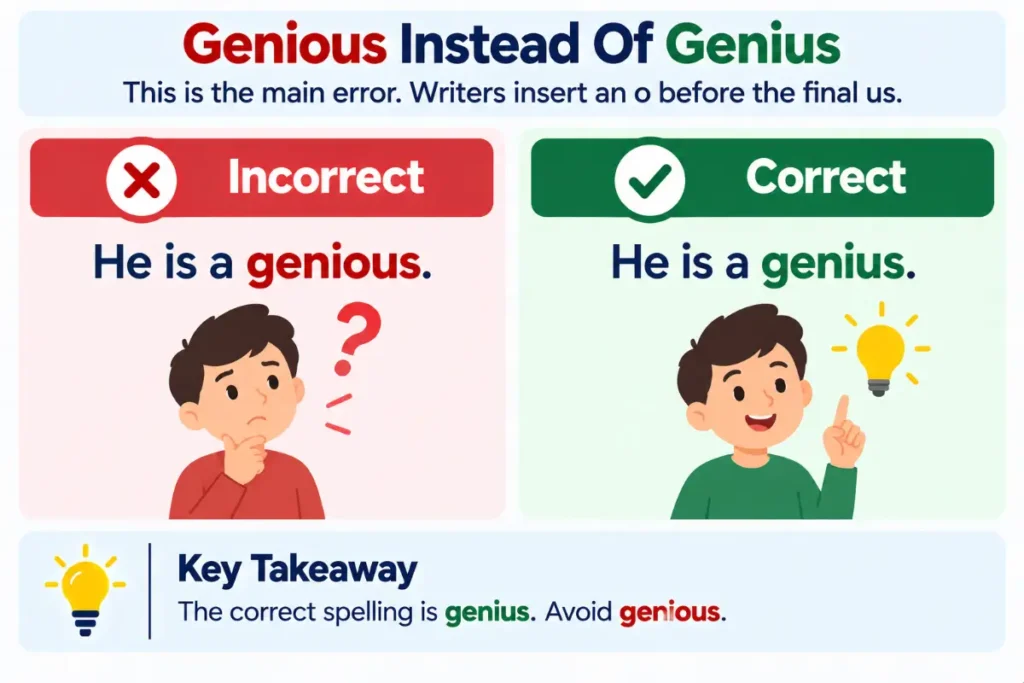
This is the main error. Writers insert an o before the final us.
Incorrect: He is a genious.
Correct: He is a genius.
The error probably feels natural because the vowel sequence resembles patterns found in other English words.
Geniuse Instead Of Genius
Some writers add an unnecessary e at the end. This can happen when the writer tries to make the pronunciation feel more obvious.
Incorrect: She is a geniuse.
Correct: She is a genius.
Genus Instead Of Genius
Genus is a real English word, but it has a completely different meaning. In biology, a genus is a category containing closely related species.
For example:
The tiger belongs to the Panthera genus.
So genus isn’t a spelling variation of genius. The two words simply look similar.
Ingenius Instead Of Ingenious
Ingenious is another real word, but it means clever, inventive, or skillfully designed.
Incorrect: That was an ingenius solution.
Correct: That was an ingenious solution.
The extra letters in ingenious can cause writers to mix its spelling with genius.
Geniousness Instead Of Genius
Writers sometimes try to create a noun such as geniousness. Standard English uses different forms depending on the intended meaning. Genius is already a noun, while ingenuity describes the quality of being inventive or resourceful.
This distinction is worth learning because replacing one word with another based only on spelling can change the meaning.
Pronunciation Guide
Genius is commonly pronounced /ˈdʒiːniəs/ in American English.
A simple pronunciation guide is:
JEE nee us
The word usually has three syllables:
gee | nee | us
The main stress falls on the first syllable.
The first sound is similar to the beginning of jeep. The middle sounds like nee. The final syllable has a relaxed sound.
One reason learners spell the word incorrectly is that the pronunciation doesn’t sound like every written letter in a slow and separate way. English often reduces unstressed sounds in normal speech.
The pronunciation doesn’t contain a clear sound that tells you to insert an o after geni. That’s why memorizing the visual form can help.
A useful habit is to say the word and picture its spelling at the same time.
GEE nee us → genius.
Etymology And Word Origin
The history of genius is especially interesting because its meaning has changed over time.
The English word comes through Latin genius. In Latin, the term was associated with an inborn spirit or protective spirit connected with a person. It was related to ideas of birth, creation, and natural qualities.
The word later developed through French and entered English with broader meanings connected to natural ability and exceptional talent.
Over time, English speakers increasingly used genius to describe extraordinary intellectual or creative ability. The modern sense can refer to both a remarkably talented person and exceptional ability itself.
This history also explains why genius is related to several words associated with talent and creativity. The word has a deeper connection with ideas of natural ability than its modern spelling alone might suggest.
The modern English spelling is now firmly established as genius.
Regional Usage
American English
Genius is the standard spelling in American English. It is widely used in education, science, technology, business, entertainment, journalism, and everyday conversation.
Americans often use the word casually as a strong compliment.
That was genius.
In formal contexts, the word can describe exceptional intellectual or creative ability.
British English
British English uses the same spelling and basic meanings. There is no standard British spelling change that turns genius into genious.
The word appears in academic writing, journalism, literature, conversation, and professional communication.
Australian English
Australian English also uses genius as the standard spelling. The meaning and pronunciation remain broadly consistent with other major varieties of English.
Genious is not a standard Australian spelling variant.
Canadian English
Canadian English follows the same standard spelling. Writers should use genius in school assignments, workplace communication, formal documents, and published writing.
The difference between genius and genious is therefore not a regional spelling issue. It is a standard spelling issue.
Grammar Rules And Part Of Speech
Genius is primarily a noun.
It can refer to a person.
She is a genius.
It can also refer to exceptional ability.
His genius was obvious from the beginning.
It can describe an outstanding idea in informal usage.
That was a genius move.
The word can work as a singular count noun when referring to a person.
He is a genius.
She is a genius.
The plural is geniuses.
The museum displayed the work of several geniuses.
The plural form is worth remembering because some writers incorrectly assume that the plural should follow an unusual Latin pattern. In modern English, geniuses is the ordinary plural form for people described as genius.
Genius As A Modifier
Genius can sometimes appear before another noun in informal English.
That was a genius move.
She had a genius idea.
This use treats genius as a modifier. It is common in casual speech and online communication.
However, in careful formal writing, you may want to choose a more precise adjective such as brilliant, ingenious, exceptional, or highly effective depending on what you actually mean.
Genius And The Article A
When genius refers to a person, it is commonly used as a count noun.
He is a genius.
She is a genius.
The article a is needed because the sentence describes one person as a member of a category.
Saying He is genius is not standard American English for this meaning.
Genius And Punctuation
Genius doesn’t require special punctuation. Use it like an ordinary noun.
For example:
The professor was considered a genius.
The phrase stroke of genius is also commonly written without special punctuation.
Genius Compared With Related Words
Genius is closely related to several words, but the terms don’t mean exactly the same thing.
Brilliant
Brilliant usually describes someone or something exceptionally intelligent, impressive, or successful. It can be used more broadly than genius.
She had a brilliant idea.
Intelligent
Intelligent means having a strong ability to learn, understand, reason, and solve problems. It doesn’t automatically suggest extraordinary ability.
He is highly intelligent.
Gifted
Gifted describes someone with unusually strong natural ability in a particular area.
She is a gifted musician.
A gifted person doesn’t necessarily need to be described as a genius.
Talented
Talented means having a natural or developed ability to do something well.
He is a talented artist.
Talent can exist at many levels and doesn’t automatically imply exceptional intellectual ability.
Ingenious
Ingenious means clever, inventive, or skillful at solving problems.
She designed an ingenious device.
This word is one of the biggest sources of spelling confusion because it looks similar to genius.
Ingenuity
Ingenuity is the ability to create clever and practical solutions.
The project required considerable ingenuity.
This word focuses on inventive thinking rather than labeling a person a genius.
Prodigy
A prodigy is a young person who shows exceptional ability in a particular area.
The child was a piano prodigy.
A prodigy is defined partly by age, while genius does not require a person to be young.
Savant
Savant can describe a highly knowledgeable person, especially someone with deep expertise in a specific area. Its use has specialized historical and modern contexts, so it shouldn’t be treated as a simple synonym for genius.
Genius In Everyday Language
The word has a wide range of use in modern English.
If someone solves a difficult problem, you might say:
You’re a genius.
That doesn’t necessarily mean you believe the person has extraordinary intellectual ability in every area. It can simply express admiration.
The same thing happens with ideas.
That’s a genius idea.
Here genius means very clever or effective.
This casual use is common in American English. The meaning is shaped by context, tone, and situation.
In formal writing, precision becomes more important. If you’re writing a research paper, calling a person a genius may be too broad unless the context supports that description. Words such as influential, highly skilled, exceptionally talented, or intellectually gifted may communicate a more specific idea.
Real Life Usage Examples
Daily Conversation
You’re a genius for remembering that shortcut.
That was a genius idea. We saved an hour.
These examples use the word as praise. The speaker doesn’t necessarily mean the person has an extraordinary intellectual profile.
Workplace Communication
The engineer’s solution showed remarkable ingenuity.
The team’s approach was exceptionally clever and practical.
In professional writing, precise descriptions often work better than broad praise. Genius can still be appropriate when the context genuinely calls for it.
Academic Writing
The paper examines the relationship between creativity and exceptional intellectual ability.
Historians have described the scientist as a genius because of the lasting influence of the work.
Academic writing often benefits from explaining why someone is considered exceptional rather than simply using the label without evidence.
News Writing
The inventor was widely praised for the simplicity of the design.
The new device was described as a stroke of genius by several commentators.
News writing often uses the term in attributed or descriptive contexts.
Literature And Storytelling
Everyone in the village believed the young inventor was a genius.
Her greatest strength wasn’t raw intelligence but the ingenuity to solve problems no one else had considered.
Literary writing can use genius to create a strong impression of extraordinary ability.
Why Genius And Ingenious Get Confused
Genius and ingenious share a historical connection and several letters. They also relate to ideas of ability and creativity. That makes them easy to mix up.
But their grammatical roles and meanings differ.
Genius is mainly a noun.
He is a genius.
Ingenious is an adjective.
He created an ingenious device.
The difference becomes clearer when you focus on the job each word performs in a sentence.
If you’re naming a person or exceptional ability, genius may be the word you need.
If you’re describing a clever design, method, or solution, ingenious may be more appropriate.
Consider these examples:
She is a genius.
She designed an ingenious machine.
The first sentence describes the person. The second describes the machine.
An Easy Memory Trick
The simplest way to remember the spelling is to focus on the middle.
Write:
genius
Then say it slowly:
gee nee us
Don’t insert an o between the i and u.
Another useful trick is to connect genius with the phrase stroke of genius. You’ve probably seen this expression many times. Seeing the correct spelling inside a familiar phrase can strengthen your visual memory.
You can also compare it with ingenious.
Genius is shorter.
Ingenious is longer.
They share letters but don’t share the exact spelling pattern.
If you are unsure while writing, stop for a second and look at the word rather than spelling it entirely from sound.
Formal Writing And Professional Use
Genius is perfectly acceptable in formal writing when the meaning fits the context. The problem isn’t the word itself. The issue is precision.
For example:
The scientist’s work demonstrated exceptional originality.
This sentence gives a specific description.
Calling the scientist a genius makes a broader claim.
In an academic paper, the second version may need explanation. In a casual conversation, it may be completely natural.
Good writing matches the strength of the word to the evidence and purpose.
The same principle applies to phrases such as stroke of genius. The expression is common and natural, but it carries a strong positive judgment.
Common Questions About The Spelling
A reader who searches for this spelling usually wants a fast answer. The short version is simple.
If you mean a person with extraordinary intellectual or creative ability, write genius.
If you have written genious, remove the o.
These three words are visually similar but have different meanings and grammatical roles.
Expert Editor Insight
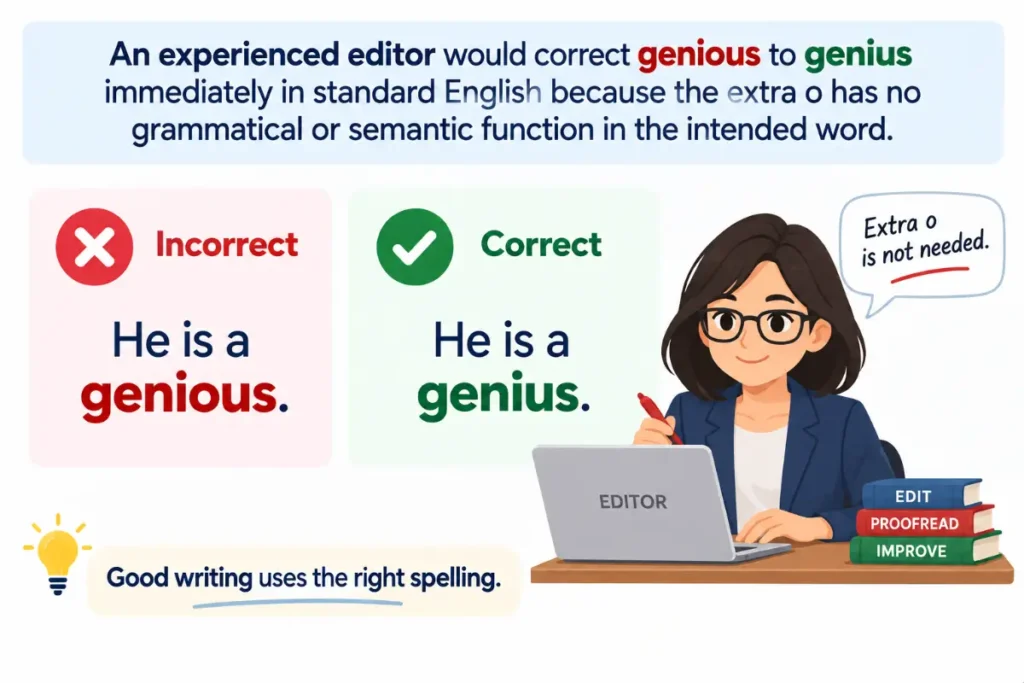
An experienced editor would correct genious to genius immediately in standard English because the extra o has no grammatical or semantic function in the intended word. The confusion is easy to understand because English spelling often gives learners limited help through pronunciation alone, and ingenious adds another familiar word with overlapping letters and meaning. A good proofreading habit is to check the word visually rather than relying only on how it sounds. Spellcheckers usually catch the error, but context based editing still matters because similar words such as genus and ingenious are legitimate English forms.\
Conclusion
genious or genius has a clear answer. Genius is the correct standard spelling, while genious is a common spelling mistake. The word is mainly a noun and can describe a person with exceptional intellectual or creative ability or the exceptional ability itself. In casual English, it can also praise a clever idea or solution.
The spelling becomes easier once you separate it from similar words such as ingenious and genus. Genius contains no o between the i and u. If you need an adjective meaning clever or inventive, ingenious is the different word you want.
For a quick memory trick, picture the word as geni plus us. When proofreading, check the middle letters before moving on. That small pause can prevent the most common mistake and keep your writing clean and professional.
FAQs
Is genious a real word?
Genious is not the standard spelling of the English word genius. In ordinary writing, it is treated as a misspelling. You may encounter it online because people type quickly or remember the vowel pattern incorrectly, but that doesn’t make it an accepted spelling variant. If you’re writing an essay, email, article, or professional document, use genius.
What does genius mean?
Genius is a noun that can describe a person with exceptional intellectual or creative ability. It can also describe exceptional ability itself. In everyday speech, people often use it more casually to praise a clever idea or solution. For example, That was genius can simply mean that something was extremely clever, effective, or well designed.
Which spelling is correct, genious or genius?
Genius is the correct standard spelling. Genious is a common spelling mistake. The correct form contains the sequence geni followed by us. There is no standard American, British, Australian, or Canadian spelling rule that changes genius to genious. If you’re referring to exceptional intelligence or ability, use genius.
How do you pronounce genius?
Genius is commonly pronounced /ˈdʒiːniəs/ in American English. A simple pronunciation guide is JEE nee us. It has three syllables, with the strongest stress on the first syllable. The pronunciation can make the spelling difficult because the sounds don’t clearly tell you to write the vowels in the exact order found in the standard form.
Is genius a noun or an adjective?
Genius is primarily a noun. It can refer to an exceptionally talented person or to exceptional intellectual or creative ability. In informal English, genius can sometimes appear before another noun as a modifier, as in genius idea or genius move. In careful writing, a more precise adjective may be better depending on the intended meaning.
What is a synonym for genius?
Depending on the context, related words include brilliance, intelligence, giftedness, talent, ingenuity, and exceptional ability. These aren’t perfect substitutes. A genius can refer to a person or exceptional ability, while ingenuity focuses on clever problem solving and talent refers to strong ability in a particular area. The best alternative depends on the exact idea you want to express.
Why do people spell genius incorrectly?
People often write genious because the pronunciation doesn’t clearly reveal the spelling. The word ingenious can also create confusion because it has a similar appearance and relates to cleverness. Fast typing makes the problem more likely because writers may spell from memory or sound. Visual practice with the correct form can make the spelling easier to remember.
Is genius appropriate in formal writing?
Yes, genius is appropriate in formal writing when the context supports the meaning. However, formal writers should use the word carefully because it can make a strong claim about someone’s ability. In academic or professional writing, specific descriptions can sometimes be more useful. Instead of simply calling someone a genius, explain the achievement or quality that demonstrates exceptional ability.
