
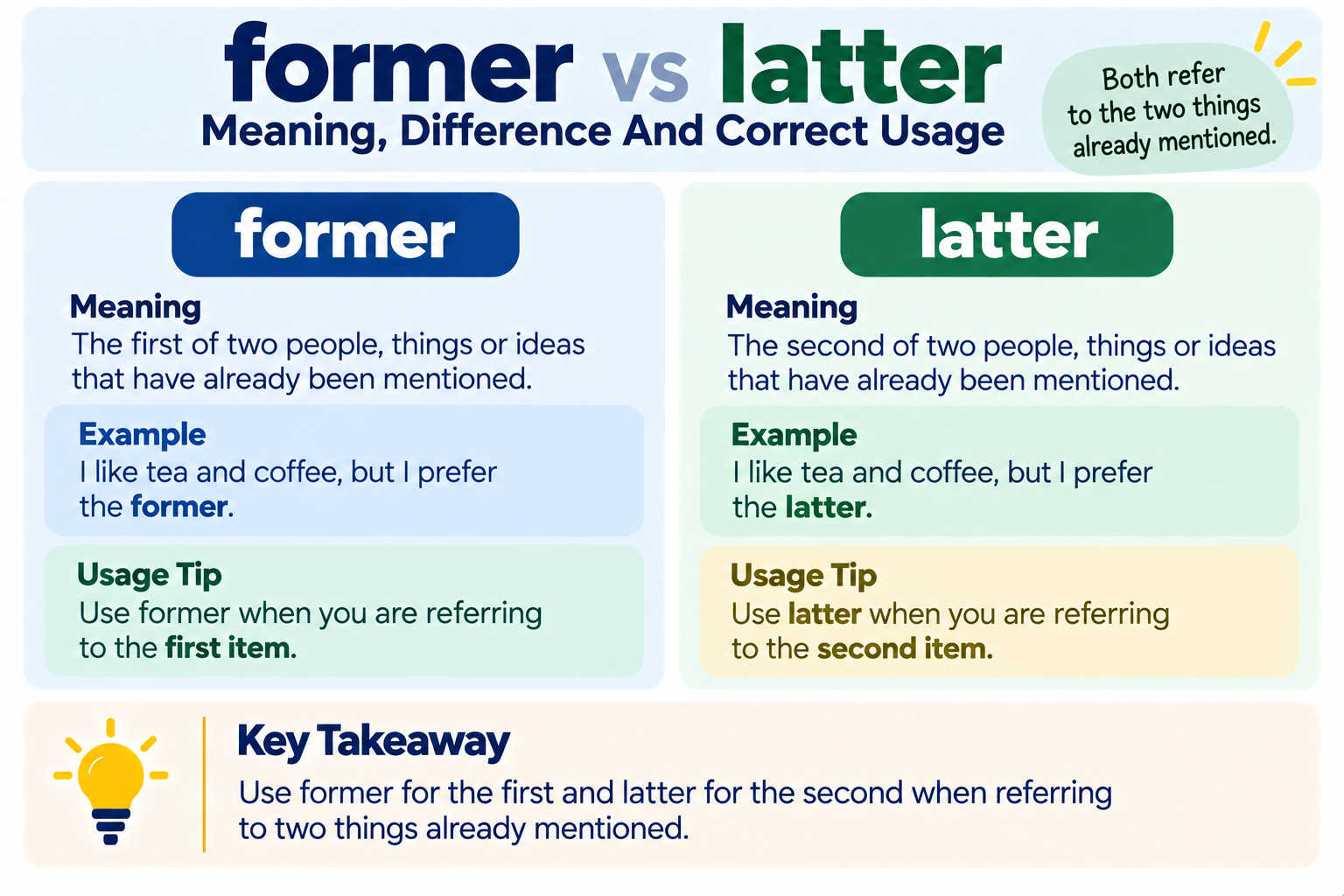
former vs latter can confuse even strong English speakers because both words refer to items mentioned earlier in a sentence or passage. The key difference is simple. Former refers to the first of two people or things mentioned while latter refers to the second.
For example, consider this sentence. Sarah received offers from two companies and chose the latter. The latter refers to the second company mentioned. If the sentence said she chose the former, it would refer to the first company.
The confusion usually comes from the fact that neither word names the person or thing directly. Instead, each word points backward to something already mentioned. Once you understand that relationship, the distinction becomes much easier. This guide explains the meaning, grammar, pronunciation, history, regional usage, common mistakes, and natural examples so you can use both terms with confidence. You’ll also learn a simple memory trick that can help you remember which word points to the first choice and which points to the second.
Quick Definition
Former refers to the first of two people or things previously mentioned. Latter refers to the second of two people or things previously mentioned. For example, in I enjoy tea and coffee but prefer the latter, latter refers to coffee because coffee was mentioned second.
Quick Answer
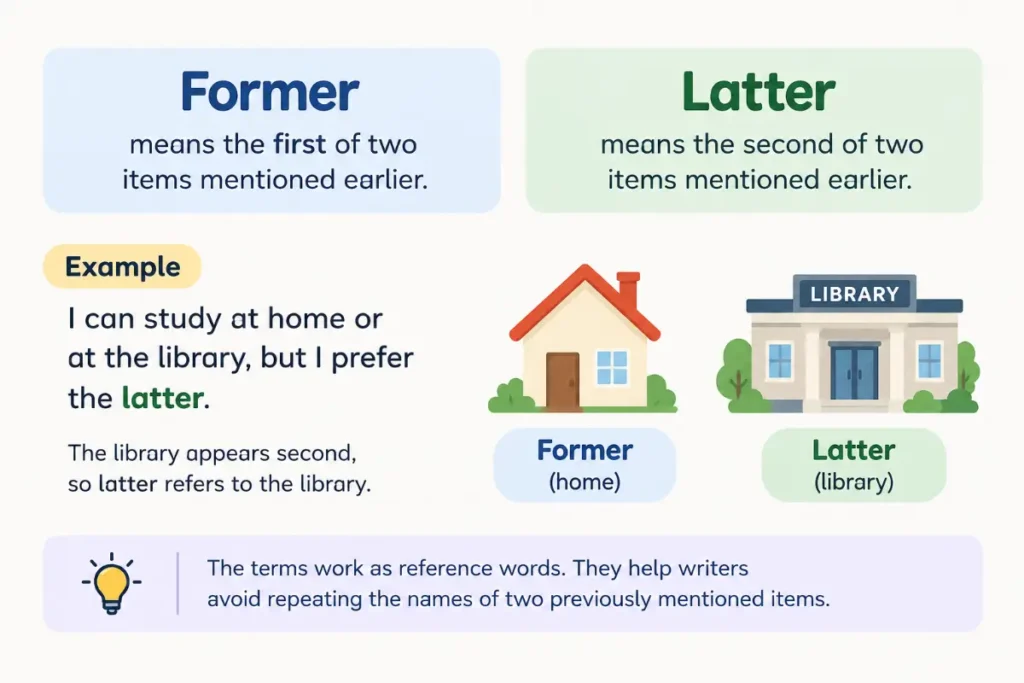
Former means the first of two items mentioned earlier. Latter means the second of two items mentioned earlier. A useful example is this. I can study at home or at the library, but I prefer the latter. Since the library appears second, latter refers to the library. The terms work as reference words. They help writers avoid repeating the names of two previously mentioned items.
Comparison Table Former Vs Latter
| Form | Meaning | Part of Speech | Origin | Usage Frequency | Formality | Common Contexts | Example |
|---|---|---|---|---|---|---|---|
| Former | The first of two previously mentioned people or things | Adjective or noun | Old English and related Germanic roots | Common in formal writing | Formal and neutral | Essays, reports, comparisons, academic writing | Between tea and coffee, I prefer the former. |
| Latter | The second of two previously mentioned people or things | Adjective or noun | Old English and related Germanic roots | Common in formal writing | Formal and neutral | Essays, reports, comparisons, academic writing | Between tea and coffee, I prefer the latter. |
The table shows an important point. Neither word is inherently more correct than the other. The choice depends entirely on the position of the item being referenced.
Meaning And Definition
Meaning Of Former
Former has several meanings in English, but the meaning relevant to this comparison is the first of two things already mentioned.
Suppose you write this sentence.
I enjoy both hiking and swimming, but I prefer the former.
The word former points to hiking because hiking came first.
This use is especially common in formal and academic writing. It allows writers to avoid repeating a noun. Instead of saying I enjoy hiking and swimming, but I prefer hiking, the writer can say I enjoy hiking and swimming, but I prefer the former.
Former can also work as a noun in this construction. For example, you might write, Of the two options, the former is cheaper. Here former stands for the first option.
There is another common meaning that has nothing to do with two choices. Former can mean previous or earlier.
My former teacher now lives in Chicago.
Here former means the teacher I had in the past. It does not mean the first of two teachers mentioned.
That distinction matters because context determines the meaning.
Meaning Of Latter
Latter refers to the second of two people or things mentioned.
Consider this sentence.
The manager offered me a promotion or a transfer, and I chose the latter.
The word latter refers to the transfer because transfer was mentioned second.
Like former, latter can function as a noun or adjective. Its reference depends on the surrounding sentence.
You might write:
The latter option costs less.
In this sentence latter acts as an adjective because it modifies option.
You might also write:
The two choices were a refund and an exchange. I selected the latter.
Here latter acts as a noun because it stands in place of exchange.
Latter should generally point to the second item in a pair. Using it for a third or fourth item can make the sentence confusing and falls outside its clearest traditional use.
The Key Difference
The easiest way to understand these words is to focus on order.
- Former means first. If two items appear in the sentence, former points to the item that appears first.
- Latter means second. If two items appear in the sentence, latter points to the item that appears second.
- Both refer backward. The reader normally needs to look at something already mentioned to understand what former or latter means.
- They work best with two items. Using these terms with long lists makes the reference harder to follow.
- They are not opposites in the usual sense. They identify positions within a pair rather than describing opposite qualities.
Consider this example.
I was offered a position in Denver and another in Seattle. I chose the latter.
Denver came first. Seattle came second. Therefore, latter means Seattle.
Change the sentence to:
I was offered a position in Denver and another in Seattle. I chose the former.
Now former means Denver.
That is the entire core rule.
Former And Latter In Grammar
Former and latter can both function as adjectives and nouns.
When they act as adjectives, they normally appear before a noun.
The former president spoke at the event.
The latter option requires less time.
In these examples, former modifies president and latter modifies option.
When they act as nouns, they stand alone and refer to previously mentioned items.
Of the two plans, I prefer the former.
She considered both jobs but accepted the latter.
This noun use is especially common in formal writing. In everyday conversation, people often repeat the actual noun instead because it sounds clearer and more natural.
For example, instead of saying:
I bought a laptop and a tablet. I prefer the latter.
A speaker might simply say:
I bought a laptop and a tablet. I prefer the tablet.
The second version is often easier for a listener because spoken language disappears quickly. A reader can look backward on a page. A listener cannot do that as easily.
Why Former And Latter Can Cause Confusion
The words create confusion because they make the reader perform a small mental search.
Imagine this sentence.
The company considered expanding its office in Boston or opening a new location in Miami. The latter plan would cost more.
The reader must remember that Boston came first and Miami came second. The word latter therefore points to the Miami plan.
That mental step is easy when the sentence is short. It becomes harder when writers place several ideas between the original pair and the reference word.
For example:
The committee discussed the cost of the project, the timeline for completion, the effect on local businesses, and several possible funding sources. After reviewing the details, the latter was considered the most realistic.
Now the reader may wonder what latter refers to. The sentence contains several possible candidates.
This is why professional editors pay attention to reference clarity. A grammatically correct sentence can still make the reader work too hard.
When To Use Former
Use former when you need to refer to the first of two previously mentioned items.
Here are several examples.
- I can work remotely or from the office, but I prefer the former.
- The school offers morning and evening classes. The former is usually less crowded.
- We discussed price and quality, and the former became the main concern.
- She considered driving or taking the train. She chose the former.
- The report compares traditional and modern teaching methods. The former relies more heavily on direct instruction.
In every example, former points to the first item.
A simple memory trick is to connect former with first. The two words do not start with the same letter, but their meanings connect neatly. The former is the first item in the pair.
When To Use Latter
Use latter when you need to refer to the second of two previously mentioned items.
Examples make the rule clear.
- I can meet on Tuesday or Thursday, and Thursday is the latter choice.
- She considered a career in medicine or law but eventually chose the latter.
- The course covers theory and practice, with the latter receiving more attention.
- We could take the highway or the coastal road. I prefer the latter.
- The article compares print books and digital books and discusses the advantages of the latter.
In every example, latter points to the second item.
A useful memory trick is to think of latter as connected with later. The second item comes later in the sequence than the first.
Former And Latter With More Than Two Items
Traditional usage works best when former and latter refer to two items.
Suppose you write:
The meeting covered budgets, staffing, marketing, and customer service. The latter was the main topic.
This creates a problem. Which item does latter identify? A reader might assume customer service because it appears last, but the traditional pair based meaning is no longer clear.
Instead, name the item directly.
The meeting covered budgets, staffing, marketing, and customer service. Customer service was the main topic.
That version is longer but much clearer.
Professional writing values clarity over cleverness. If a reference word makes the reader stop and count items, repeating the noun may be the better choice.
Sentence Examples
Here are natural examples that show the distinction in different settings.
- I can take the morning flight or the evening flight, but I prefer the latter.
- She received offers from two universities and chose the former.
- The report compares online classes with traditional classes and explains why the latter may require more classroom support.
- My brother enjoys football and basketball, but he watches the former more often.
- We discussed buying a new car or repairing the old one. The latter would save money.
- The manager offered two solutions, and the former required less time.
- The article examines public transportation and private vehicles, with the latter receiving more attention.
- I considered studying biology or chemistry, but I eventually selected the latter.
- The two designs have different strengths. The former is simpler while the latter offers more features.
- She could stay home or join her friends for dinner. She chose the latter.
Notice that each example gives the reader exactly two clear choices. That makes the reference easy to understand.
Common Mistakes
Mistaking Latter For Last
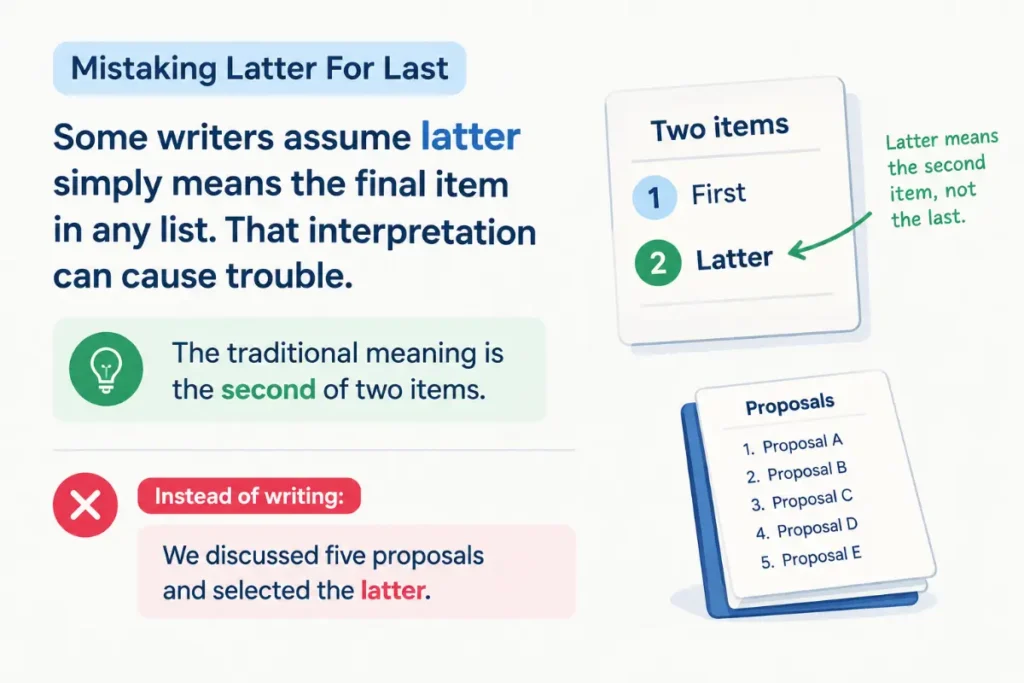
Some writers assume latter simply means the final item in any list. That interpretation can cause trouble.
The traditional meaning is the second of two items.
Instead of writing:
We discussed five proposals and selected the latter.
Name the proposal directly.
Using Former For A Past Person
Former can mean previous or earlier.
My former manager now works for another company.
Here former does not mean the first of two managers. It means the manager I had previously.
Context controls the meaning.
Using Latter Without A Clear Pair
A reader needs to know what two items latter refers to.
If the sentence mentions several people and objects before using latter, the reference may become unclear.
Confusing Latter With Later
Latter refers to the second item in a pair. Later refers to a time that comes afterward.
I’ll call you later.
The latter option is cheaper.
These words sound similar but serve different grammatical purposes.
Assuming Former And Latter Are Casual Conversation Words
They are grammatically normal, but they often sound more formal in everyday speech.
A friend might say:
I prefer the second one.
A report might say:
The latter option is more practical.
Both are correct. The choice depends on audience and tone.
Pronunciation Guide
Former is pronounced /ˈfɔːrmər/ in many standard American pronunciation guides. A simple pronunciation guide is FOR mer.
The first syllable carries the main stress.
Latter is commonly pronounced /ˈlætər/ in American English. You can think of it as LAT er.
The first syllable receives the main stress here too.
The words former and latter are not normally pronounced the same way as formal and later.
One common mistake is to confuse latter with later in speech because their sounds are close in many accents. The difference becomes clearer from context and spelling.
Another useful distinction is between latter and ladder. In many American accents, latter and ladder can sound very similar because of the way the letter t is pronounced between vowels. The meaning and spelling still remain different.
Etymology And Word Origin
Former has a long history connected with the idea of being first or previously existing. It developed through English from forms related to the concept of first or earlier. The modern word carries both the sense of previous and the sense of the first item in a pair.
Latter comes from the same broad historical family as later. Its history is tied to the idea of something coming after another thing in sequence.
The relationship between latter and later is especially useful for learners. Latter points to the second item because that item comes later in the pair.
English has kept these related forms distinct in modern usage even though their historical connection remains visible.
The words therefore have a useful built in logic. Former points toward the first position while latter points toward the later position.
Regional Usage
American English
Both former and latter are standard in American English. They appear frequently in formal writing, academic work, business documents, journalism, and analytical prose.
In casual conversation, American speakers often prefer simpler expressions such as first one and second one. That preference does not make former or latter incorrect. It simply reflects the more relaxed style of spoken English.
British English
British English also uses former and latter with the same basic meanings. There is no major regional difference in the core distinction.
British academic and professional writing commonly uses these terms when referring back to two previously mentioned subjects.
Australian English
Australian English follows the same standard distinction. Former can refer to the first of two items or to something previous. Latter generally identifies the second of two items.
The difference is mainly one of style rather than regional grammar.
Canadian English
Canadian English also uses both terms in the standard way. Writers may use former and latter in academic or professional contexts while choosing simpler alternatives in casual conversation.
There is no major Canadian spelling variation that changes the basic rule.
Formal And Informal Usage
Former and latter tend to sound more formal than first and second.
Compare these two sentences.
I had two choices and picked the latter.
I had two choices and picked the second one.
Both sentences communicate the same basic idea. The second sounds more conversational.
In formal writing, former and latter can help avoid repetition. They are particularly useful in essays, reports, legal writing, research papers, and analytical articles.
Still, formal does not always mean better. If the reader has to search backward to figure out what latter refers to, repeating the noun may be the stronger choice.
Good writing should feel clear rather than impressive.
Real Life Usage Examples
Daily Conversation
I can order pizza or pasta. I’ll take the latter.
My friends invited me to a movie or dinner. I chose the former because I wanted a quiet evening.
These examples are grammatically correct, although many speakers would simply say the pizza, pasta, movie, or dinner in casual conversation.
Workplace Communication
The company can hire another employee or increase overtime. The former may be more sustainable.
The manager considered a phone call and an email. The latter created a written record.
In workplace writing, these terms can help reduce repeated nouns when the reference remains clear.
Academic Writing
The study compares rural schools with urban schools. The former often face different resource limitations.
Researchers examined two explanations for the result. The latter received stronger support from the available evidence.
Academic writing often contains repeated comparisons, so these reference terms can be useful.
News Writing
Officials considered closing the road or reducing traffic during peak hours. The latter plan was announced on Tuesday.
The candidates discussed tax policy and education spending. The former received less attention during the debate.
News writers must still make the reference clear because readers may scan rather than read every sentence closely.
Literature And Storytelling
Maya looked at the old house and the empty field. The latter seemed strangely peaceful.
He remembered his childhood home and his first school. The former remained the stronger memory.
In storytelling, these words can work well when the writer wants a slightly formal or reflective tone.
Related And Confused Terms
First
First identifies the beginning position in an order or sequence. It is often the simplest replacement for former.
Second
Second identifies the next position after first. It can often replace latter in everyday writing.
Previous
Previous means something that came before another point in time or sequence. It does not specifically mean the first of two items.
Later
Later refers to a time that comes after another time. It should not be confused with latter.
Earlier
Earlier describes something that happened or existed before another point. It can overlap with one meaning of former but does not normally mean the first of two items.
Previous One
Previous one refers to an earlier item and is often more natural in casual conversation.
First One
First one is a clear conversational alternative to former.
Second One
Second one is a simple conversational alternative to latter.
These alternatives matter because strong writing is not about choosing the most formal word. It is about choosing the clearest word for the reader.
A Simple Memory Trick
If you often mix up the two terms, remember this pair.
Former means first.
Latter means later and second.
Imagine two boxes sitting on a table. The first box is the former. The second box is the latter.
You can also remember the order visually.
Former → first.
Latter → later.
That connection is not a formal grammar rule. It is simply a practical memory aid. For many learners, a small association like this works better than memorizing a long definition.
When Repeating The Noun Is Better
Former and latter can save words, but shorter does not always mean clearer.
Consider this example:
The report compares customer satisfaction and employee retention. The latter is difficult to measure accurately.
This is reasonably clear because there are only two subjects.
Now consider:
The report examines customer satisfaction, employee retention, workplace safety, staffing levels, training quality, and sales growth. The latter is difficult to measure.
The reader has too many possible references. The sentence forces the reader to work out what latter means.
A better version would name the subject.
The report examines several business measures. Sales growth is difficult to measure accurately.
An experienced editor looks at the reader’s experience rather than simply counting words. If repeating a noun removes confusion, repeat it.
Expert Editor Insight
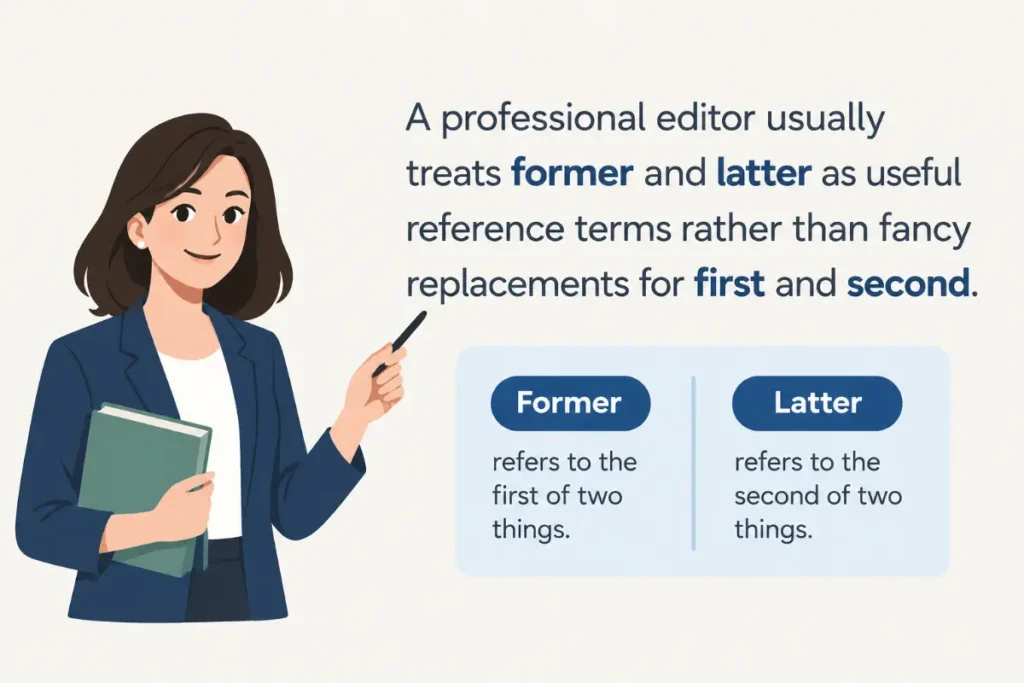
A professional editor usually treats former and latter as useful reference terms rather than fancy replacements for first and second. The main question is clarity. If two items appear close together and the reference is obvious, the words work well. If several nouns appear between the original pair and the reference, repeating the noun is usually safer. Grammar and spelling tools may not flag a sentence that uses former or latter poorly because the sentence can still be grammatically correct. Human judgment matters because clarity depends on context.
Conclusion
former vs latter becomes much easier once you focus on order. Former refers to the first of two previously mentioned items while latter refers to the second. Both are correct standard English words, but they serve different reference functions. Former can also mean previous or earlier, while latter is mainly used for the second item in a pair.
The safest way to use these terms is to give the reader a clear pair. Mention two items first, then use former for the first and latter for the second. If your sentence contains a long list or the reference feels uncertain, name the item directly. Clear writing always beats unnecessary formality.
Remember the simple connection: former means first and latter points to what comes later. Keep that pair in mind and you’ll rarely mix them up again.
FAQs
What is the difference between former and latter?
Former refers to the first of two people or things mentioned. Latter refers to the second. For example, if you mention tea and coffee and then say you prefer the latter, you mean coffee. If you say you prefer the former, you mean tea. The simplest memory aid is former for first and latter for later or second.
Does latter mean the last item in a list?
Not in standard usage. Latter traditionally refers to the second of two items that have been mentioned. It should not normally be used to point to the final item in a long list. If you have several items, name the specific item instead. That approach prevents ambiguity and makes the sentence easier for readers to follow.
Can former mean previous?
Yes. Former has another common meaning that describes something or someone from an earlier period. For example, my former employer means an employer I had in the past. This meaning differs from the use of former for the first of two items. Context tells the reader which meaning applies.
Is latter the same as later?
No. Latter refers to the second of two previously mentioned items. Later refers to a time that comes after another time. For example, I’ll call you later refers to future time. The latter choice refers to the second choice. The words are related in sound and history but have different functions.
Are former and latter formal words?
Former and latter are standard English words and often have a formal or written tone. They are common in academic writing, reports, professional documents, and analytical prose. In casual conversation, people often choose first one and second one because those expressions sound more natural in relaxed speech. Both styles are grammatically acceptable.
Can former and latter refer to more than two things?
They are best used for a pair of items. Using them after mentioning three or more things can make the reference unclear. A reader may not know which item you intend to identify. If your sentence contains a long list, repeat the noun or use a more specific reference such as the final option or the third proposal.
How do you remember which word means first?
Connect former with first. Both describe the beginning position in a pair. Then connect latter with later. The latter item comes later than the former item. For example, if you mention apples and oranges, apples are the former and oranges are the latter. This simple association can prevent most mistakes.
Should I use former and latter in casual writing?
You can, but you do not always need to. In casual writing, first one and second one often sound more natural. Former and latter can make the sentence sound more formal. The best choice depends on the audience and context. If the reference feels unclear, simply repeat the noun instead of relying on either term.
