
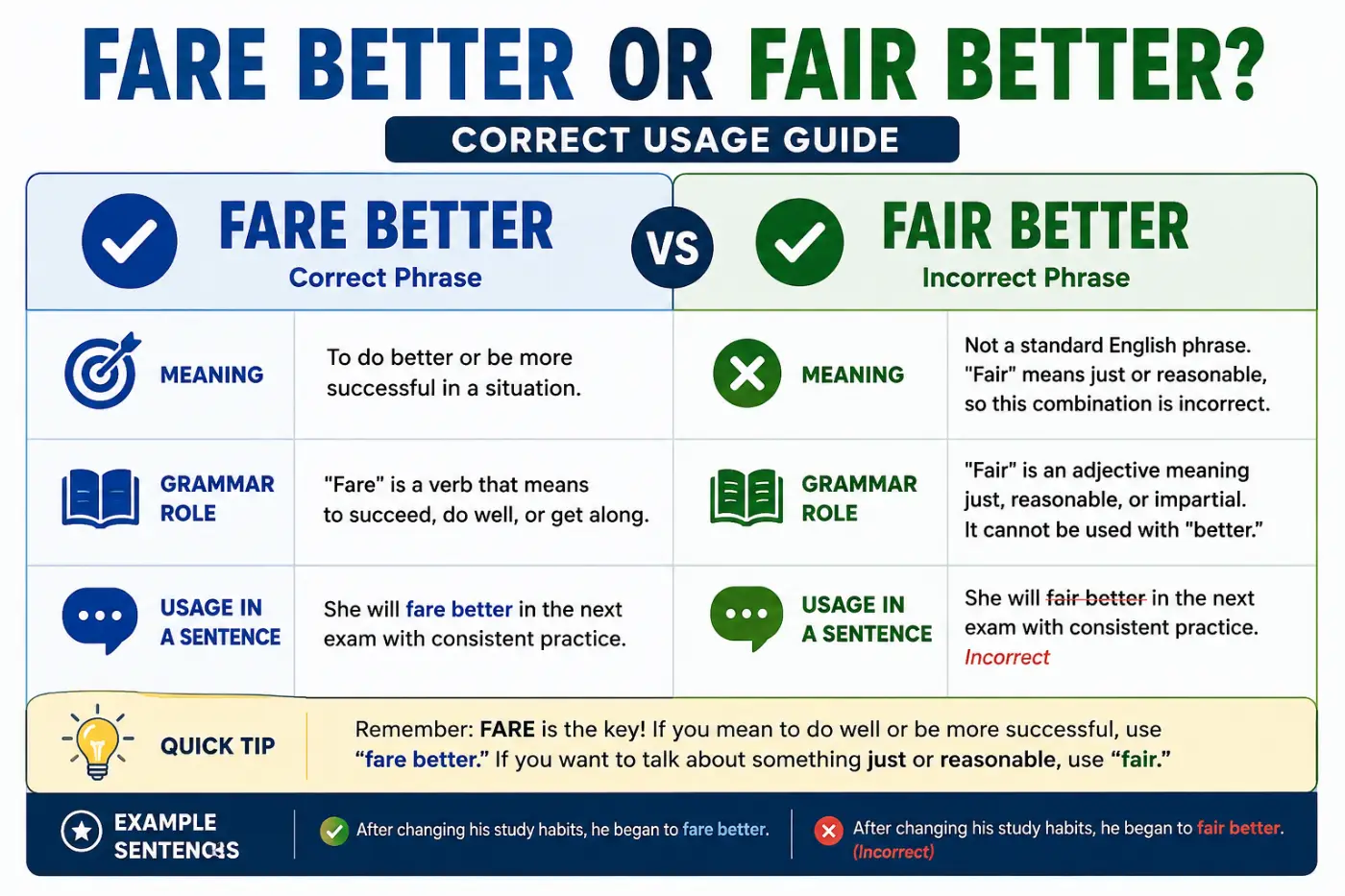
If you’ve ever wondered about fare better or fair better you’re dealing with a classic English confusion. The correct expression is fare better when you mean to do better or experience a better result. Fair better is usually incorrect in this expression because fair is an adjective or noun while fare is the verb that means to get along or perform in a particular way.
The confusion makes sense because fare and fair sound exactly the same in standard American English. They are homophones which means they share a pronunciation but have different spellings meanings and grammatical functions. That small spelling difference changes the meaning of the sentence.
In this guide you’ll learn why fare works in this phrase how the expression behaves in a sentence and when to use it in everyday and formal writing. You’ll also see clear examples common mistakes related expressions pronunciation guidance and a simple editing trick that can help you choose the right word without second guessing yourself.
Quick Definition
Fare better is the standard expression when you mean to perform better or have a better result or experience. Fair better is generally incorrect in this context because fair does not function as the verb needed to express performance or outcome. The two words sound alike but have different meanings and grammatical roles.
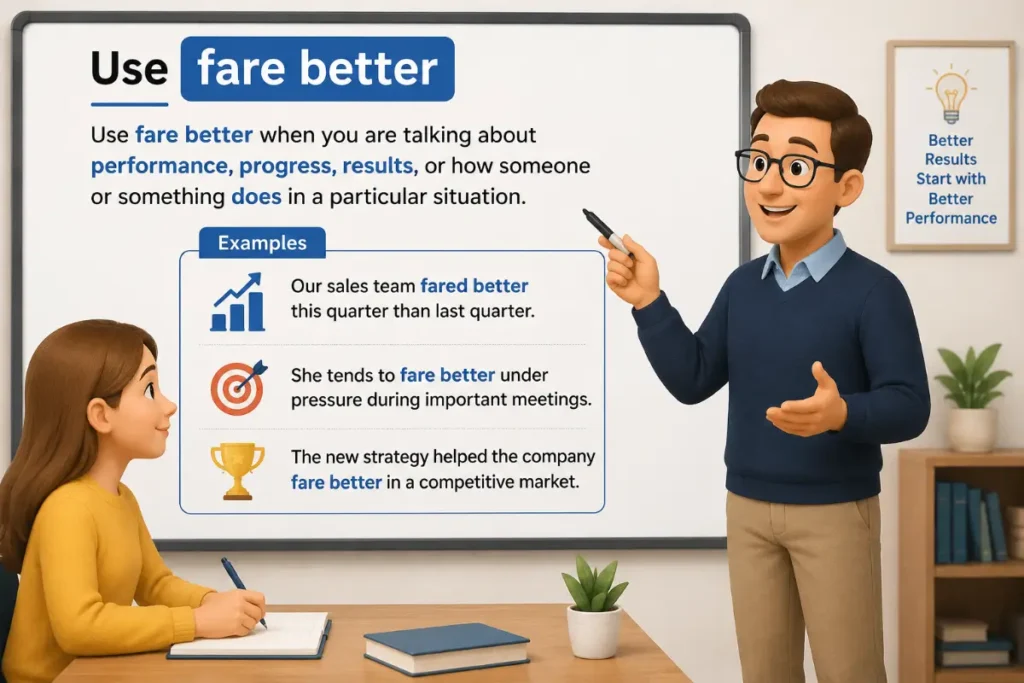
Quick Answer
Use fare better when you mean to do better or achieve a better result.
For example: Students who study regularly tend to fare better on exams.
Use fair when you mean reasonable impartial acceptable or related to a public event. Although fare and fair sound alike they cannot normally replace each other.
Comparison Table fare better or fair better
| Form | Meaning | Part of Speech | Origin | Usage Frequency | Formality | Common Contexts | Example |
|---|---|---|---|---|---|---|---|
| Fare better | To do better or experience a better outcome | Verb phrase | Fare comes from Old English and Germanic roots | Common | Neutral and formal | Education work health business performance and general discussion | Smaller teams may fare better with flexible schedules. |
| Fair better | Not the standard expression for better performance | Adjective or noun plus verb in other constructions | Fair comes from Old English roots connected with beauty and justice | Rare as this expression | Nonstandard in this meaning | Usually appears as a word choice mistake | The intended expression is fare better. |
Meaning and Definition
Meaning of Fare
Fare has several meanings in English. As a verb it can mean to get along or perform in a particular situation. This is the meaning that appears in the expression fare better.
Consider this sentence.
How did you fare during the interview?
The speaker is asking how the person performed or how things went.
Now compare it with:
She fared better than expected.
This tells us that her result or experience was better than someone expected.
Fare can also work as a noun. In that role it commonly refers to the price charged for transportation.
The bus fare increased this year.
It can also refer to food or the type of material offered in a particular setting.
The restaurant serves traditional Italian fare.
These meanings are separate from the verb used in fare better. Context tells you which meaning applies.
Meaning of Fair
Fair has several common meanings too. It can describe something reasonable or just.
The manager made a fair decision.
It can describe something that is light in color.
She has fair hair.
It can describe acceptable weather.
The weather should be fair tomorrow.
Fair can also refer to an event where people gather for entertainment shopping food or other activities.
We went to the county fair on Saturday.
Because fair has these meanings it can be a perfectly valid English word. The problem appears when a writer uses it in place of fare to express performance or results.
Why The Difference Matters
The easiest way to understand the distinction is to focus on the job each word performs.
Fare can work as a verb meaning to get along or perform. Better then modifies the degree or quality of that performance.
The new employees fared better than expected.
Fair does not provide that verb meaning.
So the phrase isn’t based on the idea of something being fair. It describes how someone or something performs.
Key Differences Explained
- Spelling. Fare contains an e after the f. Fair contains an i after the f. Both spellings are correct words but they belong to different word families.
- Meaning. Fare can describe how someone performs or how a situation goes. Fair usually describes justice quality appearance weather or an event.
- Grammar. Fare can function as a verb. That makes it suitable for the expression used to describe performance. Fair normally functions as an adjective noun or adverb in certain constructions.
- Pronunciation. In standard American English fare and fair are pronounced the same. This is the main reason people confuse them in writing.
- Context. Fare better appears in discussions about results performance progress and outcomes. Fair appears in contexts involving fairness quality appearance weather or fairs.
- Formality. Fare better works in casual conversation as well as professional academic and formal writing.
- Regional usage. The distinction remains broadly consistent across major varieties of English. The pronunciation may vary slightly by accent but the spelling distinction remains.
- Standard usage. When describing improved performance or a better outcome use fare better.
Which Form Is Correct?
Fare better is the standard expression when you mean to perform better or experience a more favorable outcome.
The grammar explains why. Fare is a verb in this construction. Better functions as an adverb describing the degree or quality of the action expressed by fare.
For example:
Older students often fare better when they manage their time carefully.
The subject is students. The verb is fare. Better tells us how they perform.
This construction has a long history in English. Fare developed from Old English and related Germanic forms associated with traveling or proceeding. Over time the verb developed broader meanings connected with how someone gets along or how something proceeds.
Fair developed along a different historical path. Its meanings became associated with beauty justice pleasantness and acceptable treatment. That history explains why the two words look different even though modern speakers pronounce them alike.
A reliable dictionary based approach also supports treating them as separate words. Dictionaries list fare and fair as distinct entries with different definitions and grammatical uses. They do not treat fair as an alternative spelling of the verb fare.
Sentence Examples
Here are natural examples that show how the standard expression works.
- Students who review their notes regularly usually fare better on tests.
- Small businesses may fare better when they understand their local customers.
- She fared better in the second interview because she felt more confident.
- Plants fare better when they receive the right amount of sunlight.
- The team fared better after changing its training schedule.
- People often fare better when they have clear goals.
- The company expects its newest product to fare better in the larger market.
- He didn’t fare as well as he had hoped during the competition.
- Families may fare better when they plan major expenses in advance.
- The second plan could fare better because it gives the staff more flexibility.
Notice that the phrase can appear in several grammatical forms. You can use fare better in the present tense or fared better in the past tense. You can also use fares better when the subject is singular.
She fares better under pressure.
They fare better with clear instructions.
He fared better after gaining more experience.
The central idea stays the same. The phrase describes performance or outcome.
Examples With The Common Error
The following examples demonstrate the mistake so you can recognize it during proofreading.
- The new system may fair better with older computers.
- She fair better when she has more time.
- The team could fair better next season.
- Students may fair better with smaller classes.
- The company might fair better under different conditions.
In each case the intended word is fare.
Common Mistakes and Misspellings
Using Fair For Performance
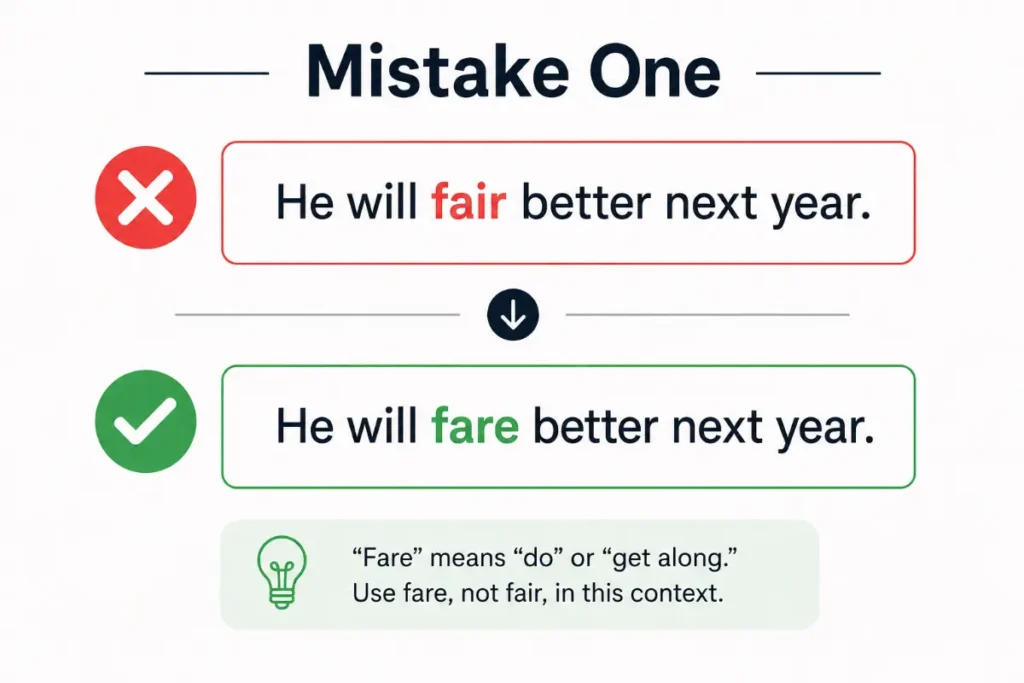
The most common mistake is writing fair when the intended meaning is perform or get along.
Incorrect: The team will fair better this year.
Correct: The team will fare better this year.
The writer has probably chosen the spelling from sound. Since the two words are homophones the error can slip past the ear.
Confusing Fare With Transportation Cost
Fare is also a noun meaning the price of a trip.
The train fare is expensive.
That meaning is different from the verb in fare better. The spelling remains the same but the grammatical role changes.
Assuming Better Goes With Fair
Some writers associate better with fair because fair and better both appear in comparisons.
A fair result.
A better result.
That connection doesn’t make fair better a valid performance expression. The meaning of the complete phrase determines the correct word.
Confusing Fair With Fairly
Fairly is an adverb that can mean reasonably or to a moderate degree.
The test was fairly easy.
It can also relate to the idea of fairness.
Everyone was treated fairly.
Neither use creates a substitute for fare in fare better.
Choosing Words By Sound
Homophones are a major source of spelling errors because pronunciation alone cannot tell you which spelling belongs on the page. The solution is to consider meaning and grammatical function before choosing the spelling.
This is a useful NLP concept as well. A language system must use context to distinguish words that share a pronunciation. Humans do the same thing when they read carefully.
Pronunciation Guide
Fare and fair have the same standard pronunciation in American English.
The IPA pronunciation is commonly represented as /fer/.
Both words have one syllable.
A simple pronunciation guide is:
fair
The vowel sound is the same as the sound in words such as care and pair for many American speakers.
The spelling difference is therefore invisible in speech. You can say the sentence correctly and still write the wrong word afterward.
For example:
The students fare better with practice.
When spoken aloud the listener hears the same sound that appears in the word fair. Context carries the meaning.
This is why reading a sentence aloud isn’t always enough to catch this error. A proofreading method that checks meaning works better.
Ask yourself:
Am I talking about fairness or performance?
If you mean performance use fare.
If you mean justice or reasonableness use fair.
Etymology and Word Origin
The history of fare helps explain its modern meaning.
Fare comes from Old English faran which was associated with traveling going or proceeding. Related forms appear across Germanic languages. Over time the English verb developed meanings connected not only with physical movement but also with how a person or situation progresses.
That broader idea remains visible today.
How did you fare?
This question doesn’t necessarily ask about travel. It asks how things went.
The same idea appears in fare better.
She fared better after changing her approach.
The sentence describes how her situation progressed.
Fair has a different history. It comes from Old English forms associated with beauty attractiveness brightness and later ideas of fairness and justice. Its modern meanings developed along that path.
So the two words are not spelling variants. They have different histories and different meanings despite sounding alike in modern English.
Regional Usage
American English
American English uses fare better as the normal expression for describing performance or results. Fair remains a separate word with meanings related to justice appearance weather and public events.
The pronunciation of fare and fair is generally identical for American speakers. That makes context especially important when people move from speech to writing.
British English
British English also uses fare better to describe how someone or something performs or progresses. The spelling distinction between fare and fair remains the same.
A British speaker may pronounce the words according to a regional accent but the written forms still carry separate meanings.
Australian English
Australian English follows the same basic distinction. Fare works in expressions describing performance or outcomes while fair has its usual meanings related to justice appearance weather and events.
There is no standard Australian spelling variant that replaces fare with fair in this expression.
Canadian English
Canadian English also keeps fare and fair as separate words. Writers use fare better when discussing results performance or progress.
Because Canadian pronunciation can share features with both American and British English the exact vowel quality can vary by speaker. The spelling distinction remains unchanged.
Grammar Rules and Part of Speech
The grammar of this phrase is straightforward once you identify the verb.
Fare is the verb.
Better is an adverb in this construction.
Together they describe improved performance or a more favorable result.
Consider:
The students fare better with regular practice.
Students is the subject. Fare is the verb. Better modifies the verb by explaining the quality of their performance.
You can change the tense without changing the basic meaning.
Present: They fare better with experience.
Past: They fared better with experience.
Third person singular: She fares better with clear instructions.
You can also combine fare with other adverbs.
The team fared poorly in the first round.
The company fared well during the difficult period.
The students fared surprisingly well on the final exam.
This pattern shows that fare is not limited to better. The verb can describe a range of outcomes.
Using Fare With Comparisons
Fare commonly appears with comparative words such as better and worse.
The second option fared better than the first.
The older model fared worse under extreme conditions.
The phrase can also appear with as well.
She didn’t fare as well as expected.
This construction is useful because it focuses on the result of an action or situation rather than simply describing a quality.
Using Fair Correctly
Fair has different grammatical patterns.
As an adjective:
That was a fair decision.
As a noun:
We visited the fair.
As part of a common adverbial expression:
He played fair.
These uses are grammatically correct but they don’t replace fare in a sentence about performance.
Real Life Usage Examples
Daily Conversation
In everyday speech people often use the expression when talking about how a person handled a situation.
You might fare better if you leave earlier.
I think she’ll fare better with a little more practice.
The phrase sounds natural but slightly more polished than simply saying do better. That makes it useful in both casual and serious conversation.
Email And Workplace Communication
Professional writing often uses the expression when discussing results.
The new schedule may fare better with a smaller team.
Our revised process fared better during the trial period.
In workplace communication the phrase can sound precise without being overly formal.
Academic Writing
Academic writers may use fare when discussing outcomes or performance.
Students who receive regular feedback may fare better in writing assessments.
The second group fared better under the revised conditions.
The verb fits naturally because academic writing often compares outcomes across groups or situations.
News And Journalism
Journalistic writing may use the phrase to describe how an organization product policy or group performs.
Local businesses could fare better if consumer demand continues to rise.
The team fared better in the second half of the season.
The expression works well because it communicates an outcome without requiring a long explanation.
Literature And Storytelling
In storytelling fare can describe a character’s progress through difficult circumstances.
He wondered how his family would fare after the move.
The travelers fared better once they reached the village.
This use has a slightly traditional feel because fare has been part of English for centuries. Still it remains perfectly natural in modern writing.
Related And Confused Terms
Several expressions connect closely with fare better. Knowing the differences can help you choose the right phrase.
- Do better. This is the simplest everyday alternative. It is especially natural in casual conversation.
- Perform better. This is more direct and often works well in academic or professional contexts.
- Succeed. This focuses on achieving a desired result rather than simply performing better than before.
- Improve. This emphasizes positive change over time.
- Get along better. This can describe how a person manages in a situation or relationship.
- Fair. This is the main confusing word. It relates to justice reasonableness appearance weather or an event rather than the performance meaning expressed by fare.
- Fare well. This means to do well or manage successfully. It is closely related to fare better.
- Fare worse. This expresses the opposite comparison and means to experience a poorer result or perform less successfully.
Fare Well And Fare Better
Fare well and fare better are closely related but they don’t express exactly the same comparison.
She fared well in the competition.
This says that her performance was good.
She fared better in the final round.
This makes a comparison. Her performance in the final round was better than her performance in another situation or better than expected.
Do Better And Fare Better
Do better is more common in ordinary speech.
You can do better with more practice.
Fare better has a somewhat more polished tone.
You may fare better with more practice.
Neither is wrong. The choice depends on context and style.
Expert Editor Insight
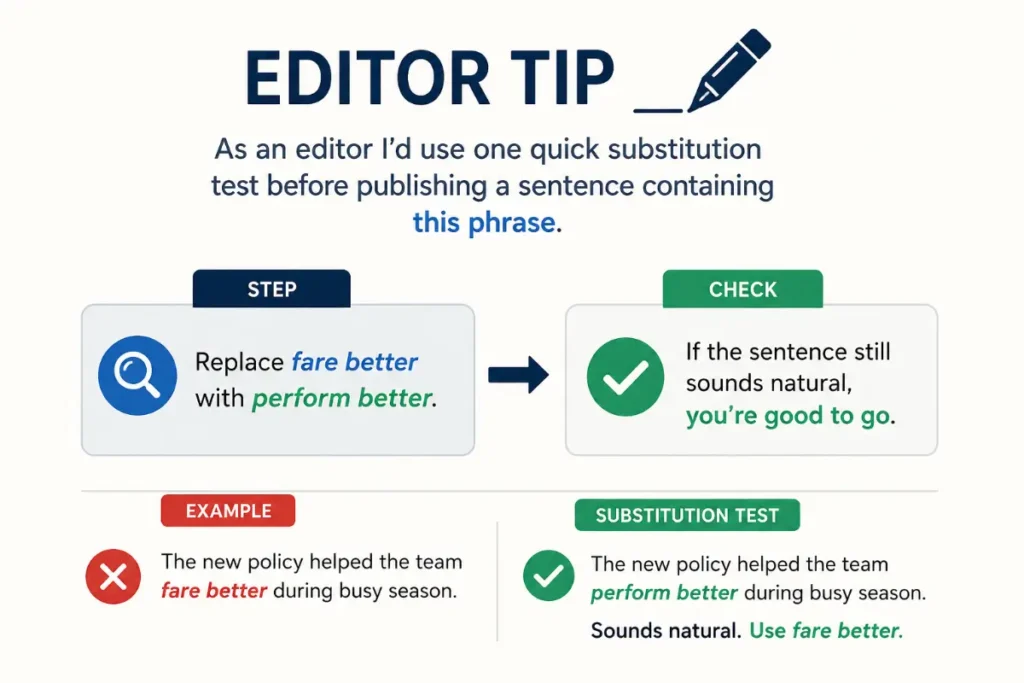
An experienced editor usually catches this mistake by checking the meaning of the complete sentence rather than relying on sound. If the sentence describes performance progress or an outcome the verb is fare. Spellcheckers can help but context based word choice errors may survive because both fare and fair are legitimate English words. My practical editing tip is simple: replace the phrase mentally with do better. If the sentence still makes sense then fare is almost certainly the word you need.
Conclusion
The answer to fare better or fair better is clear when the sentence describes performance progress or results. Use fare better because fare functions as the verb meaning to get along or perform in a particular way. Fair has different meanings connected with justice reasonableness appearance weather and events.
The two words sound the same in standard American English so the confusion usually happens in writing rather than speech. That makes this a classic homophone problem. Context and grammar provide the clue that pronunciation cannot provide.
For an easy memory trick replace the phrase with do better. If that substitution keeps the intended meaning then fare is the word you want. Once you connect fare with performance and fair with fairness the distinction becomes much easier to remember and use correctly.
FAQs
Is fair better ever correct?
Fair better is not the standard expression when you mean to perform better or experience a better result. In that context use fare better. Fair is still a correct English word in many other constructions such as fair treatment fair prices and a county fair. The issue is the meaning of the complete phrase rather than the validity of the word fair itself.
What does fare better mean?
Fare better means to perform better or experience a more favorable result. It can describe a person group product plan or situation. For example a student may fare better with regular practice. The expression often appears when comparing two situations or explaining that something performed better than expected.
Which is correct fare better or fair better?
Fare better is correct when the intended meaning is to do better or have a better outcome. Fare functions as the verb in this construction while better describes the quality of the result. Fair has different meanings and normally functions as an adjective or noun. Because both words sound alike the mistake is easy to make in writing.
How do you pronounce fare?
Fare is commonly pronounced /fer/ in American English. It has one syllable and rhymes with words such as care and pair for many speakers. Fair has the same pronunciation in standard American English. Since the two words sound alike you cannot depend on pronunciation alone to choose the correct spelling. Meaning and grammatical role provide the useful clues.
Can fare be used in formal writing?
Yes. Fare is fully suitable for formal writing when you use the correct meaning. It appears naturally in academic work professional reports journalism and analytical writing. The expression fare better can be useful when comparing performance or outcomes. If your audience prefers very plain language you can use do better instead but fare better remains grammatically sound and professional.
What is another way to say fare better?
Depending on context you can replace fare better with do better perform better improve succeed or achieve better results. The best alternative depends on the sentence. Do better sounds especially natural in conversation while perform better works well in professional and academic contexts. Fare better can be useful when you want to describe how someone or something progresses in a particular situation.
Why do people confuse fare and fair?
People confuse fare and fair mainly because they are homophones. They sound the same in standard American English but have different spellings and meanings. When someone writes from memory or quickly types a sentence the sound provides no clue about the correct spelling. Context solves the problem. Performance calls for fare while fairness and related meanings usually call for fair.
Is fare better common in American English?
Yes. Fare better is a standard expression in American English and appears in everyday speech as well as professional academic and journalistic writing. It is especially useful when discussing how a person group plan product or situation performs. Fair better is not the standard form for this meaning. The two expressions should therefore not be treated as interchangeable spellings.
