
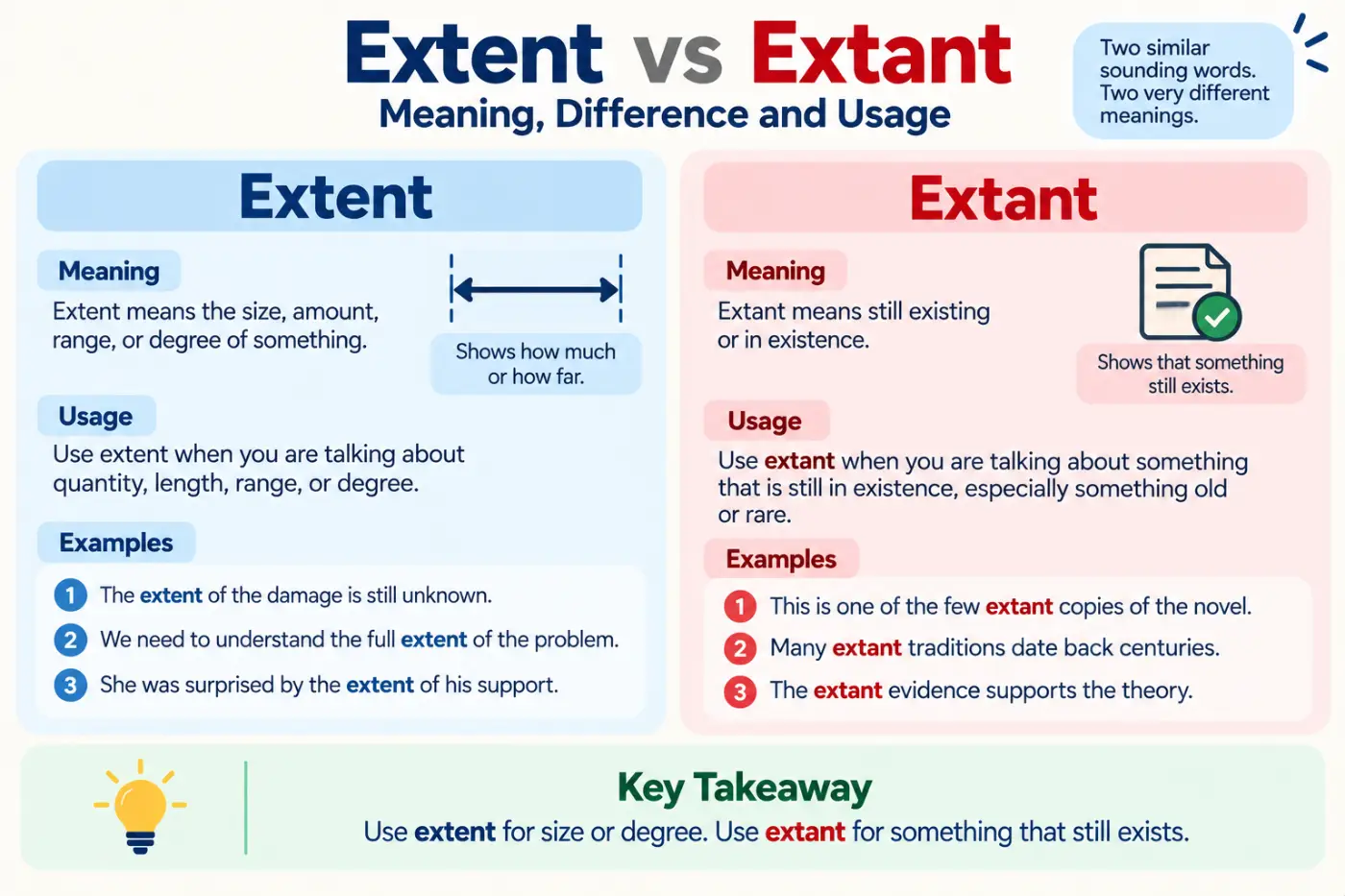
If you’ve ever paused over extent vs extant, you’re not alone. These words look and sound similar enough to cause confusion, but they don’t mean the same thing. Extent refers to the degree, size, range, or scope of something, while extant describes something that still exists, especially something that has survived from an earlier time.
The confusion comes mainly from their similar spelling and pronunciation. Both words begin with ext and contain the same basic letters, yet they perform different jobs in a sentence. One usually tells you how much or how far something reaches. The other tells you that something remains in existence.
Once you see that difference clearly, choosing the right word becomes much easier. This guide explains their meanings, grammar, pronunciation, origins, regional usage, common mistakes, and real world examples. You’ll also learn a simple memory trick that can help you avoid mixing them up in school assignments, professional writing, academic work, and everyday communication.
Quick Definition
Extent is a noun meaning the size, degree, range, or scope of something. Extant is an adjective meaning still existing or surviving, especially from an earlier period. They are both standard English words, but they have different meanings and grammatical roles.
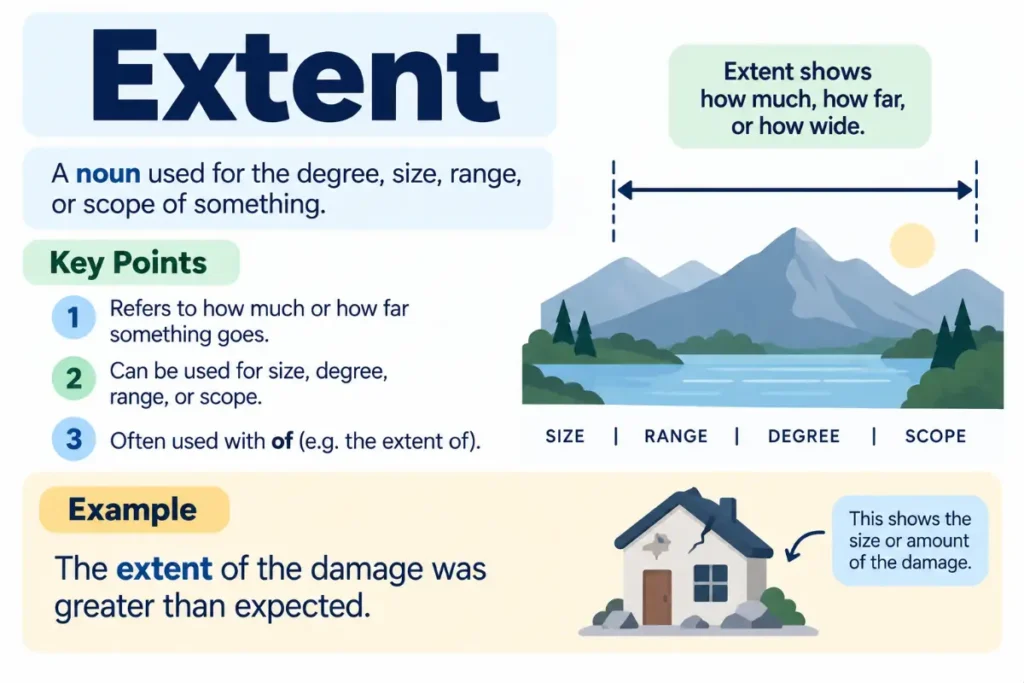
Quick Answer
Extent is a noun used for the degree, size, range, or scope of something. For example, The extent of the damage was greater than expected.
Extant is an adjective used for something that still exists. For example, Several extant manuscripts provide evidence about the period.
Neither word is a misspelling of the other. They are separate words with different meanings.
Comparison Table for Extent and Extant
| Form | Meaning | Part of Speech | Origin | Usage Frequency | Formality | Common Contexts | Example |
|---|---|---|---|---|---|---|---|
| Extent | Degree, size, range, or scope | Noun | Latin extentus through Old French and Middle English | Common | Neutral to formal | Academic writing, reports, descriptions, measurements | We need to understand the full extent of the problem. |
| Extant | Still existing or surviving | Adjective | Latin extans through French and later English | Less common | Formal | History, archaeology, literature, law, research | Researchers studied the few extant records. |
Meaning and Definition
Meaning of Extent
Extent is a noun that describes how large, broad, serious, or far reaching something is. It can refer to physical size, but it also commonly describes an abstract degree or level.
Consider this sentence.
The extent of the flood damage surprised everyone.
The word extent doesn’t mean the damage itself. It tells us how much damage occurred. The same idea works with many abstract nouns.
The extent of her influence was difficult to measure.
The extent of the problem became clear after the investigation.
In both examples, the word expresses degree or scope.
Extent can also describe physical distance or area.
The fence marks the extent of the property.
Here the meaning is closer to physical boundaries or range.
The word appears frequently with phrases such as to some extent, to a great extent, to a certain extent, full extent, and the extent of.
These patterns are useful because they show how naturally the noun works in English.
For example, you might say:
I agree with you to some extent.
This means you agree with the person partly but not completely.
Extent can also appear in questions.
To what extent did the decision affect the community?
This asks how strongly or significantly the decision affected the community.
Meaning of Extant
Extant is an adjective. It describes something that still exists, especially something that has survived from an earlier period.
For example:
Only a few extant copies of the document remain.
The adjective suggests survival. Something existed in the past and continues to exist now.
The word often appears in historical, academic, archaeological, literary, and legal contexts.
Researchers examined the extant manuscripts.
The phrase means manuscripts that still survive today.
You can also use extant for records, buildings, texts, traditions, documents, species, artifacts, laws, and other things that remain in existence.
The extant evidence is limited.
Here extant means the evidence that still exists and can be examined.
Unlike extent, this word doesn’t describe size or degree. It answers a different question.
Instead of asking how much, how large, or how far, extant tells you that something remains.
Key Differences Explained
- Meaning. Extent refers to degree, size, range, or scope. Extant refers to something that still exists.
- Part of speech. Extent is a noun. Extant is an adjective.
- Spelling. The words differ in their middle and ending letters. Extent ends with ent while extant ends with ant.
- Pronunciation. Extent normally has stress on the second syllable. Extant normally has stress on the first syllable.
- Context. Extent is common in everyday and professional English. Extant appears more often in formal or specialized writing.
- Grammar. You can talk about the extent of something. You can describe an object as extant.
- Modern usage. Extent is widely used in ordinary conversation. Extant is perfectly standard but less common and often associated with historical or scholarly subjects.
- Core idea. A simple mental distinction works well. Extent asks how much or how far. Extant says something remains.
That final distinction is the one worth remembering.
How to Choose the Right Word
The easiest way to choose between these words is to identify the idea you want to express.
If you mean size, range, degree, scope, or severity, choose extent.
The extent of the storm damage was enormous.
If you mean still existing or surviving, choose extant.
The museum contains several extant artifacts from the period.
Another useful test is grammar.
If the word can follow the or a and act as the name of a thing or concept, extent may fit.
The extent of the damage.
The full extent of the problem.
If the word describes a noun, extant may fit.
Extant documents.
Extant buildings.
Extant records.
This simple grammar test can solve the problem quickly.
Sentence Examples
The following examples show how extent works naturally in different settings.
- We didn’t realize the extent of the damage until morning.
- The teacher asked students to explain the extent of the problem.
- To some extent, I understand why she made that decision.
- The report measures the extent of water pollution in the region.
- Nobody knew the full extent of the company’s losses.
- The road marks the northern extent of the town.
- Scientists are still studying the extent of the environmental changes.
- His influence reached a surprising extent across the industry.
- The survey shows the extent to which social media affects communication.
- We need more evidence before we can determine the extent of the risk.
Now consider examples using extant.
- Scholars examined several extant copies of the ancient text.
- Only a handful of extant buildings remain from the original settlement.
- The researcher compared the extant records with newer evidence.
- The museum preserves one of the few extant examples of the design.
- Several extant laws from that period still provide useful historical evidence.
Notice the difference. The first group focuses on degree, range, size, or scope. The second group describes things that have survived.
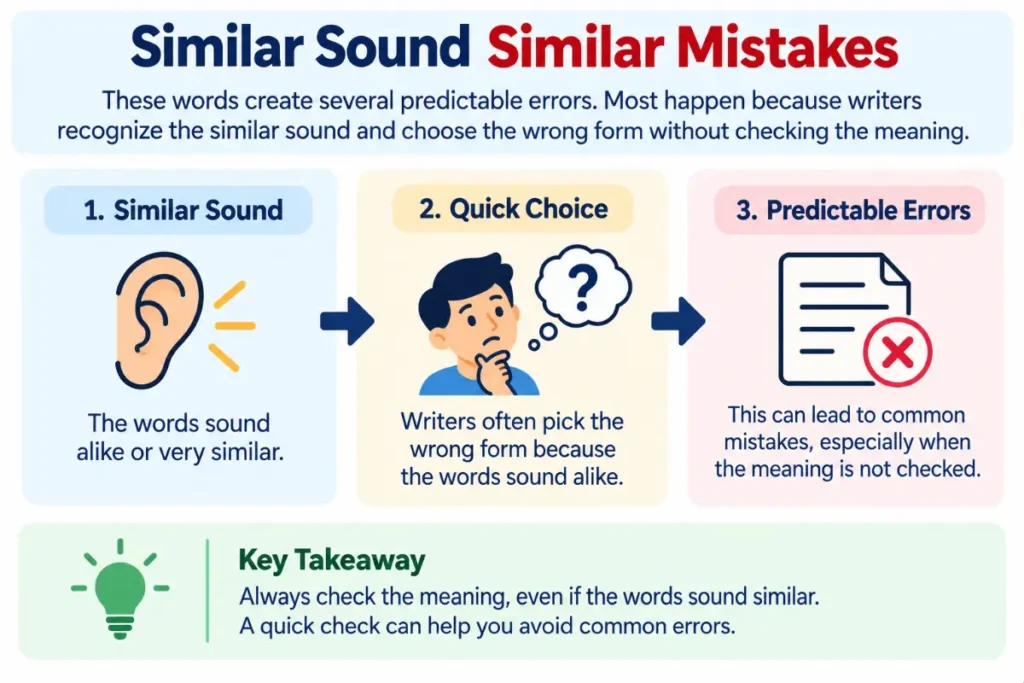
Common Mistakes and Misspellings
These words create several predictable errors. Most happen because writers recognize the similar sound and choose the wrong form without checking the meaning.
- Using extant when you mean degree.
Incorrect in meaning:
The extant of the problem is difficult to measure.
Correct:
The extent of the problem is difficult to measure.
The writer needs a noun meaning degree or scope.
- Using extent when you mean still existing.
Incorrect in meaning:
The extent manuscripts were discovered in the archive.
Correct:
The extant manuscripts were discovered in the archive.
The adjective needs to describe manuscripts that still survive.
- Treating extant as a noun.
Extant is an adjective. You can write extant documents but not normally the extant when you mean surviving documents. A noun such as records or manuscripts should usually follow it.
- Assuming similar pronunciation means similar meaning.
English contains many words that sound alike or nearly alike but have different meanings. Sound alone isn’t enough. Context and grammatical function matter.
- Confusing the words during fast typing.
Visual similarity can trigger a form of lexical confusion. Your brain recognizes the general shape of a familiar word before you consciously process every letter. That’s useful for reading but can occasionally lead to the wrong word during fast writing.
The best correction method is simple. Read the entire sentence and ask what idea you actually need. If the sentence concerns scope or degree, use the noun. If it describes something surviving from the past, use the adjective.
Pronunciation Guide
The pronunciation difference provides another useful clue.
Extent
Extent is commonly pronounced /ɪkˈstɛnt/.
You can think of it as:
ik STENT.
The stress falls on the second syllable.
The first vowel is usually a short unstressed sound. The second syllable receives the main emphasis.
Extant
Extant is commonly pronounced /ˈɛkstənt/.
You can think of it as:
EK stuhnt.
The stress normally falls on the first syllable.
Because the words share the beginning sound, learners may hear them as almost identical. The stress pattern gives you a useful clue. Extent typically puts stronger emphasis on the second syllable while extant commonly emphasizes the first.
Pronunciation can vary somewhat among speakers and dictionaries may show small differences in phonetic detail. The important point is that the words have different standard pronunciations as well as different meanings.
Etymology and Word Origin
Extent and extant come from related Latin roots, which helps explain their similar appearance.
Extent traces back to Latin extendere meaning to stretch out or spread out. The Latin past participle extentus carried the idea of something stretched or extended. The word passed through French before developing into English extent.
That history fits the modern meaning well. Something that has an extent stretches across a certain range or reaches a particular degree.
The word extant comes from Latin extans meaning standing out or projecting and ultimately connects to the Latin verb exstare meaning to stand out or stand forth. It entered English through historical French influence and developed the modern sense of something still existing.
The two words therefore share a historical connection to Latin forms involving extension or standing forth, but English developed them into distinct words.
Etymology can be useful for understanding why words look similar. It doesn’t mean their modern meanings are interchangeable.
Regional Usage
American English
American English uses extent as a common noun in everyday speech and writing. Phrases such as to some extent and the extent of the problem are natural in the United States. Extant is also standard American English but appears more often in academic, historical, legal, scientific, and scholarly contexts.
British English
British English uses both words with the same basic meanings. There is no major spelling difference between British and American English here. Extent remains common while extant tends to appear in more specialized writing.
Australian English
Australian English follows the same distinction. Extent refers to degree, range, or scope while extant describes something that still survives. Context rather than regional spelling determines the correct choice.
Canadian English
Canadian English also uses both forms according to their standard meanings. Writers in Canada may encounter extant more often in historical or academic material, while extent is common across general writing and conversation.
There is no major regional variety in which these two words switch meanings.
Grammar Rules and Part of Speech
Grammar provides one of the strongest clues for distinguishing these words.
Extent is a noun. It can function as the subject or object of a sentence and commonly appears after the.
For example:
The extent of the damage was unclear.
Here extent is the main noun in the phrase the extent of the damage.
Another common pattern is to some extent.
I agree with that idea to some extent.
This expression means partly or to a certain degree.
You can also use to what extent in questions.
To what extent did the changes affect students?
This construction asks about degree or impact.
Extant is an adjective. It describes a noun.
Extant manuscripts are valuable to researchers.
The word extant modifies manuscripts.
You can also use it after a linking verb.
Several records are extant.
This construction is grammatically possible but less common in everyday English than placing the adjective before the noun.
Because extant is relatively formal, you’ll see it more often in written language than casual conversation.
Punctuation doesn’t determine the choice. Meaning and grammar do.
If you need a noun describing scope or degree, choose extent. If you need an adjective describing something that survives, choose extant.
Real Life Usage Examples
Daily Conversation
Extent is much more likely to appear in ordinary conversation.
- I didn’t understand the extent of the problem at first.
- We had no idea about the full extent of the storm.
Extant is less common in casual speech because people usually choose simpler phrases such as still existing or surviving.
Email and Workplace Communication
Professional writing often uses extent when discussing risks, effects, or results.
- We need to assess the extent of the delay before changing the schedule.
- The manager asked for a report on the extent of the damage.
Extant may appear in specialized workplaces such as museums, archives, research institutions, or legal settings.
- The archive contains several extant versions of the agreement.
- The research team reviewed all extant records before publishing its findings.
Academic Writing
Extent is common in academic arguments because researchers often discuss degree or impact.
- The study examines the extent of the relationship between income and education.
- Researchers measured the extent of the changes over a ten year period.
Extant is useful when discussing surviving historical evidence.
- The researchers compared the extant manuscripts for differences.
- The paper focuses on extant evidence from the early period.
News and Journalism
News writing often uses extent when describing damage or consequences.
- Officials are still assessing the extent of the damage.
- The investigation revealed the extent of the financial losses.
Extant may appear in reporting about archaeology, history, culture, or preservation.
- Experts inspected several extant structures at the site.
- The exhibition features extant objects from the original collection.
Literature and Storytelling
Extent can describe the scale of a character’s experience.
- She never understood the full extent of his sacrifice.
- The story gradually reveals the extent of the family’s loss.
Extant is useful when a story or scholarly discussion refers to surviving works or objects.
- The historian studied every extant letter written by the author.
- Only a few extant versions of the tale remain.
Related and Confused Terms
Several words connect naturally with these concepts. Knowing them can sharpen your vocabulary and make the distinction easier.
- Scope. Scope refers to the range or boundaries of something. It often overlaps with extent.
- Degree. Degree refers to the amount or level of a quality. It is closely related to one major meaning of extent.
- Range. Range describes the area, limits, or variation covered by something.
- Scale. Scale refers to size, level, or proportion. It can describe physical or abstract magnitude.
- Existing. Existing means currently present or real. It captures the basic idea behind extant in simpler language.
- Surviving. Surviving describes something that remains after an event, period, or process.
- Remaining. Remaining means still present or left after some part has disappeared or been removed.
- Historical. Historical relates to the past. Extant often appears alongside historical material because researchers frequently study things that have survived from earlier periods.
These related terms aren’t perfect substitutes. Scope and range often overlap with extent, while surviving and existing are usually clearer everyday alternatives for extant.
A Simple Memory Trick
Here’s a practical way to keep the two words straight.
Think of extent as extent of something.
The extent of the damage.
The extent of the problem.
The extent of the influence.
Each phrase asks how much how large or how broad something is.
For extant, think existing.
Extant means still existing.
This isn’t a perfect letter by letter memory trick, but it connects the meaning to a familiar concept. When you’re unsure, ask yourself one question.
Am I talking about the size or degree of something, or am I describing something that still exists?
If the answer is size degree range or scope, choose extent. If the answer is still existing or surviving, choose extant.
Why These Words Are Easy to Confuse
English spelling often creates confusing pairs because words can share letters, sounds, or historical roots without sharing meaning.
Extent and extant are especially tricky because the difference is visually small. Only a few letters separate them, and both begin with ext. When you read quickly, your brain may focus on the overall word shape instead of processing every letter individually.
Pronunciation adds another layer. The first parts sound similar, so someone who has mainly encountered one word in speech may struggle to identify the other in writing.
Language learners can face an additional challenge because some languages don’t distinguish concepts in exactly the same way. A learner may translate a phrase from another language into English and choose the wrong member of a similar looking word pair.
The solution isn’t memorizing a huge vocabulary list. It’s learning each word through meaning, grammar, and context.
That gives you three separate clues instead of one.
Formal and Informal Usage
Extent works comfortably across almost every level of English. You can use it in a casual conversation, a school essay, a workplace report, or an academic paper.
For example:
I didn’t realize the extent of the issue.
That sentence sounds natural and clear.
Extant has a more formal feel. It isn’t incorrect or outdated, but it belongs more naturally in specialized contexts.
For example:
The study examines the extant evidence.
That sentence sounds appropriate in academic or historical writing. In casual conversation, a speaker might simply say:
The study looks at the evidence that still exists.
Both sentences communicate the basic idea, but the second sounds more conversational.
This difference matters when you’re choosing words for your audience. Good writing isn’t about using the most sophisticated word available. It’s about choosing the word that expresses your meaning clearly and naturally.
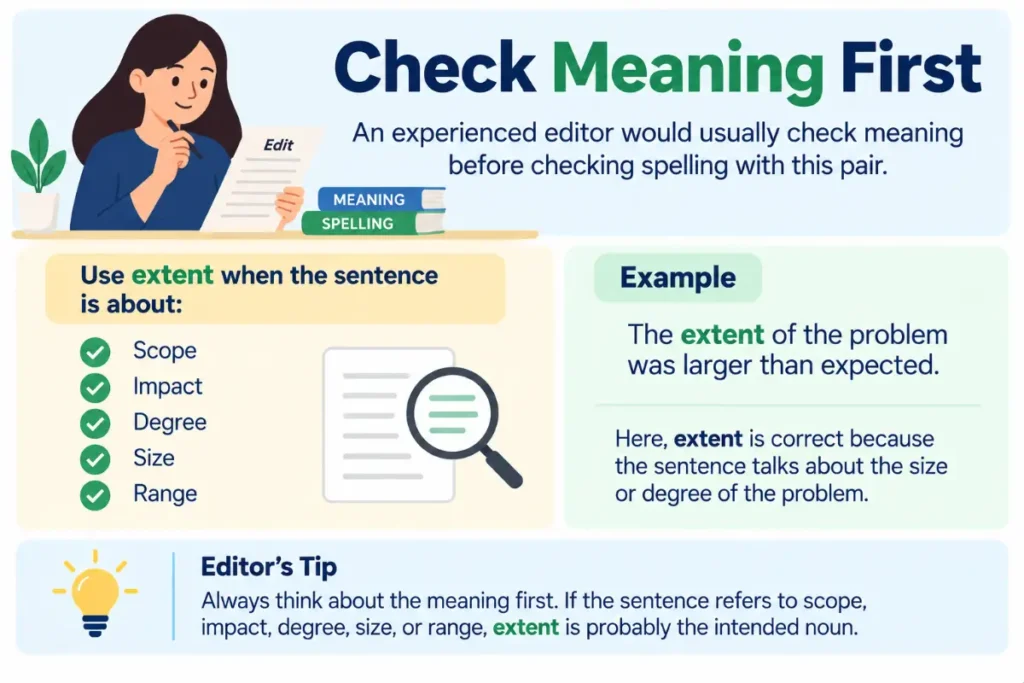
Expert Editor Insight
An experienced editor would usually check meaning before checking spelling with this pair. If the sentence discusses scope, impact, degree, size, or range, extent is probably the intended noun. If the sentence describes a surviving document, artifact, record, tradition, or other object, extant may be the right adjective. Grammar tools can catch some spelling errors but may not catch a correctly spelled word used in the wrong context. That’s why context remains the strongest editing tool. My practical tip is to replace the word temporarily with a plain phrase. Try how much for extent and still existing for extant. If the sentence suddenly makes sense, you’ve found the right choice.
Conclusion
The difference between extent vs extant becomes simple once you focus on meaning and grammar. Extent is a noun that refers to degree, size, range, or scope. Extant is an adjective that describes something that still exists or has survived from the past. Both are correct English words, but they cannot normally replace each other.
When you’re writing, look at the idea behind the sentence instead of relying on the similar spelling. Ask if you’re discussing how much something reaches or describing something that remains in existence. That quick check usually points you to the right word.
A useful memory trick is to connect extent with range and extant with existing. Once that distinction becomes familiar, this confusing pair is easy to handle in everyday, academic, and professional writing.
FAQs
What is the difference between extent and extant?
Extent is a noun that means degree, size, range, or scope. Extant is an adjective that means still existing or surviving. For example, the extent of the damage describes how much damage occurred, while extant documents are documents that still exist. The two words are both correct but serve different grammatical and semantic purposes.
Is extant a real English word?
Yes. Extant is a standard English adjective. It describes something that still exists, especially something that has survived from an earlier period. You’ll often find it in historical, academic, archaeological, literary, and legal writing. It may sound formal in everyday conversation, but it is a legitimate and useful word when the context calls for it.
Which word should I use for degree or scope?
Use extent when you mean degree, size, range, or scope. For example, The extent of the damage was difficult to determine. The word works naturally with phrases such as the extent of the problem and to some extent. Extant cannot replace it because extant describes something that continues to exist.
How do you pronounce extent?
Extent is commonly pronounced /ɪkˈstɛnt/. The main stress falls on the second syllable, so it sounds roughly like ik STENT. The first syllable is weaker than the second. Listening carefully to the stress pattern can help distinguish it from extant, which commonly places stronger stress on the first syllable.
How do you pronounce extant?
Extant is commonly pronounced /ˈɛkstənt/. It sounds roughly like EK stuhnt. The first syllable normally receives the main stress. Because the beginning resembles extent, some speakers may confuse the two when hearing them quickly. The meaning and grammatical role provide the clearest way to tell them apart.
Is extent more common than extant?
Extent is much more common in general English because people regularly discuss the size, degree, range, and impact of things. Extant is also standard but tends to appear more often in specialized areas such as history, archaeology, literature, law, and academic research. The difference is mainly one of everyday frequency and context rather than correctness.
Can I use extant in everyday writing?
You can use extant in everyday writing if you need its specific meaning, but it may sound more formal than necessary. In casual communication, phrases such as still existing or surviving are often more natural. In academic or historical writing, extant can be a precise and efficient choice because it describes surviving material in a single word.
What is an easy way to remember the difference?
Connect extent with amount or range and extant with existing. If you can replace the word with how much, how far, or scope, you probably need extent. If you can replace it with still existing or surviving, extant is likely correct. Checking the word’s grammatical role provides another useful clue because extent is a noun while extant is an adjective.
